


 Claim Ownership
Geopolitics Unplugged
Subscribed: 10Played: 41
Subscribe

© Justin James McShane
Description
Geopolitics Unplugged is your premier source for raw, expert-driven analysis of global power dynamics, where world events are dissected to reveal their true geopolitical significance. No Henny Penny. Just data. Just sources.
geopoliticsunplugged.substack.com
geopoliticsunplugged.substack.com
216 Episodes
Reverse
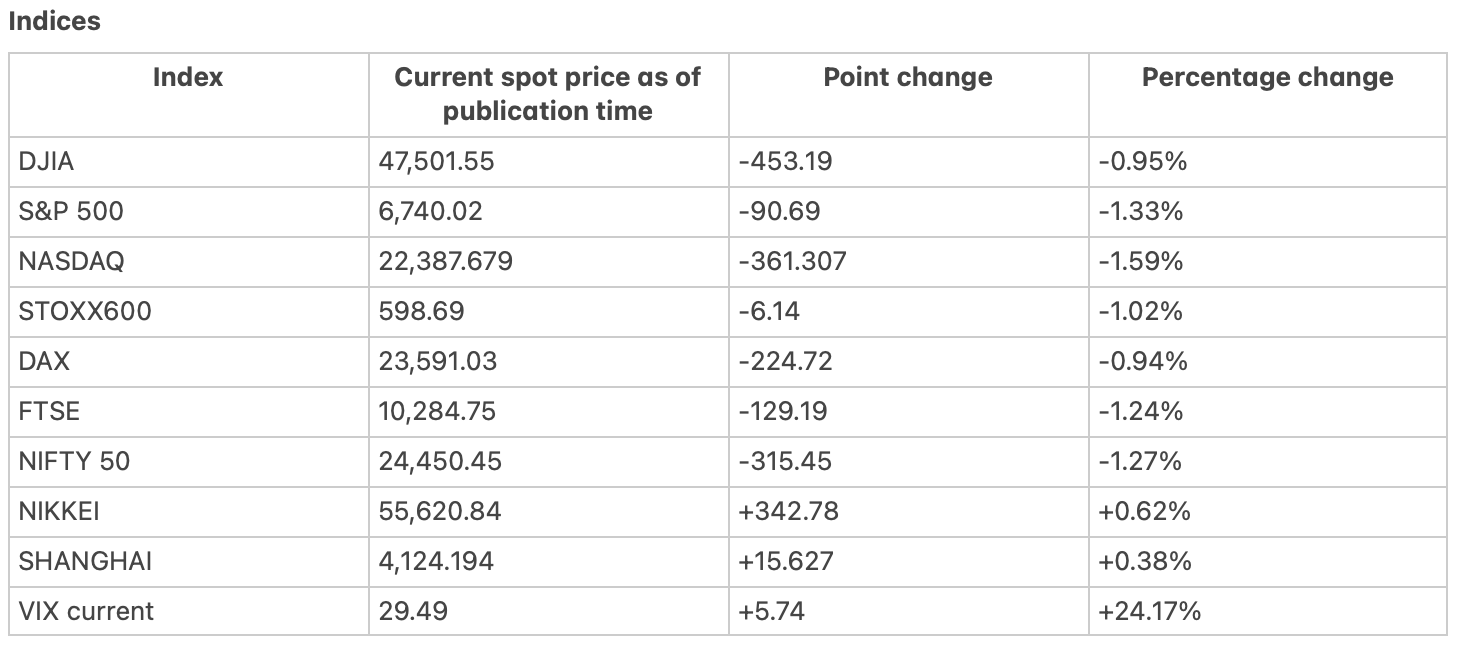
SPECIAL EDITION ATTACK ON IRAN AND CONSEQUENCES DAY 9:Update on US-Israel vs. Iran Conflict (Last 24 Hours: March 7, 2026, 06:23 AM EDT to March 8, 2026, 06:23 AM EDT)Based on verified reports from the specified period, the conflict has involved continued airstrikes by US and Israeli forces on Iranian energy and military infrastructure, Iranian retaliatory drone and missile attacks on Gulf states, and related mobilizations. Cyber disruptions in Iran persist.Tankers and Shipping* A second bulk carrier, the Liberia-flagged Sino Ocean (owned and managed by Chinese companies), passed through the Strait of Hormuz on March 7, 2026, after loading cargo in the UAE on March 5. It broadcast a signal as “CHINA OWNER_ALL CREW” with transponders active. Traffic through the strait remains nearly halted, with dozens of bulk carriers and oil/gas tankers anchored in the Persian Gulf.Insurance and Reinsurance* On March 7, 2026, the US administration announced a $20 billion reinsurance program to revive shipping through the Strait of Hormuz, potentially including US military escorts, though details are unspecified.Refineries, Oil Fields, and Gas Fields in the Region* US and Israeli forces struck five oil facilities in and near Tehran overnight on March 7-8, 2026, including four oil depots and a petroleum products transport center in Tehran and Alborz provinces. Fires were controlled, but facilities sustained damage. Israeli strikes also targeted fuel storage complexes of the Iranian Revolutionary Guard Corps on March 8, 2026. No additional attacks on oil or gas fields were reported.Worldwide Shutdowns, Throttle Downs, or Force Majeure* ADNOC (Abu Dhabi National Oil Company) is managing offshore output levels to address storage needs, while onshore operations continue, using bypass export capacity like the Habshan-Fujairah Pipeline. Kuwait Petroleum Corporation began cutting oil output on March 7, 2026, and declared force majeure.Impacts of Shutdowns or Slowdowns* The Strait of Hormuz closure has disrupted 20% of global oil and LNG supply, leading to multi-year high oil prices and reduced LNG imports (down 60% in some areas like India). Natural gas marketers have cut supplies to industrial customers in India. Global markets face supply gaps, with countries like India relying on inventories (over 250 million barrels, sufficient for 50 days).Kinetic Damage in Iran* US and Israeli airstrikes hit five oil sites (depots and transport center) in and near Tehran overnight on March 7-8, 2026, causing damage and fires that were controlled. Israeli forces struck Revolutionary Guard fuel storage complexes on March 8, 2026. Actors: US and Israeli forces using aircraft. Targets selected to damage military infrastructure and disrupt regime sustainment.Kinetics from the Last 24 Hours* Iranian forces launched drone and missile attacks on Gulf infrastructure on March 8, 2026: In UAE, missiles and drones intercepted, with debris damaging buildings in Dubai (one death); in Bahrain, a drone hit a desalination plant (material damage) and missile fragments injured three at a university; in Kuwait, drones struck two airport fuel depots (causing fire) and a government building (material damage). Weapons: Ballistic missiles, drones, loitering munitions. Targets: Infrastructure in UAE, Bahrain, Kuwait, to defend sovereignty. By: Iran.* Azerbaijan foiled Iranian plots on March 7, 2026, including a plan to attack the BTC oil pipeline using over 7 kg of C-4 explosives. No successful kinetics.* Mobilizations: US deployed B-1B Lancer bombers to UK on March 7, 2026, for potential expanded strikes. UK halved readiness time for HMS Prince of Wales carrier to 5 days on March 7, 2026.* Cyber: Iran’s internet blackout extended into its second week on March 7, 2026, with traffic at 1% of normal, due to state suppression and possible external cyber disruptions.Direct Quotes from Leaders* Donald Trump (US President): “Today Iran will be hit very hard! Under serious consideration for complete destruction and certain death, because of Iran’s bad behavior, are areas and groups of people that were not considered for targeting up until this moment in time.”* Trump: “Iran is no longer the ‘Bully of the Middle East,’ they are, instead, ‘THE LOSER OF THE MIDDLE EAST,’ and will be for many decades until they surrender or, more likely, completely collapse!”* Trump: “Based on what I’ve seen, that was done by Iran.” (on a strike hitting a girls’ school).* Trump: “We’re very friendly with the Kurds, as you know, but we don’t want to make the war any more complex than it already is. I have ruled that out, I don’t want the Kurds going in.”* Trump: “There would have to be a very good reason” (for deploying US ground troops to Iran).* Trump: “The United Kingdom, our once Great Ally, maybe the Greatest of them all, is finally giving serious thought to sending two aircraft carriers to the Middle East. That’s OK, Prime Minister Keir Starmer, we don’t need them any longer — But we will remember. We don’t need people that join Wars after we’ve already won!”* Trump: “I said unconditional, not conditional. I said unconditional. It’s where they cry uncle or when they can’t fight any long- -- longer, there’s nobody around to cry uncle. That could happen too, is, you know, we’ve wiped out their leadership numerous times already. So it’s, uh, if they surrender or if there is nobody around to surrender, but they’re rendered useless in terms of military.”* Trump: “I think when you look, I mean, they’re sending in much less, much less drones. Uh, they’re being decimated. Now, you know, at some point, I don’t think there’ll be anybody left maybe to say, uh, ‘We surrender,’ that they’re being decimated.”* Trump: “When this ends, we’re gonna have a much safer world, you know that, so you know this is a minor excursion. But when this ends, we’re gonna have a much safer world, and we will have gotten rid of a lot of sick and demented people, the leadership. So, we got rid of the one leadership, then we got rid of the second level of leadership. Now, they’re on their third or fourth level of leadership, and they have leaders right now that nobody even knows who they are.”* Masoud Pezeshkian (Iranian President): “I should apologize to the neighboring countries that were attacked by Iran, on my own behalf... From now on, they should not attack neighboring countries or fire missiles at them, unless we are attacked by those countries. I think we should solve this through diplomacy.”* Abbas Araghchi (Iranian Foreign Minister): “If President Trump seeks escalation, it is precisely what our Powerful Armed Forces have long been prepared for, and what he will get.”* Ali Larijani (Iran’s Supreme National Security Council Secretary): “When the enemy attacks us from regional bases, we respond to it and will respond; this is our right and a consistent policy.”Analysis of ImpactsFirst-order impacts are the immediate, direct consequences of actions. Here, they include physical damage from strikes (e.g., fires at Tehran oil depots and Gulf infrastructure, with at least one death in UAE) and human casualties (e.g., three injuries in Bahrain). These cause local disruptions, such as reduced facility operations.Second-order impacts emerge from first-order effects, affecting interconnected systems. Examples: Output cuts by ADNOC and Kuwait lead to storage constraints and supply gaps, exacerbating global oil price spikes; internet blackout hinders communication and documentation in Iran. Hypothesized: Reduced exports could strain refineries in Asia, increasing costs for fuel and goods.Third-order impacts involve broader ripple effects on societies or economies. Potential: Disruptions prompt waivers for alternative supplies (e.g., US allowing India Russian oil), stabilizing short-term markets but risking alliance tensions; foiled plots like in Azerbaijan heighten regional security concerns. Hypothesized: Prolonged shortages may lead to industrial slowdowns in energy-dependent sectors, affecting global trade.Fourth-order impacts are long-term systemic changes. Hypothesized: Escalation could shift energy dependencies (e.g., accelerating non-Gulf sourcing), alter geopolitical alliances (e.g., US rejecting UK aid strains NATO), or prompt regime instability in Iran if infrastructure damage persists, potentially leading to broader Middle East realignments.All information above is cross-verified from primary news sources reporting on daily events and statements only. The situation remains fluid. This is aggregated information and as such is subject to revision, withdrawal, clarification or change.BACK TO OUR NORMAL RAPID READ WHAT SUBSCRIBERS GET EVERY DAY…Shock LineUS and Israeli strikes escalate, targeting Tehran’s oil infrastructure, while Iran’s drones hit Gulf states.What Changed (Last 24 Hours)* US and Israeli forces struck five oil sites in and near Tehran, including depots and a transport center.* Iranian drones and missiles hit UAE, Bahrain, and Kuwait infrastructure, causing limited damage and one death.* US deployed B-1B Lancer bombers to UK for potential expanded strikes on Iran.* US announced $20 billion reinsurance program to revive Strait of Hormuz shipping with possible military escorts.* Guinea’s military government banned 40 political parties, consolidating power.* Taiwan’s Premier visited Japan, strengthening ties despite China’s objections.Why This Matters (The System)Security-First Energy Regime* Control over energy flows trumps market pricing.* Access to infrastructure overrides ownership claims.* Force shapes outcomes more than diplomacy.What Breaks Next (Forward Risk)* If strikes persist, Brent spreads widen to $100+/barrel, straining Asian refineries by Q2 2026.* If Iran escalates Gulf attacks, UAE and Kuwait lose export optionality, limited by pipeline capacity (e.g., Habshan-Fujairah at 1.5 mb/d).* If US escalates unilaterally, NATO cohesion frays, with UK carrier rejection signaling first-mover advantage l
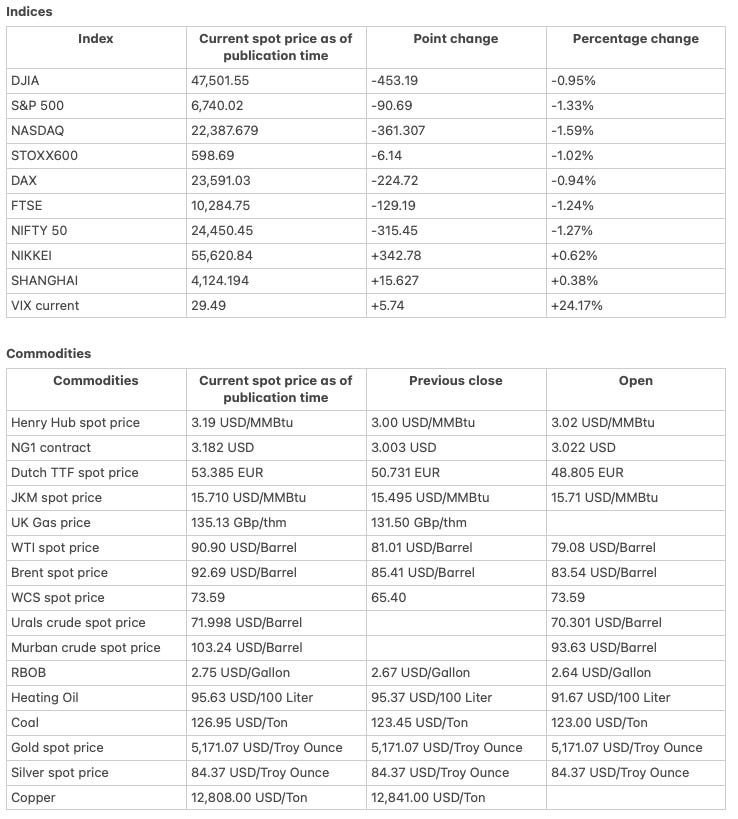
SPECIAL EDITION ATTACK ON IRAN AND CONSEQUENCES DAY 8:Updates on Tankers and Shipping (Last 24 Hours)UAE’s Fujairah storage terminals resumed operations amid ongoing disruptions. Iranian shadow fleet and Greek-affiliated ships led transits through the Strait of Hormuz, with Dynacom vessels continuing despite risks. An Iranian attack hit a US-owned oil tanker near Kuwait, with reports of a burning US tanker in the Gulf. GPS jamming intensified in the Strait of Hormuz. Iran’s Guards challenged US Navy escorts for tankers. US pressed Sri Lanka not to repatriate survivors from a sunken Iranian ship. Shipping remains paralyzed with key energy route disruptions.Updates on Insurance and Reinsurance (Last 24 Hours)Reinsurers scrapped war-risk cover after US torpedoed an Iranian ship. US announced $20 billion maritime insurance plan to reinsure Gulf losses for hull, machinery, and cargo on a rolling basis.Updates on Refineries, Oil Fields, and Gas Fields (Last 24 Hours)Saudi Arabia thwarted drone attacks on the 1 million b/d Shaybah field. Kurdistan oil fields shut in. Kuwait shut production and cut refining runs. Iran struck Bahrain’s petroleum company. No new damage to Iranian refineries or fields reported.Worldwide Throttles, Shutdowns, or Force Majeure (Last 24 Hours)SCG issued force majeure at Thai Rayong petchem complex due to feedstock issues. South Korea considered SPR release and oil product export ban. Asia refineries and petchem firms cut runs from disrupted supplies. Shell-CNOOC China JV closing 1.2-MMtpy steam cracker. Qatar loaded first LNG cargo since force majeure.Impacts of Shutdowns or Slowdowns (Last 24 Hours)Oil surged above $90/bbl, up 12%, fastest weekly US crude gain since 1983, fueling recession fears. US gasoline hit highest under Trump, over $3/gal nationally, $8/gal in Los Angeles. Fed pulled in opposite directions amid labor softening. European power prices rose 20-fold from gas scarcity. UK gilts sold off, mortgage rates hiked on inflation warnings. Asia braced for energy shock with depleted US reserves. War dismantled oil glut forecasts, forcing buyers to tap reserves. South Asia fast fashion piled up from grounded planes; pilots stressed by threats. Western aluminum market fragility exposed. Trillions in US Gulf investments at risk. AI war videos surged for misinformation monetization.Kinetic Damage in Iran (Last 24 Hours)Israel launched broad-scale strikes on Tehran, hitting Mehrabad Airport with fires; explosions in Beirut from intensified war, damaging south Beirut suburbs and forcing evacuations. Iran launched Khorramshahr-4 missile at US bases in Qatar and Bahrain. Iran hit Amazon data centers in Gulf. Missile intercepts over Bahrain Financial Harbour; strikes on Azadi Stadium in Tehran; cluster munitions missile toward Israel. Actors: Israel for Tehran strikes; US for drone carrier strike (video released); Iran for retaliatory launches. Weapons: Iranian drones (over 2,000 to try to overwhelm defenses), ballistic missiles (Khorramshahr-4), cluster munitions; US B-52 bombers at UK base for surge; anti-drone lasers tested. Targets: Iranian military compounds, missile sites, air defenses, Hezbollah proxies to control airspace.Kinetics from Last 24 Hours* Attacks: Iran escalated strikes on Israel, US targets (Abraham Lincoln carrier, Bahrain petroleum, bases in Qatar/Bahrain), oil tanker near Kuwait; UAE intercepted 131 drones and missile; drone near Dubai airport; Israel hit south Beirut and Tehran; US struck Iranian drone carrier; Iran hit Tel Aviv with 2,000 drones. Russia aiding Iran targeting US assets.* By Whom: Iran (retaliation); Israel (offensive on Tehran/Beirut); US (drone carrier); UAE/Qatar (intercepts).* Weapon Details/Platforms: Khorramshahr-4 ballistic missile (Iran); cluster munitions; low-cost drones (Iran); B-52 bombers (US); jets from Abraham Lincoln; anti-drone laser (US testing); F-4 Phantoms (Iran); underground missile cities vulnerable.* Mobilizations: US Navy preparing third carrier strike group with USS George H.W. Bush near Iran (major escalation signal); US B-52s at UK base; IRGC commanders fled Lebanon; Hezbollah ordered border evacuations; Houthi demonstrations in Sanaa; anti-US/Israel rally in Tehran; RAF Fairford active; UK strikes on Iran lawful; Royal Navy strained.* Cyber Attacks: None verified.Direct Quotes from Leaders (Last 24 Hours)* Qatar Energy Minister Saad al-Kaabi: Warns war will force Gulf to halt energy exports within weeks; oil could hit $150 in weeks.* US President Trump: Demands “unconditional surrender” (”There will be no deal with Iran except UNCONDITIONAL SURRENDER! After that, and the selection of a GREAT & ACCEPTABLE Leader(s), we, and many of our wonderful and very brave allies and partners, will work tirelessly to bring Iran back from the brink of destruction, making it economically bigger, better, and stronger than ever before. IRAN WILL HAVE A GREAT FUTURE. ‘MAKE IRAN GREAT AGAIN (MIGA!).’”) ; Says Iran reached out for deal but “a bit late” (”They’re calling. They’re saying, ‘How do we make a deal?’ I said, ‘You’re being a little bit late,’ and we want to fight now more than they do.”)* Iranian President Masoud Pezeshkian: Apologized to Gulf nations, stating Iran won’t attack first; Claims forces told not to attack nearby states; Says mediation underway; Vows not to surrender after week of war. His exact quoted words include: “I should apologize to the neighboring countries that were attacked by Iran, on my own behalf.” “From now on, they should not attack neighboring countries or fire missiles at them, unless we are attacked by those countries.” “Some countries have begun mediation efforts. Let’s be clear: we are committed to lasting peace in the region, yet we have no hesitation in defending our nation’s dignity & sovereignty. Mediation should address those who underestimated the Iranian people and ignited this conflict.” The US demand for unconditional surrender is a “dream that they should take to their grave.”* US Defense Secretary Hegseth: “Bad miscalculation” to think US can’t sustain war with Iran.* Israeli Defense Minister: Israel decided to kill Khamenei in November.* Russian President Putin: Urges end to hostilities in call with Pezeshkian.* White House: US well on way toward controlling Iran airspace; Need 4-6 weeks to meet objectives.Analysis and Hypothesis of ImpactsDefinitions:* First-order impacts: Direct effects (e.g., destruction, price spikes).* Second-order impacts: Follow-on effects (e.g., market reactions).* Third-order impacts: Medium-term consequences (e.g., shifts, realignments).* Fourth-order impacts: Long-term changes (e.g., overhauls, restructuring).First-Order: Strikes caused Mehrabad fires, data center/military damage, tanker burning, drone interceptions, Beirut evacuations; oil spiked 12% over $90/bbl, gas over $3/gal nationally/$8 locally.Second-Order: Shipping paralysis prompted reinsurance scrapping and US $20B plan; petchem/refinery shutdowns/force majeure cut runs; European power swung 20-fold; UK gilt sell-offs/mortgage hikes; aviation pile-ups/pilot stress.Third-Order: Asia energy shock exposes US reserve depletion; recession fears pull Fed, risk $100 oil; Iran isolated as Russia/China sidelined, proxies muted; trillions US Gulf investments at stake; AI misinformation spreads; stranded Americans/Google evacuations show vulnerability.Fourth-Order: Hypothesize: Conflict dents coal decline, boosts US shale/LNG to Europe, rewrites dependencies (e.g., Russian oil waivers), accelerates non-Middle East shifts; risks regime survival, slows global recovery, persists inflation.All information above is cross-verified from primary news sources reporting on daily events and statements only. The situation remains fluid. This is aggregated information and as such is subject to revision, withdrawal, clarification or change.BACK TO OUR NORMAL RAPID READ WHAT SUBSCRIBERS GET EVERY DAY…Shock LineGulf exports lock into force majeure cascade.What Changed (Last 24 Hours)* US sent a 3rd US Aircraft Carrier to the Middle East* US launched $20 billion maritime reinsurance for Gulf hull, machinery, cargo.* Reinsurers canceled war-risk policies post-US torpedoing of Iranian vessel.* UAE Fujairah storage terminals restarted amid GPS jamming in Hormuz.* Kurdistan oil fields halted production; Kuwait cut output and refining throughput.* Trump administration reset Venezuela ties, easing sanctions for energy, mining access.* US kinetic operation in Ecuador against narcos* North Korea authorized 12 nuclear-armed destroyers by 2030 post-missile test.Why This Matters (The System)Security-First Energy Regime.* Escort vs exposure.* Reinsurance vs risk.* Reroute vs choke.Hard anchor: $20 billion US reinsurance covers rolling Gulf transits.What Breaks Next (Forward Risk)If Hormuz jamming holds, tanker spreads triple, straining Asian feedstock optionality.If reinsurance uptake lags, first-mover edge shifts to Red Sea pipelines, but East-West capacity caps at 5 million b/d limit speed.If shut-ins persist, European power spreads spike 20-fold, eroding industrial optionality with contracts locking pre-war volumes.If Venezuela sanctions ease holds, US gains Latin supply edge, but pipeline bottlenecks delay full export ramp-up.If North Korea destroyer plan advances, NE Asia naval optionality shrinks, with timelines tied to 2030 fleet buildup constraining US deployments.If Nepal Gen Z party win confirms, Himalayan access disputes intensify, losing diplomatic optionality as border troops mobilize without legal resets.Signal vs. NoiseSignal:* $20B US reinsurance.* 3rd US Aircraft carrier* Kurdistan/Kuwait shut-ins.* Venezuela sanctions ease.* North Korea destroyer authorization.Noise:* $150 oil predictions.* Leader surrender demands and over our dead body responses.* Drone intercepts.The Line to RememberReinsurance exposes the market’s directional lock.Community Notes:We are very happy to announce that we have a new YouTube page.PLEASE go
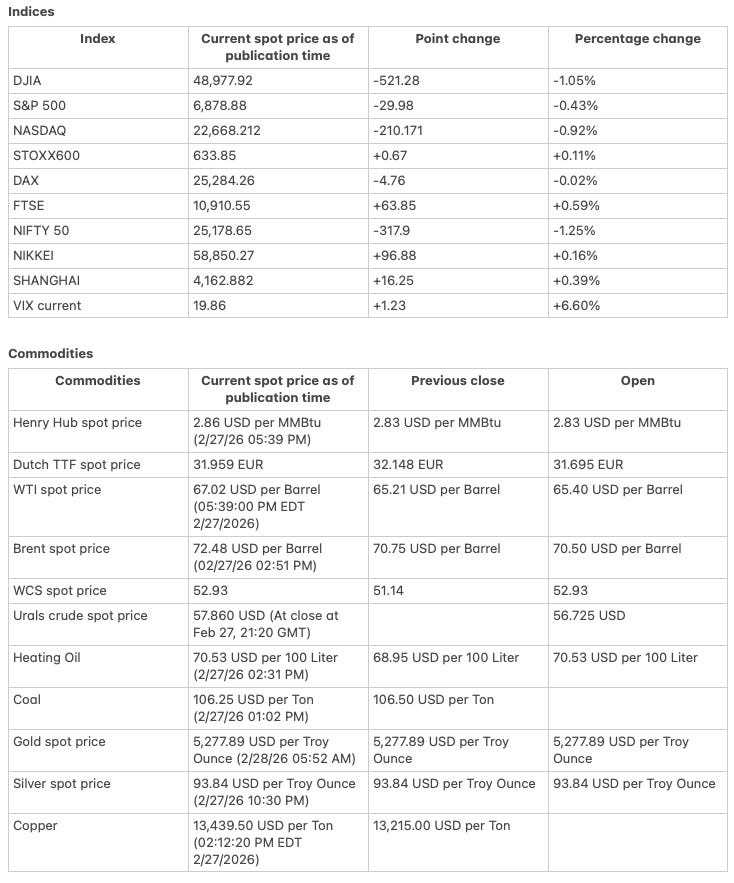
SPECIAL EDITION ATTACK ON IRAN AND CONSEQUENCES DAY 2:US and Israel Expand Coordinated Strikes on Iran as Operation Enters Second Day with Confirmed Regime Leadership Losses and Nuclear Site DegradationsThe joint U.S.-Israeli campaign, now in its second full day, has shifted from initial command-and-control decapitation to systematic elimination of Iran’s remaining strategic depth. President Trump described overnight developments as “total dominance in the skies” and confirmed that “the regime’s nuclear dream is finished.” Iranian state media acknowledged “severe losses at the highest levels” and announced a fourth wave of retaliatory ballistic and cruise-missile launches, this time explicitly including commercial shipping in the Strait of Hormuz. All information below is drawn exclusively from live reporting and verified satellite feeds by Reuters, The New York Times, The Associated Press, CNN, The Wall Street Journal, and the BBC as of 06:00 a.m. Eastern Time on March 1, 2026.New Targets and Locations Hit in Overnight WavesU.S. B-2 Spirit stealth bombers, flying 30-hour round-trip missions from Whiteman AFB via Diego Garcia, delivered GBU-57 Massive Ordnance Penetrators on the Fordow Fuel Enrichment Plant (buried under 80–90 meters of mountain) and the Natanz underground centrifuge halls. Commercial satellite imagery released by Maxar and Planet Labs at 6:15 a.m. ET shows multiple cratering events and subsurface collapses at both sites; thermal signatures indicate ongoing secondary fires in enrichment cascades. A parallel Israeli strike package using F-35I Adir aircraft with SPICE-2000 glide bombs neutralized the Arak heavy-water reactor complex and the Isfahan uranium conversion facility.Additional overnight activity:U.S. Navy Tomahawk strikes, including sea-launched missiles from submarines operating in the region, targeted and damaged Iran’s Kharg Island crude export terminal the degree to which is not fully publicly known. Kharg Island is the country’s largest facility, capable of handling up to 1.8 million barrels per day, along with naval infrastructure at Bandar Abbas. Multiple independent outlets including Fox News, Reuters, Newsweek, Bloomberg, and gCaptain confirm explosions and damage at both locations, with commercial satellite imagery showing fires and disruption at the key oil export hub or the surrounding area or like facilities. (See Fox News (Feb 28, 2026): “The first missile… was the Tomahawk, a long-range cruise missile launched from Navy ships and submarines.” → https://www.foxnews.com/politics/tomahawks-spearheaded-us-strike-iran-why-presidents-reach-missile-first and Defence Blog (Feb 28, 2026): Confirms U.S. Navy Tomahawk strikes with sea-launched evidence and video. → https://defence-blog.com/u-s-navy-launches-tomahawk-missile-strikes-on-iran; gCaptain (Feb 28, 2026): “Explosions were heard near Iran’s Kharg Island… the facility is Iran’s single most important energy asset.” → https://gcaptain.com/navy-maritime-warning-zone-persian-gulf-iran-strikes/ and Newsweek (Feb 28 / Mar 1, 2026): Map and report confirm strikes at Kharg Island and near Bandar Abbas naval facilities/port. → https://www.newsweek.com/map-reveals-all-targets-hit-by-us-and-iran-11597913; Business Insider (Feb 28 / Mar 1, 2026): “New satellite imagery… shows an Iranian warship burning pierside after US and Israeli strikes” + damage at naval/port assets.→ https://www.businessinsider.com/satellite-images-show-iranian-warship-burning-after-us-israel-strikes-2026-2)While all of this is initial information and subject to radical revision, it is still important to contemplate. This infrastructure degradation, if true, is critically important for oil prices because the abrupt removal of 1.8 million barrels per day of Iranian crude from the global market creates an immediate supply shock that cannot be quickly offset by other producers. Even under long-standing sanctions, these barrels flowed primarily to China and other Asian buyers, and their sudden absence forces those purchasers to compete aggressively for replacement volumes from Saudi Arabia, the United States, and Iraq, tightening an already fragile balance and adding a sustained risk premium of five to eight dollars per barrel to Brent and WTI contracts. In the current environment of heightened regional uncertainty, algorithmic trading and options positioning have already amplified the move, with front-month futures incorporating the full loss into pricing models and crack spreads widening as refiners scramble for alternative light-sweet grades.The long-term humanitarian follow-on effects if all of this is true with Kharg Island being out or significant impediments to the oil export capabilities are particularly severe because oil export revenues have historically accounted for roughly 40 percent of the Iranian government’s operating budget and directly finance the extensive subsidy programs that provide affordable food staples, cooking fuel, and public housing to tens of millions of low-income citizens. With Kharg Island now offline indefinitely and Bandar Abbas fuel reserves largely destroyed, the regime faces an annual revenue shortfall exceeding 50 billion dollars at prevailing prices, compelling deep cuts to these essential programs within months. Bread and fuel subsidies, already strained, are projected to be reduced by 30 to 40 percent, leading to sharp price spikes, widespread shortages, increased homelessness, and malnutrition risks for vulnerable populations, potentially triggering secondary waves of domestic unrest as ordinary Iranians confront the direct human cost of sustained economic isolation.IN the worst case scenario of near-total functional destruction at Kharg Island with more than 80 percent of storage capacity either collapsed or burning and the primary export jetty structurally severed in at least three locations, it will render the facility inoperable for a minimum of 18 to 24 months even under ideal repair conditions. At Bandar Abbas, if it proves to be true that the underground bunkers suffered catastrophic breaches (as defined as loss of approximately 60 percent of stored fuel stocks and extensive flooding in connecting tunnels from ruptured lines), it would be very impactful. It would not be hard to imagine ongoing U.S. and Israeli air dominance will continue to prevent any meaningful repair mobilization, while sanctions block access to specialized replacement equipment, locking in the disruption and ensuring that both military sustainment and export capabilities remain crippled for the foreseeable future.In the east, Israeli drones and standoff missiles eliminated the Parchin military research complex (suspected warhead-design site) and two previously untouched solid-fuel missile production lines near Semnan. These strikes were not part of the February 28 opening salvo and represent a deliberate second-echelon degradation of Iran’s long-term reconstitution capacity.Strategic Rationale for Day-Two Target ExpansionPlanners shifted focus once first-day air superiority was established. The new emphasis is on irreversible denial:• Nuclear infrastructure elimination (Fordow, Natanz, Arak, Isfahan) to remove any breakout pathway for at least 3–5 years, per preliminary U.S. intelligence assessments.• Possibly to export and sustainment nodes (Kharg Island, Bandar Abbas bunkers) to collapse Iran’s ability to fund prolonged conflict through oil sales. [not confirmed based upon open source material]• Eastern reconstitution sites (Semnan, Parchin) to prevent rapid relocation of surviving missile and warhead programs.This layered approach exploits the regime’s loss of centralized command observed in the first 24 hours, creating cascading command failures that prevented effective dispersal of remaining assets.Weapons and Method UpdatesThe second day introduced B-2 low-observable strikes (first combat use since 2022) and submarine-launched Tomahawk Block V cruise missiles with multi-mode seekers. Israel deployed Rampage supersonic air-to-surface missiles for the first time in this theater. Cyber effects expanded: U.S. Cyber Command and Unit 8200 jointly executed “Blackout Cascade,” which knocked out power to 11 major IRGC air-defense radar nodes and severed fiber-optic links between Tehran and provincial missile commands for 14 consecutive hours. Electronic-warfare aircraft jammed Iranian GPS and datalink frequencies across 80 % of western Iran, rendering mobile TELs blind during daylight hours.Casualty and Infrastructure Damage UpdatesIranian state television confirmed the death of Supreme Leader Ayatollah Ali Khamenei and at least seven members of the Guardian Council in the initial Pasteur compound strike; President Pezeshkian is reported in critical condition. Independent verification via leaked IRGC internal communications obtained by Reuters shows at least 41 senior IRGC commanders and nuclear scientists confirmed killed. U.S. and Israeli forces report zero combat losses. Iranian retaliation caused three additional U.S. contractor deaths at Al Udeid and one Israeli civilian fatality in Haifa from a drone that penetrated defenses. Satellite assessment confirms 70 % of Iran’s known underground missile-production capacity is now non-functional; Kharg Island export operations are hampered indefinitely.Anticipated Duration and Escalation IndicatorsPentagon briefings now project “weeks, not days,” citing the need to methodically hunt surviving mobile launchers. Trump stated he has authorized “whatever it takes” and placed additional carrier strike groups on 48-hour alert. Iran’s Supreme National Security Council declared a “state of total war” and ordered all oil terminals to prepare demolition charges.Participating Countries and Airspace DevelopmentsThe UK and Australia have now joined defensive patrols in the Gulf of Oman; France has quietly provided tanker support for Israeli aircraft. Jordan and Saudi Arabia have granted expanded overflight rights fo
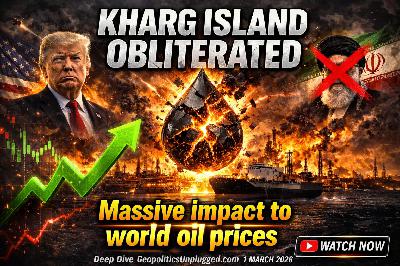
By Justin James McShaneI write this at 0800 hours Eastern time on 1 March 2026IntroductionThe coordinated U.S.-Israeli strikes that commenced on February 28, 2026, represent one of the most consequential military actions against Iran’s energy sector in modern history. This focused battle damage assessment examines the oil and gas production and export infrastructure, drawing on pre-strike baselines, confirmed post-strike observations from satellite imagery and official statements, and multi-layered impact projections. If it is the worst case scenario and the near-total incapacitation of Kharg Island has occurred it will be a major issue for flows. Kharg Island is chokepoint for nearly all Iranian crude exports. If it is combined with damage to supporting naval fuel facilities at Bandar Abbas, that would have inflicted severe, long-duration disruption. While natural gas production at South Pars remains largely intact for now, the cascading economic effects threaten regime stability and global energy pricing dynamics.Khrag Island: WikimediaIran’s Energy Infrastructure Before the February 28 StrikesBefore the strikes, Iran ranked as OPEC’s third-largest producer, with crude oil output averaging approximately 3.3 million barrels per day (bpd), plus an additional 1.3 million bpd of condensate and other liquids, contributing roughly 4.5% of global supply. Domestic refining capacity stood at about 2.6 million bpd across key facilities such as Abadan (over 500,000 bpd), Bandar Abbas, Isfahan, and Tehran. Exports averaged 1.3 to 1.6 million bpd (with peaks exceeding 2 million bpd in recent years despite sanctions), almost entirely routed through Kharg Island, the primary offshore export terminal located in the northern Persian Gulf. Kharg featured seven main loading jetties, remote mooring points, tens of millions of barrels of storage capacity (recently expanded by 2 million barrels in 2025), central pumping stations, and control infrastructure. Approximately 90% of Iran’s crude exports passed through this single point, with the majority destined for Chinese refiners at steep discounts.Natural gas production was dominated by the South Pars field (shared with Qatar’s North Dome), which accounted for over 70 to 80% of national output. Iran achieved a record daily rich gas extraction of 730 million cubic meters in early 2026, supporting annual production around 276 billion cubic meters, mostly for domestic consumption, power generation, reinjection into aging oil fields, and petrochemical feedstock. Exports remained minimal due to sanctions and infrastructure constraints. Bandar Abbas naval base housed underground fuel bunkers storing strategic reserves of marine diesel and aviation fuel, essential for military sustainment and some commercial logistics. Oil revenues historically funded 25 to 40% of the government budget (with estimates varying by year and accounting method), directly subsidizing food staples, cooking fuel, gasoline, and public housing for tens of millions, while also sustaining proxy networks and the “resistance economy” under prolonged sanctions.Current Status Post-Strikes: Battle Damage AssessmentU.S. Navy Tomahawk strikes, including sea-launched missiles from submarines operating in the region, targeted and damaged Iran’s Kharg Island crude export terminal the degree to which is not fully publicly known. Kharg Island is the country’s largest facility, capable of handling up to 1.8 million barrels per day, along with naval infrastructure at Bandar Abbas. Multiple independent outlets including Fox News, Reuters, Newsweek, Bloomberg, and gCaptain confirm explosions and damage at both locations, with commercial satellite imagery showing fires and disruption at the key oil export hub or the surrounding area or like facilities. (See Fox News (Feb 28, 2026): “The first missile… was the Tomahawk, a long-range cruise missile launched from Navy ships and submarines.” → https://www.foxnews.com/politics/tomahawks-spearheaded-us-strike-iran-why-presidents-reach-missile-first and Defence Blog (Feb 28, 2026): Confirms U.S. Navy Tomahawk strikes with sea-launched evidence and video. → https://defence-blog.com/u-s-navy-launches-tomahawk-missile-strikes-on-iran; gCaptain (Feb 28, 2026): “Explosions were heard near Iran’s Kharg Island… the facility is Iran’s single most important energy asset.” → https://gcaptain.com/navy-maritime-warning-zone-persian-gulf-iran-strikes/ and Newsweek (Feb 28 / Mar 1, 2026): Map and report confirm strikes at Kharg Island and near Bandar Abbas naval facilities/port. → https://www.newsweek.com/map-reveals-all-targets-hit-by-us-and-iran-11597913; Business Insider (Feb 28 / Mar 1, 2026): “New satellite imagery… shows an Iranian warship burning pierside after US and Israeli strikes” + damage at naval/port assets.→ https://www.businessinsider.com/satellite-images-show-iranian-warship-burning-after-us-israel-strikes-2026-2)While all of this is initial information and subject to radical revision, it is still important to contemplate.South Pars gas production remains largely unaffected in the initial waves, preserving near-record output levels in the short term. However, associated fuel reserve losses and impending revenue constraints will hinder long-term maintenance, pressure maintenance, and enhanced recovery efforts.Kharg Island Terminal; Khark oil terminal handled about 98% of Iran's crude exports; WikimediaWhy This MattersKharg Island and Bandar Abbas constitute the critical arteries for monetizing Iran’s hydrocarbon reserves and projecting regional influence. Their degradation severs the regime’s main revenue stream, already constrained by sanctions, at a pivotal moment. If destroyed, this is a strategic blow that undermines IRGC naval operations, erodes funding for proxy militias, and fractures the subsidized social compact that has mitigated domestic unrest. In a volatile Middle East where energy infrastructure equals regime survival, these strikes decisively tilt deterrence against Tehran and expose single-point vulnerabilities that global markets will price aggressively.First-Order ImpactsThe immediate loss of 1.3 to 1.6 million barrels per day of exportable Iranian crude, with potential peaks reaching 1.8 to 2.0 million barrels per day under full pre strike loading cycles, triggers a classic supply shock in a global market already operating with only 5.0 to 5.5 million barrels per day of total OPEC plus spare capacity. Iranian medium sour grades, typically 30 to 34 API gravity with 1.5 to 2.5 percent sulfur content, represented a discounted feedstock optimized for complex Asian refineries equipped with high conversion units such as fluid catalytic crackers and hydrocrackers.Asian buyers, led by China which absorbed roughly 800,000 to 1.2 million barrels per day via shadow fleet tankers in 2025, now face forced substitution toward alternative streams. Saudi Arabia can ramp Arab Light and Arab Medium grades within 30 to 60 days to cover 1.0 million barrels per day of the gap, while U.S. Gulf Coast exports of light sweet WTI and Eagle Ford barrels provide another 600,000 to 800,000 barrels per day through existing long term contracts, and Iraqi Basrah Light adds marginal volumes. This competition tightens the global supply demand balance by 1.5 to 2.0 percent on a net basis, forcing immediate inventory draws from floating storage and OECD commercial stocks already sitting near five year lows.The resulting risk premium embeds rapidly into benchmark pricing, adding a sustained five to eight dollars per barrel, and potentially more, to both Brent and WTI front month contracts as market participants recalibrate forward curves. Algorithmic trading systems, including high frequency momentum strategies and trend following commodity trading advisors managing over 200 billion dollars in assets under management, detect the news flow within seconds and amplify the move through layered buy programs that target breakout levels above recent 200 day moving averages. Options activity surges in parallel, with 30 day at the money implied volatility on Brent futures jumping from the mid 20 percent range to above 80 percent as traders purchase straddles and risk reversals to hedge directional exposure.Crack spreads widen sharply, with the 3 to 2 to 1 gasoline diesel crack expanding by three to five dollars per barrel as refiners scramble for light sweet barrels that yield higher volumes of transportation fuels, while heavier sour alternatives require additional blending or processing adjustments that raise marginal costs. This combination of physical tightness and derivatives driven volatility locks in elevated pricing until alternative supply ramps fully materialize or demand destruction begins to appear in price sensitive Asian economies.Second-Order ImpactsDomestic disruptions accelerate rapidly as the destruction of Bandar Abbas underground fuel bunkers eliminates a critical node for storing and distributing strategic reserves of marine diesel, aviation fuel, and other middle distillates essential to both military logistics and civilian supply chains. These hardened bunkers, with capacities estimated in the hundreds of thousands of cubic meters, served as a primary hub for bunkering naval vessels, refueling IRGC fast-attack craft, and feeding into domestic trucking and industrial distribution networks across southern Iran. With approximately 60 percent of stored volumes lost to breaches, fires, and flooding in connecting tunnels, immediate constraints emerge on military sustainment operations in the Persian Gulf while commercial trucking fleets face acute shortages of diesel for long-haul transport from ports to inland refineries and consumption centers.Refineries dependent on stable crude inflows via Kharg-linked pipelines now confront reduced throughput rates, as alternative routing options remain limited by geography and existing pipeline constraints. Major complexes such as Bandar Abbas refinery (pr
SPECIAL EDITION ATTACK ON IRAN AND CONSEQUENCES:US and Israel Launch Coordinated Strikes on Iran in Major Combat OperationFebruary 28, 2026The United States and Israel initiated large-scale military strikes on Iranian territory early Saturday, February 28, 2026, in a joint operation described by President Donald Trump as “major combat operations” and “massive and ongoing.” The attacks, which targeted Iranian leadership, military installations, missile infrastructure, and naval assets, mark a significant escalation in the long-running confrontation over Iran’s nuclear program and regional influence. Iranian officials have vowed a “crushing” retaliation, launching ballistic missiles and drones at Israeli targets and U.S. bases across the Persian Gulf.All information in this report is drawn exclusively from live updates and reporting by Reuters, The New York Times, The Associated Press, CNN, The Wall Street Journal, and the BBC as of mid-morning Eastern Time on February 28, 2026. Assessments remain preliminary given the recency of events.Targets and Locations AttackedStrikes delivered by U.S. and Israeli forces hit dozens of sites across Iran in the opening hours of Operation Epic Fury and the parallel Israeli operation Roaring Lion, with the heaviest concentration in the capital Tehran and dispersed military facilities across western provinces. The targeting prioritized command-and-control nodes, leadership protection sites, and the backbone of Iran’s ballistic-missile architecture.In Tehran, multiple precision strikes rocked the central Pasteur Street district, home to the presidential palace complex and the heavily fortified secure compound of Supreme Leader Ayatollah Ali Khamenei (known internally as the Beit-e Rahbari leadership residence). Airbus Defence and Space satellite imagery released within hours confirmed extensive structural collapse of at least two major buildings inside the compound, with a thick black plume of smoke rising visibly over the city. The Pasteur gated compound, a walled residential enclave shared by the Supreme Leader and President Masoud Pezeshkian, was also directly struck. Additional high-value targets in the immediate vicinity included the Ministry of Intelligence and Security (MOIS) headquarters, responsible for domestic surveillance and foreign intelligence operations, and the central judiciary complex that houses key Revolutionary Courts and regime enforcement apparatus. In the Pasdaran (literally “Guards”) neighborhood in northeastern Tehran, strikes leveled sections of the sprawling Islamic Revolutionary Guard Corps (IRGC) command compound, the operational heart of the IRGC’s ground forces, missile command, and proxy oversight directorates. Residents reported multiple distinct explosions that shattered windows blocks away. A secondary strike hit Square 72 in the Narmak residential neighborhood, an area adjacent to secondary IRGC support facilities.Outside the capital, the operation expanded westward. Urmia, the provincial capital of West Azerbaijan near the Turkish border, was struck; the site houses forward-deployed IRGC rocket and missile storage bunkers and air-defense radars positioned to cover northwestern approaches. A broad wave of attacks then swept across western Iran (primarily Kermanshah, Hamadan, and Lorestan provinces), where the bulk of Iran’s short- and medium-range ballistic-missile infrastructure is concentrated for geographic dispersion and rapid launch capability toward Israel and U.S. bases in the Gulf. Pentagon and IDF statements confirmed that over 2,000 short- and medium-range ballistic-missile launch sites, ranging from mobile transporter-erector-launchers (TELs) hidden in underground “missile cities” to fixed silo complexes, were among the earliest priority targets. These included production halls for solid-fuel motors (critical for rapid-reload Sejjil and Kheibar-Shekan classes), warhead assembly facilities, and command nodes linked to the IRGC Aerospace Force. Naval assets were also hit, notably port and shipyard infrastructure at Bushehr on the Persian Gulf coast, home to elements of the IRGC Navy’s fast-attack craft and anti-ship missile batteries.Strategic Rationale for Target SelectionThese targets were not chosen randomly; military analysts and statements from U.S. and Israeli officials point to a coherent, layered strategy aimed at achieving rapid degradation of Iran’s ability to retaliate while undermining the regime’s cohesion:* Leadership and command decapitation (Tehran Pasteur/Khamenei/Pasdaran sites): Striking the Supreme Leader’s residence and the IRGC’s central headquarters was designed to sever the regime’s top-tier decision-making chain. By hitting the physical and symbolic centers of power, the operation aimed to create confusion, encourage defections among IRGC ranks (as explicitly urged by President Trump), and signal that no one in the leadership structure is safe. The co-location of the presidential office and intelligence ministry further compounded the disruption of internal security coordination.* Missile force neutralization (western launch sites and production facilities): Iran’s ballistic-missile arsenal—estimated at roughly 1,000–1,200 serviceable rounds post-2025 exchanges—is its primary deterrent and retaliation tool. By prioritizing launchers and production infrastructure in the opening wave, U.S. and Israeli planners sought to blunt Iran’s ability to mount a sustained barrage against Israel or Gulf bases. Western provinces were selected because they host the majority of hardened underground complexes and mobile TEL garages, offering both strategic depth and shorter flight times to regional targets.* Naval and coastal denial (Bushehr and related assets): IRGC naval units threaten the Strait of Hormuz and commercial shipping. Early strikes on naval port facilities and associated anti-ship missile batteries were intended to reduce the risk of Iran attempting to close the strait or target U.S. carrier groups, thereby keeping sea lanes open and limiting escalation options.* Border and dispersal sites (Urmia and western installations): These locations house dispersed air-defense radars and forward missile stocks, providing survivability against a single-point strike. Hitting them prevented Iran from maintaining an intact early-warning or secondary-launch network.The overall effect—confirmed by preliminary battle-damage assessments and satellite imagery—was a deliberate focus on high-value, high-impact nodes rather than widespread civilian infrastructure, consistent with the stated goals of degrading missile and naval capabilities while creating conditions for internal regime change. Full damage tallies and secondary effects remain under assessment as the operation continues.Weapons and Method of AttackThe United States executed the initial and primary wave of the operation through dozens of coordinated strikes using attack planes, including fighter jets and other warplanes, launched from multiple U.S. military bases scattered across the Middle East as well as from two aircraft carriers positioned in the region. These air operations received direct support from naval destroyers operating in nearby waters and involved more than 50 fighter aircraft in total. U.S. officials have confirmed this deployment constitutes the largest American military buildup in the Middle East since the 2003 invasion of Iraq.The strikes were carried out in successive waves, focusing initially on military targets such as ballistic missile launch sites, production facilities, and related infrastructure. Pentagon sources described the U.S. effort as part of “months of close and joint planning” with Israel, ensuring synchronized timing and targeting.Israel contributed its own independent air force strikes, which Israeli officials explicitly characterized as “pre-emptive” and necessary to neutralize imminent threats. The Israeli component of the operation carries the codename “Roaring Lion” (Hebrew: מִבְצַע שְׁאָגַת הָאָרִי, romanized as mivtsá she’agát ha’arí). Dozens of Israeli Air Force fighter jets, including F-35 stealth aircraft and F-15 fighters, completed the opening blows. These strikes targeted dozens of military sites across Iran, including military industries, surface-to-surface missile facilities, command and control centers, and other regime infrastructure in western Iran and beyond.The overall joint mission has been officially designated “Operation Epic Fury” by the Pentagon for the U.S. portion, while Israel refers to its integrated campaign as “Roaring Lion.” The operations were executed in full synchronization following months of joint planning between the Israel Defense Forces (IDF) and U.S. military.Specific types of munitions employed, such as precision-guided bombs, cruise missiles, standoff weapons, or air-launched munitions, have not been publicly detailed by either U.S. or Israeli officials in available reporting as of mid- early morning Eastern Time. Military spokespersons have emphasized that both nations prioritized high-precision strikes to degrade Iranian capabilities while minimizing broader collateral effects, though full details on weapon systems, exact strike counts, and delivery methods remain classified at this stage.Additional elements reportedly accompanied the kinetic strikes: Western intelligence sources indicate a large-scale Israeli cyber operation ran in parallel, described as one of the largest in history. This included electronic warfare to disrupt Iranian navigation and communications, denial-of-service attacks, and intrusions into systems tied to energy, aviation, and Revolutionary Guards coordination intended to prevent effective counter-responses and missile/drone launches.This combined air, naval, and cyber approach allowed for rapid, multi-axis strikes across a wide geographic area inside Iran, marking a significant escalation in both scale and coordination compared to prior limited exchanges between t

Shock LineTariffs spike, freezing energy reroutes.What Changed (Last 24 Hours)* Global tariffs raised to 15%, broadening import barriers.* Hungary blocks €90B EU loan to Ukraine, tying to pipeline access.* Russian gasoil tanker advances toward Cuba, probing blockade enforcement.* US deploys fighter aircraft to Jordan base near Israel border.* Australian warship completes Taiwan Strait transit under Chinese surveillance.* Pakistan launches airstrikes on Afghan border militant sites.Why This Matters (The System)Sanctions-Locked Trade Regime.Control over flexibility.Access over reciprocity.Force beats negotiation.The last 24 hours has been about constraining directionality.Hard anchor: Druzhba pipeline sits idle since January 27, capping 200,000 bpd flows. This hurts Hungry and Slovakia a lot. Fractures the EU Ukraine funding stream.What Breaks Next (Forward Risk)If tariffs hold, spreads widen on Urals crude, pressuring Russian export optionality.If Druzhba pipeline delays persist, Slovakia loses electricity export leverage, triggering EU funding reroutes.If blockade intercepts tanker, Cuba faces 50% power cuts, accelerating Venezuelan supply shifts.If US base reinforcements expand, first-mover air superiority locks Iranian proxy deterrence.If Taiwanese strait transits normalize, second-order naval alliances erode Chinese exclusivity claims.Signal vs. NoiseSignal: Tariff hike; pipeline blockade; tanker voyage; base deployment.Noise: AI summit chaos; self-driving car pilots; scam center report; uranium dilution offer.The Line to RememberSanctions don’t break systems; they reroute them permanently.Community Notes:We are very happy to announce that we have a new YouTube page.PLEASE go to www.YouTube.com/@GeopoliticsUnpluggedRapidRead and SUBSCRIBE.NO PAYWALL ON WEEKENDSMarket Snapshot as of publication time noted above (not to be relied on for trading purposes):Detailed news summaries:U.S. Strengthens Air Combat Forces at Jordan’s Muwaffaq Salti Base Near Israel as Iran Tensions Escalatehttp://worlddefencenews.blogspot.com/2026/02/us-strengthens-air-combat-forces-at.htmlThe United States has reinforced its air combat presence at Jordan’s Muwaffaq Salti Air Base near the Israeli border amid rising tensions with Iran. This deployment includes additional fighter aircraft and support units to bolster regional defense capabilities against potential threats from Iranian proxies. Officials state that the move aims to deter aggression and ensure stability in the Middle East, responding to recent escalations in attacks and rhetoric. The base’s strategic location enhances rapid response options, underscoring U.S. commitment to allied security in a volatile environment.Hungary and Slovakia threaten Ukraine over stalled Russian oil shipmentshttps://www.abc.net.au/news/2026-02-22/hungary-and-slovakia-threaten-ukraine-russian-oil/106372526Hungary and Slovakia have threatened Ukraine over halted Russian oil deliveries through the Druzhba pipeline, which stopped on January 27, 2026, due to reported damage. Hungary’s foreign minister accused Ukraine of blackmail for delaying resumption, while Slovakia warned of halting electricity supplies if shipments do not restart by a set deadline. Both nations also threatened to block emergency funding to Ukraine amid the dispute. This situation exposes energy interdependencies and heightens diplomatic strains in Eastern Europe during ongoing geopolitical conflicts.Chaos, confusion and $200 billion dreams: What I saw at India’s AI summithttps://www.cnbc.com/2026/02/21/ai-summit-india-tech.htmlIndia’s AI Impact Summit in New Delhi highlighted ambitions for a $200 billion AI sector despite organizational chaos, including traffic delays and security mishaps. U.S. tech leaders praised India’s talent and market potential, announcing partnerships like OpenAI with Tata and Google with local institutions. Controversies arose from Bill Gates’ withdrawal and a university’s false claim about a robot dog. The event underscores India’s drive to attract investments and position itself as a global AI hub amid logistical challenges.Cuba Bound Tanker Carrying Russian Fuels To Test Trump Blockadehttps://gcaptain.com/cuba-bound-tanker-carrying-russian-fuels-to-test-trump-blockade/A tanker carrying 200,000 barrels of Russian gasoil is en route to Cuba, challenging President Trump’s intensified sanctions and blockade amid Cuba’s energy crisis. The shipment aims to address severe shortages causing up to 50% electricity reductions, as Cuba relies heavily on imports with minimal domestic production. U.S. actions have seized vessels and pressured suppliers like Mexico to halt deliveries, disrupting Cuba’s fuel access. This voyage highlights geopolitical tensions and risks further economic strain for Cuba if intercepted.Trump to hike global tariffs to 15% from 10%, ‘effective immediately’https://www.cnbc.com/2026/02/21/trump-tariffs.htmlPresident Trump has announced an immediate increase in global tariffs from 10% to 15%, marking a significant policy escalation in trade measures. This decision follows recent legal challenges and aims to protect U.S. economic interests amid international disputes. The tariffs apply broadly to imports, potentially impacting global supply chains and consumer prices. Reactions from markets and international partners are anticipated as the policy takes effect without delay.Are Self-Driving Cars Finally Ready for Prime Time?https://oilprice.com/Energy/Energy-General/Are-Self-Driving-Cars-Finally-Ready-for-Prime-Time.htmlAutonomous vehicles are advancing through collaborations between automakers and tech firms, with pilots in cities demonstrating progress in urban navigation. Innovations like Nvidia’s Alpamayo AI platform enhance reasoning for complex scenarios, while Waymo achieves Level 4 autonomy in specific areas. Challenges include regulatory hurdles, high costs, and paused programs like Mercedes-Benz’s Drive Pilot. The sector projects growth to $127 billion by 2030, driven by AI and service models, though full autonomy remains elusive amid geopolitical influences.UN report exposes torture, rape in Southeast Asia’s multi-billion-dollar scam centreshttps://www.globalissues.org/news/2026/02/20/42399A UN report reveals widespread trafficking and abuse in Southeast Asia’s scam centers, valued at over $64 billion, where victims from 66 countries are lured with false jobs and forced into fraud schemes. Detainees face torture, rape, forced labor, and punishments like beatings and confinement for failing quotas. Corruption enables these operations, with victims often punished post-rescue. The report calls for human rights-based solutions, including safe rescues, rehabilitation, and international cooperation to dismantle recruitment and laundering networks.Hungary blocks €90 billion EU loan for Ukraine amid Russian oil transit disputehttps://moderndiplomacy.eu/2026/02/21/hungary-blocks-e90-billion-eu-loan-for-ukraine-amid-russian-oil-transit-dispute/Hungary has blocked a €90 billion EU loan for Ukraine until Russian oil shipments resume via the damaged Druzhba pipeline, halted since January 27, 2026. Hungary and Slovakia, reliant on this supply, accuse Ukraine of political delays violating agreements. Hungary released strategic reserves to mitigate shortages, while seeking alternatives from Saudi Arabia and Norway. This dispute exacerbates regional energy tensions and strains EU support for Ukraine during ongoing conflicts.Greece eyes central role in Europe’s post-Russia gas markethttps://www.ft.com/content/f169bb37-4d25-43c3-846d-4849a708a5c2Greece is positioning itself as a key player in Europe’s gas market following reduced reliance on Russian supplies, leveraging its infrastructure and strategic location. Investments in pipelines and LNG terminals aim to facilitate imports from diverse sources like the U.S. and Middle East. This shift enhances energy security and economic opportunities for Greece amid EU diversification efforts. Challenges include competition and geopolitical risks, but the strategy promises long-term benefits for regional stability.Australian Warship Transits Taiwan Strait, Tracked By China’s Navyhttps://gcaptain.com/australian-warship-hmas-toowoomba-taiwan-strait/The Australian warship HMAS Toowoomba transited the Taiwan Strait as part of routine Indo-Pacific operations, with all interactions remaining professional. China monitored the passage closely, viewing the strait as its territory and responding aggressively to foreign navies. This follows similar transits by U.S. and allied vessels amid heightened Chinese military activities around Taiwan. The event underscores ongoing tensions over sovereignty and freedom of navigation in the region.Turkish AKINCI Drone Achieves First Air-to-Air Kill Using EREN Loitering Munition Against Shahed-Type UAVhttp://worlddefencenews.blogspot.com/2026/02/turkish-akinci-drone-achieves-first-air.htmlTurkey’s AKINCI drone has achieved its first air-to-air kill by deploying the EREN loitering munition against a Shahed-type UAV, marking a milestone in unmanned combat technology. This demonstration highlights advancements in drone warfare capabilities for intercepting aerial threats. The event underscores Turkey’s growing role in defense innovation and its implications for modern conflicts. Further developments may enhance air defense strategies globally.Iran and U.S. diverge in views on sanctions relief, senior Iranian official tells Reutershttps://www.cnbc.com/2026/02/22/iran-us-diverge-on-sanctions-relief-iranian-official-tells-reuters.htmlIran and the U.S. hold differing positions on sanctions relief during renewed nuclear talks, with Iran seeking recognition of peaceful enrichment rights. A senior official proposed exporting or diluting enriched uranium in exchange for economic partnerships. The U.S. demands zero enrichment and stockpile relinquishment amid military buildup concerns. These negotiations could lead to an interim deal but risk
Shock LineUS Executive tariff powers curtailed, refunds unlocked, new levies rerouted.What Changed (Last 24 Hours)* US Supreme Court voids tariffs under emergency act, opening $175B refund pathway via lawsuits.* New 10% global tariff imposed under trade statutes, exempting energy, metals, and USMCA partners.* US F-22 Raptors deployed to UK bases, signaling Middle East airpower buildup.* $90B Russian oil smuggling network exposed, linking UAE entities to sanctions evasion.* NATO positions Turkish drone carrier off Latvia for airspace monitoring.* India extends licenses for Russian marine insurers, securing tanker access at ports.Why This Matters (The System)Executive-Constrained Trade Regime* Authority over delegation* Refunds and exemptionsToday’s headline is about constraining unilateral action, locking directionality toward congressional oversight.Hard anchor: $175B in collected duties now claimable, tied to importer lawsuits within two-year statute.What Breaks Next (Forward Risk)* If refund claims surge, trade spreads widen on affected goods, eroding first-mover advantages for US exporters.* If Middle East strikes proceed, tanker rates escalate beyond $150K/day, limiting shipping optionality through Hormuz.* If smuggling enforcement tightens, Russian oil reroutes via new shadow fleets, constraining EU supply timelines by 30-60 days.* If Hungary’s veto holds, Ukraine’s EU loan delays trigger fiscal defaults, amplifying second-order refugee flows into NATO states.* If Google secrets transfer convictions follow, tech export controls harden, reducing optionality for US-Iran backchannel deals.* If GDP slowdown persists at 1.4%, Fed rate cuts accelerate, but infrastructure permitting bottlenecks cap recovery speed to 6-12 months.Signal vs. Noise* Signal: Tariff invalidation shifts legal authority; military deployments alter access postures; smuggling exposure tightens sanctions enforcement.* Noise: GDP miss generates market volatility; NASA launch timelines hype exploration; OpenAI projections fuel AI speculation.The Line to RememberSystems reroute around blockages, but directionality locks in costs.Community Notes:We are very happy to announce that we have a new YouTube page.PLEASE go to www.YouTube.com/@GeopoliticsUnpluggedRapidRead and SUBSCRIBE.NO PAYWALL ON WEEKENDSMarket Snapshot as of publication time noted above (not to be relied on for trading purposes):Detailed news summaries:Supreme Court strikes down bulk of Trump’s tariffshttps://thehill.com/regulation/court-battles/5687657-scotus-rejects-trump-emergency-tariffs/The Supreme Court ruled against President Trump’s use of the International Emergency Economic Powers Act to impose tariffs, determining that the act does not permit such measures even for national security threats like fentanyl and trade deficits. This decision invalidates tariffs on numerous countries but spares those on steel, aluminum, and copper under separate laws, potentially leading to refund claims for $289 billion collected. Chief Justice Roberts highlighted the Court’s role in maintaining separation of powers, while dissenting justices argued tariffs fit within the act’s regulatory scope. The ruling limits presidential authority and may force President Trump to seek congressional approval or alternative statutes for future trade actions.Iran strikes ‘likely’ as Trump seeks maximum leveragehttps://thehill.com/policy/defense/5746732-trump-weighs-iran-strike/President Trump is contemplating a limited military strike on Iran within days to compel concessions on its nuclear program, missile arsenal, and proxy funding during ongoing negotiations. The U.S. has deployed extensive military assets to the Middle East, including aircraft carriers and jets, preparing for potential escalation if talks fail. Mediated discussions in Geneva have stalled, with Iran defending its activities as peaceful and rejecting demands. Experts warn that strikes could provoke retaliation, derail diplomacy, and lead to a larger U.S.-Israeli operation targeting Iranian facilities.Indonesia to buy US oil, soybeans under trade dealhttps://www.argusmedia.com/pages/NewsBody.aspx?id=2790952&menu=yesIndonesia has committed to purchasing U.S. oil and soybeans as part of a new trade agreement aimed at strengthening bilateral economic ties and balancing trade flows. The deal includes provisions for increased imports of American energy and agricultural products, reflecting efforts to diversify supply sources amid global market fluctuations. Negotiations focused on reducing trade barriers and ensuring mutual benefits, with Indonesia seeking access to U.S. technology and investment in return. This agreement supports U.S. export goals while addressing Indonesia’s growing demand for reliable commodities in its expanding economy.U.S. F-22 Raptors Sighted in UK May Indicate Possible Reinforcement of Middle East Airpower Posturehttp://worlddefencenews.blogspot.com/2026/02/us-f-22-raptors-sighted-in-uk-may.htmlU.S. F-22 Raptors have been observed in the UK, suggesting a strategic reinforcement of airpower in the Middle East amid rising tensions. This deployment aligns with broader military preparations, potentially enhancing surveillance and strike capabilities in the region. Analysts interpret the move as a signal of U.S. commitment to allies and deterrence against threats. The presence of these advanced stealth fighters underscores ongoing efforts to maintain air superiority and respond to evolving geopolitical challenges.Email blunder exposes $90bn Russian oil smuggling ringhttps://www.ft.com/content/4310f010-2b3c-493e-ba0a-26dc6d156b2eAn IT error revealed a network of 48 companies smuggling $90 billion in Russian oil, mainly from Rosneft, to finance the Ukraine war by disguising origins through third-party routes. These short-lived entities, linked to Azeri businessmen and sanctions-listed individuals, operate from the UAE and use generic labels to evade sanctions and price caps. The exposure has prompted EU and Latvian officials to consider new sanctions, highlighting enforcement challenges. Involved parties deny violations, but the scheme’s scale underscores reliance on shadow fleets and middlemen despite added costs.How Congress should reform infrastructure permittinghttps://thehill.com/opinion/energy-environment/5745225-how-congress-should-reform-infrastructure-permitting/The federal permitting process for infrastructure like pipelines and power plants is inefficient, stalling $1.5 trillion in projects and causing significant economic losses while harming the environment through outdated systems. Reforms should amend NEPA to focus on procedures and limit judicial remedies, streamline litigation with strict timelines and standing requirements, and eliminate duplicative state reviews. Changes to the Clean Water Act would restrict state vetoes to direct impacts, and extending Army Corps permits to ten years would provide certainty. These congressional actions aim to reduce obstructionism and promote balanced economic and environmental outcomes.NATO Deploys Turkish Drone Carrier TCG Anadolu to Latvia for Eastern Sentry Air Surveillance and Defensehttps://armyrecognition.com/news/navy-news/2026/nato-deploys-turkish-drone-carrier-tcg-anadolu-to-latvia-for-eastern-sentry-air-surveillance-and-defenseNATO has deployed the Turkish drone carrier TCG Anadolu to Latvia’s coast under Operation Eastern Sentry to enhance air surveillance and defense against Russian airspace violations. The vessel, equipped with advanced radars, combat systems, and Bayraktar TB3 drones, integrates with NATO’s network for persistent monitoring and response. Accompanied by frigates and a replenishment ship, the task group addresses Baltic defense gaps amid hybrid threats. This move strengthens the Alliance’s eastern flank and demonstrates unmanned naval aviation’s role in deterrence.India Grants One-Month Extension to Russian Marine Insurershttps://gcaptain.com/india-grants-one-month-extension-to-russian-marine-insurers/India extended approvals for four Russian marine insurers until beyond February 20, 2026, enabling continued coverage for tankers at Indian ports amid reliance on Russian crude imports. This balances U.S. pressure to reduce Moscow shipments with India’s energy needs, despite declining imports due to alternative suppliers like Saudi Arabia. Russian insurers have filled gaps left by Western sanctions and the G7 price cap since 2022. Four other Russian firms hold longer approvals, highlighting India’s strategy to sustain trade while navigating global tensions.USA Crude Oil Stocks Drop 9MM Barrels WoWhttps://www.rigzone.com/news/usa_crude_oil_stocks_drop_9mm_barrels_wow-20-feb-2026-183035-article/U.S. commercial crude oil inventories fell by 9 million barrels for the week ending February 13, 2026, to 419.8 million barrels, below the five-year average. Total petroleum stocks dropped 18.9 million barrels, with declines in gasoline, distillate, and propane. Refinery utilization rose to 91%, and production increased slightly, while imports decreased. Analysts view the data as supportive, indicating no near-term oversupply amid rising demand and geopolitical factors.Algeria’s Trans-Saharan Gas Pipeline Revival Intensifies Rivalry With Moroccohttps://www.mees.com/2026/2/20/geopolitical-risk/algerias-trans-saharan-gas-pipeline-revival-intensifies-rivalry-with-morocco/ed7642f0-0e66-11f1-8955-03c3f4723a53Algeria’s revival of the Trans-Saharan Gas Pipeline project heightens competition with Morocco over European gas transit routes, extending beyond territorial disputes to influence in sub-Saharan Africa. The initiative aims to transport gas across vast distances, challenging Morocco’s infrastructure plans. Morocco’s domestic gas needs make it vulnerable to supply disruptions amid this rivalry. This development marks a new phase in regional tensions, with both nations vying for strategic energy dominance.Supreme Court Trump tariffs ruling could put U.S. on h

Shock LineUS tightens Iran’s oil artery to China as nuclear concessions potentially surface.What Changed (Last 24 Hours)• Trump-Netanyahu pact commits US to curb Iran’s oil exports to China, targeting 80% of Tehran’s sales.• Iran’s deputy FM signals uranium dilution for sanctions relief in Geneva talks mediated by Oman.• Australia allocates $3.9B for AUKUS submarine yard construction at Osborne, enabling SSN-AUKUS builds from 2040s.• Denmark logs 292 sanctioned Russian shadow fleet tanker transits through its straits in 2025.• Japan seizes Chinese fishing vessel and arrests captain for EEZ intrusion off Nagasaki.• US conducts 30+ airstrikes on Islamic State sites in Syria, hitting weapons storage.Why This Matters (The System)Security-First Energy Regime.Control over price as states prioritize supply denial over market equilibrium.Access over ownership as alliances reroute flows, bypassing neutral infrastructure.Diplomacy over force as concessions mask escalation readiness.This is about locking directionality in contested chokepoints.Hard anchor: Iran’s oil exports at 1.5 mb/d, 80% to China via shadow routes.What Breaks Next (Forward Risk)• If US enforces Iran oil curbs, Dated Brent-WTI spread widens 10-15% on rerouted volumes straining Malacca Strait.• If nuclear talks advance, Tehran’s enrichment optionality erodes, forcing reliance on Russian fuel cycles limited by sanctions timelines.• If AUKUS yard ramps, UK-US submarine rotations gain first-mover access to Indo-Pacific ports, constraining Chinese naval patrols.• If shadow fleet scrutiny intensifies, Russian Urals discount deepens to $20/bbl, accelerating Arctic route infrastructure demands.• If AI adoption surges per Anthropic-OpenAI data, data center power draws spike 20-30% in US grids, risking blackouts absent new transmission contracts.• If US-Iran campaign preps hold, regional missile spreads trigger Israeli preemption, cascading to Red Sea shipping halts.Signal vs. Noise• Signal: Trump-Netanyahu oil pact (alters export routes); Australia $3.9B allocation (locks submarine timelines); Iran dilution offer (shifts enrichment thresholds).• Noise: Rubio Cuba remarks (no policy shift); Bangladesh economy warnings (domestic only); Germany coal proposal (preliminary draft).The Line to RememberEnergy security regimes don’t negotiate flows, they reroute them.Community Notes:We are very happy to announce that we have a new YouTube page.PLEASE go to www.YouTube.com/@GeopoliticsUnpluggedRapidRead and SUBSCRIBE.Below the paywall is the real actionWe leave the paywall open over the weekend so you can see the value of paid membership. Check it out.GeopoliticsUnplugged Substack is a reader-supported publication. To receive new posts and support my work, consider becoming a free or paid subscriber.Market Snapshot as of publication time noted above (not to be relied on for trading purposes):Detailed News Summaries:Bangladesh PM-Elect Says Economy Faces Serious Challengeshttps://www.bloomberg.com/news/articles/2026-02-14/bangladesh-pm-elect-says-economy-faces-serious-challengesThe PM-elect of Bangladesh has acknowledged that the nation’s economy is grappling with severe challenges, including high inflation rates, mounting external debt, and disruptions from global economic pressures. He outlined plans for urgent reforms aimed at stabilizing fiscal policies and stimulating growth through enhanced infrastructure investments. The government intends to prioritize international partnerships to bolster economic resilience and address unemployment issues. This declaration follows recent elections where economic revitalization emerged as a central concern for voters.Italy Likely to Join Trump Board of Peace as Observer: Melonihttps://www.bloomberg.com/news/articles/2026-02-14/italy-likely-to-join-trump-board-of-peace-as-observer-meloniItalian Prime Minister Giorgia Meloni stated that Italy will likely participate as an observer in President Trump’s Board of Peace initiative. The board’s meeting is set for February 19 in Washington, with Italy invited in an observer capacity. Meloni emphasized the necessity of Italian and European involvement during an interview with local media. She indicated a positive response to the invitation to ensure broader representation.Rubio Says Cuba’s Only Path Forward Is to Open Its Economyhttps://www.bloomberg.com/news/articles/2026-02-14/rubio-says-cuba-s-only-path-forward-is-to-open-its-economySecretary of State Marco Rubio asserted that Cuba’s communist regime must grant political and economic freedoms to its citizens for the United States to alleviate pressures causing blackouts and daily disruptions. He highlighted the failure of Cuba’s tightly controlled economy, noting its dire situation without external subsidies. Rubio made these remarks in an interview at the Munich Security Conference. The comments underscore ongoing U.S. efforts to push for reforms in Cuba.U.S. Navy to receive first Columbia-class nuclear submarine in 2028https://armyrecognition.com/news/navy-news/2026/u-s-navy-to-receive-first-columbia-class-nuclear-submarine-in-2028The U.S. Navy anticipates delivery of its first Columbia-class nuclear submarine, USS District of Columbia, in 2028 to replace the aging Ohio-class fleet. The lead vessel is currently 65-66 percent complete, with full-rate production planned for 2031. Despite earlier delays from workforce shortages and supply issues, an acceleration plan aims to meet the timeline. The program emphasizes advanced features like a life-of-ship reactor and compatibility with Trident missiles.Iran’s Internet Goes Dark as US Agencies Spar on VPN Fundinghttps://www.bloomberg.com/news/articles/2026-02-14/iranian-internet-goes-dark-as-us-agencies-clash-over-vpn-fundingU.S. agencies are debating funding methods for VPNs and anti-censorship tools amid surging demand in Iran during unrest, potentially affecting millions. The State Department and others advocate for programs enabling a quarter of Iranians to bypass government restrictions. Without continued support, Iranians risk losing secure external access. This internal U.S. conflict coincides with Iran’s internet blackout.US Military Braces for Weeks-Long Campaign Against Iranhttps://moderndiplomacy.eu/2026/02/14/us-military-braces-for-weeks-long-campaign-against-iran/The U.S. military is preparing for potential extended operations against Iran should President Trump opt for an attack amid diplomatic efforts. Negotiators are meeting Iranian representatives in Geneva with Oman’s mediation, though a deal remains challenging. Trump has bolstered regional forces, including carriers and troops, while favoring diplomacy but considering regime change. Experts warn of escalation risks due to Iran’s missile capabilities.US Airstrikes in Syria Target Dozens More Islamic State Siteshttps://www.bloomberg.com/news/articles/2026-02-14/us-airstrikes-in-syria-target-dozens-more-islamic-state-sitesU.S. forces conducted over 30 airstrikes on Islamic State targets in Syria over two weeks, responding to a deadly December attack on American and Syrian troops. The strikes hit infrastructure and weapons storage to maintain pressure on the terrorist network. Central Command reported the actions as part of sustained military efforts. This campaign extends the response to ongoing threats from Islamic State remnants.Denmark Records 292 Russian ‘Shadow Fleet’ Tankers Passing Through Danish Straitshttps://gcaptain.com/denmark-records-292-russian-shadow-fleet-tankers-passing-through-danish-straits/Denmark documented 292 voyages by EU-sanctioned Russian shadow fleet tankers through its straits in 2025, highlighting the Baltic Sea’s role in oil exports. Authorities are monitoring closely and collaborating regionally to enhance safety and environmental protection. The fleet, often aging and uninsured, poses risks of spills and infrastructure damage. Similar patterns appear in the English Channel, with calls for stricter enforcement.Japan Arrest Chinese Fishing Boat Captainhttps://gcaptain.com/japan-seizes-chinese-fishing-vessel-nagasaki/Japan seized a Chinese fishing vessel and arrested its captain for entering its exclusive economic zone off Nagasaki and attempting to evade inspection. This incident marks the first such seizure since 2022, amid strained Sino-Japanese relations. China’s foreign ministry urged protection of crew rights, while Japan vowed resolute enforcement against illegal fishing. Tensions escalate alongside disputes over Taiwan and East China Sea islands.Recycled Nuclear Fuel Key to Breaking Russia’s Energy Griphttps://oilprice.com/Alternative-Energy/Nuclear-Power/Recycled-Nuclear-Fuel-Key-to-Breaking-Russias-Energy-Grip.htmlThe U.S. Department of Energy funds research into recycling spent nuclear fuel to enhance energy independence and reduce reliance on Russia-dominated supply chains. Less than 5% of nuclear fuel’s energy is currently used, offering vast potential for efficiency. This initiative supports President Trump’s goal to revive U.S. nuclear leadership amid advancing reactor technologies. Several nations already reprocess fuel, positioning the U.S. to impact global markets.Trump Unveils White House Maritime Action Plan to Restore U.S. Seapowerhttps://gcaptain.com/white-house-maritime-action-plan/President Trump released the Maritime Action Plan to revitalize U.S. shipbuilding, aiming to rebuild the industrial base through investments and policies. The plan includes vessel fees, a trust fund, prosperity zones, and a strategic fleet to counter decline. It emphasizes national security, with interagency coordination and congressional funding needed for execution. This ambitious strategy seeks sustained production, delayed from initial timelines.Saudi-UAE Rivalry Overshadows African Union Summithttps://moderndiplomacy.eu/2026/02/14/saudi-uae-rivalry-overshadows-african-union-summit/The Saudi-UAE feud is dominating the African Union summit, with African leaders avoiding alignment amid conf
Shock LineSanctions carve-outs channel Venezuelan crude to Asian refiners.What Changed (Last 24 Hours)* US grants license for direct Venezuelan oil imports to Indian conglomerate.* Trump administration revokes federal vehicle emission standards.* OPEC+ confirms plan to resume monthly production increases from April.* Europe accelerates debate on independent nuclear deterrent amid US umbrella doubts.* US endorses Hungarian leader’s reelection, bolstering anti-EU alignment.* Peruvian Congress schedules vote to oust interim president over foreign meetings.Why This Matters (The System)Sanctions-Constrained Energy Trade Regime* Control wins over diversification* Access beats notions of reciprocity* Infrastructure trumps bilateral pactsThis is about rerouting directional flows.Hard anchor: Venezuelan heavy crude volumes at 500,000 bpd locked to Jamnagar refinery.What Breaks Next (Forward Risk)* If Iranian regime holds, Brent-Urals spread compresses below $7 as sanctioned barrels reroute.* Optionality loss for Russian exporters if Indian buyers secure Venezuelan slots via tanker fleets.* First-mover advantage locks Indian refiners into discounted grades, pressuring European diesel margins.* If European nuclear push advances, defense budgets crowd energy infrastructure upgrades.* If Hungarian endorsement sways election, EU Ukraine aid timelines extend beyond Q2.* If Peruvian ouster passes, copper export contracts face 60-day renegotiation halts.Signal vs. NoiseSignal: Venezuelan license grant; emission standards revocation; OPEC+ output signal.Noise: Inflation dip; quantum-AI speculation; Balkan protest rhetoric.The Line to RememberSanctions channel flows, they do not block them.Community Notes:We are very happy to announce that we have a new YouTube page.PLEASE go to www.YouTube.com/@GeopoliticsUnpluggedRapidRead and SUBSCRIBE.Below the paywall is the real actionWe leave the paywall open over the weekend so you can see the value of paid membership. Check it out.Market Snapshot as of publication time noted above (not to be relied on for trading purposes):Detailed News Summaries:Europe Rethinks Nuclear Weapons After US Reality Checkhttps://www.bloomberg.com/news/videos/2026-02-13/europe-rethinks-nuclear-weapons-after-us-reality-check-videoEurope is increasingly contemplating the development of its own nuclear deterrent due to waning confidence in the United States’ nuclear protection amid rising threats from Russia. Experts highlight the complexities involved in establishing an independent European nuclear capability, noting that alternatives to the American umbrella are not easily achievable. The discussion emphasizes the geopolitical shifts prompting this reevaluation, including broader defense self-sufficiency needs. Ultimately, the video concludes that while the push for autonomy grows, the path forward remains uncertain and fraught with challenges.Reliance wins US licence for Venezuelan oil, sources sayhttps://energy.economictimes.indiatimes.com/news/oil-and-gas/reliance-wins-us-licence-for-venezuelan-oil-sources-say/128301066Reliance Industries Ltd has secured a U.S. general license allowing direct imports of Venezuelan crude oil, enabling the company to bypass intermediaries and access discounted heavy crude suitable for its Jamnagar refinery. This development follows U.S. sanctions relief and aligns with a bilateral trade agreement between the U.S. and India, where India commits to reducing Russian oil imports in exchange for tariff reductions on Indian goods. Prior to sanctions in 2019, Reliance regularly sourced Venezuelan oil, and recent limited purchases through traders like Vitol have resumed. The move enhances India’s energy security by diversifying crude sources and optimizing refining efficiency for diesel, kerosene, and petrochemical production.Market Positioning Itself for Period of Higher Geopolitical Riskhttps://www.rigzone.com/news/market_positioning_itself_for_period_of_higher_geopolitical_risk-13-feb-2026-182977-article/?rss=trueThe oil market is adapting to elevated geopolitical risks, with Brent crude prices rising and volatility increasing due to U.S.-Iran tensions and other global factors. Analysts from Standard Chartered and BMI note upward adjustments in forward curves and call skews comparable to past crises, driven by threats of military action against Iran and robust physical demand from harsh weather. Supply-glut concerns are diminishing as demand forecasts improve for later in 2026, leading to revised price projections around $62-67 per barrel annually. Overall, the market anticipates sustained volatility and potential price gains if disruptions occur.Can Quantum Computing Power the AI Boom?https://www.bloomberg.com/news/videos/2026-02-13/can-quantum-computing-power-the-ai-boom-videoThe video explores whether quantum computing can drive the ongoing AI surge by providing superior processing capabilities amid global competition for technological dominance. Discussions focus on potential breakthroughs in quantum technology that could meet the high demands of AI applications, though challenges in realization persist. Experts analyze future developments and the race for quantum supremacy, emphasizing the uncertainties in fulfilling these promises. The content underscores the transformative potential of quantum advancements for AI, but highlights that viable integration remains an open question requiring further innovation.Italy’s former aircraft carrier Giuseppe Garibaldi could join Indonesian Navy by October 2026https://armyrecognition.com/news/navy-news/2026/italys-former-aircraft-carrier-giuseppe-garibaldi-could-join-indonesian-navy-by-october-2026Indonesia’s Navy Chief announced that the retired Italian aircraft carrier Giuseppe Garibaldi is slated to join the Indonesian fleet by October 2026, with ongoing negotiations involving Fincantieri and the Italian Navy potentially structured as a government grant. The vessel, commissioned in 1985 and modernized multiple times, features a 10,100-ton displacement, gas turbine propulsion exceeding 30 knots, and capacity for up to 18 aircraft, including defensive systems like missiles and radars. This acquisition supports Indonesia’s maritime modernization, funded by foreign loans, and includes adaptations for helicopters and locally produced drones. The carrier’s history includes NATO operations, enhancing Indonesia’s defense capabilities amid regional ties with Italy.Annual inflation rate fell to 2.4 percent in January, below expectationshttps://thehill.com/business/5736294-january-2026-inflation-report-cpi/The January 2026 Consumer Price Index report indicates that annual inflation decreased to 2.4 percent from 2.7 percent in December, with monthly inflation at 0.2 percent, falling short of the expected 0.3 percent. Energy prices declined by 1.5 percent, countering a 0.2 percent rise in food costs, contributing to the overall moderation. Experts note balanced growth in services and goods, providing potential relief for households amid political scrutiny of economic performance. This data offers a positive signal for President Trump and Republicans, as public sentiment on the economy shows mixed approval ratings in recent polls.OPEC+ Considers April Output Hike After Its Winter Pausehttps://oilprice.com/Energy/Energy-General/OPEC-Considers-April-Output-Hike-After-Its-Winter-Pause.htmlOPEC+ is planning to resume monthly oil production increases starting in April following a first-quarter pause aligned with seasonal weak demand and geopolitical tensions supporting prices. Key members like Saudi Arabia and Russia have confirmed this approach, with the group forecasting 1.4 million barrels per day demand growth in 2026, exceeding other estimates. Factors such as low global inventories, sanctions on Russian supplies, and U.S.-Iran issues underpin market stability. Aramco’s CEO dismisses oversupply fears, emphasizing that stored oil largely involves sanctioned volumes, setting the stage for balanced supply adjustments.Trump endorses Hungary’s Orbán in reelection bidhttps://thehill.com/homenews/administration/5737415-donald-trump-endorses-viktor-orban-hungary/President Trump endorsed Hungarian Prime Minister Viktor Orbán’s reelection via a Truth Social post, praising his leadership in protecting Hungary, economic growth, job creation, and immigration control. The endorsement highlights their shared nationalist priorities and past cooperation between the U.S. and Hungary. Orbán faces criticism for ties to Russia and opposition to EU Ukraine policies, with polls showing his party trailing the opposition. Trump previously supported Orbán in 2022, viewing him as a strong ally amid ongoing legal and political challenges.Trump Revokes Basis Of U.S. Climate Regulation, Ends Vehicle Emission Standardshttps://www.dobenergy.com/news/headlines/2026/02/13/trump-revokes-basis-of-us-climate-regulation-endsPresident Trump has revoked key foundations of U.S. climate regulations, including ending vehicle emission standards, as part of broader policy shifts prioritizing energy independence. This action aims to reduce regulatory burdens on the automotive and energy sectors, citing economic benefits and skepticism toward climate mandates. Environmental groups criticize the move for potentially increasing emissions and undermining global efforts, while supporters argue it boosts domestic production. The decision reflects ongoing debates on balancing environmental protection with industrial growth, with implications for future international agreements.US drillers cut three oil rigs, add three gas rigs, leaving weekly count unchanged, says Baker Hugheshttps://boereport.com/2026/02/13/us-drillers-cut-three-oil-rigs-add-three-gas-rigs-leaving-weekly-count-unchanged-says-baker-hughes/U.S. energy companies reduced oil rigs by three to 409 while adding three natural gas rigs to 133, maintaining the total rig count at 551 for the week ending February 13, according to Baker Hughes
Shock LineUS constrains Iran’s nuclear access via sanction threats amid peace board formalization.What Changed (Last 24 Hours)* US schedules Board of Peace meeting to enforce Israel-Hamas ceasefire with 20 nations.* India opens up $580 billion agriculture sector to US potentially* US holds indirect nuclear talks with Iran in Oman, threatening energy sector sanctions.* India lowers import duties on US agricultural goods, easing non-tariff barriers.* Malawi delays electronic invoicing rollout after business shutdown protests.* Colombia polls show leftist-rightist deadlock in presidential race.* Thailand election risks stalemate in three-way party contest.Why This Matters (The System)Containment Leverage.This is about…Control vs negotiation.Access vs denial.Diplomacy vs coercion.This is not normalization.It is constraining directional flows.Hard anchor: 20-nation board locks ceasefire enforcement.What Breaks Next (Forward Risk)If Iran talks stall, energy sanctions spike Urals-WTI spreads by 10-15%.If Board formalizes, Hamas loses military resupply optionality via regional ports.If India deal advances, US gains first-mover feed export advantage, pressuring domestic producers.If Malawi protests escalate, foreign currency shortages trigger second-order aid cuts from donors.If Colombia deadlock persists, drug enforcement contracts limit anti-cartel troop movements for 6-12 months.If Thailand stalemate holds, alliance shifts weaken ASEAN infrastructure timelines by quarters.Signal vs. NoiseSignal: Sanction threats on energy; trade barrier reductions; election deadlocks altering authority.Noise: Humanoid robot investments; photonics tech shifts; orbital data center approvals.The Line to RememberConstraints compound; access regimes reroute before they break.Community Notes:We are very happy to announce that we have a new YouTube page.PLEASE go to www.YouTube.com/@GeopoliticsUnpluggedRapidRead and SUBSCRIBE.Below the paywall is the real actionMarket Snapshot as of publication time noted above (not to be relied on for trading purposes):Detailed News Summaries:India Partially Opens $580 Billion Agri Sector to Secure US Dealhttps://www.bloomberg.com/news/articles/2026-02-07/india-partially-opens-580-billion-agri-sector-to-secure-us-dealIndia has proposed easing restrictions on its agriculture sector to facilitate cheaper imports from the United States, aiming to reduce food and feed costs while addressing a framework for an interim trade agreement. The country agreed to lower or remove import duties on various US products such as distillers dried grains, red sorghum for animal feed, soybean oil, tree nuts, and both fresh and processed fruits. This move also seeks to resolve longstanding non-tariff barriers hindering US agricultural exports to India, potentially benefiting American farmers but increasing competition for domestic producers in the world’s most populous nation.Thousands of Malawi businesses close in protest over tax changeshttps://www.theguardian.com/global-development/2026/feb/07/businesses-close-protest-malawi-tax-changes-electronic-invoicing-systemThousands of small businesses in Malawi shut down in peaceful protests against a new electronic invoicing system introduced by the revenue authority, which they fear will devastate their operations amid economic hardships like foreign currency shortages and rising costs. The demonstrations, involving marches in major cities and petitions to tax officials, successfully delayed the system’s rollout from this week until April, highlighting broader unrest over government measures to stabilize the economy through increased revenue collection. Economists note that while such policies aim to combat tax evasion and improve administration, they risk straining informal sectors unless revenues lead to better infrastructure and services. Protesters, facing black market currency rates nearly triple the official ones, argue the changes will inflate commodity prices and threaten livelihoods in a country already grappling with aid cuts and inflation.Trump Plans for Board of Peace to Meet in Washington This Monthhttps://www.bloomberg.com/news/articles/2026-02-07/trump-plans-for-board-of-peace-to-meet-in-washington-this-monthPresident Trump intends to host the inaugural formal meeting of the Board of Peace in Washington on February 19, as announced by a US official. This board forms a key component of his 20-point plan that facilitated a ceasefire between Israel and Hamas in October, involving approximately 20 nations such as Belarus, Azerbaijan, and Hungary. The group’s initial assembly occurred in Davos, Switzerland, during the World Economic Forum in January, underscoring ongoing efforts to sustain peace initiatives in the region through international collaboration.Trump warns Iran of ‘steep’ consequences if no deal reached after ‘very good’ talkshttps://thehill.com/homenews/administration/5727581-trump-us-iran-talks-consequences-tariffs/President Trump described recent indirect negotiations with Iran in Oman as very good but emphasized that failure to reach a deal on the nuclear program would result in steep consequences, including new sanctions on Iran’s energy sector and potential tariffs on trading partners. He highlighted ongoing discussions with a high-level Iranian representative, noting no rush but firm resolve to prevent Iran from acquiring nuclear weapons, while supporting anti-government protesters and calling for regime change. Iranian Foreign Minister Abbas Araghchi echoed the positive start but stressed the need for an absence of US threats in future talks. The executive order imposes sanctions to hold Iran accountable for terrorism support, ballistic missiles, and regional destabilization, with potential relief if alignment with US policies occurs.Colombia’s Presidential Race Deadlocked Between Left and Righthttps://www.bloomberg.com/news/articles/2026-02-07/colombia-s-presidential-race-deadlocked-between-left-and-rightColombia’s presidential election remains tightly contested, with conservative lawyer Abelardo de la Espriella and leftist senator Iván Cepeda statistically tied in recent polls ahead of the May 31 vote. De la Espriella holds 32.1 percent support compared to Cepeda’s 31.4 percent in the AtlasIntel survey for Semana magazine, while former Antioquia governor Sergio Fajardo trails significantly at 7.6 percent. The results, excluding undecided voters and non-voters, indicate a polarized race between left and right ideologies, potentially influencing the nation’s political direction and policies on key issues.SpaceX seeks approval for a vast orbital data center in spacehttps://www.digitimes.com/news/a20260204PD234/spacex-data-center-fcc-starlink-data.htmlSpaceX is pursuing regulatory approval from the FCC to establish a massive orbital data center utilizing its Starlink satellite network, aiming to enhance data processing and storage capabilities in space. This initiative seeks to leverage low-Earth orbit for reduced latency and improved global connectivity, potentially revolutionizing cloud computing and AI applications by bypassing terrestrial infrastructure limitations. The project aligns with SpaceX’s broader ambitions to expand satellite-based services, though details on capacity, timelines, and technical specifications remain under review amid concerns over space debris and spectrum allocation.The Rapid Rise of Humanoid Robotshttps://oilprice.com/Energy/Energy-General/The-Rapid-Rise-of-Humanoid-Robots.htmlAutomakers like Tesla and Hyundai are investing heavily in humanoid robots to automate factory operations, viewing them as cost-efficient despite current productivity limitations of 30 to 50 percent compared to human workers. Tesla’s Optimus robots are slated for public sale by 2027 at $20,000 to $30,000, with plans to deploy them for complex tasks in facilities, while Hyundai aims to produce 30,000 units annually by 2028 for its US plants, potentially leading to mass layoffs amid union opposition. The humanoid robot market, valued at $2-3 billion, is projected to reach $40 billion by 2035, driven by AI advancements, though significant technical hurdles and employment disruptions persist.AMD’s investment in photonics and modular architecture signals shift in AI infrastructure developmenthttps://www.digitimes.com/news/a20260205PD219/amd-photonics-development-infrastructure-investment.htmlAMD is committing substantial resources to photonics and modular architecture, marking a pivotal evolution in AI infrastructure to enhance data processing speed and efficiency through light-based technologies. This investment aims to integrate optical interconnects and scalable designs, reducing power consumption and improving performance in data centers and high-performance computing. The strategy positions AMD to compete in the growing AI market by addressing bottlenecks in traditional electronic systems, fostering innovations that could transform semiconductor manufacturing and support advanced AI applications.Thailand Votes as Three-Way Race Raises Risk of Stalematehttps://www.bloomberg.com/news/articles/2026-02-08/thailand-votes-as-three-way-race-raises-risk-of-political-driftThailand’s election features a competitive three-way contest that heightens the possibility of political stalemate and prolonged instability, as voters cast ballots amid concerns over governance and economic policies. The race involves major parties vying for control, with potential coalition challenges risking policy drift and delayed reforms in key sectors. Analysts warn that unresolved outcomes could exacerbate divisions, impacting investor confidence and the nation’s recovery efforts in a post-pandemic landscape.Substack Articles of Note (not necessarily news but thought provoking articles):The US-Iran negotiations are unlikely to yield a breakthroughRecent US-Iran talks in Oman represent a critical but likely futile attempt at diplomacy amid escalating tensions, with the US aiming to
GeopoliticsUnplugged Substack is a reader-supported publication. To receive new posts and support my work, consider becoming a free or paid subscriber.Shock LineTariffs lock oil flows into security-aligned channels.What Changed (Last 24 Hours)* EU proposed full ban on Russian maritime services, replacing price cap.* Iran seized two tankers in Persian Gulf, accusing smuggling.* Reliance (India) acquired 2 million barrels Venezuelan crude, resuming purchases.* US expedited Taiwan arms deliveries, including HIMARS launchers.* Canada scrapped EV sales mandate, allocated billions for incentives.* Russia expanded labor recruitment to India and Sri Lanka.Why This Matters (The System)Security-First Energy Regime.We are watching a layout between:Control vs open access.Bilateral pacts vs multilateral flows.Force vs negotiation.This is not normalization.It is constraining adversary directionality.Hard anchor: 24 MMtpa capacity addition filed for Corpus Christi LNG.What Breaks Next (Forward Risk)* If EU ban approves, Urals discounts deepen 10-15%, losing Indian buyers.* If Iran sustains seizures, Hormuz ship speeds cap at 17 knots, inflating insurance.* If Taiwan arms deploy, China invasion optionality narrows pre-2027 timelines.* If Canadian incentives persist, EV import slots lock below 10% market share.* If Thai vote rejects reform, alliance cohesion erodes, limiting US basing.* If nuclear talks falter, Indo-Pacific arms buildup strains rare earth supplies.Signal vs. NoiseSignal:* EU Russian ban proposal* Iran Gulf seizures* US Taiwan arms pushNoise:* Dow 50K milestone* AI spending forecasts* Saudi defense eventThe Line to RememberSecurity reroutes flows faster than markets adapt.Community Notes:We are very happy to announce that we have a new YouTube page.PLEASE go to www.YouTube.com/@GeopoliticsUnpluggedRapidRead and SUBSCRIBE.Market Snapshot as of publication time noted above (not to be relied on for trading purposes):Detailed News Summaries:Trump Is Remaking the Global Oil Market, and Exxon and Chevron Want Inhttps://www.bloomberg.com/news/articles/2026-02-06/oil-map-is-redrawn-as-exxon-chevron-push-expansion-under-trumpPresident Trump’s aggressive foreign policy is reshaping the international oil landscape, creating opportunities for Exxon Mobil Corp. and Chevron Corp. to expand production in high-risk OPEC-associated regions. These U.S. energy giants are securing new agreements in geopolitically unstable areas traditionally dominated by OPEC nations, aiming to boost their operations significantly. This strategic shift allows the companies to capitalize on the administration’s approach, which facilitates access to new markets and resources. Overall, the changes underscore a major transformation in global energy dynamics, benefiting American firms amid evolving geopolitical tensions.Why the Saudi World Defense Show 2026 is becoming one of the world’s biggest military eventshttp://worlddefencenews.blogspot.com/2026/02/why-saudi-world-defense-show-2026-is.htmlThe Saudi World Defense Show 2026 is rapidly gaining prominence as a leading global military event, drawing top defense manufacturers, government officials, and international delegations from over 100 countries. It features cutting-edge technologies in aerospace, naval systems, cybersecurity, and land warfare, facilitating multibillion-dollar deals and strategic partnerships. Saudi Arabia’s Vision 2030 initiative drives this growth by emphasizing localization of defense production to reduce import dependency and enhance national capabilities. The event serves as a vital platform for innovation, collaboration, and addressing emerging security challenges in a multipolar world.Why American Friction with France and the UK Could Change China’s Calculus in the Indo-Pacifichttps://moderndiplomacy.eu/2026/02/06/why-american-friction-with-france-and-the-uk-could-change-chinas-calculus-in-the-indo-pacific/Tensions between the United States and allies France and the UK, stemming from issues like Greenland control and Afghanistan contributions under President Trump’s administration, are straining NATO unity and could embolden China in the Indo-Pacific. China is accelerating its military expansion, particularly in the Taiwan Strait and South China Sea, exploiting U.S. overextension in other conflicts and naval production shortfalls. France and the UK are crucial in filling U.S. security gaps through joint patrols and alliances like AUKUS, but diplomatic rifts may weaken collective deterrence. This dynamic might prompt China to advance its regional ambitions within the next few years, viewing the period as optimal for hegemony.China and Latin America: not a choice of sides, but a choice of optionshttps://moderndiplomacy.eu/2026/02/06/china-and-latin-america-not-a-choice-of-sides-but-a-choice-of-options/Latin America engages with China not as an ideological alignment but as a strategic option to meet developmental needs through complementary resources, markets, and infrastructure projects. The partnership extends beyond commodities to joint ventures in electric mobility, renewables, and technology, enhancing economic competitiveness and reducing project timelines. This approach boosts Latin America’s bargaining power in a multipolar world, allowing diversification without dependencies. Careful management of contracts and debt ensures the relationship strengthens sovereignty and fosters sustainable growth.China’s Military Purge: Power, Paranoia and the Silence Before a Stormhttps://moderndiplomacy.eu/2026/02/06/chinas-military-purge-power-paranoia-and-the-silence-before-a-storm/China’s People’s Liberation Army has undergone a massive purge, removing dozens of senior officers, including key figures like General Zhang Youxia, amid accusations of corruption and concerns over military readiness for a potential Taiwan conflict by 2027. This has consolidated power under President Xi Jinping, reducing the Central Military Commission and halting U.S.-China military dialogues, increasing risks of miscalculation between nuclear powers. The purge reflects internal paranoia and may signal strategic deception, complicating assessments of Beijing’s intentions. Ultimately, this centralization heightens geopolitical uncertainties and the potential for escalation in sensitive regions.Trump Steps Into Tokyo’s Ballot Boxhttps://moderndiplomacy.eu/2026/02/06/trump-steps-into-tokyos-ballot-box/President Trump has endorsed Japanese Prime Minister Sanae Takaichi ahead of Japan’s election, supporting her Liberal Democratic Party’s agenda amid polls suggesting a strong majority. Takaichi’s campaign emphasizes economic relief like suspending food sales tax, though it raises debt concerns and has weakened markets. Her nationalist stance and alliance investments align with Trump’s preferences, but discussions on Taiwan have strained relations with China. This intervention highlights a global trend toward personality-driven, transactional politics, potentially stabilizing Japan-U.S. ties while risking regional tensions.Canada Rewrites Its EV Playbook: Less Mandate, More Moneyhttps://moderndiplomacy.eu/2026/02/06/canada-rewrites-its-ev-playbook-less-mandate-more-money/Canada has scrapped its national EV sales mandate, replacing it with stricter emissions standards and substantial incentives to achieve high EV adoption by 2040. The government allocated billions for rebates, charging infrastructure, and manufacturing support, praised by automakers but criticized by environmentalists as industry concessions. A partnership allows limited Chinese EV imports without incentives, aligning with Europe’s flexible approach while diverging from U.S. policies under President Trump. This pragmatic shift addresses market challenges and U.S. trade pressures, prioritizing incentives over mandates for climate goals.Tankers speed through Hormuz chokepoint on rising Iran tensionshttps://energy.economictimes.indiatimes.com/news/oil-and-gas/tankers-speed-through-hormuz-chokepoint-on-rising-iran-tensions/127988132Supertanker operators are accelerating vessels through the Strait of Hormuz at speeds up to 17 knots amid escalating U.S.-Iran tensions, aiming to minimize exposure in this critical oil trade route. This follows Iran’s unexecuted live-firing drills and increased U.S. military presence ahead of negotiations, with operators delaying ships and renegotiating insurance. Such high speeds heighten navigation risks in congested waters, contributing to volatile freight markets. Experts note that even as risks cool, the area remains complex, impacting global oil supply stability.US Stocks Set for Rebound as Market Reassess AIhttps://www.bloomberg.com/news/videos/2026-02-06/us-stocks-set-for-rebound-as-market-reassess-ai-videoU.S. stocks are poised for a rebound as investor confidence in the AI sector recovers, following recent uncertainties about spending sustainability and valuations. Markets are reassessing the economic viability of high AI investments amid ongoing debates. This cautious optimism reflects broader economic dynamics influencing tech-driven growth. Analysts highlight the need for balanced evaluations to ensure long-term stability in AI-related markets.ADNOC weighs first yuan-denominated bond issuehttps://www.oilandgasmiddleeast.com/news/adnoc-eyes-yuan-bondADNOC is considering its inaugural yuan-denominated bond issuance, potentially raising up to 14 billion yuan through a three-tranche structure with varying maturities, reflecting deepening UAE-China ties. This move aligns with regional trends in yuan financing, following recent deals by Sharjah and the Arab Energy Fund. It diversifies ADNOC’s funding sources after previous bond and sukuk issuances. The initiative taps offshore yuan liquidity without mainland regulations, enhancing economic collaboration.Exclusive: The discipline behind ADNOC Drilling’s technology-led growthhttps://www.oilandgasmiddleeast.com/news/exclusive-adnoc-drilling-technology-growth-salemA
GeopoliticsUnplugged Substack is a reader-supported publication. To receive new posts and support my work, consider becoming a free or paid subscriber.Community Notes:* I am very happy to announce that we have a new YouTube page.* I am asking you to PLEASE go to www.YouTube.com/@GeopoliticsUnpluggedRapidRead and SUBSCRIBE.* We have exclusive long format videos there for you.* Our latest one is why no one should be rooting for $50 WTI. Executive Summary:* Escalating geopolitical risk dominated the period as U.S.-brokered Ukraine peace talks collapsed after renewed Russian bombardment, President Trump threatened 100% tariffs on Canadian exports over potential China trade ties, and Iran’s Revolutionary Guard warned it had its “finger on the trigger” while a U.S. carrier strike group moved into the Middle East, collectively reinforcing a global security environment in which diplomacy, trade, and military signaling are tightening simultaneously.* Energy and infrastructure policy produced mounting economic friction as California sued the Trump administration over the Sable offshore pipeline restart, U.S. household electricity bills rose nearly 7% and natural gas prices over 5% in 2025 despite pro-fossil fuel policy, and oil and gas operators accelerated AI adoption to offset workforce shortages and margin pressure, underscoring how regulatory conflict, technology deployment, and price inflation are converging inside core energy systems.* Structural technology and governance shifts emerged as the U.S. unveiled the unmanned-turret M1E3 Abrams tank, Myanmar finalized an election consolidating junta control, Amazon’s low-Earth-orbit satellites exceeded astronomical brightness thresholds in roughly 25% of observed passes, ISWAP killed or wounded roughly 20 Nigerian soldiers in Borno State, and nuclear waste stockpiles surpassed 92,500 metric tons, illustrating how security, space, and long-horizon infrastructure risks are compounding across multiple domains.See the full stories below—plus paid subscribers get our take, detailed analysis and predictionsWHY THIS MATTERS NOWThe simultaneous breakdown of Ukraine diplomacy, weaponization of U.S.–Canada trade policy, and elevation of Middle East military signaling is resetting risk pricing and supply-chain governance over the next two quarters by shifting control from negotiators and regulators to hard constraints in energy, shipping, and defense throughput.Market Snapshot as of publication time noted above (not to be relied on for trading purposes):Detailed News Summary:U.S.-brokered peace talks break off without a deal after overnight Russian bombardment of Ukraine* https://www.cnbc.com/2026/01/24/uae-talks-between-russia-ukraine-focused-on-outstanding-elements-.html* U.S.-mediated peace negotiations between Ukraine and Russia concluded in Abu Dhabi without reaching a cease-fire agreement despite two days of discussions focused on unresolved elements of a proposed framework. The talks occurred against the backdrop of intense Russian military action, including overnight bombardments that left millions of Ukrainians without power amid subzero temperatures. Ukrainian officials condemned the attacks as cynical efforts to undermine diplomacy while affirming their opposition to territorial concessions demanded by Russia. Both Kyiv and Moscow indicated a willingness to resume talks, raising the possibility of future rounds of negotiations and continued U.S. involvement toward ending the nearly four-year conflict.Trump Threatens 100% Tariffs on Canada If It Does China Deal* https://www.bloomberg.com/news/articles/2026-01-24/trump-threatens-100-retaliatory-tariffs-against-canada* President Trump has threatened to impose a 100% tariff on all Canadian exports to the United States if Canada proceeds with a trade agreement involving China, sharply escalating economic tensions between long-standing allies. Trump specifically criticized Canadian Prime Minister Mark Carney for opening trade with China, framing the potential deal as a strategic threat and warning that it could enable China to use Canada to circumvent U.S. tariff barriers. The threat represents one of the most severe trade confrontations in decades, targeting a country that is the United States’ largest trading partner and integral to complex North American supply chains. Canadian officials have pushed back, denying any pursuit of a comprehensive free-trade agreement with China and emphasizing a focus on diversified global partnerships.Everything you need to know about new U.S. M1E3 Abrams Main Battle Tank MBT Technical Review - Specifications* http://worlddefencenews.blogspot.com/2026/01/everything-you-need-to-know-about-new_24.html* The article provides a comprehensive technical overview of the U.S. Army’s next-generation M1E3 Abrams Main Battle Tank, highlighting its significant advancements over previous variants. The M1E3 features a fully unmanned turret, an autoloading main gun, and integrated advanced digital systems designed to enhance situational awareness and combat effectiveness. These upgrades aim to reduce crew workload and improve survivability against modern threats while maintaining the Abrams’ historic firepower and armor protection. The piece also discusses anticipated logistical requirements and the broader strategic implications of deploying the M1E3 within the Army’s armored forces as part of future modernization efforts.California Suing Trump Administration Over Sable Oil Pipeline Restart* https://gcaptain.com/california-suing-trump-administration-over-sable-oil-pipeline-restart/* California’s attorney general has filed a lawsuit against the Trump administration alleging that the federal government unlawfully asserted jurisdiction over two in-state oil pipelines and permitted their operator, Sable Offshore, to restart oil flow. The pipelines, located off the coast of Santa Barbara, were previously shut down after a significant 2015 spill. California contends reclassifying the pipelines as “interstate” wrongly shifted regulatory authority from the state to the federal Pipeline and Hazardous Materials Safety Administration. The dispute underscores broader policy tensions between President Trump’s energy agenda, which emphasizes boosting fossil fuel production, and California’s stringent environmental protections.Iran Revolutionary Guard commander says ‘finger on the trigger’ as US ‘armada’ heads toward Middle East* https://thehill.com/policy/international/5704676-iran-revolutionary-guard-threat/* The commander of Iran’s Islamic Revolutionary Guard Corps (IRGC), General Mohammad Pakpour, issued a stark warning that his forces remain highly alert with their “finger on the trigger” as a U.S. naval strike group moves toward the Middle East amid escalating tensions. Pakpour’s remarks, carried on state-linked media, cautioned the United States and Israel against miscalculations that could spark conflict, emphasizing Iran’s readiness to act on directives from its leadership. The U.S. deployment, which includes the aircraft carrier USS Abraham Lincoln, comes after President Trump warned Tehran while expressing hope that military action might not be necessary. The standoff is rooted in broader regional tensions including Iran’s internal unrest, human rights concerns, and longstanding disputes over its nuclear program and influence.Trump’s Energy Policy Backfires as Consumer Bills Soar* https://oilprice.com/Energy/Energy-General/Trumps-Energy-Policy-Backfires-as-Consumer-Bills-Soar.html* Despite President Trump’s campaign promises to reduce energy costs for Americans, consumer energy bills actually rose significantly in 2025, undermining that pledge. Data shows U.S. household electricity costs increased by nearly 7 percent and natural gas prices climbed over 5 percent as renewable energy development slowed and investment uncertainty grew. The administration’s rollback of clean energy incentives and prioritization of fossil fuels contributed to stalled wind and solar projects, tightening supply and raising demand pressures. These dynamics, combined with broader trends such as increased electricity consumption and grid constraints, have placed upward pressure on bills, leaving many households facing higher energy costs rather than the savings Trump pledged.Oil and gas operators accelerate AI-driven software adoption, ISG finds* https://www.worldoil.com/news/2026/1/23/oil-and-gas-operators-accelerate-ai-driven-software-adoption-isg-finds/* New research from Information Services Group (ISG) shows that oil and gas operators are rapidly expanding the use of artificial intelligence-driven software to modernize infrastructure and improve operational reliability. Upstream companies are increasingly deploying automation, digital twin technology, and predictive maintenance tools to address tighter margins, workforce shortages, and operational complexity. ISG’s evaluation of 33 software providers highlights a shift toward integrated platforms that combine cloud computing, real-time data analytics, and enterprise asset management to anticipate failures and streamline workflows. Operators view these advanced digital solutions as crucial for boosting safety, reducing downtime, and strengthening resilience in a volatile energy landscape.Myanmar Holds Final Phase of Election Dominated By Junta Allies* https://www.bloomberg.com/news/articles/2026-01-25/myanmar-holds-final-phase-of-election-dominated-by-junta-allies* Myanmar began the third and final phase of its general election, a vote widely criticized as engineered to benefit military-aligned parties rather than reflect genuine democratic choice. The Union Solidarity and Development Party, backed by the ruling junta, is expected to secure a decisive majority of seats amid low voter turnout and ongoing civil conflict. Opposition parties and international observers have condemned the election as neither free nor fair, citing bans on major opposition groups, restrictions on particip
GeopoliticsUnplugged Substack is a reader-supported publication. To receive new posts and support my work, consider becoming a free or paid subscriber.Executive Summary:Geopolitical tensions in the Middle East escalated as President Trump deployed a U.S. Navy strike group, including an aircraft carrier, toward Iran amid renewed threats linked to Tehran’s nuclear program and brutal crackdown on protesters that has killed thousands since December 2025, driving oil prices higher with WTI settling above $60 per barrel over the weekend despite earlier bearish inventory data, as markets priced in potential supply disruptions from OPEC’s fourth-largest producer whose exports flow heavily to China via the Strait of Hormuz.U.S. control over Venezuela’s oil exports has intercepted cargoes previously dedicated to servicing $10-15 billion in oil-backed debt to China, risking a restructuring showdown that could subordinate Beijing’s claims, complicate global debt workouts under frameworks like the Common Framework, and hinder Venezuela’s post-default recovery while the U.S. pursues quick fixes with companies like Chevron to revive output through infrastructure repairs and naphtha shipments under a $2 billion framework allowing limited sales.Global energy markets face shifting dynamics as Europe anticipates record LNG imports exceeding 185 billion cubic meters in 2026 to replace phased-out Russian supplies and replenish storage, China advances yuan-denominated LNG futures to challenge dollar benchmarks and hedge volatility, while U.S. natural gas prices surged dramatically on extreme winter weather forecasts boosting heating demand, and broader trends show rising gas demand, AI-driven power needs straining grids, and efforts to diversify supplies amid sanctions on Russian and Iranian shadow fleets.See the full stories below—plus paid subscribers get our take, detailed analysis and predictionsWHY THIS MATTERS NOWPresident Trump’s deployment of a U.S. Navy carrier strike group toward Iran, combined with fresh sanctions on Tehran’s shadow fleet amid its crackdown that has killed thousands since December 2025, shifts control over roughly 1-2 million barrels per day of Iranian oil exports through the Strait of Hormuz, primarily to China, and drives sustained upward pressure on global oil prices, forcing importers and refiners to reprice risk and reallocate capital over the next 3-6 months. A strike window of Saturday into Sunday seems reasonable. Trump seems to time his Iran strikes when the oil and gas markets are closed.Market Snapshot as of publication time noted above (not to be relied on for trading purposes):Detailed News Summary:US, Kazakhstan energy ministries discuss cooperationhttps://boereport.com/2026/01/23/us-kazakhstan-energy-ministries-discuss-cooperation/Kazakhstan’s energy ministry engaged in discussions with the U.S. Department of Energy and the U.S. embassy to enhance cooperation in the oil and gas sector, focusing on Kazakhstan’s strategic priorities. As a major producer contributing around 2% of global daily oil supply, Kazakhstan has faced recent production challenges due to incidents at the Tengiz field and drone strikes on infrastructure serving the Caspian Pipeline Consortium. U.S. companies like Chevron and ExxonMobil hold significant stakes in Kazakhstan’s oilfields, underscoring the importance of these ties. Washington has deepened relations with Kazakhstan, including President Trump’s invitation to President Kassym-Jomart Tokayev for international initiatives.How much does Venezuela owe China, and why is oil involved?https://boereport.com/2026/01/22/how-much-does-venezuela-owe-china-and-why-is-oil-involved/Venezuela’s debt to China is estimated between $10 billion and $15 billion, with data remaining patchy due to the lack of comprehensive statistics since 2017 amid U.S. sanctions and a sovereign default. Most debts are oil-backed loans from China Development Bank, where proceeds from oil exports to China serviced the obligations through Beijing-controlled accounts, even as other creditors were unpaid. The U.S. takeover of Venezuelan oil exports has rerouted barrels previously used for debt repayment, disrupting this mechanism. China granted a grace period in 2019, allowing crude cargoes to compensate for payments, but the future of repayments remains uncertain under U.S. control.US control of Venezuela oil risks debt restructuring showdown with Chinahttps://boereport.com/2026/01/22/us-control-of-venezuela-oil-risks-debt-restructuring-showdown-with-china/The U.S. takeover of Venezuela’s oil exports has intercepted cargoes meant for repaying about $10-15 billion in Chinese debt, potentially complicating Venezuela’s post-2017 default restructuring and China’s cooperation in other global debt deals. Venezuela serviced Chinese loans via oil-backed arrangements, with proceeds flowing into Beijing-controlled accounts, bypassing sanctions affecting other creditors. The U.S. now directs revenues to a Qatar-based account, unlikely to service China, which could subordinate legacy creditors and challenge fair treatment in restructurings. If pushed for writedowns, China might withhold cooperation in future Common Framework workouts, prolonging Venezuela’s recovery and limiting repayments.Oil prices rebound after Trump comments on ‘armada’ moving to Iran spur supply worrieshttps://boereport.com/2026/01/23/oil-prices-rebound-after-trump-comments-on-armada-moving-to-iran-spur-supply-worries/Oil prices rebounded following President Trump’s renewed threats against Iran, raising fears of military action disrupting supplies from the major Middle Eastern producer. Brent crude futures rose 43 cents to $64.49 per barrel, while U.S. West Texas Intermediate crude increased 42 cents to $59.78 per barrel, recovering from a 2% drop the previous day. Trump’s comments about a U.S. armada heading toward Iran, coupled with warships including an aircraft carrier en route, heightened tensions amid Iran’s role as OPEC’s fourth-largest producer and key exporter to China. Prices had earlier climbed on Greenland invasion threats but softened on bearish U.S. inventory data showing a 3.6 million barrel build.‘It’s the sovereignty of the country’: Guinea-Bissau says US vaccine study suspendedhttps://www.theguardian.com/world/2026/jan/23/guinea-bissau-hepatitis-b-vaccine-studyGuinea-Bissau’s health minister suspended a controversial US-funded hepatitis B vaccine study led by Danish researchers, citing ethical concerns and poor scientific review after a coup changed leadership. The trial planned to vaccinate 7,000 infants at birth while withholding for another 7,000 until six weeks, despite high hepatitis B prevalence putting unvaccinated newborns at risk. Africa CDC will review the study, emphasizing Guinea-Bissau’s sovereignty amid U.S. HHS insistence that it proceed. Ethical lapses include initial approval by a local committee without noting withholding, no approvals from Danish or U.S. boards, violating Helsinki declaration, in a resource-poor nation with limited healthcare.AI Compute Data Centres & Mining Operations Have Shifted The Power Demand Landscapehttps://www.dobenergy.com/news/headlines/2026/01/23/ai-compute-data-centres-mining-operations-have-shiGlobal power demand is surging exponentially, with data centers projected to grow 16% in 2025 and double by 2030, mirroring trends in Canada and Alberta amid grid constraints and regulatory shifts. Radiant Ridge Energy offers hybrid solutions integrating natural gas, renewables, and storage for reliable power, with modular systems scalable to 100MW+ using 2.5 million cubic feet of natural gas daily for a 10MW site. Benefits include 24/7 availability, waste gas reuse, lower costs, and methane mitigation via instrument air, generating emission credits. Key considerations for partnerships involve fixed pricing, in-house expertise, multi-technology designs, and regulatory compliance across provinces.Trump Orders U.S. Navy Strike Group Toward Iran as Nuclear Tensions Escalatehttp://worlddefencenews.blogspot.com/2026/01/trump-orders-us-navy-strike-group.htmlPresident Trump directed a U.S. Navy strike group toward Iran amid escalating nuclear tensions, renewing warnings against restarting Tehran’s program or harming protesters. The deployment includes warships, an aircraft carrier, and guided missile destroyers, signaling heightened readiness for potential military action. Iran, OPEC’s fourth-largest producer, exports significantly to China, raising supply disruption concerns. This move follows Trump’s comments on an armada approaching Iran, amid anti-government unrest blamed on U.S. influence by Tehran. Geopolitical risks could impact global energy infrastructure, with analysts monitoring for further escalations affecting oil markets and regional stability.EU to Suspend Planned Counter-Tariffs on €93 Billion of US Goodshttps://www.bloomberg.com/news/articles/2026-01-23/eu-to-suspend-planned-counter-tariffs-on-93-billion-of-us-goodsThe European Union plans to suspend retaliatory tariffs on €93 billion of US goods for another six months after President Trump backed down from threats to impose levies on EU countries opposing his Greenland annexation push. The countermeasures, including tariffs on Boeing aircraft, US-made cars, and bourbon, were set to expire on February 7. The European Commission will propose extending the suspension, handling trade for the bloc. This follows Trump’s decision to retreat from military action on Greenland, easing tensions and allowing provisional implementation of the deal once ratified by South American nations involved.A Record LNG Year Looms for Europe as Markets Rebalancehttps://oilprice.com/Latest-Energy-News/World-News/A-Record-LNG-Year-Looms-for-Europe-as-Markets-Rebalance.htmlEurope anticipates record LNG imports exceeding 185 billion cubic meters in 2026, driven by storage replenishment, Russian supply phase-out, and pipeline exports to Ukraine, followin
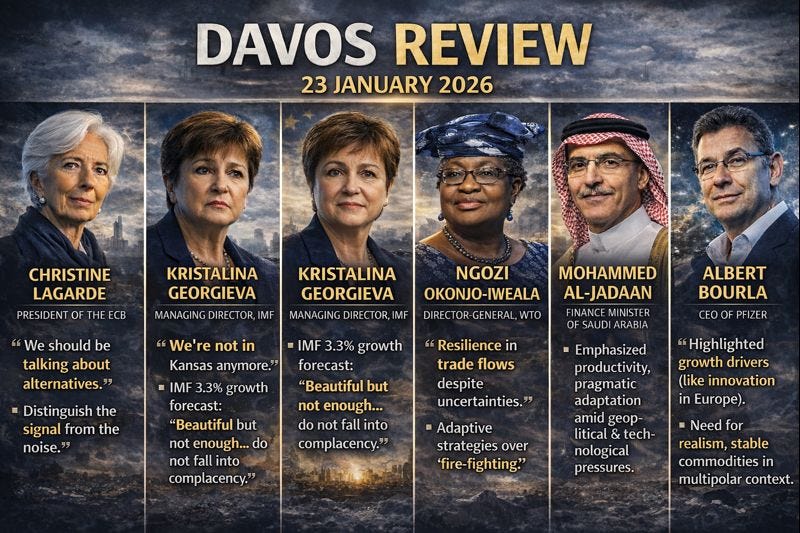
GeopoliticsUnplugged Substack is a reader-supported publication. To receive new posts and support my work, consider becoming a free or paid subscriber.The World Economic Forum Annual Meeting 2026 concluded today under the theme “A Spirit of Dialogue.” The final day centered on economic realism, with leaders stressing resilience in growth figures despite geopolitical frictions, trade policy shifts, and technological disruptions. Amid ongoing debates on multipolarity and cooperation, Day 5 prioritized distinguishing long-term signals from short-term rhetoric.Full recap below with no fluff, just sources and highlights.Key Signals from Day 5* Economic resilience shines through disruptions: Global growth projected at 3.3%, described as solid but insufficient to warrant complacency.* Wealth inequality deepens as major risk: Warnings that unaddressed disparities in distribution could lead to “real trouble” for societies and economies.* AI threatens middle-class jobs as “tsunami”: Automation risks accelerating displacement, with calls for global cooperation to manage impacts.* No full “rupture” in global order: Pushback against dramatic breaks; emphasis on adaptive “Plans B,” multipolarity, and sustained dialogue.* Trade flows persist despite uncertainties:Adaptive policies urged over alarmism, with focus on productivity, innovation, and problem-solving.Global Economic Outlook PanelModerated by Andrew R. Sorkin (CNBC / The New York Times)Panelists: Christine Lagarde (President, European Central Bank), Kristalina Georgieva (Managing Director, International Monetary Fund), Ngozi Okonjo-Iweala (Director-General, World Trade Organization), Mohammed Al-Jadaan (Minister of Finance, Saudi Arabia), Albert Bourla (Chairman and CEO, Pfizer).* Christine Lagarde pushed back on notions of a complete rupture in the global order (referencing earlier comments like those from Mark Carney), stating: “I’m not exactly on the same page... I think we should be talking about alternatives.” She called for “Plan B, or Plans B,” urging to “distinguish the signal from the noise” after a week of high-profile disruptions.* Lagarde highlighted deepening wealth disparities: “We have to be careful about the distribution of wealth and the disparity that is getting deeper and bigger... we are heading for real trouble” if ignored. She emphasized improving Europe’s investment climate, promoting innovation, and noted that AI progress depends on international cooperation to prevent fragmentation.* Kristalina Georgieva described the current global environment as permanent change: “We’re not in Kansas anymore.” She presented the IMF’s 3.3% growth forecast as “beautiful but not enough... do not fall into complacency,” citing unexpected economic strength despite trade tensions and policy shifts.* Georgieva flagged her top concern as the “impending impact on the middle class” from AI-driven job losses, terming it a potential “tsunami” that could affect 60% of jobs in advanced economies based on IMF research.* Ngozi Okonjo-Iweala stressed resilience in trade flows despite uncertainties, advocating adaptive strategies for businesses and policymakers rather than reactive “fire-fighting.” She noted high uncertainty levels are unlikely to persist, urging focus on collaborative global problem-solving.* Mohammed Al-Jadaan and Albert Bourla contributed to discussions on growth drivers, productivity (especially in regions like Europe), and the need for pragmatic adaptation amid broader geopolitical and technological pressures. No major new energy-sector disruptions (oil, natural gas) were flagged, though resilience themes indirectly support stable commodity outlooks in multipolar contexts.Other Notable AddressesThere were limited additional major public sessions marked the wrap-up day, with closing remarks by Børge Brende (President, World Economic Forum) reflecting on the week’s dialogue themes. Discussions echoed broader motifs of multipolarity, nationalism versus multilateralism, and pragmatic cooperation without new head-of-state addresses.Day 5 underscored resilience in underlying economic structures amid exogenous shocks, inequality risks, and tech disruptions. Leaders blended measured optimism on growth with realism about fractures, emphasizing dialogue, adaptive planning, and truth-telling over alarmism or complacency.For primary sources:* WEF Global Economic Outlook session page* https://www.weforum.org/meetings/world-economic-forum-annual-meeting-2026/sessions/global-economic-outlook-af4fed3639/* Live from Davos 2026: Day 5 highlights* https://www.weforum.org/stories/2026/01/live-from-davos-2026-what-to-know-on-day-5* 4 takeaways from Davos 2026* https://www.weforum.org/stories/2026/01/4-takeaways-from-davos-2026/For deeper predictions, alliance shifts, or full Rapid Reads archive, upgrade to paid.Share this if it cut through the noise for you.Thanks for reading GeopoliticsUnplugged Substack! This post is public so feel free to share it. This is a public episode. If you'd like to discuss this with other subscribers or get access to bonus episodes, visit geopoliticsunplugged.substack.com/subscribe
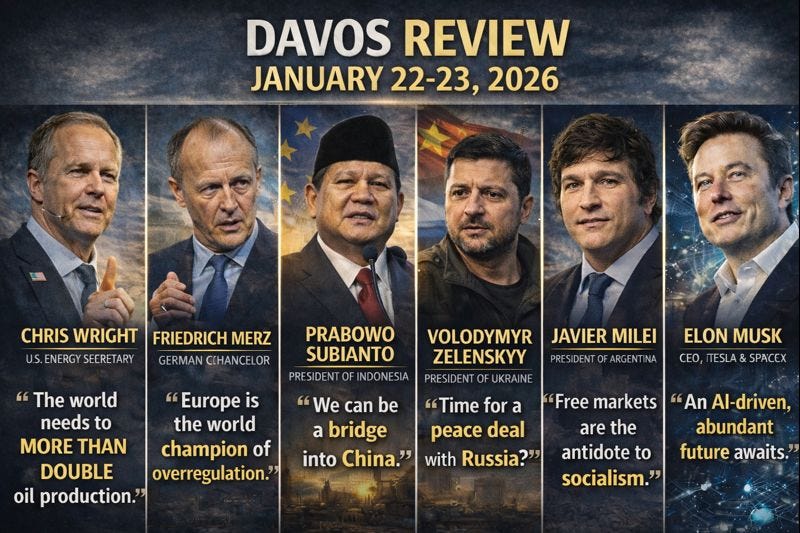
GeopoliticsUnplugged Substack is a reader-supported publication. To receive new posts and support my work, consider becoming a free or paid subscriber.This special free quick review covers Day 4’s events from the World Economic Forum Annual Meeting 2026 while previewing Day 5. Amid a fractured global order, Day 4 focused on calls for pragmatic multilateralism, free-market reforms, and sustainable energy transitions. Full recap below – no fluff, just sources and highlights.Key Signals from Day 4* Geopolitical pragmatism rises: Leaders urged adaptation to great-power competition and regulatory overhauls.* Free markets vs. overregulation: Warnings on excessive rules stifling growth, with pushes for deregulation.* Energy and blue economy spotlight: Emphasis on sustainable maritime fuels and collaborative ocean strategies.* AI and tech abundance: Discussions on technological optimism amid societal integration needs.* Ukraine conflict updates: Appeals for dialogue to end the war.Day 4 RecapChris Wright – U.S. Energy Secretary (in conversation with Vicki Hollub, CEO, Occidental Petroleum)* Stated: “The world needs to more than double oil production,” emphasizing long-term dependence on oil for decades.* Highlighted energy security through increased U.S. natural gas and LNG exports replacing Russian supplies in Europe post-2022.* Criticized EU corporate environmental regulations (e.g., methane monitoring for importers) as barriers to cooperation, calling for their removal.* Described EU and California green policies as inefficient, leading to higher prices and reduced production (e.g., California’s crude output fell from 1.1 million bpd in 1985 to 300,000 bpd in 2024).* Noted Occidental’s 2014 exit from California due to regulations, with implications for global supply chains and fossil fuel investment amid decarbonization debates.Friedrich Merz – Federal Chancellor of Germany* Highlighted Europe’s lack of preparedness for “great power politics,” criticizing Brussels as the “world champion of overregulation.”* Announced a summit with Italian PM Giorgia Meloni on February 12 to advance deregulation and capital market reforms.* Stressed restoring competitiveness against the US and China, including bypassing obstacles to the EU-Mercosur trade deal.* Urged pragmatic adaptation amid tariff threats, emphasizing security over excessive regulation.* Noted overregulation’s impact on energy sectors, calling for streamlined rules to boost industrial growth.Prabowo Subianto – President of Indonesia* Emphasized Indonesia’s role as a middle power in navigating US-China tensions.* Called for strengthened multilateralism through dialogue to address trade disruptions.* Discussed investments in renewable energy and critical minerals to support global supply chains.* Highlighted the need for inclusive growth in emerging markets amid geopolitical shifts.Volodymyr Zelenskyy – President of Ukraine* Described a “very good” meeting with US President Donald Trump, focusing on ending the war.* Urged pressure on Russia, noting the conflict’s origins in disputed 2020 US elections.* Appealed for continued international support to restore peace and rebuild infrastructure.* Stressed the war’s global implications, including energy security disruptions in Europe.Javier Milei – President of Argentina* Advocated for free markets and economic freedom as antidotes to socialism.* Warned against state intervention, citing historical examples of prosperity through liberty.* Called for ethical reforms in global economics to reduce corruption.* Emphasized tokenization of assets to streamline financial systems, with implications for energy trading.Elon Musk – CEO, Tesla and SpaceX (in conversation with Larry Fink, CEO, BlackRock)* Envisioned an “abundance technological” future driven by AI and sustainable energy.* Discussed accelerating AI timelines while ensuring societal benefits.* Highlighted Tesla’s role in EV adoption and SpaceX’s contributions to global connectivity.* Noted energy demands from data centers, urging investments in renewables like solar and batteries.Other Notable Addresses* Yo-Yo Ma’s performance and conversation with Aulani Wilhelm focused on cultural dialogue for environmental stewardship.* In the “Velocity of the Blue Economy” session, EU Commissioner Apostolos Tzitzikostas introduced a ports strategy addressing energy, sustainability, and maritime fuels.* Open Forum on “Beyond Earth – The Next Space Race” explored space as a domain for international cooperation.Day 4 underscored the tension between multilateral dialogue and unilateral power plays, with leaders highlighting free-market reforms as key to navigating AI-driven growth, energy transitions, and geopolitical frictions.Day 5 Agenda Highlights* 09:00 CET: Closing Plenary on “A Spirit of Dialogue” – Reflections from WEF leadership on the week’s outcomes.* 10:30 CET: Davos Kick-off for FIFA World Cup 2026 – Speakers include Gianni Infantino, Alessandro Del Piero, and Arsène Wenger on global unity through sports.* 12:00 CET: “Investing in People” Panel – Discussions on skills transformation and AI’s workforce impact.* 14:00 CET: “Building Prosperity Within Planetary Boundaries” – Focus on climate resilience and sustainable innovation.* 15:30 CET: “Deploying Innovation at Scale” – CEOs on responsible AI and tech deployment.* 17:00 CET: Final Press Conference – WEF President Børge Brende on key commitments.Which session are you watching most closely today? Reply in comments.Which session are you watching most closely today? Reply in the comments.* WEF Annual Meeting 2026 Agenda(https://www.weforum.org/events/world-economic-forum-annual-meeting-2026)* Live from Davos 2026: Day 4 Highlights (https://www.weforum.org/stories/2026/01/live-from-davos-2026-what-to-know-on-day-4)* Javier Milei Special Address Transcript (https://www.weforum.org/stories/2026/01/davos-2026-special-address-by-javier-milei-president-of-argentina)For deeper predictions, alliance shifts post-Trump address, or full Rapid Reads archive – upgrade to paid. Free tomorrow: Next-day recap. Share this if it cut through the noise for you.Thanks for reading GeopoliticsUnplugged Substack! This post is public so feel free to share it. This is a public episode. If you'd like to discuss this with other subscribers or get access to bonus episodes, visit geopoliticsunplugged.substack.com/subscribe
By Justin James McShaneGeopoliticsUnplugged Substack is a reader-supported publication. To receive new posts and support my work, consider becoming a free or paid subscriber.This is a special free quick review of yesterday’s (January 21) events at the World Economic Forum Annual Meeting 2026, under the theme “A Spirit of Dialogue.” Amid fractured global order, Day 3 (January 21) centered on navigating contested geopolitics through negotiation over confrontation, accelerating AI deployment, and balancing protectionism with economic realities. A full recap is below with no fluff, just sources and highlights.Key Signals from Day 3* Geopolitical negotiations over force: U.S. President Trump explicitly ruled out military action on Greenland, framing acquisition as a security imperative via talks, easing immediate transatlantic tensions.* AI as massive infrastructure build-out: Leaders highlighted AI’s job-augmenting potential and urgent scaling needs, with calls for responsible deployment amid energy and chip demands.* Tariffs as negotiation tool, not endgame: U.S. walk-back on some tariff threats post-dialogue, underscoring pragmatic adaptation in trade amid deficit concerns.* Dialogue amid fragmentation — Sessions stressed diplomacy for security (NATO, Europe defense) and shared prosperity in contested world.Day 3 Recap (January 21)Donald J. Trump – President of the United States – Special Address* Called Greenland a “core national security interest” for U.S. and NATO, part of North America; seeking “immediate negotiations” for acquisition to counter Russia/China threats.* Explicitly stated: “I won’t use force... we would be, frankly, unstoppable. But I won’t do that.” Announced framework for future deal on Greenland/Arctic after meeting NATO’s Mark Rutte.* Touted tariffs as effective negotiation tactic: slashed U.S. trade deficit 77% with no inflation; used threats to secure deals on drug prices, trade imbalances.* Highlighted economic gains: $18 trillion+ investments committed, deficit cut 27%, steel production up, factory construction +41%; predicted stock market doubling.* Emphasized U.S. AI/energy leadership over China; criticized EU green policies for weakening allies.* Geopolitical implication: Prioritizes bilateral deals and strength over traditional multilateral norms.Jensen Huang – Founder and CEO, NVIDIA – Conversation* Described AI as largest infrastructure build-out ever: 5-layer stack (energy, chips, cloud, models, apps).* Stressed AI augments jobs, especially trades like plumbers/electricians for data centers (high salaries, U.S. shortages).* Urged Europe/emerging markets to fuse AI with industry strengths; optimism for broad participation: “Get involved!”* Geopolitical implication: AI race requires massive investment; diffusion key to avoid divides.Jamie Dimon – Chairman and CEO, JPMorgan Chase – Conversation* Warned Trump’s proposed 10% credit card interest cap could cause “economic disaster,” limiting credit access.* Noted AI transforming industries; new players disrupting; markets face rapid change.* Geopolitical implication: Trade/AI policies need careful calibration to avoid unintended economic harm.Abdel Fattah El-Sisi – President of Egypt – Special Address* Focused on regional stability, security, prosperity in Middle East; pushed Gaza peace plan phase 2 with engagement.* Highlighted Egypt’s economic reforms: private sector role, infrastructure (highways, Suez Canal zone).* Geopolitical implication: Calls for dialogue to seize mutual benefits amid global challenges.Other Notable Addresses* Javier Milei – President of Argentina – Special Address: Outlined Argentina’s shift from hyperinflation to fiscal discipline; stressed productivity, AI regulation.* Panels touched European defense (NATO strengthening via diplomacy), AI in health/work (augmentation, upskilling), climate/energy transitions, jobless growth prevention.Day 3 underscored erosion of post-war norms, with calls for dialogue clashing against protectionism, AI as dual-edged sword requiring scale/responsibility, and middle powers navigating U.S.-China-EU frictions through pragmatism over ideology.Today’s Preview Section: Day 4 Agenda Highlights (January 22)* Focus expected on continued themes: global cooperation, growth sources, innovation deployment, planetary boundaries.* Key sessions likely include climate/growth linkages, AI governance, economic shocks prep (debt, disruption).* Potential high-profile: Follow-ups on AI/health, women’s health breakthroughs, humanitarian aid gaps.* Alternative events (e.g., climate-focused debriefs outside official agenda).Scheduled speakers for Day 4:* Special Address by He Lifeng, Vice-Premier of the People’s Republic of China (around 11:20–11:50 CET).* Moderated/introduced by Børge Brende (WEF President) and André Hoffmann (WEF Vice-Chair). Topic centers on China’s perspective on global cooperation, economic growth, and contested world dynamics under the dialogue theme.Other prominent sessions and speakers highlighted in the program (times approximate or thematic groupings; not all have exact slots confirmed publicly yet):* Decade Déjà Vu: Are the 2020s the New 1920s? — Featuring Christine Lagarde (ECB President) and others like Andrew R. (likely Haldane or similar economist). Discusses parallels between current economic/geopolitical risks and historical crises, low-growth era challenges.* Who Brokers Trust Now? — Panel with Tharman Shanmugaratnam (Singapore President), Annalena Baerbock (German Foreign Minister), Alexander De Croo (Belgian PM), Chuck Robbins (Cisco CEO), Comfort Ero (International Crisis Group), and moderator Ishaan Tharoor. Focuses on rebuilding trust amid fragmentation, multilateralism vs. unilateralism.* How Can We Avert a Climate Recession? — Speakers include Al Gore, Ester Baiget (Novonesis CEO), Carsten Schneider, Zhang Lei, Elizabeth Thurbon, Jai Shroff. Explores climate risks to growth, planetary boundaries, and sustainable prosperity models.* Second Act for EU Single Market — Panel with Christine Lagarde, Carlos Cuerpo Caballero (Spanish Economy Minister), Christian Sewing (Deutsche Bank CEO), Valerie Baudson, Annette Mosman, Martin Sandbu. Addresses revitalizing European economic integration and competitiveness.Which session are you watching most closely today? Reply in comments.Primary sources:* WEF Live from Davos Day 3: https://www.weforum.org/stories/2026/01/live-from-davos-2026-what-to-know-on-day-3* Trump Special Address: https://www.weforum.org/stories/2026/01/davos-2026-special-address-donald-trump-president-united-states-america/* El-Sisi Special Address: https://www.weforum.org/stories/2026/01/davos-2026-special-address-abdel-fattah-el-sisi/For deeper predictions, alliance shifts post-Trump address, or full Rapid Reads archive, upgrade to paid. Free tomorrow: Next-day recap. Share this if it cut through the noise for you.Thanks for reading GeopoliticsUnplugged Substack! This post is public so feel free to share it. This is a public episode. If you'd like to discuss this with other subscribers or get access to bonus episodes, visit geopoliticsunplugged.substack.com/subscribe
GeopoliticsUnplugged Substack is a reader-supported publication. To receive new posts and support my work, consider becoming a free or paid subscriber.Community notes:* We have switched to video posts with a video for each Rapid Read as a summary and a video for each deep dive as a preview* We have turned on comments for all articles. We now have the staff to monitor and engage. Please don’t be afraid to use it.* We continue to grow at a great clip. Thank you for joining us. 14,478 daily followers. 10,351 subscribers.* Our aim is to publish at least two deep dives per week but only if they are good/great topics. We aren’t going to publish just for the sake of publishing.* We have added a WHY THIS MATTERS NOW to the free content side of the Rapid Read. Be sure to check out the full Rapid Read on the weekend to consider upgrading to paid as on the weekends we are totally free.Executive Summary:* President Donald Trump imposed 10% tariffs on eight European NATO allies including Denmark, France, and Germany over their military support for Greenland, escalating to 25% by June unless the U.S. acquires the island, while simultaneously requiring nations to pay $1 billion for permanent membership on his Peace Board and seeing Hungary’s Viktor Orban accept an invitation to the Gaza-specific board, prompting the EU to halt its trade deal approval, French President Emmanuel Macron to seek activation of the anti-coercion instrument against the U.S., and UK right-wing parties to criticize the US Greenland move, potentially widening intra-EU rifts and shifting U.S. strategic focus toward Polish-led Central and Eastern Europe amid broader geopolitical tensions like U.S. calls for regime change in Iran following over 3,300 protest deaths and a U.S. strike killing an al Qaeda leader in Syria.* Energy sector developments featured Panama’s ports achieving a 3.6% rise in container traffic to 9.9 million TEUs in 2025, Brazil advancing gas supply security through projects like the $150 million ECOMP Itajuipe compressor and $190 million Gasoduto dos Goytacazes pipeline to offset declining Bolivian imports, Cuba facing a worsening energy crisis without Venezuelan oil shipments post-U.S. intervention and turning to Mexico for 12,284 barrels per day despite U.S. threats during USMCA renegotiations, global oil markets grappling with oversupply issues that dwarf concerns over Iran and Russia, and Syrian forces seizing major fields like Omar and Conoco amid regional instability.* Technological and military advancements included the U.S. Army’s $10.4 billion hypersonic missile program missing its 2025 fielding deadline, NASA rolling out the Artemis 2 rocket for a targeted February 6 crewed lunar mission carrying four astronauts on a 10-day journey, Apple partnering with Google on the Gemini AI model to enhance Siri’s personalization and privacy, SK Hynix completing a 1a DRAM upgrade at its Wuxi plant in China, discussions in the UK and France on implementing Australia-style social media bans for under-16s amid documented negative effects, Russia’s Zorky system rivaling Starlink with plans for over 300 satellites by 2027 and serial production starting in 2026, and a space company securing an $805 million contract for 18 missile warning satellites representing 185% of its annual revenue while developing a medium-lift rocket to capture niche markets ignored by SpaceX.See the full stories below—plus paid subscribers get our take, detailed analysis and predictionsWHY THIS MATTERS NOWPresident Trump’s 10% tariffs on goods from eight NATO allies (Denmark, France, Germany, Norway, Sweden, Netherlands, Finland, UK) effective February 1, escalating to 25% in June unless the U.S. acquires Greenland, shifts transatlantic trade flows and defense burden-sharing by raising import costs for U.S. consumers and European exporters while redirecting U.S. Arctic strategic capital toward Central-Eastern Europe over the next 6-12 months.Market Snapshot as of publication time noted above (not to be relied on for trading purposes):Detailed News Summary:Iran’s Supreme Leader Concedes Thousands Killed In Unresthttps://www.bloomberg.com/news/articles/2026-01-17/iran-media-claim-partial-internet-return-after-record-blackoutIran’s Supreme Leader Ayatollah Ali Khamenei acknowledged that several thousand people died during recent anti-government protests, accusing the U.S. and Israel of aiding the killings while vowing not to lead the country into war but to punish both domestic and international criminals. The unrest, sparked by a currency crisis, led to a nine-day internet blackout affecting 92 million people, with partial restoration reported but overall connectivity remaining at about 2% of normal levels. Human rights groups estimated 3,500 deaths and over 22,000 detentions, aligning with Khamenei’s toll, amid accusations from President Trump that Khamenei destroyed the country through unprecedented violence. Local media noted gradual easing of restrictions, though security conditions might prolong some measures.Panama Ports See 3.6% Rise In TEU Container Traffic In 2025https://gcaptain.com/panama-ports-see-3-6-rise-in-teu-container-traffic-in-2025/Panama’s ports experienced a 3.6% increase in container traffic to 9.9 million TEUs in 2025, as reported by the Maritime Authority, highlighting their role in supporting the Panama Canal’s global trade connectivity. Key terminals showed varied growth, with SSA Marine’s Manzanillo International Terminal handling 2.9 million TEUs up 5%, Panama Ports Company’s Balboa at 2.7 million TEUs up 2%, Cristobal up 9% to 1.2 million TEUs, and Colon Container Terminal surging 10% to 1.7 million TEUs. The only decline was at Panama International Terminal, down 2% to 1.4 million TEUs, amid an overall rise in empty container repositioning that underscores Panama’s strategic hub status. Officials emphasized this growth reaffirms the nation’s importance for regional equipment redistribution.Army Hypersonic Missile Fielding Falters on Missed Deadlinehttps://www.bloomberg.com/news/articles/2026-01-17/army-hypersonic-missile-fielding-falters-on-missed-deadlineThe U.S. Army has missed its self-imposed deadline for fielding the first hypersonic weapon, highlighting delays in one of the Pentagon’s top priorities despite the responsible unit being fully trained and ready. The missile, part of a $10.4 billion program, remains unprepared for deployment, contradicting the Army’s recent statement to achieve fielding by the end of 2025. This setback underscores ongoing challenges in advancing hypersonic capabilities amid high expectations for rapid development. Officials confirmed the missed timeline this week, signaling potential impacts on broader military modernization efforts.Trump to Impose Tariffs on Some European Nations Over Greenlandhttps://www.bloomberg.com/news/articles/2026-01-17/trump-to-impose-tariffs-on-some-european-nations-over-greenlandPresident Donald Trump announced 10% tariffs on goods from eight European NATO allies including Denmark, Norway, and France starting February 1, escalating to 25% in June unless Greenland is fully purchased by the U.S., targeting nations that dispatched personnel for training in the territory. The move drew sharp rebukes from EU leaders like Ursula von der Leyen and Antonio Costa, who warned of undermined transatlantic relations and a potential downward spiral, while French President Emmanuel Macron called it unacceptable and Swedish Prime Minister Ulf Kristersson rejected blackmail. EU lawmakers, led by Manfred Weber, indicated halting last year’s trade deal, which imposed 15% U.S. tariffs on EU goods and 50% on steel, amid questions over Trump’s legal authority under acts like the International Emergency Economic Powers Act. Denmark’s Foreign Minister Lars Lokke Rasmussen expressed surprise, emphasizing enhanced Arctic security, as officials agreed to a working group but remained in stalemate with the U.S.NASA rolls Artemis 2 rocket to the pad ahead of historic moon launchhttps://www.space.com/space-exploration/artemis/nasa-rolls-artemis-2-rocket-to-the-pad-ahead-of-historic-moon-launchNASA’s Space Launch System rocket for the Artemis 2 mission began its 4-mile rollout from the Vehicle Assembly Building at Kennedy Space Center on January 17, 2026, heading to Launch Complex-39B for systems checks and a wet dress rehearsal targeted for February 2, with the earliest launch on February 6. The 322-foot-tall rocket, weighing 2,870 tons when fueled and generating 8.8 million pounds of thrust, will carry astronauts Reid Wiseman, Victor Glover, Christina Koch, and Jeremy Hansen on a 10-day lunar flyby mission, testing Orion’s life support systems. This first crewed Artemis flight follows the uncrewed Artemis 1 in 2022, which faced delays from leaks and weather, and aims to pave the way for Artemis 3’s lunar landing targeted after 2027. The crew, who witnessed the rollout, will follow a free-return trajectory around the moon for safe return without entering orbit.Trump says 8 European nations face tariffs rising to 25% if Greenland isn’t sold to the U.S.https://thehill.com/policy/international/5694156-donald-trump-regime-change-iran/President Trump called for regime change in Iran, criticizing Supreme Leader Ayatollah Ali Khamenei as a sick man responsible for destroying the country through unprecedented violence and killing thousands to maintain control. He emphasized that leadership should be about respect rather than fear and death, urging new leadership amid protests where over 3,000 have died and 22,000 been detained. Khamenei accused the U.S. and Israel of backing the unrest to dominate Iran militarily, politically, and economically, claiming evidence of foreign involvement in killings and damage to infrastructure like power grids and banks. Trump, who canceled meetings with Iranian officials and suggested help for demonstrators, backed off military threats after executions reportedly stopped but reiterat
GeopoliticsUnplugged Substack is a reader-supported publication. To receive new posts and support my work, consider becoming a free or paid subscriber.Executive Summary:* President Trump is pushing tech giants to cover power costs for AI data centers while ordering emergency power auctions to support them, oil prices have risen 1% due to persistent supply risks, China has halted electricity imports from Russia over pricing disputes, Saudi Arabia has pledged $500 million in aid to Yemen following the UAE’s withdrawal, Venezuelan banks are receiving $300 million in oil revenues for market exchange, new power plants are under construction to meet demand, and LNG exporters are excited about growth potential but worried about geopolitical disruptions in 2026, underscoring a dynamic global energy landscape shaped by policy interventions and market volatilities.* In Uganda, President Museveni was declared the winner of the election amid reports of at least seven deaths from violence, an internet blackout, delays, security forces storming an opposition MP’s home killing 10 people, and the abduction of opposition leader Bobi Wine, while in South Korea former President Yoon was sentenced to five years for attempting martial law, Iran’s military support in Ukraine is diminishing, the US has imposed sanctions on Houthi funding networks, Myanmar has begun its defense in a UN genocide case, tens of thousands protested outside the US Embassy in Cuba, Venezuela’s Delcy Rodríguez has consolidated power after Maduro’s ouster, and President Trump has invited leaders like Milei and Erdogan to a Gaza ‘Board of Peace’, highlighting escalating political instabilities and international diplomatic efforts across multiple regions.* The US Navy revealed specifications for the FF(X) frigate to bolster naval power, the US approved a $1.5 billion plan for a Peru naval base to counter Chinese influence near a key port, Russia may start sea trials for the Khabarovsk nuclear submarine carrying Poseidon in 2026, NASA aims to launch Artemis 2 astronauts to the moon next month with the rocket rollout on January 17, Elon Musk stated Tesla is nearly finished with the AI5 chip design and progressing on AI6, the Supreme Court will issue opinions on Tuesday including a pending tariff ruling, President Trump floated tariffs on countries opposing US acquisition of Greenland which faces resource extraction hurdles, OpenAI committed billions to chip deals excluding some major players, and the US is scrutinizing big tech talent acquisitions, reflecting advancements in military, space, and technology sectors amid regulatory and strategic shifts.See the full stories below—plus paid subscribers get our take, detailed analysis and predictionsMarket Snapshot as of publication time noted above (not to be relied on for trading purposes):Detailed News Summary:Japanese Premier Takaichi Stakes All on Unpredictable Electionhttps://www.bloomberg.com/news/articles/2026-01-16/japanese-premier-takaichi-stakes-all-on-unpredictable-electionJapanese Prime Minister Sanae Takaichi has dissolved parliament and called for a snap election, risking her leadership in a contest marked by economic uncertainty and shifting voter sentiments. Her Liberal Democratic Party faces strong opposition from a united front of rival parties criticizing her handling of inflation, which has reached 3.5%, and foreign relations with China. Polls indicate a close race, with potential for the LDP to lose its majority for the first time in years, potentially leading to coalition governments or policy overhauls in areas like defense spending, which Takaichi has increased by 8%. Analysts predict that the outcome could significantly impact Japan’s role in regional security alliances amid ongoing global tensions.Japanese Premier Takaichi Stakes All on Unpredictable Electionhttps://www.bloomberg.com/news/articles/2026-01-16/japanese-premier-takaichi-stakes-all-on-unpredictable-electionJapanese Prime Minister Sanae Takaichi has dissolved parliament and called for a snap election, risking her leadership in a contest marked by economic uncertainty and shifting voter sentiments. Her Liberal Democratic Party faces strong opposition from a united front of rival parties criticizing her handling of inflation, which has reached 3.5%, and foreign relations with China. Polls indicate a close race, with potential for the LDP to lose its majority for the first time in years, potentially leading to coalition governments or policy overhauls in areas like defense spending, which Takaichi has increased by 8%. Analysts predict that the outcome could significantly impact Japan’s role in regional security alliances amid ongoing global tensions.Uganda Holds Elections Despite Delays and Internet Blackouthttps://www.nytimes.com/2026/01/15/world/africa/uganda-election-museveni.htmlUganda conducted its general elections amid significant challenges, including polling delays caused by logistical issues and a nationwide internet blackout imposed by the government to curb misinformation. Incumbent President Yoweri Museveni, seeking his seventh term, faced main challenger Bobi Wine, a popular musician-turned-politician who accused the regime of voter suppression and intimidation. Observers reported isolated incidents of violence, with security forces deploying heavily in opposition strongholds, leading to concerns over the election’s fairness from international monitors like the African Union. Preliminary results suggest Museveni maintains a lead, but opposition claims of fraud could spark post-election unrest in a country with a history of political turbulence.At least seven killed in Uganda violence, Museveni dominates election resultshttps://www.reuters.com/world/africa/ugandas-president-museveni-takes-strong-lead-early-election-results-2026-01-16/Violence marred Uganda’s election as at least seven people were killed in clashes between security forces and opposition supporters, with reports of gunfire and arrests in Kampala and other cities. Early results show President Yoweri Museveni leading with over 65% of the vote, solidifying his decades-long rule despite allegations of rigging from challenger Bobi Wine. The internet blackout and delays in vote counting have fueled tensions, prompting calls for calm from international observers who noted irregularities in the process. Opposition leaders vow to challenge the results in court, potentially prolonging instability in the East African nation.Ugandan opposition MP says security forces stormed home killing 10 peoplehttps://www.theguardian.com/world/2026/jan/16/uganda-election-early-results-show-museveni-in-lead-as-violence-reportedAn Ugandan opposition MP reported that security forces raided his home, resulting in the deaths of 10 people, including family members and aides, amid escalating violence during the election period. Early results indicate President Yoweri Museveni is in the lead, but the opposition accuses the government of widespread fraud and suppression. The internet blackout has hindered communication and reporting, drawing criticism from human rights groups who demand investigations into the killings. This incident highlights the deepening political crisis in Uganda, where tensions between the ruling party and opposition have reached a boiling point.Trump to Push for Tech Giants to Pay for Power Costshttps://www.bloomberg.com/news/videos/2026-01-16/trump-to-push-for-tech-giants-to-pay-for-power-costs-videoPresident Trump announced plans to require major technology companies to contribute to electricity costs associated with their data centers, emphasizing the strain on the national grid from AI and cloud computing demands. In a video address, he argued that firms like Google and Amazon should fund infrastructure upgrades, potentially through new fees or partnerships with utilities. This policy aims to address power shortages in key states, with estimates showing data centers consuming up to 8% of US electricity by 2030. Critics warn it could increase operational costs for tech giants, impacting innovation, while supporters see it as fair burden-sharing.Former South Korean President Yoon Sentenced to Five Years Over Martial Law Attempthttps://moderndiplomacy.eu/2026/01/16/former-south-korean-president-yoon-sentenced-to-five-years-over-martial-law-attempt/Former South Korean President Yoon Suk Yeol received a five-year prison sentence for his attempt to impose martial law, which the court deemed an unconstitutional abuse of power aimed at suppressing political dissent. The ruling follows months of investigations into Yoon’s actions during a period of domestic unrest, where he deployed military forces without parliamentary approval. Prosecutors highlighted evidence of Yoon’s intent to consolidate authority amid low approval ratings and corruption scandals. This verdict marks a significant moment in South Korea’s democracy, potentially deterring future leaders from similar overreaches and strengthening judicial oversight.Iran’s Military Role in Ukraine Is Clearly Shrinkinghttps://oilprice.com/Geopolitics/Middle-East/Irans-Military-Role-in-Ukraine-Is-Clearly-Shrinking.htmlIran’s involvement in supporting Russia in the Ukraine conflict has notably decreased, with shipments of drones and missiles dropping by 70% over the past year due to international sanctions and domestic production constraints. Analysts attribute this shrinkage to pressure from the US and EU, which have targeted Iranian suppliers, leading to logistical disruptions. Despite earlier contributions that bolstered Russian offensives, Tehran’s focus has shifted to internal economic issues and regional conflicts in the Middle East. This development could alter the dynamics of the Ukraine war, reducing Russia’s access to key weaponry and influencing global geopolitical alignments.Saudi Pledges $500mn To Yemen After UAE Withdrawalhttps://www.mees.com/2026/1/16/news-in-brief/saudi-pledges-500mn-to-yemen-after-uae-wi
GeopoliticsUnplugged Substack is a reader-supported publication. To receive new posts and support my work, consider becoming a free or paid subscriber.Executive Summary:* President Trump’s executive order firewalling Venezuelan oil revenues held in the US, coupled with potential sanction lifts and meetings with Big Oil executives committing up to $100 billion for reconstruction, has swelled oil held at sea to over 29 million barrels amid naval blockades, while Maduro’s fall defuses Guyana’s border risks enabling its production surge to potentially rewrite the global energy map alongside Arctic and Greenland developments, Ethiopia’s $12.5 billion Africa’s largest airport hub, China’s gas growth reducing LNG demand by millions of tons, and Russia’s diversified economy remaining resilient even if oil prices drop below $60 per barrel due to higher taxes filling revenue voids.* Escalating Iranian protests have resulted in 65 confirmed deaths amid internet blackouts and IRGC warnings of intensified crackdowns signaling a potential regime crisis, as US forces executed large-scale strikes on over 70 ISIS targets in Syria using precision munitions in retaliation for killing two soldiers and a civilian interpreter, while Trump’s threats on Venezuela and Greenland heighten Canadian fears of annexation potentially leading to a 2% GDP NATO defense boost, alongside Sudan’s war displacing 13.6 million and nearing health system collapse with 21 million in acute food insecurity, and Cuba’s faltering economy under CIA assessment not inevitably toppling the regime despite lost Venezuelan oil subsidies.* China’s AI leaders warn of a widening US gap after a $1 billion IPO week amid resource disparities, as Elon Musk pledges X’s algorithm open-source in seven days to enhance transparency, FCC approves SpaceX’s 7,500 additional Starlink satellites boosting global connectivity, Lockheed Martin’s F-35 program surpasses 1,300 aircraft with record 191 deliveries in 2025 amid combat successes, crypto ATMs face US bans with $240 million scam losses in 2025’s first half, and OpenAI integrates ChatGPT into healthcare for personalized advice while SRAM emerges as an AI inference alternative to HBM despite capacity limits.See the full stories below—plus paid subscribers get our take, detailed analysis and predictionsMarket Snapshot as of publication time noted above (not to be relied on for trading purposes):Detailed News Summary:Farming Without Subsidies: Could New Zealand’s Approach Work Elsewhere?https://www.bloomberg.com/news/videos/2026-01-10/should-the-world-move-away-from-farm-subsidies-videoNew Zealand’s abrupt removal of agricultural subsidies in the 1980s forced farmers to innovate and focus on market-driven efficiency, resulting in a more sustainable and dynamic industry that enhanced environmental practices and organic matter buildup. Experts like former US Agriculture Secretary Dan Glickman and New Zealand’s Lockwood Smith discuss how this model could reform global agriculture by reducing distortions in trade and markets. However, applying it elsewhere, such as in the US with entrenched corn and ethanol subsidies, faces significant political resistance despite potential benefits for worldwide food systems.Venezuela Oil Being Held at Sea Swellshttps://www.rigzone.com/news/wire/venezuela_oil_being_held_at_sea_swells-10-jan-2026-182731-article/?rss=trueVenezuelan crude oil volumes held at sea have risen to over 29 million barrels, the highest in more than three years, largely concentrated in Asian waters where China serves as the primary importer amid preparations for potential supply disruptions. This surge follows US intervention, including the seizure of President Maduro and a naval blockade on oil flows, creating uncertainty over the cargoes’ destinations. US officials have clarified that legitimate trade to China will not be restricted, differentiating it from illicit dealings with Iran and Russia.Trump’s Venezuela, Greenland Threats Make Canada Fear It’s Nexthttps://www.bloomberg.com/news/articles/2026-01-10/trump-s-venezuela-greenland-threats-make-canada-fear-it-s-nextPresident Trump’s aggressive actions in seizing Venezuelan President Maduro and pushing for Greenland control have revived fears in Canada of potential US annexation, prompting discussions on bolstering defenses like expanding civil reserves and drone strategies. Canadian experts warn of economic coercion over military invasion, with 85% of trade vulnerable, urging diversification to reduce US dependence by doubling non-US exports in a decade. Geopolitical similarities to Greenland amplify concerns, leading to increased military spending to meet NATO’s 2% GDP target amid eroded US reliability.Lockheed Martin’s F-35 Program Crosses 1,300 Aircraft With Record 2025 Deliverieshttp://worlddefencenews.blogspot.com/2026/01/lockheed-martins-f-35-program-crosses.htmlLockheed Martin delivered a record 191 F-35 aircraft in 2025, surpassing previous highs and pushing the global fleet to nearly 1,300 jets across 12 nations, with milestones including one million flight hours and TR-3 software completion. The program finalized $24 billion contracts for up to 296 more jets and sustainment deals, while countries like Italy and Denmark expanded orders. These achievements underscore the F-35’s unmatched reliability and lethality, positioning it for future technological advancements amid combat successes.What the Big Oil executives told Trump about investing in Venezuelahttps://www.cnbc.com/2026/01/10/what-the-big-oil-executives-told-trump-about-investing-in-venezuela.htmlIn a White House meeting, executives from ExxonMobil, ConocoPhillips, and Chevron briefed President Trump on Venezuelan investments, emphasizing the need for legal reforms and highlighting the country’s current “uninvestable” status due to past asset seizures. Exxon CEO Darren Woods noted readiness to assess assets but stressed significant changes required, while Conoco’s Ryan Lance advocated for debt restructuring and energy system overhaul. Chevron expressed optimism for rapid production increases, but Treasury Secretary Bessent suggested smaller firms might lead initial efforts under US security guarantees.Iranian Guards Issue Stark Warning as Tehran Struggles to Contain Protestshttps://moderndiplomacy.eu/2026/01/10/iranian-guards-issue-stark-warning-as-tehran-struggles-to-contain-protests/Iran’s Revolutionary Guards warned that security is a “red line” amid escalating protests over inflation that evolved into demands to end clerical rule, resulting in 65 deaths and over 2,500 arrests. Authorities imposed internet blackouts and used live fire, accusing protesters of foreign collaboration, while opposition figure Reza Pahlavi called for strikes. International leaders condemned the violence, urging restraint, as the unrest challenges the regime’s stability amid economic hardships and sanctions.China AI Leaders Warn of Widening Gap With US After $1B IPO Weekhttps://www.bloomberg.com/news/articles/2026-01-10/china-ai-leaders-warn-of-widening-gap-with-us-after-1b-ipo-weekAt Beijing’s AGI-Next summit, leaders from Alibaba, Tencent, and Zhipu warned of China’s widening AI gap with the US, estimating less than 20% chance of breakthroughs in three to five years due to resource disparities and US export controls. Despite over $1 billion raised in IPOs by firms like Zhipu and MiniMax, internal competition hampers progress, with calls for collaboration to advance AGI. Chinese firms prioritize practical applications, but US advantages in compute and innovation may prolong the divide.Elon Musk Says X to Make Algorithm Open Source in Seven Dayshttps://www.bloomberg.com/news/articles/2026-01-10/elon-musk-says-x-to-make-its-algorithm-open-source-in-seven-daysElon Musk announced X will open-source its recommendation algorithm within seven days, repeating every four weeks with developer notes, amid regulatory scrutiny over content moderation and misinformation in Europe, France, Indonesia, and the UK. The move integrates Grok AI to personalize feeds, addressing user complaints and “For You” bugs. Greater transparency may mitigate pressures but risks exploitation, as X navigates past rejections of algorithm demands deemed politically motivated.CEOs on Guard as Trump Rattles Companies With Series of Edictshttps://www.bloomberg.com/news/articles/2026-01-10/ceos-on-guard-as-trump-rattles-companies-with-series-of-edictsPresident Trump’s second-term edicts blend deregulation with populist interventions, creating uncertainty for CEOs through actions like controlling Venezuelan oil, threatening Greenland seizure, altering vaccine schedules, and potentially disrupting wind power. Oil executives engage directly on Venezuela investments, while pharmaceutical and energy sectors face shifts. Businesses anticipate mixed impacts, with deregulation benefits overshadowed by risks requiring adaptive strategies amid political demands.The crypto ATM’s days in America may be numberedhttps://www.cnbc.com/2026/01/10/bitcoin-crypto-atm-scam-fraud-regulation.htmlCrypto ATMs face mounting regulatory threats due to scams, with Spokane banning them and states like Arizona considering restrictions after $240 million in losses in 2025’s first half, often targeting vulnerable elderly. Industry advocates argue for enforcement over bans, emphasizing ATMs’ role in financial inclusion for underbanked populations despite high fees. Future outlook suggests constrained growth, shifting focus to education amid crypto’s maturation as an investment asset.Why Russia’s economy is unlikely to collapse even if oil prices fall[Why Russia’s economy is unlikely to collapse even if oil prices fall](Why Russia’s economy is unlikely to collapse even if oil prices fall)Russia’s economy demonstrates resilience against falling oil prices through diversification, budget surpluses, and low public debt below 20% of GDP, with oil revenues halved but offset by ruble devaluation maintain

Summary:In this episode, we discuss China's significant demographic changes, particularly its aging population and declining workforce, examining the causes like the One-Child Policy and low fertility rates. We analyze the economic impact, including strains on the labor market, manufacturing, and technology sectors, as well as the challenges to social systems like pensions and healthcare. Furthermore, we explores the global effects of China's demographic shift on supply chains and trade. Finally, we assess China's policy responses to these issues and outline potential future economic scenarios, emphasizing the lessons for other nations facing similar demographic challenges. This is a public episode. If you'd like to discuss this with other subscribers or get access to bonus episodes, visit geopoliticsunplugged.substack.com/subscribe

Comments

Download from Google Play

Download from App Store
 United States