


 Claim Ownership
The Future Ledger
Subscribed: 1Played: 4
Subscribe

© Tyms Inc.
Description
Where AI and automation meet CFOs.
Explore the cutting-edge of finance as we dive into the intersection of AI, automation, and the evolving role of CFOs. Join us for insightful conversations with industry leaders, tech innovators, and finance professionals as we discuss how emerging technologies are reshaping financial strategies, workflows, and decision-making in the modern business landscape. Whether you’re a finance executive, tech enthusiast, or curious about the future of accounting, this podcast is your gateway to understanding the tools and trends defining tomorrow’s financial world.
Explore the cutting-edge of finance as we dive into the intersection of AI, automation, and the evolving role of CFOs. Join us for insightful conversations with industry leaders, tech innovators, and finance professionals as we discuss how emerging technologies are reshaping financial strategies, workflows, and decision-making in the modern business landscape. Whether you’re a finance executive, tech enthusiast, or curious about the future of accounting, this podcast is your gateway to understanding the tools and trends defining tomorrow’s financial world.
7 Episodes
Reverse
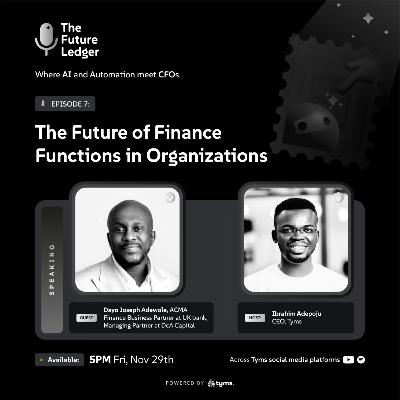
In this episode of the Future Ledger podcast, Ibrahim Adepoju and Dayo Adewole discuss the transformative impact of AI on the finance profession. They explore how AI is reshaping the roles of accountants, the importance of upskilling, and the need for finance professionals to adapt to new technologies.
Dayo shares insights on the evolving responsibilities of CFOs and the significance of human involvement in data analysis and decision-making. The conversation emphasizes the importance of embracing change and positioning oneself strategically in the finance industry.
Takeaways
* AI is becoming integral to finance operations.
* Accountants must adapt to new technologies and roles.
* Upskilling is crucial for future career success.
* AI will not replace the human element in finance.
* Finance professionals should focus on strategic value.
* Volunteering in projects can enhance learning opportunities.
* Change management is essential in the evolving finance landscape.
* AI can drive efficiency in accounting processes.
* Data management skills are vital for leveraging AI.
* The future of finance involves a blend of technology and human insight.
Sound Bites
"AI is everywhere in finance now."
"You want to be in that human loop."
"Change management is key in finance today."
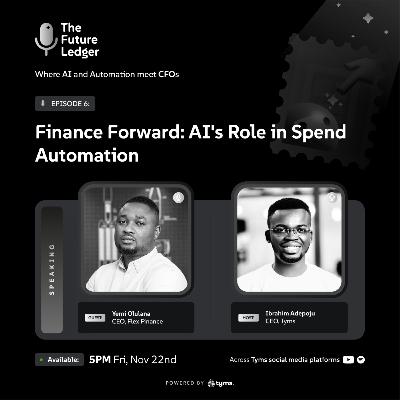
In this episode of the Future Ledger podcast, host Ibrahim Adepoju, CEO of Tyms discusses the critical role of automation in financial management, particularly in spend management, with guest Yemi Olulana, CEO of Flex Finance.
They explore how automation can streamline processes, the impact of AI on expense management, and the importance of integrating spend management with existing accounting systems.
Yemi shares insights on building solutions tailored for African businesses and emphasizes the need for effective workflow and approval processes to enhance financial operations.
Takeaways
Spend automation is essential for efficient financial management.
AI enhances expense tracking and provides valuable insights.
Businesses should start automating spend from day one.
Spend management tools complement existing accounting software.
Fragmentation in finance leads to inefficiencies and errors.
Building a user-friendly product encourages adoption of spend management solutions.
Approval workflows help maintain control over expenses.
Automation reduces manual errors and saves time for finance teams.
Every business, regardless of size, needs a solid financial process.
Sound Bites
"It's never too early to start automating spend."
"Automation saves time and reduces errors."
"Every business needs a solid financial process."
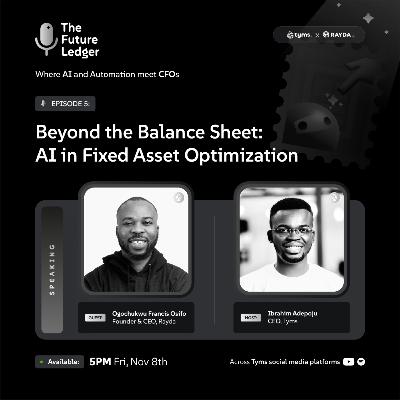
In this episode of The Future Ledger podcast by Tyms (an AI-powered accounting software), Ibrahim Adepoju speaks with Francis Osifo, CEO of Rayda, about the transformative role of AI in asset management. They discuss the challenges businesses face in managing the lifecycle of assets, the importance of insights and automation, and the need for technology adoption in organizations.
Francis shares his experiences and the innovative solutions Rayda offers to streamline asset management processes, ultimately enhancing productivity and decision-making for businesses.
Takeaways
AI can provide valuable insights into asset management.
Preventive maintenance can save businesses significant costs.
Understanding workflows is key to technology adoption.
Quickly demonstrating value can ease technology integration.
Automation can free up time for more strategic tasks.
Zero touch deployment can streamline asset management.
Internal controls can be enhanced through technology.
Companies face challenges in providing equipment for remote teams.
Infrastructure issues can hinder hiring in emerging markets.
Effective asset management can lead to better strategic planning.
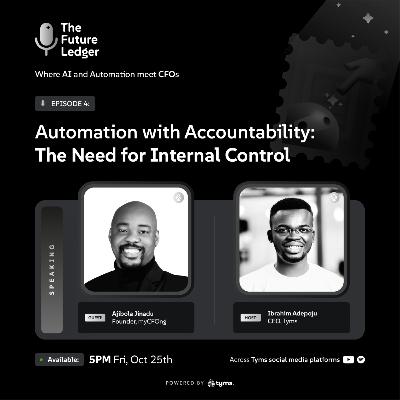
In this episode of The Future Ledger, Ibrahim Adepoju and Ajibola Jinadu discuss the critical relationship between automation and accountability in business processes.
They emphasize the necessity of strong internal controls before implementing automation, sharing practical examples and insights on establishing effective workflows.
The conversation also covers the significance of audit trails in maintaining accountability and the role of software as a supportive tool rather than a solution in itself.
Takeaways
Automation won't solve your control problems.
Strengthen your processes before automation.
Identify your workflows to set up controls.
Audit trails help track accountability.
Software is an assistant, not a replacement.
Real-time data helps refine processes.
You need to know your business before automating.
Weak controls lead to accountability issues.
Automation and accountability go hand in hand.
Don't just jump on any software for automation.
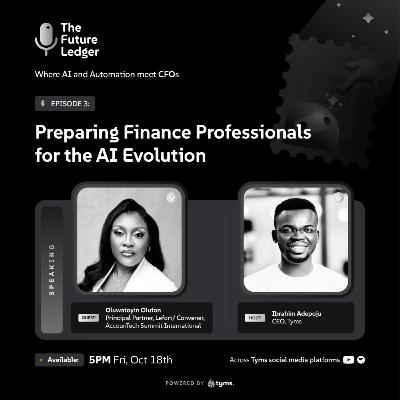
In this episode of The Future Ledger, Ibrahim Adepoju and Oluwatoyin Olufon discuss the essential skills finance professionals need to thrive in an AI-driven world.
They explore the impact of AI on job security, emphasizing that those who adapt will benefit, while those who resist change may face job loss.
The conversation also addresses data privacy and security concerns associated with AI adoption, and provides a step-by-step guide for organizations looking to implement AI solutions effectively.
Takeaways
AI is here to stay and transforming finance.
Data analytics is essential for finance professionals.
Understanding AI and its workings is crucial.
AI will not take jobs but will change them.
Professionals must adapt to remain relevant.
Data privacy and security are paramount in AI.
AI can enhance productivity significantly.
Implementing AI should be done strategically.
Choosing the right AI solution is critical.
Continuous learning and upskilling are necessary.
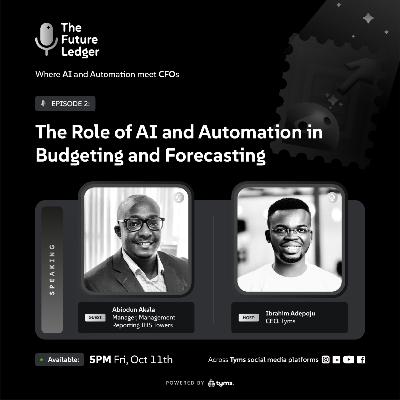
In this episode of "The Future Ledger" Podcast, Ibrahim Adepoju and guest Abiodun Akala discuss the critical role of AI and automation in budgeting and forecasting.
They explore the definitions and importance of budgeting and forecasting for businesses of all sizes, the challenges associated with manual budgeting processes, and the significant benefits of automating these processes.
The conversation also touches on the potential of generative AI to enhance financial analysis and decision-making, emphasizing the need for organizations to adapt to these technological advancements to improve efficiency and accuracy in their financial strategies.
Takeaways
Budgeting is essential for business survival and growth.
Forecasting helps organizations align their financial goals with their strategic vision.
Manual budgeting is often tedious, time-consuming, and error-prone.
Automation can streamline budgeting processes and improve accuracy.
AI can provide real-time insights and enhance decision-making capabilities.
Generative AI can analyze trends and predict financial outcomes.
Organizations should leverage technology to improve budgeting efficiency.
The budgeting season is a critical time for financial planning.
Effective budgeting requires collaboration across departments.
AI and automation are transforming the future of finance.
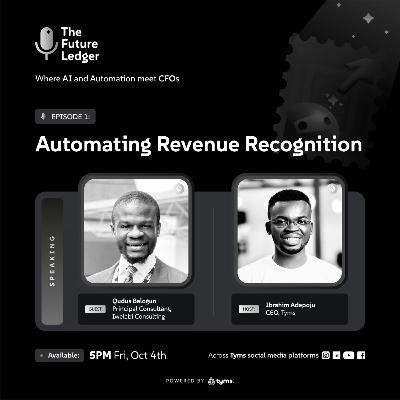
In this episode of the Future Ledger podcast, Ibrahim Adepoju and Qudus Balogun discuss the critical topic of revenue recognition and the role of automation in accounting.
They explore various methods of recognizing revenue, the complexities involved in different industries, and how automation can streamline accounting processes.
The conversation emphasizes the importance of understanding performance obligations and contract liabilities, as well as the future integration of AI in accounting practices.
Takeaways
Revenue recognition is essential for business decisions.
Understanding IFRS 15 is crucial for accurate revenue recognition.
Performance obligations must be clearly defined.
Automation reduces human error in accounting processes.
Contract liability is important for recognizing revenue.
Different industries have unique revenue recognition challenges.
AI can enhance efficiency in accounting tasks.
Investing time in learning automation pays off.
Documentation is key for accurate financial reporting.
Technology should be seen as a partner in accounting.
Comments


Download from Google Play

Download from App Store
 United States