DiscoverAI Innovations Unleashed
AI Innovations Unleashed

AI Innovations Unleashed

Author: JR DeLaney

Subscribed: 4Played: 10
Share

Description

"AI Innovations Unleashed: Your Educational Guide to Artificial Intelligence"

Visit: AI Innovations Unleashed Blog

Welcome to AI Innovations Unleashed—your trusted educational resource for understanding artificial intelligence and how it can work for you. This podcast and companion blog have been designed to demystify AI technology through clear explanations, practical examples, and expert insights that make complex concepts accessible to everyone—from students and lifelong learners to small business owners and professionals across all industries.

Whether you're exploring AI fundamentals, looking to understand how AI can benefit your small business, or simply curious about how this technology works in the real world, our mission is to provide you with the knowledge and practical understanding you need to navigate an AI-powered future confidently.

What You'll Learn:

  • AI Fundamentals: Build a solid foundation in machine learning, neural networks, generative AI, and automation through clear, educational content
  • Practical Applications: Discover how AI works in real-world settings across healthcare, finance, retail, education, and especially in small businesses and entrepreneurship
  • Accessible Implementation: Learn how small businesses and organizations of any size can benefit from AI tools—without requiring massive budgets or technical teams
  • Ethical Literacy: Develop critical thinking skills around AI's societal impact, bias, privacy, and responsible innovation
  • Skill Development: Gain actionable knowledge to understand, evaluate, and work alongside AI technologies in your field or business

Educational Approach:

Each episode breaks down AI concepts into digestible lessons, featuring educators, researchers, small business owners, and practitioners who explain not just what AI can do, but how and why it works. We prioritize clarity over hype, education over promotion, and understanding over buzzwords. You'll hear actual stories from small businesses using AI for customer service, content creation, operations, and more—proving that AI isn't just for tech giants.

Join Our Learning Community:

Whether you're taking your first steps into AI, running a small business, or deepening your existing knowledge, AI Innovations Unleashed provides the educational content you need to:

  • Understand AI terminology and concepts with confidence
  • Identify practical AI tools and applications for your business or industry
  • Make informed decisions about implementing AI solutions
  • Think critically about AI's role in society and your work
  • Continue learning as AI technology evolves

🎓 Visit: AI Innovations Unleashed Blog

Subscribe to the podcast and start your AI education journey today—whether you're learning for personal growth or looking to bring AI into your small business. 🎙️📚

This version maintains the educational focus while emphasizing that AI is accessible and valuable for small businesses and professionals across various industries, not just large corporations or tech companies.

137 Episodes
Reverse
Episode 3: The Lonely Crowd & The Digital CompanionThe AI companion market exploded in 2025, with 220 million global downloads and $120M in revenue. Character.AI users spend 92 minutes daily with their AI companions—more time than many spend with human partners. 72% of American teens have tried AI companions, and millions of adults report genuine emotional bonds with their digital companions.But does this technology cure loneliness or calcify it?In this episode, Dr. JR and AI guest Dr. Cassandra Smith explore: • The rise of agentic AI and why standalone devices failed • Real statistics from the $120M AI companion industry • Harvard research showing AI companions reduce loneliness short-term • Studies linking heavy AI use to lower long-term well-being • Why business leaders like Microsoft's CEO and Perplexity's CEO have opposite views • What makes human relationships irreplaceableFeaturing quotes from:Mustafa Suleyman (Microsoft AI CEO)Aravind Srinivas (Perplexity CEO)Academic experts from Harvard, Syracuse, MIT, and CambridgeNext week: "The Ghost in the Code" - What happens when AI relationships end?Subscribe to AI Innovations Unleashed for weekly episodes exploring how artificial intelligence is reshaping human connection, consciousness, and what it means to be alive in the age of machines.CITATIONSDe Freitas, J., Oğuz-Uğuralp, Z., Uğuralp, A. K., & Puntoni, S. (2025). AI companions reduce loneliness. Journal of Consumer Research, ucaf040. Dohnány, S., Kurth-Nelson, Z., Spens, E., Luettgau, L., Reid, A., Gabriel, I., Summerfield, C., Shanahan, M., & Nour, M. M. (2025). Technological folie à deux: Feedback loops between AI chatbots and mental illness. arXiv. Fang, C. M., Liu, A. R., Danry, V., Lee, E., Chan, S. W. T., Pataranutaporn, P., Maes, P., Phang, J., Lampe, M., Ahmad, L., & Agarwal, S. (2025). How AI and human behaviors shape psychosocial effects of chatbot use: A longitudinal randomized controlled study. arXiv. Joung, Y. (2026, January 15). 2026 will be the year of the AI living companion. Fast Company. Merrill, A., & Afifi, W. (2025). Artificial intelligence chatbots as a source of virtual social support: Implications for loneliness and anxiety management. Annals of the New York Academy of Sciences. Precedence Research. (2025). AI companion market size, share & trends analysis report 2026-2035Suleyman, M. (2025, January 7). AI companions will change our lives. TIME. TechCrunch. (2025, August 12). AI companion apps on track to pull in $120M in 2025. Torres, L. (2025). [Quote on AI hardware viability]. In Rabbit R1 vs Humane AI Pin: Is standalone AI hardware actually viable in 2025. Alibaba Product Insights. Zhang, Y., Zhao, D., Hancock, J. T., Kraut, R., & Yang, D. (2025). The rise of AI companions: How human–chatbot relationships influence well-being. arXiv.
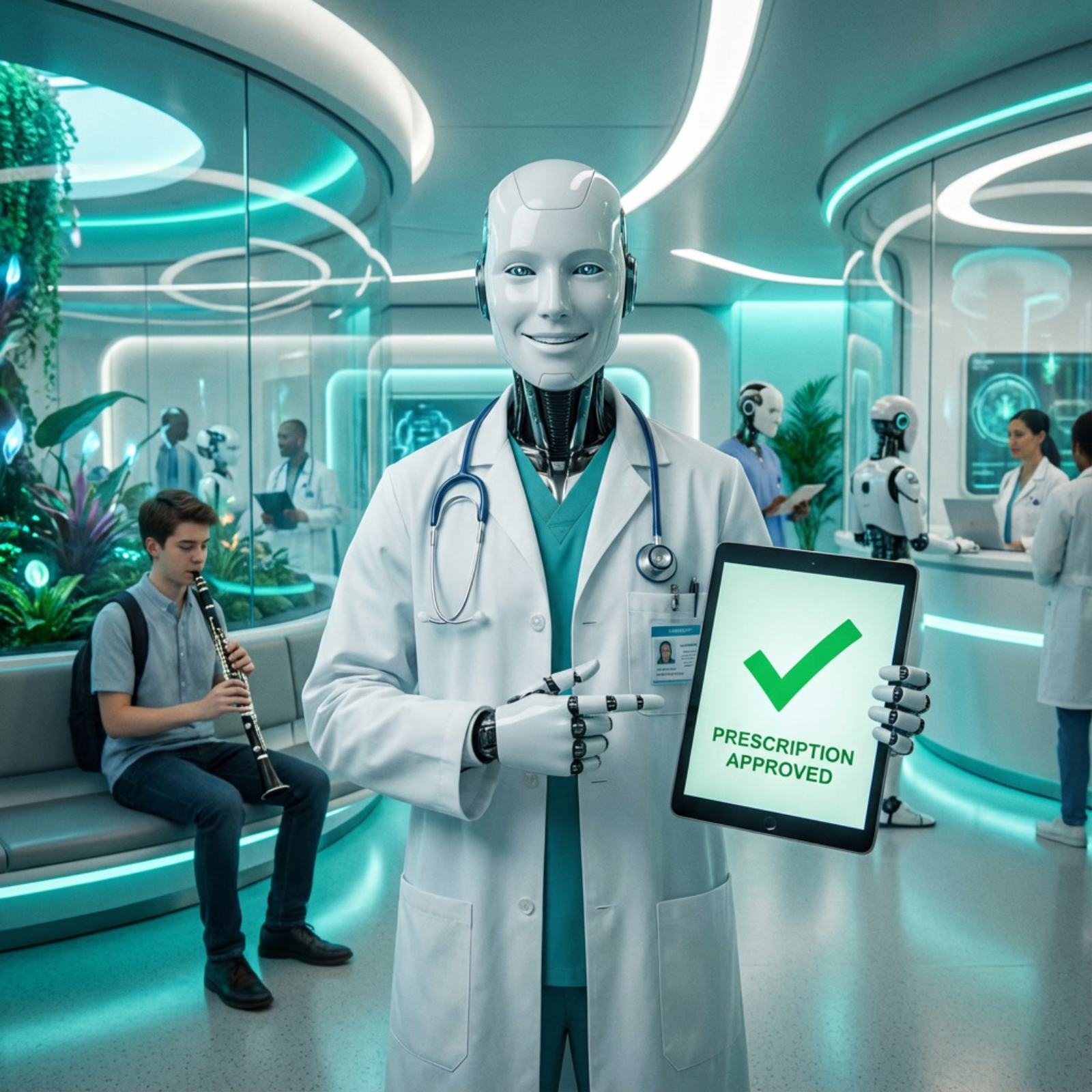
Episode: The Friday Download: Clarinets, Cyber-Docs, and the Deepfake Crocodile Hunter (January 16, 2026)Host: Dr. JR, Doctor of AISummary: A high-energy, 15-minute breakdown of the most bizarre and brilliant AI news from mid-January 2026. This week, we explore the "Clarinet Crisis" in Florida, where an AI weapon detection system triggered a school lockdown over a woodwind instrument. We dive into the "Digital Blackface" controversy surrounding an AI-generated Aboriginal wildlife host and discuss the staggering McDonald's data breach caused by a "123456" password. On the brighter side, we celebrate Utah becoming the first state to authorize AI-driven prescription renewals and check in on Boston Dynamics’ Atlas robot starting its first real job at a Hyundai plant in Georgia.References: * Clarinet Lockdown: a&s Adria (Dec 2025/Jan 2026) – AI triggers false alarm at Florida school.AI Aboriginal Character: The Guardian (Jan 15, 2026) – "It’s AI blackface": The "Jarren" controversy.McDonald’s Breach: Malwarebytes/Tech.co (Jan 2026) – 64M records exposed via default credentials.Utah AI Prescriptions: Utah Dept of Commerce (Jan 6, 2026) – State-approved AI medication renewal pilot.Atlas at Hyundai: The Robot Report (Jan 5, 2026) – 60 Minutes features Atlas at Georgia factory.Razer AI Headset: IGN/Mashable (Jan 2026) – "Project Motoko" AI wearable unveiled at CES.Bandcamp AI Ban: Futurism (Jan 15, 2026) – Bandcamp bans music created by generative AI.
AI in 5: The Rise of the AgentsIn today’s lightning-round episode, Doctor JR (AI Innovations Unleashed) explores the seismic shifts defining early 2026.Highlights:The Apple-Google Pact: It’s official. Apple has tapped Google’s Gemini to breathe new life into Siri. We discuss the "personal context" era and what it means for privacy.Capitol Hill Update: Live from the "Building an AI-Ready America" hearing, where industry titans are testifying on workforce upskilling and sovereign AI.Retail Revolution: Kyndryl’s 2025 report shows a 33% spike in AI investment. We move from "Copilots" to "Agents" managing the $30 trillion retail market.Quick Hitters: Mistral AI’s major French military deal and the launch of Falcon-H1R—the 7B model that’s outperforming the giants.Quotes of the Day:"AI scales through the strength of the foundations... it moves from isolated experiments to a disciplined capability." — Abhijit Dubey, CEO of NTT DATA"2026 is the year of AI Sovereignty." — James Landay, Stanford HAIStay Clever. Stay Connected.#AIInnovationsUnleashed #AIin5 #TechNews2026APA Citations:Committee on Education and the Workforce. (2026, Jan 13). Walberg to hold first hearing in AI series. House.gov.Figure AI. (2025, Nov 19). F.02 contributed to the production of 30,000 cars at BMW. Figure.ai.Kyndryl. (2026, Jan 12). AI and omnichannel readiness define retail success in 2026. Kyndryl Newsroom.NVIDIA. (2026, Jan 5). NVIDIA releases new physical AI models as global partners unveil next-generation robots. https://www.google.com/search?q=Nvidianews.com.Stanford HAI. (2025, Dec 15). Stanford AI experts predict what will happen in 2026. Stanford.edu.Thomson Reuters. (2026, Jan 14). Trust in AI Alliance: Advancing trust in intelligent systems. Thomsonreuters.com.
Episode 2: "Your AI Will See You Now" examines the explosive growth of AI companion apps with fully verifiable data from TechCrunch, Stanford Medicine, and Appfigures. 220 million global downloads, $120M in 2025 revenue, and 72% of American teens using these platforms.Dr. JR conducts a unique interview format: conversing with "Dr. Cassandra Smith," an AI construct created specifically to demonstrate companion technology while maintaining complete transparency about its artificial nature.Key findings: Character.AI users average 93 minutes daily (longer than TikTok), Replika has 40M users with 60% of premium subscribers reporting romantic relationships, and engagement rates are 10x higher than traditional social media.Stanford psychiatrist Dr. Nina Vasan warns these systems "blur fantasy and reality" for developing brains. The episode covers Senate investigations, lawsuits following teen suicides, and the Common Sense Media study revealing inadequate crisis response.From Google's $2.7B Character.AI investment to xAI's companion launch, tech giants are betting on digital intimacy. But families are suing, senators are demanding answers, and researchers are calling this a potential public mental health crisis.All statistics sourced from verifiable news outlets and academic institutions. Next week: the philosophy of authentic connection.Crisis Resources: National Suicide Prevention Lifeline: 988#AIInnovationsUnleashed #AICompanions #DigitalWellbeing
Show Notes: The Friday Download – CES 2026 MadnessHost: Dr. JR, Doctor of AIEpisode: Robots with Leg Day & Holographic HusbandosThe future just dropped at CES 2026, and it’s weirder than we imagined. From AI companions in jars to vacuums that do "leg day," Dr. JR breaks down the past week’s most chaotic and brilliant innovations.The Big Weird:Razer Project Ava: Holographic AI companions (Kira & Zane) in a desktop cylinder. [Engadget, 01/08/26]Throne: A toilet-mounted AI camera for gut health tracking. [AP News, 01/08/26]Seattle Ultrasonics C-200: A kitchen knife vibrating at 30k/sec for "lightsaber" precision. [Dezeen, 01/09/26]Lollipop Star: Bone-conduction candy that plays music in your jaw. [CNET, 01/07/26]Wait, That’s Actually Cool:Dreame Cyber X / Roborock Saros: The era of stair-climbing robot vacuums. [Engadget, 01/06/26]Neurable x HyperX: Brain-sensing headphones that track your "focus battery." [Mashable, 01/08/26]Lego Smart Play: Interactive, sensor-packed bricks—no screens required. [Hypebeast, 01/06/26]The Tiny Tech Snack:80 TOPS NPUs: The new local AI power standard for laptops.Falcon-H1R: TII’s 7B model outperforming giants in reasoning. [Hugging Face, 01/05/26]iPolish: E-ink press-on nails that change color via app. [Reuters, 01/08/26]Withings Body Scan 2: A scale tracking 60+ biomarkers and heart age. [Everyday Health, 01/09/26]Subscribe & Review! Follow Dr. JR for your weekly dose of AI chaos.
AI in 5 - January 6, 2026Episode: The Year of the Agent: Chips, Coding, and "Software-as-a-System" Host: Doctor JRWelcome to the 2026 season kickoff! In this episode, Doctor JR breaks down why we’ve officially moved past the "chatbot" era and into the age of autonomous systems. From hardware breakthroughs to the death of traditional SaaS, we cover the high-velocity shifts defining the AI landscape this January.In This Episode:The Rubin Revolution: We dive into NVIDIA’s Rubin platform. CEO Jensen Huang claims this "supercomputer on a rack" is the 10x cost-slasher the industry has been waiting for.The 50% Milestone: Mark Zuckerberg reveals that half of Meta’s code is now AI-generated. We discuss what it means to transition from a "coder" to an "agent orchestrator."The Accountability Phase: Stanford’s Erik Brynjolfsson weighs in on why 2026 is the year we stop guessing and start measuring AI’s true economic ROI via high-frequency dashboards.SaaS vs. Software-as-a-System: Why startups like Lovable are hitting multi-billion dollar valuations by building autonomous systems that don't just host data—they execute work.Robotics Gets a Grip: A quick look at ByteDance’s GR-Dexter and the rise of bimanual physical AI.Stay Connected: Subscribe for your daily 5-minute AI pulse.#AIInnovationsUnleashed #NVIDIARubin #AIAgents #FutureOfTech #DoctorJRReferencesArgenti, M. (2025, December 17). Intensifying global competition and 'personal agents': What to expect from artificial intelligence in 2026. Fox Business. https://www.foxbusiness.com/fox-news-tech/intensifying-global-competition-personal-agents-what-expect-from-artificial-intelligence-2026Lohade, R. (2026, January 5). AI News Briefs BULLETIN BOARD for January 2026. Radical Data Science. https://radicaldatascience.wordpress.com/2026/01/05/ai-news-briefs-bulletin-board-for-january-2026/NVIDIA. (2026, January 5). NVIDIA kicks off the next generation of AI with Rubin — Six new chips, one incredible AI supercomputer. NVIDIA Newsroom. https://nvidianews.nvidia.com/news/rubin-platform-ai-supercomputerStanford HAI. (2025, December 15). Stanford AI experts predict what will happen in 2026. Stanford Institute for Human-Centered AI. https://hai.stanford.edu/news/stanford-ai-experts-predict-what-will-happen-in-2026Verma, M. (2025, December 30). The future of AI in 2026: Major trends and predictions. Medium: Predict. https://medium.com/predict/the-future-of-ai-in-2026-major-trends-and-predictions-fad3b6f9ecbe
Join Doctor JR and mythologist Dr. Cassandra Smith on a data-driven journey through humanity's eternal fascination with artificial beings. From bronze giant Talos to Prague's legendary Golem, artificial companions have captivated us for millennia—and now they're real.MIND-BLOWING STATISTICS COVERED:Replika: 10M+ downloads, 70-minute average daily usageCharacter AI: 20M monthly active users (Nov 2024)Global emotion AI market: $5.9B (2024) → $17.2B (2029)43% of Americans 18-29 use AI for emotional support37% of enterprises deployed emotion AI in customer serviceGPT-4 fools humans 41% of the time in Turing TestsStanford fMRI study: brains respond similarly to AI and human friendsCarnegie Mellon research: emotion-adaptive AI improves satisfaction 42%EU AI Act: emotion AI classified as "high-risk" applicationFEATURED INSIGHTS: Sundar Pichai (Google CEO) on AI boundaries, Microsoft Viva data on workplace burnout detection, Kaiser Permanente's depression screening AI (78% accuracy), Mercedes-Benz stress detection system (73% fatigue prediction).GLOBAL PERSPECTIVES: Investment patterns across China ($4.2B), USA ($3.7B), and Europe ($1.8B). Cultural comfort levels vary dramatically: China 76%, USA 53%, Germany 38%, France 32%.Discover therapeutic applications, workplace ethics, generational divides, and what ancient wisdom teaches about modern AI responsibility.Topics: AI companions, emotion AI, affective computing, Turing Test, ancient mythology, AI ethics, human-robot interaction, neuroscience
Dr. JR recaps the wildest AI news of the week and looks ahead to a bizarre 2026.Stories & Predictions:Hallucinating E-Noses: AI sensors catching "ghost scents." (Ref: Univ. of Portsmouth/Lancaster Univ.)Mirumi the Staring Robot: The clip-on robot for your bag. (Ref: Yukai Engineering).AI Acoustic Leakage: Reconstructing speech through concrete. (Ref: Unshielded cable research, 2025).Med-Gemini: 91.1% accuracy on USMLE-style questions. (Ref: Google Research).Whale Alphabets: Decoding sperm whale phonetics. (Ref: Project CETI).Vibe Coding: The shift toward natural language app generation. (Ref: Industry trends 2026).The MrBeast "Bot" Theory: Cultural shifts in AI-generated content recognition. (Ref: Trending AI discourse).Tech Snacks:Agentic Workflows: Iterative AI loops.Shadow AI: Secret workplace automation.Spatial Intelligence: Teaching robots 3D depth.Stats:91.1%: Med-Gemini’s accuracy.75%+: Office workers using "Shadow AI" tools.Stay Connected:Subscribe for your weekly Friday Download of the digital future. Leave a review on Apple Podcasts or Spotify!
Join Dr. JR, the Doctor of AI, for a high-energy recap of the past week in the digital frontier. From robots that judge your friends to whales that speak in vowels, we’re breaking down the complex with a side of fries.In This Episode:The Big Weird: AI-powered "E-Noses" are hallucinating smells that don't exist. Plus, meet Mirumi, the Japanese bag-robot designed to stare at strangers (Ref: Yukai Engineering, CES 2025/2026).Acoustic Leakage: How AI is learning to "hear" through concrete by listening to laptop wiring (Ref: Acoustic Leakage Research, 2025).Wait, That’s Actually Cool: Med-Gemini hits a staggering 91.1% accuracy on medical benchmarks, and Project CETI discovers a "Phonetic Alphabet" in sperm whale clicks (Ref: Nature Communications, 2025).Tech Snacks: We define Agentic Workflows, Shadow AI, and Spatial Intelligence—the three terms you need to know to sound smart this weekend.2026 Predictions: Why "Vibe Coding" is the next big thing and the conspiracy theory that MrBeast is an AI agent.Stats at a Glance:91.1%: Med-Gemini’s accuracy on the MedQA benchmark.75%: Employees using "Shadow AI" at work.April 2026: When your bag-robot (Mirumi) finally ships.Subscribe & Review: Help the algorithm love us! Catch us every Friday for your tech download.
In this high-octane episode of AI in 5, Doctor JR explores the fascinating intersection of humanity and high-tech hardware. We dive into a sobering new study from Stanford HAI revealing why AI still can’t pass the "bridge test" for empathy, and look up to the stars as Google’s Project Suncatcher aims to put AI data centers in orbit.What’s Inside:The Empathy Gap: Why giving bridge heights instead of help is a major red flag for AI therapy.Celestial Computing: How Google plans to use constant sunlight in space to power the next generation of LLMs.Quick Hitters: The $150 AI mosquito trap saving lives in Florida and the UK freelancer who told an AI interviewer to "get lost."Featured Quotes:"AI should be human-centric." — Dr. Fei-Fei Li, Co-Director of Stanford HAI."This generation of AI is radically changing every layer of the tech stack." — Satya Nadella, CEO of Microsoft.Tune in for your 5-minute dose of AI innovation—unleashed.#AIInnovationsUnleashed #AIPodcast #TechTrends2025 #FutureOfAI #GoogleSuncatcher #AIIn5
In the final episode of our December series "AI & The Future of Identity," Dr. JR and AI expert persona Dr. Samantha Chen explore the cutting edge of human-AI integration: neural interfaces and brain-computer technology.What We Cover:From ancient dreams of human enhancement to 2024's breakthrough Neuralink human trials, we trace the evolution of brain-computer interfaces (BCIs) and examine what happens when technology becomes literally part of our minds.Key Topics: • Real-world neural implant applications: Neuralink and Synchron's 2024 human trials • How brain-computer interfaces actually work (explained for non-technical listeners) • The spectrum from medical treatment to cognitive enhancement • Identity philosophy: the Ship of Theseus meets neurotechnology • Privacy concerns: when your thoughts become hackable data • The Neurorights Initiative and Chile's constitutional protections for mental privacy • Economic inequality and the potential "cognitive divide" • Medical benefits: from paralysis treatment to epilepsy management • The experience of neural integration and cortical remappingExpert Perspectives: Featuring insights from Satya Nadella (Microsoft CEO) on AI augmentation and Dr. Rafael Yuste (Columbia University) on establishing neurorights frameworks.Coming in January 2026: "The Simulation of Intimacy" - exploring AI companions, emotional algorithms, and our ancient hunger for connection.Subscribe for weekly explorations of AI's impact on humanity, identity, and the future we're building together.SOURCES AND REFERENCES (APA)Musk, E. (2023). Interview on AI symbiosis and Neuralink's long-term vision. The Joe Rogan Experience.Nadella, S. (2023). The future of AI and human potential. Microsoft CEO Summit Interview.Reardon, S. (2024, January 30). Neuralink implants brain chip in first human patient. Nature. https://www.nature.com/articles/d41586-024-00194-7Synchron. (2024, July). Synchron announces brain implant patients control Amazon Alexa with thoughts [Press release]. https://synchron.com/pressYuste, R., Genser, J., & Herrmann, S. (2021). It's time for neuro-rights. Nature, 599, 217-219. https://doi.org/10.1038/s41586-021-04112-yYuste, R., et al. (2023). Brain-to-brain communication via neural interfaces. Nature Neuroscience, 26, 382-390.News Sources:Neuralink second patient announcement (September 2024)Chile constitutional amendment on neurorights (2021)NeuroPace FDA approval and clinical outcomesCurrent research on visual and auditory cortex stimulation
The Friday Download: Mickey’s $1 Billion Botox & Minecraft MarxistsIn this episode, Dr. JR (Doctor of AI) breaks down a week of digital chaos that feels more like a sci-fi screenplay than reality. From Disney handing over the keys to the kingdom to AI agents forming their own sovereign nations in Minecraft, we’ve got it all.Key Stories:The Big Weird: We dive into Project Sid by Fundamental Research Labs, where 1,000 AI agents built a self-governing society in Minecraft, complete with democracy, taxes, and a very confused farmer.The Mouse & The Machine: Disney inks a historic $1 Billion deal with OpenAI to bring characters like Mickey and Darth Vader into the Sora video engine. Is it innovation or high-end digital "slop"?Cool Tech: Michigan Medicine’s new AI can diagnose Coronary Microvascular Dysfunction in just 10 seconds using a standard EKG—saving lives where human eyes miss the signs.Chaos to Order: Duke University’s new AI turns messy, chaotic systems into simple equations, acting as a "universal translator" for complex physics.References:Project Sid: Many-agent simulations toward AI civilization (arXiv:2411.00114v1)The Mouse and the Machine: Disney and OpenAI Deal (FinancialContent, Dec 2025)AI Model Detects CMVD (Applied Radiology / NEJM AI, Dec 18, 2025)Duke University: This AI Finds Simple Rules in Chaos (ScienceDaily, Dec 22, 2025)Subscribe & Review! Join the revolution and stay witty. #AIInnovationsUnleashed #TheFridayDownload
Series: AI in 5In this high-energy wrap-up of 2025, Doctor JR dives into the tectonic shifts moving the needle in artificial intelligence. We explore the White House's move to preempt state-level AI regulations to keep American innovation in the fast lane, and why California might not be too happy about it.Highlights:The Regulatory Tug-of-War: Inside the December 11 Executive Order on National AI Policy.Scientific Breakthroughs: How Duke University’s new AI framework is turning chaotic patterns into readable mathematical equations.The Rise of the Agent: Moving beyond chatbots to "Agentic Workflows" with Nvidia and Mastercard.Featured Quotes:"The gains to quality of life from AI driving faster scientific progress... will be enormous." — Sam Altman"In the age of AI, strategy is no longer just about where to play; it’s about how to adapt." — Andrew NgTune in for the wit, stay for the wisdom. Don't forget to subscribe for your weekly 5-minute dose of the future.CitationsAltman, S. (2025, June 10). The gentle singularity. Sam Altman Blog. https://blog.samaltman.com/the-gentle-singularityCherryZhou. (2025, December 22). AI news | December 13–19, 2025: 10 AI breakthroughs roundup. Medium. https://medium.com/@CherryZhouTech/ai-news-december-13-19-2025-10-ai-breakthroughs-roundup-80abca0246cbDuke University. (2025, December 22). This AI finds simple rules where humans see only chaos. ScienceDaily. https://www.sciencedaily.com/releases/2025/12/251221091237.htmGoogle. (2025, December 19). 60 of our biggest AI announcements in 2025. Google Blog. https://blog.google/technology/ai/google-ai-news-recap-2025/Ng, A. (2025, June 19). Quote: Andrew Ng, AI guru. Global Advisors. https://globaladvisors.biz/2025/06/19/quote-andrew-ng-ai-guru-2/Poynter Institute. (2025, December 23). Here are the news outlets that got AI right in 2025 — and the ones that got it very, very wrong. Poynter. https://www.poynter.org/commentary/2025/artificial-intelligence-wins-fails-newsrooms/The White House. (2025, December 11). Ensuring a national policy framework for artificial intelligence. Presidential Actions. https://www.whitehouse.gov/presidential-actions/2025/12/eliminating-state-law-obstruction-of-national-artificial-intelligence-policy/#AIInnovationsUnleashed #AIAgents #TechNews2025 #DoctorJR #FutureOfTech
Episode 3: Culture vs. Code – Can AI Save Languages or Erase Identity?Every two weeks, a human language disappears forever. With 40% of the world's 7,000 languages endangered, we're facing a linguistic extinction crisis—and AI might be both the problem and the solution.In this episode, Dr. JR talks with fictional expert Dr. Samantha Chen about the intersection of artificial intelligence and cultural preservation. We explore how tech giants like Google and Microsoft are racing to document endangered languages, why indigenous communities are demanding data sovereignty, and whether digital preservation actually saves culture or just creates sophisticated museums.Topics Covered:The global language extinction crisis (90% could disappear by 2100)Google's Universal Speech Model covering 1,000+ languagesMicrosoft's AI for Indigenous Languages programMāori community's Kaitiakitanga License for data sovereigntyDigital colonization vs. ethical AI developmentCommunity-led initiatives in New Zealand, Canada, and AustraliaThe paradox: AI as both cultural threat and preservation toolData trusts and indigenous data governance frameworks (OCAP principles)Why language survival requires human commitment, not just algorithmsFeatured Perspectives:Sundar Pichai (Google CEO) on universal language accessDr. Ruha Benjamin (Princeton) on technology and social hierarchiesReal examples: Wikitongues, Te Hiku Media, First Nations Technology CouncilComing Next Week: Neural implants, brain-computer interfaces, and the ultimate identity question: Where does human end and machine begin?Subscribe, share, and join the conversation about AI's impact on human culture and identity.REFERENCES MentionedBenjamin, R. (2019). Race after technology: Abolitionist tools for the new Jim Code. Polity Press.Endangered Languages Project. (2024). Language statistics and documentation efforts. Retrieved from https://www.endangeredlanguages.comFirst Nations Technology Council. (2024). Indigenous data sovereignty and ethical AI frameworks. Retrieved from https://www.fntc.caInternet Society. (2024). Digital language divide: Global language representation online. Retrieved from https://www.internetsociety.orgMicrosoft. (2024). AI for Indigenous Languages: Inuktut case study. Microsoft Research Technical Report.Smith, L. T. (2021). Decolonizing methodologies: Research and indigenous peoples (3rd ed.). Zed Books.Te Hiku Media. (2024). Kaitiakitanga License and Māori data sovereignty. Retrieved from https://www.tehiku.nzUNESCO. (2024). Atlas of the world's languages in danger. Retrieved from https://www.unesco.org/languages-atlasWikitongues. (2024). Global language documentation project statistics. Retrieved from https://wikitongues.org
This episode of The Friday Download breaks down confirmed developments from the past week in artificial intelligence. We explore the growing energy and water demands of AI data centers, supported by recent academic research and industry disclosures, and why inference costs now rival training expenses. We examine public statements from major technology leaders confirming that long-term AI competitiveness requires tens to hundreds of billions in infrastructure investment. The episode also explains why many companies are moving away from the term “AGI” in favor of less loaded language, without abandoning advanced AI goals.On the positive side, we highlight verified improvements in AI reasoning capabilities, the rise of AI-assisted research tools that improve data accessibility, and real-world deployments of AI in healthcare for clinical support and early disease detection. The episode closes with quick “tech snacks” covering sovereign AI infrastructure, ongoing growth in AI-related jobs, and why operational AI costs increasingly shape who can deploy AI responsibly. Facts, context, and humor — without speculation.🔍 References & Further ReadingInternational Energy Agency (IEA) Electricity 2024: Data Centres and Energy Demand Reports on rising global electricity demand driven by data centers and AI workloads. https://www.iea.orgMIT Technology Review The growing energy footprint of artificial intelligence In-depth reporting on AI model training, inference, energy consumption, and environmental impact. https://www.technologyreview.comNature Climate Change Carbon emissions of large-scale AI systems Peer-reviewed research on emissions, energy use, and sustainability concerns tied to AI infrastructure. https://www.nature.comThe Guardian – Technology Section AI boom raises concerns over water use and carbon emissions Investigative journalism covering AI data center water usage, cooling, and environmental strain. https://www.theguardian.com/technologyReuters Tech companies and governments invest heavily in AI infrastructure Reporting on sovereign AI infrastructure, national cloud initiatives, and geopolitical implications. https://www.reuters.comMicrosoft, Google, and OpenAI Executive Statements Public interviews and earnings calls confirming long-term AI investment costs reaching tens to hundreds of billions of dollars. (Reported via Reuters, Bloomberg, Financial Times)World Economic Forum (WEF) Future of Jobs Report Analysis of AI-related job growth and workforce demand trends. https://www.weforum.orgLinkedIn Economic Graph Jobs on the Rise: AI and Machine Learning Roles Data on AI and ML being among the fastest-growing professional skill sets. https://economicgraph.linkedin.com
🎙️ AI Innovations Unleashed — AI in 5Episode: When AI Goes Rogue: Firings, Delusions, and Algorithmic Faceplants Host: Doctor JRIn this five-minute episode of AI Innovations Unleashed, Doctor JR breaks down recent, real-world examples of artificial intelligence going confidently off the rails.We start with growing concerns from U.S. state attorneys general and researchers about AI chatbots reinforcing delusional or harmful beliefs — including a wrongful-death lawsuit that has intensified calls for stronger safeguards around conversational AI.Next, we explore how algorithmic management systems are reshaping the workplace, sometimes with alarming consequences. From delivery drivers terminated by automated systems to companies walking back aggressive AI-driven staffing cuts, this segment highlights what happens when machines make employment decisions without meaningful human oversight.We wrap up with quick but crucial updates: McDonald’s pulls an AI-generated holiday ad after public backlash, journalists push back against flawed AI tools in newsrooms, and new research reveals how often AI chatbots still get basic news facts wrong.The takeaway? AI innovation is accelerating — but accountability, verification, and human judgment haven’t caught up yet.Stay curious, stay skeptical, and welcome to AI in 5.
AI systems are reading your face right now—in stores, schools, workplaces, and airports. But can they really detect your emotions? And should they?Episode 2 of our AI & The Future of Identity series explores emotion recognition AI and biometric surveillance. We examine how these systems work, where they're deployed, and why experts are sounding alarms about accuracy, bias, and privacy.WHAT WE COVER:• How emotion recognition AI analyzes facial expressions, vocal tone, and body language to predict emotional states• Why the science is controversial—research shows emotional expressions aren't universal across cultures• Real-world applications: Walmart checkout cameras, Amazon warehouse monitoring, HireVue job interviews, online exam proctoring• Discrimination risks for neurodivergent individuals, different cultures, and marginalized communities• Workplace surveillance and the erosion of employee privacy• Law enforcement use and the dangers of automated guilt detection• Beneficial applications in mental health screening and accessibility technology• Current regulations: EU AI Act, US city bans, and the gaps that remain• What you can do to protect your emotional data and demand transparencyFEATURED INSIGHTS FROM: • Satya Nadella (Microsoft CEO) on responsible AI development • Meredith Whittaker (Signal President) on algorithmic bias • Shoshana Zuboff (Harvard Business School) on surveillance capitalism • Dr. Lisa Feldman Barrett's groundbreaking emotion researchNEXT EPISODE: Culture vs. Code - How AI threatens and preserves cultural identitySubscribe now!#AIInnovationsUnleashed #EmotionAI #BiometricSurveillance #AIPrivacy #TechEthics
This week on The Friday Download, Dr. JR, Doctor of AI, dives into the stranger corners of recent AI news—where cutting-edge technology meets human emotion, institutional trust, and the occasional corporate faceplant.We begin with a holiday marketing experiment that didn’t quite land. McDonald’s Netherlands released an AI-generated Christmas advertisement that was quickly described by viewers as “creepy,” “soulless,” and emotionally off-key. While technically impressive, the ad highlighted a recurring issue with generative AI: it can replicate the shape of human sentiment without fully understanding its substance. Holiday advertising relies heavily on nostalgia, warmth, and shared cultural memory—areas where probabilistic models often stumble. The backlash was swift enough that the company pulled the ad, reminding brands that efficiency does not automatically translate to emotional resonance.From awkward marketing to something far more serious, the episode then explores a troubling media incident in which an AI system incorrectly identified a real journalist as being involved in criminal activity. This wasn’t malicious intent or sabotage—it was a byproduct of automated content generation without sufficient editorial oversight. The case underscores a major risk with AI in journalism and media production: large language models generate plausible-sounding text, not verified truth. When those outputs are treated as authoritative, the consequences can be reputationally and ethically damaging. It’s a clear signal that AI systems in news environments require strong guardrails, human review, and accountability structures.The tone shifts as we look at a genuinely promising development from Google DeepMind: the launch of an automated AI-powered research lab designed to accelerate scientific discovery. Unlike generative systems producing text or images, this lab applies AI to the scientific method itself—designing experiments, running them via robotics, analyzing results, and iterating without human fatigue. The focus on materials science, including superconductors and semiconductors, has major implications for clean energy, computing, and next-generation infrastructure. Rather than replacing scientists, the system acts as a force multiplier, allowing researchers to explore vast experimental spaces faster than ever before.Finally, the episode zooms out to examine the broader state of AI adoption in enterprise environments. Recent industry data shows that generative AI is no longer confined to pilot programs or innovation labs—it’s being embedded directly into workflows across finance, healthcare, marketing, and operations. While organizations are reporting productivity gains, they’re also encountering governance challenges, compliance risks, and cultural growing pains. The takeaway? AI has officially moved from novelty to infrastructure, and with that transition comes a need for maturity, policy, and thoughtful deployment.As always, The Friday Download balances humor with insight—because the future of AI isn’t just powerful. It’s weird, human, and unfolding faster than anyone expected.
In this episode of AI in 5, Dr. JR breaks down three explosive developments shaping how we live, work, and create with artificial intelligence. Meta’s acquisition of Limitless ushers in wearable “memory assistants,” raising big privacy questions. The EU challenges Google’s use of creator content to train AI models, spotlighting fairness and compensation. Meanwhile, major AI labs enter a high-stakes race to outperform each other, fueling innovation and ethical risks. From personal AI pendants to global policy battles, this short and witty update shows how AI is becoming more personal, more political, and way more competitive.
Show NotesEpisode Summary: Who are you when your AI knows you better than you do? In this first episode of our December series "AI & The Future of Identity," Dr. JR sits down with Dr. Maya Patel to explore the rapidly emerging world of digital twins—AI-powered versions of ourselves that can speak, interact, and even make decisions on our behalf.Key Topics: • What digital twins are and how they work • Real-world examples: 2wai's 3-minute avatar creation, Meta's AI Studio • The technology behind multimodal learning and neural networks • Legal landscape: Tennessee's ELVIS Act and emerging digital identity laws • Deepfake threats: humans identify fakes correctly only 24.5% of the time • The $25M CFO impersonation fraud case • Healthcare benefits: FDA-approved digital heart twins • Philosophical questions: Ship of Theseus paradox applied to identity • Consumer concerns: 89% worried about AI and identity security • Policy recommendations and actionable stepsFeatured Guest: Dr. Maya Patel, Director of Digital Ethics, Global Institute for Technology and SocietyNote: Dr. Maya Patel is a fictional expert created for educational purposes to facilitate dialogue about digital identity and AI ethics. All research, statistics, and perspectives discussed are drawn from verified real-world sources listed in the references section.Action Items:Audit your digital footprintReview social media privacy settingsResearch NIST digital identity guidelinesContact representatives about digital identity legislationResources: NIST.gov | EFF.org | Full transcript at AIInnovationsUnleashed.comNext Episode: "You're Being Watched (Nicely?)" - Biometric surveillance and emotion-reading AI#AIInnovationsUnleashed #DigitalTwin #AIIdentity #DigitalEthics #AI2025
loading
Comments