


 Claim Ownership
Contrast and Clarity with the JACR
Subscribed: 1Played: 4
Subscribe

© Maddi Wulfeck
Description
Welcome to "Contrast & Clarity with the JACR," where we dive into the latest trends in the world of radiology. Join hosts Maddi Wulfeck and Jeff Waltz as they discuss current radiology topics and innovations that are shaping the future of healthcare. Topics will span the hottest trends in radiology such as artificial intelligence, expert perspectives, and what the future holds for the field.
Whether you're a seasoned radiologist, resident, medical student, or simply curious about the field, this podcast sets the stage for an exciting journey into the world of medical imaging.
Whether you're a seasoned radiologist, resident, medical student, or simply curious about the field, this podcast sets the stage for an exciting journey into the world of medical imaging.
37 Episodes
Reverse
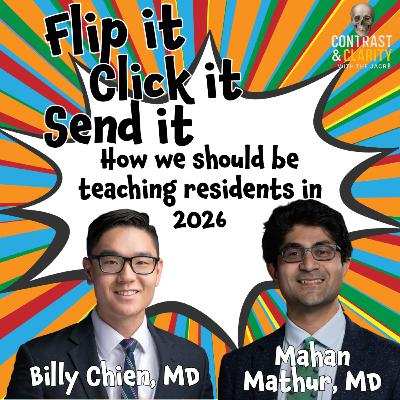
Are we training radiology residents for yesterday’s world?Because the traditional model of workstation teaching + didactic conferences? It may not be sustainable anymore.In this week's episode, Maddi and Jeff sit down with the authors of “Alternative Approaches to Resident Education” to unpack what the future of radiology training could — and maybe should — look like:· Social media as a legitimate educational tool· AI-powered feedback platforms and “precision education”· Peer learning models reshaping safety culture· Flipped classrooms and spaced-repetition learningBut this isn’t just about shiny new tools. It’s about economics. Opportunity cost. Faculty time. Educational ROI. And is there a smarter, more sustainable way to train the next generation? If we want better-trained radiologists in a high-volume, AI-augmented future...we may need to rethink how we teach – and what we are willing to invest. Because the real question isn’t whether education needs to evolve. It’s whether we’re willing to redesign it.Find the full JACR article here: https://shorturl.at/0ASDg
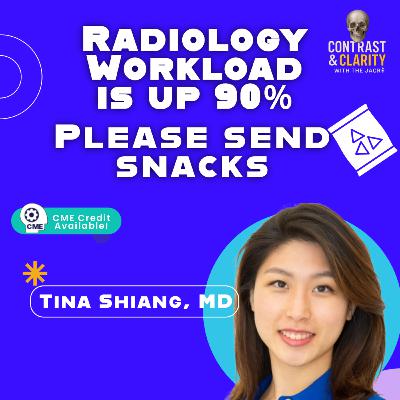
Imaging volumes are "down."Radiologist workload is "up."Length is stay is longer.Wait. What?In this episode of Contrast & Clarity with the JACR, Maddi and Jeff sat down with Tina Shiang, MD to unpack her recent analysis of inpatient imaging utilization and radiology workload over the past decade. Here is the twist: when imaging is adjusted for disease severity, overall inpatient imaging utilization actually decreased. But CT and MRI utilization rose sharply - and the professional workload tied to those studies skyrocketed. Translation? There may be fewer studies per patient overall - but we are reading far more complex studies. If you care about imaging value, radiologist well-being, operational strategy, or the future of hospital-based radiology - this conversation and the underlying data are essential. Because the real question isn't just how much imaging we are doing, it's what kind of imaging we are doing - and who is carrying the weight. Find the full JACR article here: https://www.jacr.org/article/S1546-1440(25)00278-9/abstractClaim your CME credit here: https://shorturl.at/m2OyY
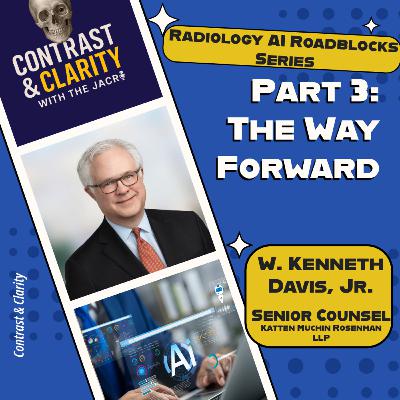
That “black box” AI algorithm your practice just bought might look sleek on a demo screen—but when something goes wrong, it won’t be the software company signing the report. It’ll be you. In this episode of Contrast & Clarity, Maddi and Jeff interview Ken Davis, Senior Counsel in Healthcare at Katten Law Firm, for a no-fluff conversation about the intersection of radiology, contract law, and the use of artificial intelligence. Together, we dive into the legal realities of AI implementation – and the due diligence that radiologists can’t afford to ignore. We explore questions like:· What kind of due diligence should practices perform before deploying AI?· How do clinical vs. nonclinical AI tools differ from a liability standpoint?· Why is it important to try to see beyond the black box nature of an algorithm?· What should new radiologists know about the AI their group uses? If your practice is using AI – or considering it – this episode is your legal reality check. Find the prior relevant JACR articles here:https://www.jacr.org/article/S1546-1440(25)00444-2/abstracthttps://www.jacr.org/article/S1546-1440(25)00438-7/abstractFind Ken Davis’ article “Top Ten Legal Considerations forUse and/or Development of Artificial Intelligence in Healthcare”: https://shorturl.at/0CrE5Find the additional article mentioned on patients’ views on the use of AI in healthcare: https://shorturl.at/iJ7ia
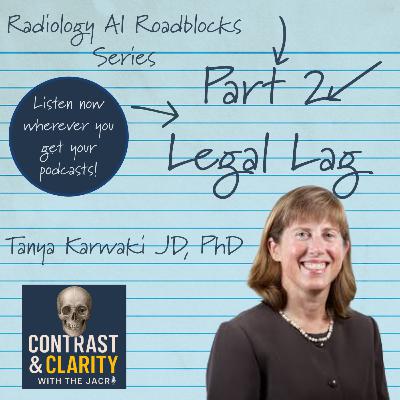
What happens when AI gets it wrong – and who’s actually on the hook? In this episode of Contrast & Clarity with the JACR, we sit down with Tanya E. Karwaki, JD, PhD, author of the JACR opinion piece “Balancing Artificial Intelligence Risks and Benefits in an Evolving Legal Environment,” to unpack one of the most uncomfortable – but unavoidable topics in radiology AI: legal risk. AI adoption in radiology is accelerating, with more than a thousand FDA-approved tools already in circulation. But the legal framework governing their use? Still very much under construction. Dr. Karwaki walks us through why increasing lawsuits may be inevitable, how malpractice standards evolve alongside new technologies, and what radiologists should understand about liability when AI recommendations are followed—or ignored.From informed consent and data privacy to emerging state-level legislation and disclosure requirements, this conversation provides critical context for anyone navigating AI implementation in clinical practice today.If you’re using AI, thinking about using AI, or wondering where the legal guardrails actually are—this is an episode you don’t want to miss.Find the JACR article here: https://www.jacr.org/article/S1546-1440(25)00438-7/abstract
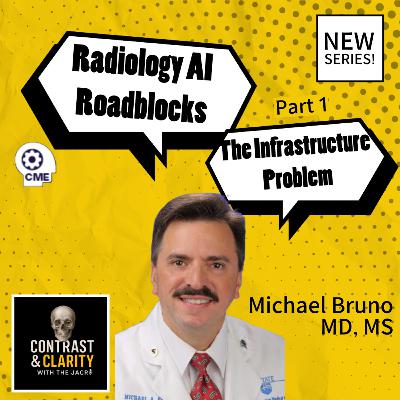
Artificial intelligence isn’t failing radiology. Our healthcareinfrastructure just isn’t ready for it. In this episode of Contrast & Clarity with the JACR, we cut through the hype to tackle the real reason artificial intelligence hasn’t transformed radiology yet—and it’s not because the algorithms aren’t good enough.Joined by Michael Bruno, MD, MS and drawing from insightshighlighted at the 2024 Intersociety Summer Conference, Maddi and Jeff unpack the systemic barriers holding AI back: legacy IT systems, fragmented data pipelines, regulatory uncertainty, and workflows that force humans and AI to coexist rather than collaborate. We discuss:• Why AI keeps getting treated as a “bolt-on” instead of afoundational tool• The mismatch between AI’s potential and real-world clinicalworkflows• Why ROI, governance, and trust—not accuracy—are stalling adoption• What actually needs to change for AI to move from demo todeployment This isn’t a conversation about shiny tools or futuristic promises.It’s about systems, incentives, and the uncomfortable reality that AI won’t fix radiology until we fix the environment it’s deployed into.If you’ve ever wondered why AI feels simultaneously inevitable and underwhelming—this episode is for you.Find the JACR article here: https://www.jacr.org/article/S1546-1440(25)00444-2/abstractClaim your CME credit here: https://shorturl.at/u6Hcj
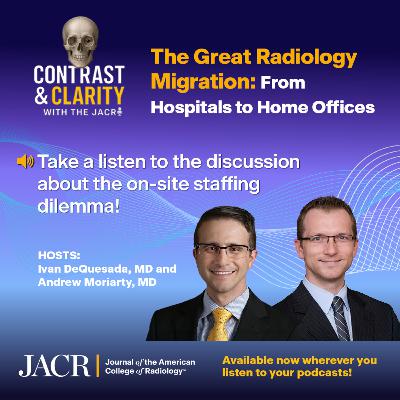
What happens when the dream of remote radiology becomes a nightmare for practice culture? Tune in as Maddi and Jeff are joined by Ivan DeQuesada, MD and Andrew Moriarty, MD to discuss onsite staffing concerns and the tensions between productivity, patient care, and the modern radiologist's desire for flexibility. From empathetic accountability to equitable hybrid scheduling and strategic work-from-home incentives, this discussion reveals why balancing autonomy and presence is crucial for private practice radiology. Find the JACR article here: https://shorturl.at/0J0gI
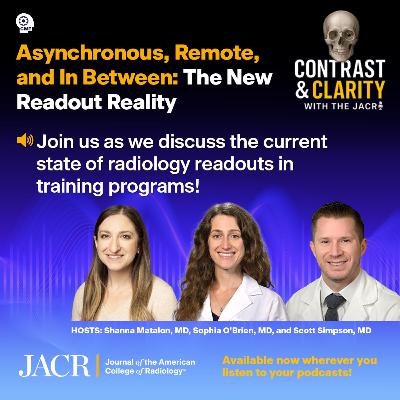
How has the traditional radiology resident readout evolved in the post-pandemic era?In this week's episode, Maddi and Jeff are joined by Shanna Matalon, MD, Sophia O'Brien, MD MSEd, and Scott Simpson, MD MSEd to talk about what trainees and faculty really think about side-by-side, remote, and asynchronous readouts, why feedback gaps persist, and how programs can improve the educational experience in hybrid environments. A must-listen for anyone involved in radiology training!Find the JACR article here: https://shorturl.at/NOjj2Claim your CME here: https://cortex.acr.org/Presenters/CaseScript/CaseView?Info=6U95sEWo3jaJM3JERvUep1s27mel6%2b%2bZUPcxFIuv1ms%253d
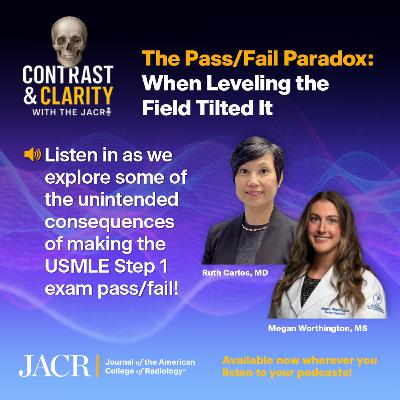
When USMLE Step 1 went pass/fail, the goal was to lower stress and level the playing field. Instead, it may have just moved the goalposts. In this week's episode, Ruth Carlos, MD, MS, FACR and Megan Worthington, MS join Maddi and Jeff to talk about how the change to pass/fail for the USMLE Step 1 examination has reshaped the residency match - especially for competitive specialties like radiology. Although the move to pass/fail was supposed to fix student stress, it instead shifted the spotlight (and pressure) to Step 2, school prestige, and the alphabet soup of rankings. Find the JACR article here: https://pubmed.ncbi.nlm.nih.gov/40541763/
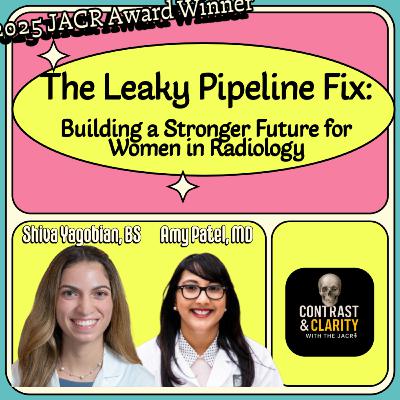
Women make up half of the medical school graduates, but only a quarter of radiology residents. In this episode, Maddi and Jeff are joined by Amy Patel, MD and Shiva Yagobian, BS to go beyond the statistics and explore the social, institutional, and policy-level barriers that shape the "leaky pipeline" from training to leadership. Whether you're a trainee wondering where all the women in leadership are - or a department leader looking to make real, sustainable change - this episode offers both the data and the direction to help close the gap. Find the JACR article here: https://pubmed.ncbi.nlm.nih.gov/40216284/
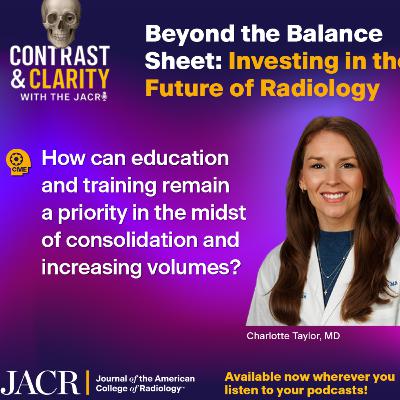
As health systems and radiology practices continue to consolidate, education often ends up as collateral damage. In this episode, Charlotte Taylor, MD joins Jeff and Maddi to discuss how radiology educators can adapt - and even thrive - when clinical demands and financial pressures are rising. From incentive scorecards and creative teaching models to intentional early resource allocation to enable tailored training, this conversation explores practical, scalable ways to preserve excellence in training the next generation of radiologists. Find the JACR article here: https://pubmed.ncbi.nlm.nih.gov/40543532/Claim your CME here: https://shorturl.at/LVxwh
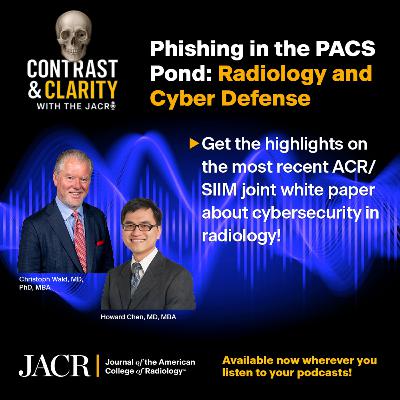
What happens when hackers meet PACS? Nothing good for patient care. Join us this week as Maddi and Jeff get insight from Po-Hao Chen, MD, MBA and Christoph Wald, MD, PhD, MBA on their brand-new ACR-SIIM white paper on radiology cybersecurity. We will explore ransomware, downtime drills, and the unglamorous but essential world of cyberhygiene. Read the full JACR manuscript: https://www.jacr.org/article/S1546-1440(25)00409-0/fulltextWant more cybersecurity resources? Visit: https://www.acr.org/Data-Science-and-Informatics/Informatics/cybersecurity-resources
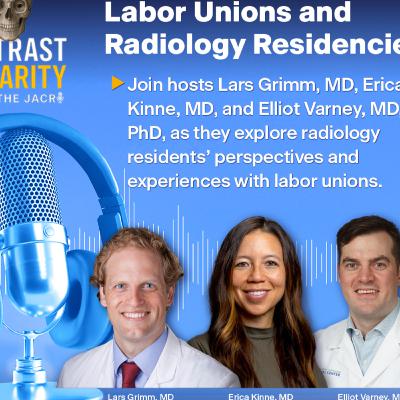
Do labor unions really change the residency experience - or just the perception of it? This week, Maddi and Jeff explore radiology residents' perspectives on labor union participation with Erica Kinne, MD, Elliot Varney, MD, PhD, and Lars Grimm, MD based on their most recent research. From vacation days and housing stipends to duty hours and wellness, radiology residents weighed in on both the perks and pitfalls of unionization. Find the original JACR article here: https://www.jacr.org/article/S1546-1440(25)00203-0/fulltext
How can multidisciplinary teams improve lung cancer screening? What are the primary barriers to lung cancer screening and how can they be addressed? In this week's episode, Maddi and Jeff catch up with Lauren Groner, DO, MS and Rishikesh Dalal, MD, MPH about their research that used behavioral and implementation science to better understand lung cancer screening barriers and develop a strategy to increase screening rates. Their team also developed LungCheck.org to help serve as a hub of information for both providers and patients! Claim your CME here: https://shorturl.at/6qr97Find the JACR original article here: https://www.jacr.org/article/S1546-1440(24)00999-2/fulltext
Are radiologists following the playbook on what to do next when there is an incidental adrenal nodule on a lung cancer screening CT? Maddi and Jeff interview Aparna Singh, MD about her new study that shows radiologists aren't exactly consistent in handling these unexpected findings - sometimes over-reacting, sometimes under-reacting, and often skipping an important lab test entirely. There is also a special guest appearance by Jared Christensen, MD, MBA and his expert insight on the S modifier. Find the JACR original article here: https://pubmed.ncbi.nlm.nih.gov/40044307/
Inappropriate medical imaging results in low-value, excess imaging - but what about the environmental impact?Maddi and Jeff sit down with Gregory Cavanagh, MD, Julia Schoen, MD, MS, and Elizabeth Rula, PhD to discuss how their study estimated excess green house gas emissions that are associated with inappropriate medical imaging in the Medicare Part B population from 2017 to 2021. Find the JACR article here: https://pubmed.ncbi.nlm.nih.gov/40152841/Get your CME here: https://cortex.acr.org/Presenters/CaseScript/CaseView?Info=RTWVsH3pWR4iYbD5FO37fw305omFBCsKOef8Wr0foV4%253d
The incidental finding of hepatic steatosis on imaging may present an avenue for opportunistic screening, leading to more efficient identification of metabolic dysfunction-associated steatotic liver disease (MASLD) and risk prediction for fibrosis. How can radiologists best facilitate this? In this episode, Maddi and Jeff sit down with Emily Schonfeld, MD and Andrea Siobhan Kierans, MD to discuss their recent review article about recommendations for when hepatic steatosis is found on imaging and subsequent noninvasive tests to help predict overall fibrosis staging. Find the JACR article here: https://pubmed.ncbi.nlm.nih.gov/40044315/
Have you ever wondered what additional screening measures could be implemented by utilizing information from routine CT scans? In this episode, Maddi and Jeff were joined by Soterios Gyftopoulos, MD, MBA, FACR and Casey Pelzl, MPH to discuss their research about how simple, opportunistic CT bone density screening could transform bone health and healthcare spending.Find the JACR article here: https://www.jacr.org/article/S1546-1440(24)00837-8/fulltext
The Merit-Based Incentive Payment System (MIPS) is the largest pay-for-performance program that links reimbursement to performance of Medicare clinicians. How have radiologists performed under this program and are there certain predictors of success? In this episode, Maddi and Jeff are joined by YoonKyung Chung, PhD and Lauren Nicola, MD to discuss their findings about radiologists' performance under the 2019 MIPS program and they also gain valuable insight from the experts. Find the JACR article here: https://www.jacr.org/article/S1546-1440(25)00055-9/fulltext
Join us for the last installment of this three part series about re-imagining the radiology residency! In this episode, Fatima Elahi, DO guest co-hosts with Maddi and Jeff to discuss RadDiscord, which is a free educational digital community that allows equalized access to high-quality education. Available to medical students, radiology residents, as well as attending physicians, the platform allows access to case conferences, crowd-sourced Anki decks, and a supportive community. Link to RadDiscord: https://www.raddiscord.org/Claim your CME here: https://cortex.acr.org/Presenters/CaseScript/CaseView?Info=wQDhaBanwKm1w3DGH9WrXdv9Thf1LcnhMqXIoSk5Hqk%253d
Part 2 of Revamping the Radiology Residency! Fatima Elahi, DO joins Maddi and Jeff again to discuss competency-based education and its feasibility for real-world adoption in residencies. Priscilla Slanetz, MD, MPH, FACR gives her insight regarding metrics and standardized radiology residency curricula to enable a competency-based education that is time independent. Find the JACR articles here: https://pubmed.ncbi.nlm.nih.gov/39612973/https://pubmed.ncbi.nlm.nih.gov/39612972/Claim your CME here: https://cortex.acr.org/Presenters/CaseScript/CaseView?Info=bSIRxZHC2JPSCgR0CE01uLu%2fU1lCh%2b%2blG%2fLdV1V0Wj0%253d

Comments

Download from Google Play

Download from App Store
 United States