


 Claim Ownership
It's All Greek (and Latin) To Me
Subscribed: 62Played: 690
Subscribe

© Hat Trick Productions
Description
Want a quick way to know more about Classical Myths and Literature? Join Armand D'Angour (Professor of Classics at Oxford University) and Jimmy Mulville (Comedy Producer, Chairman of charity 'Classics For All' and lifelong classics devotee) as they explore stories and quotes that are familiar through their use in our everyday lives.
Ever said 'Carpe Diem!' or heard about the 'Oedipus Complex'? Ever really thought about where that quote comes from or what the Oedipus Complex really refers to?
Let Armand and Jimmy tell you where these originated, what they actually mean, and who wrote them.
Hosted on Acast. See acast.com/privacy for more information.
21 Episodes
Reverse
This week, Jimmy and Armand plunge into the tense world of ancient Athenian democracy, where the fate of an entire city hung on a single vote. The fierce Mytilene Debate showcased the incredible power of demagogues, the importance of the thin line between justice and vengeance and the undeniable power of ‘sleeping on it’…
They also unpick the origins and intricacies of Ancient Athenian Democracy, ostracism by pottery shard, and how quoting Euripides might just save your life...
Thank you to Professor Paul Cartledge for the suggestion for this week’s episode. The Main Text Explored was Thucydides’ History of the Peloponnesian War, Book III.
Presented by Armand D’Angour and Jimmy Mulville
Produced by Diggory Waite
A Hat Trick Production
For more on the charity Classics For All, who support state schools to introduce or develop the teaching of classical subjects sustainably on the curriculum or as an after school activity, visit www.classicsforall.org.uk
“Dulce et decorum est pro patria mori” – “It is sweet and glorious to die for one’s country.”
This week, Jimmy and Armand dive into the conflicted world of Horace, the Roman poet who famously threw away his own shield, switched sides in a civil war and then wrote stirring verses urging young men to die for Rome’s new leadership.
We explore Horace’s transformation from the carefree party bard many imagine, into a potential imperial propagandist; how Augustus used poetry to shape public feeling; and how this short Latin phrase – once used to promote war – would echo across the centuries, only to be picked up and shattered by Wilfred Owen in his devastating First World War poem.
Also in this episode: a Roman consul who walks willingly to torture, Horace’s surprisingly cheeky thoughts on adultery, and how Yorkshire accents might just be the secret to perfect Latin pronunciation.
Main texts explored:
Horace – Odes, Book 3, Ode 2 (Angustam amice pauperiem pati) Contains the famous line: “Dulce et decorum est pro patria mori.”
Horace – Odes, Book 1, Ode 37 (Cleopatra Ode)
Horace – Odes, Book 3, Odes 1–6 (The “Roman Odes”) Explored generally.
Horace – Odes, Book 3, Ode 7 (Ode on Adultery)
Wilfred Owen – “Dulce et Decorum Est”
Cavafy – “Thermopylae” (modern poem)
Horace – Odes, Book 3, Ode 5 (Regulus Ode)
Presented by Armand D’Angour and Jimmy Mulville
Produced by Diggory Waite
A Hat Trick Production
For more on the charity Classics For All, who support state schools to introduce or develop the teaching of classical subjects sustainably on the curriculum or as an after school activity, visit www.classicsforall.org.uk
Was Herodotus the Father of History — or the Father of Lies?
Jimmy and Armand dive into the strange and spectacular world of Herodotus — a world filled with fox-sized, gold-digging ants, Pharaohs running brutal language experiments on babies and cultures who’d never dream of burning their dead… but would happily eat them.
They explore how Herodotus crafted his Histories, why later Greek historians threw serious shade at his methods, and how someone with more in common with a travel vlogger or Victorian explorer than a modern academic came to shape our understanding of history itself.
Main texts explored: Histories, Herodotus
Presented by Armand D’Angour and Jimmy Mulville
Produced by Diggory Waite
A Hat Trick Production
For more on the charity Classics For All, who support state schools to introduce or develop the teaching of classical subjects sustainably on the curriculum or as an after school activity, visit www.classicsforall.org.uk

He gyrated, he pouted, he played two pipes at once – and he may have been the Elvis of ancient Greece...
This week, Jimmy and Armand plunge into the strange, stirring soundscape of the classical world, where music wasn’t background – it was everything.
We meet professional pipers who whipped crowds into frenzies, women whose musical talent could buy them out of slavery, and frogs who sang in rhythmic unison to torment a god. From breath-defying performance techniques to the eerie beauty of melodies reconstructed from scraps of papyrus, this is a world where language and pitch were inseparable – and where the past can still sing.
The music heard (in order) was:
‘Improvisation on the Lourve Aulos’ performed by Callum Armstrong.
'The Frog Chorus' from ‘The Frogs’ by Aristophanes performed by Callum Armstrong.
‘Pindar's 12th Pythian Ode’ performed by Stef Conner and Barnaby Brown.
‘Euripides Orestes’ performed by a mixed choir and Barnaby Brown on the Aulos.
A big thank you to all the performers.
Presented by Armand D’Angour and Jimmy Mulville
Produced by Diggory Waite
A Hat Trick Production
For more on the charity Classics For All, who support state schools to introduce or develop the teaching of classical subjects sustainably on the curriculum or as an after school activity, visit www.classicsforall.org.uk
“They make a desert and call it peace.” It’s one of the most brutal lines in ancient history – but was it ever actually spoken?
Jimmy and Armand unpack the sharp, unsettling world of Roman historian Tacitus, who often slipped his most biting critiques of Ancient Rome into the mouths of her enemies. We explore the fine line between history and drama, how Roman speeches were crafted rather than recorded, and what that says about truth, narrative, and power.
Also in this episode: collapsing assassination boats, Roman mothers who just won’t die, the surprising origin of the phrase “parting shot” (which isn’t actually ‘parting shot’ at all!) and why Chelmsford was once (sort of) the heart of the Roman Empire.
The main texts explored were:
Agricola, Tacitus
Annals, Tacitus
Histories, Tacitus
Presented by Armand D’Angour and Jimmy Mulville
Produced by Diggory Waite
A Hat Trick Production
For more on the charity Classics For All, who support state schools to introduce or develop the teaching of classical subjects sustainably on the curriculum or as an after school activity, visit www.classicsforall.org.uk
Armand and Jimmy follow the pawprints of history to uncover the deeply emotional – and sometimes bizarre – relationships the ancients had with their animals. From the heartbreaking moment Odysseus returns home to find his loyal dog Argos dying, to a Roman epitaph that mourns a beloved pup named Patrikhi, they reveal a world where grief and love for pets were immortalized in verse. Along the way, they explore a Roman orator who dressed his pet eel in jewellery, Virgil’s possible tax-dodging fly funeral, and Julius Caesar’s short-lived affection for a giraffe…
The main texts explored (in order) were: Homer’s Odyssey, Roman Epitaph for Patrikhi, Catullus Poems 2 & 3, Martial Epigrams 1.109, Pliny the Elder’s Natural History, Herodotus’ Histories and Euripides’ Orestes.
Presented by Armand D’Angour and Jimmy Mulville
Produced by Diggory Waite
A Hat Trick Production
For more on the charity Classics For All, who support state schools to introduce or develop the teaching of classical subjects sustainably on the curriculum or as an after school activity, visit www.classicsforall.org.uk
Armand and Jimmy plunge into the smoke and ash of one of Ancient Rome’s most haunting eyewitness accounts: Pliny the Younger’s letters describing the eruption of Mount Vesuvius in 79 CE. With ash raining from the sky and the sea vanishing before their eyes, the Roman world seemed to collapse in real time. But beyond the drama lies a deeper story – of science, courage, superstition, and family. Why did Pliny the Elder sail toward the disaster? What made these letters survive two thousand years? And how did a volcano help shape both the mythology of Roman nature writing and our understanding of imperial control? Expect crumbling cities, singing dolphins, volcanic gods, and one of the most vivid ancient accounts of catastrophe ever written.
Thank you to Genn and Jenny from the Ancient History Fangirl podcast for their suggestion of this week’s topic and the main text explored: Pliny the Younger’s Epistulae
Presented by Armand D’Angour and Jimmy Mulville
Produced by Diggory Waite
A Hat Trick Production
For more on the charity Classics For All, who support state schools to introduce or develop the teaching of classical subjects sustainably on the curriculum or as an after school activity, visit www.classicsforall.org.uk
Armand and Jimmy dive into the passionate, mysterious world of Sappho – the iconic lyric poet of archaic Greece, whose fragments of song have echoed across millennia. From fiery expressions of desire to haunting lines of loneliness, they explore how Sappho’s poetry defined love, lyricism, and the female voice in a male-dominated world. Along the way, they unpack why she was called the “10th Muse,” how her songs were exactly that – songs rather than just poems, and how a single line could move an Athenian statesman to tears. Discover how Sappho’s legacy shaped Roman poets like Catullus, inspired modern writers like Anne Carson, and still resonates in today’s age of short-form storytelling and queer expression.
Thank you to Martha Kearney for suggesting this week's topic and the main texts we explored (in order): Sappho’s Fragment 31, Catullus’ Poem 51, Sappho’s Fragment 58, Fragment 16.
Presented by Armand D’Angour and Jimmy Mulville
Produced by Diggory Waite
A Hat Trick Production
For more on the charity Classics For All, who support state schools to introduce or develop the teaching of classical subjects sustainably on the curriculum or as an after school activity, visit www.classicsforall.org.uk
Armand and Jimmy follow Julius Caesar to the banks of the Rubicon - and the moment that changed Roman history forever. With the help of Britain’s best-known classicist, Mary Beard, they unravel the famous phrase "The die is cast" and reveal why it doesn’t mean what most people think. Along the way, they explore Caesar’s love of Greek drama, the surprising truth about ancient dice (made from donkey knuckles!), and the gossipy brilliance of Suetonius, Rome’s ultimate scandal historian. From political gambles to lapidary phrases carved in stone, discover why these ancient words still roll through our culture today - from posh politicians to Spanish power metal bands.
Thank you to Mary Beard for suggesting this week's deep dive into Julius Caesar, "The Die is Cast," and the main text we explored: Suetonius' Lives of the Caesars.
Presented by Armand D’Angour and Jimmy Mulville
Produced by Diggory Waite
A Hat Trick Production
For more on the charity Classics For All, who support state schools to introduce or develop the teaching of classical subjects sustainably on the curriculum or as an after school activity, visit www.classicsforall.org.uk
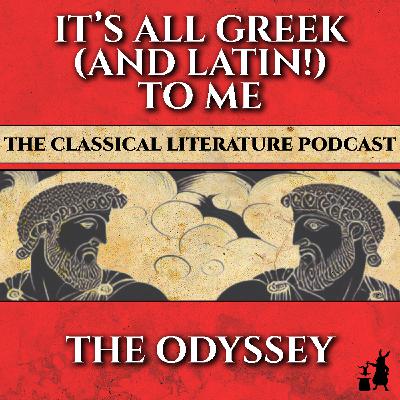
Armand and Jimmy set sail through the timeless tale of The Odyssey, Homer’s epic poem that follows the long and perilous journey of Odysseus as he fights monsters, resists temptresses, and outwits gods to return home. Along the way, they uncover the story’s deep emotional core — Penelope’s cleverness, Telemachus’ coming of age, and Odysseus’ own struggle between glory and homecoming. From the Cyclops’ cave to the bow-stringing, bloody showdown, discover how and why The Odyssey continues to inspire creators like Ralph Fiennes (The Return) and Christopher Nolan (in his upcoming adaptation), and why it still resonates with us today.
Thank you to Alex Horne for suggesting this week's topic and our main text explored: The Odyssey by Homer
Presented by Armand D’Angour and Jimmy Mulville
Produced by Diggory Waite
A Hat Trick Production
For more on the charity Classics For All, who support state schools to introduce or develop the teaching of classical subjects sustainably on the curriculum or as an after school activity, visit www.classicsforall.org.uk

Armand and Jimmy explore the hilarious and bold story of Lysistrata, the comedic tale of Ancient Greek women who devise an unexpected strategy to end the Peloponnesian War by withholding sex from their men. They also dive into the unique brand of humour of its author, Aristophanes, which cleverly lampooned prominent figures of his time, as seen in other works like The Frogs…
Main text explored: Lysistrata by Aristophanes
The Frogs by Aristophanes
Presented by Armand D’Angour and Jimmy Mulville
Produced by Diggory Waite
A Hat Trick Production
For more on the charity Classics For All, who support state schools to introduce or develop the teaching of classical subjects sustainably on the curriculum or as an after school activity, visitwww.classicsforall.org.uk
Hosted on Acast. See acast.com/privacy for more information.
Armand and Jimmy delve into one of the greatest masterpieces of Roman literature, The Aeneid, shedding light on its historical significance and the political motivations behind its creation by the poet Virgil. They explore the enduring power of the famous line, Sunt Lacrimae Rerum ("There are tears of things"), and offer an in-depth discussion of Book 6, where Aeneas, the hero, descends into the Underworld…
Main text explored: The Aeneid by Virgil
Presented by Armand D’Angour and Jimmy Mulville
Produced by Diggory Waite
A Hat Trick Production
For more on the charity Classics For All, who support state schools to introduce or develop the teaching of classical subjects sustainably on the curriculum or as an after school activity, visitwww.classicsforall.org.uk
Hosted on Acast. See acast.com/privacy for more information.
Join Armand and Jimmy as they delve into Plato’s Symposium, unraveling the diverse perspectives on love shared by Plato, Socrates, and their fellow guests. Armand reveals the intriguing figure he believes was instrumental in shaping Plato’s views on love before explaining the origins of the term 'Platonic Love...'
Main text explored: The Symposium by Plato
Presented by Armand D’Angour and Jimmy Mulville
Produced by Diggory Waite
A Hat Trick Production
For more on the charity Classics For All, who support state schools to introduce or develop the teaching of classical subjects sustainably on the curriculum or as an after school activity, visitwww.classicsforall.org.uk
Hosted on Acast. See acast.com/privacy for more information.
Armand and Jimmy discuss Juvenal, one of the earliest and most influential satirists, emphasising how every aspect of his work was crafted for comedic effect—from the absurd content, such as the foolish desires his fellow Romans prayed for in Satire 10, to the very structure of his verse itself...
Main text explored: Satire 10 of Book 4 by Juvenal
Presented by Armand D’Angour and Jimmy Mulville
Produced by Diggory Waite
A Hat Trick Production
For more on the charity Classics For All, who support state schools to introduce or develop the teaching of classical subjects sustainably on the curriculum or as an after school activity, visitwww.classicsforall.org.uk
Hosted on Acast. See acast.com/privacy for more information.
Armand and Jimmy delve into the myth of Narcissus and Echo, revealing how it has left its mark on modern psychology by prompting the ideas of 'Narcissism' and more recently 'Echoism.' They also shed light on the poet Ovid, who told the tale in his Metamorphoses shortly before his own life story took an unfortunate turn...
Main text explored: Book III of Metamorphoses by Ovid
Presented by Armand D’Angour and Jimmy Mulville
Produced by Diggory Waite
A Hat Trick Production
For more on the charity Classics For All, who support state schools to introduce or develop the teaching of classical subjects sustainably on the curriculum or as an after school activity, visitwww.classicsforall.org.uk
Hosted on Acast. See acast.com/privacy for more information.
Armand and Jimmy discuss Homer's epic poem The Iliad and in particular the moment where the Greek warrior Diomedes and the Trojan Glaucus meet on the battlefield...
Main text explored: The Iliad by Homer
Presented by Armand D’Angour and Jimmy Mulville
Produced by Diggory Waite
A Hat Trick Production
For more on the charity Classics For All, who support state schools to introduce or develop the teaching of classical subjects sustainably on the curriculum or as an after school activity, visitwww.classicsforall.org.uk
Hosted on Acast. See acast.com/privacy for more information.
Odi et amo - 'I hate and I Iove'
Armand and Jimmy chat about the Roman poet Gaius Valerius Catullus and the trials and tribulations of his love affair with a young woman whom he calls Lesbia—who, Armand explains, may have been misidentified for centuries...
Main texts explored (in order of appearance in episode):
Catullus 85
Catullus 83
Catullus 8
Catullus 2
Catullus 3
Catullus 10
Catullus 1
Presented by Armand D’Angour and Jimmy Mulville
Produced by Diggory Waite
A Hat Trick Production
For more on the charity Classics For All, who support state schools to introduce or develop the teaching of classical subjects sustainably on the curriculum or as an after school activity, visit www.classicsforall.org.uk
Hosted on Acast. See acast.com/privacy for more information.
A multidisciplinary approach to this episode, as Jimmy and Armand explore the exclamation ‘Eureka!’ uttered by Archimedes, known from a story told by architectural historian Vitruvius about how the inventor discovered how to assess the metallic content of a gold crown.
However, is the story fake news? If so, what was the true story? A bit of classical detective work provides a more plausible explanation.
Main text explored: De Architectura by Vitruvius
Presented by Armand D’Angour and Jimmy Mulville
Produced by Diggory Waite
A Hat Trick Production
For more on the charity Classics For All, who support state schools to introduce or develop the teaching of classical subjects sustainably on the curriculum or as an after school activity, visit www.classicsforall.org.uk
Hosted on Acast. See acast.com/privacy for more information.
In this episode we take the oft quoted idea of the Oedipus Complex and find out its origins in Sophocles’ tragedy Oedipus Rex.
Armand and Jimmy first present a handy guide to the key points of the story, then explore how we believe the themes of the play might have been received by its audience at the time, as well as current thinking on how plays such as this were presented to their audiences in ancient Athens.
Main text explored: Oedipus Rex by Sophocles
Presented by Armand D’Angour and Jimmy Mulville
Produced by Diggory Waite
A Hat Trick Production
For more on the charity Classics For All, who support state schools to introduce or develop the teaching of classical subjects sustainably on the curriculum or as an after school activity, visit www.classicsforall.org.uk
Hosted on Acast. See acast.com/privacy for more information.
We kick off the series with an expression that is often heard; but what do we know about who wrote it and from which literary work it is plucked?
Armand and Jimmy discuss possible translations of the phrase, what the writer was trying to convey with it as well as how we interpret the meaning of Carpe Diem in our lives today.
There’s also a quick potted history of how Armand and Jimmy both got drawn in by the Classics.
Main text explored: The Odes of Horace
Presented by Armand D’Angour and Jimmy Mulville
Produced by Diggory Waite
A Hat Trick Production
For more on the charity Classics For All, who support state schools to introduce or develop the teaching of classical subjects sustainably on the curriculum or as an after school activity, visit www.classicsforall.org.uk
Hosted on Acast. See acast.com/privacy for more information.

Comments

Download from Google Play

Download from App Store
 United States