


 Claim Ownership
Cambridge Centre for European Legal Studies (CELS) Podcast
Subscribed: 72Played: 623
Subscribe

© Faculty of Law, University of Cambridge
Description
The Centre for European Legal Studies (CELS) at the Faculty of Law, University of Cambridge, runs a series of lunchtime seminars during the Michaelmas and Lent Terms. These seminars provide a platform for the presentation of new ideas by leading scholars from inside and outside the University. The lunchtime seminars address topical issues of European Union Law and Comparative Law, with a view to using collective debate as a forum for developing and disseminating ideas, and producing high quality research publications which contribute to an understanding of major issues in the European Union.
There is a close link between the CELS Lunchtime Seminar series and the Cambridge Yearbook of European Legal Studies (CYELS). Papers generated from most of these seminars are published as articles in the CYELS. Video recordings of the seminars are made available via podcast, and videos on YouTube (https://www.youtube.com/playlist?list=PLy4oXRK6xgzGUiTnOrTDiD0SfIbGj2W-x).
For more information see the CELS website at http://www.cels.law.cam.ac.uk/
There is a close link between the CELS Lunchtime Seminar series and the Cambridge Yearbook of European Legal Studies (CYELS). Papers generated from most of these seminars are published as articles in the CYELS. Video recordings of the seminars are made available via podcast, and videos on YouTube (https://www.youtube.com/playlist?list=PLy4oXRK6xgzGUiTnOrTDiD0SfIbGj2W-x).
For more information see the CELS website at http://www.cels.law.cam.ac.uk/
176 Episodes
Reverse
On 28 March 2026 CELS held a seminar event on 'The Rule of Law as a (dis)unifying Value in the European Legal Order?'.Among the rule of law's many virtues is its capacity to provide a framework for deliberating competing ideas of justice, fairness and equality. Yet a value once widely shared is now increasingly contested in both status and meaning. The Centre held this event to explore these and related questions.The seminar was structured around four core sub-themes. Each of these will begin with a 20-minute presentation followed by a facilitated discussion:I:The Nature of Values in Supranational Legal Orders - Nabil H. Khabirpour (Video (YouTube) / Audio)II: The Judiciary and the Rule of Law in Europe - Lord Justice Baker (Video (YouTube) / Audio)III: The Rule of Law, the Market, and European Identity - Professor Catherine Barnard (Video (YouTube) / Audio)IV: Enforcing the Rule of Law as a Value under EU Law - Professor Albertina Albors-Llorens (Video (YouTube) / Audio)For more information see:https://www.cels.law.cam.ac.uk/activities-archive
On 28 March 2026 CELS held a seminar event on 'The Rule of Law as a (dis)unifying Value in the European Legal Order?'.Among the rule of law's many virtues is its capacity to provide a framework for deliberating competing ideas of justice, fairness and equality. Yet a value once widely shared is now increasingly contested in both status and meaning. The Centre held this event to explore these and related questions.The seminar was structured around four core sub-themes. Each of these will begin with a 20-minute presentation followed by a facilitated discussion:I:The Nature of Values in Supranational Legal Orders - Nabil H. Khabirpour (Video (YouTube) / Audio)II: The Judiciary and the Rule of Law in Europe - Lord Justice Baker (Video (YouTube) / Audio)III: The Rule of Law, the Market, and European Identity - Professor Catherine Barnard (Video (YouTube) / Audio)IV: Enforcing the Rule of Law as a Value under EU Law - Professor Albertina Albors-Llorens (Video (YouTube) / Audio)For more information see:https://www.cels.law.cam.ac.uk/activities-archive
On 28 March 2026 CELS held a seminar event on 'The Rule of Law as a (dis)unifying Value in the European Legal Order?'.Among the rule of law's many virtues is its capacity to provide a framework for deliberating competing ideas of justice, fairness and equality. Yet a value once widely shared is now increasingly contested in both status and meaning. The Centre held this event to explore these and related questions.The seminar was structured around four core sub-themes. Each of these will begin with a 20-minute presentation followed by a facilitated discussion:I:The Nature of Values in Supranational Legal Orders - Nabil H. Khabirpour (Video (YouTube) / Audio)II: The Judiciary and the Rule of Law in Europe - Lord Justice Baker (Video (YouTube) / Audio)III: The Rule of Law, the Market, and European Identity - Professor Catherine Barnard (Video (YouTube) / Audio)IV: Enforcing the Rule of Law as a Value under EU Law - Professor Albertina Albors-Llorens (Video (YouTube) / Audio)For more information see:https://www.cels.law.cam.ac.uk/activities-archive
On 28 March 2026 CELS held a seminar event on 'The Rule of Law as a (dis)unifying Value in the European Legal Order?'.Among the rule of law's many virtues is its capacity to provide a framework for deliberating competing ideas of justice, fairness and equality. Yet a value once widely shared is now increasingly contested in both status and meaning. The Centre held this event to explore these and related questions.The seminar was structured around four core sub-themes. Each of these will begin with a 20-minute presentation followed by a facilitated discussion:I:The Nature of Values in Supranational Legal Orders - Nabil H. Khabirpour (Video (YouTube) / Audio)II: The Judiciary and the Rule of Law in Europe - Lord Justice Baker (Video (YouTube) / Audio)III: The Rule of Law, the Market, and European Identity - Professor Catherine Barnard (Video (YouTube) / Audio)IV: Enforcing the Rule of Law as a Value under EU Law - Professor Albertina Albors-Llorens (Video (YouTube) / Audio)For more information see:https://www.cels.law.cam.ac.uk/activities-archive
Speaker: Professor Niamh Dunne, LSEBiography: Niamh Dunne is a professor at the Law School of the London School of Economics, where she teaches and researches in competition law.Abstract: Is it possible to reconcile the competing visions of what constitutes ‘effective’ abuse of dominance enforcement that emerge from the contemporary jurisprudence of the Commission and the Court of Justice? Article 102 has been a focal point for efforts both to modernise but also to render more effective the application of EU competition law, with different strands of recent case law emphasising the pursuit of market efficiency, the protection of equality of market access, and the prevention of exploitation by dominant undertakings. This presentation will explore the coherence of these developments, and consider whether this question matters in light of the Commission’s stated objective of achieving ‘a robust enforcement’ of Article 102. For more information see:https://www.cels.law.cam.ac.uk/weekly-seminar-series
Speaker: Professor Morten Rasmussen, University of CopenhagenBiography: Morten Rasmussen is Associate Professor at the SAXO Institute, University of Copenhagen and a leading expert on the legal histories of European integration and the League of Nations. He has published numerous articles and book chapters on these topics. The most recent publication is a general history of early period of European Union Law from 1950 to 1993. He is currently co-editing a Cambridge Handbook of the League of Nations and international law.Abstract: Professor Rasmussen will present on his forthcoming publication 'The History of European Union Law - Constitutional Practice, 1950 to 1993'. The formative period of EU law witnessed an intense struggle over the emergence of a constitutional practice. While the supranational institutions, including the European Commission, the European Court of Justice and the European Parliament, as well as EU law academics helped to develop and promote the constitutional practice, member state governments and judiciaries were generally reluctant to embrace it. The struggle resulted in an uneasy stalemate in which the constitutional practice was allowed to influence the doctrines, shape and functioning of the European legal order that now underpins the EU, but a majority of member state governments rejected European constitutionalism as the legitimating principle of the new EU formed on basis of the Treaty of Maastricht (1992). The lecture traces the struggle and accounts for eventual stalemate over the constitutional practice and the fragile and partial system of rule of law that exists in the EU today.For more information see:https://www.cels.law.cam.ac.uk/weekly-seminar-series
Speaker: Professor Halvard Haukeland Fredriksen, UIB, NorwayBiography: Halvard Haukeland Fredriksen is professor of European law at the University of Bergen, Norway. Besides his Norwegian law degree, he holds the degrees of Mag.Jur. and Dr.Jur. from the University of Göttingen (Germany) as well as a PhD from the University of Bergen. Member of the Norwegian Academy of Science and Letters. Co-Director of the Bergen Centre of the Europeanization of Norwegian law. Editor-in-chief of the Norwegian Law Journal. Member of the 2022-2024 ‘EEA Review Committee’ that assed Norway’s current affiliation to the European Union.Abstract: For more than three decades, the Agreement on the European Economic Area (EEA) has integrated Iceland, Liechtenstein and Norway into the better part of the EU internal market. Over the years, the Agreement has been supplemented by numerous other agreements between Norway and the EU, creating a complex patchwork of agreements commonly referred to as ‘the Norway model’. Notwithstanding the model’s democratic problems, the general view in Norway is that it has worked well as a compromise between those in favour of membership of the Union and those very much opposed to this idea. However, the EU’s strive for ‘strategic autonomy’ in the current geopolitical situation makes it more complicated to remain part of the internal market without being part of the customs union and the common commercial policy. The seminar will discuss the legal challenges confronting ‘the Norway model’ as well as possible remedies.For more information see:https://www.cels.law.cam.ac.uk/weekly-seminar-series
The Centre for European Legal Studies (CELS), The Centre for Public Law (CPL) and the Lauterpacht Centre for International Law (LCIL) held a roundtable event on 'The Future of the European Convention on Human Rights in the United Kingdom' on 21 February 2026.The European Convention on Human Rights (ECHR) remains one of the most significant instruments of human rights protection in Europe. Yet in the United Kingdom, its place in the constitutional order is increasingly contested. Political debate has raised questions about the appropriateness of the ECHR's reach, its domestic incorporation through the Human Rights Act 1998, and the proper balance between parliamentary sovereignty and Strasbourg supervision.The aim of this roundtable was to bring together Cambridge academics to consider possible trajectories for reform and the mechanisms to achieve this. The discussion provided a space not only for doctrinal and legal analysis but also for assessing political realities and potential path. The roundtable started from the perspective that there is a perception, very strong in some quarters, that the ECHR is not fit for purpose.Chair: Catherine BarnardNabil KhabirpourJan KlabbersMarcus GehringChair: Sandesh SivakumaranDarren PetersonStevie MartinFor further information:CELS: https://www.cels.law.cam.ac.uk/CPL: https://www.cpl.law.cam.ac.uk/LCIL: https://www.lcil.cam.ac.uk/
Case C-181/23 Commission v Malta (investor citizenship) is one of the most important decisions the Court has handed down on EU citizenship. It is of significant interest not just because of the issues raised, but because of the reasoning of the Court and the Court’s view of citizenship in the EU legal order. This seminar provides the opportunity to hear from both those closest to the decision and academic commentators on their assessment of this momentous decision.Chair: Professor Catherine Barnard, University of Cambridge Discussants: Professor Markus Gehring, University of CambridgeDr Emilija Leinarte, University of CambridgeProfessor Daniel Sarmiento, Universidad Complutense, MadridDr Martin Steinfeld, University of Cambridge Professor Takis Tridimas, Luxembourg Centre for European Law (LCEL) For more information see:https://www.cels.law.cam.ac.uk/weekly-seminar-series
Speaker: Professor Daniele Gallo, Luiss University, ItalyAbstract: The seminar, building upon Professor Gallo’s book, Direct Effect in EU Law (EU Law Library Series, OUP, 2025), will explore the uneasy trajectories of a transformative doctrine such as direct effect. By reassessing both the present and future of this legal and political construct, it will argue that such chameleon-like principle has evolved into a broader legal category than it was at the outset of the European integration process and that this development has been only partially captured by the CJEU. In doing so, Professor Gallo will revisit the no horizontal direct effect rule of contemporary directives and argue for its overcoming in light of the text, scope, and objectives of legal acts that are substantially different from those envisaged by Article 288 TFEU.For more information see:https://www.cels.law.cam.ac.uk/weekly-seminar-series
Speaker: Dr Raphaële Xenidis, Sciences Po Law School, FranceAbstract: EU anti-discrimination law has been a subject of choice for critiques from various disciplines. One influential motif that has durably structured the critical analysis of EU anti-discrimination law is the distinction between formal and substantive equality. Substantive approaches seek to diagnose and remedy the disjunctions between formal equality frameworks and social realities. Yet, such critiques often remain implicit in their engagement with social theory, leaving the very notion and construction of ’social realities’ largely unexamined. This paper thus asks: How does the principle of non-discrimination mediate and produce specific forms of individual subjectivity, interpersonal relationships, institutional arrangements, material and spatial organisation and ultimately social order? How does it authorise the existence of certain subjects and groups while excluding and rendering others invisible? What 'forms of life' does EU anti-discrimination and its jurisprudential construction by the Court enable or preclude?For more information see:https://www.cels.law.cam.ac.uk/weekly-seminar-series
Speaker: Dr Julian Ghosh, Cambridge University Abstract: In this seminar Dr Ghosh will address what, post-Lipton are the rules for REUL/AL; examples of UK Court decisions which should but do not apply REUL/AL and will provide a useful template for future litigation.For more information see:https://www.cels.law.cam.ac.uk/weekly-seminar-series
An online debate considering the recent Supreme Court case of 'For Women Scotland Ltd v The Scottish Ministers' which was handed down on 16 April featuring Aidan O’Neill KC (Scot.), KC (E&W), BL (Ireland) who appeared for For Women Scotland. In the discussion Aidan reflected on his experiences of the case, the judgment and participate in a debate of the issues it raises going forward. This was followed by a response from Dr Lena Holzer, and then a question and answer session.For more information see: https://www.cels.law.cam.ac.uk/activities-archive
Speaker: Dr Bernadette Zelger, University of InnsbruckAbstract: The debate about the future of the European Union has long left academic circles, arrived in the midst of society and been awarded political attention. Meanwhile, there has been an increase of Euroscepticism accompanied by more nationalist political developments echoed in the swings to the right all across the EU. These developments may, arguably at least in parts, be explained by social resentments of the peoples of Europe. While acknowledging that law constructs and contributes to a social reality of its own it is thus, arguably also about the lack of a genuine socio-economic equilibrium within the law and political system of the EU. This imbalance is not only found within the EU legal constitutional framework, but also within the case-law of the European Court of Justice. However, possible solutions to solve this socio-economic imbalance are limited: It is either (i) Treaty reform or, alternatively, (ii) a change in the approach of the Court in its jurisprudence. While these alternatives are both valid and, to some extent, mutually exclusive, they unveil and epitomise different visions as regards the future of the European Union. However, while acknowledging the differences in the approach, they are arguably different means to serve the very same end: Warrant the European Union’s future success. For more information see:https://www.cels.law.cam.ac.uk/weekly-seminar-series
Speaker: Professor Orla Lynskey, University College London Abstract: The EU ‘digital empire’ seeks to align technological development to its rights and values by adopting and promoting a rights-driven model of technological regulation. Bradford’s influential characterisation of EU digital strategy is credible when one maps the array of legal ‘Acts’ applicable to data, digital markets, digital services and AI adopted by the EU in recent years, all of which are without prejudice to the EU data protection law. Yet, when one delves deeper, the EU’s commitment to rights-based regulation of the digital sphere is not iron-clad. Rather, as we demonstrate through an empirical analysis of the European Commission’s adequacy decisions over a quarter of a century (1999-2024), there are clear divergences amongst EU institutions about the balance to be struck between fundamental rights and economic interests. Such divergence suggest the EU might more accurately be characterised as an amalgamation of fiefdoms rather than an empire. This inter-institutional dynamic is relevant to the legitimacy of EU actions in the digital sphere and may foreshadow the future direction of EU data law.For more information see:https://www.cels.law.cam.ac.uk/weekly-seminar-series

Speaker: Dr Andriani Kalintiri, King’s College LondonAbstract: Is EU antitrust law resilient in the face of change? This question has acquired prominence amidst the many crises and disruptions of recent times, such as the COVID-19 pandemic, climate change and digitalisation. Attempts to answer it though have been rather narrow in scope and tend to employ the language of resilience casually. This article contributes to knowledge (a) by developing a conceptual framework for understanding and assessing legal resilience in administrative enforcement systems and (b) by applying it to Articles 101 and 102 TFEU with a view to investigating its ability to respond to change in a systematic manner. The analysis reveals that the current regime exhibits several design features that enable decisionmakers to make resilience choices as needed, and the resilience choices that have been made on various occasions are prima facie justifiable given the nature of the problem the European Commission and/or the EU Courts were faced with. However, certain aspects of the existing legal framework may weaken or limit EU antitrust law’s ability to deal with certain problems, in particular (very) complex ones, whereas some of the resilience choices that have been made have had implications for legal certainty, coherence and legitimacy that may not have been sufficiently appreciated so far. The article highlights the added value of a legal resilience perspective for effectively using EU antitrust law as a tool for tackling problems in an ever-changing world and demonstrates that, albeit not a panacea, such a perspective may reinforce the quality of enforcement and public’s trust in it.3CL runs the 3CL Travers Smith Lunchtime Seminar Series, featuring leading academics from the Faculty, and high-profile practitioners: https://www.3cl.law.cam.ac.uk/centre-activitiesFor more information about CELS see: https://www.cels.law.cam.ac.uk/weekly-seminar-series

Speaker: Professor Barend van Leeuwen, Durham UniversityAbstract: What do we mean when we talk about the "horizontal direct effect" of the free movement provisions? You would think that, after decades of case law on the free movement provisions, the meaning of this concept should be relatively clear and crystallised. However, there is still a significant amount of disagreement about the very meaning of the concept of "horizontal direct effect". While some EU lawyers speak of horizontal direct effect when the free movement provisions are applied in a dispute between private parties (a procedural approach), other EU lawyers will only refer to horizontal direct effect when the rule or conduct that is being challenged is of a private nature (a substantive approach). This paper will analyse these different interpretations of the concept of horizontal direct effect through the lens of the "Familiapress dilemma". It will be argued that a distinction should be made between horizontal direct effect cases (in which private rules or actions are challenged in a dispute between private parties) and horizontal enforcement cases (in which State rules or actions are challenged in a dispute between private parties). The problem with a procedural approach to horizontal direct effect is that no connection is made between direct effect and the question of who is held responsible (and liable) for breaches of the free movement provisions. This makes it more difficult to provide effective judicial protection to victims of breaches of free movement law, because it is unclear who should ultimately "pay the bill". Against this background, it will be argued that the CJEU should develop more explicit techniques or "formulas" to allocate responsibility in free movement cases. In parallel, the CJEU should improve the effectiveness of the remedies of State liability and private liability for breaches of the free movement provisions.For more information see:https://www.cels.law.cam.ac.uk/weekly-seminar-series

Speakers: Professor Eleanor Sharpston KC, Advocate General, CJEU (2006-2020) and Goodhart Professor, University of Cambridge (2023/2024) and Dr Markus W. Gehring, Associate Professor, Faculty of Law and Member of CELS. Abstract: On 18 September 2023 the Group of 12 Experts from both France and Germany released their proposal ‘Sailing on High Seas: Reforming and Enlarging the EU for the 21st Century’. The Group make two proposals on the Rule of Law and five further proposals for institutional reform. Overall, the Group had three objectives to increase the EU’s capacity to act, to get the institutions ready for enlargement and strengthen democratic legitimacy and rule of law. This resulted in a series of proposals for inter alia treaty change. The proposals are all on a continuum but largely aim for reform rather than a recreation of the European Union. They align with other reform proposals and at times take up proposals that were made for EU reform in the past or indeed discussed during the EU Constitutional convention process in the early 2000s. The objective here was clearly reformation rather than revolution. This conversation discusses some of the individual reform proposals in the context of the practice of the Court of Justice – could these proposal mean the beginning of 'Europe’s Second Constitution'?For more information see:https://www.cels.law.cam.ac.uk/weekly-seminar-series

Speaker: Professor Eleanor Sharpston KC, Advocate General, CJEU (2006-2020) and Goodhart Professor, University of Cambridge (2023/2024)Abstract: As an AG Professor Sharpston worked on religious discrimination and employment matters, delivering an opinion in one of the first two hijab cases (Bougnaoui) and then the ‘shadow opinion’ in Wabe and Müller, which she posted via Professor Steve Peers’ EU law blog after leaving the Court. She has already compared Achbita and Bougnaoui to the decisions in Egenberger and the Caritas hospital case (IR v JQ) in her festschrift contribution for Allan Rosas. Unsurprisingly, she has been keeping an eye open for further developments in that case law (WABE and Müller, S.C.R.L (Religious clothing) and, most recently, Commune d’Ans (Grand Chamber, 28 November 2023). Additionally, she has also been looking at what the Court has been saying in relation to ritual slaughter of animals (as required for meat-eating observant Jews and Muslims). Notable cases include Liga van Moskeeën, Oeuvre d’assistance aux bêtes d’abattoirs (OABA) and Centraal Israëlitisch Constistorie. The case law of the European Court of Human Rights also addresses these issues: Eweida v UK on religious symbols in the workplace, and the very recent decision (13 February 2024) in Executief van de Moslims van België and Others v Belgium on banning ritual slaughter of animals without prior stunning. The cases are constitutionally important in terms of the deference shown to Member States; and in some respects, they are troubling for anyone who is religious and non-Christian.Discussion chaired by Dr Markus W. Gehring, Associate Professor, Faculty of Law and Member of CELS.For more information see:https://www.cels.law.cam.ac.uk/weekly-seminar-series
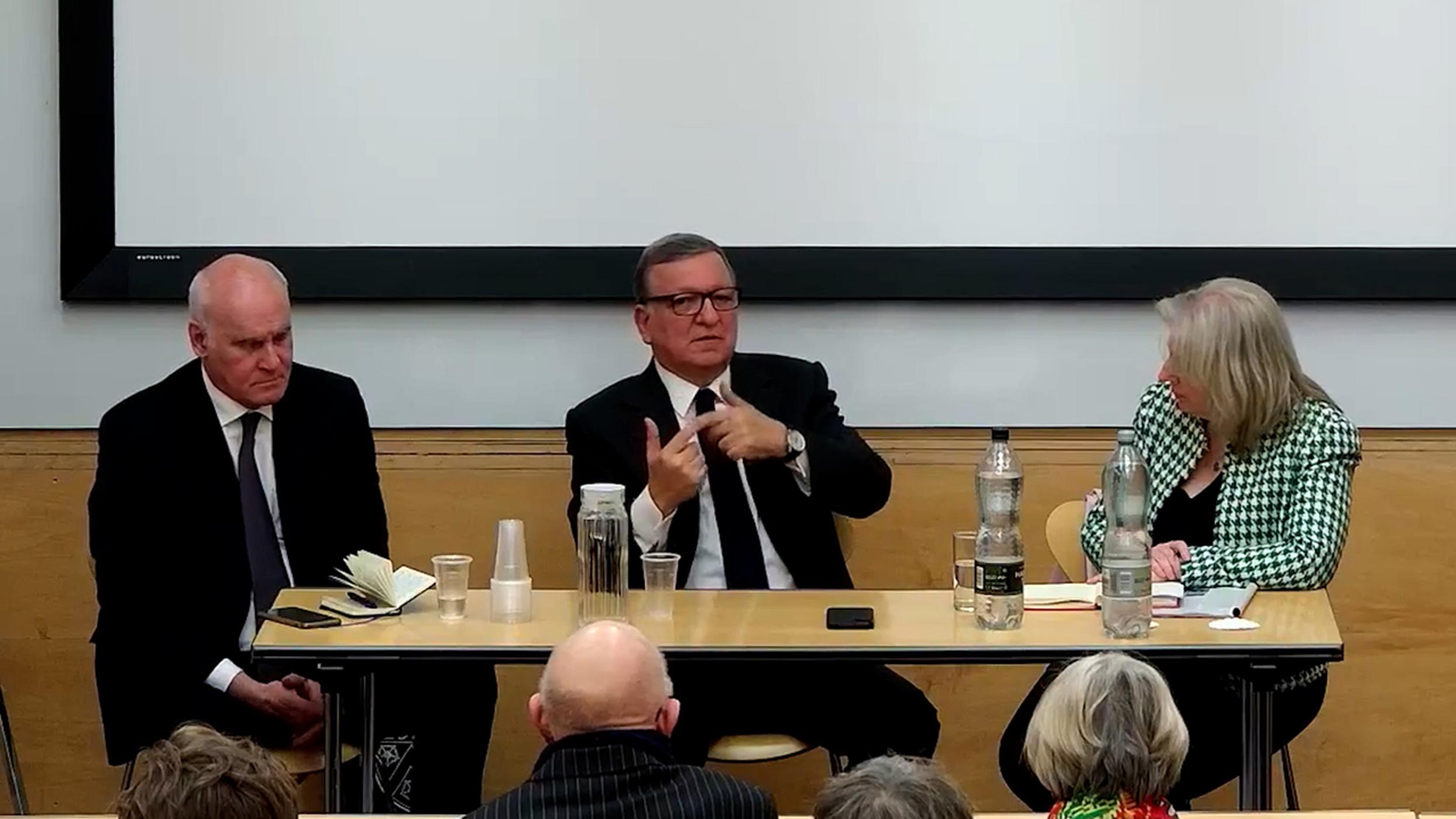
Speaker: José Barroso, former President of the European CommissionBiography: José Manuel Durão Barroso served twelve years in the Government of Portugal including as Prime Minister and Minister of Foreign Affairs Minister. He was President of the European Commission during two mandates (2004/2014).His academic appointments include visiting professor at Georgetown University and visiting professor at Princeton University. He is currently a visiting professor at the Catholic University of Portugal and at the European University Institute, School of Transnational Governance, Florence. José Manuel Barroso studied Law (University of Lisbon) Political Science and International Affairs (University of Geneva).He is currently Chair of the Board of Gavi, the Vaccine Alliance, and Chairman of International Advisors, Goldman Sachs.For more information see:https://www.cels.law.cam.ac.uk/weekly-seminar-series


Download from Google Play

Download from App Store
 United States
Mr Green is one of the leading online casinos offering a wide range of games and bonuses. The casino has an excellent reputation, and it is clear that they take care of their players. The customer service is amazing, and they offer a great selection of games. The bonuses are also very generous, and the wagering requirements are reasonable. For more information, you can use the link https://bestcasinoplay.ca/online-casinos/mr-green/ link . Overall, my experience with Mr. Green was Very nice, and I would definitely recommend it to anyone who is looking for a great online casino.