


 Claim Ownership
The Dionysius Circle Podcast
Subscribed: 5Played: 11
Subscribe

Description
The Dionysius Circle Podcast focuses on Christian Platonism and the broader Platonic tradition. We study the integration of Platonism within Christian philosophy and theology, along with Plato himself and the later schools of Platonism. We also explore how Platonism developed in Jewish and Islamic thought. The project includes an ongoing interest in philosophical Platonism, both ancient and contemporary.
For more, visit DionysiusCircle.org.
16 Episodes
Reverse
This episode is a discussion with philosopher Damiano Costa about his paper "An Argument Against Aristotelian Universals." Costa examines the Aristotelian view that universals really exist, yet depend for their existence on being exemplified by particular things, and he explains why he thinks this position cannot be sustained.
The discussion focuses on two arguments against Aristotelian universals. The first targets the idea that the existence of a universal is grounded in exemplification. Costa argues that if exemplification is a relation, then exemplification would require the prior existence of the universal itself, making it impossible for exemplification to ground that universal's existence.
The second argument considers whether grounding universals in states of affairs or facts, such as "the apple is red," can avoid this difficulty. Costa argues that this strategy also fails, since such facts involve universals as constituents, where constituents partly ground the fact in the first place.
In this episode, Sam Bennett speaks with Gyula Klima about the medieval problem of universals and the philosophical issues that arise when we try to explain how universal cognition of singular things is possible. Klima begins with his intellectual background and then walks through the problem as it develops from Plato's ideal objects and the challenge posed by the Third Man argument, to Aristotle's account of abstraction and universal concepts. He discusses Augustine's placement of universals in the divine mind, Boethius's and Abelard's efforts to explain how features separable in thought need not be separable in reality, and Aquinas's account of common natures and universal concepts as the shared objects of individual acts of understanding.
In this episode, I talk with Dr. Christophe de Ray from Nanyang Technological University about his article "Corruptio Boni: An Alternative to the Privation Theory of Evil," published in the journal Ratio: An International Journal of Analytic Philosophy. Drawing inspiration from Augustine, Dr. de Ray argues that evil is not the mere absence of a good that ought to obtain, but rather the corruption of a good: something that harms, diminishes, or destroys it.
What kind of thing is evil?
If all being is good, where does disorder come from?
Can evil have reality without being a substance?
In this episode, we talk with philosopher Pierce Marks about his paper "Evil as Privation: Its True Meaning and Import." We discuss the Platonic roots of the view that evil is a lack of the good, the distinction between "mere" and "depraved" privations, and whether natural evils like death or predation are genuine evils or part of the world's perfection.
In this episode, Dr. Andreas Bergman joins us to discuss his recent open-access article, The Maximian Perspective on Paul: A Reconstruction of the Works of the Law and Maximus the Confessor. We begin by outlining the main features of the Old and New Perspectives on Paul, particularly the contested meaning of the phrase "works of the law" in Pauline theology. From there, we explore how Maximus the Confessor's ascetical theology complicates and enriches this debate. Dr. Bergman explains Maximus's tripartite division of the law (natural, written, and spiritual), his understanding of motivation in relation to justification, and how Maximus can, in different respects, be seen as aligning both with and against key elements of the major interpretive traditions.
In this episode of the Dionysius Circle podcast, I explore with New Testament scholar Dr. Joshua Heavin his recent article on participation in Christ and divine and human righteousness. Drawing from both Paul's letters and the theology of St. Gregory of Nyssa, we examine how righteousness is not merely a moral property but, at its deepest level, a person — Christ himself. We also unpack Gregory's fourfold model of participation and how it offers a transformative vision of the Christian life.
In this episode, we speak with Dr. Clelia Attanasio about her recent work on Pseudo-Dionysius and the distinction between theurgy and hierurgy. We explore how Moses, as the paradigmatic hierurgist, models the human ascent through contemplation and the use of sacred symbols in response to divine action.
In this episode of the Dionysius Circle Podcast, we're joined by Rev. Dr. Kjetil Kringlebotten, a priest in the Church of Norway and author of Liturgy, Theurgy, and Active Participation. We talk about what it really means to participate in the liturgy, why God's action is at the heart of worship, and how Christian Platonism can deepen our understanding of the Church's rituals.
In this episode of The Dionysius Circle Podcast, Dr. Sam Bennett speaks with Dr. Stephanos Stephanides, a postdoctoral researcher at the University of Cyprus specializing in Platonic philosophy, about his article, "Reconsidering the Essential Nature and Indestructibility of the Soul in the Affinity Argument of the Phaedo." The conversation touches on the structure of Plato's Phaedo, the Affinity Argument's approach to the soul's indestructibility, and the distinction between composite and incomposite entities, while reflecting on how later interpretations, including Neoplatonic perspectives, have engaged with these ideas.
Sam Bennett interviews Dr. Van Tu, a philosopher specializing in ancient philosophy, about her article, Is the Soul a Form?. The conversation examines whether the Final Argument of Plato's Phaedo understands the soul as a transcendent form, an immanent form, or a form carrier. They also discuss the possible existence of a transcendent form of the soul within Plato's metaphysical system, its role in the final argument for immortality, and the distinction between the immortality of the soul and personal immortality.
In this episode, we're joined by Dr. Suzanne Obdrzalek to discuss her fascinating interpretation of Plato's Phaedo. Dr. Obdrzalek argues that Plato attributes spatial characteristics to the soul—such as location, extension, and the ability to causally interact with the body. We also delve into broader implications of this view, including how it sheds light on Plato's eschatology and challenges contemporary assumptions about dualism.
In this episode, Dr. Elizabeth (Betsy) Jelinek, Chair of the Philosophy Department at Christopher Newport University, shares her insights into Plato's Phaedo. We discuss her article, "Explanation in the Phaedo: An Argument Against the Metaphysical Interpretation of the Clever Αἰτία," diving into the relationship between forms, causality, and the relevance of sensible particulars in Platonic thought.
In this episode of The Dionysius Circle Podcast, we're joined by renowned scholar of Plato, David Ebrey. We dive into his latest book on Plato's Phaedo, exploring Socrates' radical views on the immortality of the soul, the nature of the forms, and the role of philosophy as preparation for death. David sheds light on the literary structure of the dialogue, its connections to Greek tragedy, and Plato's unique philosophical approach to ethics, metaphysics, and the natural world.
The Dionysius Circle Podcast explores Theias Philosophias ("Divine Philosophy")—the union of theology and philosophy. Hosted by Dr. Sam Bennett, the podcast delves into the wisdom of the Eastern Christian Fathers, such as St. Dionysius the Areopagite, St. Maximus the Confessor, and St. Gregory of Nyssa. It examines their connections to Plato and Neoplatonism and their influence on later thinkers like St. Thomas Aquinas and St. Gregory Palamas. The podcast also explores key philosophical and theological currents, such as mysticism and apophaticism.
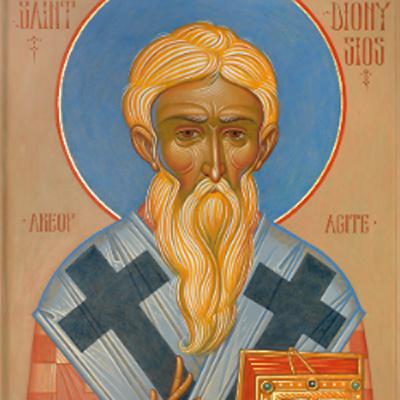
The Dionysius Circle Podcast explores Theias Philosophias ("Divine Philosophy")—the union of theology and philosophy. Hosted by Dr. Sam Bennett, the podcast delves into the wisdom of the Eastern Christian Fathers, their connections to Plato and Neoplatonism, and their influence on later thinkers like St. Gregory Palamas and St. Thomas Aquinas. It also examines key philosophical and theological currents, such as mysticism and apophaticism.
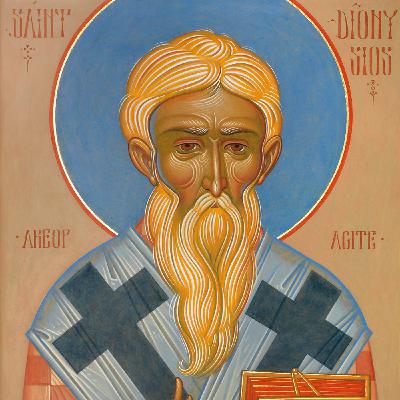
For more, visit DionysiusCircle.org [http://dionysiuscircle.org/]. Special thanks to Peter-Anthony Togni for his composition Of the Father's Love Begotten from Sea Dreams, and to Fr. Silouan Justiniano, a hieromonk at the Monastery of St. Dionysios the Areopagite in Long Island, NY, for his beautiful iconography.
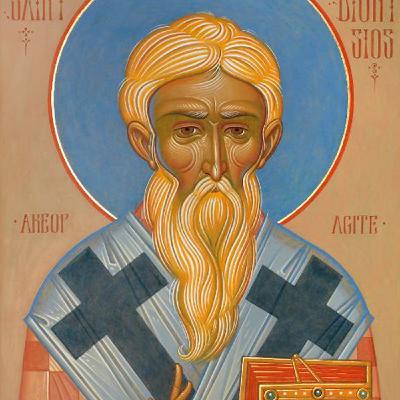
Host Dr. Sam Bennett introduces the Dionysius Circle Podcast, exploring Theias Philosophias ("Divine Philosophy")—the union of theology and philosophy. Discover the insights of the Eastern Christian Fathers, their ties to Plato and Neoplatonism, their influence on thinkers like St. Thomas Aquinas, and connections to Western Fathers and mysticism.
For more, visit DionysiusCircle.org [http://dionysiuscircle.org/]. Special thanks to Peter-Anthony Togni for his composition Totus Tuus, from Sea Dreams.
Comments


Download from Google Play

Download from App Store
 United States