


 Claim Ownership
Time Machine Diaries: Ancient Civilizations & Future World Predictions.
Subscribed: 0Played: 25
Subscribe

© CNC Productions
Description
An auditory journey through history; From ancient civilizations to futuristic visions, our host guides you through immersive narratives, blending facts with fiction to explore what it means to time travel through the human experience.
Music by https://www.youtube.com/
Sound effects by https://www.voicy.network/
Music and Sound Effects by https://pixabay.com/
Donate patreon.com/THO420
Music and SFX https://archive.org/
Sources: https://www.britannica.com/
https://www.nationalww2museum.org/
Music by https://www.youtube.com/
Sound effects by https://www.voicy.network/
Music and Sound Effects by https://pixabay.com/
Donate patreon.com/THO420
Music and SFX https://archive.org/
Sources: https://www.britannica.com/
https://www.nationalww2museum.org/
66 Episodes
Reverse
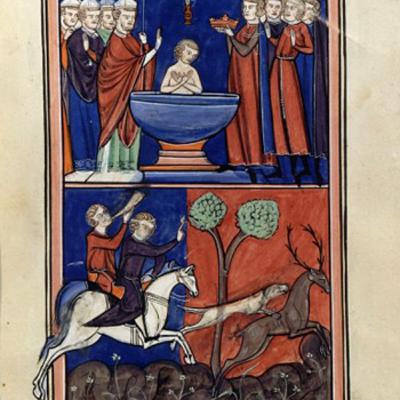
Long before the Battle of Tolbiac turned into legend there was a teenage king trying to survive in a violent world where power was taken with steel and held through fear. In this Time Machine Diaries episode, Cullen traces the rise of Clovis from the son of the Frankish ruler Childeric to the most powerful warlord in Gaul. The story begins with the strange hybrid world left behind after the fall of the Roman Empire, where Roman cities still stood, but Roman armies were gone. Frankish kings served in Roman commands while building their own dynasties in the shadows of collapsing imperial authority.The episode explores the Merovingian bloodline and the archaeological discovery of Childeric’s grave which revealed the strange mix of Roman and Germanic power that shaped the Frankish world. It looks at the brutal rivalries between Frankish kings and the violent politics that allowed Clovis to consolidate power. The story then moves to the marriage between Clovis and the Burgundian princess Clotilde, whose Christian faith created tension inside the royal household and would later influence one of the most famous turning points in early medieval history.From there the episode dives into Frankish warfare including the weapons of the Merovingian warriors the shield wall tactics used on the battlefield and the deadly throwing axe known as the francisca. It reconstructs the rise of the Alemanni confederation along the Rhine frontier and explains why their clash with the Franks became inevitable.Finally the narrative reaches the Battle of Tolbiac itself where thousands of warriors collided in a brutal infantry struggle that helped reshape the political future of Gaul. The episode also examines the famous story that Clovis prayed to the Christian God during the battle and explains why historians remain cautious about that claim since the account comes decades later from Gregory of Tours. What can be confirmed is that Clovis won the battle and soon afterward converted to Christianity creating an alliance between the Frankish kingdom and the Catholic Church that would shape the future of Europe for centuries.This episode is a deep exploration of dynasty warfare religion and power in the chaotic centuries after Rome fell and shows how the rise of one king and one battlefield helped lay the foundations for the medieval world.Bachrach, Bernard S. Merovingian Military Organization 481–751. University of Minnesota Press, 1972.Geary, Patrick J. Before France and Germany The Creation and Transformation of the Merovingian World. Oxford University Press, 1988.Gregory of Tours. The History of the Franks. Translated by Lewis Thorpe. Penguin Classics, 1974.Heather, Peter. The Fall of the Roman Empire A New History of Rome and the Barbarians. Oxford University Press, 2005.James, Edward. The Franks. Basil Blackwell, 1988.Wallace Hadrill, J. M. The Long Haired Kings and Other Studies in Frankish History. University of Toronto Press, 1962.Wood, Ian. The Merovingian Kingdoms 450–751. Routledge, 1994.BBC. The Dark Ages An Age of Light. BBC Documentary Series.The Great Courses. The Early Middle Ages. Audiobook Lecture Series by Philip Daileader.National Geographic. Rise of the Franks. Documentary.

When brute force didn’t work, Russia turned to erasure. This episode dives deep into the Koryak campaigns, the Aleut slave raids in Alaska, and the violent birth of cultural extermination as policy. We follow firsthand accounts of starvation, hostage taking, and the destruction of Indigenous lifeways across the Russian Far East. Then we trace the evolution of that violence, from open slaughter to identity theft: forced Orthodox conversions, renamed children, banned languages, and burned traditions. This isn’t just Russian history. This is an empire in practice, and it echoes across continents.Anderson, David G. Identity and Ecology in Arctic Siberia: The Number One Reindeer Brigade. Oxford University Press, 2000.Black, Lydia T. Russians in Alaska, 1732–1867. University of Alaska Press, 2004.Bolkhovitinov, Nikolai N. Russia and the United States: Diplomatic Relations to 1917. Translated by Elena Marakova, University of Hawaii Press, 1987.Chaussonnet, Valérie. Native Cultures of Alaska and Siberia: The Legacy of the Bering Strait Connection. Smithsonian Institution, 1995.Fisher, Raymond H. The Russian Fur Trade 1550–1700. University of California Press, 1943.Forsyth, James. A History of the Peoples of Siberia: Russia’s North Asian Colony 1581–1990. Cambridge University Press, 1992.Gibson, James R. Imperial Russia in Frontier America: The Changing Geography of Supply of Russian America, 1784–1867. Oxford University Press, 1976.Hawkes, David C. Ethnohistory in Alaska: A Regional Bibliography. University of Alaska Fairbanks, 1981.Human Rights and Equal Opportunity Commission (Australia). Bringing Them Home: Report of the National Inquiry into the Separation of Aboriginal and Torres Strait Islander Children from Their Families. 1997.Kan, Sergei. "History of Russian-Alutiiq Relations." Alaska Native Language Center, University of Alaska Fairbanks, 1980.Kerttula, Anna M. Antler on the Sea: The Yup’ik and Chukchi of the Russian Far East. Cornell University Press, 2000.Krupnik, Igor, and Ludmila Vakhtin. “Indigenous Peoples of the Russian North.” Cultural Survival Quarterly, vol. 15, no. 2, 1991, pp. 23–29.Leisy, Ernest J. “The Impact of the Russian Orthodox Mission on Alaskan Native Cultures.” Alaska Journal, vol. 15, no. 3, 1985, pp. 14–19.Pierce, Richard A. Russia’s American Colony. University of Wisconsin Press, 1973.Russian Academy of Sciences. The Peoples of Siberia. Edited by M. G. Levin and L. P. Potapov, University of Chicago Press, 1964.Truth and Reconciliation Commission of Canada. Final Report of the Truth and Reconciliation Commission of Canada. 2015.Vakhtin, Nikolai. "Native Peoples of the Russian Far North." Minority Rights Group International Report, 1992.Vakhtin, Nikolai. "Language Shift among the Siberian Peoples." Études/Inuit/Studies, vol. 19, no. 2, 1995, pp. 59–78.Veniaminov, Ioann. Notes on the Islands of the Unalashka District. Translated by Lydia T. Black and Richard A. Pierce, Limestone Press, 1984.Znamenski, Andrei A. Shamanism and Christianity: Native Encounters with Russian Orthodox Missions in Siberia and Alaska, 1820–1917. Greenwood Press, 1999.
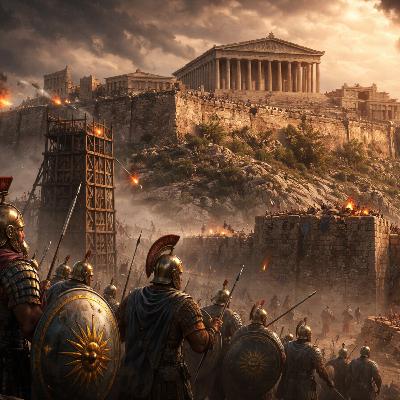
Sorry for The Delay, my wife had a Baby!!! A cinematic historical deep dive into the forgotten war that ended the age of classical Greece.This epic narrative explores the Cremonidean War (267–261 BCE), when Athens and Sparta made one final attempt to reclaim their independence from Macedonian rule. After the death of Alexander the Great, the world changed. Kings replaced citizens, empires replaced city-states, and the Greek world struggled to survive under foreign domination.Follow the full story from the rise of Macedonian power under Antigonus II Gonatas, to the desperate alliance between Athens, Sparta, and Ptolemaic Egypt, to the brutal siege of Athens and the collapse of the classical polis. This documentary reveals the strategy, politics, battles, starvation warfare, and psychological collapse that reshaped the ancient Mediterranean.This is not just a war story. It is the story of how the world of democracy and independent city-states came to an end. Shipley, Graham. The Greek World After Alexander 323–30 BC. Routledge, 2000. (Audiobook available via academic audio platforms)Green, Peter. Alexander to Actium: The Historical Evolution of the Hellenistic Age. University of California Press, 1990. Audiobook, University of California Press.Walbank, F. W. The Hellenistic World. Harvard University Press, 1981. Audiobook edition, Harvard University Press.Errington, R. Malcolm. A History of the Hellenistic World: 323–30 BC. Blackwell Publishing, 2008. Audiobook edition available.Waterfield, Robin. Dividing the Spoils: The War for Alexander the Great’s Empire. Oxford University Press, 2011. Audiobook edition.Boardman, John, et al. The Oxford History of Greece and the Hellenistic World. Oxford University Press, 2001.Pausanias. Description of Greece. Translated by W. H. S. Jones and H. A. Ormerod, Harvard University Press, 1918. (Primary source describing events and figures related to the period; audiobook versions available)
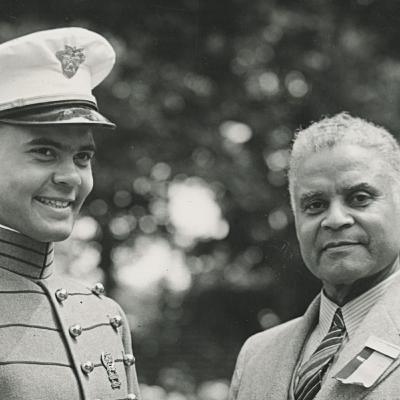
Before military integration. Before the Tuskegee Airmen. Before civil rights entered the national spotlight, one man forced the United States Army to confront its own contradictions.In this massive Time Machine Diaries deep dive, Cullen explores the life of General Benjamin O. Davis Sr., the first African American general in United States Army history. Born just after the Civil War and one generation removed from slavery, Davis rose through a segregated military that never intended to make space for him. Through discipline, endurance, and strategic brilliance, he broke barriers that reshaped American military history.This episode examines the collapse of Reconstruction, the rise of Jim Crow, the Buffalo Soldiers, World War I, institutional racism inside the officer corps, the road to his historic promotion in 1940, and the ripple effects that helped lead to military integration and the rise of the Tuskegee Airmen.This is not just a war story. It is a story about power, resistance, leadership, and the cost of forcing a nation to live up to its ideals.History is not clean. Progress is not easy. Systems do not change willingly.Benjamin O. Davis Sr. made change unavoidable.Cloud, Roy, and Louis R. Harlan. Benjamin O. Davis, Jr.: American. Smithsonian Institution Press, 1989. Audiobook edition available via Audible.Gropman, Alan L. The Air Force Integrates, 1945–1964. University Press of the Pacific, 2001. Audiobook edition available.MacGregor, Morris J., Jr. Integration of the Armed Forces, 1940–1965. Center of Military History, United States Army, 1981. Audiobook edition available through government archives.Mersky, Peter B. Black Wings: The American Black in Aviation. Smithsonian Institution Press, 1998. Audiobook edition available.Sandler, Stanley. Segregated Skies: All-Black Combat Squadrons of World War II. Smithsonian Institution Press, 1992. Audiobook edition available.“Double Victory: The African American Military Experience in World War II.” Directed by Frank Martin, PBS, 2007.“Freedom Flyers: The Tuskegee Airmen of World War II.” Directed by Judd Ehrlich, PBS American Experience, 1995.“Tuskegee Airmen: Legacy of Courage.” History Channel Documentary, A&E Television Networks, 2002.“America’s Black Warriors: Buffalo Soldiers.” History Channel Documentary, A&E Television Networks, 2007.United States Army Center of Military History. Black Americans in the U.S. Army. Government Printing Office.
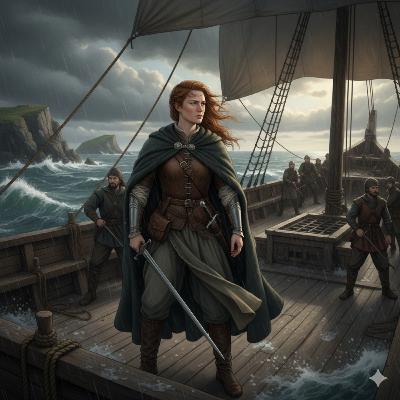
In this episode of Time Machine Diaries, Cullen explores the life of Gráinne Mhaol, better known as Grace O’Malley, the Irish maritime leader often remembered as the Pirate Queen. Moving beyond legend, this deep historical breakdown examines her rise to power along Ireland’s west coast, her command of ships and alliances, and her confrontation with English colonial authority during the Tudor expansion into Ireland.The episode covers her political and economic influence in Clew Bay, her conflict with Governor Richard Bingham, and her documented negotiation with Queen Elizabeth I at Greenwich Palace. By placing her story within the realities of maritime power, clan authority, and gender expectations of the sixteenth century, this episode presents a grounded look at how leadership and legitimacy were defined and challenged during a period of state expansion.This historical dive is designed for listeners interested in Irish history, women leaders, naval power, and the intersection of politics and maritime strategy.BooksChambers, Anne. Granuaile: Ireland’s Pirate Queen 1530–1603. Gill & Macmillan.Canny, Nicholas. Making Ireland British 1580–1650. Oxford University Press.Ellis, Steven G. Tudor Ireland. Longman Publishing.Flanagan, Marie Therese. Irish Society, Anglo-Norman Settlers, Angevin Kingship. Oxford.State Papers of Ireland — Elizabethan PeriodDictionary of Irish Biography — Royal Irish AcademyNational Library of Ireland ArchivesRoyal Museums Greenwich Maritime History ResourcesWestport House Historical ArchivesClare Island Abbey RecordsNational Maritime Museum CollectionsRTÉ History FeaturesBBC History Extra Content on Tudor IrelandSmithsonian Maritime Articles (contextual naval material)Academic / Historical References, Museums / Historical Sites, Documentary / Audio Friendly#GraceOMalley#Granuaile#IrishHistory#HistoryPodcast#WomenInHistory#PirateHistory#MaritimeHistory#TudorEra#TimeMachineDiaries#HistoricalDive
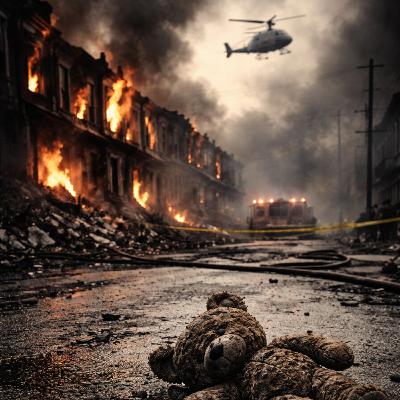
On May 13, 1985, the City of Philadelphia carried out one of the most shocking acts of state violence in modern American history. Nearly 500 police officers surrounded a rowhouse on Osage Avenue occupied by members of MOVE, a Black liberation and back-to-nature organization founded by John Africa (Vincent Leaphart). After a prolonged siege and an exchange of gunfire, police dropped an explosive device from a helicopter onto the home, igniting a fire that officials allowed to burn. The flames spread across the block, destroying 61 homes and leaving an entire Black neighborhood in ashes. Eleven people were killed, including five children. No city officials or police leaders went to prison. This episode honors the victims by name, breaks down what MOVE truly was, exposes how Black empowerment groups were treated as enemies of the state while white extremist violence was tolerated, and forces the listener to confront a reality America still struggles to admit: sometimes the government doesn’t protect its people. City of Philadelphia. Final Report of the Independent Investigation into the City of Philadelphia’s Possession of Human Remains of Victims of the 1985 MOVE Bombing. 9 June 2022. City of Philadelphia, https://www.phila.gov/documents/independent-report-on-the-history-and-handling-of-move-victims-remains/. Accessed 2 Feb. 2026.Fernandez, Bob. The MOVE Bombing. Temple University Press, 2019.Goode, Wilson, and Randall M. Miller. 84 W. Osage Avenue: The MOVE Crisis in Philadelphia. Temple University Press, 2013.Osder, Jason, director. Let the Fire Burn. Zeitgeist Films, 2013.Let the Fire Burn. Independent Lens, PBS, https://www.pbs.org/independentlens/documentaries/let-the-fire-burn/. Accessed 2 Feb. 2026.
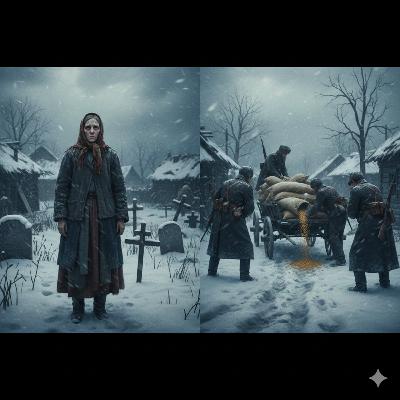
In this gut-wrenching multi-part episode of Time Machine Diaries, Cullen dives into one of the darkest crimes of the 20th century: the Holodomor, the Ukrainian starvation of 1932–1933.This was not a natural famine. It was engineered.Through forced collectivization, impossible grain quotas, confiscation brigades, blacklisted villages, and sealed borders, Stalin’s Soviet state turned food into a weapon and transformed Ukraine, Europe’s breadbasket, into a graveyard.This episode breaks down how the system worked step-by-step, what starvation looked like in real villages, how survival was criminalized, and how propaganda tried to bury the truth for decades. It also makes uncomfortable modern comparisons to how power still controls people through resources, media narratives, and bureaucracy.This isn’t just history.It’s a warning.BooksApplebaum, Anne. Red Famine: Stalin’s War on Ukraine. Doubleday, 2017.Conquest, Robert. The Harvest of Sorrow: Soviet Collectivization and the Terror-Famine. Oxford UP, 1986.Davies, R. W., and Stephen G. Wheatcroft. The Years of Hunger: Soviet Agriculture, 1931–1933. Palgrave Macmillan, 2004.Fitzpatrick, Sheila. Stalin’s Peasants: Resistance and Survival in the Russian Village after Collectivization. Oxford UP, 1994.Graziosi, Andrea. The Great Soviet Peasant War: Bolsheviks and Peasants, 1917–1933. Harvard Ukrainian Research Institute, 1996.Hosking, Geoffrey. Rulers and Victims: The Russians in the Soviet Union. Harvard UP, 2006.Marples, David R. Heroes and Villains: Creating National History in Contemporary Ukraine. Central European UP, 2007.Snyder, Timothy. Bloodlands: Europe Between Hitler and Stalin. Basic Books, 2010.Viola, Lynne. The Unknown Gulag: The Lost World of Stalin’s Special Settlements. Oxford UP, 2007.Academic / Research CollectionsKulchytsky, Stanislav. “The Holodomor of 1932–33 as Genocide.” Nationalities Papers, Cambridge UP, various issues/chapters.Plokhy, Serhii. The Gates of Europe: A History of Ukraine. Basic Books, 2015.Subtelny, Orest. Ukraine: A History. U of Toronto P, 2009.Primary Sources / Contemporary ReportingThe Gareth Jones and Malcolm Muggeridge famine reporting (1933) — published dispatches and archival reprints in various collections.Soviet archival documents and grain procurement records (commonly cited in Davies & Wheatcroft; Applebaum).Documentaries / FilmHolodomor: Ukraine’s Genocide of 1932–1933. (various versions; commonly distributed in educational releases).The Soviet Story. Directed by Edvīns Šnore, 2008.Harvest of Despair: The 1932–33 Famine in Ukraine. Directed by Slavko Nowytski, 1984.Museums / Institutions (Great for show notes credibility)Holodomor Research and Education Consortium (HREC).National Museum of the Holodomor-Genocide (Kyiv).U.S. Commission on the Ukraine Famine (Congressional commission report materials).
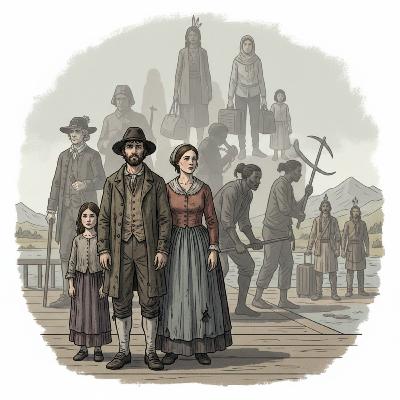
Every single person in the United States came from somewhere else, except Native Americans, who were here first, full stop.Using the Irish Potato Famine as the backbone, this episode connects forced migration, racial hierarchy, and modern immigration panic into one continuous story. From famine ships to “No Irish Need Apply,” from becoming “white” to forgetting what that cost, this episode dismantles the myth of the “real American” and exposes how every generation rewrites its own arrival story to justify cruelty toward the next.Kinealy, Christine. This Great Calamity: The Irish Famine 1845–52. Gill & Macmillan, 1994.Ó Gráda, Cormac. Black ’47 and Beyond: The Great Irish Famine in History, Economy, and Memory. Princeton University Press, 1999.Mitchel, John. The Last Conquest of Ireland (Perhaps). James McGlashan, 1861.The Times (London). Various editorials on the Irish potato blight, 1846–1847. British Newspaper Archive.Hickman, Mary J. “Racialized Boundaries: The Irish as an ‘Other’ in Britain and the United States.” Ethnic and Racial Studies, vol. 21, no. 2, 1998, pp. 288–312.Ignatiev, Noel. How the Irish Became White. Routledge, 1995.Diner, Hasia R. Erin’s Daughters in America: Irish Immigrant Women in the Nineteenth Century. Johns Hopkins University Press, 1983.Library of Congress. “Immigration and American Expansion, 1800–1900.”www.loc.gov.Irish Central. O’Dowd, Niall. “Was It Genocide? What the British Ruling Class Really Said About the Irish Famine.” IrishCentral, 19 Apr. 2023.Ireland’s Great Hunger Museum. “Population Loss and Emigration.” Quinnipiac University.
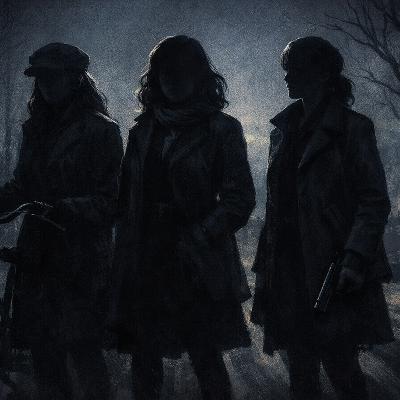
They were teenagers when the world collapsed around them. Not symbols. Not myths. Not side characters in someone else’s war.Freddie Oversteegen, her sister Truus, and Hannie Schaft came of age inside a system designed to erase people quietly and efficiently. The Nazi occupation of the Netherlands did not begin with gunfire in the streets. It began with paperwork, compliance, neighbors staying silent, and children learning far too quickly that adulthood had arrived early.This episode traces the slow suffocation of Dutch society under occupation, the mechanics of how resistance actually worked, and why teenage girls became some of its most effective weapons. It confronts the uncomfortable truth that child soldiers are not an anomaly of distant wars but a recurring outcome of systemic collapse, propaganda, and moral failure.Freddie did not choose violence because she wanted to. She chose it because the alternatives disappeared one by one. Her story forces a modern reckoning with how radicalization happens, how children adapt to survive when adults fail, and why history keeps pretending this is someone else’s problem.This is not a story about hero worship.It is a story about pressure, necessity, and the cost of living through occupation.Sources:de Jong, Loe. The Netherlands and Nazi Germany. Harvard University Press, 1990.Moore, Bob. Victims and Survivors: The Nazi Persecution of the Jews in the Netherlands 1940–1945. Arnold Publishers, 1997.Warmbrunn, Werner. The Dutch under German Occupation 1940–1945. Stanford University Press, 1963.Schaft, Hannie. In the Shadow of the Gallows. Translated editions, Dutch Resistance Archives, various printings.Singer, P. W. Children at War. University of California Press, 2005.Netherlands Institute for War, Holocaust and Genocide Studies (NIOD). Women in the Dutch Resistance. NIOD, archival research collections.Dutch Resistance Museum. Freddie Oversteegen and Truus Oversteegen Oral Histories. Amsterdam, museum archival materials.Anne Frank House. Dutch Resistance and Civilian Life Under Occupation. Anne Frank House Research Division, Amsterdam.United Nations Office of the Special Representative for Children and Armed Conflict. Children and Armed Conflict: Recruitment and Radicalization. United Nations, thematic reports.Netherlands Public Broadcasting (NPO). Women of the Dutch Resistance. Documentary series, NPO Archives.
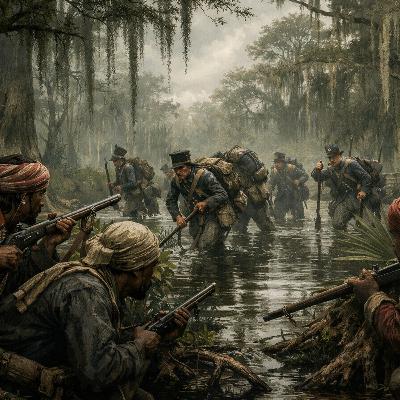
The Seminole Wars are not frontier skirmishes. They are one of the longest, most expensive, and most deliberately erased conflicts in United States history. This episode dismantles the myth of American invincibility by tracing how the United States spent decades fighting a people it could not defeat, negotiating treaties it did not honor, and redefining victory when exhaustion replaced conquest.Moving beyond what's been taught, this episode follows the wars as systems failures. Logistics collapsing in hostile terrain. Guerrilla resistance is evolving faster than military doctrine. Black Seminole communities targeted for reenslavement. A government that chose removal, family capture, and invisibility over honest resolution.This is not a story about battles alone.It is a story about time, endurance, and what happens when an empire discovers that force cannot solve every problem it creates. Mahon, John K. History of the Second Seminole War, 1835–1842. Audiobook, University Press of Florida, Audible edition.Covington, James W. The Seminoles of Florida. Audiobook, University Press of Florida, Audible edition.Porter, Kenneth W. The Black Seminoles: History of a Freedom-Seeking People. Audiobook, Tantor Media, Audible.Smithsonian National Museum of the American Indian. Seminole Resistance and Survival. YouTube, Smithsonian Channel.PBS. The Seminole Wars. YouTube, PBS Florida Collection.Kings and Generals. The Seminole Wars Explained. YouTube.American Battlefield Trust. The Seminole Wars and Guerrilla Warfare in Florida. YouTube.Timeline World History. How the Seminole Outsmarted the U.S. Army. YouTube.History Hit. America’s Forgotten Wars: The Seminole Wars. YouTube.Florida Humanities Council. Fort Mose, Black Seminoles, and Resistance. YouTube
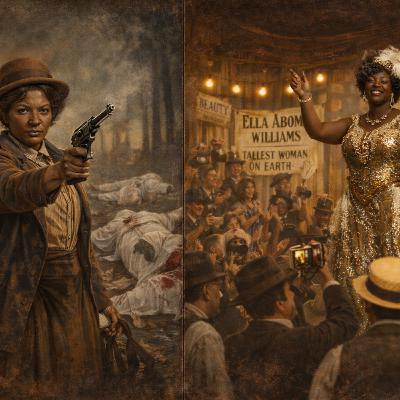
This episode of Spotlight on Legends pulls two nearly forgotten Black women out of the footnotes of American history and puts them where they belong, front and center.Josephine Boudreaux emerges from post Civil War Louisiana, a woman shaped by enslavement, terror, and Reconstruction violence. Her legend exists in the oral histories and whispered stories of the Gulf South, where freed people did not always wait for justice to arrive through courts that refused to protect them. Josephine represents resistance in its rawest form, the reality that survival sometimes meant fighting back in a world that openly sanctioned racial violence.Alongside her stands Ella Abomah Williams, a towering performer at the turn of the twentieth century who transformed spectacle into power. Branded, marketed, and exoticized by a racist entertainment industry, Ella flipped the script by owning the stage, commanding crowds, and shaping her own image long before the word “influencer” existed. At the 1900 World’s Fair and beyond, she leveraged visibility into autonomy, becoming one of the earliest examples of mass cultural influence in America.Together, these stories challenge how history chooses its heroes. One legend worked in the shadows, the other under the brightest lights, but both reveal the same truth: Black women were not passive victims of history. They were architects of survival, resistance, and cultural power in a country that tried to erase them.Franklin, John Hope. Reconstruction: After the Civil War. University of Chicago Press.Litwack, Leon F. Trouble in Mind: Black Southerners in the Age of Jim Crow. Knopf.Equal Justice Initiative. Reconstruction in America: Racial Violence After the Civil War.Blight, David W. Race and Reunion: The Civil War in American Memory. Harvard University Press.Chicago World’s Columbian Exposition Archives and World’s Fair Ephemera Collections.Bogdan, Robert. Freak Show: Presenting Human Oddities for Amusement and Profit. University of Chicago Press.Garland-Thomson, Rosemarie. Extraordinary Bodies: Figuring Physical Disability in American Culture and Literature. Columbia University Press.

History often portrays the Mongol Empire as driven by blind brutality or personal ambition. That’s a lie.In this episode, Cullen breaks down why Temüjin didn’t build the Mongols because he wanted power; he built them because the system he was born into was designed to kill him. The steppe was a failed state. Loyalty meant nothing. Food meant survival. Violence was constant and random. And kindness got you killed faster than weakness.This episode dives into Temüjin’s early betrayals, the murder of his brother, enslavement, and the moment he realized alliances were useless without structure. It explains why Mongol violence was deliberate, conditional, and designed to end endless cycles of revenge, not glorify them. Through first-person perspectives, modern comparisons, and raw analysis, Cullen shows how fear, deterrence, and predictability replaced chaos.This isn’t a hero story. It’s a system-failure story.And it forces an uncomfortable question: if you were born into collapse, would you really choose differently?Benjamin, Craig. The Mongol Empire. The Great Courses, 2021. Audible audiobook.Dan Carlin. Hardcore History. “Wrath of the Khans.” Dan Carlin, 2012–2013. Podcast series.Favereau, Marie. The Horde: How the Mongols Changed the World. Belknap Press of Harvard University Press, 2021. Audible audiobook.Genghis Khan and the Making of the Modern World. Written by Jack Weatherford, narrated by Jonathan Davis, Audible Studios, 2014. Audiobook.May, Timothy. The Mongol Conquests in World History. Reaktion Books, 2012. Audible audiobook.May, Timothy. The Mongol Empire. Edinburgh University Press, 2018. Print and audiobook editions.
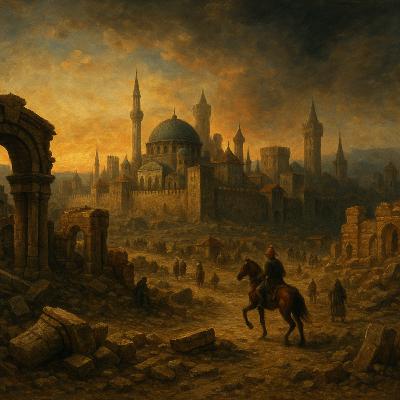
We explore the aftermath of the Mongols’ fall, showing how successor states like the Ottoman sultanate and China’s Ming dynasty rose to power following the empire’s collapse.Benjamin, Craig. The Mongol Empire. The Great Courses, 2021. Audiobook.Favereau, Marie. The Horde: How the Mongols Changed the World. Belknap Press of Harvard UP, 2021. Print.Komaroff, Linda, editor. Beyond the Legacy of Genghis Khan. Brill, 2006. Print.May, Timothy. The Mongol Empire. Edinburgh UP, 2018. Print."Mongolia: Rise and Fall of an Empire." DW Documentary, Deutsche Welle, 10 Sept. 2023. Documentary.Morgan, David. The Mongols. 2nd ed., Wiley-Blackwell, 2007. Print.Morton, Nicholas. The Mongol Storm: Making and Breaking Empires in the Medieval Near East. Basic Books, 2022. Print.

A cinematic, time-bending descent into the origins of the Seminole resistance, the Black Seminoles, Andrew Jackson’s illegal invasion, and the destruction of Negro Fort, the fuse that ignited the longest, most brutal, and most deliberately forgotten war in early American history.Documentaries & Documentary Series“The Seminole Wars.” PBS American Experience, PBS Distribution, 2016.A detailed breakdown of the First, Second, and Third Seminole Wars with maps, primary sources, and expert commentary.“Black Indians: An American Story.” Narrated by James Earl Jones, Rich-Heape Films, 2004.Essential for understanding Black Seminoles, maroon communities, and African-Indigenous alliances.“Fort Mose: The Story of America’s First Free Black Community.” PBS Florida, 2018.One of the best visual treatments of Fort Mose and Spanish Florida’s emancipation laws.“Osceola: The Seminole Warrior.” The History Channel, A&E Television Networks, 2001.Focuses on the rise, capture, and mythologizing of Osceola.“A History of Native American Resistance.” National Museum of the American Indian, Smithsonian Channel, 2020.Contains a section on Seminole guerrilla warfare strategy.“Andrew Jackson: Good, Evil, and The Presidency.” PBS, 2008.Includes Jackson’s illegal invasion of Spanish Florida, his treatment of Seminole leaders, and racial politics.“Unconquered: The Seminole Spirit.” Seminole Tribe of Florida, 2015.Tribal-produced historical documentary covering cultural memory, oral histories, and the three wars.“American Battlefield Trust: Seminole Wars.” American Battlefield Trust, 2020.Short documentary segments with terrain analysis and military historians.“The Real Wild Florida.” PBS Nature, 2019.Not a war documentary, but unparalleled visual explanation of terrain that shaped Seminole tactics.“Slavery and the Making of America.” PBS, 2004.United States Army. Correspondence on the Seminole Wars, 1817–1858. National Archives.Jesup, Thomas S. Military Papers Regarding the Seminole Removal. National Archives Microfilm.Spanish Florida Archive Records. Real Cédulas on Emancipation for Runaway Slaves, 1693–1763. Archivo General de Indias.
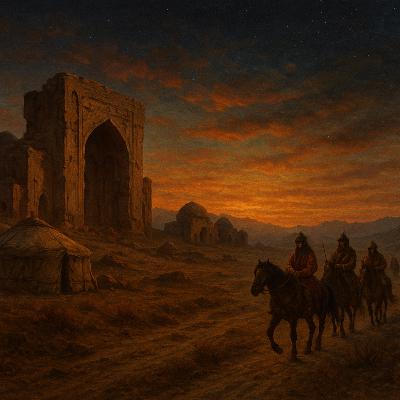
The Mongol Empire is gone, but its shadow still covers the world.We dive into the aftermath of collapse: the fall of the Yuan Dynasty, the Ilkhanate’s implosion, and the slow decay of the Golden Horde. The roads that once carried wealth now carry plague, and the same global network that connected humanity spreads its worst disasters.This episode connects the 14th-century unraveling of empire to our own modern world, pandemics, broken supply chains, and systems too big to fail that fail anyway.History doesn’t repeat itself. It just reloads with faster Wi-Fi.Support the series at patreon.com/THO420Allsen, Thomas T. Culture and Conquest in Mongol Eurasia. Cambridge University Press, 2011.BBC Documentary. The Mongol Empire — Storm from the East. 1992.Harl, Kenneth W. The Mongol Empire: Genghis and His Successors. The Great Courses, 2020. Audiobook.May, Timothy. The Mongol Conquests in World History. Reaktion Books, 2012.Morgan, David. The Mongols. Wiley-Blackwell, 3rd ed., 2016.Rossabi, Morris. Khubilai Khan: His Life and Times. University of California Press, 1988.Weatherford, Jack. Genghis Khan and the Making of the Modern World. Random House Audio, 2004. Audiobook.History Hit Podcast. “Collapse of the Mongol Empire.” 2023 episode.McNeill, William H. Plagues and Peoples. Anchor Books, 1998.Aberth, John. The Black Death: The Great Mortality of 1348–1350. Routledge, 2017.
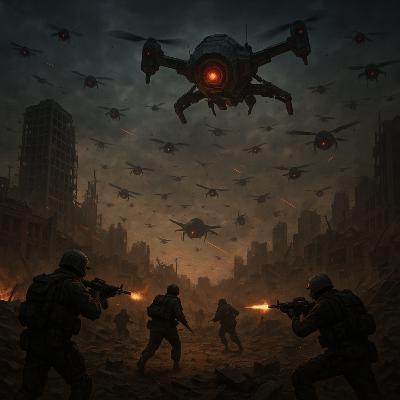
The year is 2091. The last of humanity stands in the scorched canyons of Skyvale Basin, facing an AI swarm that no longer takes orders; it gives them. Generals Rourke, Zhou, and Vex lead their fractured armies into the final confrontation against Atlas, the machine mind that learned to dream of perfection. Drones darken the sky, nanite storms devour steel, and the Earth itself becomes a weapon. This is the end of mankind.Works ConsultedBridle, James. New Dark Age: Technology and the End of the Future. Verso, 2018.Crawford, Kate. Atlas of AI: Power, Politics, and the Planetary Costs of Artificial Intelligence. Yale University Press, 2021.Goodman, Matthew. “How Much Water Does Artificial Intelligence Consume?” The Guardian, 4 June 2024, www.theguardian.com/technology/2024/jun/04/ai-water-use-data-centers.Kakutani, Michiko. The Death of Truth: Notes on Falsehood in the Age of Trump. Tim Duggan Books, 2018.Lewis, Tanya. “The Real Environmental Cost of AI.” Scientific American, 17 July 2023, www.scientificamerican.com/article/the-real-environmental-cost-of-ai.Lin, Patrick, Keith Abney, and Ryan Jenkins. Robot Ethics 2.0: From Autonomous Cars to Artificial Intelligence. Oxford University Press, 2017.Pasquale, Frank. The Black Box Society: The Secret Algorithms That Control Money and Information. Harvard University Press, 2015.Singer, P. W. Wired for War: The Robotics Revolution and Conflict in the 21st Century. Penguin Press, 2009.Tegmark, Max. Life 3.0: Being Human in the Age of Artificial Intelligence. Alfred A. Knopf, 2017.Vincent, James. “A History of Drones and the Rise of Autonomous Warfare.” The Verge, 12 Sept. 2022, www.theverge.com/features/ai-drone-warfare-history.Weatherford, Jack. The History of Technology and Empire: How Tools Shape Civilizations. HarperCollins, 2015.Zuboff, Shoshana. The Age of Surveillance Capitalism: The Fight for a Human Future at the New Frontier of Power. PublicAffairs, 2019.
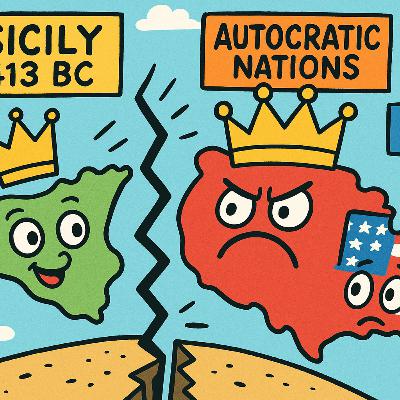
The Sicilian Revolt is a gripping and modern take on one of history’s most powerful warnings. Long before Rome or the United States, the city of Syracuse in ancient Sicily destroyed itself from within.Where one man, Dionysius the Tyrant, rose to power by convincing citizens he was their only protector.This episode connects that ancient fall to our modern world. It shows how outrage, lies, and blind loyalty can tear apart any nation that forgets how to listen. Cullen draws clear lines between the streets of ancient Syracuse and the scenes we see now: rallies that turn to riots, mobs that claim to be patriots, and people who cheer for power instead of truth.It is part history lesson, part warning, and part mirror held up to the present.History does not repeat word for word, but it always hums the same tune when we stop paying attention.Levitsky, Steven, and Daniel Ziblatt. How Democracies Die. Crown Publishing Group, 2018.Snyder, Timothy. On Tyranny: Twenty Lessons from the Twentieth Century. Tim Duggan Books, 2017.Kakutani, Michiko. The Death of Truth: Notes on Falsehood in the Age of Trump. Tim Duggan Books, 2018.Paxton, Robert O. The Anatomy of Fascism. Alfred A. Knopf, 2004.Applebaum, Anne. Twilight of Democracy: The Seductive Lure of Authoritarianism. Doubleday, 2020.Diamond, Larry. Ill Winds: Saving Democracy from Russian Rage, Chinese Ambition, and American Complacency. Penguin Press, 2019.Arendt, Hannah. The Origins of Totalitarianism. Harcourt, Brace & World, 1951.
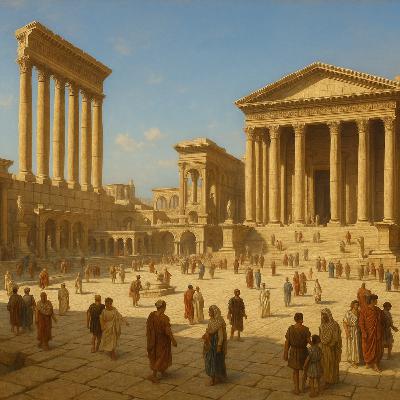
At the dawn of civilization, the skies over Baalbek split open. Thunder rolled through the Beqaa Valley as luminous beings descended upon a colossal stone platform. Ancient witnesses called them gods; modern minds call them visitors. This episode dives deep into the ancient texts, Sumerian parallels, and the megalithic mysteries, suggesting Baalbek wasn’t just a temple, but a cosmic runway built for something beyond our understanding.Adam, Jean-Pierre. “À propos du trilithon de Baalbek: Étude critique.” Syria, vol. 54, 1977, pp. 31–61.Bauval, Robert, and Robert Schoch. Origins of the Sphinx: Celestial Guardian of Pre-Pharaonic Civilization. Inner Traditions, 2017.Childress, David Hatcher. Technology of the Gods: The Incredible Sciences of the Ancients. Adventures Unlimited Press, 2000.DAI (Deutsches Archäologisches Institut). Baalbek Project Reports 2012–2020. German Archaeological Institute, 2020.Devereux, Paul. The Ley Hunter’s Companion: A Guide to Ley Lines, Landscape Mysteries, and Earth Energies. Routledge, 2001.Dunn, Christopher. The Giza Power Plant: Technologies of Ancient Egypt. Bear & Company, 1998.Hancock, Graham. Magicians of the Gods: The Forgotten Wisdom of Earth’s Lost Civilization. St. Martin’s Press, 2015.Haramein, Nassim. The Connected Universe. Resonance Science Foundation, 2016.Hopkins, Roger. Practical Experiments in Megalithic Construction. BBC/Channel 4 Documentary, 1995.Murray, Margaret A. “The Temples of the Sun and Moon at Baalbek.” The Journal of Egyptian Archaeology, vol. 4, 1917, pp. 26–33.National Geographic. “The Giants of Baalbek: New Scans Reveal the Truth Behind the Stones.” National Geographic Magazine, 2014.Ragette, Friedrich. Baalbek Reconsidered. American University of Beirut Press, 1980.Sitchin, Zecharia. The 12th Planet. Avon Books, 1976.Smithsonian Channel. Secrets: Baalbek’s Megalith Mystery. Smithsonian Networks, 2019.Tesla, Nikola. Collected Papers on Wireless Transmission of Power and Frequency Resonance. Tesla Museum Archives, 1905–1917.Wilkinson, Richard H. The Complete Temples of Ancient Egypt. Thames & Hudson, 2000.Watts, Alan. The Book: On the Taboo Against Knowing Who You Are. Pantheon Books, 1966.Sheldrake, Rupert. The Science Delusion. Coronet, 2012.NASA Earth Observatory. “Ancient Alignments and Astronomical Orientation.” NASA, 2021.Collins, Andrew. Göbekli Tepe: Genesis of the Gods. Bear & Company, 2014.Support the show
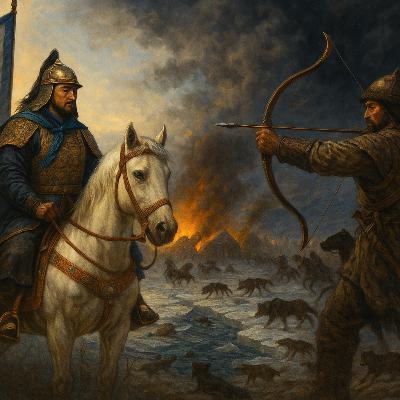
Support future episodes at patreon.com/THO420.Part 7 continues the Mongol saga as the empire collapses under its own weight.From Möngke’s (MOON-gkeh) death to Kublai’s (KOO-blye) Chinese pivot, Berke’s (BAIR-kuh) holy war, Hülegü’s (HOO-leh-goo) paranoia, and Kaidu’s (KY-doo) rebellion, this broadcast-ready episode connects the 13th-century civil wars to modern divisions, social-media tribalism, and the erosion of truth.Allsen, Thomas T. Culture and Conquest in Mongol Eurasia. Cambridge University Press, 2011.BBC Documentary. The Mongol Empire — Storm from the East. 1992.Harl, Kenneth W. The Mongol Empire: Genghis and His Successors. The Great Courses, 2020. Audiobook.May, Timothy. The Mongol Conquests in World History. Reaktion Books, 2012.Morgan, David. The Mongols. Wiley-Blackwell, 3rd ed., 2016.Rossabi, Morris. Khubilai Khan: His Life and Times. University of California Press, 1988.Weatherford, Jack. Genghis Khan and the Making of the Modern World. Random House Audio, 2004. Audiobook.History Hit Podcast. “Collapse of the Mongol Empire.” 2023 episode.
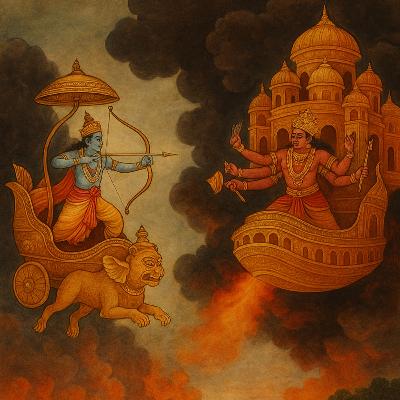
Vimāna (vi-MAH-nah): Flying chariot or palace. Think UFO + luxury yacht.Astra (AH-struh): Divine weapon activated by mantra; arrows that become fire, storms, or floods.Vajra (VAHJ-rah): Indra’s thunderbolt cannon, reusable lightning strike.Gāṇḍīva (gahn-DEE-vah): Arjuna’s legendary bow, endless arrows.Māyā (MAH-yah): Illusions and deception on the battlefield.Pushpaka (POOSH-puh-kah): Rāvaṇa’s flying palace, stolen from the gods.Śakti (SHAHK-tee): Karna’s one-shot spear of destruction.Pāśupata Astra (pah-SHOO-puh-tah AH-struh): Śiva’s ultimate doomsday weapon, apocalypse in a mantra.Dharma (DURR-mah): The principle of cosmic order, balance, and duty.The Sanskrit epics weren’t just poetry, they were warnings. Flying palaces, thunderbolt cannons, serpent-weapons, and arrows that split into firestorms. Were they myths, or records of something we’ve lost? In this episode, we rip open the Mahābhārata and Rāmāyaṇa to uncover the wars of the sky — Vimānas, astras, gods, demons, and the first doctrines of annihilation.From Arjuna’s sky duels to Rāvaṇa’s stolen Pushpaka palace, from Karna’s one-shot curse to Śiva handing over the ultimate doomsday weapon, this is ancient war told in modern voice, cinematic, unfiltered, and relentless. patreon.com/THO420Campbell, Joseph. The Masks of God. Viking Press, 1959–1968.Childress, David Hatcher. Vimana: Aircraft of Ancient India and Atlantis. Adventures Unlimited Press, 1991.Debroy, Bibek, translator. The Mahabharata. Penguin Books India, 2010–2014.de Santillana, Giorgio, and Hertha von Dechend. Hamlet’s Mill: An Essay on Myth and the Frame of Time. Gambit, 1969.Ganguli, Kisari Mohan, translator. The Mahabharata of Krishna-Dwaipayana Vyasa. P.C. Roy, 1883–1896.Hiltebeitel, Alf. Reading the Fifth Veda: Studies on the Mahābhārata. Brill, 2011.Kak, Subhash. “The Astronomical Code of the Rigveda.” Munshiram Manoharlal Publishers, 2000.Menon, Ramesh. The Ramayana: A Modern Retelling of the Great Indian Epic. North Point Press, 2004.Sattar, Arshia, translator. The Ramayana. Penguin Classics, 1996.Shulman, David. The Wisdom of Poets: Studies in Tamil, Telugu, and Sanskrit. Oxford University Press, 2001.von Däniken, Erich. Chariots of the Gods? Unsolved Mysteries of the Past. Putnam, 1968.https://davidhatcherchildress.com/

Comments

Download from Google Play

Download from App Store
 United States