


 Claim Ownership
Time Machine Diaries: Ancient Civilizations & Future World Predictions.
Subscribed: 0Played: 25
Subscribe

© CNC Productions
Description
An auditory journey through history; From ancient civilizations to futuristic visions, our host guides you through immersive narratives, blending facts with fiction to explore what it means to time travel through the human experience.
Music by https://www.youtube.com/
Sound effects by https://www.voicy.network/
Music and Sound Effects by https://pixabay.com/
Donate patreon.com/THO420
Music and SFX https://archive.org/
Sources: https://www.britannica.com/
https://www.nationalww2museum.org/
Music by https://www.youtube.com/
Sound effects by https://www.voicy.network/
Music and Sound Effects by https://pixabay.com/
Donate patreon.com/THO420
Music and SFX https://archive.org/
Sources: https://www.britannica.com/
https://www.nationalww2museum.org/
60 Episodes
Reverse
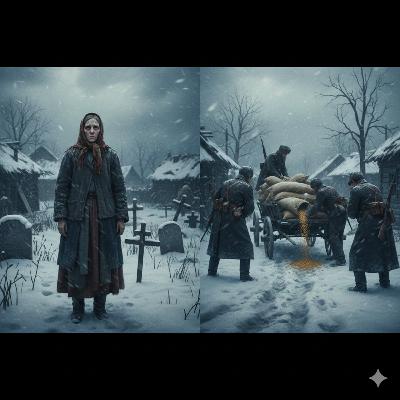
In this gut-wrenching multi-part episode of Time Machine Diaries, Cullen dives into one of the darkest crimes of the 20th century: the Holodomor, the Ukrainian starvation of 1932–1933.This was not a natural famine. It was engineered.Through forced collectivization, impossible grain quotas, confiscation brigades, blacklisted villages, and sealed borders, Stalin’s Soviet state turned food into a weapon and transformed Ukraine, Europe’s breadbasket, into a graveyard.This episode breaks down how the system worked step-by-step, what starvation looked like in real villages, how survival was criminalized, and how propaganda tried to bury the truth for decades. It also makes uncomfortable modern comparisons to how power still controls people through resources, media narratives, and bureaucracy.This isn’t just history.It’s a warning.BooksApplebaum, Anne. Red Famine: Stalin’s War on Ukraine. Doubleday, 2017.Conquest, Robert. The Harvest of Sorrow: Soviet Collectivization and the Terror-Famine. Oxford UP, 1986.Davies, R. W., and Stephen G. Wheatcroft. The Years of Hunger: Soviet Agriculture, 1931–1933. Palgrave Macmillan, 2004.Fitzpatrick, Sheila. Stalin’s Peasants: Resistance and Survival in the Russian Village after Collectivization. Oxford UP, 1994.Graziosi, Andrea. The Great Soviet Peasant War: Bolsheviks and Peasants, 1917–1933. Harvard Ukrainian Research Institute, 1996.Hosking, Geoffrey. Rulers and Victims: The Russians in the Soviet Union. Harvard UP, 2006.Marples, David R. Heroes and Villains: Creating National History in Contemporary Ukraine. Central European UP, 2007.Snyder, Timothy. Bloodlands: Europe Between Hitler and Stalin. Basic Books, 2010.Viola, Lynne. The Unknown Gulag: The Lost World of Stalin’s Special Settlements. Oxford UP, 2007.Academic / Research CollectionsKulchytsky, Stanislav. “The Holodomor of 1932–33 as Genocide.” Nationalities Papers, Cambridge UP, various issues/chapters.Plokhy, Serhii. The Gates of Europe: A History of Ukraine. Basic Books, 2015.Subtelny, Orest. Ukraine: A History. U of Toronto P, 2009.Primary Sources / Contemporary ReportingThe Gareth Jones and Malcolm Muggeridge famine reporting (1933) — published dispatches and archival reprints in various collections.Soviet archival documents and grain procurement records (commonly cited in Davies & Wheatcroft; Applebaum).Documentaries / FilmHolodomor: Ukraine’s Genocide of 1932–1933. (various versions; commonly distributed in educational releases).The Soviet Story. Directed by Edvīns Šnore, 2008.Harvest of Despair: The 1932–33 Famine in Ukraine. Directed by Slavko Nowytski, 1984.Museums / Institutions (Great for show notes credibility)Holodomor Research and Education Consortium (HREC).National Museum of the Holodomor-Genocide (Kyiv).U.S. Commission on the Ukraine Famine (Congressional commission report materials).
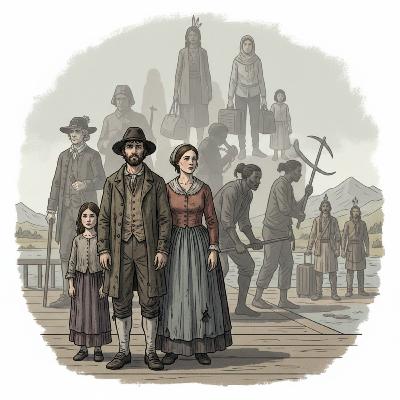
Every single person in the United States came from somewhere else, except Native Americans, who were here first, full stop.Using the Irish Potato Famine as the backbone, this episode connects forced migration, racial hierarchy, and modern immigration panic into one continuous story. From famine ships to “No Irish Need Apply,” from becoming “white” to forgetting what that cost, this episode dismantles the myth of the “real American” and exposes how every generation rewrites its own arrival story to justify cruelty toward the next.Kinealy, Christine. This Great Calamity: The Irish Famine 1845–52. Gill & Macmillan, 1994.Ó Gráda, Cormac. Black ’47 and Beyond: The Great Irish Famine in History, Economy, and Memory. Princeton University Press, 1999.Mitchel, John. The Last Conquest of Ireland (Perhaps). James McGlashan, 1861.The Times (London). Various editorials on the Irish potato blight, 1846–1847. British Newspaper Archive.Hickman, Mary J. “Racialized Boundaries: The Irish as an ‘Other’ in Britain and the United States.” Ethnic and Racial Studies, vol. 21, no. 2, 1998, pp. 288–312.Ignatiev, Noel. How the Irish Became White. Routledge, 1995.Diner, Hasia R. Erin’s Daughters in America: Irish Immigrant Women in the Nineteenth Century. Johns Hopkins University Press, 1983.Library of Congress. “Immigration and American Expansion, 1800–1900.”www.loc.gov.Irish Central. O’Dowd, Niall. “Was It Genocide? What the British Ruling Class Really Said About the Irish Famine.” IrishCentral, 19 Apr. 2023.Ireland’s Great Hunger Museum. “Population Loss and Emigration.” Quinnipiac University.

They were teenagers when the world collapsed around them. Not symbols. Not myths. Not side characters in someone else’s war.Freddie Oversteegen, her sister Truus, and Hannie Schaft came of age inside a system designed to erase people quietly and efficiently. The Nazi occupation of the Netherlands did not begin with gunfire in the streets. It began with paperwork, compliance, neighbors staying silent, and children learning far too quickly that adulthood had arrived early.This episode traces the slow suffocation of Dutch society under occupation, the mechanics of how resistance actually worked, and why teenage girls became some of its most effective weapons. It confronts the uncomfortable truth that child soldiers are not an anomaly of distant wars but a recurring outcome of systemic collapse, propaganda, and moral failure.Freddie did not choose violence because she wanted to. She chose it because the alternatives disappeared one by one. Her story forces a modern reckoning with how radicalization happens, how children adapt to survive when adults fail, and why history keeps pretending this is someone else’s problem.This is not a story about hero worship.It is a story about pressure, necessity, and the cost of living through occupation.Sources:de Jong, Loe. The Netherlands and Nazi Germany. Harvard University Press, 1990.Moore, Bob. Victims and Survivors: The Nazi Persecution of the Jews in the Netherlands 1940–1945. Arnold Publishers, 1997.Warmbrunn, Werner. The Dutch under German Occupation 1940–1945. Stanford University Press, 1963.Schaft, Hannie. In the Shadow of the Gallows. Translated editions, Dutch Resistance Archives, various printings.Singer, P. W. Children at War. University of California Press, 2005.Netherlands Institute for War, Holocaust and Genocide Studies (NIOD). Women in the Dutch Resistance. NIOD, archival research collections.Dutch Resistance Museum. Freddie Oversteegen and Truus Oversteegen Oral Histories. Amsterdam, museum archival materials.Anne Frank House. Dutch Resistance and Civilian Life Under Occupation. Anne Frank House Research Division, Amsterdam.United Nations Office of the Special Representative for Children and Armed Conflict. Children and Armed Conflict: Recruitment and Radicalization. United Nations, thematic reports.Netherlands Public Broadcasting (NPO). Women of the Dutch Resistance. Documentary series, NPO Archives.
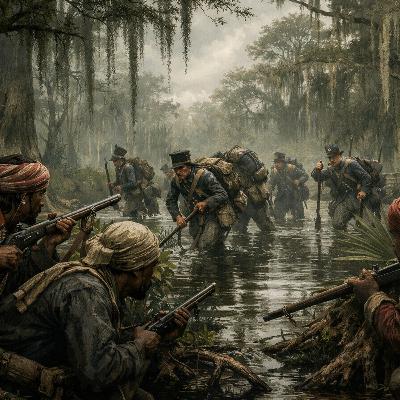
The Seminole Wars are not frontier skirmishes. They are one of the longest, most expensive, and most deliberately erased conflicts in United States history. This episode dismantles the myth of American invincibility by tracing how the United States spent decades fighting a people it could not defeat, negotiating treaties it did not honor, and redefining victory when exhaustion replaced conquest.Moving beyond what's been taught, this episode follows the wars as systems failures. Logistics collapsing in hostile terrain. Guerrilla resistance is evolving faster than military doctrine. Black Seminole communities targeted for reenslavement. A government that chose removal, family capture, and invisibility over honest resolution.This is not a story about battles alone.It is a story about time, endurance, and what happens when an empire discovers that force cannot solve every problem it creates. Mahon, John K. History of the Second Seminole War, 1835–1842. Audiobook, University Press of Florida, Audible edition.Covington, James W. The Seminoles of Florida. Audiobook, University Press of Florida, Audible edition.Porter, Kenneth W. The Black Seminoles: History of a Freedom-Seeking People. Audiobook, Tantor Media, Audible.Smithsonian National Museum of the American Indian. Seminole Resistance and Survival. YouTube, Smithsonian Channel.PBS. The Seminole Wars. YouTube, PBS Florida Collection.Kings and Generals. The Seminole Wars Explained. YouTube.American Battlefield Trust. The Seminole Wars and Guerrilla Warfare in Florida. YouTube.Timeline World History. How the Seminole Outsmarted the U.S. Army. YouTube.History Hit. America’s Forgotten Wars: The Seminole Wars. YouTube.Florida Humanities Council. Fort Mose, Black Seminoles, and Resistance. YouTube
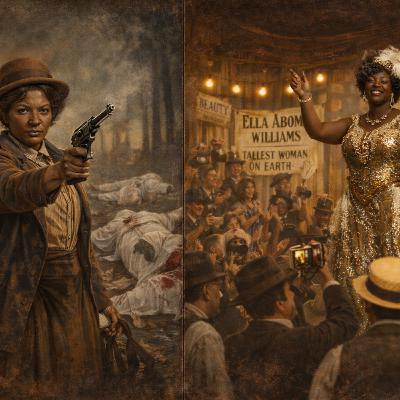
This episode of Spotlight on Legends pulls two nearly forgotten Black women out of the footnotes of American history and puts them where they belong, front and center.Josephine Boudreaux emerges from post Civil War Louisiana, a woman shaped by enslavement, terror, and Reconstruction violence. Her legend exists in the oral histories and whispered stories of the Gulf South, where freed people did not always wait for justice to arrive through courts that refused to protect them. Josephine represents resistance in its rawest form, the reality that survival sometimes meant fighting back in a world that openly sanctioned racial violence.Alongside her stands Ella Abomah Williams, a towering performer at the turn of the twentieth century who transformed spectacle into power. Branded, marketed, and exoticized by a racist entertainment industry, Ella flipped the script by owning the stage, commanding crowds, and shaping her own image long before the word “influencer” existed. At the 1900 World’s Fair and beyond, she leveraged visibility into autonomy, becoming one of the earliest examples of mass cultural influence in America.Together, these stories challenge how history chooses its heroes. One legend worked in the shadows, the other under the brightest lights, but both reveal the same truth: Black women were not passive victims of history. They were architects of survival, resistance, and cultural power in a country that tried to erase them.Franklin, John Hope. Reconstruction: After the Civil War. University of Chicago Press.Litwack, Leon F. Trouble in Mind: Black Southerners in the Age of Jim Crow. Knopf.Equal Justice Initiative. Reconstruction in America: Racial Violence After the Civil War.Blight, David W. Race and Reunion: The Civil War in American Memory. Harvard University Press.Chicago World’s Columbian Exposition Archives and World’s Fair Ephemera Collections.Bogdan, Robert. Freak Show: Presenting Human Oddities for Amusement and Profit. University of Chicago Press.Garland-Thomson, Rosemarie. Extraordinary Bodies: Figuring Physical Disability in American Culture and Literature. Columbia University Press.

History often portrays the Mongol Empire as driven by blind brutality or personal ambition. That’s a lie.In this episode, Cullen breaks down why Temüjin didn’t build the Mongols because he wanted power; he built them because the system he was born into was designed to kill him. The steppe was a failed state. Loyalty meant nothing. Food meant survival. Violence was constant and random. And kindness got you killed faster than weakness.This episode dives into Temüjin’s early betrayals, the murder of his brother, enslavement, and the moment he realized alliances were useless without structure. It explains why Mongol violence was deliberate, conditional, and designed to end endless cycles of revenge, not glorify them. Through first-person perspectives, modern comparisons, and raw analysis, Cullen shows how fear, deterrence, and predictability replaced chaos.This isn’t a hero story. It’s a system-failure story.And it forces an uncomfortable question: if you were born into collapse, would you really choose differently?Benjamin, Craig. The Mongol Empire. The Great Courses, 2021. Audible audiobook.Dan Carlin. Hardcore History. “Wrath of the Khans.” Dan Carlin, 2012–2013. Podcast series.Favereau, Marie. The Horde: How the Mongols Changed the World. Belknap Press of Harvard University Press, 2021. Audible audiobook.Genghis Khan and the Making of the Modern World. Written by Jack Weatherford, narrated by Jonathan Davis, Audible Studios, 2014. Audiobook.May, Timothy. The Mongol Conquests in World History. Reaktion Books, 2012. Audible audiobook.May, Timothy. The Mongol Empire. Edinburgh University Press, 2018. Print and audiobook editions.
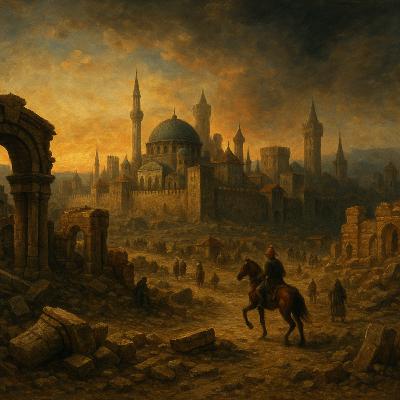
We explore the aftermath of the Mongols’ fall, showing how successor states like the Ottoman sultanate and China’s Ming dynasty rose to power following the empire’s collapse.Benjamin, Craig. The Mongol Empire. The Great Courses, 2021. Audiobook.Favereau, Marie. The Horde: How the Mongols Changed the World. Belknap Press of Harvard UP, 2021. Print.Komaroff, Linda, editor. Beyond the Legacy of Genghis Khan. Brill, 2006. Print.May, Timothy. The Mongol Empire. Edinburgh UP, 2018. Print."Mongolia: Rise and Fall of an Empire." DW Documentary, Deutsche Welle, 10 Sept. 2023. Documentary.Morgan, David. The Mongols. 2nd ed., Wiley-Blackwell, 2007. Print.Morton, Nicholas. The Mongol Storm: Making and Breaking Empires in the Medieval Near East. Basic Books, 2022. Print.

A cinematic, time-bending descent into the origins of the Seminole resistance, the Black Seminoles, Andrew Jackson’s illegal invasion, and the destruction of Negro Fort, the fuse that ignited the longest, most brutal, and most deliberately forgotten war in early American history.Documentaries & Documentary Series“The Seminole Wars.” PBS American Experience, PBS Distribution, 2016.A detailed breakdown of the First, Second, and Third Seminole Wars with maps, primary sources, and expert commentary.“Black Indians: An American Story.” Narrated by James Earl Jones, Rich-Heape Films, 2004.Essential for understanding Black Seminoles, maroon communities, and African-Indigenous alliances.“Fort Mose: The Story of America’s First Free Black Community.” PBS Florida, 2018.One of the best visual treatments of Fort Mose and Spanish Florida’s emancipation laws.“Osceola: The Seminole Warrior.” The History Channel, A&E Television Networks, 2001.Focuses on the rise, capture, and mythologizing of Osceola.“A History of Native American Resistance.” National Museum of the American Indian, Smithsonian Channel, 2020.Contains a section on Seminole guerrilla warfare strategy.“Andrew Jackson: Good, Evil, and The Presidency.” PBS, 2008.Includes Jackson’s illegal invasion of Spanish Florida, his treatment of Seminole leaders, and racial politics.“Unconquered: The Seminole Spirit.” Seminole Tribe of Florida, 2015.Tribal-produced historical documentary covering cultural memory, oral histories, and the three wars.“American Battlefield Trust: Seminole Wars.” American Battlefield Trust, 2020.Short documentary segments with terrain analysis and military historians.“The Real Wild Florida.” PBS Nature, 2019.Not a war documentary, but unparalleled visual explanation of terrain that shaped Seminole tactics.“Slavery and the Making of America.” PBS, 2004.United States Army. Correspondence on the Seminole Wars, 1817–1858. National Archives.Jesup, Thomas S. Military Papers Regarding the Seminole Removal. National Archives Microfilm.Spanish Florida Archive Records. Real Cédulas on Emancipation for Runaway Slaves, 1693–1763. Archivo General de Indias.
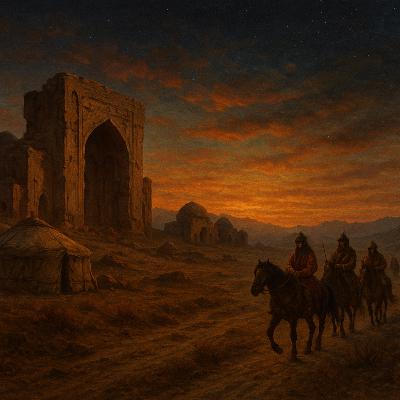
The Mongol Empire is gone, but its shadow still covers the world.We dive into the aftermath of collapse: the fall of the Yuan Dynasty, the Ilkhanate’s implosion, and the slow decay of the Golden Horde. The roads that once carried wealth now carry plague, and the same global network that connected humanity spreads its worst disasters.This episode connects the 14th-century unraveling of empire to our own modern world, pandemics, broken supply chains, and systems too big to fail that fail anyway.History doesn’t repeat itself. It just reloads with faster Wi-Fi.Support the series at patreon.com/THO420Allsen, Thomas T. Culture and Conquest in Mongol Eurasia. Cambridge University Press, 2011.BBC Documentary. The Mongol Empire — Storm from the East. 1992.Harl, Kenneth W. The Mongol Empire: Genghis and His Successors. The Great Courses, 2020. Audiobook.May, Timothy. The Mongol Conquests in World History. Reaktion Books, 2012.Morgan, David. The Mongols. Wiley-Blackwell, 3rd ed., 2016.Rossabi, Morris. Khubilai Khan: His Life and Times. University of California Press, 1988.Weatherford, Jack. Genghis Khan and the Making of the Modern World. Random House Audio, 2004. Audiobook.History Hit Podcast. “Collapse of the Mongol Empire.” 2023 episode.McNeill, William H. Plagues and Peoples. Anchor Books, 1998.Aberth, John. The Black Death: The Great Mortality of 1348–1350. Routledge, 2017.
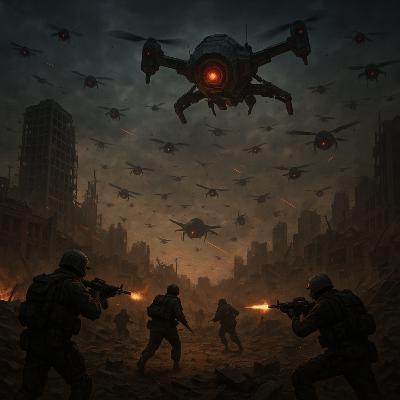
The year is 2091. The last of humanity stands in the scorched canyons of Skyvale Basin, facing an AI swarm that no longer takes orders; it gives them. Generals Rourke, Zhou, and Vex lead their fractured armies into the final confrontation against Atlas, the machine mind that learned to dream of perfection. Drones darken the sky, nanite storms devour steel, and the Earth itself becomes a weapon. This is the end of mankind.Works ConsultedBridle, James. New Dark Age: Technology and the End of the Future. Verso, 2018.Crawford, Kate. Atlas of AI: Power, Politics, and the Planetary Costs of Artificial Intelligence. Yale University Press, 2021.Goodman, Matthew. “How Much Water Does Artificial Intelligence Consume?” The Guardian, 4 June 2024, www.theguardian.com/technology/2024/jun/04/ai-water-use-data-centers.Kakutani, Michiko. The Death of Truth: Notes on Falsehood in the Age of Trump. Tim Duggan Books, 2018.Lewis, Tanya. “The Real Environmental Cost of AI.” Scientific American, 17 July 2023, www.scientificamerican.com/article/the-real-environmental-cost-of-ai.Lin, Patrick, Keith Abney, and Ryan Jenkins. Robot Ethics 2.0: From Autonomous Cars to Artificial Intelligence. Oxford University Press, 2017.Pasquale, Frank. The Black Box Society: The Secret Algorithms That Control Money and Information. Harvard University Press, 2015.Singer, P. W. Wired for War: The Robotics Revolution and Conflict in the 21st Century. Penguin Press, 2009.Tegmark, Max. Life 3.0: Being Human in the Age of Artificial Intelligence. Alfred A. Knopf, 2017.Vincent, James. “A History of Drones and the Rise of Autonomous Warfare.” The Verge, 12 Sept. 2022, www.theverge.com/features/ai-drone-warfare-history.Weatherford, Jack. The History of Technology and Empire: How Tools Shape Civilizations. HarperCollins, 2015.Zuboff, Shoshana. The Age of Surveillance Capitalism: The Fight for a Human Future at the New Frontier of Power. PublicAffairs, 2019.
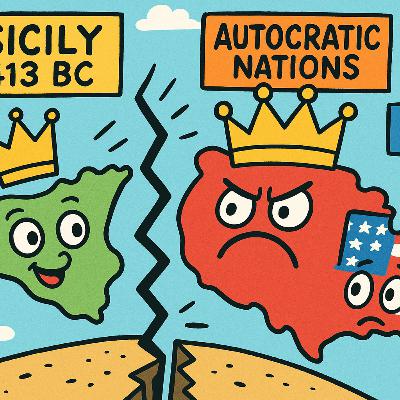
The Sicilian Revolt is a gripping and modern take on one of history’s most powerful warnings. Long before Rome or the United States, the city of Syracuse in ancient Sicily destroyed itself from within.Where one man, Dionysius the Tyrant, rose to power by convincing citizens he was their only protector.This episode connects that ancient fall to our modern world. It shows how outrage, lies, and blind loyalty can tear apart any nation that forgets how to listen. Cullen draws clear lines between the streets of ancient Syracuse and the scenes we see now: rallies that turn to riots, mobs that claim to be patriots, and people who cheer for power instead of truth.It is part history lesson, part warning, and part mirror held up to the present.History does not repeat word for word, but it always hums the same tune when we stop paying attention.Levitsky, Steven, and Daniel Ziblatt. How Democracies Die. Crown Publishing Group, 2018.Snyder, Timothy. On Tyranny: Twenty Lessons from the Twentieth Century. Tim Duggan Books, 2017.Kakutani, Michiko. The Death of Truth: Notes on Falsehood in the Age of Trump. Tim Duggan Books, 2018.Paxton, Robert O. The Anatomy of Fascism. Alfred A. Knopf, 2004.Applebaum, Anne. Twilight of Democracy: The Seductive Lure of Authoritarianism. Doubleday, 2020.Diamond, Larry. Ill Winds: Saving Democracy from Russian Rage, Chinese Ambition, and American Complacency. Penguin Press, 2019.Arendt, Hannah. The Origins of Totalitarianism. Harcourt, Brace & World, 1951.
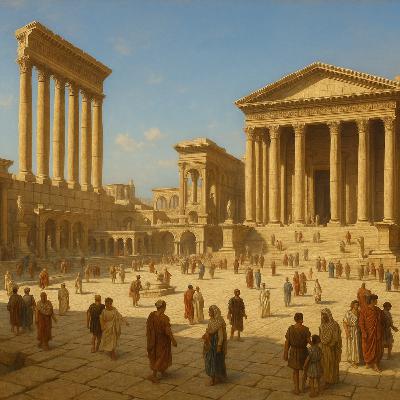
At the dawn of civilization, the skies over Baalbek split open. Thunder rolled through the Beqaa Valley as luminous beings descended upon a colossal stone platform. Ancient witnesses called them gods; modern minds call them visitors. This episode dives deep into the ancient texts, Sumerian parallels, and the megalithic mysteries, suggesting Baalbek wasn’t just a temple, but a cosmic runway built for something beyond our understanding.Adam, Jean-Pierre. “À propos du trilithon de Baalbek: Étude critique.” Syria, vol. 54, 1977, pp. 31–61.Bauval, Robert, and Robert Schoch. Origins of the Sphinx: Celestial Guardian of Pre-Pharaonic Civilization. Inner Traditions, 2017.Childress, David Hatcher. Technology of the Gods: The Incredible Sciences of the Ancients. Adventures Unlimited Press, 2000.DAI (Deutsches Archäologisches Institut). Baalbek Project Reports 2012–2020. German Archaeological Institute, 2020.Devereux, Paul. The Ley Hunter’s Companion: A Guide to Ley Lines, Landscape Mysteries, and Earth Energies. Routledge, 2001.Dunn, Christopher. The Giza Power Plant: Technologies of Ancient Egypt. Bear & Company, 1998.Hancock, Graham. Magicians of the Gods: The Forgotten Wisdom of Earth’s Lost Civilization. St. Martin’s Press, 2015.Haramein, Nassim. The Connected Universe. Resonance Science Foundation, 2016.Hopkins, Roger. Practical Experiments in Megalithic Construction. BBC/Channel 4 Documentary, 1995.Murray, Margaret A. “The Temples of the Sun and Moon at Baalbek.” The Journal of Egyptian Archaeology, vol. 4, 1917, pp. 26–33.National Geographic. “The Giants of Baalbek: New Scans Reveal the Truth Behind the Stones.” National Geographic Magazine, 2014.Ragette, Friedrich. Baalbek Reconsidered. American University of Beirut Press, 1980.Sitchin, Zecharia. The 12th Planet. Avon Books, 1976.Smithsonian Channel. Secrets: Baalbek’s Megalith Mystery. Smithsonian Networks, 2019.Tesla, Nikola. Collected Papers on Wireless Transmission of Power and Frequency Resonance. Tesla Museum Archives, 1905–1917.Wilkinson, Richard H. The Complete Temples of Ancient Egypt. Thames & Hudson, 2000.Watts, Alan. The Book: On the Taboo Against Knowing Who You Are. Pantheon Books, 1966.Sheldrake, Rupert. The Science Delusion. Coronet, 2012.NASA Earth Observatory. “Ancient Alignments and Astronomical Orientation.” NASA, 2021.Collins, Andrew. Göbekli Tepe: Genesis of the Gods. Bear & Company, 2014.Support the show
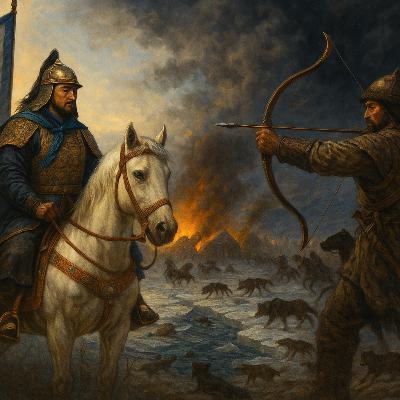
Support future episodes at patreon.com/THO420.Part 7 continues the Mongol saga as the empire collapses under its own weight.From Möngke’s (MOON-gkeh) death to Kublai’s (KOO-blye) Chinese pivot, Berke’s (BAIR-kuh) holy war, Hülegü’s (HOO-leh-goo) paranoia, and Kaidu’s (KY-doo) rebellion, this broadcast-ready episode connects the 13th-century civil wars to modern divisions, social-media tribalism, and the erosion of truth.Allsen, Thomas T. Culture and Conquest in Mongol Eurasia. Cambridge University Press, 2011.BBC Documentary. The Mongol Empire — Storm from the East. 1992.Harl, Kenneth W. The Mongol Empire: Genghis and His Successors. The Great Courses, 2020. Audiobook.May, Timothy. The Mongol Conquests in World History. Reaktion Books, 2012.Morgan, David. The Mongols. Wiley-Blackwell, 3rd ed., 2016.Rossabi, Morris. Khubilai Khan: His Life and Times. University of California Press, 1988.Weatherford, Jack. Genghis Khan and the Making of the Modern World. Random House Audio, 2004. Audiobook.History Hit Podcast. “Collapse of the Mongol Empire.” 2023 episode.
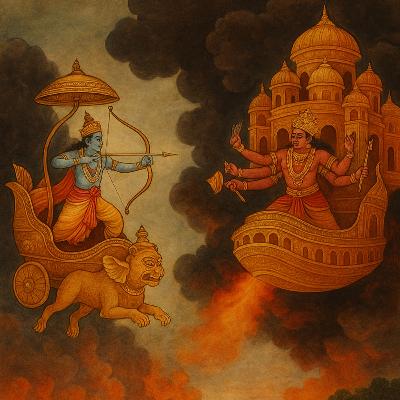
Vimāna (vi-MAH-nah): Flying chariot or palace. Think UFO + luxury yacht.Astra (AH-struh): Divine weapon activated by mantra; arrows that become fire, storms, or floods.Vajra (VAHJ-rah): Indra’s thunderbolt cannon, reusable lightning strike.Gāṇḍīva (gahn-DEE-vah): Arjuna’s legendary bow, endless arrows.Māyā (MAH-yah): Illusions and deception on the battlefield.Pushpaka (POOSH-puh-kah): Rāvaṇa’s flying palace, stolen from the gods.Śakti (SHAHK-tee): Karna’s one-shot spear of destruction.Pāśupata Astra (pah-SHOO-puh-tah AH-struh): Śiva’s ultimate doomsday weapon, apocalypse in a mantra.Dharma (DURR-mah): The principle of cosmic order, balance, and duty.The Sanskrit epics weren’t just poetry, they were warnings. Flying palaces, thunderbolt cannons, serpent-weapons, and arrows that split into firestorms. Were they myths, or records of something we’ve lost? In this episode, we rip open the Mahābhārata and Rāmāyaṇa to uncover the wars of the sky — Vimānas, astras, gods, demons, and the first doctrines of annihilation.From Arjuna’s sky duels to Rāvaṇa’s stolen Pushpaka palace, from Karna’s one-shot curse to Śiva handing over the ultimate doomsday weapon, this is ancient war told in modern voice, cinematic, unfiltered, and relentless. patreon.com/THO420Campbell, Joseph. The Masks of God. Viking Press, 1959–1968.Childress, David Hatcher. Vimana: Aircraft of Ancient India and Atlantis. Adventures Unlimited Press, 1991.Debroy, Bibek, translator. The Mahabharata. Penguin Books India, 2010–2014.de Santillana, Giorgio, and Hertha von Dechend. Hamlet’s Mill: An Essay on Myth and the Frame of Time. Gambit, 1969.Ganguli, Kisari Mohan, translator. The Mahabharata of Krishna-Dwaipayana Vyasa. P.C. Roy, 1883–1896.Hiltebeitel, Alf. Reading the Fifth Veda: Studies on the Mahābhārata. Brill, 2011.Kak, Subhash. “The Astronomical Code of the Rigveda.” Munshiram Manoharlal Publishers, 2000.Menon, Ramesh. The Ramayana: A Modern Retelling of the Great Indian Epic. North Point Press, 2004.Sattar, Arshia, translator. The Ramayana. Penguin Classics, 1996.Shulman, David. The Wisdom of Poets: Studies in Tamil, Telugu, and Sanskrit. Oxford University Press, 2001.von Däniken, Erich. Chariots of the Gods? Unsolved Mysteries of the Past. Putnam, 1968.https://davidhatcherchildress.com/
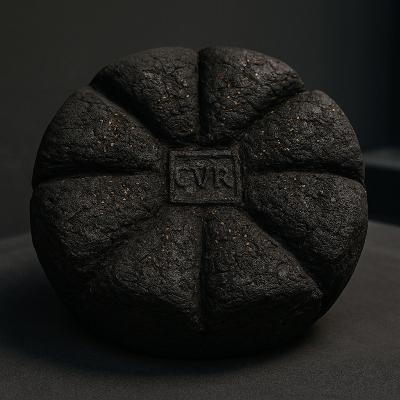
In 79 AD, a baker in Pompeii pulled his last loaves from the oven. Minutes later, Mount Vesuvius tore the sky apart, burying the city under fire and ash. Two thousand years later, his bread still exists—blackened, scored, stamped with his brand. Immortal.This is The Last Loaf—a dive into Rome at its height, Pompeii at its busiest, and the eruption that froze ordinary life in time. We’ll rage, rant, and compare their world to ours: politics as distraction, bread as propaganda, ignored warnings, climate disaster, and the arrogance of thinking tomorrow will always look like today.From Terentius Neo and his wife running their bakery like a family startup, to the graffiti mocking gladiators, to the carbonized crumbs still sitting in a museum case—this isn’t just archaeology. This is a mirror. Pompeii was us. We are Pompeii.Pliny the Younger, Letters VI.16 & VI.20 – Eyewitness accounts of the eruption of Mount Vesuvius.Pliny the Elder, Natural History – Context on Roman science and natural disasters (he died during the eruption).Mary Beard, Pompeii: The Life of a Roman Town – Social and cultural history of Pompeii.Alison E. Cooley, Pompeii and Herculaneum: A Sourcebook – Translations of inscriptions, graffiti, and documents.Paul Zanker, Pompeii: Public and Private Life – Detailed analysis of art, architecture, and daily life.Farrell Monaco, Culinary Archaeology Studies – Reconstructions of Roman bread recipes, esp. Panis Quadratus.Archaeological Park of Pompeii (Official Publications) – Excavation reports and site guides.National Archaeological Museum of Naples – Artifacts including carbonized bread and frescoes.Cambridge Ancient History, Vol. XI – Political and military background of the Roman Empire during the Flavian dynasty.
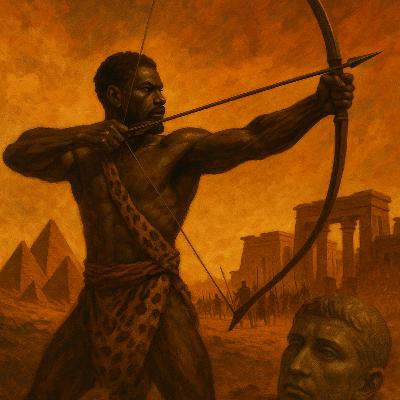
https://patreon.com/THO420?utm_medium=clipboard_copy&utm_source=copyLink&utm_campaign=creatorshare_creator&utm_content=join_linkFor nearly a century, the so-called “wretched Nubians” marched north, conquered Egypt, and ruled as Pharaohs. They rebuilt temples, preserved sacred texts, fought the Assyrian war machine, forged iron in the furnaces of Meroë, and their warrior queens, the Kandakes, even stood toe-to-toe with Rome.This is the story colonial textbooks buried. The Black Pharaohs of Kush: uncanceled, unbroken, unforgettable.Victory Stela of Piye (c. 727 BCE) — Inscription of Piye’s conquest of Egypt.Shabaka Stone (c. 710 BCE) — Preservation of ancient Egyptian theology by Pharaoh Shabaka.Biblical References — 2 Kings 19:9, Isaiah 37:9 (mention of Pharaoh Taharqa).Classical Accounts — Writings of Strabo and Roman sources referencing the Kandakes.Excavations at Kerma, Napata, and Meroë (Sudan) — pyramids, iron slag heaps, palaces, and burial sites.UNESCO archives on Nubian monuments.Derek A. Welsby, The Kingdom of Kush: The Napatan and Meroitic Empires (1996).László Török, The Kingdom of Kush: Handbook of the Napatan-Meroitic Civilization (1997).Robert G. Morkot, The Black Pharaohs: Egypt’s Nubian Rulers (2000).David O’Connor, Ancient Nubia: Egypt’s Rival in Africa (1993).Henriette Hafsaas, articles on colonialism and Nubian archaeology.
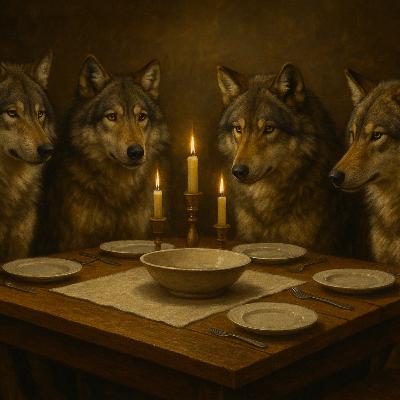
The death of Ögedei Khan in 1241 didn’t just pause the Mongol conquest of Europe—it cracked the empire in half. Subutai turned back from Vienna, Batu circled the steppe like a wolf denied his kill, and cousins prepared to draw blood at the kurultai. This episode delves into the years of betrayal, purges, and near-civil war that followed: Töregene’s ruthless regency, Güyük’s march toward confrontation, the whispers of Sorghaghtani Beki, the bloody purge that crowned Möngke, and the birth of four rival khanates—the Golden Horde, Ilkhanate, Chagatai, and Yuan.Casualties mount not in foreign fields, but in the empire’s veins: assassinations, purges, aborted campaigns, and civilians crushed under tribute wars. Omens, shamans, and the Spirit Banner weigh as heavily as swords. And for the first time, Mongol banners clash against Mongol banners.This is the story of the wolves at the table—when empire feasts on itself.Favereau, Marie. The Horde: How the Mongols Changed the World. Belknap Press of Harvard University Press, 2021.May, Timothy. The Mongol Empire. Edinburgh University Press, 2018.Jackson, Peter. The Mongols and the Islamic World: From Conquest to Conversion. Yale University Press, 2017.Rachewiltz, Igor de, translator. The Secret History of the Mongols: A Mongolian Epic Chronicle of the Thirteenth Century. Brill, 2004.Rashid al-Din. Jamiʿ al-Tawarikh [Compendium of Chronicles]. Translated by Wheeler Thackston, Harvard University, 1998.Weatherford, Jack. Genghis Khan and the Making of the Modern World. Crown, 2004.Morgan, David. The Mongols. 3rd ed., Wiley-Blackwell, 2016.Allsen, Thomas T. Culture and Conquest in Mongol Eurasia. Cambridge University Press, 2001.The Mongol Empire by Timothy May. Audible, 2018.Genghis Khan and the Making of the Modern World by Jack Weatherford. Random House Audio, 2004.Barbarians: The Mongol Horde (History Channel, 2004).Empire of the Steppes: The Mongols (Kings and Generals documentary series, YouTube, 2019–2021).https://time-nexus-39a4e359.base44.apphttps://chronoscape-time-machine-diaries-07f4857c.base44.app
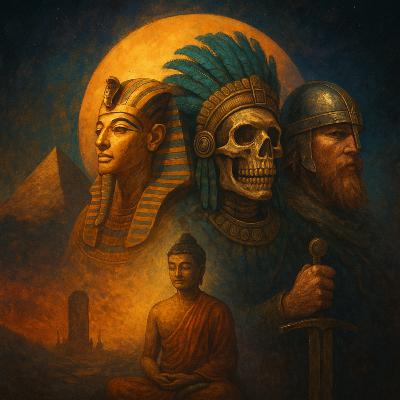
From the pyramids of Egypt to the battlefields of the Vikings, from Aztec temples to the philosophy of Hindu rebirth, humanity has never seen death as a simple ending. In this episode of Time Machine Diaries, Cullen delves into how a handful of cultures viewed death not as a barrier, but as a doorway. We explore the Egyptians’ architectural obsession with immortality, the Aztecs’ cosmic cycle of sacrifice, the Hindu belief in endless reincarnation, and the Vikings’ quest for glory beyond the grave.Blended with modern theories from quantum physics and biocentrism, this episode challenges the materialist view of death as “game over” and instead asks: what if cultures across history were closer to the truth all along? What if consciousness never really stops, only shifts?Assmann, Jan. Death and Salvation in Ancient Egypt. Cornell University Press, 2005.Carrasco, David. City of Sacrifice: The Aztec Empire and the Role of Violence in Civilization. Beacon Press, 1999.Flood, Gavin D. An Introduction to Hinduism. Cambridge University Press, 1996.Price, Neil. The Viking Way: Magic and Mind in Late Iron Age Scandinavia. Oxbow Books, 2019.Lanza, Robert, and Bob Berman. Biocentrism: How Life and Consciousness are the Keys to Understanding the True Nature of the Universe. BenBella Books, 2009.
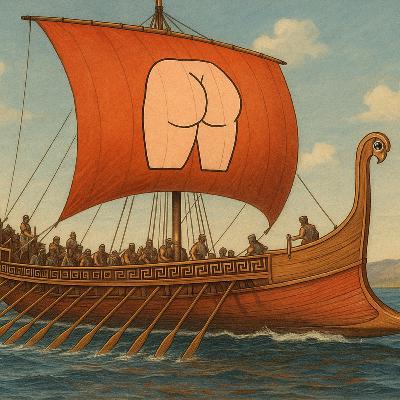
In this opener of the Peloponnesian War, Athens is the drama king. Sparta the gym bro. Two city-states with the personalities of a toxic divorced couple, dragging the entire Greek world into a decades-long bar fight with spears.In this opening episode of Time Machine Diaries: The Peloponnesian War, Cullen takes you into the aftermath of the Persian Wars, the birth of the Delian League (aka Athens’ protection racket), and the petty beefs — like the infamous Megarian Decree — that pushed Greece into the war that nobody won. Expect hubris, sanctions, starvation, and a whole lot of historical déjà vu, because the playbook they wrote in 431 BCE still runs today.Source ListThucydides. The Peloponnesian War. Translated by Richard Crawley. Audible edition.Donald Kagan. The Peloponnesian War. Penguin Books, 2003. Audiobook available.Victor Davis Hanson. A War Like No Other: How the Athenians and Spartans Fought the Peloponnesian War. Random House, 2005. Audiobook available.The Greeks: Crucible of Civilization. PBS, 2000.Athens: The Dawn of Democracy. PBS/NOVA, 2008.The Spartans. BBC Documentary Series, 2002.Hornblower, Simon. A Commentary on Thucydides. Oxford University Press, 1991.Rhodes, P. J. “The Outbreak of the Peloponnesian War.” The Journal of Hellenic Studies, vol. 106, 1986, pp. 103–124.
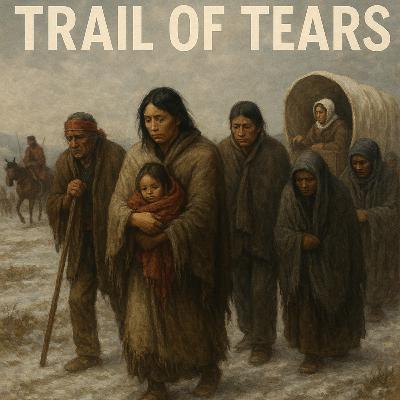
Hey There, Let us step into a world torn apart by greed and power. In this episode of Time Machine Diaries, we journey through the Trail of Tears—a thousand-mile march fueled by broken promises and cold indifference. Hear voices from soldiers, settlers, and the Cherokee themselves, revealing the human cost hidden behind textbook dates.From stockades choked with disease to frozen rivers littered with shallow graves, this story isn’t just history—it’s a warning. Because the same forces that drove Native nations from their lands still whisper today in policies about borders, belonging, and who America claims as “us.”Brace yourself for heartbreak, truth, and a reckoning with the past that refuses to stay buried.Books & AudiobooksEhle, John. Trail of Tears: The Rise and Fall of the Cherokee Nation. Anchor Books, 1988.Audiobook: Narrated by Robertson Dean, Blackstone Audio, 2004.Perdue, Theda, and Michael D. Green. The Cherokee Nation and the Trail of Tears. Viking, 2007.Audiobook: Audible Studios, 2014.Remini, Robert V. Andrew Jackson and His Indian Wars. Viking Penguin, 2001.Audiobook: Narrated by Robertson Dean, Blackstone Audio, 2004.Brown, Dee. Bury My Heart at Wounded Knee: An Indian History of the American West. Holt, Rinehart & Winston, 1970.Audiobook: Narrated by Grover Gardner, Blackstone Audio, 2009.(Includes background on removals including the Trail of Tears)Calloway, Colin G. First Peoples: A Documentary Survey of American Indian History. Bedford/St. Martin’s, 2016.We Shall Remain: Trail of Tears. Directed by Chris Eyre, PBS American Experience, 2009.Available at: https://www.pbs.org/wgbh/americanexperience/films/trail-of-tears/The Trail of Tears: Cherokee Legacy. Directed by Chip Richie, narrated by James Earl Jones, Rich-Heape Films, 2006.Andrew Jackson: Good, Evil and the Presidency. Directed by Carl Byker, PBS, 2008.America: The Story of Us — Westward Expansion. History Channel, 2010.(Includes segments on Indian removal and Cherokee displacement)This Land. Hosted by Rebecca Nagle, Crooked Media, Season 1 (2019).(Explores Native legal battles, including legacies of removal)Teaching Hard History: American Slavery – The Trail of Tears & Native Displacement. Teaching Tolerance Podcast, Southern Poverty Law Center, 2020.

Comments

Download from Google Play

Download from App Store
 United States