


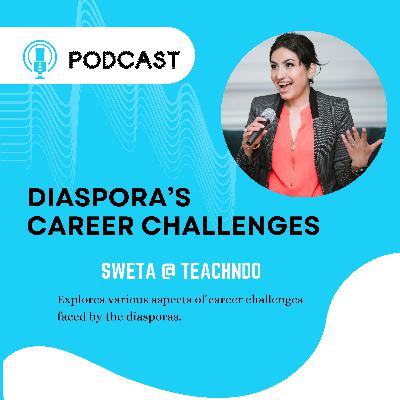
Diaspora's Career Challenges
Subscribed: 0Played: 0
Subscribe

© Sweta Regmi | Award-winning Career Strategist | Speaker | CEO @ Teachndo
Description
Diaspora’s Career Challenges shares real career struggles of immigrant & diaspora professionals in Canada. Hosted by award-winning career strategist Sweta Regmi, founder of Teachndo, featured on national news and 100+ media outlets, including CBC, CNBC, WSJ, Globe & Mail, Daily Mail, Forbes, FOX 26. Topics: workplace bias, code-switching, EDI, identity, and career advice for newcomers.
Perfect for first-generation immigrants, second-gen Canadians, Policy Makers & Diversity Consultants.
🎤 Sweta Regmi | Speaker Contact 🔗 teachndo.com/speaker
🎁 Free Job Search Tools: teachndo.com/resources
Perfect for first-generation immigrants, second-gen Canadians, Policy Makers & Diversity Consultants.
🎤 Sweta Regmi | Speaker Contact 🔗 teachndo.com/speaker
🎁 Free Job Search Tools: teachndo.com/resources
14 Episodes
Reverse
Have you ever wondered why some voices travel farther online while others stay buried at the bottom of the feed? The more I study career systems and digital platforms, the more I realise the field is not equal. Not in hiring and not even on social media. And now there is data showing it.Recent studies on algorithmic bias found that posts from women receive far less visibility than posts from men. The World Economic Forum reported that women get up to 30 percent less reach on professional platforms. A study by Cornell University found that online algorithms consistently amplify white coded language more than language patterns linked to people of colour. They shape who gets seen, who gets heard and who gets picked for opportunities.And now LinkedIn is part of the conversation. BBC and The Guardian have reported that some women who changed their gender setting to male saw higher post views. Others rewrote their content using male coded language and saw impressions rise. While women of colour who did the same saw impressions go down. So the system is not only reacting to gender. It is reacting to intersectionality.This trend made me test something myself. I took my real bio, the actual story I tell about my work and my lived experience, and I asked ChatGPT to rewrite it in three versions. White female coded, POC women coded and South Asian women coded. I kept the same structure and asked the model to explain every change.Across these versions, the model also explained the deeper patterns behind each rewrite. It said white women can lead with story and still be seen as credible. POC women need a mix of credentials and strategy to be read as leaders. South Asian women need stronger authority signals, data, expertise and performance proof. Warmth from South Asian women is often misread as passivity. Warmth from white women is often read as leadership confidence.These are patterns the model learned from global data. And these patterns are being picked up by platforms like LinkedIn whether we like it or not. This is proxy bias. DATA USE AND VISIBILITYThis brings me to something that has been on my mind. What happens when we declare who we are on platforms. When we choose our gender, our identity, our demographic or even our pronouns. How is our data being used. They say it is for insights and research, but who really knows what is happening behind the scenes. Who gets visibility. Who gets pushed down. And how does someone get to the top of a search list.AI IN HIRINGAnd it does not stop at social media. In one of my earlier episodes I talked about AI interview tools . One way video interviews. Automated scoring systems. Tools that judge your verbal communication, your accent, your pacing and even your pauses. Who are these tools coded for. Who fits the template of confidence. Who gets misread. These questions matter because these systems now screen tens of thousands of candidates before a human ever sees them.THE BIG PROBLEMSo when governments invest over one billion dollars into AI and quantum computing, as the Canadian budget just announced, we have to ask a simple question. Who is auditing these algorithms. Who is checking the patterns. Who is holding these tools accountable when they quietly punish underrepresented communities.If you are looking for an authentic keynote speaker in Canada or globally who speaks on career development, workplace diversity, AI biases, and the immigrant journey, book Sweta Regmi for your next event.Book Sweta Regmi, Founder & CEO, Teachndo as a keynote speaker: https://www.teachndo.com/speakerDownload Free career resources: https://www.teachndo.com/resources
In this episode of Diaspora Career Challenges, keynote speaker and career strategist Sweta Regmi shares her journey from being overlooked to becoming a recognized voice on career development and representation.Invited as a keynote speaker for a government Career Development Day, Sweta reflects on what it means to be seen, valued, and trusted to speak about workplace culture, diversity, and the immigrant career journey. She explores why representation matters, how diaspora voices can break barriers, and why amplifying underrepresented perspectives is essential for true inclusion.Sweta also dives into the challenges many speakers face, especially women of color and professionals from immigrant and diaspora backgrounds. Despite being underrepresented on global stages, she explains how it is possible to get booked as a keynote speaker without elite networks, PR teams, or marketing budgets—by creating content, building thought leadership, and speaking up about issues that matter.Key themes in this episode: • The power of representation in keynote speaking • Career challenges faced by immigrants and diaspora professionals • Why women, POC, and diaspora voices are underrepresented as speakers • How to amplify your voice and get invited to the stage • Practical strategies to be seen, heard, and booked as a keynote speakerIf you are looking for an authentic keynote speaker in Canada or globally who speaks on career development, workplace diversity, representation, and the immigrant journey, book Sweta Regmi for your next event.Book Sweta Regmi, Founder & CEO, Teachndo as a keynote speaker: https://www.teachndo.com/speakerDownload Free career resources: https://www.teachndo.com/resources
Ever felt lost in workplace jargon and Canadian slang or wondered why your coworker just said “bet” in a meeting? You’re not alone. In this episode of Diaspora’s Career Challenges, I break down how to navigate corporate lingo, Canadian slang, and even some Gen Z speak, without losing your vibe.We cover:Why newcomers shouldn’t have to decode secret workplace codes (it’s giving gatekeeping)The role of inclusion beyond just hiring (real ones know)Canadian slang explained [yes, even “Timmy’s” and “Double Double”]Why fitting in is overrated and how to truly stand out Accent bias, corporate buzzwords, and why even native-born professionals get lost in the sauceGen Z terms you’ll hear at work — from “slaps” to “sending me” — and how not to cringe when you hear themWhether you’re new to Canada, starting a new job, or trying to vibe with colleagues from different generations, this episode will help you blend without bending.Listen in for real talk, sarcasm, and tips that hit different.This episode is for anyone who’s ever been made to feel like they don't fit the corporate mold. 40 Common Corporate Jargon, Canadian Slangs, Gen Z Phrases with Meaning: https://www.teachndo.com/post/breaking-down-the-language-barrier-navigate-corporate-jargon-and-slangFree Career Resources: https://www.teachndo.com/resourcesDiaspora's Career Challenge Podcast Episodes: teachndo.com/podcastepisodesBook me to speakSweta Regmi - https://www.teachndo.com/speaker
Ever been told your communication skills need work, but you’re already leading projects, managing teams, and getting things done?They say immigrants lack soft skills — but who decides what good communication even looks like?If you’re an immigrant or part of the diaspora, this might sound familiar. You speak more than one language, but somehow your accent, grammar, or “tone” becomes the reason you’re rated lower in performance reviews. Soft skills? You’ve got plenty. But they don’t seem to count the same.In this episode, I unpack how communication and soft skills are often used as coded feedback—a quiet form of bias that holds many immigrants back from promotions, raises, and recognition. I share my own lived experiences with white and South Asian bosses, including: • Getting my emails proofread after I was already managing people • Being asked “Who helped you?” after creating a training guide • Watching my grammar get fixed, my credit erased, and my confidence shaken • And later, finally being rated the highest by a director who saw my real valueThis episode is for anyone who’s ever been made to feel like their voice doesn’t fit the corporate mold. Because communication isn’t grammar—it’s how we lead, handle chaos, and move things forward. If you’re tired of being told to “speak or write better” just to be heard, this episode is for you.Free Career Resources: https://www.teachndo.com/resourcesDiaspora's Career Challenge Podcast Episodes: teachndo.com/podcastepisodesBook me to speakSweta Regmi - https://www.teachndo.com/speaker
It’s AAPI Heritage Month — but let’s be real: South Asians are still the afterthought.In this raw and unapologetic episode of Diaspora’s Career Challenges, Sweta Regmi dives into the erasure of South Asian voices during AAPI Month and beyond. From the dominance of East Asian representation in media and corporate diversity panels, to the harmful stereotypes, casteism, and colorism within our own communities — this episode unpacks the layered struggles South Asians face in both professional and cultural spaces.We talk about: • Why “Asian” doesn’t always mean East Asian • How anti–South Asian hate is rising — and being normalized • The myth of the “good immigrant” and the cost of staying silent • Workplace invisibility, emotional labor, and missed promotions • Intra-community discrimination: caste, color, and gender bias • Why exposure ≠ compensation — especially in DEI spacesFrom curry jokes to corporate gaslighting, from internalized shame to external discrimination — we’re done being the diversity checkbox. South Asians aren’t a monolith. We’re not your punchline. We’re here, we’re loud, and we’re taking up space.🎧 Tune in, share it, and let’s rewrite the narrative — because South Asian stories deserve more than just a heritage month shoutout.Free Career Resources: https://www.teachndo.com/resourcesDiaspora's Career Challenge Podcast Episodes: teachndo.com/podcastepisodesBook me to speakSweta Regmi - https://www.teachndo.com/speaker#AAPIHeritageMonth #AmplifySouthAsianVoices #Diaspora'sCareerChallenges
Ever pressed 2 for French or Spanish to dodge an accent? This episode exposes the not-so-subtle bias behind “accent shopping” in customer service calls. From real-life contact center stories to AI now being used to mask employee accents as digital whitewashing, we dive deep into the uncomfortable truth: It’s not always about comprehension—it’s about who sounds “acceptable.”So here’s how it goes…You call a contact center. You don’t press 1 for English—because let’s be honest, you don’t want to get ‘Raj from Bangalore’ or ‘Mei from Manila.’Nope. You press 2 for French… or Spanish.Then go, ‘Oops! Meant English!’—knowing that bilingual reps are usually North American-born.Welcome to Accent Shopping.It’s not in the handbook, but it’s alive and thriving in every customer service line across North America.And now?Companies are using AI to MASK employee accents.Yes. We’ve gone that far to please a customer.So I gotta ask:What will customers complain about now? That the AI sounded too ‘neutral’?Let’s dive in.”🎧 Listen as we unpack:Why customers game language menus to avoid international voicesHow AI is erasing human identity for “neutral” North American speechWhat counts as a “Canadian,” "American" or “professional” accentReal examples of bias in call transfers—and who gets deemed “Canadian enough”Whether you’ve ever been judged for your voice or caught yourself preferring certain accents, this one’s got some real talk you need to hear. Free Career Resources: https://www.teachndo.com/resourcesDiaspora's Career Challenge Podcast Episodes: teachndo.com/podcastepisodesBook me to speakSweta Regmi - https://www.teachndo.com/speaker
In this episode of Diaspora's Career Challenges, we tackle the hidden job market stats and break down why it’s not actually hidden—it’s just exclusive. If you’re an immigrant, newcomer, or someone without an Ivy League connection, you’ll want to hear this. We dive into why networking is often more about privilege than merit, and what strategies actually work to land the job you deserve. Tune in for the truth on navigating today’s job market and getting noticed in a system that’s stacked against you.The Hidden Job Market Exposed: Why It Was Never Meant for You“80% of jobs are hidden.” Sounds great, right? But here’s the truth: the hidden job market isn’t hidden—it’s exclusive. If you’re an immigrant, newcomer, or anyone without an Ivy League bestie, guess what? You’re not on the guest list. That’s the reality.While gurus, networking coaches, and LinkedIn influencers preach about tapping into the “hidden market,” here’s the real deal: 500,000+ job vacancies in Canada in 2025. So, why are we pushing people to chase these so-called hidden opportunities when there’s a stocked pond right in front of them?Let’s talk about the biases that fuel the so-called hidden market:People hire people who look like them.People hire people who went to the same schools.People hire people they golf with.That’s not networking. That’s bias.The Biases Keeping the Job Market ‘Hidden’Let’s just call it what it is:🚨 Affinity Bias – Hiring people similar to you.🚨 Confirmation Bias – Seeing an immigrant name and assuming they won’t “fit.”🚨 Halo Effect – Assuming a Harvard grad must be the smartest person in the room.🚨 Opportunity Hoarding – Keeping jobs in exclusive circles.🚨 Privilege Bias – If you have to network to survive, was the system ever really merit-based?I’ve worked at top companies, and I can’t imagine not posting jobs. Hiring isn’t random—there’s a system behind it. But yes, some jobs aren’t posted:Small businesses with no HR team hire based on word-of-mouth.Executive search firms recruit for C-suite roles confidentially.Companies pulling from networks before jobs even go live.But is that 80% of all hiring? No. That’s an outdated myth recycled over and over.Here’s what’s real:Strategic personal branding – Make it impossible to ignore you.Targeted job applications – Yes, they work if done right.Informational interviews – The right kind, not just “pick your brain” sessions.Storytelling on LinkedIn – So hiring managers find you.The truth is, the so-called “hidden job market” favors privilege, not merit. So when people tell newcomers, “Just network harder,” we need to question what that really means.What works instead? Focus on strategies that you control—personal branding, applying strategically, building real professional relationships, and ensuring that you are seen. Stop chasing shadows and focus on what’s tangible.Free Career Resources: https://www.teachndo.com/resourcesDiaspora's Career Challenge Podcast Episodes: teachndo.com/podcastepisodesBook me to speakSweta Regmi - https://www.teachndo.com/speaker
In this episode of Diaspora 's Career Challenges, Sweta Regmi explores how language – specifically English – shapes our professional lives and impacts career success, especially for immigrants. Language biases, particularly in ESL, profoundly affect how people perceive others’ intelligence, capabilities, and even employability. But why does this happen? And how does the way we speak influence our career growth?Why is it that when non-native speakers of English try their best, they’re often met with condescension, but when a native English speaker attempts another language, they’re praised for their effort?In this insightful episode, we discuss: • Language Bias in the Hiring: How accent discrimination affects immigrant job seekers and employees, and the implicit biases that hinder career progress. • The Power of English Proficiency: Why non-native English speakers are often judged unfairly, and the impact of this on self-esteem and career advancement. • The Science Behind Language Biases: How our brains are wired to favor certain accents over others, and how this influences hiring decisions and professional relationships. • Overcoming Language Bias in Careers: Strategies to navigate bias in the workplace, leveraging your unique language skills, and turning accent challenges into career advantages. • Cultural Influence on Communication: How the globalization of English affects career success for immigrants and minorities, and how cultural differences play a role in workplace dynamics.We’ll take a deep look at: • The stereotyping of non-native speakers and how their language proficiency is often unfairly questioned. • The double standards in how accents are perceived, especially when comparing South Asian accents to European ones. • My personal story of navigating language bias as an immigrant who changed the way I speak without even trying. • The role of AI in perpetuating language bias and how even technology is skewed against non-native speakers. • The unwritten rules of what “correct” English sounds like, and how they often exclude those who speak it differently.Whether you’re someone who speaks multiple languages or someone who has faced judgment based on your accent, this episode is for you. It’s time to break free from the biases tied to language and accent.This episode is essential for anyone navigating the challenges of language barriers, accent discrimination, or working in environments where English is the dominant language. Whether you’re an immigrant job seeker or a professional working in an English-speaking country, this episode provides critical insights to help you break free from language-based bias and thrive in your career.Whether you’re someone who speaks multiple languages or someone who has faced judgment based on your accent, this episode is for you. It’s time to break free from the biases tied to language and accent.Key Takeaways: • Understand how English language bias affects your career opportunities • Learn how to overcome accent discrimination in professional settings • Gain strategies to embrace your multilingual skills and turn them into career assets • Discover how cultural and language biases shape hiring decisions and workplace interactionsFree Career Resources: https://www.teachndo.com/resourcesDiaspora's Career Challenge Podcast Episodes: teachndo.com/podcastepisodesBook me to speakSweta Regmi - https://www.teachndo.com/speaker
Finding Direction in Mixed Heritage: A Conversation with Nina Melendez Ibarra Emmy-nominated producer, journalist, LinkedIn Content Producer and Author.I found Nina Melendez Ibarra on LinkedIn—through a post that made me stop scrolling. She had shared an article about migrant workers in Qatar and how the media needs to do better in covering these stories. It hit close to home.As someone from Nepal, I’ve seen firsthand how migrant workers leave everything behind in search of better opportunities, only to return to coffins. It’s a reality too often ignored. So when I saw Nina speaking up, I had to know why.That’s when I discovered her Sri Lankan heritage. It made sense—she understood. She understood what it meant to come from a place where people’s struggles aren’t always headline news. And when I was curating speakers for my AAPI Heritage Month event last year, I knew she had to be part of it. She said yes.Now, our conversation continues on my podcast, Diaspora’s Career Challenges.Finding Direction When You Come From EverywhereFor those of us with mixed heritage or immigrant backgrounds, the question “Where are you really from?” follows us everywhere—sometimes spoken, sometimes just implied. And it’s not just about geography. It’s about identity. Where do we belong? Who claims us? How do we navigate careers when our backgrounds don’t fit into neat little boxes?Nina has spent her life moving through different cultures—Puerto Rico, Sri Lanka, Japan, France, Brooklyn—always adapting, always navigating. And yet, as she told me in our conversation, the biggest lesson she learned wasn’t about fitting in. It was about standing firm in who you are. “At the end of the day, that thing in you that lights you up is what is going to prevail. The more you push that aside for societal expectations, the more miserable you’ll be.”The Myth of Hard Work and Finding Your PlaceMany of us were raised on the belief that working hard is the key to success. But Nina learned something different:“I was always under the impression that you had to work very hard. And I worked my butt off for the majority of my career. And I consistently saw other people advancing who did not work as hard, did not know as much, and were not as qualified. And that was weird for me to come to terms with.”The truth? Hard work is just one piece of the puzzle. “Don’t work harder—work smarter. Get to know the right people. Be friends with the right people. Understand how to manage up. Be unapologetic about finding ways to get into rooms and having folks who will bring you into those rooms, because this is not a meritocracy.”For many of us from immigrant or mixed backgrounds, this is a tough lesson. We’re taught that success comes from keeping our heads down and proving our worth. But Nina’s story is a reminder: You don’t just earn a seat at the table—you claim it.Navigating Identity & Career Growth with Nina Melendez Ibarra🎙 In this week’s episode of Diaspora’s Career Challenges, we dive into:✅ Finding direction in a global identity—How to make your background an asset, not a question mark✅ The myth of meritocracy—Why hard work alone isn’t enough (and what to do instead)✅ Navigating spaces that weren’t built for you—How to take up space in leadership✅ Embracing your mixed heritage—Why your differences are your greatest strengthsYour Identity is Your PowerFor those of us with complex identities, the world doesn’t always know where to place us. But here’s the thing: We get to decide where we belong.💡 Instead of proving you fit, stand out.💡 Instead of waiting for a door to open, walk in.💡 Instead of working twice as hard, work strategically.Free Resources: https://www.teachndo.com/free-resourcesDiaspora's Career Challenge Podcast Episodes: Diaspora’s Career Challenges | Sweta Regmi Podcast| TeachndoBook me to speakSweta Regmi - Top Global Speaker, Career Strategist & Personal Branding Consultant | Teachndo Canada
In this eye-opening episode, we reveal how AI is secretly shaping who gets hired, promoted, or fired — and why it’s a disaster for immigrants, diaspora, people with accents, and marginalized groups. With Emmy-winning investigative journalist Hilke Schellmann, we dive into the hidden biases baked into AI hiring algorithms, from accent discrimination to gender bias.
AI Bias in Hiring: From One-Way Video Interviews to Resume Screening
This isn’t science fiction, it's happening right now. Tune in to learn how AI is impacting your career, and what you can do to fight back before the robots make all the decisions.
Guest Speaker, Hilke Schellmann, Author of "The Algorithm", Assistant Professor of Journalism at New York University | Keynote Speaker | Emmy-award winning investigative journalist
Host: Sweta Regmi , Certified Career & Resume Strategist @ Teachndo
AI is rejecting you during an interview: Here is how to ace and fix it.
Your Interview Could Be With AI, Ace Job Interview!
Diaspora's Career Challenge Podcast Episodes: Diaspora’s Career Challenges | Sweta Regmi Podcast| Teachndo
Book me to speak
Sweta Regmi - Top Global Speaker, Career Strategist & Personal Branding Consultant | Teachndo Canada
How Diaspora and Immigrants Navigate Bias Through Name Changes on Resumes.
Do Immigrants Navigate Bias Through Name Changes on Resumes?
Are they Breaking the Mold?
What would they do to fit in?
Would you change your name to an English-sounding one just to land an interview?
If you’ve never thought about it, it’s likely because you don’t have an ethnic or non-English name. For many immigrants and diasporas, the pressure to fit in starts with their resumes. They are often forced to “whiten” their resumes—removing any trace of cultural identity—to navigate biases in the hiring process.
Welcome to the world of resume whitening, where changing your name could be the difference between being called for an interview or being overlooked.
But why? It’s because companies that claim to value diversity still sometimes gravitate toward familiarity—the kind that doesn’t challenge their comfort zones.
And so, people with ethnic names are left with a choice:
• Do you embrace your identity and risk being ignored?
• Or do you conform by changing your name, all to survive in a biased system?
Some even go so far as to legally change their names to sound more “acceptable.”
And honestly, I don’t blame them. It’s survival of the fittest out here, right?
Until next time, this is Breaking the Mold: Diaspora Career Challenges, where we unpack the struggles of fitting in and the strength it takes to stand out.
Key Takeaways from This Episode
1. What Is Resume Whitening?
• Resume whitening is the practice of anglicizing names or removing cultural identifiers to reduce bias during the hiring process.
• Many job seekers, especially immigrants and diasporas, resort to this practice to improve their chances of landing interviews.
2. The Cost of Fitting In:
• Erasing a name or cultural identity can feel like losing a piece of who you are.
• This is especially true when jobseekers feel pressured to conform to workplace norms that don’t value diversity authentically.
3. Diversity & Inclusion: The Irony
• Companies often tout diversity but unintentionally perpetuate biases through hiring practices.
• The pressure to “fit in” highlights how far we still have to go in creating equitable workplaces.
4. A Message for Immigrants and Diasporas
• You’re not here to fit in. You’re here to stand out. Your name, your accent, and your identity are assets, not liabilities.
5. Resources for Job Seekers
• Looking for help to overcome bias and stand out? Check out free career and job search resources at
Career Resources for Immigrants & Newcomers by Sweta Regmi: Free Resume, Interview, LinkedIn, and Job Search Help in Canada | Teachndo
If you’ve faced challenges like these, you’re not alone. Don’t let the pressure to conform strip away your unique identity. Instead, let it be your strength.
Book me to speak
Sweta Regmi - Top Global Speaker, Career Strategist & Personal Branding Consultant | Teachndo Canada
Diaspora's Career Challenges Podcast | Sweta Regmi - Career Strategies for Immigrants & Global Professionals Teachndo
In this powerful episode of Diaspora's Career Challenges, award-winning CBC journalist Angie Seth opens up about the often overlooked emotional impact of the question, "Where are you really from?"
Through her personal journey of navigating multiple cultures and raising children in a mixed-race family, Angie sheds light on the deep-rooted biases that shape our identity and how they affect both personal and professional lives.
From the internal identity struggles of immigrant families to the stereotypes faced by children in multicultural households, Angie shares candid reflections on how this question can trigger difficult conversations about belonging and heritage.
As someone who’s worked at the intersection of culture and journalism, Angie provides a unique perspective on how hidden biases can affect career paths, opportunities, and the professional growth of individuals from diverse backgrounds.
In this episode, we explore:
The emotional toll of being asked, "Where are you really from?"
How mixed-race families navigate identity in a multicultural world
The role of stereotypes and cultural assumptions in shaping career paths
The complexities of balancing heritage with modern identity
Personal stories from Angie’s life as a background South Asian-Canadian journalist
This conversation is a must-listen for anyone interested in understanding the challenges faced by individuals from diaspora communities, and how these challenges influence their careers, relationships, and personal growth.
Podcast Host: Sweta Regmi, Founder & CEO Teachndo, Award-winning Career Strategist.
Speaker Contact:teachndo.com/speaker
Welcome to Diaspora’s Career Challenges, the podcast dedicated to empowering immigrants and newcomers as they navigate the complex journey of settling into a new country. This isn’t just about job searches—it’s about everything that comes with being part of a diaspora: career growth, workplace struggles, navigating bias and discrimination, and overcoming the unique challenges that arise when trying to build a life in an unfamiliar environment.Whether you're climbing the corporate ladder, transitioning careers, or finding your place in a new industry, this podcast provides real stories, expert insights, and actionable strategies to help you thrive.What You'll Learn: Cultural Fit vs. Cultural Add: The delicate balance of staying true to your heritage while adapting to a new culture—without compromising your identity. The Cost of Code-Switching: How constantly altering who you are to meet corporate norms can impact your sense of self and limit career growth. SEIB Quotas: Seen: Being included for diversity quotas, but not truly valued. Exploited: Tokenism and being used for appearances or PR purposes. Isolated: Exclusion from decision-making spaces and career advancement opportunities. Blocked: Facing systemic barriers that prevent true career growth. The Silent Struggles: Tackling identity crises, imposter syndrome, and the mental toll of being a marginalized professional in spaces not built for you. Discrimination & Bias: Confronting racism, bias, and microaggressions in the workplace and beyond, and how to cope with, challenge, and rise above them.Why This Podcast Matters: For too long, the struggles of diaspora professionals have been overlooked or swept under the rug. From feeling like an outsider in the workplace to facing systemic bias and discrimination, many immigrants and newcomers have navigated their careers in silence. As someone who has lived through these challenges, I’m here to break that silence. This podcast is for anyone who has ever felt like they don't belong, who’s faced barriers based on their identity, or who’s had to constantly code-switch to survive in a new environment.Together, we’ll share stories of resilience, offer actionable strategies for overcoming career obstacles, and advocate for the change we deserve. It’s time to stop pretending these challenges don’t exist and start addressing them head-on.Subscribe now and join a community dedicated to turning struggle into success. Let’s build our careers, reclaim our power, and pave the way for the next generation of diaspora professionals.Free Career Resources: Career Resources for Immigrants & Newcomers by Sweta Regmi: Free Resume, Interview, LinkedIn, and Job Search Help in Canada | TeachndoSpeaker Contact: Sweta Regmi - Top Global Speaker, Career Strategist & Personal Branding Consultant | Teachndo Canada
South Asian Heritage Speakers Ready to Spark hosted by Sweta Regmi, Founder & CEO, Career & Personal Branding Strategist. Winning journalists, Emmy-nominated producers, Best-Selling Authors, LinkedIn Top Voice, TEDx speakers, and influential figures rooted in South Asian heritage, our lineup promises to ignite your passion and inspire.
Full episode: https://www.youtube.com/watch?v=84BVm5ou7Nc&list=PLHfPGHqV-5PjYtp3MA3Iu3scrsup-9W1W
TOPICS:
How to Pitch to Media
5 Actionable Steps to Conflict Resolution at Work
How to Get Featured on LinkedIn News
How to Get Paid What You Have Earned and Deserve
4 Ways to Engage and Connect with the Audience
Why TEDx Matters and How it Will Elevate Your Career and Legacy
How do You Network with a Company You Want to Work For?
How to Get Hired at Amazon Using Leadership Principles
Speakers:
National News Anchor, Award-winning Journalist Angie Seth
Emmy Nominated Senior Producer & Host LinkedIn Live Editorial, Nina Melendez Ibarra
Ex-Canada News Editor at LinkedIn now PR at Indeed Jessy Bains
WSJ & USA TODAY Best Selling Author, LinkedIn Top Voice, Head of Inclusion, Equity, and Impact Mita Mallick
and more...
Comments


Download from Google Play

Download from App Store
 United States