


 Claim Ownership
A History of Marketing
Subscribed: 27Played: 241
Subscribe

© Andrew Mitrak
Description
A podcast about the stories and strategies behind the campaigns that shaped our world. Featuring conversations with top CMOs, marketing professors, authors, historians, and business leaders.
marketinghistory.org
marketinghistory.org
55 Episodes
Reverse
A History of Marketing / Episode 50Fifty episodes felt like a milestone worth marking. So I wanted a guest who was, well, obviously awesome.April Dunford is the authority on positioning for B2B tech companies and the author of the updated and expanded edition of Obviously Awesome. I’m a huge fan of April’s work and frequently reference her book, her blogs, and her frameworks in my daily work as a marketer. April’s premise is provocative: positioning cannot live in the marketing department alone. She argues that if the CEO, sales, and product leads aren’t in the room providing input, marketing is left guessing about what makes the product special and who it is actually for. Without their buy in, marketing will inevitably lose the “battle of opinions.”In this conversation, we discuss:* Building on Ries & Trout: The positioning pioneers defined the concept in their 1981 book, but they didn’t give a how-to manual. April does.* The death of the “positioning statement”: Why filling out a template is not a methodology.* Blind men and the elephant: How sales, product, and marketing departments each hold a different piece of the puzzle.* Skip the parts people don’t read: April discovered that CEOs don’t finish books, so she cut her manuscript in half.April is one of the most persuasive and grounded thinkers in the field. Here’s my conversation with April Dunford.Listen to the podcast: Spotify / Apple PodcastsSpecial Thanks to Xiaoying Feng, a Marketing Ph.D. Candidate at Syracuse, for reviewing and editing transcripts for accuracy and clarity.The Origin of April Dunford’s Positioning FrameworkAndrew Mitrak: I have a confession to make. Every time I join a new company, among the first things I do is I visit aprildunford.com and I enter my new email address and I download one of your positioning templates. You probably have several of my old corporate email addresses cluttering your mailing list. Sorry about that.April Dunford: I appreciate you jacking up my newsletter subscription numbers.Andrew Mitrak: And a big fan of your work and I want to say congrats on the updated and expanded edition of Obviously Awesome.April Dunford: Thanks. I’m super excited to get it out there.Andrew Mitrak: For this conversation, I wanted to start back before you became the go-to expert on positioning, and when you were coming up in your career, when did you first encounter the concept of positioning?April Dunford: That’s a good question. Pretty early, actually. My first real job in tech was at a little startup and I was brand new and junior, they assigned me to a product and the thinking was that product wasn’t doing very well and the plan was to shut it down. This is why I got assigned to it as the product marketer.We didn’t end up shutting it down. What we ended up doing was looking at gathering some feedback from people that were using the product, and then we got an idea to reposition it. We didn’t know it was called positioning, we thought we were doing, we’re just doing a Hail Mary thing to see if we can make this unsuccessful product successful doing something slightly different.We repositioned it, relaunched it, and it was super successful. Revenue started going up to the right, everybody’s happy, we’re making a lot of money on that product.And then we got acquired by a big company in California and the big parent company assigned us a couple of products that weren’t doing very well and then said, hey, do that thing you did with the other one. I didn’t have really any idea what we did with the other one. I was worried about getting fired, I thought, okay, I better figure this out.I did a deep dive into positioning. I figured out, A, this is what it’s called. B, I had a lot of conversations with smart marketers asking them about, how do you do positioning? If you were in this situation, what would you do? Do you have a strategy for that or a methodology for that?I also read a bunch of books. There’s the classic positioning book, Positioning: The Battle for Your Mind by these guys Ries and Trout, written in the early 80s, but even back then was considered the book on positioning. And then I took a couple of courses and some post-grad stuff at a couple of universities just learning about positioning.I dumped into this whole positioning thing pretty early in my career, and I was really interested in this idea, could we get a way to do positioning in a really repeatable manner so that we wouldn’t have this problem of, we launched the thing and it didn’t work and then now we’ve got to try and change it. Could I get to a point where there is a process for us to follow to, first of all, maybe do a better job guessing at what the positioning should be in the first place, and then secondly, if we do need to change it, is there a nice repeatable step-by-step thing we could follow to do that.Is Product Positioning Intuitive or Learned?Andrew Mitrak: You initially positioned or repositioned a product without even knowing what positioning was or knowing that it was called positioning that you were doing. And then you went to look at the literature. What’s your takeaway from that? Does that reveal to you that the fundamentals of positioning are somewhat intuitive or can be learned, or do you feel it was just dumb luck really? Or do you feel there were parts of it where this is just obviously the right thing to do for the product? How do you overall think about, can positioning sort of just be an intuitive thing, or is it best to look at the literature that’s out there?April Dunford: Sometimes it is really intuitive. I would say that’s true. I would say a lot of the time when I talk to founders, they’ll talk about how they built the product in the first place, and they’ll be, we saw this need, we had this idea, we could do this in a different way than the existing products that are out there.And we looked at it, we understood what the competition was, we built a thing that was demonstrably different, we understood what the value of that thing was because it was solving our own pain, we understood what kind of customers would want to buy that, and therefore what market we position in. It’s just, it is what it is, it’s super easy. And I think that happens a lot in the early stages of a company. Not for everybody, but I do think it happens a lot.However, what also happens a lot is if you fast forward two or three years, the market’s changed. Maybe your competitors caught up with you and the thing that made you really different isn’t different anymore. Or maybe the way people buy or what they want to do has totally changed. Or maybe your competitors did an acquisition and that changes the whole way everybody thinks about this market.Or maybe you and your product have changed, and you now do a whole bunch of other stuff that you didn’t originally do, and that enables you to get at a different kind of customer to deliver a different kind of value. Now how do you position it? That’s where people get messed up. Sometimes it can be quite intuitive at the beginning, but then a whole bunch of things change and it’s, okay, now the positioning needs to shift. How do we do that? Because we didn’t do anything the first time, it was just obvious. I think that happens a lot.The other thing that happens a lot is you have this thesis when you launch the product and you said, okay, we saw this problem and this is what it’s gonna be and these kind of people are gonna love us for these reasons and here’s the competitor. Then we launch it, and it turns out our thesis was incorrect.We get out there and we’re, man, we launched this thing and we thought banks were gonna love it, but it turns out we’re selling to insurance companies, we didn’t really build it for that, but they’re buying it like crazy. Now we’re in the insurance business, hello. And they love it, but there are some things they don’t love so much, and they’re comparing us to competitors we never really thought about. How do we position this thing because we thought it was gonna be something else.And this is not unusual, to be honest. We call that a pivot in lean startup language. It’s not unusual for a company to build something for one market and then get in the market and find out, whoops, the market’s a little bit different than we thought. People are looking at our product a little bit different than we thought. We’re getting pulled into another market, so how do we position for that? And again, that’s when having a methodology for this would be helpful.The B2B vs. B2C Divide in PositioningAndrew Mitrak: You did your positioning exercise initially and then went to the books, went to Ries and Trout and the others. Do you find yourself as you’re reading the literature on positioning, was it confirming what you did, oh, that’s what we did was called, or was it saying, oh, were there things that you’re, oh, I wish I had known that to start, or what was the discovery process for reading?April Dunford: No. And I was so mad about this. Here’s how this went. I went and I’m having all these conversations with people, I’m talking to all these smart heads of marketing, right? And I’m saying, how do you do this positioning thing? What do you do? And everybody’s doing it the way we did it, which was a little bit of trial and error, a little bit of getting some feedback from customers, a little bit of, let’s try this and if it doesn’t work we’re gonna adjust. A bit of messing around until you get something that works.And that feels terrible when you’re the head of marketing because your head’s on the block, man. And if you don’t figure it out fast enough, everyone’s gonna get mad and you’re gonna get fired. And that was unsatisfying.And then I took some courses and read the Ries and Trout book, which does an amazing job of defining here’s what positioning is, here’s why it’s important. And then they give you a whole bunch of examples. But the examples aren’t tech, this thing was written before the internet, man. I th
A History of Marketing / Episode 49Have you ever stood in front of a 500-year-old painting of a father devouring his son and asked yourself, “Who paid for this?” Me neither. Until I met Peter Van Wijnaerde.Peter is a CMO based in Ghent, Belgium, and the writer behind a Substack that connects art history to modern marketing. Rory Sutherland recommended I speak with Peter (which is as high a compliment as you can get in this field) after seeing his presentation on medieval branding. Peter’s premise is provocative: art was the original marketing department. Patrons funded paintings, statues, and tapestries not for beauty’s sake, but because they needed to project power, build legitimacy, and sway public opinion. The separation of fine art and commerce is a relatively recent development.Peter brings a perspective that’s part art aficionado, hobbyist historian, and marketing strategist. He shows us that “stopping power” has been central to persuading the masses for a thousand years.Here is my conversation with Peter Van Wijnaerde.Listen to the podcast: Spotify / Apple PodcastsQuick Update: Thank you to the thousands of marketers from around the world who have played The CMO Game! It’s been amazing to see the response and I’ve had a few marketing professors reach out to request using it in their classes. Special Thanks to Xiaoying Feng, a Marketing Ph.D. Candidate at Syracuse, for reviewing and editing transcripts for accuracy and clarity. And thank you to Rory Sutherland for introducing me to Peter.The Intersection of Art History and MarketingAndrew Mitrak: You’ve written about so many topics connecting history, marketing, mythology, and art, and branding, and merging the past with the present in our work as marketers today. So how would you describe the content of your Substack and your perspective that you bring?Peter Van Wijnaerde: I like to stretch out the history of marketing a little bit to before the 1950s. And I love art and I love looking at art and I love using those art pieces that were made to compel people to have stopping power. I use those to explain how marketing is really one of the oldest professions there is and what we can learn today of marketing. So not that there’s no surprises anymore in the current time, but my blog is about widening the scope of the time frame of marketing.Andrew Mitrak: You mentioned one of the oldest professions. It is funny when Pompeii was uncovered – the ancient city that was covered by Mount Vesuvius. They discovered brothels but also they discovered artwork that would point people to the brothels. Right. So if prostitution is the oldest profession, there seems to be types of advertising to get people there. So they were very interconnected. So advertising does seem like an old profession.Peter Van Wijnaerde: Exactly.Andrew Mitrak: So what was your initial spark? How did you start connecting the past to the present?Peter Van Wijnaerde: I was always a very visual person, liked to engage with things that are visual. But I think the spark happened my first time in Vienna in the Belvedere. I started to appreciate medieval art. And normally medieval art is something we laugh about. You have the memes with the medieval cats and there is full Instagram feeds full of that. But actually we should not laugh with medieval art, because it’s very communicative. Because it’s very symbolic. It says there are two guys and a child and the child is just a little human and this is happening, right? And so it’s basically like a cartoon. I started to appreciate it, started to look at it and then started wondering, that must have been expensive and difficult to make. Why were people making this?Uncovering Medieval Marketing in the Bayeux TapestryPeter Van Wijnaerde: The moment that it clicked was when I was doing medieval travels through Europe. And I was in France and I was in Bayeux. Have you ever heard about the Bayeux Tapestry?Andrew Mitrak: I don’t know about the Bayeux Tapestry. I’m not too familiar with tapestries in general.Peter Van Wijnaerde: Well, it’s a 70-meter long tapestry that was embroidered in the year 1080, let’s say. They don’t know precise but it was embroidered there. And it’s a tapestry about the Battle of Hastings, about William the Conqueror kicking out the Anglo-Saxons out of England and putting in Nordic rule in England. And this guy, his brother, yes, this one.Andrew Mitrak: For listeners, most people listen to the audio, but I am going to, because this is a visual conversation, I’ll pull them up on the screen, because I find it useful to hear and see what you’re talking about. So I’m sharing my screen and showing the Bayeux Tapestry.Peter Van Wijnaerde: So what’s so interesting about the Bayeux Tapestry is that it’s a scroll of 70 meters, it’s about 40 centimeters high or something. And it tells the story about why William the Conqueror thought he had the right to conquer England and what the deal was and how they prepared for it and who they talked to and the whole story from beginning to end is on that tapestry. And it was made...Andrew Mitrak: So it’s a really wide tapestry. Cause it’s like frame by frame. Cause it’s... wow, okay. Yeah.Peter Van Wijnaerde: And you can roll it up too. And it was made by his brother, the Bishop Odo of Bayeux. And what’s so interesting about it, it was not a painting, it was not a statue, it was a tapestry. And there is actually really no other tapestry of that kind. But if you think about it, it was mobile, you could roll it up easily, you can transport it easily and put it out somewhere else also as easily. So it was actually a bit of a prop of a PR tour for William the Conqueror by his brother the Bishop of Bayeux. And then it clicked. And I thought, oh my god, they should give this Odo guy an Effie Award or something because he invented a completely new way of storytelling to convince the people that this king is their legitimate ruler. And you don’t do that by building a cathedral because a cathedral is only in one place. So I thought this is a 1,000-year-old marketing campaign in front of me. So this is when it started clicking even more.Andrew Mitrak: It’s, and you mentioned medieval art almost looks like a cartoon sometimes because it’s a little more two-dimensional, they didn’t quite have the same sense of perspective and lighting and depth that you convey that you’d later see in the Renaissance. But and then also medieval art sometimes you see it in memes today. Like you see it in internet memes and you see it kind of translates kind of because it’s cartoon-like. And in a way memes are such a huge part of internet culture and the way people communicate now. And this artwork, this tapestry kind of reminds you of a comic book almost, or a frame by frame and it sort of takes that type of visual storytelling and it seems like it communicates that to the masses who mostly would be illiterate but would still appreciate a story.Peter Van Wijnaerde: If you walk in front of it and you just go, it takes half an hour to see the whole thing. And there’s action scenes in there and little jokes in there. There’s a warrior showing his bare ass to another warrior, things like this. So it’s also made to entertain. And I think that’s beautiful actually. It’s not just, this is history, this is also, also very interesting fact: the guy who made it gave himself a very prominent role in the history as well. But he was the guy who commissioned it right? So he could embroider himself into history.Andrew Mitrak: Okay, yeah, so sort of the marketer, the marketers being a little self-promotional in a sense, or at least the patrons being self-promotional. That’s great.Inspiration Everywhere: Learning from the PastAndrew Mitrak: So I originally heard about your work from my conversation with Rory Sutherland, and he mentioned that he loved your presentation on medieval branding. Which is a very high compliment. I mean, take that win because if Rory Sutherland complimented my work, that would be wonderful. So very cool. So that was my initial spark for reaching out to you. And you’ve already talked a little bit about medieval history or medieval artwork and how it relates to branding. So was this part of that presentation? The Bayeux Tapestry, was this part of the presentation or could you just share what the presentation was that Rory was speaking about that seemed resonated with him?Peter Van Wijnaerde: Well, the insight that, so this was not about the Bayeux Tapestry. This was about some tactics that some brands do today that you can also see that kings and queens did in history. So it was actually, I think the title was ‘Medieval Marketing Lessons for Modern Marketers‘. That was the thing. And it all starts from this, the reason that if you are in power, you need to stay in power. And there are several ways that you can stay in power. And one of them is fighting. But that’s not a good thing for your resources, because you will lose a lot of men and you will lose the belief of your people if you lose too many men. So for efficiency reasons, the kings and queens looked for different ways to keep their power or make sure no one started fighting them. If people believed that it was not worth fighting you because you were stronger, because you had better allies, or you would end up in hell because this guy has the blessing of God. That’s also an important one. So they started making up all these stories. And what I did in this talk was picking apart some of those stories and translate how they are actually being used today. Just to show, not to tell people this is the way you should do marketing, but more to tell people, like, if you’re in marketing, if you’re in branding, open your eyes. Ideas are everywhere. That was more, and I look for them in history. Other people can look for them in kindergartens or whatever, because I assume a lot of real human behavior also happens there.Andrew Mitrak: It is one of the professions where I feel like you ca
A History of Marketing / Episode 48This week, I’m joined by Scott McDonald, who spent three decades in the research trenches of America’s biggest magazine publishers before becoming president of the Advertising Research Foundation (ARF), an organization now celebrating its 90th year of trying to separate marketing science from marketing spin.Scott led consumer research departments during the Golden Age of Magazines. His insights helped launch Martha Stewart Living, tripled The New Yorker’s subscription price, and he saw the internet disrupt the business model he’d spent years optimizing.Along the way, he picked up insights that still resonate. Including: * The Strength of Weak Ties: How a core sociological concept explains networking and provides a framework for go-to-market efforts.* The Power of Print: Why Steve Jobs insisted that every new Mac launch campaign include an ad in Time Magazine.* Cultivating Authentic Brands: Behind-the-scenes stories of using qualitative focus groups when launching Martha Stewart Living.* Scientific Marketing via the ARF: Including the empirical rule that cutting your share of voice during a recession will reliably cost you market share.Listen to the podcast: Spotify / Apple PodcastsNow here is my conversation with Scott McDonald.Special Thanks:Thank you to Xiaoying Feng, a Marketing Ph.D. Candidate at Syracuse, for reviewing and editing transcripts for accuracy and clarity.And thank you to Bill Moult, whom you may remember from episode 23 of this podcast, for introducing me to Scott.Connecting Sociology with Marketing ResearchAndrew Mitrak: You got your PhD in sociology from Harvard University, and then you got into a career in media and advertising. Sociology is such a fascinating topic. I always enjoyed my sociology classes in college. At a broad level, how did sociology influence your career?Scott McDonald: Well, my interest in sociology went back to undergraduate days really, where I was mostly in the historical comparative wing of sociology and interested in social movements and things like that. And then when I graduated, I graduated from University of California, Berkeley and was totally broke by the time I got out of school. I needed a job. I went to the job board and found a job that involved program evaluation, just kind of project work, evaluating educational programs for the California Department of Education. And it ended up being quite fascinating because it was the first time I’d actually thought about how you would address structured applied problems using the skills of social science. So I cut my teeth on that, doing projects for the Department of Education, for Bay Area Rapid Transit, for all these sort of public entities. And that drove my desire to go to graduate school in sociology to learn the quant side, which I had not really studied as an undergraduate.So that’s really the main throughline to the work that I’ve had in advertising and media because I approached it very much through a background in studying statistical modeling, pattern recognition. I was particularly interested in graduate school in demography. And so demography sits at the border between sociology and economics. There are other borders in anthropology and psychology and other things like that. But I was mostly interested in the border between sociology and economics. And that carried through, I’d say, through my entire business side career. But also I had really fallen in love with doing applied work as opposed to sitting around theorizing at a university. So I was much more receptive to those job offers.And one came to me when I was just rehearsing for doing job talks, going around to campuses and presenting myself as a soon-to-be graduate of a PhD program. And quite randomly, a good example of the sociological theory of the strength of weak ties, that a job at Time (magazine) came up where they were looking for an academic social scientist to try to crack a problem that they found intractable. Because a guy at Sports Illustrated in the Time Inc. portfolio had gone to high school in Chicago with the wife of my thesis advisor. The weak tie led to the referral. I went to New York and hit it off and decided to move to New York and work for Time Magazine instead of joining the faculty at the University of Arizona as a starting tenure track professor.Andrew Mitrak: Can you define more so the strength of weak ties? Like what is that idea? I haven’t actually come across it.Scott McDonald: It was popularized as the six degrees of separation concept. That it isn’t so much who you know immediately, but it’s who people that you know know. That’s one degree of separation or two. So most jobs actually come to people through those kinds of referrals. Not exactly the person that I know, but someone else that I might be able to help them actually discover an interesting job. The exception usually in sociology is recent immigrants. Why do you have Haitian taxi drivers or Indian newsstand owners or something like that? Because their networks are small and they’re very specific to immigrant communities. But once you kind of move out of that, and of course universities themselves are super important as drivers of social networks, and they allow people to expand their networks a whole lot. There’s a whole field of economics now that has to do with the life chances that come to someone just as a function of whether they grow up in a well-networked place like say Austin or a poorly networked place like Waco. Geographically they’re not that distant, but they have very different social networks and different opportunity structures. So sociology, you know, again this is like demography, pattern recognition. When you think of the way that you would discover some of these theories and test them, they’re similar to analyzing the influence of say a magazine compared to a social media influencer. You can graph that stuff.Andrew Mitrak: It sounds like a concept that’s really applicable to marketing in a lot of ways. And we tend to as marketers think of it as just social networking or your second-degree LinkedIn connections or your alumni network, or how you might build an audience through reaching out to influencers and connectors. But it seems actually useful to look at concepts from sociology that have probably studied this in a more rigorous way and come up with things like the strength of weak ties to frame some of your go-to-market efforts.Scott McDonald: I’ve always thought of sociology as being very, very flexible partly because it overlaps with all these adjoining fields. And it’s always scrambling to try, it doesn’t have one unifying theory as economics does. It’s got a bunch of theories. So—Andrew Mitrak: Sounds kind of like marketing.Scott McDonald: It is, exactly. Exactly.The Golden Era of Magazine PublishingAndrew Mitrak: So you got to Time.Scott McDonald: My first big post-graduating job.Andrew Mitrak: And this was in the early 80s or so?Scott McDonald: Yeah, 1982.Andrew Mitrak: So what was the portfolio of Time magazines? Obviously everybody knows Time Magazine, and you mentioned Sports Illustrated...Scott McDonald: Yeah, so the big moneymakers were the weekly magazines. It was Time, Sports Illustrated, and People (magazine). And they all made boodles of money. It was sort of the heyday of the magazine publishing industry. There were also a bunch of monthly magazines as well. And of course, Time Inc. owned a bunch of other things. Book of the Month Club, a publishing imprint. I forget exactly which ones they had, but they had a lot of things. And importantly, HBO. And so there was already kind of a media empire. They owned some cable systems and stuff like that. And then a couple years after I joined, they merged with Warner Communications, which brought them a movie studio, a music company, and a bunch of other of those assets, the Turner Broadcasting System, and CNN, and all that. So it became more and more of a media conglomerate while I was there. A very interesting place to work.Andrew Mitrak: Yeah, we’ll talk about your time there, your work there, and how it evolved while you were there. But before we get into that, I thought this might be an opportunity to talk about magazines more broadly. You kind of called this the Golden Era of magazines. And they were such a huge part of American media and culture in the 20th century. And we haven’t really discussed magazines at all on this podcast aside from occasionally we reference an iconic ad that would have appeared in a magazine. And iconic ads are so critical to the medium of magazines. Do you have any thoughts on the rise of magazines in the 20th century and how it impacted the way brands marketed themselves?Scott McDonald: Well, a lot of magazines are aspirational. And people kind of put themselves into that. Many are vertical. Time was an example of a fairly broad magazine, and it competed with other leading news sources. But it was much more in-depth than say what you would get from broadcast television news or something like that. Much more the middle-brow intellectual version of news. It wouldn’t be The Wall Street Journal necessarily, but something that was very, you know, they broke stories and competed in news. So a high-brow, well-heeled audience at a reasonable amount of scale that provided, say financial companies, any company that was trying to influence opinion would be a reasonable target. So like Microsoft when it launched, Apple Inc. when it launched. As a matter of fact, Steve Jobs always insisted that any new campaign had to include Time Magazine. So he was from a generation that viewed this as a super important, influential medium.And magazines actually were that. They were criticized sometimes as being gatekeepers. Editors had a lot of power in setting agendas or anointing. I worked for Condé Nast. Vogue (magazine) is famous for anointing a new designer. Someone that Anna Wintour likes gets featured in Vogue and they’ve made
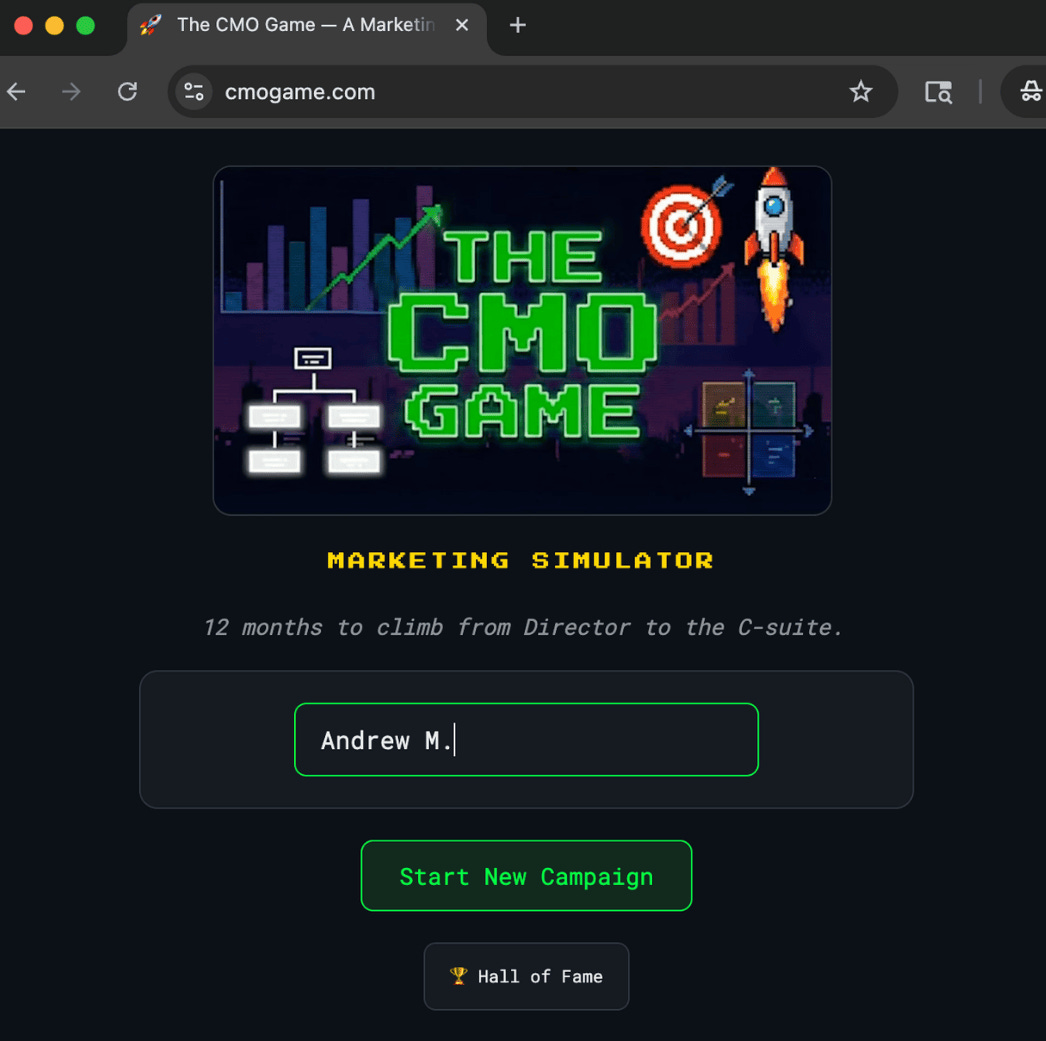
I have an unusual update this week: I made a game! It’s called The CMO Game.You have 12 months and $5M to launch your product and climb from Director of Marketing to the C-Suite. But your CEO has aggressive goals and if you don’t meet them, it’s game over.It’s like The Oregon Trail, but for marketing (and with less dysentery).You can play it right now at cmogame.com.Why Make a Marketing Game?One thing I keep coming back to is how hard it is to teach marketing. Books, lectures, and podcasts are great resources, but I really learned marketing by doing. By making bets with incomplete information. By investing in long-term brand while hitting this quarter’s target. By navigating pressures from sales, finance, and the CEO.I designed The CMO Game with this in mind, creating an active simulation that complements other resources for marketing education.Like this podcast, it’s free and designed for marketers who want to get better.How The CMO Game WorksYou start by picking a product: soda, shoes, skincare, or software. Then you lock in positioning: premium, value, lifestyle, or disruptor. Each combination has unique marketing channels and tactics that work best.Next, you hire your team and make your pre-launch investments. And every single choice is a trade-off.Skip PR, and you’ll be caught flat-footed when a crisis hits later in the year. Over-index on data, and you’ll get great insights and better projections—but you’ll have way less money to actually run campaigns.Then comes the launch itself. You have to decide your strategy: Do you go for a massive, splashy launch to grab immediate market share? Or do you hold back, preserving your budget for a steady drumbeat of campaign spending over the next 11 months?Over the next 12 months, you face unexpected challenges, respond, and adjust your budget. Every decision has tradeoffs.The game models the tension between brand and performance marketing.Brand equity grows like compound interest, it’s invisible early but pays dividends late in the game. Performance marketing is efficient and immediate, but growth is linear and lacks long-term payoffs.Strategy, Luck, and the Messy Reality of BusinessNot everything is in your control. Some months you get lucky. Other times you face a crisis. How you respond matters as much as how you plan.Premium skincare, value sneakers, and enterprise software all require different approaches. The game rewards players who grasp this, and penalizes those who treat marketing as one-size-fits-all.And yes, the CEO can fire you. If revenue stalls, if brand equity craters, if you make too many bad calls in a row... you’ll end up #OpenToWork.What Marketers Are SayingI shared early builds of The CMO Game with marketers, professors, and friends who work in gaming.Elton X. Graham, CMO of Sur La Table, put it well:“Mitrak’s game sparks the right conversations by not giving you marketing answers, but better questions to ask... which is where real learning starts.”Brian Marr, a marketing executive and professor, plans to use it in his Advanced Marketing course, describing it as a “great way to break the ice in the first class.”This is what excites me most: that people might learn timeless marketing principles while having fun playing a game.Play It and Share ItThe CMO Game is 100% free. No login. No email capture. No in-app purchases. Just cmogame.com.A full playthrough takes 10-20 minutes, depending on how much time you spend considering your strategy.If you’re happy with your results, you can submit your score to the “Hall of Fame” leaderboard. If you think you can do better, play again with a different strategy.If you like The CMO Game, the best thing you can do is share it with someone: a colleague, a student, or a friend who’s curious about marketing. If you’re a professor, you are more than welcome to share the game with your class. I’d love to hear what you think, and I appreciate feedback on how to improve The CMO Game. Email me at hello [at] marketinghistory.org or find me on LinkedIn.Thanks!-Andrew This is a public episode. If you would like to discuss this with other subscribers or get access to bonus episodes, visit marketinghistory.org
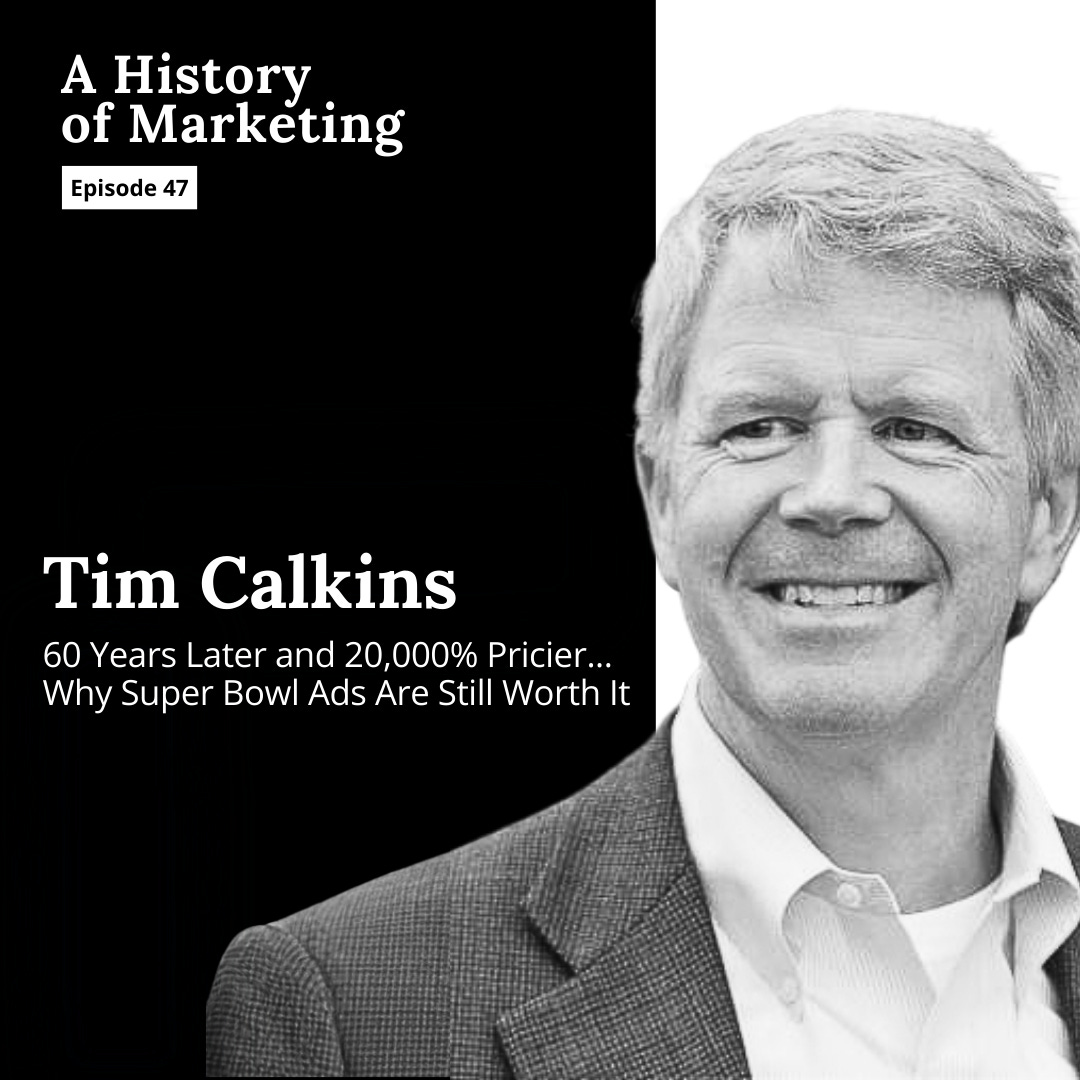
A History of Marketing / Episode 47In 1967, a 30-second spot at the very first Super Bowl cost roughly $37,500. This Sunday, for Super Bowl 60, brands are paying upwards of $8 million. That is a price increase of over 20,000%.So… Is it still worth it?For Professor Tim Calkins, who’s spent 22 years studying this exact question, the answer is an emphatic, ‘Yes.’Since 2005, Calkins has led the Kellogg Super Bowl Ad Review, where MBA students evaluate every ad that airs during the big game. It’s easy to say which ads are funny. It takes more work to determine which ads will be effective.In this conversation, we dig into how Super Bowl advertising has evolved: why brands now release their spots weeks early, why the creative has gotten safer as the stakes have climbed higher, and what the tone of these ads reveals about the American economy and political climate.If you’re planning to watch the game this Sunday (or just the commercials), this conversation will deepen your appreciation for the work that goes into making every second worth $266,667.Listen to the podcast: Spotify / Apple PodcastsWe also talk about Tim’s years managing Kraft Mayo and Miracle Whip (two surprisingly different marketing challenges), and the most common mistakes that marketers make when delivering business presentations. As you’ll hear, Tim is an excellent speaker.Now here is my conversation with professor Tim Calkins.Special Thanks:Thank you to Xiaoying Feng, a Marketing Ph.D. Candidate at Syracuse, for reviewing and editing transcripts for accuracy and clarity.The Kellogg Super Bowl Ad ReviewAndrew Mitrak: Professor Tim Calkins, welcome to A History of Marketing.Tim Calkins: Well, thank you. It is great to be here.Andrew Mitrak: We will be publishing this right before the 2026 Super Bowl, which is Super Bowl 60. I had a lot of fun preparing and researching some of your work and also watching some old classic Super Bowl ads. The reason I wanted to have you on for this conversation is that you started publishing the Kellogg Super Bowl Ad Review in 2005, so over 20 years now. Can you introduce this project for listeners?Tim Calkins: This is our 22nd year doing this event. Back in 2005, we began the Super Bowl Ad Review, the Kellogg Super Bowl Ad Review as we call it. I teach at Kellogg, I teach marketing at Northwestern University’s Kellogg School of Management. Before I was at Kellogg though, I was at Kraft Foods, and I worked in marketing at Kraft Foods for a number of years. When I was at Kraft Foods, now Kraft Heinz, with my team I would sometimes do an exercise where we would look at Super Bowl ads and try to think about what we could learn from what had happened on the Super Bowl.When I came over to Kellogg, I thought there was a similar opportunity there to do something around the Super Bowl where we get the Kellogg students evaluating these Super Bowl spots. So the event has now been running for 22 years. The format is always the same. We pull together a panel of Kellogg MBA students. Nowadays it is about 70 or 75 students. As the Super Bowl unfolds, as it plays, the students evaluate all the ads that run.What makes our panel different from a lot of other panels that are out there is that we are very focused on efficacy. We are trying to think about: will these spots, will these Super Bowl ads, build the business and build the brand? Ultimately that is what Super Bowl advertising is all about. A lot of panels, and a lot of Super Bowl rating things—there are lots of these—they will look at likeability, humor, which one did you like the best, which one was funniest. Our panel, we don’t really do that. That’s not really the question. The question really is, using sort of an analytical framework and process, how do we think about which ones of these will be most effective?Every year we come up with our ratings. We give a handful of advertisers As, and then Bs, Cs. On occasion, we give out an F if somebody really misses the mark. It is a really fun event, but it also is a lot of work because what you realize being part of it is that there are so many ads that will run on the Super Bowl. There are probably 75 official Super Bowl spots, but then there are all these other things that show up. You have local spots, you have network promo spots for different shows. It is a lot of evaluation that the students do. It ends up being a very draining experience.Andrew Mitrak: Can you walk me back to the beginning? You mentioned Kraft, which later became Kraft Heinz, which I will follow up on because I want to ask you about that too. When you first started paying attention to Super Bowl ads there, this might be an obvious question, but what stood out to you about Super Bowl ads? Why did you want to pay special attention to Super Bowl ads?Tim Calkins: Super Bowl ads are really unique things in the world of marketing. What is amazing is they become more and more unique as time has gone by. Even if you go back 25 or 30 years ago—so we are now at Super Bowl 60, so you go back to Super Bowl 25 even—the advertising that was running was really different than normal advertising. What happens on the Super Bowl is a few things. Number one, it is expensive, so the investment is high. Number two, you have a huge audience, so there is a lot of people who are watching it. But also, the expectations are different for a Super Bowl spot.You can’t turn around and run an ad that you are running on Survivor. You can’t turn around and run that ad on the Super Bowl. For most advertisers, you are creating a special piece of creative just for that event. People expect to see amazing Super Bowl spots. That is the expectation and companies are under a lot of pressure to deliver.The Framework Behind Super Bowl AdvertisingTim Calkins: The reason it is really interesting to study is that you know that for each one of these advertisers, they are putting forward their best thinking, their best creative talents. This is the pinnacle of their work. So much scrutiny is on these things. Given that, it is fascinating to see what they decide to do. Sometimes they do brilliant things and other times they really miss. But to understand what is happening there and really think about it as a marketer is a really unique opportunity and you can learn a ton.Andrew Mitrak: You mentioned how Super Bowl ads are kind of this unique thing. They are a little different than other ads. When you think about this project of analyzing Super Bowl ads, how does it connect to your broader work in brand and marketing strategy? Do you see these as really closely related where a Super Bowl ad is just the epitome of a brand and a marketing strategy wrapped into 30 or 60 seconds? Or do you feel like this is just a little bit of a different, kind of like a fun side quest that’s related to a brand, but it is a slightly separate, unique, different thing than the rest of the brand itself? How do you frame this work?Tim Calkins: I think a Super Bowl spot is very much at the heart of everything that I teach. I teach marketing strategy, I teach biomedical marketing, I teach influencer marketing, branding. Across all of those classes where I really spend a lot of time is trying to think about the strategy. What are the choices that companies and brands are making? Are they going after new consumers, for example, or are they going after their current consumers? Are they trying to skew younger? Are they trying to go older? Is it about repositioning a brand, getting people to think differently about it? What are all the choices that companies are making?So when we look at Super Bowl spots, and I look at a Super Bowl spot, I am really interested in pulling apart the choices that the companies have made. Your first choice: the decision to run an ad on the Super Bowl. Well, that’s a big decision. How is it that the company reached that decision and decided that was a good use of 8, 10, 20, 30 million dollars? That begins there. Then the question is, okay, well what products are they talking about and who do they seem to be going after and what’s the message they are putting forward? All of those are sort of strategic choices that the company is making.Ultimately it does get down to some creative execution things, and those are fun too. But I think a lot of the heart of a good Super Bowl ad comes from the strategic choices that are made in the development process.Andrew Mitrak: What is the first Super Bowl ad you yourself remember watching? Were you always interested in Super Bowl ads?Tim Calkins: Oh, I’ve long followed the Super Bowl. Like everybody, I watched the Super Bowl. As I was growing up and came through college and all of that, I would watch the Super Bowl and you’d watch the advertising, of course, a big part of the event. It was really only when I got to Kraft that I began to look at it with a marketing lens. That is a very different way to evaluate a Super Bowl spot. Beforehand you might be looking at, you know, what’s one of the early ones I remember... the Coke Mean Joe Greene ad that ran, which was one of the great spots. Or, of course, Apple’s spot that ran back in 1984, these old spots that ran.But it was very different for me when you begin to think about these as marketing investments and marketing tools. That is where all of a sudden it begins to change how you watch a Super Bowl ad. It is one of the things I try to do as I talk about the Super Bowl, is to get people to look at them a little bit differently. It is so easy for people to pass a quick judgment on a Super Bowl spot. “Oh, that was funny. That was great. That was stupid.” People are very quick to pass judgment on it and nothing to stop them from doing that.But when you really pull back and try to think about what is happening there, it totally changes how you evaluate it and how you think about it. You just have a lot more respect for the risk of these pieces of advertising and you have a lot of respect for how difficult it is to do. I think to
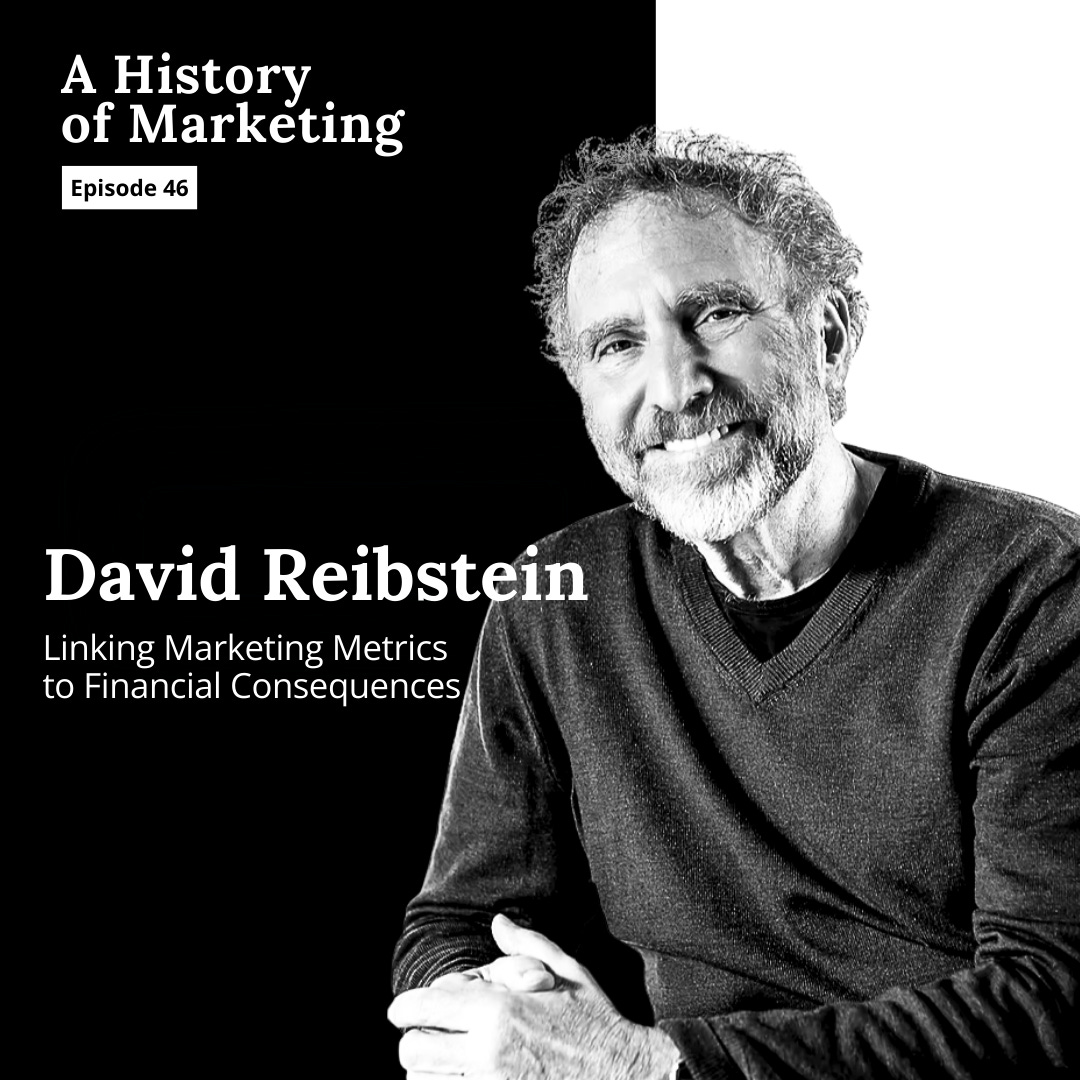
A History of Marketing / Episode 46David Reibstein has spent his career straddling disciplines that don’t always talk to each other: quantitative analysis and behavioral science, academic theory and management practice, marketing departments and finance teams. As a Professor of Marketing at the Wharton School of the UPenn and the co-author of Marketing Metrics, Reibstein is a world-renowned expert on how to measure what marketing actually contributes to a business.We discuss what David learned while under the mentorship of Frank Bass, a pioneer of bringing quantitative analysis to marketing and half the namesake of the Ehrenberg-Bass Institute. Then we trace David’s early analysis on brand switching through his current research on nation branding and cryptocurrency confidence.Along the way, we dig into why brand equity rarely shows up on balance sheets, why CMOs still struggle to justify Super Bowl ad spend, and what the Finance Minister of Saudi Arabia wanted to discuss over a private lunch.Listen to the podcast: Spotify / Apple PodcastsA few highlights from our discussion:* How Frank Bass transformed marketing from “think like a customer” intuition into a data-driven discipline* Why brand equity should account for both price premiums and volume gains* The surprising reach of nation branding research (and the heckler who said his data were wrong)* What crypto and meme coins reveal about confidence as currencySpecial Thanks:Thank you to Xiaoying Feng, a Marketing Ph.D. Candidate at Syracuse, for reviewing and editing transcripts for accuracy and clarity.And thank you to Bill Moult, whom you may remember from episode 23 of this podcast, for introducing me to Professor Reibstein.The Influence of Frank Bass on Marketing ScienceAndrew Mitrak: I thought I would start at the beginning of your career. One of the names that I saw you collaborated with and worked for was Frank Bass. I’ve interviewed a professor from the Ehrenberg-Bass Institute, and we’ve talked a lot about their work on the podcast. We haven’t actually talked about Frank Bass himself, so I thought I might just start there and ask you about Frank Bass and what you learned from working with him.David Reibstein: It’s a great place to start because that really is where my academic career began. He was known as basically one of the key people that was bringing quantitative aspects into the field of marketing. He was bringing meat into the whole category. He contacted me while I was in a master’s program. Frank started talking to me about, “You don’t need to finish that master’s program. Why don’t you come join the PhD program now?” I was three-quarters of the way through my master’s program, and I went and joined the PhD program, thinking if I go into academia, I don’t need that master’s. And I’ve never needed that master’s.Andrew Mitrak: So Bass was a pioneer in bringing this quantitative side of marketing to the field. Could you just describe the field before him? What was the status of quantitative analytics and taking more of a data-driven approach and measuring the impact of marketing at the time? Can you give us a picture of the before and after?David Reibstein: So if you think about what was marketing practice, it was “think like a customer.” There were a lot of consumer behavior aspects that were to it. Actually, when I was in my PhD program, I worked a lot with Jacob Jacoby, thinking about that. I had a minor in consumer behavior, but that was sort of where marketing had been. It’s now a major sector of the field of marketing.The Evolution of Data and EconometricsDavid Reibstein: But the quantitative side, if you think about the availability of data, it was 100% survey data with quarterly, at best, Nielsen data. We didn’t have a richness of data. Bass was looking at some time series data, how sales changed quarter to quarter. That’s sort of the field as it was at that time. He spent a lot of time, and some of the classes that we took with him—I say we, my fellow doctoral students—was thinking about econometrics as it applied to marketing. How sales changed over time with changes in marketing expenditures. That’s sort of where it is. If you think about where we are in 2026, the nature of data has exploded. You don’t need me in this session to talk about big data, but the abundance of data and moving away to a very large degree, but not entirely, from survey data has certainly been a prevalent part of how the field has evolved.Andrew Mitrak: Once you left your master’s where you were three-quarters of the way through and got started working on your PhD program under the guidance of Frank Bass, what did you learn from him? What did you collaborate with him on?David Reibstein: We spent a lot of time looking at brand switching behavior. It’s sort of related to brand loyalty issues versus just random behavior that happened to be there. He talked a lot about the stochastic man, that it’s all a stochastic process. There’s a probability of you buying certain brands, but what you bought last period doesn’t have an impact exactly on this period. There are different theories about how people switch, but a lot of what it is that I was working on with him at that time was looking at that switching behavior from consumers. That obviously would relate to frequently purchased goods (fast-moving consumer goods).Current models and thinking about customer lifetime value and how long you think they’re going to stay with you over what period of time—some of that early work really feeds into trying to think about customers and how long you’re going to have them as customers over time. We were trying to change the probability of choice. It moved from being deterministic, “Here’s what they’re going to choose,” to “Here’s the probability that they’re going to pick these particular items.” Predicting probability of choice, we’re much better at doing that than predicting specific choice.Andrew Mitrak: So this area became a thread throughout your career, tying marketing activity to measurable business impact. This is something that you worked on for decades afterwards, and it started back under your work under Frank Bass. Why did you see that this was the area to focus on for so long? Did you feel like there was a gap in this area where you could be the person to carve out your career here? What did you identify there?David Reibstein: I’m going to go back to your previous question and tie it to this question. A lot of what I learned from Dr. Bass, from Frank Bass, is really methodologies. Econometrics was a major part of that, but certainly how to deal with data, structural equations, and trying to think about all of that. But it turns out that rather than just be a methodologist, what I thought was important was to spend some time trying to think about actions that management takes and then relating that to particular outcomes using the appropriate methodologies.Bridging Methodology and ManagementDavid Reibstein: So when I left Purdue, I joined Harvard. I wanted to spend some time trying to think about, “So how do we use this stuff? For what purpose?” So as I’m at Harvard, it was all “Just think about management,” and less thinking about the methodology. I viewed myself in a position to try and think about relating these together. I wanted to look at actual management behavior in marketing and how that relates to outcomes. So I wanted to know how it relates to profit because that’s what they really care about. I wanted to use quantitative statistical methods in a rigorous way to try and address that particular question. I think that gets to your specific question.Andrew Mitrak: When you were studying under Frank Bass, would you say that the type of activity you were doing was more sort of large-scale, macro style—the quantitative side of marketing—or were you also working on some of the behavioral science, the micro, and the psychological side as well? Or did that come later?David Reibstein: So the answer is yes and yes. Which is, originally working with him, it was looking at all the macro. And then what I evolved to, and what I ended up doing my specific dissertation on, was looking down at individual customers and seeing what their specific behavioral patterns were. Could we predict what those individual behavior patterns were? Which is why thinking about... you can’t look at brand switching on the macro level. We’re going to get market shares and sales, but not down to the individual behavior. What I started getting into in my dissertation was trying to think about indeed that individual level behavior and how people switched, and could we predict what those probabilities of behavior would end up being.Andrew Mitrak: Really hard to do both. To be able to do both the large quantitative analysis and what I imagine to be lab work or very individual type of work with individuals and understanding psychology.David Reibstein: Actually, what’s interesting in today’s world—today, 2026—most doctoral students as they’re coming out, they declare “I’m quantitative” or “I’m behavioral.” We sort of ask them, “Which group do you really fall in?” I’ve always been a straddler. And it’s like, how do we take what we could think about on the behavioral side and quantitatively analyze that? So I’ve published in Marketing Science and the Journal of Marketing Research, but I’ve also published in the Journal of Consumer Research, trying to think about those two.The Role of Marketing StrategyDavid Reibstein: But I’m... most people will agree I’m an anomaly rather than a norm or a model that one should follow because you sort of are expected to fall into one of those buckets, one of those two buckets. And then I’m going to complicate it a little bit more because I also thought about the management side of that. So that sort of got me into marketing strategy, which is a lot of what I end up teaching now at Wharton, thinking about the marketing strategy side of that. So I’m going to add three legs
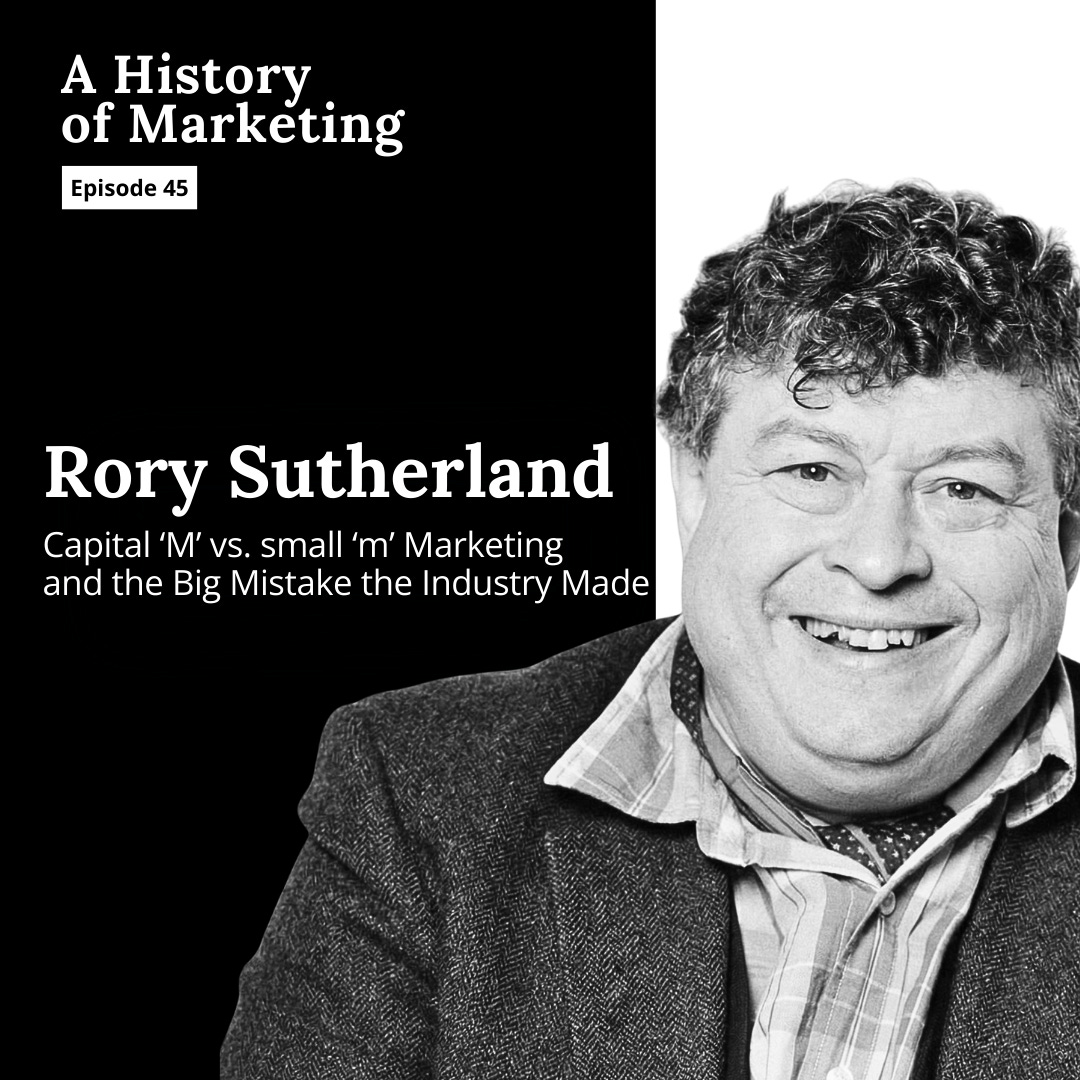
A History of Marketing / Episode 45 Today marks exactly one year since I hit publish on the very first episode of A History of Marketing. I wanted to do something special for the anniversary, so I’m happy to share my excellent conversation with Rory Sutherland.You may know Rory from his Ted Talks which have been viewed by millions, or his TikToks which have been viewed by tens of millions. He is the Vice Chairman at Ogilvy and the founder of their behavioral science practice.I’m a big fan of his book, Alchemy: The Dark Art and Curious Science of Creating Magic in Brands, Business, and Life. As we discuss on the podcast, Alchemy is all about how marketers think, rather than just what we do.Listen to the podcast: Spotify / Apple PodcastsWe also cover:* The real David Ogilvy: Rory shares about meeting David Ogilvy, and the parts of Ogilvy’s life you won’t find in his books, like his stint as a British spy in Washington during World War II.* The “Capital M” vs. “small m” marketing mistake: Why the industry got marketing wrong by turning it into a department rather than a way of thinking.* Behavioral science and business: How to practically apply behavioral science and “nudge” to marketing strategies.Rory has a way of using history and behavioral science to reveal “unseen opportunities” that most traditional data misses. This conversation changed how I think about the role of marketing, and I hope it does the same for you.Special Thanks:Thank you to Xiaoying Feng, a Marketing Ph.D. Candidate at Syracuse, who volunteers to review and edit transcripts for accuracy and clarity.And thank you to Paul Feldwick, whom you may remember from episode 30 of this podcast, for introducing me to Rory.Espionage, Aerophobia, and the “Hidden” Psychology of David OgilvyAndrew Mitrak: I wanted to ask you about David Ogilvy. I wanted to start with him because he’s such a big figure, and I love his books. I haven’t actually discussed him that much on the podcast, and you’ve worked at Ogilvy since the late ‘80s. I’m wondering if you have an element of David Ogilvy’s success that you’ve learned from working at Ogilvy that I wouldn’t have learned from reading one of his books.Rory Sutherland: I only met him once, and I can date it more or less exactly because it was after the Eurostar opened—the tunnel train tunnel between France and the UK. David was absolutely terrified of flying. In fact, in later life, he crossed the Atlantic by ship in preference to flying. He was absolutely paranoid about flying. I’ve met people who met him off flights, and he kind of emerged down the jetway as a kind of physical wreck. So, he was only really prepared in later life to travel to London after the train service opened. Consequently, I only met him once. I knew his wife, later widow, quite well subsequently because we used to have Ogilvy events and WPP events indeed at the Château de Touffou where he’s in fact buried.I think actually there’s a part of his life as well where he will emerge actually even more interesting than he’s believed to be at the moment. Part of his life, which was effectively with British Intelligence in Washington, D.C. during World War II, when he worked with, for example, Ian Fleming and a few other people.Andrew Mitrak: There’s the book about this called The Irregulars. It’s fantastic.Rory Sutherland: The Irregulars, which is absolute—yeah, which I think I might have actually discussed this with the author. Of course, he was, whether it was just discretion or he was actually D-noticed or had signed the Official Secrets Act, but I’m fairly sure that during his lifetime he wasn’t really allowed to talk about this period of his life. A large part of which, I think, was effectively persuading the US to enter the war in the very beginning of 1940-41, pre-Pearl Harbor. He was engaged in persuading the US to enter the war, and then presumably also persuading the US to enter the war in Europe before they fully embarked on the war in the Far East. So, a large part of that was probably involved with his previous experience with Gallup; he would have been effectively gauging public opinion and working out the right strategies for getting American support, which was by no means, certainly in terms of the war in Europe, by no means automatic, certainly before Pearl Harbor. It’s very similar to World War I, in fact, where obviously Woodrow Wilson—who bizarrely is my fourth cousin twice removed—where Woodrow Wilson effectively fought an election on the whole basis of isolationism and then had to do an about-face. So, I think there’s a whole part of his life which he couldn’t write about at all, which, being a showman, which he was—and I make no apology for that—he would have undoubtedly loved to have written about, but simply couldn’t.Ogilvy’s Psychology of LeadershipRory Sutherland: When I said I met him the once, he presented his work and gave a talk. Interestingly, we’d sort of heard rumors that he was slightly losing his marbles because this would have been—he would have already been in his 80s at that point. But he was completely lucid and fantastically clear in his presentation. I always remember a detail, which is that he’d pinned up a lot of his work, which was then laminated and stuck to the walls. Of course, he then needed it collected, and you had that little awkward social moment where nobody wants to be seen doing the—in a large group of people, no one wants to be seen doing the menial work of collecting the drawing pins and putting everything back in a bag. He simply made the point that he said the work has been pinned up on the wall by the European chairman of Ogilvy, so it shouldn’t be beneath anyone’s stature to help me take it down. So, there was that psychological astuteness, a very, very clever bit of behavioral science. Look, if the second most senior person in the room has pinned this work to the wall, none of you should feel any diminution of status by removing the drawing pins. So, he was clearly that sort of very astute psychologist even in his—I’m trying to work out the date, he was born in 1911, so he would have been in his sort of mid-80s, I’m guessing. He died in ‘99 [sic], I think, if I’ve got that right.The Limits of Traditional Market ResearchAndrew Mitrak: Yeah. So, you mentioned how he has this intuitive behavioral science sort of understanding. He also worked for Gallup, and he really preaches about research, research, research in his books. A lot of your work is sort of where does research fall short, right? A lot of your insights are about what is intuitive or psychological where people aren’t stating their preferences? Marketers are being intuitive and uncovering revealed preferences through behavior. I’m wondering, do you have a heuristic for where research falls short, or where you might disagree with Ogilvy on his take on marketing research?Rory Sutherland: I mean, we can overstate this, because it’s often taken, my view, that market research is a terrible thing because people don’t know why they do what they do, which is to some extent true. Now, this is not to say that a lot of research can’t be both useful and accurate. If people really hate something and they say they hate it, it’s undoubtedly worth taking that on board. You could learn an awful lot about what you’re getting wrong by simply researching your customers. There are also, which David didn’t have to the same extent, completely free sources of information like call centers, which I always think are a massively underutilized resource because they’re the place where you learn what you’re getting wrong, or what your customers can’t do online, or all manner of things. So, don’t get me wrong. He never said this famous phrase often attributed to him: that the trouble with market research is that people don’t think what they feel, they don’t say what they think, and they don’t do what they say. That’s somebody else who said that. I don’t think David would have said it because he was undoubtedly a research advocate because he preferred the discipline of research to what he called sort of random creative self-indulgence.Tacit Knowledge and Entrepreneurial ArbitrageAndrew Mitrak: It’s funny because I want to pause on that line real quick because it’s in your book. It’s in Alchemy, but you say in Alchemy that you don’t think he ever said that, or you can’t confirm whether he ever said that. So you found out that he did not say that?Rory Sutherland: Well, certainly nobody, and several colleagues of mine had tried to find an accurate attribution. I think if you go to something like Quote Investigator online, it has been attributed to other people, possibly earlier than David. And by the way, I mean, that’s not completely true. A lot of the time we do actually think what we feel, and we say what we think, and we do what we say. What is important, though, is that the tacit information is disproportionately valuable because it’s there that you can find yourself either under a massive illusion about what people really want because it’s what they say they want. Lower prices would be an example. It would be very, very dangerous to take that literally because people always say it because it’s a rational-sounding answer. “I’d do this more often if only it was cheaper.” Well, that’s both true and not true, and in any case, there will also be a chunk of people who will never tell you that they’d do something if it were only more expensive. So, around price, for example, there’s an enormous amount of misinformation. Also, information that’s tacit, which therefore isn’t in the public domain, is disproportionately valuable because it’s a source of kind of entrepreneurial arbitrage. And you know, I mean, okay, if you—nobody when Steve Jobs came along was really actively saying, “I’d buy a computer if only they weren’t so f**king ugly.” Okay? Nobody was really saying that. And so, an awful lot of entrepreneurial activity involves a bet on something which you assume
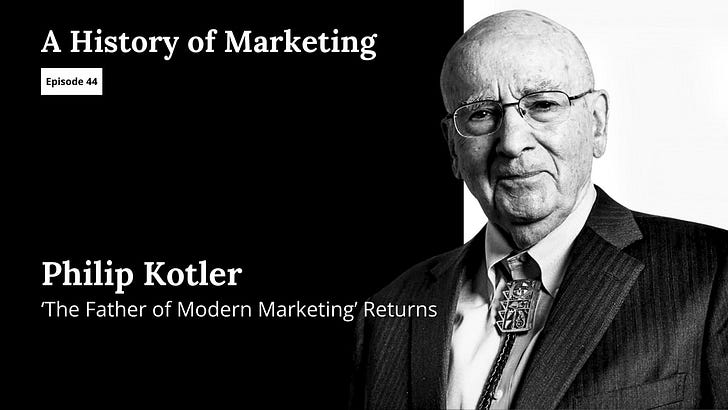
A History of Marketing / Episode 44 When I launched A History of Marketing at the start of this year, I had a vision of exploring the origins of our craft. But I never imagined that 2025 would be bookended by “The Father of Modern Marketing.”Dr. Philip Kotler kicked off the podcast as the first guest I interviewed. Now, it is my distinct honor to welcome him back to the show for our final interview of 2025.The Year in Review: 69,523 ThanksThis year has exceeded every expectation I had. To date, this podcast has been downloaded and streamed 69,523 times across YouTube, Spotify, and various podcast platforms.What started as my personal quest for knowledge has reached marketers on every continent (save for Antarctica). I’ve received notes from a wide range of listeners: from global CMOs and Ivy League professors to high school students and interns; from entrepreneurs who have scaled million-dollar businesses to self-described Marxists and lifelong marketing critics.To every one of you who has listened, shared, or sent a note: Thank you. This show has been like the best possible version of a self-directed MBA. I’ve learned, I’ve made new friends, and I’ve become a better marketer because of it.A Legend Who ListensOne of the most incredible moments of this year—and this interview—was learning that Dr. Kotler doesn’t just appear on the show; he listens to it. Much of the success of this podcast is due to Kotler’s early support. Phil was my first-ever guest, and his recommendation opened doors to other legends like Jag Sheth and David Aaker. As we wrap up 2025, I want to express my deepest gratitude to Philip for his mentorship and to you, the audience, for coming on this journey with me.What We Cover in This Episode:* The “Mount Rushmore” of Marketing: Kotler names the practitioners he admires most (and his answers might surprise you).* Addressing the Critics: His refreshing take on those who try to build their names by opposing “Kotlerism.”* The 4Ps vs. The 7Ps: Why Kotler sees “promotion” imoving toward a more expansive “Communication System.”* Marketing’s Mathematical Turn: The tension between “people people” and “number people.”* And much moreEnjoy the final conversation of the year with Dr. Philip Kotler. I’m looking forward to what we’ll discover together in 2026.Listen to the podcast: Spotify / Apple PodcastsThank you to Xiaoying Feng of Syracuse University, who reviews transcripts for accuracy, adds helpful links for readers, and gives me feedback to improve the show. The Enduring Legacy of Philip KotlerAndrew Mitrak: I’ve recorded more than 40 interviews with marketing executives, academics, and authors, and you are the single name that is most referenced across all of these interviews, across everybody. Do you ever think about why your work has endured? I’ve seen so many other marketing frameworks come and go, yet 60 years on, folks still reference Philip Kotler and your work. Why do you think that is?Philip Kotler: Well, that’s a good question. I haven’t really thought about it until you asked it. By the way, I’m a watcher of all your programs, and I’ve learned a great deal about the history of marketing, and I tell others to also follow your work.Your question is, why am I still around in the marketing world? I did some thinking about that. I think a lot has to do with my textbooks. I have three textbooks: Marketing Management, Principles of Marketing, and Marketing: An Introduction. All of them are already in their 16th, 17th, or 18th edition. So therefore, lots of people around the world—in fact, those are books used around the world—know me that way.I’ve also published, besides three big textbooks, many other books on marketing like entrepreneurial marketing, transformative marketing, and so on. So I think that makes a difference. I have traveled a lot around the world, many countries, to upgrade them on marketing thinking. Particularly, it started with 12 annual visits to Sweden, 12 annual visits to Milan to say what’s happening in the field of marketing. And then I got a lot of honorary degrees. So for some reason, those all have added up to lasting in this field and enjoying it very much.Andrew Mitrak: So it’s accumulated over time—all of these degrees, these textbooks, all this work. And today you are often referred to as the “Father of Modern Marketing,” but it wasn’t always that way. There was a time when you were early in your career; there was a time when you were midway through your career and you were just publishing your first books. Did it ever feel like there was a turning point when you started to feel like a major name in the field versus feeling like an earlier career professional trying to establish yourself?Philip Kotler: What happened is every time I published a book, it had good reviews, and that meant getting more readers. I think that getting honorary degrees abroad—I received 22 honorary degrees abroad—in each case, I visited the university giving that award. All of that happened way before I was ever called the Father of Modern Marketing, and to this day I don’t know who first used that expression. It wasn’t that I created it and publicized it. So I’ve been very lucky to be recognized for my work in marketing.Andrew Mitrak: It didn’t strike me that you would have bestowed that title upon yourself… that doesn’t seem like your style. [Laughs]Kotler on Addressing CriticsAndrew Mitrak: One thing I’ve noticed since publishing this podcast and being, I think, more attuned to your work and how other marketers speak about you, is that there’s a common way that marketers will try to make a name for themselves or their ideas. They’ll define their ideas almost in opposition to Kotler, almost in opposition to you. They’ll say things kind of to the effect of, “Oh, Kotler’s principles, they don’t work in this segment,” or “They don’t work in this country, and you need my framework to succeed.”It almost reminds me of a boxer who is kind of trash-talking the champion to get publicity for himself or something. It seems like, “Oh, because you’re the Father of Modern Marketing, they’re trying to elevate their ideas to your stature.” I’m wondering, not to dismiss, I am sure their ideas merit a lot, and the tactics they use, if you’ve noticed this over the course of your career and how you’ve responded to it.Philip Kotler: Well, I relish those challenges. In fact, I’ve often said that I wish someone would replace my theory or system of marketing thinking with something better. One fellow from Ireland, he’s a professor in Ulster, Dr. Stephen Brown, really took to that position. He wrote an article saying that the specter of marketing is Kotler, or “Kotlerism.” It’s like Kotlerism is around too much. And he actually tried to explain my being visible because he thought I was following what Karl Marx did to become known. It’s a very interesting article.He also wrote a whole book of a fictional marketing department, and it was really about Northwestern University and my role in the marketing universe. So I get those things, and I find that’s fine. Recently, someone just wrote a book called Marketing is Dead, which is to say that they have a better answer to what it should really be. I welcome those things. As a matter of fact, my complaint is that marketing doesn’t have enough debates. A good field is going to have some real opposition about concepts and theories and measurements and so on, and we need more of that.Andrew Mitrak: That’s a great outlook. I’ll try to look up that article you were referencing and see if I can paste a link in the blog that accompanies this post. You mentioned how marketing doesn’t have enough debates. On this thread, what is your overall assessment of how marketing has evolved since you’ve been in the field? Let me ask in another way, if you’re, quote, “The Father of Modern Marketing,” how do you feel about how your child has grown up?The Evolution from Mass Marketing to One-to-OnePhilip Kotler: It turns out that I’ll start with the fact that the first big debate I really had with the rest of the profession is whether marketing is only a commercial subject of relevance to commercial firms, or it applies to all organizations and even groups and individuals. And I made the point that marketing is done by everyone in so many ways. A vote was actually taken on that issue by the American Marketing Association, and we won. That marketing is far more than just a commercial subject for firms.Marketing started pretty much with mass marketing as an area because of the image of Coke and McDonald’s and stuff like that. But then along came segmentation, targeting, and positioning (STP), meaning that you got to focus your marketing on a group with a very specific need to be solved by your solution. And that ushered in several decades of work—interesting work—the whole idea of what is a segment and how do you target and position it.Then the next stage, which we’re in now, is one-to-one marketing. We never thought that we need to have more than the geographical look of a demographic to not know the individuals in that demographic. But the fact is, now we can collect information on every individual, which allows us to customize and personalize our messaging so that it’s correct messaging at the right time and for the right purpose. So I’ve seen that happen.Now, how many companies are really going to do one-to-one marketing? Because we are in that stage of celebrating it. Not that—well, it’s interesting. The smallest companies tend to be one-to-one marketers, if I mean by that the small pastry shop where the French consumer comes every week and says hello and is greeted. They are into one-to-one marketing. But what’s impossible normally for large companies is to know each individual and have a nice way to greet them. But now they’re trying to do that. So that’s an interesting effort to get close to individuals even though you’re a huge company. Something must be lost in that process, but th
A History of Marketing / Episode 43 If you studied marketing in school, you likely carried Kevin Lane Keller’s work in your backpack.He co-authored Marketing Management, the all-time best-selling marketing textbook, alongside Philip Kotler. And with Strategic Brand Management, Kevin he defined how a generation of marketers understands brand equity. As a Professor at Dartmouth’s Tuck School of Business, he has spent decades bridging the gap between rigorous academic theory and elite corporate practice. He’s consulted for giants like Disney, Nike, and Ford, but perhaps his most interesting “field research” came from working with the Australian rock band, The Church.This conversation is a rare treat for our listeners. Despite his massive impact and the high regard of his peers, Kevin keeps a relatively low profile and seldom sits for deep-dive, long-form interviews. This episode offers unique insights from one of the primary minds to shape modern marketing.Listen to the podcast: Spotify / Apple PodcastsIn our conversation, we discuss:* The P&G Playbook: How he helped transform Pampers by connecting functional technology to emotional “brand mantras.”* The Art & Science: Why great branding requires both a philosophical “philosophy of consumption” and disciplined data tools.* Managing The Church: What he learned about marketing, fan engagement, and “continuity vs. change” while managing a legendary Australian rock band.Now, here is my conversation with Kevin Lane Keller.Thank you to Xiaoying Feng, a Marketing Ph.D. Candidate at Syracuse, who volunteers to review and edit transcripts for accuracy and clarity.Collaborating with Kotler on “Marketing Management”Andrew Mitrak: Kevin Lane Keller, welcome to A History of Marketing.Kevin Lane Keller: Thanks for having me.Andrew Mitrak: I’m so excited for this conversation because like a lot of people, Marketing Management was my textbook in grad school, and your name was on the cover there right alongside Philip Kotler’s. So, how did you get involved with becoming Philip Kotler’s co-author?Kevin Lane Keller: It’s interesting. I actually used the textbook too when I got my MBA. I had the third edition, so it’s going back a ways. I think it was the fall of 1978. I have enormous respect and he is a legend, but was a legend back then when I was taking the course. But I had the chance to publish my own textbook on Strategic Brand Management. I had done that and that was really my area of interest, but I’ve always been a marketer at heart in a very broad sense. So the publisher was looking for someone to be a co-author, and because of my experience and some of the things I was interested in, it seemed like a nice fit. So I actually did the 11th edition. Phil and I worked together just to sort of try it out, kind of both sides, and it went well. I enjoyed it a lot. And so I think it made sense and starting with the 12th edition I was formally the co-author and have been a co-author ever since.Andrew Mitrak: When you write a book like that, that is so widely read and is sort of the Bible for a lot of folks who are just getting into marketing—if a professional marketer reads one book, that’s often the one that they reference—is there a lot of pressure when you write a book like that to make sure it’s accurate and up to date? Do the stakes seem very high for it?Kevin Lane Keller: It’s daunting. When you think about it, it’s an impossible task because you’re trying to capture all the richness and all the detail and manage to distill that down and package it and write it and source it and reference it and everything, and make it engaging and interesting. So it is difficult. I enjoyed doing that. I think the challenge of that. And you break it down. It’s a little bit like building a house. You think, “Oh my God, building a house.” Well, you’re doing rooms and within rooms there are certain things you have to do. So you really break it down. It is very modular in how to approach it. But the big challenge is really keeping it up to date and making sure that it captures what modern marketing is and, more importantly, maybe what it should be.The Challenge of Keeping Marketing Texts RelevantAndrew Mitrak: Yeah, I have a question around keeping it up to date because there are probably certain core principles that you want to keep tried and true. Things like segmentation, targeting, and positioning, I think, were in my version of the book. I’m sure the Four Ps were referenced in it and things like that. But then there are a lot of things that change. So how do you think about what changes versus what doesn’t change?Kevin Lane Keller: I think there is always continuity and change in marketing in general. I’ve worked with a lot of brands, I’ve worked with a lot of legacy brands, really strong brands, and that’s always the challenge: how do I move forward, but how do I move forward in the right direction and in the right way, at the right pace and all of that. It’s no different with a textbook. You are thinking about what are the new ideas and the new concepts. And sometimes new frameworks and new ways to organize and think about things. But yet at the same time, there are those core principles and segmentation and targeting in some sense, and positioning in some sense. It may change some how you think about those, but that notion and those concepts themselves at least at a high level are ones that are retained. But a lot of things change and especially with digital and with AI, we’re really trying to make sure the book reflects that.Andrew Mitrak: Yeah, I was thinking just about that example exactly. Like I’m sure SEO is covered in a book, right? It’s a very big thing. But then even the language around it is changing. Sometimes it’s called Answer Engine Optimization with an AI. Sometimes called Generative Engine Optimization, GEO or AEO with AIs. And then it’s sort of just you might just call it LLMs. And the language itself, especially at this moment when we’re recording here in November 2025, is changing so much where if you committed to something in a book very quickly it could be outdated. If that version is used for years, it could just wind up being a thing where you’re like, “Ah, kind of missed the boat on that one.” So how do you sort of think about staying relevant without becoming outdated too much?Kevin Lane Keller: Well, I think you think about updating more frequently. I think that is probably one of the answers because there is nothing you can do. You can only go and be as current as you can till literally the moment of publication. So you’re always having the final proofs and you’re looking at them and you’re literally making changes and edits to try to make sure everything is as up to date as possible at that point in time. But at that point in time, then you move on in some sense. It is a little more dynamic with publishing. You have more opportunities to do updates and bring that in. So that’s the advantage of the e-text and the more digital versions versus the hard copy, the kind of classic textbook version in that sense. But you are always trying to. And look, the AI, that is an area that is just exploding so much and changing so much that it’s going to be a moving target for a while.Andrew Mitrak: Oh yeah, keeps it interesting.Kevin Lane Keller: Yeah, it does. Yes.Collaborating with a Marketing LegendAndrew Mitrak: So what was it like collaborating with Phil Kotler?Kevin Lane Keller: I had known him some through the years. He had actually tried to recruit me as a PhD student to Kellogg at one point in time, wrote a very nice letter when I was just first getting my PhD and through the years. He’s one of these guys. I joked when they had at one point an event to kind of honor Phil at Kellogg at Northwestern, and I joked that there had to be like three Philip Kotlers and we only actually had one of them in the room and the others were busy doing all the other things that Phil Kotler does because he’s just remarkably productive. I mean, unbelievably so. And the way he gets things done. But he’s the nicest guy. His ability, his radar to pick up on what matters. His ability to synthesize that, clarify it, put it into context. It’s just amazing. So for me, I’ve learned so much, which is great. But I’ve also enjoyed it so much. So he’s made it fun. So it’s just been great. And he’s still heavily involved with the book. So he definitely is still providing a lot of input, a lot of feedback. So he’s definitely part of the book still.Andrew Mitrak: That’s amazing. Even into his mid-nineties. I think because he was the first interview on this podcast and he had a similar experience where he would just respond to emails so quickly and kind of be on top of things so fast. It’s amazing that he’s able to do it all.Kevin Lane Keller: Well, there are three Philip Kotlers. I’m convinced. But maybe if it’s just one, it’s even more extraordinary. I’d be amazed even with three.Andrew Mitrak: When you first started collaborating, him having this Father of Modern Marketing type legendary status in the field, were there ever any disagreements you had with him? Or did you feel like you could push back or evolve things? Or did you feel like because of that, his status, you had to be deferential to him and also he was sort of the original author? What was that dynamic like?Kevin Lane Keller: That’s a good question because that’s a big issue. A lot of times it’s just people, you know, we all have that issue. We’re kind of territorial or we just sort of kind of want to stick with what we’ve done and for whatever reason. And he’s been always really flexible and open-minded about that. So that has just not been an issue, which has been great. I think there are certain topics he’s reluctant to give up in the book that sometimes, maybe they’re not as important now as they once were. They’re still important, and I get the reasoning, but that’s the one area is just sort of in that space where it’s just always
A History of Marketing / Bonus Episode Earlier this year, I spoke with students at Syracuse University taking an “Essentials of Marketing” course. I shared stories from my non-traditional career in marketing that’s spanned filmmaking, virtual reality, robotics, trucking, and technology. I framed these stories into “five rules of thumb” for early career marketers.I’m releasing this as a “bonus” episode. I prefer to let the history and my guests be the star of the show, but regular listeners might be entertained by this personal detour and find some value in these takeaways.I want to give a special thank you to Xiaoying Feng for the invitation to her class and for being such a wonderful supporter of the show.Now, here’s the presentation.Listen to the podcast: Spotify / Apple PodcastsFive Rules of Thumb for Career GrowthI had planned to do a presentation on marketing history, but then Xiaoying asked me to talk about my career and journey.I realized you don’t just want to hear one thing after another. So I thought I would call it “Five Rules of Thumb.” So whether you are planning to be a marketer or just somebody early in your career, as you exit college and enter the “real world,” here are some things I’ve learned.I didn’t want to call them “lessons.” That felt a little too formal.So rules of thumb. For what it’s worth, they have worked for me, so hopefully, they work for you too.👍Rule of Thumb #1: Don’t Get ComfortableThe very first rule of thumb I want to start with is what somebody told me once, which is “Don’t get comfortable.”The story behind this one is that it was February of 2012, and I was going to a job interview. The job interview was with one of the biggest ad agencies in Seattle. I was 22 years old and feeling super confident. I actually had just won a Seattle ADDY Award for an advertisement I made for my university. I had also just released a 30-minute documentary that just won an audience award at a film festival. And I just graduated college a year early as well, and I was already producing videos for an investment company in Seattle. But I wanted to break into the ad agency world, which is why I was having this job interview. So I sat down for the interview, and the guy, who was the founder of this agency.He said to me, “I watched the first 10 minutes of your documentary. I didn’t understand what it was about. That’s not good.” I thought, Oh gosh, this is a tough start to an interview. Then he said, “I also watched your ad. I didn’t like it.” And he said, “What else are you working on?”I didn’t really have a good answer for him. I was like, “This is the toughest start to a job interview I’ve ever had.” I realized I wasn’t going to get this job. So, I just asked him what advice he had for a recent graduate who had a full-time job but wanted to get into advertising.His advice was: “Don’t get comfortable.”This guy was kind of a jerk, as you could tell, and I’m kind of glad that I never worked for him, but his advice was actually pretty good. I think what he was trying to say was: “When you are comfortable, you are not growing. Growth comes from discomfort.” The job I had at the investment company was a pretty comfortable job, but any growth I was going to have would come from pushing myself outside of my comfort zone. Even though this was someone I didn’t work with, I was grateful for the advice, and it stuck with me.Jobs, Side Hustles, Startups, and PodcastsTo place my career journey on a linear timeline, I would say the first era was being an undergraduate and I started making videos for the student newspaper. That turned into a job with UWTV; I made the first-ever student-produced TV show. While I was an undergrad, I was making 30-minute episodes a week. I was 19 years old when I started doing that, and all of a sudden, I was managing a staff of 15 people. I was the worst manager ever because no 19-year-old is a good manager, but I got a lot of practice making videos.Russell Investments reached out to UW and said, “Hey, who do you have can make videos? We need a video person.” And I got a job there. In the meantime, I was doing films and ads on the side as well. I always say I had a real job, and then that “don’t get comfortable” element was always doing side hustles or doing school on top of work or doing ads and doing freelance work on top of work. So that was kind of my “don’t get comfortable”. I was spinning multiple plates. I’m always doing a few things at once to try to learn more and more.The second era of my career was being a startup marketer, and I shifted from investment companies to startups because I just saw that startups have a lot of room for growth, and I’ll speak to this presentation on some of the benefits and also some of the risks associated with startups as well. While I was at startups, I started a side hustle during the COVID years. I realized I could take a lot of tactics I was doing for some of the startups I was working with, and do those first as a side hustle and then as a full-time job at my own agency.Finally, we’re at the present. I am now at Google, and it’s funny, I wanted to work at Google, right from when I graduated from college. I applied there when I was 22, 23 years old, and never got an interview. But then some of my startup opportunities, and some of my other networking and body of work, led to a role at Google. And I now lead demand generation for the SMB and startup segments for Google Workspace. It involves tools that I actually love and use every day. I’ve worked at companies where I’ve used competitive products, and I’ve used Google. I love Google’s products as well, so it’s really great to be at a really great company and then also marketing a product that I actually love and believe in.That ties back to how I met Xiaoying. I started this podcast called, A History of Marketing, because I always wanted to learn new things, become a better marketer, and apply some of my creative and media production background. I wanted to take those skills and my marketing skills, and see who I could meet to keep learning and exploring new things. At Google, it’s an amazing company, but I am really marketing one product in a more specific role, not doing the whole suite of marketing. I am not the CMO at Google or anything like that, and I’m really focused on one particular area, but I want to keep learning a lot of different areas about marketing. This podcast is a great way to continue being a better marketer, to continue to learn things.👍👍Rule of Thumb #2: Adopt Tech Early + Publish Your Work = Doors Open For YouThis takes me to rule of thumb number two, which is a useful lesson in almost any industry: If you adopt tech early and you publish your work, doors just open for you.This is true almost in anything that I can think of, if you are a young person, especially, you want to stand out. There are so many benefits to being early on the adoption curve of anything. There are so many benefits to publishing your work online or in some areas where others, your peers, future employers, other people on the internet, a PhD candidate at Syracuse, and people who can find your work. It’s just doors open for you. It’s something that I’ve tried to embrace over my career, and I almost just wish I had done even more of it over time. I’ll give some examples of this.It wouldn’t be a marketing presentation without some frameworks. Has anybody heard of the book Crossing the Chasm? It is one of the best B2B marketing books, and basically the gist of it is that you have this early stage with very innovative people who adopt things on the bleeding edge, then early adopters, the second chunk here, and they are the early folks who will adopt your new technology.And then there is this “chasm” that breaks from the early adopter phase to the early majority—or the mainstream public phase of adopting things is really hard, and a lot of products don’t make it there. You have probably seen products come and go that didn’t quite catch on. Virtual Reality might actually be an example of that.However, because of this chasm, as somebody who is an individual, whether you have a technical role, a media or film production role like I did, or a marketing role, being an early adopter is your competitive advantage because for a lot of people, it takes them a while to catch on, and they are looking to early adopters to publish things and create things.Especially in a B2B marketing role, I’d recommend it. But this is a framework, where once you see this pattern, you will see it over the course of your life, everywhere. You just gonna see, “That person is an early adopter. That person is a laggard. Or that product crosses the chasm and goes mainstream.”Here are some examples of this. When I was a student in 2009, I was producing that TV show. There’s me when I had a lot more hair. But also, look at this giant camera that’s there and all those film equipment. And here I am working on this TV show, and there are these big cameras out there and big equipment.What else was happening in 2009? I’m going to date myself here, but YouTube had just launched a few years earlier in 2006, and it was in 2009 that they started supporting HD (High Definition) uploads. Then, Canon released this product called the Canon EOS 7D. It was the first DSLR that was at a price point you could afford—maybe $1,000 or $2,000, expensive but still affordable, for a prosumer audience—that could record HD video in it.Before that, it’d have been recording to tape, mostly doing standard definition, and you didn’t have these interchangeable lenses. This together was a magical combination and it changed the media and film-producing landscape. All of a sudden, companies could hire a college student for a thousand bucks to film a high-definition video and upload it to YouTube, instead of hiring a big camera crew with professionals with big, giant, over-the-shoulder cameras.I was so excited to adopt this and it got me so many opportunities just
A History of Marketing / Episode 42 This week, I’m sharing my excellent conversation with Geoffrey Colon, a creative strategist and author of Disruptive Marketing. Geoffrey is a self-described “hybrid” marketer with a career spanning the full spectrum of the industry, from running street teams for Red Bull to leading brand strategy at Microsoft, with stints at Ogilvy, Dentsu and his own agencies in between. He’s won Cannes Lions, Webby’s, and bylined articles in Fast Company and Advertising Age.In our conversation, Geoffrey draws a direct line between the first radio ads of the 1920s and the creator economy of today. He argues that the most successful marketers aren’t the ones try to invent something new, but those who embrace the art of the “remix” copying, transforming, and combining ideas from the past.Here is what you’ll learn in this episode:* The First Radio Ad: The story of station WEAF in 1922, and how a real estate promotion for apartments in New York City created the blueprint for interruptive advertising methods still in use today.* The Art of the Remix: Why Geoffrey believes we overvalue “originality” and undervalue the power of borrowing ideas from adjacent industries to create something new.* Guerrilla Tactics: A look back at the era of Red Bull street teams, and why physical, guerrilla marketing is making a comeback in a digital-first world.* The Power of Unlearning: Why the age of AI isn’t just learning new tools, but being willing to “unlearn” old ways without falling victim to sunk costs.Be sure to check out Geoffrey’s newsletter at Creative Studies and his popular TikTok.Listen to the podcast: Spotify / Apple PodcastsThank you to Xiaoying Feng, a Marketing Ph.D. Candidate at Syracuse, who volunteers to review and edit transcripts for accuracy and clarity.The First Radio Ad: WEAF and the Birth of Broadcast MarketingAndrew Mitrak: Geoffrey Colon, welcome to A History of Marketing.Geoffrey Colon: Thanks for having me.Andrew Mitrak: You wrote a book called Disruptive Marketing, which we’ll talk a lot about. The very start of the book talks about the first radio ad on WEAF back in 1922. Can you talk about this story and how did you kind of come across this?Geoffrey Colon: So WEAF was a station in New York City. At the time, radio was music and people talking on it. They would do things no different than today. They would maybe talk about what was happening in the world. That’s where most people were getting news, probably similar to how a lot of people get news on a news feed now on a social media app. You would turn the radio on and listen, I think as a group, to sort of figure out, “Oh, what’s going on?” and you would be entertained that way.And at the time, they had to figure out how to monetize radio. It was expensive. The technology to run it was expensive. And I think the station said, “Well, how are we going to make this work? Because we have to figure out how to pay for all of this equipment.” And one of the people there got the idea of, “Well, why don’t we talk about things that need to be promoted?” And they came up with an idea of, “Let’s promote this local housing that was basically available in the Bronx* where families could go live.” And that was really the first radio ad as we knew it.[*Correction: The neighborhood was in Queens, not The Bronx] And that, I guess, was the beginning of the end, if you want to look at it that way, Andrew, in the sense that all media always has advertising that invades it. So you have radio, you have television, you have the internet, you have social media, you have whatever comes next. But advertising always figures out how to invade these spaces where people pay attention to something.Andrew Mitrak: It’s a great story. I’m wondering, reading your book, it was published in 2016. It’s all here and now, future-looking work. And by the way, a lot of the future sort of, the things that you say in 2016 will happen in the future, happened in the future. So it’s very prescient in a lot of ways. But you start the book with this case study from 1922. What was your thinking? Why was that? Why did you feel the desire to start with this particular case study? What lessons did you want readers to draw from it?Geoffrey Colon: Yeah, there’s a tendency of us in marketing and many fields, we don’t really look back on really older history. We have a tendency of looking at things that have happened in the last two, maybe five-year cycle. And what I wanted to do is note like, hey, wait a minute. Here is a case of something that is 80-some years old and it basically explains how almost everything, what happens in every media space.So like when people say, “Oh, the world is about attention and capturing attention,” it’s like, well, that was the case back in 1922 when this radio station decided, “Oh, let’s use attention, people’s attention to promote an opportunity to live somewhere.” I mean, we’ve always been in an attention economy. I don’t think that’s new at all. And that’s what I was really trying to show. And I’ve always been a believer of like everything is a remix. If we go back and study history, it doesn’t necessarily, you know, what’s the phrase? It doesn’t repeat, but it rhymes. And that I think we’re not good as an industry of looking at how a lot of things are remixed and recycled from older eras that we just figure out like, “Oh, how do we make that fit the new era?” This concept of copy, transform, and combine.Andrew Mitrak: Yeah, no, it’s totally true. It’s a theme that we’ve covered a lot on the show of that there’s these things that feel like contemporary debates within marketing or advertising. Is it creativity or is it measurement? Is it storytelling or is it salesmanship? And these debates, they’ve been happening for like 150 years. It’s like a lot of the things, it’s like, “Oh yeah, you could just trace it back.” And it’s not new. And it’s like, gosh, wouldn’t you think like we would just acknowledge that or at least start like, “Yeah, these are debates that have happened. Let’s kind of move forward from there.”Geoffrey Colon: Yeah. Performance versus brand. I mean, a lot of people could say, wait a minute, that, you know, David Ogilvy was talking about that because he was always like, “If advertising doesn’t sell, then it’s not really doing what it’s supposed to do.” We have those debates now in this current era where it’s like, “Well, does it help sell?” It’s like, all right, we’ve been talking about this for 50, 60 years.Andrew Mitrak: Yeah, totally. So one of the things that I like about this WEAF radio case study story is that one of the things is that this idea of radio ads didn’t come from radio people. That it came from like telephone people at AT&T. And that it’s like there was an innovative thing at the time, right? It was radio and it was ads and it was selling stuff and that was a way to monetize it. So there was innovation there, even though it was also interruptive. But it was people borrowing ideas from an adjacent industry and applying them in a novel way. And it seems like that’s a theme throughout your work is that that’s an angle for creativity and for the eye. Can you speak to that idea of borrowing from adjacent industries and applying them?Geoffrey Colon: Yeah, I mean, I’ve always been a generalist, not to use that term, but you know, how do you look at the world that, you know, in a wide manner? And then say, “They’re doing this over there. How do we apply that in our area?” But again, remix it so it fits our area. I sort of cringe when people will sort of say, “We need to go out and get an expert to do this particular job.” And then the job isn’t really creative or the output from that job isn’t really creative. And then people will sometimes be frustrated and say, “Well, it’s not as creative as I thought it would be.” And it’s like, well, yeah, because you’re basically having people who are not really wide, they’re just deep. And they’re doing exactly what you expect them to do.I mean, there’s plenty of areas in marketing where I see this. Like if you market healthcare or insurance, you are probably doing a lot of the same things there. It wasn’t until a couple of years ago when you had organizations like GEICO and Progressive and State Farm said, “Wait a minute, let’s throw that old playbook out because they actually hired people who came from different industries to figure out what their marketing and advertising was going to look like.” So I think, you know, we should take more risk in terms of who can we get that is unique to basically apply their learnings to our field.We’ve seen this in lots of different areas. Even if people say like, “Well, you wouldn’t hire someone outside medicine to work on medicine.” The thing is doctors and scientists are still inspired by lots of areas outside of medicine that they then apply. This is why, you know, you have a lot of medical scientists now saying things like, “Hey, one of the best things you could do is actually fitness.” And fitness doesn’t necessarily fall into like medical science, Andrew. It falls into like, well, wait a minute, that deals with like VO2 max and basically walking and doing things that should really, you know, come natural to people. But, you know, the more you apply things from other areas, the more that actually can lead to some interesting outcomes for, you know, how we basically navigate life.Andrew Mitrak: Totally. You know, this is like another area that even within the guests that I’ve spoken with, I’ve spoken with real like, you know, marketing PhDs, experts, and folks who like are very, very deep into marketing as a discipline. And then I just had an interview that I just recently published with a historian at Nike. And basically the gist of the story was that, you know, their first head of marketing was their lawyer. Phil Knight was an accountant. Carolyn Davidson, who designed the Nike logo, was a student. And all these people who aren’t trained ma
A History of Marketing / Episode 41 This week, I’m joined by Tracey Panek, the corporate historian for Levi Strauss & Co, a company that embraces its past as an active part of its marketing strategy. Tracey’s role sits directly within the marketing department. Among her many tasks is to mine Levi’s archives for authentic stories. “Authenticity” may be a buzzword we hear often, but Levi’s backs it up with primary sources, including patents, artifacts recovered from shipwrecks, and of course, jeans… lots and lots of jeans.Tracey walks us through the brand’s evolution from a dry goods wholesaler serving miners in the California Gold Rush to a globally recognized icon of American culture. This episode is a great case study in how a company can embrace its heritage without getting stuck in the past.Here is what you’ll learn in this episode:* The Patent to Trademark Pivot: How Levi’s transitioned from relying on the functional patent of the copper rivet (1873) to building brand equity through the “Two Horse” trademark once the patent expired.* The “Picks and Shovels” Reality: Why Levi Strauss was originally an importer/wholesaler, and how a customer letter led to the invention of jeans.* Cultural Chameleons: How the brand navigated the shift from John Wayne conservatives to the “dangerous” denim of the 1950s and the psychedelic counterculture of the 1960s.* Campaign Spotlights: The stories behind the sales-doubling “Launderette” ad of the 80s and the Walt Whitman-inspired “Go Forth” campaign.Listen to the podcast: Spotify / Apple PodcastsThank you to Xiaoying Feng, a Marketing Ph.D. Candidate at Syracuse, who volunteers to review and edit transcripts for accuracy and clarity.Bridging History and Marketing at Levi’sAndrew Mitrak: Tracey Panek, welcome to A History of Marketing.Tracey Panek: Thank you for having me.Andrew Mitrak: I thought I’d start by asking you about the connection between history and marketing at Levi Strauss & Co. You’re a corporate historian. What is your relationship to other marketers at the company?Tracey Panek: Well, I’m actually part of the marketing department, so it’s a very close relationship. It’s actually a really great place to be because I can see what projects are coming up and what I can tie into that we can use and provide resources from the archives to. So, it’s a great spot to be in.Andrew Mitrak: One of my research sources for prepping for this interview was a book called Levi Strauss: The Man Who Gave Blue Jeans to the World, written by Lynn Downey. I saw that Lynn worked as a historian at Levi’s. Was she your predecessor? Did she help build this history department, and what did this history department look like when you took it over?Tracey Panek: Lynn was my predecessor. She worked at the company for almost 25 years. She was hired in 1989 to establish the archives. Her great contribution was to help start to tell the stories, was to help try to clear up myths about Levi in particular, but other stories that had been told that weren’t really accurate. She also scoured the world in search of pieces to add to the collection, to build the collection. So when I joined in 2014 at her retirement, there was a great collection in place.But one of the things that was missing is it was a very manual collection. And what I mean by that is it was not digital. If you wanted to use the collection, you had to come in person. There was the need to bring the collection into the 21st century. So I started in mid-year 2014. By the end of the year, we were doing the first photoshoot—we now do this annually—but we were photographing all of the vintage pieces on site. That has been the beginning of a much more digital collection. So we have the physical collection and the digital collection, adding new and exciting pieces along the way.Andrew Mitrak: If she was hired back in 1989, there is sort of a self-awareness about Levi’s place in history, that they know that they’re a historic brand and that for over 35 years now, they’ve embraced their place in history and kind of leaned into themselves as a historic brand.Tracey Panek: Yeah, definitely. Being able to have the archives and have the resources to come up with authentic stories. Today we use that word in marketing, and for me, what it means is that they’ve got to be accurate. They’ve got to be based on primary sources as much as we can, and having the collection allows us to do that.The Early Life and Resilience of Levi StraussAndrew Mitrak: I want to ask you about the life of Levi Strauss, because reading his story, I just felt grateful to be alive today. He fled and escaped Bavaria because of antisemitic laws. The trip across the Atlantic was super dangerous and it seemed miserable. Then once he got to the East Coast, he then traveled through Panama to get to California, and that was really dangerous as well. Do you think these hardships helped shape his character and made him and his company more resilient?Tracey Panek: Well, you’re very right in describing a lot of the hardships that he went through. He was the youngest son in a Jewish family. There were very few opportunities for him to work or to marry with all the restrictions and pogroms that they had. So his father dies when he’s still very young, he’s 15 or 16, and he and his mother and two older sisters decide that they’ll make their way to America. They looked with hopefulness and kind of an American spirit that today we look back on and we call the American Dream. And I think there was a bit of adventurousness and wanting to make a name for himself and his family.He definitely went through a lot, even changing his name when he arrives in America. He was lucky to have a couple of older brothers and they help him to learn about what will be his business, dry goods in the wholesale side of it. So absolutely. One of the stories I love to tell to describe how tough he was and how resilient he was—because you went through a lot and you just had to get up and move on—is 1857. Four years after Levi sets up his company. He’s only been in San Francisco a few years but has managed to be very successful. So successful that by 1857, he decides to send an amount of treasure—I want to say it’s like close to $80,000 in gold.But you can imagine, in 1857, it is worth a lot. And he’s going to send it back to New York where his family is and where Wall Street still is, it’s still the financial capital of the United States. He sends it by steamship down the Pacific down to Panama. It is then loaded onto a train, goes to the Atlantic side because of course there’s no canal at that time, and then another steamship, the treasure rooms are the contents are deposited into another ship and they head up to New York. But off of the coast of the Carolinas, the ship hits a storm and it sinks to the bottom of the ocean floor. And all of that treasure is lost.It’s a huge amount of money. And Levi just has to continue on and not dwell on it. Although I think it’s rather telling that in some of the invoices not long after that date, there is little notes: “Are you insured? Are you insured?” It’s a great story of resilience. I actually bid on and won a piece of that ship. The ship is called the SS Central America, “Ship of Gold” is what it’s referred to as because it’s this Gold Rush era ship. And we have in the archives now a piece of the copper hull plate that’s on display and that is a perfect example of what you point out. You had to be hardy. You had to get up and move on when you’re faced with obstacles and you had to be resilient.Andrew Mitrak: Yeah. That was one of the stories in the book that stood out to me. Like, oh my gosh, this shipwreck and he’s sending a decent chunk of his fortune back. And also like 400-something people die. It’s a really horrible tragedy, all this money lost, but also these people lost. And it kind of also speaks to just the hardships of operating a business at that time, making it to California and the West Coast in the first place, and that that was just how commerce was done, is how things were sent back and forth. Anybody who is coming to the West Coast, they’re making this perilous journey where they can sink, they can get horrible diseases.Tracey Panek: I’ll just mention one more thing about those early years. The other great story about Levi is a year after he arrives in the city, and he’s pretty successful early on, he donates a portion of his profits to an orphanage in the city. It’s still around today, that orphanage, Edgewood. In fact, I went last year to a big event they had there. It set a precedent for giving back to the community and also spoke volumes really about Levi, his Jewish values, his own values about, you know, you go through hardships, but where you can, you try to give back something.Andrew Mitrak: Yeah, that’s great.Levi Strauss: The Wholesaler and the Gold RushAndrew Mitrak: I think of Levi Strauss as the classic “picks and shovels” story, and that it’s not the people who search for the gold who make the riches, but it’s the people who sell the tools that get them wealthy. But also, when I learned about this story in grade school—I grew up in California and they teach you about the Gold Rush then—they taught me as if Levi Strauss was selling the jeans directly to the miners and they kind of pitched that as a story. But it was a little more complex than that. He founded the company in 1853 when he was only 24 years old, but then the riveted denim jean wasn’t invented until 1873. So he wasn’t really selling jeans until much later. So what was he actually selling the miners during the Gold Rush? Because it wasn’t the jeans yet.Tracey Panek: The Gold Rush was an important part of the company’s history. Levi wouldn’t have come to San Francisco were it not for the Gold Rush. He leaves New York where he’s learned from his brothers, but he comes out to make a name for himself. And you’re right, he’s not going to do it by looking for gold. But he recognizes an op
A History of Marketing / Episode 40Long before giant balloons floated down Broadway* at the Macy’s Thanksgiving Day Parade, a remarkable young woman with a prosthetic eyeball developed the beginnings of the Macy’s brand in the 1860s.Her name was Margaret Getchell. She was a marketing visionary who gave Macy’s its iconic red star logo, she captured customers’ imaginations with fantastical window displays, and she cemented the brand’s connection to the holiday season.Even though she was the first female executive of Macy’s, Margaret Getchell’s contributions were largely lost to time. That was until Stephanie Forshee rediscovered Getchell’s story began the work of restoring her legacy.Stephanie published Getchell’s belated obituary in the New York Times as part of their “Overlooked No More” series, and introduced her story to a new generation through her children’s book, Hidden Gems: Margaret Getchell LaForge, which is part of a series celebrating fierce females in business.It’s an inspiring story that gave me new appreciation for the Macy’s brand. Now, here’s my conversation with Stephanie Forshee.Listen to the podcast: Spotify / Apple PodcastsThank you to Xiaoying Feng, a Marketing Ph.D. Candidate at Syracuse, who volunteers to review and edit transcripts for accuracy and clarity.Andrew Mitrak: Stephanie Forshee, welcome to A History of Marketing.Stephanie Forshee: Thank you. Thank you for having me, Andrew. I’m excited to be here.Andrew Mitrak: I’m so excited to speak with you and have a great conversation about the life and career of Margaret Getchell. That’s a name, Margaret Getchell, that I’m guessing a lot of listeners haven’t heard before. You’ve written a piece for The New York Times about Getchell, as well as a children’s book called Hidden Gems. So to start, how would you describe Margaret Getchell to someone who’s never heard of her before?Stephanie Forshee: Yes, I think you’re correct that most people don’t know the name. Margaret Getchell was America’s first female retail executive. She worked for R.H. Macy & Co. during the 1860s and 1870s. She worked with the founder, Rowland Hussey Macy, who was a distant cousin of hers. She started with the company in 1860 as a cash clerk, worked her way up to head bookkeeper, and then made history in 1866 when she was named Superintendent of the store. That means she was the manager of the store, overseeing about 200 employees at that time, which would have been a big deal, of course.Rediscovering a Retail PioneerAndrew Mitrak: As well as that managerial and executive experience, she had a lot of contributions to marketing that we will speak on as well. I’m just wondering, how did you first come across this story? When was the moment where you realized, “Wow, I need to help tell this story and make more people aware of Getchell?”Stephanie Forshee: Early in the pandemic, very early on, when we were still in lockdown, March 2020, I was a business journalist at the time and enjoyed reading about businesses, particularly retail companies. I was nerding out on this book about the history of Macy’s. Within the first few chapters, there was information about Margaret Getchell and some of the early employees of the store. That’s when I learned she was supposedly America’s first female retail executive.I had never heard the name, so I was very intrigued by her story. I was doing a little searching online, and I just thought maybe it was just my ignorance, silly me for not having heard of this woman, but I quickly realized that not a lot of people knew about her or had written about her. There was an encyclopedia.com entry about her and maybe two or three articles about her at the time. She was very uncovered in terms of what she deserved. I started researching her as much as I could and immediately became more and more intrigued by her story. I was very interested in the idea of uncovering information about this woman that very few people knew about. So that was exciting for me as well.Andrew Mitrak: It’s always an exciting rush of a feeling when you discover somebody who has an interesting story and realize it is relatively uncovered. You think everything is covered on the internet, and it is surprising, of course, your book is called Hidden Gems, when there is more to be told here. I’ve experienced that myself, and it is a good rush.Stephanie Forshee: Yes, I can definitely relate to that.Andrew Mitrak: Your background is as a PR professional now, but you had been a reporter as well at some point, so telling stories was in your wheelhouse as well.Stephanie Forshee: Yes, I was a business journalist for about 15 years and worked for various publications. I was always drawn to stories that were sort of off the beaten path. Finding Margaret fit into that narrative, even though it was something completely new to me—covering a historic figure and researching someone like this. That was a whole new process but used a lot of the same skills.From Schoolteacher to Retail ExecutiveAndrew Mitrak: Let’s walk through some of Getchell’s career. To start, how did she get her job at Macy’s? You mentioned that Rowland Hussey Macy, the name of Macy, was a distant cousin of hers. Was that the initial connection for her to start work there?Stephanie Forshee: Actually, they had not met at that point. She graduated high school at the age of 16. She was very skilled with numbers, so she became an arithmetic teacher for a school on Nantucket. Then she traveled to a couple of different cities in New Jersey and New York.Years earlier, she suffered an eye injury. It was a freak accident playing a game of tag with her sister. It was a gory accident where she injured her eye. She didn’t immediately lose her vision, but it was deteriorating over the years. When she was 19 years old, she finally had surgery to have her eye removed and replaced with a prosthetic eye. It is one of those incidents that changed the trajectory of her life.Andrew Mitrak: Just to pause on that—an eye injury. Today that seems gruesome, but in the 1840s or 1850s, just thinking of what eye surgery was probably like back then... there were probably not the same types of anesthesia or processes. It seems like a really horrific, traumatic, formational experience.Stephanie Forshee: I agree. That is something I’ve been researching the past few years—what that would have been like, that time versus today. You’re right, it is not something that anyone would want to endure. But it did shape her as a person and was something she had to deal with.So, when she was 19, she underwent this surgery. This was early in the summer of 1860. As she was recovering, the doctor recommended she should consider a change in career. She had been a school teacher at that point, and he was saying that grading papers by candlelight things like that was probably not too great for her eye. That’s how the story goes. In hindsight, the doctor was probably suggesting, “You’re 19, you need to be married and go about your life.”But she did take it into consideration to change her career. She had heard of her distant cousin Rowland Macy. They had both grown up, he was 20 years her senior, but they both were from the island of Nantucket. He was her distant cousin, even though they never met. She decided to apply there. The meeting went very well; she had an interview with him, she explained that she was skilled, so he hired her as a cash clerk to start, and she made her way up from there.The Humble Beginnings of R.H. Macy & Co.Andrew Mitrak: It’s funny that it all started because a doctor allegedly recommended this change in career. It’s funny tho, reading some of these old books, old biographies, how often doctors would recommend things like, “Go move out West” or “Go live near a lake.” Doctors don’t really prescribe that kind of treatment anymore. A lot of changes in medicine and doctors’ recommendations. Anyway, this may have been the starting point for her meeting with R.H. Macy. The meeting went well. Can you share a little more about R.H. Macy and about Macy, the department store itself in 1860? Obviously, I am guessing, it wasn’t the major brand that it later became. Where was it in its journey? Just started? Was a little more established? Where was it in its establishment?Stephanie Forshee: At that time, the New York store was only two years old. Rowland had other ventures—he really had a lot riding on this because he’d opened stores in Massachusetts as well as California, and Wisconsin, and those just didn’t pan out the way he had hoped. He was not the “Merchant Prince” at that time as he came to be known later.At that time, the store was on its way. Sales were okay; they were definitely growing and surviving. But when she came to the store, it was not a full-fledged department store by any means. It was a dry goods store. The advertising, the signs out front just said cloaks, millinery, silks, and gloves. They had select items, but it was just a small store. Over the years, it would expand greatly.Andrew Mitrak: Can you paint a picture of that time for women in business? Was it common for somebody like Margaret, a young woman, she was 19 or 20 at this time, to get a job at a store, or was this unusual just to work in business at all as a young woman?Stephanie Forshee: In New York, it would be pretty uncommon even just to have this job, much less what she would go on to accomplish. There were definitely women employed by the store, but it wasn’t that common at that point.What is interesting is that she was from Nantucket, so she came in with all the confidence in the world. Nantucket, if you ever visit there or even read about it, they are very proud of its heritage and history. They were known as the whaling capital of the world at that point. Most of the men, the majority of them, were out on whaling voyages for months or years at a time. The women, just like in many times when men went to war, women had to run things. It was like that early on. In Nantu
A History of Marketing / Episode 39A recurring theme on A History of Marketing is the tension between marketing as an art and marketing as a science.Lately, we’ve explored the former. David Gluckman shared how he invented Baileys Irish Cream in 1973 based on gut instinct and “the benefit of ignorance.” Scott Reames revealed how the team that birthed the Nike brand in 1971 had no formal training as marketers.This week, the pendulum swings in the other direction in my excellent conversation with Jim Spaeth, Ph.D.Jim’s career places him at the center of the industry’s shift toward rigorous measurement. From his early days at Young & Rubicam and General Foods, Jim pioneered Marketing Mix Modeling (MMM), a discipline designed to measure marketing’s ROI in financial terms and further optimize investments in marketing.* The Origins of MMM: How General Foods used early models to uncover granular insights to bridge the gap between marketing and finance* Connecting Ads to Sales: How the ambitious ScanAmerica venture attempted to measure actual SKU-level supermarket purchases to locally-aired TV ads* Standardizing Internet Advertising: His time leading the Advertising Research Foundation (ARF) during the dot-com boom, where he fought to standardize the chaotic new language of clicks and views* The Future of Measurement: How deep learning and AI are addressing the lingering challenges of causality and creative assessmentIf the last few episodes demonstrated the power of creative intuition, this conversation explores the discipline of proving that intuition actually works.Listen to the podcast: Spotify / Apple PodcastsThank you to Xiaoying Feng, a Marketing Ph.D. Candidate at Syracuse, who volunteers to review and edit transcripts for accuracy and clarity.Defining Marketing Mix ModelingAndrew Mitrak: Jim Spaeth, welcome to A History of Marketing.Jim Spaeth: Thank you.Andrew Mitrak: I’m really excited to speak with you. Prior guests, Shelly Zalis and Bill Moult, both highly recommended speaking with you, especially on the history of marketing mix modeling, which is something that has been brought up on this show before, but we haven’t fully delved into.So, I thought I’d ask you about some of that. And first, I thought maybe we could define that for listeners. So if you were at a dinner party or having a glass of wine with somebody and you had to explain marketing mix modeling to them—to somebody who hadn’t heard of it before—how would you overall describe that to them?Jim Spaeth: I would describe it in a few ways. The simplest is just from what its goal is. It attempts to decompose the contribution to sales of all of the marketing and non-marketing factors that drive sales. And at its simplest, in some ways, it’s to prove that marketing is accomplishing something. To quantify what it’s accomplishing and to measure the return on investment. So, it’s a way for marketing and finance people to talk to each other. That’s kind of one part of it.But also, by understanding all of the factors that are driving sales, you can begin to think about how to optimally allocate budgets, which things are working, which things need help, how external factors that you don’t control impact your sales. So good examples would be things like the weather, the economy, competitive product pricing. You don’t control everything, but you need to react to certain things. So, in a way, conceptually, it’s the engine for an ideal dashboard for a marketer.Andrew Mitrak: And do you think of it more as a backward-looking dashboard analyzing results or more of a forward-looking model of where to apply things? Or is it a little bit of both?Jim Spaeth: It’s a little bit of both. It’s accused of being backward-looking because the problem is, typically marketing mix models need two or three years’ worth of data. So, what they learn or figure—learn tends to make it sound like AI, and these days there is AI in marketing mix, but not always, and certainly there hasn’t been—but what you can infer, I guess is a better way of saying it, from marketing mix is what the impact of those historical activities have been.So if you ran the same television campaign for the last 10 years, that’s what you’re going to understand about, that’s what your model is going to tell you about. It’s not going to tell you about this great new campaign and what it might do. Now, that said, you can use marketing mix to, as I said, optimize your spend going forward based on what historical responses have been. You can use it to forecast, and forecasting can be at a broad level or it could be at a very granular level to help, you know, production, inventory, things of that sort.But you always have to recognize that it’s based on history. So that’s why it has that backward-looking reputation. However, I would say any technique is backward-looking because any technique based on data is based on something from the past. I mean, it might be yesterday or last week or last month, but it’s something from the past. It’s just a question of how far back in the past you have to go.The Origins of MMM: From Marketing as Art to ScienceAndrew Mitrak: You mentioned earlier in your career, you were at General Foods in-house. And by the way, General Foods is probably better known today for the Post cereal brands, is that right?Jim Spaeth: Oh, it was the home of Post, Maxwell House, Jell-O, Tang that went to the moon, or at least in space, I can’t remember anymore. So, it was merged with Kraft, then Kraft has been merged with Heinz...Andrew Mitrak: And so really mass CPG products. Were you involved in marketing mix modeling there?Jim Spaeth: So that was kind of the beginning. GF was the beginning of marketing mix modeling, quite frankly. I would say the prologue is, before that, I worked for nine years at Young & Rubicam when it was a full-service ad agency. And those were the days of the 15% commission, so the agency had a lot of money to bestow many, many benefits and services upon their clients, and they weren’t always squabbling over every nickel and dime.So we had a big, big research department and we did a lot of different stuff. But these guys were thinking about how to use science in marketing. Marketing was an art. I mean, it was just all an art. It was judgment, it was creativity, it was... and it worked. You know, we just couldn’t really prove it, we couldn’t measure it, but you could see it work when well-marketed brands beat the crap out of the more commodity brands, and they could charge more money and get away with it because they seemed to be higher value. So we knew marketing worked, but it hadn’t really been measured and it hadn’t really been submitted to the science of optimization and all those kinds of things. So that work was beginning at Y&R.So, those are kind of the prologue days, really trying to bring science methods, econometrics, and such into the marketing world.An Early Insight: Connecting Stove Top Stuffing Sales with Potato PricesAndrew Mitrak: You worked at Y&R before General Foods. Did having this in-house and agency perspective on marketing mix modeling shape your views in any way? Did you notice sort of gaps or things that didn’t work? Because not everybody has the luxury of working at both.Jim Spaeth: Yeah, that’s a really good, really, really good point. Absolutely did. My knowledge from Y&R of how media is bought and sold made a big difference, because why do you need to learn something when you can’t act on it, right? So, you buy your television largely in the upfront market. While you have some flexibility, you’re pretty much, let’s say, 80% locked in. So, we’re not going to be able to change it anytime soon, whereas radio was pretty nimble, and if you learned something about radio, you could act on it over the weekend and make a change.So things like that, knowing how media really worked was very, very helpful. And then the view from inside the business, inside the food business, was amazing because you really got to see how it worked—both organizationally, how it worked, what the decisions were, when they got made, what the decision-making process was like.I came in initially into the market research department where we began to build an actual, honest-to-God marketing mix modeling practice, which meant, to boil it down simplistically, using econometrics. So using regression modeling and all the sales and marketing data you could lay your hands on. And in those early days, we built models for all of the GF brands.And they were very simplistic. They would just say, “Here’s my sales. To what degree is...” Now remember, we’re talking in the ‘80s now, right? “To what degree does television drive sales versus radio versus outdoor versus magazines? What’s the impact of pricing? What about my in-store promotions? What about my coupons?” So what I just named, seven or eight factors, maybe there would be 10 or 12 factors in a model. My personal big breakthrough was when I discovered that Stove Top stuffing did well when the price of potatoes was high. So, you know, starch on your plate could be Stove Top, could be potatoes. When potatoes were expensive, you go to Stove Top. When potatoes are cheap, Stove Top didn’t do as well. So, that was pretty sophisticated. That was a cross-elasticity in the model. So they were really, really simplistic.Who Actually Used Marketing Research?Andrew Mitrak: When you built those early models at General Foods, who do you present that to, and who makes use of that information? Is it to product groups as far as, “Okay, we’re going to change our products”? Is it to advertising agencies who then use it to inform their campaigns? How does that research actually get put into practice?Jim Spaeth: That’s a very, very good question because that development of that kind of organizational process has been equally, if not more, important than the development of data and statistical technique. In those days, we worked collaboratively. So every division had it
A History of Marketing / Episode 38“Why should all alcoholic drinks taste punishing and challenging? Why shouldn’t they taste pleasant?”My guest, David Gluckman, asked himself this question in 1973. It led him to develop what became Baileys Irish Cream, a liqueur that’s now sold ~2.5 billion bottles globally.In our conversation, David shares the remarkably haphazard origin story of Baileys along with the contrarian lessons from his career creating alcoholic drink brands like Tanqueray No. Ten, Cîroc, and Smirnoff Black.Listen to the podcast: Spotify / Apple PodcastsWe dive into the stories and insights from David’s book, “That sh*t will never sell!” David’s candid about his disdain for modern marketing practices, his frustration with Baileys’ brand extensions, and why he believes great ideas never come from middle management.I also ask David about how brands interact with unexpected internet memes, the ethics of marketing alcohol, and if cavalier marketers like him can succeed in an era when brands have become bureaucratized. Here is my spirited conversation with David Gluckman. Thank you to Xiaoying Feng, a Marketing Ph.D. Candidate at Syracuse, who volunteers to review and edit transcripts for accuracy and clarity.How a Tax Break Inspired Baileys Irish CreamAndrew Mitrak: David Gluckman, welcome to A History of Marketing.David Gluckman: Thank you very much. Nice to be a part of it.Andrew Mitrak: I loved reading your book, That Sh*t Will Never Sell, which is a really fun read. I’m excited to speak about your full career and all of the amazing products and beverages you’ve had a chance to work with. But I thought I’d start off with one of your most famous stories and case studies, and that’s all about Baileys. Could you share the story of developing Baileys?David Gluckman: It all happened very quickly and it happened pretty well seamlessly, as well. We got a brief on a Friday afternoon which said that the Irish government were looking for brands for export, and if they were successful, they’d get a 10-year tax holiday, which is quite significant. But it was just a telephone conversation late on a Friday afternoon.And the following Monday—we had just been in business on our own—my partner came in and I said, “What are we going to do about this Irish brief?” We discussed it and I said, going back to my previous career 10 years earlier, “Is there anything in my experience in the development of Kerrygold butter—branded Irish butter—which we could bring to bear on this?”My partner said, “Well, what happens if we mix cream and Irish whiskey?”So, being an action man, I said, “Let’s go down to the local supermarket, buy some cream, buy some whiskey, mix it together, and see what it tastes like.” There was no intellectualization, there was no identification of a target group or anything like that. We simply—the brief was hot off the presses, so we just started thinking.The mixture of Irish whiskey and cream was pretty disgusting. But I just figured there was something there. So we went back to the supermarket, looked around, and we bought some powdered drinking chocolate. Added it, added some sugar, and I think the realization dawned: Why should all alcoholic drinks taste punishing and challenging? Why shouldn’t they taste pleasant? And what we had with this mixture was a very pleasing, chocolate-flavored drink.I got quite excited by this because there’d never been anything quite like it that I’d come across. So I called up my client and said, “We have an idea in solution to Friday’s brief. Can we talk?”And that’s how it started, really. It was my experience on Kerrygold that was the trigger, if you like, that led to the first part of the solution, which was the product, the liquid.The Benefit of Ignorance: Developing a Drink with No TrainingAndrew Mitrak: Yeah, that’s right. It seems like such a jump. So this, to place this in time, this was the early 1970s.David Gluckman: It’s 1973. That’s right.Andrew Mitrak: 1973 that you’re developing Baileys. And you had worked previously with Kerrygold and on Procter & Gamble products. But it seems like jumping into you mixing the drinks themselves and coming up with a concoction, it seems like a jump. And you were also involved in the branding elements as well. So this is an example of the product being developed with the same people behind some of the branding of the product. I guess, could you speak to that experience of just developing a drink and developing a beverage itself? Did you feel like you had any training or authority to do that? Or what prompted you to actually develop the drink?David Gluckman: I think that not having any training and being fairly ignorant was probably a benefit. Because had we had some scientific knowledge, we would have been deterred by the thought that something that contained cream could survive in temperatures of 40 degrees above zero or 40 degrees below. If you have a certain element of ignorance, you can do anything. If you don’t know what you can’t do, you can do anything.And I think ideas start in different ways, and that’s how this one started. I can’t explain why. We didn’t start like this every time, but I wasn’t averse to mixing products up and changing things around.Andrew Mitrak: There must be so many lessons in this because it all starts with a tax incentive, which is—I wouldn’t imagine, it doesn’t seem like the best reason to start a beverage is because of for tax reasons, but why not? You do that. You mix it yourself with ingredients from the grocery store and it’s, I don’t mean this in an insulting way, kind of dumb. It’s just like, “Oh, that’s Irish cream, Irish whiskey, why not?” It’s not really over-intellectualizing it.And then you go on to develop the name and the brand and the bottle. Can you speak to the next steps of building everything that surrounds the liquid itself? What did that look like?From a Bottle in a Cab to the ‘Baileys’ Bistro SignDavid Gluckman: I was excited, so I jumped in a cab and took it over to my client. And he was just intrigued by what I had in a bottle in my hands. So, not allowing any foreplay, he grabbed it and tasted it and said, “Hey, this tastes really good. Maybe we should do it.”And that was the most important part of the whole procedure because had he turned to me and said, “Look, this is not our thing,” that would have been the end of the brand and the end of the story. But he bought the idea immediately. He just thought it was worth taking to his technical people to see whether they could make it happen.But then he said to me, because he was a man of some impatience, “We must now think about branding.”And I remembered... the best way to start branding is to start with a name, a brand name, because you can’t design a package without a brand name. And I remember talking to a gentleman, the late Tony O’Reilly—very famous businessman, he was for a while president of Heinz in America, worldwide, and also one of the most famous men in Ireland. He said to me over a drink, “If you ever develop a brand that requires an Irish surname, don’t use one like his.”So I said, “Well, why ever not?” I mean, O’Reilly’s, whatever it was, sounded perfectly normal to me. He said, “No, Irish family names have a tendency to sound whimsical.”So that lodged in my cortex somewhere. And I remembered that. Anyway, we were moving office, and as we arrived at our office, there was a restaurant below it called Baileys Bistro. And I think when you’re developing brands, you think about every aspect of the brand almost 24/7. It becomes a kind of an obsession. It’s always not too far from the front of your mind. And when I saw the name Baileys, I thought it was perfect.Baileys Irish Cream. It just seemed to fit. And so I called up my client and said, “Why don’t we call it Baileys?” And he said, “That sounds terrific. Let’s do that.” It’s an Anglo-Irish name. And that’s how the name began.Crafting an Instant Classic: The Design and Branding of BaileysDavid Gluckman: And from there we developed packaging. And I think that in the brief for the packaging, there were echoes of Kerrygold. I said to the designer, “Imagine Kerrygold with all that wonderful bucolic greenness that is Ireland, and build that in. But remember that it’s an alcoholic drink and people will pay a premium price for it. So it doesn’t belong in the chiller cabinet, but on the liquor shelf. So give it some status and some quality.”And he got it almost in one. But in effect, that was the Baileys story. There are one or two bits and pieces, but effectively that was it.Andrew Mitrak: The thing that surprised me is just the time in which this happened. 1973... I was born in 1990 and that, and so Baileys was around before I was born and certainly had been around by the time I became of drinking age. And it just seemed like one of the products that’s been around forever, right? That so many spirits and liqueurs feel like pretty old brands. And Baileys, for me, just seemed—I would have assumed that it was a hundred years old or more, not just invented today, like 50 years ago or so.Did you think about creating a history for Baileys or having it appear to be older than it really was and have some traditions to it? Or did you want it to be perceived as, “This is a new product, this is a new option for you, this is a new alcohol you can consume?”David Gluckman: I think we were governed by the kind of style that attached to alcoholic drinks at that time. You know, there was a lot of heritage, dates going back to the 19th and 18th century. There were idiosyncratic devices, like the bat on the Bacardi bottle. I think the convention was antique and conservative. Although there were brands that were emerging at that time that were much more modern, like Malibu, for example, which didn’t follow those rules.But no, I don’t think so. I think we just had a vision in our mind of what the label and the packaging had to say. And it was all about a celebration of Ireland’s green an
A History of Marketing / Episode 37This week, I’m sharing a special conversation with Scott Reames. Scott spent three decades at Nike and for 16 years was Nike’s official corporate historian, a role he invented. He even helped Phil Knight with research and fact-checking for Shoe Dog, the only business memoir I’ve read more than once.Nike is the first brand I remember embracing as a kid. I suspect this might be true for a lot of marketers.Growing up in the 1990s, I played basketball, I watched Michael Jordan win six NBA championships, and my favorite movie was Space Jam (which, as we’ll discuss in this episode, originated as a Nike ad).Nike is the gold standard for branding. They set the bar for iconic advertising, bold messaging, and culture-defining sponsorships.But how did they build their marketing empire? Who were the marketers responsible?In our conversation, Scott shares the stories of Nike’s most important marketing milestones and the people behind the brand.Nike’s brand wasn’t built by seasoned marketing experts, but by a group of self-taught mavericks in Portland, Oregon with passion, ambition, and good instincts. Their professions: an accountant, a social worker, a lawyer, and a student.In this conversation, Scott shares:* How Blue Ribbon Sports (Nike’s original name) established its early reputation in the running community with the help of cofounder Bill Bowerman.* How marketing helped Nike win a legal battle against Onitsuka, allowing it to continue as a brand.* The story of Rob Strasser, Nike’s first head of marketing, who started as the lawyer on that Onitsuka lawsuit.* The real story of the movie Air, and how Hollywood gets so much wrong.* The surprisingly morbid inspiration behind “Just Do It”.Here’s my conversation with Scott Reames.Listen to the podcast: Spotify / Apple PodcastsThank you to Xiaoying Feng, a Marketing Ph.D. Candidate at Syracuse, who volunteers to review and edit transcripts for accuracy and clarity.Nike’s Secret Sauce: ‘We never sold shoes. We sell dreams.’Andrew Mitrak: Scott Reames, welcome to A History of Marketing.Scott Reames: Thank you for having me. I’m excited to talk.Andrew Mitrak: I’m so excited to talk about the history of marketing at Nike. And as I was preparing for this interview, I was thinking, is the history of marketing at Nike just the same as the history of Nike?Scott Reames: It’s funny, I was thinking about a quote I have from Jeff Johnson, who was the first full-time employee hired in 1965, right? So, Phil Knight and Bill Bowerman, the co-founders, were working full-time at their own jobs, and they hired Jeff to essentially be boots on the ground and really do everything: start the marketing, start the advertising, start the product development, everything.And he told me years ago, he said, “The secret sauce for Nike, Scott, is we’ve never sold shoes. We sell dreams.” And to me, that is like the epitome of marketing. I mean, that literally is marketing. It’s marketing a product by going well beyond just, “Here’s what it does for you, here’s how it wears, here’s why it’s good for your foot,” that kind of stuff.So yeah, I would say if that was the mindset in 1965, then it certainly was a part of the fabric of what developed later into the company of Nike.The Bold Early Days of “Blue Ribbon Sports”Scott Reames: I mean, Phil Knight, there are some early letters that Phil Knight wrote to early retailers and coaches as well, but mostly retailers. And at the time, Nike started—or Blue Ribbon Sports started—as an Onitsuka Tiger distributor, not it didn’t have its own brand yet. And Tiger is now ASICS for those who aren’t as familiar. So we were the distributors of the Tiger brand running shoe in the United States.And Phil created a letter, I think it was also in 1965, might have been ‘66, where he didn’t name the runner, didn’t name the athlete, but said that there was a runner, a high-profile runner who had been running in Tiger shoes and felt that they were one of the greatest shoes ever. And he said something along the lines of, “The only people who won’t be running in the shoe are either uninformed or idiots.” And then Phil at the bottom wrote, “And now you are no longer uninformed.”I was like, wow. I mean, talk about a not-too-subtle dig at coaches and retailers. So from the beginning, there’s been that understanding that Nike, or Blue Ribbon Sports then Nike, maybe looks at things a little differently.Andrew Mitrak: That’s a bold line. There’s so much there. So, Jeff Johnson, who I’ll ask more about, he said Nike doesn’t sell shoes, they sell dreams. But in the early days, and you mentioned this, they weren’t Nike at all. They were Blue Ribbon Sports, and they were selling Tigers, Onitsuka Tigers. I actually, Onitsuka has re-released these, and I wear Tigers a lot.Scott Reames: Nice.Andrew Mitrak: Like they’re actually pretty good shoes. They’re kind of that old, I don’t know how much they actually match the original style of it, but I like Nikes of course, but I do also like my Tigers as well, those branded ones. And so, do you think that Nike in 1965, were they making marketing decisions? Or what was sort of the original Blue Ribbon Sports approach to marketing?Scott Reames: I think in the earliest days—‘64 was when the partnership started and the shoes started getting delivered from Tiger. ‘65 was when the first outreach really began. So the original, early marketing was really mostly done by Tiger because Nike was just… I keep calling it Nike, it’ll be interchangeable, but Blue Ribbon Sports, because Nike didn’t exist yet, was just the distributor of the Tiger brand shoes. They didn’t do a lot of their own marketing. They mostly sent out the flyers that that Tiger had sent to them.That started to change as the ‘60s progressed. Jeff Johnson started to be more involved in creating the flyers that would be used in the US. By the end of the ‘60s, Phil Knight is actually writing some copy. He actually coined the term “Swoosh fiber” that was used to describe basically nylon, the nylon uppers, in a 1969 print ad. So that was the first place that we can see the word Swoosh being used, and obviously becomes important later.How Marketing Won a Landmark Legal BattleScott Reames: But throughout the ‘60s, what Nike, Blue Ribbon Sports, did was increasingly taking over the marketing of Tiger, at least in the United States. To the point that when the two brands did part ways in the ‘70s, and they each sued each other for breach of contract, the judge ruled in Blue Ribbon Sports’ favor in terms of who owned the names like the Nike Cortez, the other shoe brand names, that we—they said Nike owned them because they had done the marketing of those products. And so it’s like Bill Bowerman designed the Cortez, and they ruled, the judge ruled that neither Tiger nor Blue Ribbon Sports owned the design of the Cortez, but that Blue Ribbon Sports owned the name of the Cortez because of the marketing they’d done of it.So those are anecdotal, but those are indications that the company was starting to realize the benefit and the power of marketing and advertising.Andrew Mitrak: Yeah, so marketing helped give them a legal win early on.Scott Reames: Which was critical because if you lose that, if we lost that case, I wouldn’t be talking to you today.Andrew Mitrak: Exactly. There are so many places where the Nike story seems like it could have just flipped a coin and could have gone either way. One of those, really early on, Phil Knight, I think he’s in Japan, and he comes up with the name Blue Ribbon Sports because he needs a company name. I’ve heard a few versions of the inspiration for that name. What do you think is the real story?Scott Reames: Well, one of the versions I bet you’ve heard is that it was his favorite beer, Pabst Blue Ribbon. That was lore and/or myth that was spread mostly by his contemporaries and others of that era who just liked to tease him. And he never really went out of his way to correct them. He just thought it was funny.But when we were working on Shoe Dog, he obviously wanted to really tell the story correctly. And he admitted there that no, he didn’t… while he did kind of BS his way into a meeting with the Onitsuka—well, with the president of Onitsuka—that when they said, “Who do you represent?” he was prepared that that question might be asked, and he answered “Blue Ribbon Sports,” because as a track athlete himself and just in general, a blue ribbon signifies first place or it’s a great thing to earn when you’re in Little League or sports in general. So he felt “Blue Ribbon Sports” telegraphed the message that this was a quality company, even though it didn’t exist.Andrew Mitrak: It’s so funny just to contrast the name Blue Ribbon Sports to Nike. Like one just kind of seems so generic, vanilla, it’s a distributor, right? And the other is so branded and is kind of abstract and all that. And you have to kind of create new meaning into it. It’s not obvious what Nike is until the brand exists. So it’s just funny to contrast the two.Scott Reames: That’s correct.Bill Bowerman’s Credibility and the Birth of an EmpireAndrew Mitrak: So, Phil Knight’s early partner was Bill Bowerman, the co-founder of Nike. And Bill Bowerman, he gives all of this credibility and reputation to Nike as a brand. So do you almost think of this partnership somewhat as a marketing decision to work with Bowerman, or how do you think Bowerman improved Blue Ribbon Sports’ marketing presence?Scott Reames: Well, certainly his name, the gravitas of his… I mean, literally the University of Oregon had won its first track and field title, NCAA title, in 1962. So he was certainly a rising star in track and field coaching. And the university also was starting to register some A-level runners. There was a man named Otis Davis that ran in the Olympics in 1960 who was a Duck. So it was basically a program on the rise.And obviously Phil Knight, having run for Bill Bowerman, also had a personal af
A History of Marketing / Episode 36This week my guest is Ken Rufo, the owner and principal of Manchester Street, a marketing consultancy focused on B2B differentiation. Prior to this, he ran positioning and strategy at Emphatic Thinking, a consulting firm that’s now owned by Accenture. Ken earned his PhD in communication from the University of Georgia, and I met him back when he was my professor in my master’s program at the University of Washington.One of the things that I like about Ken Rufo is that he brings such a unique, original view on marketing, and he’s not afraid to be provocative and contrarian. For instance, when it comes to marketing messaging, he’s less interested in brand storytelling and more interested in making persuasive arguments. Listen to the podcast: Spotify / Apple PodcastsKen questions if marketing’s obsession with data was actually a mistake. He argues there’s too much attention on what’s easy to measure instead of what actually influences buying decisions.These are themes that I explored in my prior two episodes with Jon Miller and Kerry Cunningham, and I see this conversation with Ken as completing a trilogy of sorts on how B2B marketing has developed in the 21st century and how data and analytics and marketing tech have all changed how we go to market.Note to listeners: I hope you don’t mind the past month’s focus on recent marketing history. It’s been fun for me to dive into the inflection points that shape today’s digital marketing world (especially in B2B)as it’s relevant to the work I do every day. Don’t worry: we’ll travel back to earlier times of marketing history in episodes to come.Here’s my conversation with Ken Rufo.Thank you to Xiaoying Feng, a Marketing Ph.D. Candidate at Syracuse, who volunteers to review and edit transcripts for accuracy and clarity.Bridging the Gap Between Marketing Theory and PracticeAndrew Mitrak: Ken Rufo, welcome to A History of Marketing.Ken Rufo: Thank you for having me.Andrew Mitrak: You were a professor that I had in grad school, but you’ve also been a successful principal at agencies and a consultant. And a thing that I’ve noticed over the course of the 40 or so interviews I’ve had for this podcast is that there is a really big gap between academia and practice. And you seem like one of the few individuals that I’ve encountered who successfully bridged that gap. I’m wondering if you have any observations on that.Ken Rufo: Yeah, it’s a good call out. And I think that academics, to their disservice, are significantly behind the times. And this is a very gross generalization, so there are going to be people who listen to this who get upset with me. But you look at a lot of the even the digital marketing curricula that are present in MBA programs, they’re five years on a good day behind where the industry is. They’re a decade behind, right? Like there are still classes in digital marketing that are not talking through the kind of granularities of a DMP DSP integration, for example. And I don’t know how you really understand what’s happening at a digital marketing level if you don’t understand that degree of technical granularity.On the other hand, I think that one of the things that happens on the non-academic side is because there is not rigorous academic theory and research behind a lot of things, there are a lot of things in the marketing world that are imaginary that we take as being true. A lot of things like that. You’ve probably heard things like the seven touchstones, right? Like you need seven touches before there’s a sale. That’s made up.Andrew Mitrak: The marketing rule of seven.Ken Rufo: Yeah, that’s a made-up rule. It was made up by a radio station like back in like the 30s or 40s to explain why it is you should buy multiple ad spots. It wasn’t based on research. There is research about threshold effects within persuasion within marketing, but it’s highly variable based on like the size of the market, the number of entrants, how recently you’ve been an entrant. Like the math is super complicated and it’s really only understandable right now post hoc. It’s not like this formula thing that you just plug in a formula and be like, I need nine buys, you know.Andrew Mitrak: It is funny how sometimes somebody will present a plan or some strategy and say, as we all know, you need seven touchpoints to get a customer. And you kind of want to start off with the meeting by saying, that’s BS. But it’s something we all kind of nod along with.The Evolution of Marketing’s Value Proposition in the Post-Dot-Com EraAndrew Mitrak: I know we could go a number of routes, but I want to kind of narrow in on the last 25 years or so to the post-dot-com era of marketing. Do you have thoughts on how the value proposition of marketing itself has changed over that era?Ken Rufo: Yeah, I have two, I have two really, I think, strong thoughts on this. And one of them will be a hot take and the other one will be, I think, really conventional. I think the first thing is we’ve gotten better and better and better at targeting. And we’ve realized that it’s not just enough to target a person, you have to target a time. Right? So like there has been a general switch from kind of like segment-based or audience-based marketing towards finding the moments in which the touchpoints actually matter, right? And the easy way to think about this is that in any act of marketing for it to be compelling, I need both my interest in the thing to be present and my attention to be available.So I can have the most amazingly catered, like audience of 10 people type message, you know, like really granular messaging, but if I’m not paying attention, and it’s not the right time for me to make a purchase, it doesn’t matter. Or at least it doesn’t matter in any kind of timeframe in which I could attribute conversion, right?So that has been really amazing. There is a downside to that. This is not the hot take, but the downside of that is that the more you target a smaller window, like you went from like broad message to a group of people to a person to a moment in that person’s life, the harder it is to fit a lot of information in. There’s a kind of compression paradox where if I’m just targeting you with the right display ad at the right time or the right search ad with the right time, it’s a smaller target and if I nail it, I just can’t fit that much information density into that package. And so that is a little bit of an issue. So I think that’s one of the things that’s really cool about what’s happened is that we’ve kind of understood this.“Hot Take”: Has Marketing Cannibalized Itself?Ken Rufo: The other thing, and this is more of the hot take, is that we have shot ourselves in the foot. I’ve never seen an industry self-cannibalize as successfully as marketing did when it went digital. Everyone was so excited to go digital. They were like, we’re going to we’re going to show you, like if we invest over here, we can AB test, look how B performs better than A and, you know, our CTR rate is like 100% higher, which often when people say like our CTR rate’s like 100% higher, what they mean is that there were five clicks before and now there’s 10 clicks out of a thousand. You know, now that that was in fact technically a 100% jump, but that’s not super compelling. I don’t know you can build a growth strategy off of like a five to 10 click-through rate, especially when that’s not even the conversion.But the biggest issue is it’s not how persuasion works. The stuff that we measure in a digital world, the original value proposition is we can provide you with demonstrable and measurable results. But the reality is that’s not how persuasion works and the kinds of things that we measure don’t measure persuasion, they measure interaction.Andrew Mitrak: Do you think it’s a result of marketing needing to justify its own existence? We want to prove the ROI of marketing and therefore we’ll kind of invent some metrics to prove ROI and therefore we’ll kind of obsess over those metrics and we need to get them better and better all the time. Is that kind of what’s behind it or if not, what would you attribute the cause to?Ken Rufo: Okay, that’s actually a really fascinating question. I’m going to say there’s three. The first one is marketing is often considered a soft skill. So unlike technical skills or financial skills or whatever else, marketing is a soft skill. I say some slightly compelling things and we wordsmith, right? Wordsmith is typically used in a negative, oh, you’re wordsmithing, right? Or sometimes a positive when you want to hire somebody in to make something sound prettier or whatever.But it’s considered a soft skill. So there’s a lot of folks in the especially in the tech world who like because they can solve computer challenges, kind of assume they can solve marketing challenges. Sometimes they’re right, sometimes that’s not accurate. I think same with CFOs, they tend to look at the CMO and they go, look, I can I can look at like we had X number of sellers, we hired X plus 10, you know, we got more revenue, see the sales team created revenue. How did you create revenue? Right? And the marketers are like, well, okay, I’m going to come up with an Excel document, it’s going to show you a bunch of stuff and we can attribute a lot of that to marketing.And I think the problem here is that because it’s a soft skill, it’s not as trusted, right? And there’s a bias against soft skills by folks who are more technical or objectively inclined. But I think the other problem here is that at the end of the day, marketing measures the interaction that a company has with a customer prior to sale and occasionally if we’re talking about retention marketing subsequent to a sale, right? But it does not measure the act of persuasion. Like what’s happening inside the brain is still black box, right? It’s still like unknowable. So I think part of the problem here is that what marketing is measuring is just it’s not me
A History of Marketing / Episode 35This week, I’m joined by Jon Miller, a Harvard-trained physicist turned marketing tech pioneer. Jon is best known as the cofounder of Marketo, and he helped define the playbook for B2B demand generation over the past 2 decades.A serial entrepreneur, Jon founded Engagio and was CMO of Demandbase. He’s busy building his next venture (which he not-so-subtly hints at during our chat).Jon pulls back the curtain on the rise of marketing automation. He shares the inside story of Marketo’s creation, the explosion of the “MQL-chasing playbook,” and how that playbook eventually led to the category’s stagnation.This is a great companion piece to my last podcast episode with Kerry Cunningham. Together, they tell the story of the symbiotic relationship between advisory firms like SiriusDecisions and tech companies like Marketo. They created a powerful cycle: They sold B2B firms on new marketing frameworks, the software to manage them, and the consulting to implement it all, spiraling into what Cunningham describes as the “MQL industrial complex.”Jon explains why he now believes the very system he helped build is flawed, leading to a focus on short-term metrics that “causes us to do wrong by the customer”. We discuss why he thinks innovation in the category “fell off a cliff” and what it will take to build a new playbook for the age of AI.Jon is super insightful and a great storyteller, and he’s candid about the ups and downs of working with startups, so this one is entertaining and informative throughout. Now here’s my conversation with Jon Miller.Listen to the podcast: Spotify / Apple Podcasts / YouTube PodcastsShoutout to Kerry Cunningham for introducing me to Jon Miller. Thank you to Xiaoying Feng, a Marketing Ph.D. Candidate at Syracuse, who volunteers to review and edit transcripts for accuracy and clarity.Andrew Mitrak: Jon Miller, welcome to A History of Marketing.Jon Miller: Thank you for having me. Hello, hello.Andrew Mitrak: I’m so excited for this conversation. I want to start with one of your LinkedIn posts. Quote: “The metrics-obsessed, MQL-chasing playbook that I helped create at Marketo is steering us away from marketing’s fundamental truth. Do right by the customer.”And so, this quote encapsulates the story I’m hoping to unpack through this conversation with you: the creation of Marketo, how B2B marketing became obsessed with MQLs, and what sort of downstream impacts this had on marketing today. So, does that sound good to you?Jon Miller: That sounds great. This is a topic near and dear to my heart.Riding the Dot-Com Wave: MarTech in the Internet BubbleAndrew Mitrak: Well, let’s start at the beginning. I saw that you started by studying physics at Harvard. So I’m wondering, how did you go from there to a career in marketing and MarTech?Jon Miller: It’s one of those things that makes sense when you look at it retroactively, but you wouldn’t have necessarily thought it going in. I always thought I would be an academic when I studied physics, and I actually applied and got into MIT for a PhD program.But at the same time, being at a place like Harvard, there’s a lot of recruiting, and consulting firms and banking firms who come to campus. I couldn’t help thinking that that life seemed kind of glamorous, potentially, compared to the life of the academic researcher. And so I decided to apply and give it a shot. MIT was kind enough to let me defer my admission for a year, and so I ended up taking a job in a management consulting firm. And it turns out I really liked it.The quantitative background from physics actually applied to the consulting world, especially the kind of projects I was working on, which ended up being projects around topics like: there’s all this information about my customers, how can I use that information to make better decisions about how to interact with them and how to create the best value exchanges with them.So, I decided to go to business school. And so I found myself at Stanford, from 1997 to 1999, which if you recall is like the peak of the internet bubble.Andrew Mitrak: It’s an exciting place to be.Jon Miller: If you were at Stanford and not thinking about starting a company at the time, you were doing something wrong. Almost by just momentum, I ended up getting a job at a company called Epiphany, which was literally down the street from Stanford. I started working there in my second year of my MBA, and I could literally walk there. That’s how close this was.And I had no business getting a job in a high-tech company at that point. I had no high-tech experience or anything like that. But Epiphany was just entering the marketing technology space. Turns out, the consulting firm that I’d worked at before was a company called Exchange Partners, and we’d had a sister company called Exchange Applications. That company ended up building a marketing technology product that actually had an IPO and was probably the top marketing technology of the mid-90s.So, Epiphany was entering that space. They knew about Exchange Applications as the competitor, and the fact that I had even any connection at all through this sister company was enough for them to give me a job. So I find myself at Epiphany at the peak of the internet bubble, building marketing technology.The State of Marketing Technology in the Dot-Com EraAndrew Mitrak: What did marketing technology look like at this time?Jon Miller: It’s a great question. First off, it was on-premise. So, you know, half a million to a million-dollar software investment and another million-plus of implementation fees. And you were typically connecting this technology to a data warehouse. And it was mostly technology to build and extract lists. Right? So, The Gap would use Epiphany to query their data warehouse to pull this list for the direct mail catalog A versus this list for direct mail catalog B. And then email just started to come on board. So now they’re going to also use this to pull the list for email one and email two.Andrew Mitrak: Who’s buying the technology? Is this an IT buyer? Is this a CMO who’s buying it? What’s who’s on the buying committee for something like this?Jon Miller: Back then, with what I just described, it was like a million-dollar-plus investment. So it was complex capital investments that were very IT-driven. That was hard. The marketing department didn’t necessarily always have the political capital to drive their agenda into the IT department. And that was something that really, I think at the time, held marketing technology back.Andrew Mitrak: Yeah, and I imagine that it’s just a brand new thing. That marketing technology is sort of a new category and that there must have been some customer education on your part for them to just buy a product and use a product and implement it through their org like that.Jon Miller: To a degree. I think people had been doing—remember, especially before email, the main channel was direct mail, whether you’re sending postcards or coupon discounts or catalogs or things like that. And people had been doing direct mail and list pulls for a long time. It’s just they were doing it with handcrafted SQL code. And so, the innovation, the thing that was “new,” was the ability for a non-SQL database coder person to be able to go in and slice and dice the data to sort of start pulling some of their own lists. So it wasn’t a completely new thing, but it was a better, more efficient process.Andrew Mitrak: So you’re at Epiphany in the dot-com era. Were they impacted by the dot-com bubble?Jon Miller: Absolutely. I mean, I still remember the day that we announced that we had sold Amazon as one of our customers. And the stock went up literally, I’m not exaggerating, $70 per share that day. So I mean, that was literally hundreds of thousands of dollars of value on paper for me personally from that announcement. You can imagine that was a good day.And then the internet bubble... we peaked at a market capitalization of $8 billion, which is just insane to think about. And then the internet bubble popped and everything came crashing down. The stock went from $300 a share down to $60 a share. That was still worth a fair amount of money on paper, but you can imagine psychologically, when it was just at $300, it’s pretty hard to sell it at $60.And so, a lesson I learned is if you ever have the ability to take profit off the table, sell your stock when you can.Founding Marketo and the Shift from On-Prem to SaaSAndrew Mitrak: Can you tell me the story of founding Marketo? What was the problem you were hoping to solve with Marketo? This is sometime after the dot-com bubble bursting, I think it’s around the 2005 era. So what was going on then?Jon Miller: I stuck with Epiphany until 2005 when we finally sold Epiphany to an ERP firm called SSA Global. And I didn’t have interest in working there. And so when I was offered a package to leave, I took the package, came home, told my wife this. She thought I was insane because we had just bought our first house and we had a mortgage and she was pregnant with our first kid.So I was out kind of looking for a job, but I remember I had lunch one day with Phil Fernandez. Phil had been the president and chief operating officer of Epiphany. So I was like, “So what are you thinking of doing?” He’s like, “Oh, I want to be CEO of a company and I’m interviewing at a couple places, but I’m also thinking about starting something.” He asks me what am I thinking about doing. I was like, “Well, I want to be CMO or VP of Marketing and I’m interviewing a couple places, but it really does seem like there ought to be a company.” And we realized that the vision that we both sort of had for the company was pretty similar.So what was that vision? To your question, like, what was the idea and what was it for Marketo? And I’ve already alluded to this slightly. So before Marketo, there was on-premise software, which was a complicated capital investment to buy. The proble
A History of Marketing / Episode 34Today we’re talking about a phenomenon my guest, Kerry Cunningham, calls the “MQL Industrial Complex.”If you’re not in B2B marketing, that term might be new. It refers to the Demand Waterfall, a framework introduced has dominated business-to-business marketing for two decades. It’s shaped how companies organize their teams, spend their budgets, and ultimately, measure success. It introduced the phrase MQL (marketing qualified lead) and standardized SQL (Sales Qualified Lead). Kerry Cunningham is among the world’s foremost experts on this topic. He was a Senior Research Director at SiriusDecisions, the company that invented the Demand Waterfall in 2006. He was also a VP at Forrester, the company that owns it now.And here’s the twist: Kerry is now one of the Demand Waterfall’s staunchest critics, arguing it was misguided from the beginning. He’s now Head of Research and Thought Leadership at 6Sense and is exploring what comes after the MQL.As a B2B marketer who’s spent a lot of time working within this model, I tend to agree with Cunningham’s arguments. This conversation gets to the heart of some of the bad incentives and flawed assumptions I’ve seen firsthand, so you might hear me get more fired up than usual in this one. Even if you’re not in the world of B2B marketing, this episode is a great case study in how marketing theory, practice, and technology all intersect to shape the industry.Now, here’s my conversation with Kerry Cunningham.Listen to the podcast: Spotify / Apple Podcasts / YouTube PodcastsThank you to Xiaoying Feng, a Marketing Ph.D. Candidate at Syracuse, who volunteers to review and edit transcripts for accuracy and clarity.Andrew Mitrak: Kerry Cunningham, welcome to A History of Marketing.Kerry Cunningham: Thanks, Andrew. I’m glad to be here.Andrew Mitrak: I’m excited to have you because I first encountered your work from The Anti-MQL Manifesto and your description of The MQL Industrial Complex. MQLs have existed as long as I’ve been in B2B marketing, and they’re something I kind of live with, for better or for worse—probably mostly for worse—throughout my day. And so, transparently, I think they’re the wrong metric and lead to a massive waste of time and effort. So your content around this resonated with me.But part of this podcast, since it’s a history podcast, I’m always curious about, “How did we come up with these ideas? Where did MQLs come from? How did we start living in this MQL industrial complex?” So, can you describe for listeners, where did this MQL industrial complex come from?The Genesis of “The MQL Industrial Complex”Kerry Cunningham: Totally, yeah, I’m happy to talk about that. And I think it’s important to understand the history because one of the things that I’ve been doing really constantly over the last seven or eight years is telling everybody we’ve been doing it wrong. And that message is not always well-received, curiously enough. But what I find is if there’s an understanding of how we got here, then it can help ease the pain of realizing that we got to move on.So how we got here, I think, is kind of just a fluke of technology in a way. My friend Jon Miller, who started Marketo, or one of the founders of Marketo, and a few other folks—the founder of Eloqua. I almost started working for one of the very first marketing automation platforms back in the late 90s also.Those systems were designed primarily with the idea of the buyer as a person in mind. And certainly, the simplest way to have a system that is going to try to engage people and then try to collect and do something with that information is one based on individual people.The buyer in B2B has never been an individual person, except on the very low end of the scale. But, you know, we find even now, if the deal is a $50,000 annual value or more, which is not a particularly big deal in B2B, there’s five or six people involved in that not just the decision-making process, but all the researching process.So anyway, the first technology that came around was built around the person because that was the easiest object to focus on. And what happens over time is you get these systems, it was widely adopted and very rapidly. And then once that happens, then things come along like—I worked at SiriusDecisions for a long time. SiriusDecisions developed the really canonical framework for measuring how you’re doing in this world where you’re producing leads.And so, SiriusDecisions developed the framework, it became a standard, and so you’ve got these practices: “Oh, let’s go out and get some leads, that seems like a thing that we do. Okay, great.” Now we’ve got a framework for saying, “Here’s how we should measure it.” Then you get standards, you get benchmarks are developed, and everybody wants to know, how am I doing? What are the best practices for improving that?And before long—and this is why I call it a complex, because it isn’t just the technology. It’s the technology plus you get these measurement frameworks, you get standards, you get benchmarks. And all of those things get an entire industry focused on how to improve their execution of the process, rather than asking the question, should we be doing this at all? Because if anybody had been asking the question, “Should we be doing this this way at all?” 20 years ago, the answer would have been, “No, this doesn’t make a lot of sense.”But instead, what happens is you get some technology, it’s the first thing everybody has. You want to use it. How does it work? Well, we send emails to people and they respond. They come to our website, they fill out a form, and we go after them. Okay, well, we can do that. Who’s doing that well? What’s the best process for doing that, right? So it all just goes down that path of, how do we do it well, or how do we execute best against this, instead of really thinking about whether we should be doing it.And the curious thing is, in those same organizations, and I was in some of them back in the day, you have people in product marketing, content marketing, even when it was new, thinking about buyer personas and understanding that each account that they might want to sell to has multiple buyer personas. But nobody ever connected the dots between, “Well, what happens if we get multiple buyer personas who happen to respond to this stuff we’re putting out there?” Is that a thing we should notice? Should we care about that? Does it matter? Is it good? Is it bad? That question, I mean, like literally never got asked. And when you look back, it’s like, well, that’s the simplest, dumbest thing in the world we should have been doing.So that’s really kind of how it goes. It’s kind of this first-through-the-gate with the technology, and then everybody went after it.How Marketing Automation Software Shaped the MQLAndrew Mitrak: That’s a great high-level overview and framework for how it developed. You know, just kind of diving deeper into that, when that technology developed—it sounds like the technology developing, the first marketing automation platforms that were adopted—that kind of helped set some of the groundwork for this industrial complex to be built upon. What were those technologies specifically, and around what years did they come out and start to get adopted?Kerry Cunningham: Yeah, so the marketing automation platforms. And so, Marketo wasn’t the first, but it was certainly the first really widely adopted, really well-marketed. And it functioned very well for what it did. Eloqua came along more or less at the same time. So this is the mid-2000s, 2005, 6, I think, in that time frame when these things come around.A lucky coincidence for me, in a sense, is that—and actually, I think I would take that back and say it’s probably more like 2007, 8, 9 when it really started taking hold. The technologies were around since 2004 or 5. I dropped out of B2B. So I was part of a company, and we had a liquidity event, and I just dropped out of B2B for about four years. The four years when marketing automation was really coming in and taking over. So I left B2B, I did other things, I came back, and I was able to look around because I wasn’t part of the implementations of all of this. I didn’t get caught up in the “how do we do it better?” I came around and I looked at it and I was like, “What the hell is this? This doesn’t make any sense.” The buyer is this big group of people, and all you’re doing is looking at individuals and not even noticing if we have buying committees, whatever, paying attention.So that’s really when it happened and also why I was just fortunate. Like, if I had been working in the space in that time, I’m sure I would have fallen into the same trap as everybody else. I’m not any smarter than anybody else in that respect.Andrew Mitrak: And so these technologies come out, and they look at leads as an individual person versus being structured to look at somebody as like a team—that teams or groups of people purchase products. Was that a technology limitation at the time as to how these were built? Or was it more of just the initial idea? Because if there were some flaws to them, I’m wondering why they got adopted. Was it a technical reason at the time? Was it just that, “This is better than before, and don’t let the perfect be the enemy of the good”? What do you think it was that led them to get so adopted at this point?Kerry Cunningham: A little bit of a mix of those things. So I think one, the technology is easier if you don’t have to connect disparate individuals from the same organization. That’s a complex problem to solve. And you’ve got examples from B2C where they already have systems like this where we’re tracking individual people in B2C contexts. So you can just port that idea over, which is really what happened, to B2B. So it was kind of a borrowing from B2C, where the buyer really is an individual most of the time, into the B2B context.And then, frankly, I think just what we do as humans, whi
A History of Marketing / Episode 33This week I'm sharing an excellent conversation with Russell W. Belk, Professor and Kraft Foods Chair in Marketing at York University.Professor Belk is recognized as a leading expert on consumption, materialism, collecting, and sharing. In 1988 he published “Possessions and The Extended Self,” one of the most widely cited papers in the field of consumer research. The Extended Self is a simple but compelling idea that, “You are what you own.” That possessions become extensions of our identities. Of course, this has massive implications for marketing.We spend most of our conversation exploring The Extended Self. We look at how luxury brands have leaned into the phenomenon. We discuss the relationship between marketing and materialism. We also explore how The Extended Self has adapted in the age of social media and streaming digital media that we subscribe to but don’t own.Listen to the podcast: Spotify / Apple Podcasts / YouTube PodcastsMore from Russell Belk:* Belk’s articles on Google Scholar* Belk’s Interview with the American Psychological Association* Find Russell Belk on LinkedInShoutouts:Laura Ries, whom I spoke with on podcast episode #19, released an excellent new book: The Strategic Enemy. Find it wherever books are sold.Thank you to Xiaoying Feng, a Marketing Ph.D. Candidate at Syracuse, who volunteers to review and edit transcripts for accuracy and clarity.Andrew Mitrak: Russ Belk, welcome to A History of Marketing.Russell Belk: Thank you.Andrew Mitrak: Well, I'm looking forward to a conversation about your work and your career, but I thought I'd start right at the beginning. What initially drew you to marketing and researching consumption and consumer behavior?Russell Belk: My father went to art school and got into advertising. And I can remember these dinner table conversations: “Can advertising really do that to people?” The Hidden Persuaders by Vance Packard had come out, and I think that was a topic of one of our conversations, or probably more than one. And so that's stuck in the back of my mind. And I wandered over to business and started taking some classes and found that there was something congenial there and something challenging there, even though I regarded most of what I was hearing in the classroom as a load of rubbish. But which I think was a healthy take. But ultimately, I found some ways of getting through the program and finding things that interested me.Andrew Mitrak: Hidden Persuaders has come up a lot on this podcast. So it's a thing that I think inspired a lot of people.Bringing Anthropology, Psychology, and Sociology to Consumer ResearchAndrew Mitrak: Now, you eventually went on to earn your PhD in marketing. And when I think of your work on consumption, consumer behavior, materialism, and what would go on to be the extended self, it feels like a new jumping-off point that's not just marketing. You know, it mixes anthropology and psychology and sociology. So when did that line of research come up? Was that while you were getting your marketing PhD?Russell Belk: No, it took almost 10 years for me to get there. All of my training was in psychology, basically, and that was the name of the game: doing experimental psychological research at the time. I never had a course in sociology or anthropology, and so that was self-taught.And I was interested in things including gift-giving and collecting as initial topics, and they didn't lend themselves very well to experimentation, as you can well imagine. I had been researching gift-giving, in particular, by reading a lot of anthropology and sociology, and eventually, the methods began to at least accumulate as a possibility for me. And then I put together this thing along with Melanie Wallendorf called the Consumer Behavior Odyssey, and that was a jumping-off place for a number of us to get into more anthropological and sociological topics.The Origin Story of "Possessions and the Extended Self"Andrew Mitrak: After the Odyssey, you published one of your best-known works, and that's "Possessions and the Extended Self." And when I look this up on Google Scholar, it shows nearly 17,000 citations. It's a widely cited work and really influential. Can you share the story of writing this paper and the initial reaction to it when you published it?Russell Belk: Well, I think in retrospect, it goes back to my going off to university and finding that there were a lot of wealthier people than those that I'd gone to high school with. And so I became a little bit disaffected with the lifestyles of the rich and famous, if you will. And so, coming into it, trying to understand what possessions meant was the basic thing I wanted to do with my research.So this thing that the paper came out of was originally going to be a book. And one of the chapters of that was on materialism, and about the same time, I sent off an article on materialism that was from my old psychological days, and it developed a scale of materialism and some conceptual work. And another part of it was this notion of the extended self.Russell Belk: The way I used to do research in a pre-Google era was I would go to the library of the university once or twice a year, and I would go through all of the current journals, including law and medicine and all the fields. And if there was something interesting in the table of contents, I'd have a look at it. If it seemed to warrant it, I'd make a copy and bring it back.But one of the things that I found that was really fortuitous was William James's work. And he really talked about—well, he didn't use that term—the extended self. "A man is all that he can call his" is a quote that I'd taken from him. And I also happened to be reading some of his brother Henry James's work and found that the themes that Henry James talked about in fiction were similar to some of the things that William James was talking about in psychology. And so those were among the pieces. I tend to read quite broadly, and so I took advantage of a number of different types of evidence or research in trying to pull that thing together.Why “The Extended Self" ResonatedAndrew Mitrak: When I was reading about The Extended Self to prep for this, everything to me felt obviously true. And I'm wondering, is that just a bias in hindsight that, it's been around 40 years, it's been so influential, it's more commonly known? Or was it more that you were articulating something that everybody felt was true but hadn't quite been conceptualized and articulated in the way that you phrased it and the way that you kind of packaged up the paper?Russell Belk: Well, I think I pulled together a bunch of threads, but William James was writing in 1890, and so the ideas that are critical to it aren't new at all. It's been recognized for some time. I think I maybe systematized it a little bit. I played out the implications a bit and looked at things like burglaries and loss and harm to possessions and so forth. And so I think I did something with the concept rather than just reiterating common sense, hopefully. But yeah, in hindsight, hopefully, this has become a more pervasive and accepted concept today.Of course, as we become a more gadget-oriented, materialistic society, there's reason to go back and look at these things. And also, as we become less materialistic, as we dematerialize now.Is “the Extended Self” Innate or Culturally Learned?Andrew Mitrak: So you mentioned the history of these ideas, that they're not necessarily new ideas, but do you think that the core concept of the extended self—that we're not just our body and minds, that our possessions aren't just external objects, they're an extension of our own identity—do you feel like this is something that's biologically ingrained in what it means to be human? Or is it something that's more learned culturally? Are there cultures where this isn't the case, or is it true around the world?Russell Belk: No, it's not completely true around the world, and it's not biologically ingrained. It is cultural. And so if you look at Aboriginal Australians, until a generation or two ago, they were nomadic. And if you're nomadic, it is a burden to have possessions. And so, rather than having my spear and your spear, if I want to go out and hunt wallaby or kangaroo, I just pick up a spear that is in the community, take it out, use it, and bring it back. And rather than each person carrying spears and shields and other things, it makes sense to not be very materialistic.There are, from different vantage points, religious groups who are anti-materialistic. I had a student at one point who studied Catholic seminaries. And there was one where the priests—and it was all male—would switch cells (they were called cells) periodically so they wouldn't get accustomed to a particular point of view and see that as their possession. One of them had a letter from his sister that he put under his mattress and kept and felt terribly sinful for doing that. And this was a simplistic, a simplifying ethos, rather. And so, yes, there are cultures, and I would say that these are learned relationships. And now we're learning to get by with less in terms of physically owned possessions. And so that, too, is maybe pointing us in the direction of dematerializing and becoming less materialistic, in at least that physical object sense.Andrew Mitrak: Yeah, I'm sure. Well, let's put a pin in that because I'll come back to the idea of both dematerialization but also digitization and the extended self online, which is a really interesting area you've written about.The Role of Marketing in the Rise of MaterialismAndrew Mitrak: But coming back to the history of this idea, at least in America or Western culture, I've heard people that I disagree with kind of describe, "Oh, our materialism is all just marketing," that these marketers came around and Edward Bernays and others, they placed this idea that we have to have better stuff and we have to start replacing

Comments

Download from Google Play

Download from App Store
 United States