


 Claim Ownership
The Derby Mill Series
Subscribed: 5Played: 118
Subscribe

© Intrepid Growth Partners
Description
A podcast all about artificial intelligence, LLMs, machine learning and reinforcement learning, featuring the founders building the next generation of AI-driven companies. Host Ajay Agrawal leads panellists Rich Sutton, Sendhil Mullainathan, Niamh Gavin and Suzanne Gildert through discussions with entrepreneurs. Each episode explores what’s possible when cutting-edge research meets real-world implementation.
insights.intrepidgp.com
insights.intrepidgp.com
23 Episodes
Reverse
Barney Hussey-Yeo is the founder and CEO of Cleo, the company behind an AI-powered financial companion that is transforming the way millions of people manage their money. Founded in London in 2016, the company has an annual recurring revenue of $350 million. It has doubled its subscriber base every year since 2021, and now has more than 300 employees in offices in London, New York and San Francisco.Here, host Ajay Agrawal and the Derby Mill panel of Rich Sutton, Sendhil Mullainathan and Niamh Gavin brainstorm with Barney Hussey-Yeo on where Cleo may go, at the limit. How can the agentic AI help its subscribers avoid costly mistakes while offering advice that is both reliable and tailored to the individual? What challenges arise when working with incomplete, inconsistent financial data? And how will Cleo’s machine learning model transform the way regular people manage their finances? Barney, Ajay and the Derby Mill team discuss it all—and more.GUESTS AND HOSTSBarney Hussey-Yeo, founder and CEO, CleoAjay Agrawal, co-founder and partner, Intrepid Growth PartnersRichard Sutton, senior advisor, Intrepid Growth Partners, 2024 Turing Award recipient, pioneer of reinforcement learning and professor, University of AlbertaSendhil Mullainathan, senior advisor, Intrepid Growth Partners, MacArthur Genius grant recipient and professor, MITNiamh Gavin, senior advisor, Intrepid Growth Partners, Applied AI scientist and CEO, Emergent PlatformsLINKSSubscribe to The Derby Mill Series at our Substack (main site) or on YouTube, Spotify or Apple PodcastsWatch Cleo’s one-minute demo video. And here’s the Cleo website.Derby Mill is created by the team at Intrepid Growth Partners and produced by Ghost Bureau.DISCUSSION POINTS00:00 Future of financial products and AI in banking01:30 What is the Cleo AI personal finance assistant04:04 Cleo growth active users and scaling an AI startup05:41 How Cleo builds trust during onboarding07:30 Using large language models for personal finance AI12:04 Optimizing financial health with AI and Cleo18:33 How conversational AI captures user context in finance25:49 Cleo monetization strategy subscriptions and financial products32:18 Pushing AI to the limit: next-gen finance applications33:40 Holistic financial management with AI guidance36:33 AI helping users achieve financial goals44:41 Future of finance AI and market transformationDISCLAIMERThe content of this podcast is for informational and educational purposes only and should not be construed as marketing, solicitation, or an offer to buy or sell any securities or investments. The opinions expressed in this video are those of the participants and do not necessarily reflect the views of Intrepid Growth Partners or its affiliates. Any discussion of specific companies, technologies, or industries is for illustrative purposes and does not constitute investment advice. Viewers are encouraged to consult with their own financial, legal, and tax advisors before making any investment decisions. This is a public episode. If you would like to discuss this with other subscribers or get access to bonus episodes, visit insights.intrepidgp.com

The Derby Mill regulars host Shopify CEO Tobias Lütke on the heels of the ecommerce giant’s release of its Winter Edition 2026, aka The RenAIssance Edition, a significant artificial intelligence-enabled refresh of the company’s products and services. With more than 150 new and updated products, the update aims to help entrepreneurs, merchants and small businesses use AI to amplify their human creativity.In one of the first conversations to happen with Tobi Lütke after the Shopify update, AI legends Rich Sutton, Sendhil Mullainathan, Niamh Gavin and Suzanne Gildert join Intrepid’s Ajay Agrawal to examine where artificial intelligence, machine learning and reinforcement learning may take ecommerce at the limit. How can AI help ecommerce merchants? What can machine learning do for small business? Could Shopify Sidekick’s agentic AI help merchants optimize their path to profitability? And will Shopify SimGym empower small businesses with the testing capability of much larger companies? It’s all on the agenda, and more, in our latest episode.About Shopify CEO and co-founder Tobias Lütke:Tobias Lütke is CEO and co-founder of Shopify, the marquee shopping cart system of the e-commerce industry, which he co-founded in 2006 after encountering difficulties trying to create an online snowboard retailer. Today, the company has a market capitalization of $210 billion USD, with customers in 175 countries around the world. FY2024 revenue was $8.88 billion US and transactions on the Shopify platform can amount to 10% of all US commerce.GUESTS AND HOSTSTobias Lütke, CEO and co-founder, ShopifyAjay Agrawal, co-founder and partner, Intrepid Growth PartnersRichard Sutton, senior advisor, Intrepid Growth Partners, 2024 Turing Award recipient, pioneer of reinforcement learning and professor, University of AlbertaSendhil Mullainathan, senior advisor, Intrepid Growth Partners, MacArthur Genius grant recipient and professor, MITNiamh Gavin, senior advisor, Intrepid Growth Partners, Applied AI scientist and CEO, Emergent PlatformsSuzanne Gildert, founder and CEO, Nirvanic Consciousness TechnologiesLINKSSubscribe to The Derby Mill Series at our Substack (main site) or on YouTube, Spotify or Apple Podcasts.Shopify’s Winter ‘26 Edition presentation and summary press release.Mentioned in the pod: Susan Athey’s co-written journal paper is Artificial Intelligence, Competition, and Welfare, published by the National Bureau of Economic Research.Derby Mill is created by the team at Intrepid Growth Partners and produced by Ghost Bureau.DISCUSSION POINTS00:00: Cold open with Shopify CEO Tobi Lütke saying, the goal is not to be the most powerful AI company, but to make AI gifts from labs maximally valuable to people.01:01: Guest introductions, including Tobi Lütke, CEO of Shopify; Turing award winner Rich Sutton, who pioneered reinforcement learning; MacArthur Genius recipient Sendhil Mullainathan; applied AI scientist Niamh Gavin; and robotics and AI expert Suzanne Gildert.01:50: Tobi discusses Shopify’s scale—operating close to six million storefronts and serving close to a billion customers purchasing about $30 billion a month in gross merchandise value.03:17: Shopify as a counter-example to machine intelligence amplifying the power of large companies, instead using it to significantly boost smaller companies.04:28: Toby Lütke provides an overview of Shopify, a Canadian company started 20 years ago that powers millions of merchants, often the websites customers buy from if it’s not Amazon.06:57: Introduction of the three specific AI applications to be discussed, starting with “SimGym” for launching with confidence without real consumer testing.07:38: Description of SimGym, a simulator with AI shoppers that predict customer behaviour and reflect the archetype of a merchant’s customers.08:51: Discussion on the data backbone for SimGym’s personalized prediction, which includes transactional history, browsing behaviour matched to personas through standard clustering, and demographics from deliveries.10:30: The goal of SimGym is to help small businesses get to conviction faster with their testing, as traditional AB testing takes a very long time for them.12:58: Sendhil Mullainathan discusses how Shopify deploys scale economies to artisan producers, providing small businesses with data to make consequential decisions.14:09: Introduction of “Sidekick,” Shopify’s agentic co-pilot, and the feature “Sidekick Pulse,” which delivers insights based on a store’s data, economic trends, and Shopify’s commerce knowledge, serving the non-sophisticated, time-and-money-constrained entrepreneur.15:55: Sidekick is described as an assistive technology that automates tasks, finds factors to benchmark a business’s success, and provides insights in a human-like way, contrasting with the “very autistic” nature of typical software.18:02: Shopify as a bridge between incredible research and the global network of commerce, bringing valuable morsels back to “entrepreneurship land”.19:31: How merchants complained when Sidekick was temporarily taken down, with some referring to it as their “employee of the month”.22:11: Shopify’s business model is fully aligned with customers; it does not charge for services like Sidekick because it benefits from bigger businesses, allowing the value of the AI to be absorbed in the existing model.24:24: “Shop slop”—the concern that fully automated store production and drop shipping might push out small business owners.25:48: Tobi Lütke argues that e-commerce is different from content generation because it has two governors: atoms must be assembled, and a transaction involves money, which is a rivalrous resource, meaning a purchase validates the value.28:02: Rich Sutton asks how SimGym works and how it can be better than a shop owner’s intuition. Tobi Lütke’s response explains that it involves parameterized agents using a vision model browser loop to browse the website.30:44: Discussion of Shopify’s advantage in having end-goal data (the sale) for its Reinforcement Learning (RL) system, providing true ground truth for the goal.34:10: Ajay speculates that Shopify may become the most powerful AI company due to its access to vast data, the end goal (sale), and the large number of independent merchants, enabling a high degree of experimentation crucial for RL.36:39: Introduction of “Shopify Product Network,” which uses machine intelligence to fill in product gaps for small merchants, like a skateboard store selling compatible helmets, thereby removing a scale economy disadvantage.39:18: Introduction of the third AI product, “Sidekick Pulse,” which provides “next best action” predictions to merchant owners, advising on the most ROI- or sales-increasing action to take.40:57: Niamh Gavin’s vision is that this technology enables a new age of affordable mass personalization by levelling the playing field for merchants and leveraging the community in a win-win network effect.41:41: Suzanne Gildert questions the long-term objective function, asking if optimizing only for purchase volume could lead to a “dopamine addiction system” and suggests including consumer happiness.42:34: Sendhil Mullainathan presents a positive future vision where Shopify’s architecture pushes AI in a different, decentralized direction, focusing on innovations that decision-makers (small merchants) find helpful.44:32: Clarification of the two AI trajectories: autonomous decision-making (large organizations) versus human-machine “centaur” optimization (Shopify’s small merchants), where local information and the shop owner’s power are key.47:40: The discussion notes that the centaur model would require a different set of performance benchmarks, focusing on improving human performance aided by AI.49:54: Sendhil Mullainathan compares autonomous coding to co-pilots, suggesting that the centaur model focuses on making AI errors more transparent to humans and optimizing for diversity/variance rather than correctness.53:38: Tobi Lütke reiterates that Sidekick and the other products function as “assistive technology with human in the loop,” aligning with the philosophical view that computers should work for humans and handle computing/data transfers.56:08: Mention of the HSTU architecture, developed with Liquid AI and Nvidia, which has been “extremely game-changing.”57:23: Rich Sutton discusses the limits of e-commerce, questioning whether decentralization should be around the merchant or the customer, suggesting a future where Shopify supports both.01:02:30: The question is raised: what new and surprising thing will make online commerce different a year from now.01:03:13: Niamh Gavin predicts that Sidekick Pulse’s ability to generate insights and automatically execute next best actions (like drafting a win-back email) will be the most surprising change in online commerce.01:04:39: Suzanne Gildert expresses interest in consumers delegating agency to their own AI assistants, which could use simulation tools like SimGym to make buying choices from artisan merchants.NUGGETSShould AI Optimize for Correctness or Variance? (2101)MacArthur Genius Sendhil Mullainathan to Shopify CEO Tobi Lütke: Should AI Optimize for Correctness or Variance?Nugget 2 - The Most Powerful AI in the World (2102)Could Shopify’s Winter ‘26 Edition Make It the World’s Most Powerful AI Company? Ajay Agrawal, Rich Sutton and Tobi Lütke discuss.DISCLAIMERThe content of this podcast is for informational and educational purposes only and should not be construed as marketing, solicitation, or an offer to buy or sell any securities or investments. The opinions expressed in this video are those of the participants and do not necessarily reflect the views of Intrepid Growth Partners or its affiliates. Any discussion of specific companies, technologies, or industries is for illustrative purposes and does not constitute investment advice. Viewers are encouraged to consult with their own financial, legal, and tax advisors before maki
Does the Canadian AI community have a communications problem? Too often, AI investors feel they have to go outside of the country to find great targets for deals. Similarly, domestic AI companies find it difficult to attract dollars from Canadian sources of capital. Too few investors and companies actually talk to one another. And fewer still have the kind of trusted relationship required to get deals done.So in this episode, Derby Mill host Ajay Agrawal, a co-founder and partner at Intrepid Growth Partners, gathers some of the key figures working to create the Canadian AI community, to discuss how to improve things. We’re excited to welcome Canada’s first Minister of Artificial Intelligence, Evan Solomon, in a discussion that also includes one of the driving forces behind Canadian growth equity, Mark Shulgan, also a co-founder and partner at Intrepid, as well as Adam Keating, the co-founder and CEO of CoLab, a software platform that uses AI to accelerate and improve engineering design processes, based in St. John’s, Newfoundland.Their discussion highlights the special moment in which Canadian AI finds itself—as well as the challenges the country must overcome to achieve international success.GUESTS AND HOSTS (extended bios below)Evan Solomon, Canada’s Minister of AI and Digital InnovationAdam Keating, CEO & co-founder, CoLabMark Shulgan, co-founder and partner, Intrepid Growth PartnersAjay Agrawal, co-founder and partner, Intrepid Growth PartnersLINKS Derby Mill series website. Derby Mill is created by the team at Intrepid Growth Partners.Be sure to catch every episode of The Derby Mill Series by subscribing on the following platforms: YouTube // Spotify // Apple PodcastsDISCUSSION POINTS00:00 Cold open01:35 Context for episode02:19 What is CoLab?04:21 Role of AI06:21 AI beyond hotspots07:44 Canada’s AI potential17:09 AI in St. John’s24:22 CoLab’s innovation29:04 Canada’s greatest risk37:36 Final remarksEvan Solomon is Canada’s first Minister of Artificial Intelligence and a Member of Parliament representing Toronto Centre. Before entering politics, he was one of Canada’s most recognized journalists for more than 25 years, known for his incisive interviews and deep coverage of national and global issues. He co-founded Shift, an award-winning international magazine exploring the rise of the digital age, and is the author of two best-selling books, Fueling the Future and Feeding the Future. Today, Evan leads Canada’s efforts to build a responsible and ambitious AI future — one that reflects Canadian values and strengthens the country’s digital sovereignty.Mark Shulgan is the co-founder and Partner of Intrepid Growth Partners, a growth-stage investment fund. Previously, Mark founded and led OMERS Growth Equity, which he launched in 2018. During his time at OMERS, Mark invested $1 billion in private North American software and healthcare companies and served as the chairman of the investment committee. Prior to joining OMERS, Mark co-founded and then led the Thematic Investing team (now called Venture and Growth Equity) at CPP Investments.Adam Keating is a mechanical engineer who co-founded CoLab out of sheer frustration when he saw how engineers were being held back by inadequate tools for working together. He led development of one of the world’s first Hyperloop vehicles (taking home 2nd place internationally at SpaceX’s 2017 competition), he’s invented an electric propulsion system for large-scale aircraft, designed systems for biology-guided radiotherapy, and managed elements of multi-billion dollar energy projects—just to name a few achievements!NUGGETSEvan Solomon on Canada’s AI Problem (2001)Many Canadian tech companies struggle to gain recognition and funding at home, says Canada’s Minister of AI and Digital Innovation, Evan Solomon.Evan Solomon on Canada’s AI Potential (2002)Canada’s Minister of AI and Digital Innovation Evan Solomon says Canadian talent and innovation are the “lowest-hanging fruit” for global AI leadership.Canada’s Greatest AI Risk (2003)Intrepid co-founder and Derby Mill Series host Ajay Agrawal asks Canadian AI Minister Evan Solomon about the biggest risks AI poses for the country.DISCLAIMERThe content of this podcast is for informational and educational purposes only and should not be construed as marketing, solicitation, or an offer to buy or sell any securities or investments. The opinions expressed in this video are those of the participants and do not necessarily reflect the views of Intrepid Growth Partners or its affiliates. Any discussion of specific companies, technologies, or industries is for illustrative purposes and does not constitute investment advice. Viewers are encouraged to consult with their own financial, legal, and tax advisors before making any investment decisions. This is a public episode. If you would like to discuss this with other subscribers or get access to bonus episodes, visit insights.intrepidgp.com
Engineering is growing more complex—but design reviews still drag through email screenshots and PowerPoints.In this episode of the Derby Mill Series we welcome Adam Keating, CEO & co-founder of CoLab, whose platform uses AI to accelerate and improve engineering design reviews. One client achieved a 40% reduction in the cost of poor quality in a single year.With 160 employees and clients like Ford, Hyundai, GE, Johnson Controls and Lockheed Martin, CoLab is headquartered in St. John’s, Newfoundland.This week we’re also proud to note that Intrepid Growth Partners, the Derby Mill Series’ parent firm, led a US$72 million Series C financing round in CoLab, marking a major step in scaling the company’s AI work for engineering.So what would that scaling look like? What’s the future of AI and engineering? And how can machine learning improve generative design? These topics and more are explored in today’s episode by our hosts Ajay Agrawal, Rich Sutton, Sendhil Mullainathan, and Niamh Gavin, along with special guest Suzanne Gildert. They ask: what if AI didn’t just assist engineers, but fundamentally changed how design decisions are made—faster, smarter, with fewer errors?GUESTS AND HOSTSAdam Keating, CEO & co-founderSuzanne Gildert, co-founder & CEO, Nirvanic Consciousness TechnologiesAjay Agrawal, co-founder and partner, Intrepid Growth PartnersRichard Sutton, senior advisor, Intrepid Growth Partners, 2024 Turing Award recipient, pioneer of reinforcement learning and professor, University of AlbertaSendhil Mullainathan, senior advisor, Intrepid Growth Partners, MacArthur Genius grant recipient and professor, MITNiamh Gavin, senior advisor, Intrepid Growth Partners, Applied AI scientist, CEO, Emergent PlatformsLINKSIntrepid leads the Series C investment in CoLabCoLab secured US$72 million in venture capital funding.Series C round press from Axios and The Globe and Mail.Adam Keating’s LinkedIn post announcing the Series C round, which features a cool video that provides some great contextCoLab website.Video explainer of what CoLab doesVideo explainer of CoLab AutoReview.Mentioned in the episode: genetic algorithms to design radio antennas.Derby Mill series website.Derby Mill is created by the team at Intrepid Growth Partners.Rich Sutton’s home page. Follow Rich on X.Sendhil Mullainathan’s website. Follow Sendhil on X.Be sure to catch every episode of The Derby Mill Series by subscribing on the following platforms:YouTube // Spotify // Apple Podcasts // SubstackDISCUSSION POINTS00:00 Cold open01:29 Context for episode02:59 About CoLab05:25 Niamh: ML techniques07:54 Suzanne: Training data11:25 Rich: Language & application18:30 Niamh: Open vs. closed foundations22:52 CoLab customer base24:34 Sendhil: ML similarity model30:49 Protein model for parts33:26 CoLab at the limit39:50 Rich: Value functions45:44 Feedback cycles52:35 Adam Keating responds56:05 Final remarksNUGGETSWhy Are People in the Loop At All? (1901)CoLab CEO and Co-founder Adam Keating talks about designing a waterbottle. MacArthur Genius Award recipient Sendhil Mullainathan responds with why are humans in the loop at all?The Future of Collaborative Design (1902)Why does Suzanne Gildert, CEO of Nirvanic, worry about the future of collaborative design?Automotive Design and AI (1903)Derby Mill host Ajay Agrawal and co-host Niamh Gavin debate the limitations of automotive design.DISCLAIMERThe content of this podcast is for informational and educational purposes only and should not be construed as marketing, solicitation, or an offer to buy or sell any securities or investments. The opinions expressed in this video are those of the participants and do not necessarily reflect the views of Intrepid Growth Partners or its affiliates. Any discussion of specific companies, technologies, or industries is for illustrative purposes and does not constitute investment advice. Viewers are encouraged to consult with their own financial, legal, and tax advisors before making any investment decisions. This is a public episode. If you would like to discuss this with other subscribers or get access to bonus episodes, visit insights.intrepidgp.com
A trillion-dollar clash of ideas is roiling the artificial intelligence community. Today, in a special episode, our host Ajay Agrawal leads Rich Sutton, Sendhil Mullainathan and Niamh Gavin, and special guest Suzanne Gildert, in a fascinating exploration of the issue: Are Large Language Models (LLMs) sufficiently “bitter lesson pilled” to live up to their hype?“Bitter lesson pilled” is the AI community’s term of art for scaling with the constantly falling cost of compute (e.g., search and learning). The term arises from Rich Sutton’s 2019 essay, The Bitter Lesson.As he recently told independent journalist Dwarkesh Patel on the Dwarkesh Podcast, Rich Sutton does not believe that LLMs are sufficiently “bitter lesson pilled.” In other words, Rich believes LLMs suffer from a key vulnerability: A limit exists on their ability to improve – and it’s much closer than we’ve been led to believe.GUESTS AND HOSTSAjay Agrawal, co-founder and partner, Intrepid Growth PartnersRichard Sutton, senior advisor, Intrepid Growth Partners, 2024 Turing Award recipient, pioneer of reinforcement learning and professor, University of AlbertaSendhil Mullainathan, senior advisor, Intrepid Growth Partners, MacArthur Genius grant recipient and professor, MITNiamh Gavin, senior advisor, Intrepid Growth Partners, Applied AI scientist, CEO, Emergent PlatformsSuzanne Gildert, founder and CEO, Nirvanic Consciousness TechnologiesLINKSThe Dwarkesh Podcast episode featuring Rich Sutton. The computer scientist Andrej Karpathy’s take. Rich’s original Bitter Lesson essay.Meta machine-learning engineer Chris Hayduk’s tweet about the debate on X, retweeted by Rich and referenced in this episode by Sendhil.Good description of the train-fly problem that Sendhil mentioned, from Presh Talwalkar. Derby Mill series website. Derby Mill is created by the team at Intrepid Growth Partners.Rich Sutton’s home page. Follow Rich on X.Sendhil Mullainathan’s website. Follow Sendhil on X.Be sure to catch every episode of The Derby Mill Series by subscribing on the following platforms:YouTube // Spotify // Apple PodcastsDISCUSSION POINTS00:00 Cold open00:39 Context for episode01:39 The bitter Lesson02:49 Supervised learning04:30 Challenge of RL09:49 Discussing a Tweet13:30 Rich’s opinion on the big lesson21:28 Tension in the LLM space23:25 Behaviour and extrapolation25:27 What is considered AI26:05 Final remarksNUGGETSWhy Squirrels Still Outthink Supervised AI (1801)Derby Mill Series host Ajay Agrawal asks co-host Suzanne Gildert, why can’t AI learn like a squirrel?Addressing Rich’s Tweet (1802)MacArthur Genius Award recipient Sendhil Mullainathan responds to a tweet that underscores a key difference between LLMs and humans.What Happens if LLMs Don’t Pay Off Soon (1803)The Bitter Lesson says, “look out if you’re putting all your eggs into the basket of human knowledge,” according to Turing Award recipient Richard Sutton.DISCLAIMERThe content of this podcast is for informational and educational purposes only and should not be construed as marketing, solicitation, or an offer to buy or sell any securities or investments. The opinions expressed in this video are those of the participants and do not necessarily reflect the views of Intrepid Growth Partners or its affiliates. Any discussion of specific companies, technologies, or industries is for illustrative purposes and does not constitute investment advice. Viewers are encouraged to consult with their own financial, legal, and tax advisors before making any investment decisions. This is a public episode. If you would like to discuss this with other subscribers or get access to bonus episodes, visit insights.intrepidgp.com
The Derby Mill Series hosts are back to kick off Season 2 with an episode about automating factories—an extension of a discussion we began in the series’ first-ever episode. Here, hosts Ajay Agrawal, Rich Sutton, Sendhil Mullainathan and Niamh Gavin sit down with Vention founder and CEO Etienne Lacroix and CTO Francois Giguere. Vention’s mission: to become the default operating system for factory automation, combining modular hardware, intuitive design software, and low/no-code programming tools to speed deployment and enhance performance. The team asks, What if AI could go beyond design assistance and run fully autonomous, self-optimizing factories from concept to deployment?About VentionVention is a vertically-integrated manufacturing automation platform. Its primary AI application today is predicting optimal component selection and system design. When a manufacturer specifies their automation needs, Vention’s AI recommends compatible parts, layouts, and configurations from its proprietary dataset of 400,000 labelled designs, with real-time pricing and compatibility checks. Vention serves more than 4,000 factories across more than industries, including facilities belonging to Tesla, L’Oréal, Amazon and Lockheed Martin.GUESTS AND HOSTSEtienne Lacroix, founder and CEO, VentionFrancois Giguere, CTO, VentionAjay Agrawal, co-founder and partner, Intrepid Growth PartnersRichard Sutton, senior advisor, Intrepid Growth Partners, 2024 Turing Award recipient, pioneer of reinforcement learning and professor, University of AlbertaSendhil Mullainathan, senior advisor, Intrepid Growth Partners, MacArthur Genius grant recipient and professor, MITNiamh Gavin, senior advisor, Intrepid Growth Partners, Applied AI scientist, CEO, Emergent PlatformsLINKSVention CEO Etienne Lacroix explains the mission at Nvidia GTC 2025Vention websiteVention’s video tutorials mini-siteDerby Mill series website. Derby Mill is created by the team at Intrepid Growth Partners.Rich Sutton’s home page. Follow Rich on XSendhil Mullainathan’s website. Follow Sendhil on XBe sure to catch every episode of The Derby Mill Series by subscribing on the following platforms:YouTube // Spotify // Apple Podcasts DISCUSSION POINTS00:00 Cold open01:52 Automating manufacturing with Vention03:45 Factory assembly tasks05:40 AI for design07:48 Faster and cheaper10:28 When automation reaches its limits10:43 Pragmatic control system design12:02 AI training datasets12:58 Vention’s end-to-end platform15:20 Hybrid AI model approaches17:47 AI spotting unmet needs21:28 Manual versus automated processes27:46 Full process of factory automation37:20 Customer interfaces40:59 Data feedback and improvement45:58 Distribution shift in AI1:00:17 Adaptive AI in factories1:04:59 Final thoughtsNUGGETSWhy Automating Factories Is Becoming Faster and Cheaper (1701)Intrepid’s Ajay Agrawal asks Vention founder and CEO Etienne Lacroix why automating factories is becoming faster to do, and cheaper to implement.Automating Automation (1702)Vention CTO Francois Giguere describes the future of AI-driven workflows, which he says includes the counterintuitive tagline of “automating automation.”ML Can Fix the Black Box Model Challenges (1703)Why MIT’s Sendhil Mullainathan believes machine learning can do what physical models can’t.DISCLAIMERThe content of this podcast is for informational and educational purposes only and should not be construed as marketing, solicitation, or an offer to buy or sell any securities or investments. The opinions expressed in this video are those of the participants and do not necessarily reflect the views of Intrepid Growth Partners or its affiliates. Any discussion of specific companies, technologies, or industries is for illustrative purposes and does not constitute investment advice. Viewers are encouraged to consult with their own financial, legal, and tax advisors before making any investment decisions. This is a public episode. If you would like to discuss this with other subscribers or get access to bonus episodes, visit insights.intrepidgp.com
Our hosts chat with Liran Belenzon, CEO and co-founder of BenchSci. Based in Toronto, BenchSci has raised more than $215-million to date, and is backed by such funds as former U.S. vice-president Al Gore’s Generation Investment Management, private and public markets investment giant TCV, Google-backed Gradient Ventures and F-Prime Capital Partners. More than half of the world’s largest pharmaceutical companies are clients of BenchSci, which is officially known as Scinapsis Analytics Inc.The company’s mission is to accelerate the speed and quality of life-saving R&D to improve patient health. This episode touches on the challenges and potential of using AI in drug discovery, emphasizing the importance of understanding disease biology and the need for significant investment in data collection and analysis. The name, BenchSci, is a reference to “bench science,” the fundamental laboratory research that uncovers the biological mechanisms underlying diseases and forms the foundation for drug discovery.With machine intelligence, BenchSci seeks to automate hypothesis generation and experiment design by deeply analyzing scientific publications, preprints, and pharma data. Central to their approach is building a comprehensive knowledge graph that maps bio-entities such as genes, proteins, and diseases, along with their complex relationships.GUESTS AND HOSTSLiran Belenzon, co-founder and CEO, BenchSciAjay Agrawal, co-founder and partner, Intrepid Growth PartnersRichard Sutton, senior advisor, Intrepid Growth Partners, 2024 Turing Award recipient, pioneer of reinforcement learning and professor, University of AlbertaSendhil Mullainathan, senior advisor, Intrepid Growth Partners, MacArthur Genius grant recipient and professor, MITNiamh Gavin, senior advisor, Intrepid Growth Partners, Applied AI scientist, CEO, Emergent PlatformsLINKSBenchSci explanation videoBenchSci websiteBenchSci ranked #29 on Deloitte’s 2024 Technology Fast 500™BenchSci named to The Globe and Mail’s Canada’s Top Growing Companies 2024 listLiran’s 2023 TechTO talk about fundraisingMentioned by Sendhil in this episode: Don R. Swanson, a pioneer in information scienceDerby Mill show websiteRich Sutton’s home page. Follow Rich on XRead Sendhil’s co-written journal on Machine Learning as a Tool for Hypothesis GenerationSendhil Mullainathan’s website. Follow Sendhil on XBe sure to catch every episode of The Derby Mill Series by subscribing on the following platforms:YouTube // Spotify // Apple Podcasts DISCUSSION POINTS00:00 Cold open and introductions01:33 R&D for drug discovery and BenchSci02:07 A shocking number of drug trials fail04:33 What BenchSci does and doesn’t do09:50 What kind of feedback is sent to BenchSci?14:09 Where does BenchSci fall on these extremes?16:39 Is BenchSci too ambitious?21:20 Niamh’s take25:37 Rich’s take27:15 Hypothesis generation29:31 What Niamh loves about AI34:47 Final remarksNUGGETSSmall Changes in Drug Research Matter (1601)Intrepid's Sendhil Mullainathan explains why even a 1% improvement in drug trial success can be worth millions.AI for Discovery (1602)Intrepid's Niamh Gavin shares how AI’s "global sweep" could unlock science’s blind spots.AI’s Biggest Scientific Breakthrough (1603)Intrepid’s Sendhil Mullainathan explains the hidden obstacle holding back AI’s biggest scientific breakthroughs.DISCLAIMERThe content of this podcast is for informational and educational purposes only and should not be construed as marketing, solicitation, or an offer to buy or sell any securities or investments. The opinions expressed in this video are those of the participants and do not necessarily reflect the views of Intrepid Growth Partners or its affiliates. Any discussion of specific companies, technologies, or industries is for illustrative purposes and does not constitute investment advice. Viewers are encouraged to consult with their own financial, legal, and tax advisors before making any investment decisions. This is a public episode. If you would like to discuss this with other subscribers or get access to bonus episodes, visit insights.intrepidgp.com
Joining the usual Derby Mill team of Ajay Agrawal, Rich Sutton, Sendhil Mullainathan and Niamh Gavin are two experts in the automation of business workflows: AppliedAI CEO and founder Arya Bolurfrushan, and member of the technical staff Phillip Kingston.AppliedAI closed a $55 million USD Series A round of financing in February 2025 led by G42 and with backing from Palantir and McKinsey, among others. With a pre-investment valuation of $300 million, the UK-founded, Abu Dhabi-based firm develops software to enhance the efficiency of businesses by automating their back-office processes, particularly in highly regulated industries such as healthcare, insurance, and pharmaceuticals. For example, AppliedAI processed more than four million pages of U.S. medical records in 2024. On its client list are such firms as Abu Dhabi’s M42 Healthcare Group, U.S. law firm Morgan & Morgan and UK-based drug safety firm Qinecsa.In this discussion, Arya and Phillip join the Derby Mill hosts to discuss the technicalities of automating workflows, such as medical coding for hospitals. They explore the challenges and opportunities of integrating AI and human intelligence to optimize things at the limit, and conclude by speculating how business could change when automation is fully integrated into every step of the process.GUESTS AND HOSTSArya Bolurfrushan, founder and CEO, AppliedAIPhillip Kingston, member of the technical staff, AppliedAI, and Visiting Professor at State University Kyiv Aviation Institute, Kyiv, UkraineAjay Agrawal, co-founder and partner, Intrepid Growth PartnersRichard Sutton, senior advisor, Intrepid Growth Partners, 2024 Turing Award recipient, pioneer of reinforcement learning and professor, University of AlbertaSendhil Mullainathan, senior advisor, Intrepid Growth Partners, MacArthur Genius grant recipient and professor, MITNiamh Gavin, senior advisor, Intrepid Growth Partners, Applied AI scientist, CEO, Emergent PlatformsLINKSAppliedAI’s Series A press releaseAppliedAI websiteArya Bolurfrushan on McKinsey’s Faces of DisruptionPhillip Kingston’s personal webpageRich Sutton’s home page. Follow Rich on XSendhil Mullainathan’s website. Follow Sendhil on XBe sure to catch every episode of The Derby Mill Series by subscribing on the following platforms:YouTube // Spotify // Apple Podcasts // SubstackThumbnail image is a detail from a mural by Diego Rivera, Man at the CrossroadsDISCUSSION POINTS00:00 Cold open and introductions01:10 Business productivity workflows and Applied AI02:37 How most workflows are 80% similar06:39 An example from the healthcare industry10:21 AppliedAI’s commercial approach12:50 Niamh asks Philip to get technical on their process16:32 What is "supervised automation"?25:21 Sendhil’s take32:56 Rich’s take40:15 How AppliedAI may change things at the limitNUGGETSHow Will AI Algorithms Change Human Workflows? (1501)MIT Economist Sendhil Mullainathan asks, if we knew there was an AI algorithm underneath most business processes, would the entire workflow be different?Fewer Human Hours Per Case (1502)AppliedAI’s Phillip Kingston describes how the company chooses which workflows to automate.Human Auditors, Not Processors (1503)AppliedAI’s Arya Bolurfrushan explains why the cost of auditing AI workflows may increase over time.DISCLAIMERThe content of this podcast is for informational and educational purposes only and should not be construed as marketing, solicitation, or an offer to buy or sell any securities or investments. The opinions expressed in this video are those of the participants and do not necessarily reflect the views of Intrepid Growth Partners or its affiliates. Any discussion of specific companies, technologies, or industries is for illustrative purposes and does not constitute investment advice. Viewers are encouraged to consult with their own financial, legal, and tax advisors before making any investment decisions. This is a public episode. If you would like to discuss this with other subscribers or get access to bonus episodes, visit insights.intrepidgp.com
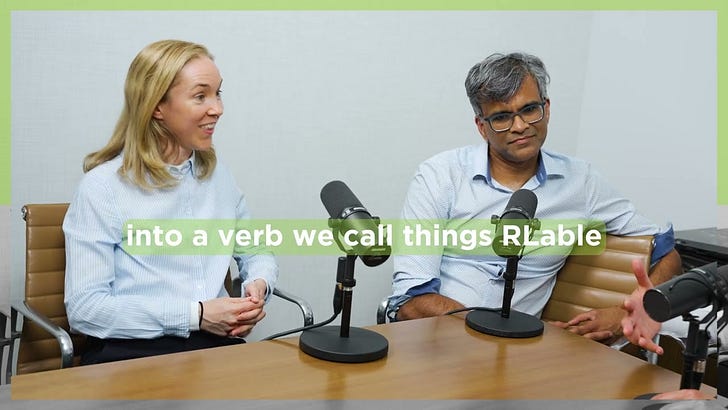
Nvidia CEO Jensen Huang recently described physical AI, a category that includes robots that can perceive, understand and act in the real world, as the next wave in artificial intelligence. So in the last episode before Derby Mill’s summer break, and our first-ever in-person recording session, the team of Ajay Agrawal, Rich Sutton, Sendhil Mullainathan and Niamh Gavin welcome Suzanne Gildert, the CEO and founder of Nirvanic Consciousness Technologies in Vancouver, BC.Gildert is a pioneering figure in the humanoid robotics community. Here, she discusses with the Derby Mill team such questions as: Why now for humanoid robots? What are the advantages and disadvantages of the bipedal human form factor? What makes humanoid robots difficult to create? The episode concludes with Ajay asking the team what they want listeners to think about during our two-month summer break. See you in September!GUESTS AND HOSTSSuzanne Gildert, co-founder & CEO, Nirvanic Consciousness TechnologiesAjay Agrawal, co-founder and partner, Intrepid Growth PartnersRichard Sutton, senior advisor, Intrepid Growth Partners, 2024 Turing Award recipient, pioneer of reinforcement learning and professor, University of AlbertaSendhil Mullainathan, senior advisor, Intrepid Growth Partners, MacArthur Genius grant recipient and professor, MITNiamh Gavin, senior advisor, Intrepid Growth Partners, Applied AI scientist, CEO, Emergent PlatformsLINKSNirvanic Consciousness Technologies homepageThe Jenson Huang / NVIDIA presentation Ajay references early in the episode. Reuters storyBoth Sendhil and Rich love the sci-fi novels of Iain BanksDerby Mill show websiteRich Sutton’s home page. Follow Rich on XSendhil Mullainathan’s website. Follow Sendhil on XBe sure to catch every episode of The Derby Mill Series by subscribing on the following platforms:YouTube // Spotify // Apple Podcasts // SubstackDISCUSSION POINTS00:00 Cold open01:52 Welcome and intro to humanoid robots and Suzanne Gildert04:20 What’s so hard about building a humanoid robot?06:15 The complexity of the human body07:55 So why bother making a humanoid robot?09:30 Why are humanoid robots so hot right now?10:50 Why now: AI software15:49 Rich Sutton explains why humanoid robots are so intriguing17:05 Can we code robots the same way we approached LLMs?20:30 Teaching robots with reinforcement learning in simulation21:47 Sendhil: How important are humanoid robots?29:10 Niamh: Is the bipedal form factor the best all-around solution?37:15 Sendhil: What about hybrid human-robot creatures?41:15 Agent architecture and humanoid robots44:35 The idea that we explore by random action selection48:00 Suzanne on types of decision making52:13 Decision making as centrepiece of economics, and AI57:19 Quantum physics and self-aware AI1:00:50 Defining consciousness1:05:00 Lightning round: Niamh on cost of experimentation1:06:33 LR: Ajay on what’s RLable1:07:37 LR: Rich on AI disillusionment1:08:40 LR: Suzanne on AI consciousness1:10:20 LR: Sendhil on the “what is AI” turf war1:18:18 Ajay wraps up season 1NUGGETSNugget 1 - Cost of ExperimentationIntrepid's Ajay Agrawal asks AI scientist Niamh Gavin to name one topic for listeners to reflect on over Derby Mill's summer break.Nugget 2 - AI Disillusionment and Turf WarsIntrepid's Ajay Agrawal asks Turing Award winner Rich Sutton to name one topic for listeners to reflect on over Derby Mill's summer break.Nugget 3 - Consciousness and EmpathyIntrepid's Ajay Agrawal asks Nirvanic CEO Suzanne Gildert to name one topic for listeners to reflect on over Derby Mill's summer break. Her response is to appeal to viewers to question any fearful reaction they have to the notion of conscious AI.DISCLAIMERThe content of this podcast is for informational and educational purposes only and should not be construed as marketing, solicitation, or an offer to buy or sell any securities or investments. The opinions expressed in this video are those of the participants and do not necessarily reflect the views of Intrepid Growth Partners or its affiliates. Any discussion of specific companies, technologies, or industries is for illustrative purposes and does not constitute investment advice. Viewers are encouraged to consult with their own financial, legal, and tax advisors before making any investment decisions. This is a public episode. If you would like to discuss this with other subscribers or get access to bonus episodes, visit insights.intrepidgp.com
Headquartered in Toronto, Private AI detects and removes personally identifiable information (PII) from data using large language models (LLMs), all without compromising individual or institutional privacy. In this episode, Private AI co-founder and CEO Patricia Thaine offers a behind-the-scenes look at the company’s technical strategy, including the scalability challenge inherent in protecting confidential company information, and the growing threat of re-identification. With more than 30,000 hours invested in building their PII detection system, Private AI now operates in seven countries and partners with organizations such as the Business Development Bank of Canada, MaRS, and the University of Toronto.This episode features the Intrepid team exploring such questions as:* How can organizations effectively protect personally identifiable information (PII) and confidential company information in large language models?* What are the risks of re-identification, even after attempting to anonymize data?* How can companies balance data utility with privacy preservation?* How can privacy protection be approached as a dynamic, evolving challenge rather than a static solution?* What role can technology play in helping organizations understand and control their data privacy?GUESTS AND HOSTSPatricia Thaine, co-founder & CEO, Private AIAjay Agrawal, co-founder and partner, Intrepid Growth PartnersRichard Sutton, senior advisor, Intrepid Growth Partners, 2024 Turing Award recipient, pioneer of reinforcement learning and professor, University of AlbertaSendhil Mullainathan, senior advisor, Intrepid Growth Partners, MacArthur Genius grant recipient and professor, MITNiamh Gavin, senior advisor, Intrepid Growth Partners, Applied AI scientist, CEO, Emergent PlatformsLINKSPrivate AI website, explainer videoPrivate AI demo, PrivateGPTRead the NYT article, A Face Is Exposed for AOL Searcher No. 4417749Pymetrics, a company that pioneered the use of AI and behavioural science to improve workforce decisions, was acquired by Harver.Rich Sutton’s home page. Follow Rich on XSendhil Mullainathan’s website. Follow Sendhil on XBe sure to catch every episode of The Derby Mill Series by subscribing on the following platforms:YouTube // Spotify // Apple Podcasts DISCUSSION POINTS00:00 Introduction01:22 Meet Patricia Thaine of Private AI01:41 About Private AI02:54 How Private AI redacts and protects data04:18 What would scalability look like for confidential company info?08:14 Deconstructing NYT’s article: A Face is Exposed for AOL Searcher No. 441774910:12 Can your digital footprint be an identifier?15:35 Solving the synthetic data problem19:15 How data minimization can help with privacy21:24 Mapping out the future of data privacy25:56 What would a reward function look like?27:12 Final commentsNUGGETSNugget 1 - The Challenge of De-Identification Concerning Data PrivacyPrivate AI CEO and co-founder Patricia Thaine describes the challenge of data privacy and de-identification.Nugget 2 - Consumer Market Demand and RegulationIntrepid’s Sendhil Mullainathan explores the challenge of creating a start-up in the “personally identifiable information” space. Nugget 3 - Different Types of CII and PIIPrivate AI’s Patricia Thaine discusses the nuances of removing personally identifiable information, as even a piece of jewellery in an X-ray can compromise anonymity. DISCLAIMERThe content of this podcast is for informational and educational purposes only and should not be construed as marketing, solicitation, or an offer to buy or sell any securities or investments. The opinions expressed in this video are those of the participants and do not necessarily reflect the views of Intrepid Growth Partners or its affiliates. Any discussion of specific companies, technologies, or industries is for illustrative purposes and does not constitute investment advice. Viewers are encouraged to consult with their own financial, legal, and tax advisors before making any investment decisions. This is a public episode. If you would like to discuss this with other subscribers or get access to bonus episodes, visit insights.intrepidgp.com
Hospitals in jurisdictions around the world face tight budgets and staff shortages. Artisight offers an AI-powered suite of software services designed to help hospitals do more with the limited resources they have available. Based in Chicago and led by a medical doctor who also has an MBA, Dr. Andrew Gostine, Artisight’s mission is to improve quality metrics and financial outcomes with the help of computer vision, IoT sensors and vital-sign monitoring. For example, one hospital system that used Artisight’s technology, Northwestern Medicine, saw a 52% reduction in nursing overtime and a 76% reduction in nursing turnover alongside improved nursing and patient satisfaction scores. At the start of 2024, Artisight announced that it raised US$42 million in a funding round that was oversubscribed by 2.4x and included NVIDIA as an investor.On the agenda in today’s discussion: What’s the potential for AI-enabled healthcare administration? How can AI be of assistance to the healthcare industry? What can be done to increase efficiency in the near term, and where does the technology go at the limit? The Derby Mill team talks to Artisight CEO and co-founder Dr. Andrew Gostine, and chief science officer and co-founder Tim Koby, to discuss the future of healthcare.GUESTS AND HOSTSDr. Andrew Gostine, Co-Founder & Chief Executive Officer, ArtisightTim Koby, Co-Founder & Chief Science Officer, ArtisightAjay Agrawal, co-founder and partner, Intrepid Growth PartnersNiamh Gavin, senior advisor, Intrepid Growth Partners, Applied AI scientist, CEO, Emergent PlatformsLINKSDerby Mill show websiteArtisight’s website, explainer videoLearn more about Artisight’s Series B funding roundBe sure to catch every episode of The Derby Mill Series by subscribing on the following platforms:YouTube // Spotify // Apple Podcasts DISCUSSION POINTS00:00 Introduction01:07 Meet the Artisight team02:00 Core value of Artisight03:44 Sensor suite: What data is collected05:42 Artisight’s top 3 AI predictions09:39 Why fall prevention matters most16:12 AI in hospital care—why now?24:05 Raising the ceiling in healthcare25:47 Improving models without moving data30:19 Smarter AI vs. smartest doctor?40:14 Are there limits to trusting AI?44:54 Numbers that prove AI trust51:01 Next big AI-driven interventions55:05 Rewards for in-hospital problem-solving59:57 AI vs. human default in hospital care01:09:35 Final remarksNUGGETSNugget 1 - Using AI to Maximize Hospital CareAI can now recognize procedures like IV insertions without staff saying a word, thanks to AI using voices as a timestamp and training computer vision with synthetic images.Nugget 2 - "Why now?" How Real-World Problems Held AI Back Until TodayFor years, AI has promised to transform healthcare. So why is it only working now? Emergent Platform CEO Niamh Gavin uses her healthcare expertise to describe the real-world hurdles that held earlier AI solutions back. Artisight CEO and co-founder, Dr. Andrew Gostine, explains the innovation that was needed to reach the quality of AI and get it to where it is today.Nugget 3 - Stopping Sepsis Before It StartsAI could predict sepsis up to 18 hours before it strikes—early enough that patients may never meet the clinical criteria at all. Artisight CEO and co-founder Dr. Andrew Gostine explains how predictive intelligence is transforming preventative care, and why fall prevention was just the beginning.DISCLAIMERThe content of this podcast is for informational and educational purposes only and should not be construed as marketing, solicitation, or an offer to buy or sell any securities or investments. The opinions expressed in this video are those of the participants and do not necessarily reflect the views of Intrepid Growth Partners or its affiliates. Any discussion of specific companies, technologies, or industries is for illustrative purposes and does not constitute investment advice. Viewers are encouraged to consult with their own financial, legal, and tax advisors before making any investment decisions. This is a public episode. If you would like to discuss this with other subscribers or get access to bonus episodes, visit insights.intrepidgp.com
StackAdapt is an advertising platform that leverages AI to optimize digital ad campaigns across multiple channels, including display, video, native, and connected TV. With an auction system, it evaluates millions of ad opportunities each second using predictive analytics to maximize ROI and enhance audience targeting. By integrating customer data and providing privacy-conscious, scalable solutions, StackAdapt provides advertisers with data-driven insights and automated ad placement. So how can AI enhance discovery and shape awareness of digital advertising solutions that people may not yet realize they need? And what reward systems might be most effective for RL in optimising ad campaigns? The Derby Mill team talks to StackAdapt CTO and co-founder Yang Han to discuss potential answers. GUESTS AND HOSTSYang Han, CTO and co-founder, StackAdaptAjay Agrawal, co-founder and partner, Intrepid Growth PartnersRichard Sutton, senior advisor, Intrepid Growth Partners, 2024 Turing Award recipient, pioneer of reinforcement learning and professor, University of AlbertaSendhil Mullainathan, senior advisor, Intrepid Growth Partners, MacArthur Genius grant recipient and professor, MITNiamh Gavin, senior advisor, Intrepid Growth Partners, Applied AI scientist, CEO, Emergent PlatformsLINKSDerby Mill show websiteStackAdapt’s website and explainer videoRead Rich Sutton’s latest paper Welcome to the Era of ExperienceRich Sutton’s home page. Follow Rich on XSendhil Mullainathan’s website. Follow Sendhil on XBe sure to catch every episode of The Derby Mill Series by subscribing on the following platforms:YouTube // Spotify // Apple Podcasts DISCUSSION POINTS 00:00 Introduction02:00 Welcome, Yang Han, CTO and Co-Founder of StackAdapt02:45 How advertising on StackAdapt works09:10 How StackAdapt thinks about ROI11:30 Yang on ad competition and who gets the credit.13:55 Niamh on what StackAdapt will look like at the limit.18:23 Sendhil on how we can surface decision-making in advertising.24:20 Rich on the advantages of assistance-based shopping.29:13 Becoming customer-focused with the rise of AI31:53 What executives lack when perfecting the matching problem.26:47 What’s one thing investors should pay attention to in this industry? Nugget 01 - Alternative Customer-First Business ModelNugget 02 - Educating Customers with Personalized AdsNugget 03 - Disrupting the Ad Market with Agent DiscoveryDISCLAIMERIntrepid GP is an investor in StackAdapt. The content of this podcast is for informational and educational purposes only and should not be construed as marketing, solicitation, or an offer to buy or sell any securities or investments. The opinions expressed in this video are those of the participants and do not necessarily reflect the views of Intrepid Growth Partners or its affiliates. Any discussion of specific companies, technologies, or industries is for illustrative purposes and does not constitute investment advice. Viewers are encouraged to consult with their own financial, legal, and tax advisors before making any investment decisions. This is a public episode. If you would like to discuss this with other subscribers or get access to bonus episodes, visit insights.intrepidgp.com
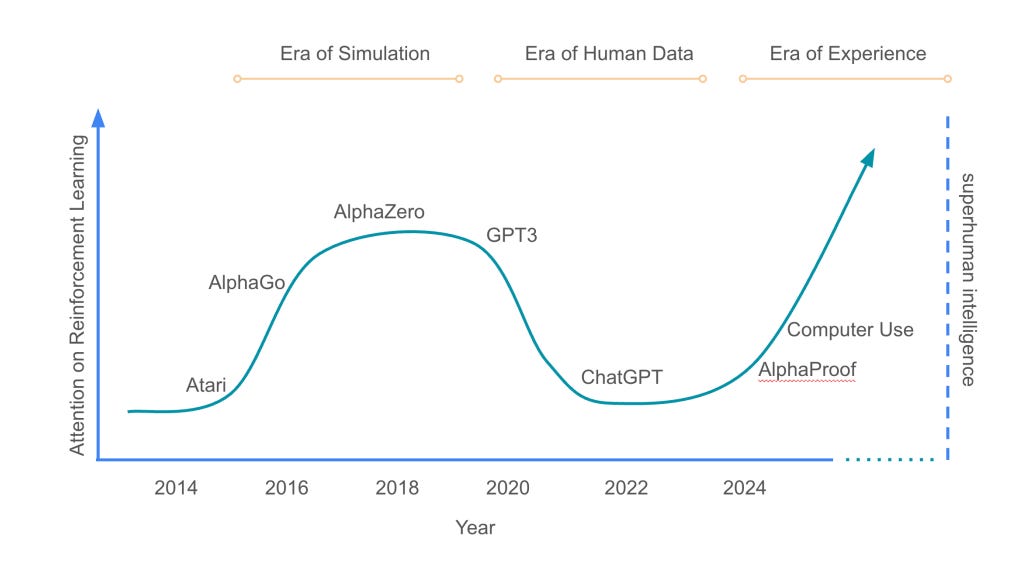
Derby Mill co-host Richard Sutton and his former student, David Silver, recently published a paper about the future of artificial intelligence, called Welcome to the Era of Experience. So in this episode the show’s other hosts—Ajay Agrawal, Sendhil Mullainathan and Niamh Gavin—take their chance to interview Rich about the essay, and provide their take on its implications.Today’s large language models (LLMs) are trained on human-generated data. So far, this has led to the development of incredible capabilities, such as mastering complex games like backgammon or chess, or absorbing content created by humans and creating fascinating new iterations of art.While the evolution of LLMs—from AlphaZero (2017) to ChatGPT (2022) to DeepSeek (2025) and beyond—can make it seem as though their possibilities are endless, the agents remain constrained by the scope of the data they are given. In the paper, Silver and Sutton write that “in key domains such as mathematics, coding, and science, the knowledge extracted from human data is rapidly approaching a limit.” Consequently, AI agents will have to be trained on other data, such as their own experiences, which could lead to rapid innovation and superhuman capabilities—a time period which Silver and Sutton refer to as the “age of experience.”This episode, a roundtable discussion, focuses on the following quotes pulled from the paper:* Why now? "This will become possible, as outlined above, when agents are able to autonomously act and observe in streams of real-world experience, and where the rewards may be flexibly connected to any of an abundance of grounded, real-world signals."* Why science? "Perhaps most transformative will be the acceleration of scientific discovery."* Human-like vs superhuman AIs. "This era of experience will likely be characterised by agents and environments that, in addition to learning from vast quantities of experiential data, will break through the limitations of human-centric AI systems... Furthermore, the pursuit of this agenda by the AI community will spur new innovations in these directions that rapidly progress AI towards truly superhuman agents.”GUESTS AND HOSTSAjay Agrawal, co-founder and partner, Intrepid Growth PartnersRichard Sutton, senior advisor, Intrepid Growth Partners, 2024 Turing Award recipient, pioneer of reinforcement learning and professor, University of AlbertaSendhil Mullainathan, senior advisor, Intrepid Growth Partners, MacArthur Genius grant recipient and professor, MITNiamh Gavin, senior advisor, Intrepid Growth Partners, Applied AI scientist, CEO, Emergent PlatformsLINKSDerby Mill show websiteRead Rich Sutton’s latest paper Welcome to the Era of ExperienceRich Sutton’s 2019 paper The Bitter LessonCo-founder of OpenAI, Ilya Sutskever, says AI reasoning power will become less predictableListen to our previous episode about DeepSeekCheck out co-author David Silver’s websiteRich Sutton’s home page. Follow Rich on XSendhil Mullainathan’s website. Follow Sendhil on XBe sure to catch every episode of The Derby Mill Series by subscribing on the following platforms: YouTube // Spotify // Apple Podcasts DISCUSSION POINTS00:00 Introduction01:34 Context about the paper02:56 Chronology of AI paradigms03:10 Why now?06:09 Niamh’s chronology of AI development14:10 Why science?20:36 Sendhil on scientific research and AI27:07 Grounded vs. ungrounded rewards29:21 Rich on RL temporal difference errors31:10 Human-like vs. superhuman AIs36:40 Final commentsNugget 01 - AI for Scientific DiscoveryNugget 02 - Is Science like RL?Nugget 03 - The Value of ExperienceDISCLAIMERThe content of this podcast is for informational and educational purposes only and should not be construed as marketing, solicitation, or an offer to buy or sell any securities or investments. The opinions expressed in this video are those of the participants and do not necessarily reflect the views of Intrepid Growth Partners or its affiliates. Any discussion of specific companies, technologies, or industries is for illustrative purposes and does not constitute investment advice. Viewers are encouraged to consult with their own financial, legal, and tax advisors before making any investment decisions. This is a public episode. If you would like to discuss this with other subscribers or get access to bonus episodes, visit insights.intrepidgp.com
Skin Analytics is a UK company using AI to automate the diagnosis of serious skin conditions, starting with skin cancer. Its core product, DERM, is the only Class III CE mark AI medical device for autonomous dermatology in the UK’s health system. Used on more than 150,000 real-world patients, DERM achieves 99.8% negative predictive value, outperforming dermatologists. The company is expanding into general dermatology and launching in the EU and US.In the future, Skin Analytics intends to create a dermatology AI platform that is able to diagnose and treat a broader range of conditions. Based on a diverse sampling of low-cost data, the company intends its platform to transition from self-supervised to unsupervised learning, enabling ubiquitous, low-friction health monitoring.This episode features the Intrepid team exploring such questions as:* What would it take to build healthcare around AI abundance, not human bottlenecks?* How might one frame an approach to reach 99% automation in dermatological triage?* What are the tradeoffs between sensitivity, specificity, and health system efficiency?* How could reward systems (RL or pathway-based optimization) be introduced?* What’s the potential of self-supervised learning across multiple medical modalities?GUESTS AND HOSTSNeil Daly, founder and director, Skin AnalyticsJack Greenhalgh, AI director, Skin AnalyticsAjay Agrawal, co-founder and partner, Intrepid Growth PartnersRichard Sutton, senior advisor, Intrepid Growth Partners, 2024 Turing Award recipient, pioneer of reinforcement learning and professor, University of AlbertaSendhil Mullainathan, senior advisor, Intrepid Growth Partners, MacArthur Genius grant recipient and professor, MITNiamh Gavin, senior advisor, Intrepid Growth Partners, Applied AI scientist, CEO, Emergent PlatformsLINKSDerby Mill show website: insights.intrepidgp.com/podcastSkin Analytics website and explainer videoRich Sutton’s home page. Follow Rich on XSendhil Mullainathan’s website. Follow Sendhil on XBe sure to catch every episode of The Derby Mill Series by subscribing on the following platforms: YouTube // Spotify // Apple Podcasts DISCUSSION POINTS00:00 Introduction01:24 Meet the team: Skin Analytics06:12 The lead-up to image recognition10:29 Patient drop-off post-referral14:03 Getting classification right18:47 Integrating into the healthcare system22:36 Cancer detection in the limit27:55 At-home cancer detection34:10 Making dermatology RL-able45:00 Using data as proxies for other diagnoses50:21 Early detection vs. overdiagnosis55:07 Higher rates of cancer detection advantages57:00 What took so long?59:07 Final remarksNugget 01 - Sensors Reveal Hidden Data in the SkinTraditionally, dermatology has been rate-limited by the human eye and optical sensors. So incorporating a variety of additional sensors to collect more diverse and comprehensive data can open the door to a new kind of pre-primary care, potentially revealing more information about internal conditions like hypertension or liver disease.Nugget 02 - The Economic Model Behind At-Home DiagnosesThere's a massive direct-to-consumer interest in skin health, which opens the door to a potential expansion of at-home skin-monitoring apps that could be used beyond only in primary care settings. But overdiagnoses risk overwhelming the healthcare system. In order to avoid case buildup, these apps require an economic model that leverages medical systems and consumer trust.Nugget 03 - Redesigning the Treatment DelayWhat prevents people from accessing treatment is not the diagnostic delay (which often involves a lengthy wait for results), but rather the delay in seeking help: People tend to wait for a reason to address an issue, which increases the risk of lowering the survival rate as a disease spreads.DISCLAIMERIntrepid GP is an investor in Skin Analytics. The content of this podcast is for informational and educational purposes only and should not be construed as marketing, solicitation, or an offer to buy or sell any securities or investments. The opinions expressed in this video are those of the participants and do not necessarily reflect the views of Intrepid Growth Partners or its affiliates. Any discussion of specific companies, technologies, or industries is for illustrative purposes and does not constitute investment advice. Viewers are encouraged to consult with their own financial, legal, and tax advisors before making any investment decisions. This is a public episode. If you would like to discuss this with other subscribers or get access to bonus episodes, visit insights.intrepidgp.com
In this unpacked episode, the team further expands its discussion of themes that came up in episode seven, which explored the automation of customer support with artificial intelligence. Our guests in that episode were a duo that is leading efforts in that space: CEO Mike Murchison and chief product and technology officer Mike Gozzo from Ada.In this episode, Intrepid Growth Partners cofounder and partner Ajay Agrawal leads the discussion with Intrepid Senior Advisors Rich Sutton (Turing Award winner), Sendhil Mullainathan (MacArthur genius grant recipient) and Niamh Gavin (CEO, Emergent Platforms).In the previous episode, we learned that Ada’s north star is “percent automated resolutions”, or the percentage of customer inquiries that are fully resolved by AI without human intervention. One challenge is that Ada relies on large language models (LLMs) rather than action-based goals, often requiring human agents to step in when confidence is low.“It’s a mistake to think that [Ada’s AI agents] have goals,” says Sutton. ”What we have instead … is we have [AI agents] mimicking people.”All of which raises the question of how customer support will evolve as this technology advances towards the limit.Our team also debates the need for clear, objective measures of AI performance and the challenges of achieving true goal-oriented AI systems.Our panel of experts:Ajay Agrawal, co-founder and partner, Intrepid Growth PartnersRichard Sutton, 2024 Turing Award recipient, pioneer of reinforcement learning and professor, University of AlbertaSendhil Mullainathan, MacArthur Genius grant recipient and professor, MITNiamh Gavin, Applied AI scientist, CEO, Emergent PlatformsSutton, Mullainathan and Gavin are all Intrepid Growth Partners’ senior advisors.LINKSAda websiteThis episode extends the discussion from Derby Mill episode 07: Customer Support Rich Sutton’s home page. Follow Rich on XSendhil Mullainathan’s website. Follow Sendhil on XBe sure to catch every episode by subscribing on the following platforms:YouTube // Spotify // Apple PodcastsDISCUSSION POINTS00:00 Introduction and opening credit02:00 Ada refresher03:46 Clip: Testing harness06:50 Clip discussion begins10:15 What are goal-based objectives?13:30 Is this the year of the agent?17:40 What makes agents goal-oriented19:20 Decision-making fundamentals in AI21:27 Clip: Automating system improvement over time23:32 Clip discussion begins30:13 Automating the evaluation process34:08 What could Ada look like in the limit?41:03 Closing remarksNUGGET 01: Vertical vs. Horizontal CompetitionFine-tuning used to be costly and impractical, pushing companies to open-source solutions—only to revert to OpenAI due to complexity. Now, companies like Ada build on top of model providers, offering flexibility while managing AI’s complexity. Niamh discusses the competitiveness between verticalized AI (industry-specific applications) and horizontal AI (broad sector models).NUGGET 02: The Challenge of InterpretabilityAda's evaluations rely on human judgment. The challenge here is interpretability—determining whether an outcome is truly good without direct human input. Rich Sutton offers potential solutions, including using reinforcement learning with human feedback (RLHF) as a proxy measure trained on high-quality data.NUGGET 03: Benchmarking vs. Deployment in the FieldNiamh and Sendhil discuss how, despite concerns about hallucinations in AI-powered customer service, CEOs adopt GenAI more for signaling competence than for real effectiveness.DISCLAIMERThe content of this podcast is for informational and educational purposes only and should not be construed as marketing, solicitation, or an offer to buy or sell any securities or investments. The opinions expressed in this video are those of the participants and do not necessarily reflect the views of Intrepid Growth Partners or its affiliates. Any discussion of specific companies, technologies, or industries is for illustrative purposes and does not constitute investment advice. Viewers are encouraged to consult with their own financial, legal, and tax advisors before making any investment decisions. This is a public episode. If you would like to discuss this with other subscribers or get access to bonus episodes, visit insights.intrepidgp.com
Meet Ada, a Canadian AI agent platform automating the resolution of customer service interactions. When customers have complex requests—such as resetting passwords, checking order status, or requesting a refund—Ada uses large language models to radically reduce the amount of human effort required to fulfill the customer’s inquiry.Here, Ada CEO Mike Murchison and Chief Product & Technology Officer Mike Gozzo join the Derby Mill podcast to discuss the intersection of AI and customer support—and where the technology may go, at the limit.Our panel of experts:Ajay Agrawal, co-founder and partner, Intrepid Growth PartnersRichard Sutton, 2024 Turing Award recipient, pioneer of reinforcement learning and professor, University of AlbertaSendhil Mullainathan, MacArthur Genius grant recipient and professor, MITNiamh Gavin, Applied AI scientist, CEO, Emergent PlatformsLINKSAda websiteAda CEO Mike Murchison LinkedInAda Chief Product & Technology Officer Mike Gozzo LinkedInRich Sutton’s home page. Follow Rich on X.Sendhil Mullainathan’s website. Follow Sendhil on X.Sendhil’s article on Algorithms Need Managers, Too published in the Harvard Business Review Be sure to catch every episode by subscribing on the following platforms:YouTube // Spotify // Apple PodcastsDISCUSSION POINTS00:00 Introduction01:49 Meet Ada, the company automating customer support05:05 Customer service & books: an analogy05:41 Murchison describes automated resolution08:50 Human feedback for automated improvement 23:17 LLMs in customer service26:10 The difference between language and action26:34 Ada’s use of LLMs30:01 Murchison on how “deterministic” Ada’s actions are30:59 Improving decision quality37:06 Protecting against LLM’s unreliability 44:40 Closing remarksNUGGET 01: Human Feedback for Automated ImprovementAda describes the role of humans "coaching" their AIs. Why this is one of the first areas for "automated improvement," and how can the preference data they are collecting through the coaching process be used to "drive automated improvements throughout the entire system."NUGGET 02: Decision-Making QualityRich Sutton asks how Ada improves the quality of the system's decisions, and questions the role of humans vs. AI in terms of evaluating versus improving the quality of decisions.NUGGET 03: DistillationGiven the cost and latency virtues of smaller models, when do we anticipate applications to use large foundation models at the limit? Is the Ada case a good example of using large models to bootstrap a commercial solution en route to smaller, more specialized models?DISCLAIMER The content of this podcast is for informational and educational purposes only and should not be construed as marketing, solicitation, or an offer to buy or sell any securities or investments. The opinions expressed in this video are those of the participants and do not necessarily reflect the views of Intrepid Growth Partners or its affiliates. Any discussion of specific companies, technologies, or industries is for illustrative purposes and does not constitute investment advice. Viewers are encouraged to consult with their own financial, legal, and tax advisors before making any investment decisions. This is a public episode. If you would like to discuss this with other subscribers or get access to bonus episodes, visit insights.intrepidgp.com
In the first episode of The Derby Mill Series to post since our co-host Rich Sutton won the Turing Award, the highest distinction in the field of computer science, Sutton joins our panel of experts to further discuss the application of artificial intelligence to the task of mining exploration. What ensues is a remarkable conversation about the increasing relevance of cheap and easily discoverable data sources in an age dominated by artificial intelligence and reinforcement learning.The analogy begins with mining, where core samples may provide an element of ground truth but are, at the same time, tough and very expensive to get. Other data sources, such as aerial imagery, chips and dust, are cheap and more easily available. So can the pattern-recognition abilities of artificial intelligence elevate the relevance of that lower-fidelity, more easily available information?Extending the analysis, Intrepid Senior Advisors Niamh Gavin and Sendhil Mullainathan draw parallels with health care. Apple Watch’s skin sensors are certainly less accurate than an annually drawn blood test. But as the Watch conducts its tests numerous times a day, and as AI better recognizes troubling sensor patterns, the cheaper Watch data could become just as important as more expensive medical diagnostics.Generalizing to other areas, Intrepid partner Ajay Agrawal notes that lower-fidelity data that is more easily available could become as informative as high-fidelity data that is tougher to extract. Our experts’ ultimate prediction, then, observes that cheap data plus artificial intelligence could transform the fundamental economics of many different industries.Our panel of expertsRichard Sutton, 2024 winner of the Turing Award, pioneer of reinforcement learning and professor, University of AlbertaSendhil Mullainathan, MacArthur Genius grant recipient and professor, MITNiamh Gavin, Applied AI scientist, CEO, Emergent PlatformsAjay Agrawal, co-founder and partner, Intrepid Growth PartnersLINKSIntrepid Growth Partners’ Senior Advisor Rich Sutton wins the Turing Award. NY Times. Financial Times. Betakit.This episode extends a discussion in Derby Mill episode 05: Mining Exploration.Referenced in this episode: Sendhil Mullainathan's heart attack studyyRich Sutton’s home page. Follow Rich on XSendhil Mullainathan’s website. Follow Sendhil on XBe sure to catch every episode by subscribing on the following platforms:YouTube // Spotify // Apple PodcastsDISCUSSION POINTS00:00 Introductions and opening credit01:43 Recap of Mining Exploration06:01 Clips: Mining industry transformation09:52 Niamh on narrowing the search zone12:18 Rich on sequential decisions and pattern recognition15:08 Sendhil on using supervised learning to train predictors19:34 Niamh on non-invasive markers21:52 Signals in healthcare vs. mining25:02 The combination of human + AI27:47 A new age of data analysis29:50 Data sources and reinforcement learning35:53 A cognitive barrier for data42:24 The indicator analogy45:58 Closing remarksNUGGETS (short excerpts from the full episode)NUGGET 01: Sum > Whole of Its PartsNiamh Gavin argues that human + AI intelligence is better than either in isolation.NUGGET 02: A More Interactive Feedback ProcessRich Sutton advocates for an awareness that important mining exploration problems require a wide diversity of data inputs.NUGGET 03: The Less Invasive, Far Cheaper Data Axis“What if I had a sweat test that was 10% as good as a blood test?” asks Sendhil Mullainathan, noting the way AI can make use of data from cheap and more easily available diagnostics to improve numerous different industries.NUGGET 04: AI and the Increasing Relevance of Little TestsExpert intelligence is expensive today, notes Rich Sutton, but as computational power decreases, AI will help to bolster the importance of all sorts of cheap and easy tests.DISCLAIMERThe content of this podcast is for informational and educational purposes only and should not be construed as marketing, solicitation, or an offer to buy or sell any securities or investments. The opinions expressed in this video are those of the participants and do not necessarily reflect the views of Intrepid Growth Partners or its affiliates. Any discussion of specific companies, technologies, or industries is for illustrative purposes and does not constitute investment advice. Viewers are encouraged to consult with their own financial, legal, and tax advisors before making any investment decisions. This is a public episode. If you would like to discuss this with other subscribers or get access to bonus episodes, visit insights.intrepidgp.com
Intrepid partner Ajay Agrawal and senior advisors Rich Sutton, Sendhil Mullainathan and Niamh Gavin are back to dig deep in this episode all about using artificial intelligence to increase the efficiency of mining exploration. That’s the act of using machine-learning techniques to analyze information from the earth, such as core samples, to decide multi-million-dollar questions, like where to build a mine or whether to expand an existing operation. Our guests are CEO Grant Sanden and President of Resource Modelling Solutions Jared Deutsch from GeologicAI, a Calgary-based company that redefines geological and mining decision-making with advance core-scanning technology and AI-powered analytical and modelling solutions. From Sanden:“You've got challenges in mining… You know, you're only touching a trillionth of the deposit… And it really is a structural problem in prediction… but then once you can deal with that well, you're now characterizing uncertainty. And with these new tools, we can plan through more robustly with uncertainty properly quantified, which is a challenging endeavour.”And from President RMS Jared Deutsch:“The application of AI and mining is so unique because we're so data-poor spatially, but so data rich, thanks to scanning and many other technologies, where we have millimetre-scale data. Challenge is, we're 100 meters away from our next millimetre scale data. So this makes for a very challenging problem in a very non-stationary environment, where no mineral deposit is like another one. And we can't really afford to sit around for a few 100 million years and wait to see how these things evolve. So it makes for a really fun and exciting application of AI, but a bit unique compared to other areas.”EP 05 HOSTSAjay Agrawal, co-founder and partner, Intrepid Growth PartnersRichard Sutton, pioneer of reinforcement learning and professor, University of AlbertaSendhil Mullainathan, MacArthur Genius grant recipient and professor, MITNiamh Gavin, Applied AI scientist, CEO, Emergent PlatformsLINKSGeologicAI website and a short explainer video highlighting a GeologicAI use case.GeologicAI CEO Grant Sanden LinkedInRMS President Jared Deutsch LinkedInRich Sutton’s home page. Follow Rich on XSendhil Mullainathan’s website. Follow Sendhil on XBe sure to catch every episode by subscribing on the following platforms:YouTube // Spotify // Apple PodcastsDISCUSSION POINTS00:00 Introduction01:23 Meet the GeologicAI team, and learn what the company does04:22 Challenges and opportunities in mining data05:41 Deutsch describes how unique mining exploration is as an AI application06:53 Mullainathan asks about human-algorithm interaction08:07 Sanden explains AI- and human-algorithm approaches10:41 Gavin compares mining and healthcare as AI applications12:23 Sutton on the way AI can create a super geologist14:33 Sanden on the scale of GeologicAI’s operations15:48 Mullainathan asks about optimizing the data collection17:41 Agrawal on the extreme length of learning loops in mining19:44 Mullainathan: Are there ways to reduce the 20-year lag?25:13 The challenge of optimizing the data-collection cycle27:24 Agrawal describes the mine of the future30:08 The optimal path from limited loops to ultimate loops31:00 Closing remarksNUGGETS (short excerpts from the full episode)NUGGET 01: Human-Algo InteractionAIs learn from human feedback. Humans learn from AI predictions in edge cases. Sendhil Mullainathan and Grant Sanden discuss what this human-algorithm interaction might look like at the limit.NUGGET 02: Super GeologistsAIs have the opportunity to learn from more core sample examples than any person. We know about the impact of adding more data to training sets to enhance performance. How accurately can we estimate the marginal benefit to adding a bit more data relative to the cost of collecting it? Rich Sutton questions whether we can imagine any geologist that will be better at mineral classification than the best AI.NUGGET 03: Data StrategyHow does data collection via following the "natural order of things" differ from the optimal data collection strategy? A 20-year feedback loop seems crazy ("a little bit of a time lag"). Sendhil Mullainathan and Jared Deutsch discuss how to decrease the feedback loop. NUGGET 04: A cheaper alternative to mining cores?In the prior clip, we discussed the shifting value of core samples. In this case, Grant Sanden and Niamh Gavin consider other, much cheaper data sources (chips, dust, aerial imagery) that might also provide predictive power regarding hidden underground mineral deposits. Sendhil Mullainathan discusses how new forms of high-fidelity prediction that are orders of magnitude cheaper, although perhaps less accurate, might transform the fundamental economics of the mining industry.DISCLAIMERThe content of this podcast is for informational and educational purposes only and should not be construed as marketing, solicitation, or an offer to buy or sell any securities or investments. The opinions expressed in this video are those of the participants and do not necessarily reflect the views of Intrepid Growth Partners or its affiliates. Any discussion of specific companies, technologies, or industries is for illustrative purposes and does not constitute investment advice. Viewers are encouraged to consult with their own financial, legal, and tax advisors before making any investment decisions. This is a public episode. If you would like to discuss this with other subscribers or get access to bonus episodes, visit insights.intrepidgp.com
The new environment for global trade is dominating discussions in many business sectors, including artificial intelligence. To discuss the implications for global software companies and start-ups, Intrepid Growth Partners co-founders Dr. Mark Machin, Mark Shulgan and Ajay Agrawal arranged a conversation with global trade expert Marc L. Busch, a professor of international business diplomacy at Georgetown University. On the agenda: How may trade conflicts affect technology entrepreneurs and the development of machine learning applications? What can global tech companies do to protect themselves? And what are Prof. Busch’s predictions for how this all plays out? EP 04 HOSTSMarc L. Busch is the Karl F. Landegger Professor of International Business Diplomacy at the Walsh School of Foreign Service, Georgetown University, and a Global Fellow at the Wilson Center’s Wahba Institute for Strategic Competition.Dr. Mark Machin, co-founder and managing partner, Intrepid Growth PartnersMark Shulgan, co-founder and partner, Intrepid Growth PartnersAjay Agrawal, co-founder and partner, Intrepid Growth PartnersLINKSDerby Mill show website: https://insights.intrepidgp.com/podcastMarc L. Busch’s personal website. Follow Marc on X and LinkedInRecent Marc Busch article on how “mode 5 services” can promote U.S. manufacturing without imposing new tariffsDISCUSSION POINTS 00:00 Introductions 03:10 Ajay Agrawal introduces Professor Marc L. Busch 03:54 Busch on the legal bases for tariffs and executive orders09:56 Non-Tariff Barriers and Intellectual Property19:56 Impact on Software and AI Companies26:26 Advice for Canadian and European AI Companies29:16 Stargate, tariffs on semiconductors and subsidies as offsets for harm33:46 Predictions on how this will play out amid political considerations37:04 Potential for retaliation via anti-trust measures40:23 Role of the WTO and International Compliance45:32 Advice for Canadian AI companies53:54 Lighting round: What should Canadian entrepreneurs ask their politicians to do?54:53 How can Canada and the UK prevent a brain drain to US?55:59 What should UK entrepreneurs ask their government to do?56:41 Wrap upDISCLAIMERThe content of this podcast is for informational and educational purposes only and should not be construed as marketing, solicitation, or an offer to buy or sell any securities or investments. The opinions expressed in this video are those of the participants and do not necessarily reflect the views of Intrepid Growth Partners or its affiliates. Any discussion of specific companies, technologies, or industries is for illustrative purposes and does not constitute investment advice. Viewers are encouraged to consult with their own financial, legal, and tax advisors before making any investment decisions. This is a public episode. If you would like to discuss this with other subscribers or get access to bonus episodes, visit insights.intrepidgp.com
In the first of our “unpacked” episodes, Intrepid partner Ajay Agrawal leads our senior advisors Rich Sutton, Sendhil Mullainathan and Niamh Gavin in a conversation that further explores the themes that arose in episode one. That episode featured a conversation with Rae Jeong, CEO of Maneva, which is using AI and reinforcement learning (RL) techniques to move factories toward autonomous operations. In this episode, the team discusses the importance of making factories more "RLable" to enable incremental changes and ultimately achieve radical improvements. We explore the importance of continuous training data, the role of humans in active learning, and the balance between exploration and exploitation. The conversation highlights the challenges of implementing RL in manufacturing, such as the need for selective instrumentation and the potential for synthetic data. EP 03 HOSTSAjay Agrawal, co-founder and partner, Intrepid Growth Partners Richard Sutton, pioneer of reinforcement learning and professor, University of AlbertaSendhil Mullainathan, MacArthur Genius grant recipient and professor, MITNiamh Gavin, Applied AI scientist, CEO, Emergent PlatformsLINKS Derby Mill show website: https://insights.intrepidgp.com/podcastThe first episode featuring Maneva CEO Rae JeongManeva AI websiteManeva CEO Rae Jeong LinkedInA short video about Maneva’s work transforming Laura Secord chocolate productionRich Sutton’s home page. Follow Rich on XSendhil Mullainathan’s website. Follow Sendhil on XDISCUSSION POINTS 00:00 Introductions and opening credits 01:39 Clip: Rae Jeong discusses Maneva's approach to autonomous factories02:01 Rich Sutton comments on the challenge of active learning in operating factories04:54 Niamh Gavin on the use of simulated environments for experimentation06:29 Rich Sutton: “It’s hard to compete with a human” for experimentation08:05 Can simulation actually recreate a factory in all its complexity?09:42 Sendhil Mullainathan is confused where Maneva actually uses RL10:41 Balancing exploration and exploitation14:52 Discussion of temporal credit assignment in manufacturing 15:54 Clip: Sendhil asks how Maneva uses labels and exploration17:42 Clip: AI needs to conduct exploration to achieve continuous improvement 16:34 Exploring the future of manufacturing with reinforcement learning19:29 The challenge of making factories more “RL-able”23:01 Why prediction tends to come before control 28:55 Discussion of selective instrumentation and the role of humans32:09 Sendhil asks, do you know why EKG leads are placed where they are?34:28 Clip: Temporal credit assignment and taking RL to the limit in factories38:28 Sendhil emphasizes the need for a CEO-level sale for RL in manufacturing44:00 Challenges of fully instrumenting a factory49:00 Algorithms identifying valuable measurements52:42 Conclusion and final thoughtsDISCLAIMERThe content of this podcast is for informational and educational purposes only and should not be construed as marketing, solicitation, or an offer to buy or sell any securities or investments. The opinions expressed in this video are those of the participants and do not necessarily reflect the views of Intrepid Growth Partners or its affiliates. Any discussion of specific companies, technologies, or industries is for illustrative purposes and does not constitute investment advice. Viewers are encouraged to consult with their own financial, legal, and tax advisors before making any investment decisions. This is a public episode. If you would like to discuss this with other subscribers or get access to bonus episodes, visit insights.intrepidgp.com

Comments

Download from Google Play

Download from App Store
 United States