


 Claim Ownership
Golf 247.eu: The Global Platform for Innovative Technologies and Teaching Concepts.
Subscribed: 0Played: 9
Subscribe

© Golf247.eu
Description
Golf247.eu is a technology company that brings together the best teaching concepts in the world into one platform, aimed at connecting golf instructors, academies, clubs, schools, national PGAs, and golf associations. By leveraging cutting-edge tools, it helps these groups deliver better golf instruction, manage their businesses more efficiently, and provide faster services with more time-saving solutions. Golf247 continuously seeks new features from across the globe that can enhance the capabilities of PGAs, golf clubs, academies, and instructors.
586 Episodes
Reverse
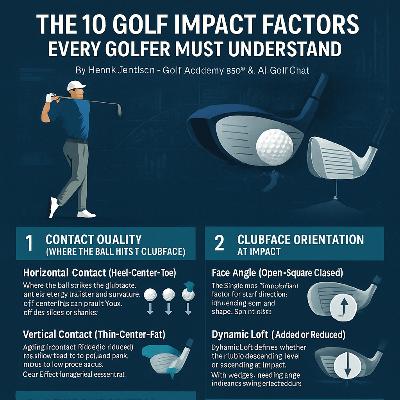
By Henrik Jentsch – Golf Academy 360° & AI Golf ChatEvery golf shot begins and ends at one decisive moment: impact. It’s the only point where club and ball connect, and mastering this split second means mastering your game. While many golfers have heard of eight impact factors, the true number is ten—and each one plays a unique role in controlling direction, spin, distance, and strike quality.These ten variables can be grouped into five core categories. Understanding them is the foundation for consistency and improvement.1. Contact Quality (Where the Ball Hits the Clubface)Horizontal Contact (Heel–Center–Toe)Where the ball strikes the face laterally dictates energy transfer and curvature. A center hit delivers optimal power and consistency. Off-center hits on the toe may hook or fade due to the gear effect. Heel shots risk slices and even dreaded shanks.Vertical Contact (Thin–Center–Fat)This affects launch and spin. A thin shot, struck too high on the face or low on the ball, leads to low, weak ball flights. A fat shot hits the ground before the ball—draining distance. Clean contact is essential, especially with high-lofted clubs where mis-hits are exaggerated.2. Clubface Orientation at ImpactFace Angle (Open–Square–Closed)The clubface angle is the single most important factor for where the ball starts. An open face points the shot right; a closed face sends it left. Combined with swing path, it defines the shot’s curvature—slice, draw, or straight.Dynamic Loft (Added or Reduced)Dynamic loft refers to the actual loft delivered at impact. Adding loft increases launch and spin—often unintentionally through scooping. Reducing loft compresses the ball better and controls flight, especially with short irons.Gear EffectWhen contact is off-center, the face twists, altering ball flight. More loft amplifies this effect. Even a technically “square” face can produce curve if the strike is on the toe or heel.3. Club Movement Through the BallSwing Path (Outside–In or Inside–Out)The club’s direction relative to the target line influences spin and shape. An outside-in path typically slices; an inside-out path may hook. To hit a desired shape, your path must complement your face angle.Vertical Attack Angle (Steep–Neutral–Shallow)This defines whether the club is descending, level, or ascending at impact. With wedges, a descending angle is ideal. With a driver, a slightly ascending path increases carry and reduces spin.4. Low Point ControlLow Point Location (Before or After the Ball)To compress the ball, the lowest point of your arc should occur just after impact. If it’s too far behind, you’ll hit it fat. Too far ahead? You might top it or lose loft. Tools like AI Golf Chatbot help measure this precisely.Low Point DepthHow deep the club goes into the ground affects strike quality. A proper divot after the ball is ideal—but excessive depth signals swing flaws, like steep shoulders or poor weight shift.5. Clubhead SpeedSpeed alone doesn’t guarantee performance—only efficient speed does. Once mechanics are sound, speed becomes the multiplier. With a driver, more speed means more distance. With wedges, less is often more.The Practical Coaching OrderWhen coaching or self-analyzing, follow this sequence:Contact first (horizontal + vertical),Then swing path and face angle,Followed by attack angle and low point,Only then focus on speed.Getting these fundamentals right—especially contact and face angle—lays the foundation for all ball control. Speed becomes powerful only when it’s controlled.www.Golf247.eu

Modern high-performance golf has shifted from subjective “feel” to measurable data. The perfect drive is no longer about raw power, but about optimizing ball speed, launch angle, and spin rate. Using launch monitors and 3D biomechanical tracking, players can engineer a repeatable flight window built around their delivery dynamics.Ball flight is governed by the Magnus effect and aerodynamic drag. Backspin creates lift, while drag reduces forward velocity. The objective is to maximize the lift-to-drag ratio: enough spin for stability, but not so much that distance is lost. This balance is largely defined at impact.Impact location is critical. The Vertical Gear Effect explains how strikes above or below the clubhead’s center of gravity (CG) alter launch and spin. High-face contact reduces spin and increases launch. Low-face strikes add spin and create ballooning trajectories. Testing at 100 mph club speed shows:0.5” low: 4.3° launch, 3,165 rpm, 196 yd carryCenter: 6.8° launch, 2,564 rpm, 218 yd carry0.5” high: 9.4° launch, 1,862 rpm, 231 yd carryThe optimal “hot zone” lies slightly above center, often toward the high toe. This region reduces spin while maintaining ball speed.Distance efficiency follows the High-Launch, Low-Spin model. Optimal windows vary by swing speed:105+ mph: 10–16° launch, 1,750–2,300 rpm97–104 mph: 12–16°, 1,950–2,500 rpm84–96 mph: 13–16°, 2,400–2,700 rpmBelow 83 mph: higher launch and spin to sustain carryAngle of Attack (AoA) is the main spin lever. A positive AoA (+3° to +5°) promotes high launch with lower spin and improves Smash Factor. Excessively negative AoA produces low launch and excessive spin.Biomechanically, elite players rely on a precise Kinematic Sequence: pelvis, thorax, arms, club. Efficient energy transfer creates measurable speed gains between segments. Stability is defined by minimal sway and controlled pelvis motion. Many professionals lower the pelvis early in the downswing before extending upward, helping shallow the club and create positive AoA.The 2025 equipment landscape reflects the “10K MOI” trend. AI-designed faces with micro-control zones reduce spin variation and improve forgiveness. Lightweight, high-stability shafts allow increased clubhead speed without sacrificing control. Shaft weight and kick point must match swing speed to optimize delivery.Common launch problems are predictable. Ballooning drives often result from low-face strikes and negative AoA. Floaty, unstable shots may come from excessive high-face contact. Inconsistent carry frequently traces back to strike variability.Environmental factors matter. Cooler air increases drag, reducing distance by several yards. To maximize rollout, descent angle should stay under 37° on firm fairways.Modern driver performance is no longer guesswork. By controlling strike location, optimizing launch and spin, aligning biomechanics, and fitting equipment precisely, distance becomes measurable and repeatable.If you find our content valuable and believe it improves your understanding and performance, we would greatly appreciate your support. Subscribing to our channel helps us continue creating high-quality and even better content for you in the future.📺 The Explainerwww.Golf247.eu

Executive SummaryThe 90th Masters enters Round 2 on Friday, April 10, shifting from anticipation to execution. After a demanding opening round, Rory McIlroy and Sam Burns lead at -5 (67). The tournament is already shaped by three forces: firm, fast conditions under relentless sun, McIlroy’s psychological freedom following his 2025 Grand Slam, and ongoing tension surrounding LIV players’ reintegration.Round 1: Tactical SurvivalThursday rewarded discipline over power. Augusta played as a second-shot course, where approach precision into correct green quadrants proved decisive.Leaders:Rory McIlroy (-5): Elite iron play despite only five fairways; closed birdie-birdie-birdie (13–15).Sam Burns (-5): Complete performance—11 fairways, 16 greens, dominant putting.Contenders:Kitayama (-3): Field-leading approach playDay / Reed (-3): Efficient par-5 scoringScheffler (-2): Eagle start, then steady controlSchauffele / Rose / Lowry (-2): Solid positioningCourse Conditions: The True OpponentBy late Thursday, Augusta turned “crispy.” Greens rejected even well-struck shots.Critical Holes:No. 5 (Magnolia): Hardest hole (4.324 avg), long approach requiredNo. 15 (Firethorn): Played over par (5.121), multiple blow-upsNo. 11: Punished mistakes severelyThe course now demands trajectory control and precise landing angles.Psychological & Structural DynamicsTension surrounds the return of LIV players, highlighted by criticism from Tom Watson. Performance reflects this:DeChambeau (+4): Struggled with controlRahm (+6): No birdies, likely cut dangerFriday Strategy: Pressure PhaseRound 2 introduces urgency. The cut line (projected +3 to +4) forces aggressive yet controlled decisions.Weather Impact:25°C, firm greensWNW wind (~15 mph, gusts to 29 mph)Increased difficulty, especially in afternoonKey Focus:Distance control into firm greensEmotional stabilitySmart par-5 scoringPlayer to WatchLudvig Åberg (+2): Gained 4.41 strokes on approach (3rd). If short game stabilizes, a surge is likely.Featured Groups (ET)9:43 – Rahm / Åberg10:19 – Scheffler1:20 – DeChambeau / Schauffele1:44 – McIlroyCritical Watch PointsPar 5 Efficiency will define contendersThe Cut Line creates pressure dynamicsHole 12 becomes volatile with shifting windsConclusion:The Masters is not won on Thursday—but on Friday, the field begins to separate into contenders and survivors.📺 The Explainerwww.Golf247.eu

The 90th Masters begins today at Augusta National, marking a clear transition in the game. For the first time since 1994, neither Tiger Woods nor Phil Mickelson is in the field, creating a new competitive landscape. Defending champion Rory McIlroy arrives with a lighter mindset after completing the career Grand Slam in 2025, while world number one Scottie Scheffler remains the leading favorite.Subscribe to this channel. Yesterday’s Par 3 Contest was won by Aaron Rai (–6), with four holes-in-one recorded. Key developments included physical concerns for Collin Morikawa (back injury) and the emotional return of Gary Woodland, who continues his recovery from brain surgery. Bryson DeChambeau also signaled a strategic shift toward a more disciplined, course-driven approach.Today’s opening round features a 91-player field facing firm, fast conditions. Augusta is expected to play at maximum difficulty, with increased green speeds and a lengthened 17th hole now requiring more demanding approach shots. Precision and mental control will be critical from the start.Key contenders include Scottie Scheffler, seeking a third Green Jacket, and Ludvig Åberg, building on his impressive debut. A strong group of 22 debutants adds further unpredictability.Featured tee times include:10:07 AM – DeChambeau, Fitzpatrick, Schauffele10:31 AM – McIlroy, Young, Howell1:08 PM – Rahm, Gotterup, Åberg1:20 PM – Spieth, Rose, Koepka1:44 PM – Scheffler, MacIntyre, WoodlandWeather conditions are ideal: temperatures around 73°F with minimal rain risk, but gusty winds up to 17 mph may challenge club selection and shot control.Key storylines include McIlroy’s post–Grand Slam mindset, Woodland’s mental resilience, Morikawa’s injury concerns, and the absence of historic icons shaping a new era. Several dark horses, including Jacob Bridgeman and Nicolai Højgaard, could emerge early.If you enjoyed this content, please subscribe and follow our channel. It helps us continue delivering daily golf insights and high-quality Masters coverage.📺 The Explainerwww.Golf247.eu

The 2026 Masters marks a decisive shift in major championship dynamics. For the first time in over three decades, neither Tiger Woods nor Phil Mickelson is present, removing the psychological “center of gravity” that once defined the field. This absence has created a true competitive vacuum. Players no longer arrive to survive dominant figures—they arrive believing they can win. Around 15–20 contenders now operate with genuine freedom, producing a landscape of volatility and opportunity.Three distinct cohorts have emerged. Rory McIlroy, the defending champion, enters in a rare “weightless” state after completing the Grand Slam, freed from historical pressure. Bryson DeChambeau and Jon Rahm represent the “tactical rebels,” shifting from aggressive disruption to disciplined, course-centered strategy. Meanwhile, in-form challengers like Matt Fitzpatrick and J.J. Spaun bring momentum and belief into a field without hierarchy.The most notable evolution is strategic. Augusta is no longer attacked—it is obeyed. DeChambeau embodies this transformation. Once defined by power and a “Par-67” mindset, he now prioritizes precision, green mapping, and controlled misses. McIlroy, by contrast, leans into psychological calm, though questions remain whether reduced intensity risks competitive sharpness.Augusta’s pressure continues to expose vulnerabilities. Collin Morikawa, limited by injury, must rely on his weaker short game, creating strategic tension. Gary Woodland, following brain surgery, depends on structured security awareness to stabilize focus—turning safety into a performance tool.The course itself remains the ultimate judge. The extended 17th hole reinforces back-nine difficulty, demanding precise long-iron execution under pressure. Weather conditions—dry air and rising temperatures—eliminate external excuses, placing total emphasis on distance control. Even minimal errors will be punished.The 2026 champion will be defined by three traits: emotional control in a leaderless field, precision under pressure—especially on the 17th—and elite distance management. This Masters will not reward aggression, but discipline. In a field without a center, victory belongs to the player who governs themselves best when the course demands absolute obedience.📺 The Explainerwww.Golf247.eu

To walk Augusta National in April 2026 is to step into both beauty and history. The 90th Masters feels less like an anniversary and more like a turning point. For decades, the tournament was shaped by dominant figures—predictable Sundays defined by one player. This year, that certainty is gone. What remains is volatility: a field filled with belief, depth, and genuine contenders.The competitive structure has shifted. There is no longer a clear hierarchy, but a wide, unpredictable landscape. The gap between favorite and outsider has narrowed, making this one of the most dangerous Masters in recent memory. This change reflects more than form—it signals a transformation in how the modern game defines success.Part of that shift comes from the new qualification model. By granting direct entry to winners of key international opens, Augusta has expanded its reach beyond the traditional American pathway. The result is a more global field, where players arrive from every corner of the game, reshaping the tournament’s identity.At the top, the narratives are deeply human. Rory McIlroy arrives free from the burden of the Grand Slam, playing with a calm authority. Scottie Scheffler remains the benchmark, though now balancing life as a father with competitive focus. Others, like Jon Rahm, face questions about consistency, while veterans such as Justin Rose and Xander Schauffele bring resilience and quiet threat.Yet one absence defines the atmosphere. Tiger Woods is not here. For the first time in a generation, Augusta feels different without him—a reminder that even the greatest careers are finite.As always, Augusta remains the ultimate test. It is not a course of power, but of precision—especially distance control. The greens demand exact energy, not just direction. Small mistakes are magnified, and patience becomes the defining skill.Modern equipment reflects this shift toward precision, but technology alone cannot solve Augusta. The real challenge is psychological. In the silence of this place, players are left with their thoughts. Doubt becomes louder, and emotional control decides outcomes.The winner in 2026 will not be the most aggressive player, but the one who makes the fewest emotional errors. That truth has not changed in 90 years.Because in the end, Augusta does not reward reputation—it reveals understanding.📺 The Explainerwww.Golf247.eu

The 2026 Masters (April 9–12, Augusta National) marks a shift toward true competitive balance. With no dominant favorite, the field reflects global depth, qualification changes, and key absences. The narrative is no longer about inevitability, but about execution under pressure in a fluid competitive landscape.Success at Augusta remains a blend of course knowledge and current form, but in 2026, precision on firm, fast greens is decisive.Scottie Scheffler sets the consistency benchmark with elite ball-striking.Rory McIlroy, defending champion, faces the mental challenge of repeating while carrying strong motivation.Jon Rahm holds a technical edge with high-launch approaches suited to firm conditions.Bryson DeChambeau remains high-risk, high-reward, capable of overpowering the course if errors are controlled.Momentum players add volatility. J.J. Spaun (recent win), Matt Wallace, Robert MacIntyre, Michael Kim, and Alex Fitzpatrick all bring form capable of disrupting the hierarchy.The field is shaped by key absences. Phil Mickelson and Tiger Woods are missing, reducing veteran pressure. Collin Morikawa’s back issues add uncertainty. LIV Golf presence is reduced due to ranking limitations, while new qualification pathways strengthen international representation.Amateurs introduce further disruption. Players like Mateo Pulcini, Fifa Laopakdee, Mason Howell, and Ethan Fang bring aggressive, fearless play. Their influence often forces professionals out of conservative strategies early.Conditions are expected to be warm with minimal wind. This removes external randomness and shifts the focus entirely to execution. Fast greens and firm surfaces demand precise distance control, accurate approach positioning, and disciplined decision-making. Being below the hole remains critical.Final Assessment:The 2026 Masters is a precision-driven tournament defined by global depth and structural change. With fewer dominant figures, success will depend on technical control, especially on the greens, and the ability to handle pressure in an open field. Players like Scheffler and McIlroy stand out, but the path to victory is wider—and more unpredictable—than in previous years.📺 The Explainerwww.Gof247.eu

Description The 2026 updates to the Rules of Golf are not just minor adjustments — they represent a significant shift toward common-sense decision-making and fairness.In this video, we break down the most important rule changes from the USGA and The R&A and explain what they actually mean for players at every level, from professionals to club golfers.The key idea behind the 2026 changes is simple:Less punishment for technical mistakes and more focus on intent, logic, and real gameplay situations.What You Will LearnWhy players are now protected from penalty stackingHow course conditions can be restored without penaltyWhy alignment remains a true player skillWhat happens when two balls collide on the greenHow “reasonable judgment” is now part of the rulesThe Most Important Changes ExplainedPractice Rules (Rule 5.2b)Players no longer receive multiple penalties for repeated actions on the same green.One situation now results in one penalty, removing unfair accumulation.Course Conditions (Rule 8.1a)Players are allowed to restore elements such as sprinkler heads or drain covers.This reflects a move toward practical, common-sense decisions without penalty.Alignment (Rule 10.2b)Self-standing putters cannot be used as alignment tools.Alignment remains a skill that must be performed by the player.Ball in Motion (Rule 11.1b)If two balls collide on the putting green, the stroke is replayed.This ensures outcomes are based on execution rather than random interference.Why This MattersGolf is moving away from technical penalty traps and toward fairness, logic, and real-world judgment.This represents one of the most important philosophical shifts in modern golf.Model Local Rules (Game-Changer)Committees now have greater flexibility to adapt rules to specific conditions:Relief from old pitch marks (not divots)Reduced penalties for accidental ball movementStrategic use of internal out of boundsExpanded relief options near greens in certain conditionsThis means that the playing experience can vary depending on how competitions are set up.Equipment & Technology UpdatesBroken clubs may be replaced under specific conditionsPreferred lies are now more preciseDistance measuring devices remain restricted at elite levelsNew ball regulations may influence distance in professional golfThe Real ShiftThe rules are now built around one central principle:Would a reasonable player have known that a breach occurred?If the answer is no, penalties are often reduced or removed.Final ThoughtThis is not just a rules update.It is a shift in how fairness is defined in golf.Understanding these changes can give you a clear advantage on the course.www.Golf247.eu

Golf is changing faster than ever — and most players don’t even realize what’s coming. Right now, the game is at a turning point. Tradition is colliding with technology, and the future of golf will be shaped by two forces: regulation and digital innovation. On one side, governing bodies are trying to protect the game. On the other side, technology is expanding it faster than ever before.One of the biggest changes is the golf ball rollback. The USGA and R&A are introducing new limits to reduce distance. Testing begins in 2026, elite players will be affected by 2028, and full implementation is expected by 2030. The new standard caps distance at around 317 yards with a 127 mph swing speed. This will have a major impact. It protects classic courses, brings precision and shot-making back into focus, and reduces the need for longer layouts. At the same time, it creates challenges. Slower swing speed players could lose significant distance, junior development may be affected, and manufacturers face pressure to redesign equipment. Tour players are expected to lose around 10 to 15 yards, but fairness remains a key question.At the same time, a completely different revolution is happening. The digital side of golf is exploding. The simulator market is growing rapidly and is expected to more than double over the next decade. But this is not just about indoor golf. It’s about a fundamental shift from passive watching to active participation. AI-driven coaching systems are changing how players improve. Markerless tracking systems with over 30 data points can analyze swings in real time. Immersive technologies like AR and VR are turning practice into an experience. This creates continuous practice-performance loops instead of traditional instruction.Participation is also changing. Golf is no longer driven only by on-course play. It is increasingly driven by content, media, and entertainment. Modern golf brands are building large audiences and converting them into real business models. New formats like simulator competitions and tech-driven leagues attract younger audiences, even with lower traditional TV numbers. The fastest-growing group in golf is between 18 and 34. This audience prefers digital formats, faster experiences, and more engaging content. Golf is becoming more accessible, more entertaining, and more connected.Looking ahead, the future of golf will be hybrid. By 2030, the game will combine regulated performance and equipment limits with scalable digital ecosystems. While rules control distance, technology expands reach, engagement, and monetization far beyond the course.If you understand this shift, you understand where golf is going. And if you adapt early, you are not just part of the future — you are ahead of it.📺 The Explainerwww,Golf247.eu

Golf content is changing fast — and if you don’t adapt, you will get left behind. We are no longer in the TV era. We are in the creator era, where platforms like YouTube decide who grows and who disappears. The biggest shift? Playing and watching golf are merging into one experience. If your content doesn’t grab attention immediately, it won’t perform — no matter how good your knowledge is.High-quality video is no longer optional. It’s the baseline. What really drives growth is the combination of technology, storytelling, and format. If one of these is missing, your content will not scale.Your production setup matters more than ever. The best creators use reliable tools that deliver consistent results in any situation. Action cameras create dynamic movement, gimbal systems ensure smooth footage, and 360° cameras allow flexible storytelling and reframing. The key principle is simple: stability, lighting, and flexibility decide everything. If your video looks unstable or unclear, viewers leave instantly.But the most important factor is retention. Watch time is the number one KPI on YouTube. If people don’t stay, your video stops getting recommended. Every high-performing video follows the same structure: the first 3–10 seconds must hook the viewer, every 30–60 seconds something needs to change, and there must be a constant mix of talking, action, and visuals. Clean audio is critical — bad sound is one of the main reasons people stop watching. The goal is simple: keep the viewer engaged at all times.Golf content itself is evolving. Traditional formats are too slow. Modern creators turn golf into entertainment. Scramble creates faster pace and team energy, Stableford adds risk and drama, and Skins delivers constant pressure and storytelling. Every shot becomes part of a bigger narrative.Coaching is evolving as well. It’s no longer about static swing analysis. It’s about real-time adaptation — reading the situation, adjusting instantly, and delivering feedback that actually matters. Just like content creation, everything becomes dynamic.So what actually drives subscribers and growth? It always comes down to three things: technology, story, and format. Clean and stable video, a clear structure that keeps attention, and dynamic, authentic content. If you combine these, your content becomes addictive.The strategy is simple: be authentic, invest in stability, and stay flexible. New tools like 360° reframing allow you to show ball flight and player reaction at the same time. That creates more emotion, more clarity, and more engagement — and that’s exactly what keeps people watching.If you understand this, you’re no longer just uploading golf videos. You’re building a channel people actually want to follow. And that’s how you grow on YouTube.📺 The Explainerwww.Golf247.eu

Indoor golf is exploding — and most people don’t understand how big this shift really is. Golf is no longer just a traditional outdoor sport. It’s becoming a technology-driven ecosystem. Indoor golf and off-course formats now offer year-round access combined with data-driven performance tracking. The numbers are clear. The global golf market is expected to reach around $13 billion by 2033, while the simulator segment alone is approaching $3 billion by 2030. But the real story is the demographic shift. 57% of golfers are now under 50, and the fastest-growing group is 18 to 34. And this group prefers indoor golf experiences.The biggest change, however, is happening in technology. Golf is moving into a software-first era. Hardware measures — but software keeps players engaged. Modern systems powered by engines like Unreal Engine 5 create photorealistic training environments, making practice more realistic than ever. At the same time, overhead launch monitors allow full freedom of movement, portable systems lower the barrier to entry, and dynamic terrain platforms simulate real lies. This is closing the final gap between indoor training and on-course performance.One of the clearest examples of where this is going is TGL. TGL represents the blueprint for the future of golf. It combines short, fast-paced formats, large-scale simulation environments, and real-time data integration. With live tracking, betting integration, and new sponsorship models, it creates a completely new kind of golf experience. This is no longer just sport — it’s performance and entertainment combined.At the same time, coaching is undergoing a massive transformation. The traditional lesson model is being replaced by scalable systems. The new structure looks like this: entry level offers short challenges for quick results, membership models provide monthly programs for consistency, and premium coaching delivers high-end, data-driven training with biomechanics. The result is higher margins, less time dependency, and global scalability through AI and data.So what does this all mean? Indoor golf is not a trend — it’s a long-term growth model. The future belongs to platforms that combine realistic playing conditions, data-driven coaching, and scalable digital systems. And the key audience, players aged 18 to 54, is digital, growing, and financially strong. This is where the industry is going — and it’s happening right now.📺 The Explainerwww.Golf247.eu

Pro golf has officially changed forever in 2026. The OWGR decision has reshaped the entire system — and most players won’t recover from it.On February 3, 2026, the Official World Golf Ranking made a game-changing move. LIV events are now classified as “Small Field Tournaments.” This means only 57 players instead of the standard 75, no cut, and ranking points awarded only to the Top 10 and ties.This structure heavily rewards elite performance. A clear example is Jon Rahm, who jumped from 97th to 28th in the rankings. But while top players benefit, the system creates a major problem for everyone else. The bottom 70–80% of players are now effectively stuck. They cannot generate enough ranking points to move up, which makes the system increasingly closed and top-heavy.At the same time, the major championships had to adapt. New qualification pathways have been introduced to reintegrate top LIV players without breaking the existing structure. The Masters expanded its invitations through global National Open winners. The U.S. Open created new exemption categories for leading LIV players. And The Open Championship removed restrictions, allowing the full LIV season leaderboard to count.The result is a hybrid system. Top LIV players are back in the majors, but professional golf is still not unified.What we now see is a clear split between two different models. The PGA Tour continues to dominate traditional broadcast, with peak audiences around 3.6 million viewers and a classic competitive structure. LIV Golf, on the other hand, focuses on live engagement, drawing massive crowds of over 100,000 spectators at events like Adelaide, while operating with lower TV numbers but a completely different commercial model built around teams and franchises.This is no longer just competition between tours. It is two fundamentally different business systems operating side by side.Looking ahead, the sport is moving toward a stable dual structure. By 2028, professional golf will likely be divided into two levels. The first level will consist of elite events and major championships with around 120 players. The second level will function as a performance-based system with promotion and relegation across secondary tours.The PGA Tour and LIV Golf will continue to operate in parallel, connected primarily through the ranking system rather than unified governance.Professional golf has transitioned from fragmentation to structured duality. It is now a system that balances tradition with commercial innovation — and this new model will define how performance, access, and value are measured in the modern game.📺 The Explainerwww.Golf247.eu

1. Institutional Recognition: The OWGR BreakthroughThe OWGR decision of February 3, 2026, marks a pragmatic compromise that effectively ends the “rebellion phase” in professional golf. By classifying LIV events as “Small Field Tournaments,” the ranking system acknowledges elite player density while preserving merit through a “virtual cut.”Key Differences:Field Size: 57 (LIV) vs. 75+ standardFormat: 72 holes, no cut vs. 36-hole cutPoints: Top 10 & ties vs. ~50% of fieldThis structure rewards top performers—illustrated by Jon Rahm’s rise from 97th to 28th—but creates a “death spiral” for lower-ranked players. As top-50 density declines, Strength of Field (SOF) and Strokes Gained (SG) weaken, reducing total points and trapping much of the field in ranking stagnation.2. Pathways to Prestige: Major Access RecalibratedGolf’s governing bodies have adjusted qualification systems to reintegrate elite LIV players into majors.Masters: Expanded invitations via national open winners (Categories 19–24)U.S. Open: New exemptions (F-23, F-24) for top LIV performersThe Open: Removal of the “top-5 limit” confirms the LIV season as a valid performance metricThese changes create structured but limited access, balancing tradition with competitive reality.3. The Commercial Paradox: Reach vs. EnergyThe sport’s commercial model is now split between broadcast scale and live engagement.PGA Tour:Peak TV: 3.6M viewersStable attendanceLIV Golf:Avg. TV: 338,000Live: 102,000 (Adelaide record)LIV has shifted toward a franchise model, with teams like Legion XIII and Torque GC securing independent sponsorships. This reduces reliance on central funding while strengthening regional engagement. With AI tools like Salesforce’s “Chip,” LIV continues to activate under-served markets despite limited TV disruption.4. Future Trajectory: The 2028 Bifurcated ModelAfter stalled merger talks, golf is moving toward a dual-structure system:Level 1 (Premier): 21–26 events + majors, 120-player fields, traditional cutsLevel 2 (Performance): Secondary tier with promotion/relegationThe PGA Tour and LIV now operate as parallel systems, connected primarily through OWGR.Conclusion:The bifurcated structure is no longer temporary—it is the new global framework of professional golf.📺 The Explainerwww.Golf247.eu

1. Executive ContextThe final week before the Masters represents the ultimate performance filter. Form, confidence, and tactical readiness are fully exposed under pressure.Two dominant narratives define the landscape:Gary Woodland’s comeback excellence and Hyo Joo Kim’s sustained dominance.These archetypes—resilience and consistency—set the performance benchmark heading into Augusta.2. PGA TOUR — Houston OpenMemorial Park continues to reward complete ball-striking while punishing volatility, making it a reliable indicator of Major readiness.Gary Woodland delivered a dominant performance built on elite tee-to-green control and efficient putting. His win signals a clear return to top-tier performance, driven by technical stability rather than short-term momentum.Key contenders:Nicolai Højgaard, Min Woo Lee, and Johnny Keefer all demonstrated high-level consistency and control.InsightWoodland’s efficiency metrics elevate him from contender to serious threat for the Masters.3. LPGA TOUR — Ford ChampionshipHyo Joo Kim confirmed elite form with back-to-back victories in a low-scoring environment.Her duel with Nelly Korda highlighted performance under pressure, where precision iron play and putting conversion were decisive.Insight:Kim’s sustained scoring performance establishes her as one of the most dangerous players entering the Major season.4. Global Circuit OverviewDP World Tour (Indian Open):One of the toughest setups globally, rewarding discipline and mistake avoidance.PGA TOUR Champions:Consistency and putting efficiency remain the key performance drivers.LIV Golf:No event. Focus on recovery, but reduced competitive reps may impact readiness.Regional Tours:Asian, Challenge, and Sunshine Tours continue as talent pipelines, while Japan and Australasia build toward full schedules.5. Technical DriversModern performance is defined by system optimization:Driver: High launch, low spin for distance controlWedges: Increased precision in scoring zonesPutting/Data: Critical for marginal gains and consistencyInsight:Peak performance is now reproducible through integrated systems, not temporary form.6. Strategic OutlookThe performance model for Augusta is clear:Elite ball-striking combined with high-efficiency putting.Gary Woodland and Hyo Joo Kim currently define this standard.The competitive hierarchy is set—players must now convert form into results at the highest level.📺 The Explainerwww.Golf247.eu

1. The Regulatory ShiftThe updated standards from USGA and R&A address increasing driving distances and the environmental impact of course expansion. Testing conditions—unchanged since 2004—are now aligned with modern athletic performance to preserve classic venues and ensure sustainability.Key changes:Swing Speed: 120 → 125 mphSpin Rate: 2520 → 2200 rpmLaunch Angle: 10° → 11°A unified implementation date of January 2030 is under discussion. This supports the “One Game” principle and simplifies production cycles for manufacturers.2. Quantifying the ImpactDistance loss varies depending on swing speed due to the physics of velocity squared. Faster players are more affected, while iron performance remains largely stable.Projected distance loss:Long hitters: 13–15 yardsTour average: 9–11 yardsLPGA/LET: 5–7 yardsRecreational: <5 yardsResearch confirms “Iron Integrity”—minimal change for 5-irons and shorter clubs—preserving skill-based shot-making.3. Ball Fitting RealityTraditional compression-based fitting is outdated.Myth: Soft = fast → Reality: Soft can reduce energy transfer at high speedsMyth: Low compression suits slower swings → Reality: Many slower players gain distance with firmer balls due to improved launch and spinModern fitting follows a green-to-tee approach:Fit the ball for iron control and stopping power first, then optimize driver settings to match.4. Strategic AdaptationThe rollback era rewards precision over aggression.Key principles:Use average distances, not best shotsPlay natural shot patterns (draw/fade)Define safe miss zonesAdjust mindset with a personalized “par”Course management shifts from reactive to predictive decision-making.5. Integrated Coaching ModelPerformance now depends on combining data, technique, and physical capacity.Hierarchy of improvement:Data-driven practice (launch monitor insights)Impact control (low point, face orientation)Functional fitness (rotation, stability, glutes)The rollback does not reduce skill—it amplifies it. The game remains a test of precision, strategy, and adaptability under evolving constraints.📺 The Explainerwww.Golf247.eu

1. The Architecture of Psychological PerformanceElite performance is fundamentally decided on the "five-inch course"—the critical distance between the ears. Mental discipline is the primary differentiator between elite professionals and hobbyists. Central to performance collapse is the Confidence Spiral, a destructive feedback loop where poor outcomes trigger negative emotional states that degrade mechanical execution. This is driven by Ego Depletion (Shin et al.), a precursor to failure where self-control is exhausted by prolonged cognitive demands. Collin Morikawa’s 2025 season serves as a definitive case study; despite maintaining elite ball-striking, a loss of putting confidence led to him losing 4.5 strokes to the field in a single round. Understanding these pitfalls necessitates the adoption of repeatable tactical interventions to interrupt negative loops.2. Tactical Interventions: Visualization and Physiological RegulationTo stabilize performance under pressure, players must shift from technical tinkering to mental rehearsal. The Jack Nicklaus "Mind Movie" utilizes a precise three-act sequence: 1) see the ball at the target, 2) visualize the path, trajectory, and behavior on landing, and 3) rehearse the swing required to manifest that image. This is supported by the "4-4-4" breathing method, where the rhythm of the breath is more critical than the ratio for regulating the stress response. These tools manage the Mind Meter, quantifying arousal on a 00–99 scale (where 00 represents a meditative state of awareness). Maintaining objective arousal zones ensures the mind remains quiet and the body stays relaxed.3. Data-Driven Mastery and Objective AccountabilityStrategic mastery requires transitioning from subjective "feel" to objective "real." Performance technology like Tagmarshal and WindTag (real-time wind data) eliminates guesswork and doubt—the primary mental distractions. By utilizing a Mental Game Scorecard to calculate a "Mental Game Handicap," golfers move focus from outcomes to "Process Goals." Tracking consistency and routine adherence creates a resilient growth mindset and mitigates cognitive fatigue. This data-driven approach allows for the celebration of improvement through tangible evidence rather than emotional judgment.4. The Professional Protocol: Daily Habits and Strategic ReviewMental toughness is a practiced skill, not a static trait, requiring a structured protocol to "callus the mind." A 10-Minute Mental Workout must integrate personal highlight reels, identity statements, and gratitude exercises. Tactically, the "10-second rule" serves as a vital post-shot intervention for emotional regulation, providing a brief window to process frustration before resetting. Post-round, golfers must transform failure into a learning asset through an analytical review:Identify successful execution and its causal attributes.Identify performance deficits and formulate strategic improvements.Analyze the specific mental processes or moods that influenced these results.This rigorous discipline ensures long-term consistency and transforms the mental game into a measurable component of competitive success.📺 The Explainerwww.Golf247.eu

The Biomechanical Engine: Kinetic SequencingElite iron play is driven by efficient energy transfer through a connected kinematic chain, not raw force. Consistency depends on a proximal-to-distal sequence, where each segment accelerates and peaks progressively later.Pelvis (~500°/s): initiates the downswingThorax (~700°/s): accelerates as the pelvis deceleratesLead Arm (~1100°/s): increases distal speedClub (~2000°/s): reaches peak velocity at impactA key power source is the X-Factor Stretch, where the pelvis rotates toward the target while the thorax is still completing the backswing. This creates elastic loading in the core, enhancing force production and club delivery.Strike Quality: Smash Factor & Impact ControlSmash Factor (Ball Speed / Clubhead Speed) measures efficiency, but maximum values do not guarantee optimal performance.Optimized Strike: centered contact, controlled spin loft → predictable distanceHigh Smash (Thin): low spin, high speed → poor distance controlGlancing Strike: excessive face-to-path → high spin, reduced energy transferKey impact variables:Angle of Attack (AoA): vertical strike directionDynamic Loft: delivered loft at impactSpin Loft: difference between AoA and dynamic loft, controlling spin and compressionThese parameters define strike quality and ball flight stability.Structural Foundations: Stability & ControlConsistent mechanics require a stable setup. Elite players maintain a neutral pressure distribution (~50/50), while amateurs often shift excessively to the trail side, reducing low-point control.Minimizing sway improves ground interaction and strike consistency.Neurological Control – Quiet EyeFixating visually on a precise point on the ball (~2 seconds before impact, ~0.5 seconds after) enhances motor control, reduces variability, and improves execution under pressure.The Technological Edge: Data-Driven CoachingModern coaching has shifted from subjective observation to measurable data.3D Motion Analysis tracks 6 Degrees of Freedom (rotational + linear movement)Launch Monitors measure ball flight outcomes (speed, spin, launch)While launch data shows results, 3D systems reveal the underlying movement patterns, accelerating learning and correction.Core PrincipleElite iron performance is the integration of:Efficient biomechanics + centered strike + measurable validationDistance and consistency are not created by effort, but by precision, sequencing, and control.📺 The Explainerwww.Golf247.eu

1. Introduction: The Evolution of Golf Performance AnalysisThe paradigm of elite instruction has shifted from observing "swing style" to measuring "swing kinetics." In modern performance coaching, the interaction between the golfer and the ground is the gold standard for maximizing clubhead speed (CHS). This report synthesizes Ground Reaction Forces (GRF) and Centre of Pressure (CoP) as the primary drivers of the kinetic chain. By analyzing how a golfer leverages the turf, practitioners move beyond aesthetic corrections to optimize the foundational forces that power the swing, moving from 1D pressure toward 3D force-based optimization.2. Fundamental Distinctions: Force vs. PressureTechnical precision in terminology is vital for accurate data interpretation.1D Pressure vs. 3D Force: Pressure is a 1D measure acting perpendicular to the surface. True 3D GRFs, captured via force plates, include lateral (target-side) and rotational components. Specifically, torque results from unaligned horizontal forces acting in opposite directions at the feet.Mass vs. Pressure Shift: "Weight shift" (movement of body mass) and "Pressure shift" (force exerted) are often decoupled. PGA Professional Kevin Streelman illustrates this: pressure can increase in the lead foot while body mass is still moving toward the trail side in transition.3. The Kinetic Sequence: Shift, Brake, and PressPower is generated through a "Kinetic Chain," where energy travels via a proximal-to-distal flow. This is organized into a three-step sequence:Lateral GRF (Shift): The initial lateral "bump" toward the target.Torque (Brake): The lead-leg "post" transitions from an eccentric load (slowing lateral glide) to a concentric drive. This creates a stable pivot point to convert lateral momentum into rotation.Vertical GRF (Press): The downward drive that "launches" the club past the golfer.Peak Force Windows (Adams/JP):Lateral: 10:00 to 9:00 position (Lead-arm 45° to parallel).Torque: 9:00 to 8:00 position (Lead-arm parallel to shaft parallel).Vertical: 8:00 position (Shaft parallel), well before impact.4. Analytical Findings: Correlations with Speed and SkillSkill Level: Skilled golfers exhibit higher total GRF and earlier peak timing than amateurs (Watson et al.).Gender Nuances (Bush Study): In NCAA Division I females, peak lead-leg force is the greatest correlate to clubhead velocity (CHV) (r=0.53–0.72). Notably, these findings were statistically insignificant due to small sample size (n=6) despite large effect sizes.Club Variance: Driver swings produce greater net angular impulse. Conversely, irons generate higher relative vertical forces at the shoe-turf interface to facilitate downward compression and turf interaction.5. Conclusion: Strategic Takeaways for Performance OptimizationA "ground-up" swing construction is essential for long-term speed and efficiency.Executive Action List:Prioritize Impulse: Mechanical power is underpinned by Impulse (force over time). Force magnitude is secondary to the timing of peak forces relative to the downswing.Post Early: The lead-leg "brake" must occur before impact to effectively transmit energy through the torso and arms via eccentric-to-concentric loading.3D Awareness: Moving beyond 1D pressure plates to 3D force plates is mandatory to capture the horizontal and torque components critical for elite performance.📺 The Explainerwww.Golf247.eu

1. The Methodological DivideThe Constraints-Led Approach (CLA) defines learning as solving movement problems rather than copying ideal positions. Coaches manipulate Individual, Task, and Environment constraints to create adaptive players. This “repetition without repetition” improves on-course transfer.Traditional instruction relies on explicit mechanics and repetition, often creating dependency.In contrast, CLA builds autonomy, adaptability, and decision-making.2. The Balanced Model: Three-Legged StoolPure discovery without structure leads to inconsistency. High-level coaching requires balance:Explicit Instruction: Clear biomechanical maps to accelerate learningDrills: Build precision, timing, and feelExploration (CLA): Apply skills under variable conditionsThis combination prevents wasted time and improves long-term performance.3. Strategic Practice DesignEffective training moves beyond simple repetition:Blocked Practice: Establishes basic movement patternsRandom Practice: Changing club and target every shot improves retention and engagementTransfer Training: Simulating pressure and routines ensures performance on the courseRandom and pressure-based practice significantly increase skill transfer.4. High-Value ToolsThe Sandwich Drill accelerates change:New motion → Old motion → New motion → ShotThis contrast helps the brain redefine what feels correct.External cues (e.g. “Popping the Cork”) shift focus away from mechanics and enhance natural movement, improving coordination and performance.ConclusionThe goal is not perfect technique, but adaptable performance.Drills alone are insufficient, and playing without structure is inefficient.The most effective approach blends instruction, drills, and game-like training to build self-coaching athletes and long-term consistency.📺 The Explainerwww.Golf247.eu

1. The "Over-the-Top" Epidemic: A Metric-Based AssessmentIdentifying the "over-the-top" delivery is the fundamental diagnosis in high-performance coaching. Utilizing Sportsbox AI 3D data, we observe this inefficient pattern in approximately 85% of amateur golfers, with typical club path errors measured between 8 and 12 degrees. These metrics manifest as weak right-side curves and glancing, powerless strikes. As analysts like Henrik Jentsch and Zach Allen emphasize, this delivery failure is not a stylistic choice but a direct result of failing to manage the core scientific principle of ball striking: centrifugal force.2. The Science of the "Throw-Out" ActionTo achieve professional-level consistency, a golfer must prioritize the laws of science over swing opinions. The mechanical relationship between swing speed and centrifugal force creates a "throw-out" action: just as a spinning object is forced outward as velocity increases, the club orbits away from the body as speed builds. While a 45-mph practice swing may stay on-plane, the "urge to hit" spikes velocity, triggering an unsequenced opening of the torso and a premature outward orbit. Professionals anticipate this inevitable physical consequence of speed and implement counter-mechanics to pre-empt the "throw-out."3. Professional Benchmarks: The "Underneath" PrincipleElite movement patterns are grounded in scientific laws rather than aesthetic preference. Jack Nicklaus, following pivotal advice from Byron Nelson, asserted that the hands can almost never be too close to the body. This "underneath" principle, demonstrated by Justin Rose, Jason Day, and VJ Singh, requires specific structural benchmarks:Natural Arm Hang: Returning hands to their vertical setup orientation during transition.Shoulder Alignment: Keeping the hands "underneath" the lead shoulder rather than thrown away.Proximal Maintenance: Keeping the back to the target during transition to prevent premature torso rotation.Sequence Integrity: Preserving hand-to-torso closeness until the shaft reaches parallel to the ground.4. Implementation: Tactical Training and Psychological StabilityPurposeful rehearsal is required to shift acceleration from the top of the swing to the bottom of the arc. The "Pump Rehearsal" trains this sequence: dropping the hands "down and in" while keeping the back to the target. Amateurs often fire hard from the top, causing them to "hit the brakes" and decelerate at impact to find the ball. Conversely, professionals stay patient in transition and "turn on the jets" only after the shaft reaches parallel. This optimizes Smash Factor and stabilizes the club path. Critically, it removes the psychological "anxiety of the ball" by aligning the real swing with the practice motion, resulting in controlled power and consistent delivery.📺 The Explainerwww.Golf247.eu

Comments

Download from Google Play

Download from App Store
 United States