


 Claim Ownership
Who Killed the Starter Home?
Subscribed: 1Played: 4
Subscribe

© Copyright 2025 All rights reserved.
Description
Have you seen any starter homes for sale lately? Neither have we.
In this podcast, we speak with experts and try to figure out why this humble first home is going extinct. We’ll be exploring if it is the politicians, wielding zoning laws like a murder weapon who killed the starter home? Or maybe the scaredy-cat planners and designers? Or the developers, armed with cookie-cutter plans and corporate indifference? Is it our convoluted tax policy that subsidies homeownership, but puts every tax penalty in the way of creation of the starter homes.
Spoiler alert: it’s probably a little of everything.
We’ll be peeling back the layers of bureaucracy, bad faith, and bad planning, with stops along the way for affordable housing scandals, ADU success stories, and a passionate plea for building code updates. Join us for a conversation that’s part policy deep-dive, part therapy session for frustrated builders, and entirely a love letter to cities that deserve better.
In this podcast, we speak with experts and try to figure out why this humble first home is going extinct. We’ll be exploring if it is the politicians, wielding zoning laws like a murder weapon who killed the starter home? Or maybe the scaredy-cat planners and designers? Or the developers, armed with cookie-cutter plans and corporate indifference? Is it our convoluted tax policy that subsidies homeownership, but puts every tax penalty in the way of creation of the starter homes.
Spoiler alert: it’s probably a little of everything.
We’ll be peeling back the layers of bureaucracy, bad faith, and bad planning, with stops along the way for affordable housing scandals, ADU success stories, and a passionate plea for building code updates. Join us for a conversation that’s part policy deep-dive, part therapy session for frustrated builders, and entirely a love letter to cities that deserve better.
60 Episodes
Reverse
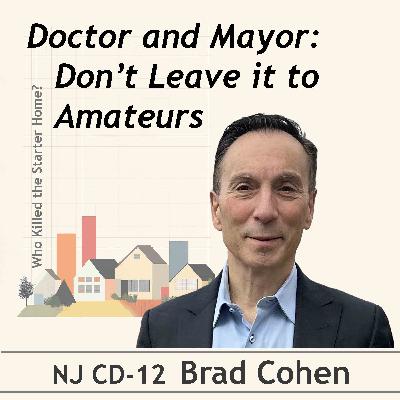
Washington is a shark tank, says Dr. Brad Cohen, a physician and the sitting Mayor of East Brunswick.
In this episode, we discuss how taking care of patients and delivering babies as a gynecologist, protecting education as a school board member, and negotiating economic development and housing as a mayor makes him qualified to make a difference in Congress.
In all his pursuits, he’s been willing to study, learn, and work to fix problems. Can this executive mindset be useful in Washington?
https://bradcohenforcongress.com/
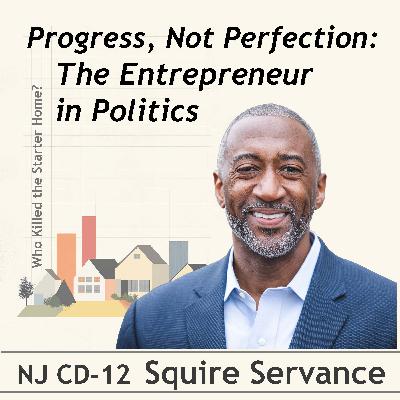
In this episode, I spoke with Squire Servance, an attorney and healthcare leader who plans to bring an entrepreneurial mindset to Congress. Our conversation centers on how his experience as a practicing lawyer and business owner informs his vision for the 12th District. Squire shares his perspective on healthcare and childcare reform, rethinking the path to career success for future generations, and understanding of AI and gig economy. We also discuss the need to balance government oversight with the room for innovation to grow. Ultimately, he argues for a leadership style rooted in negotiation across the aisle to get meaningful work done for the people.
Please note that the views expressed by the candidate are her own and do not necessarily reflect the opinions of this podcast. Given the nature of these long-form interviews, we cannot independently fact-check every claim made during the conversation. We encourage listeners to research the candidates and issues further as we approach the primary.
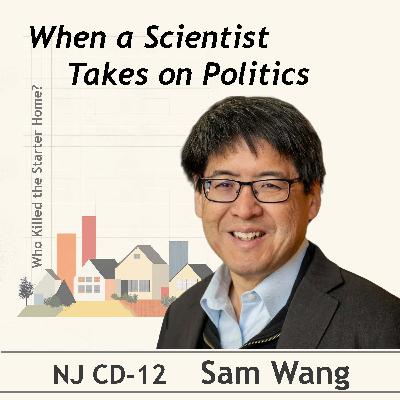
Recently, we have seen politicians attacking science, but what if scientist decide to flight back? In this episode, I spoke with a researcher who is stepping out of the lab and into the race for Congress. Sam Wang sees Washington not just as a political battlefield, but as a system with broken rules that need to be fixed with data and logic. He has spent his career studying the brain and the "science of political representation," and now he is ready to apply those findings in real life.
Our conversation dives into the vital mechanics of our democracy—how maps are drawn and how systems can be rigged. Sam argues that our current crisis is an opportunity to ensure our government processes are protected and actually work for us. The silver lining could be that it is now easy to see the cause and effect of what happens when complex systems break down, how actions far far away have direct and almost immediate impact on people’s everyday lives. Sam thinks that new leaders will emerge from this crisis and possibly our diverse district is ready to elect a scientist again.
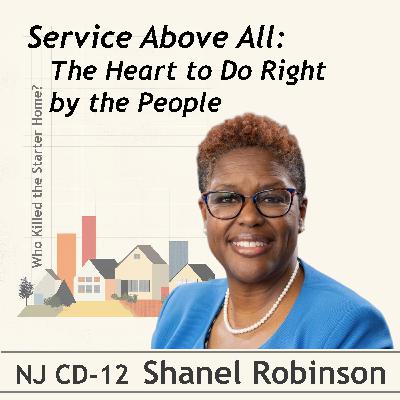
In this episode, I spoke with Shanel Robinson, whose journey from maintaining fighter jets in the military to leading Somerset County as Commissioner Director is rooted in a deep-seated desire to serve. Our conversation focused on her emotional and moral commitment to "do right by the people." We explore her transition to county leadership and her dedication to bringing compassion and heart to help her neighbors and those in need.
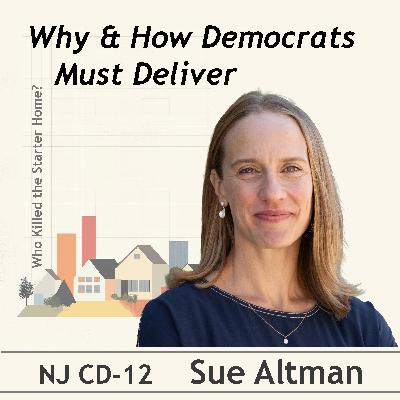
In this episode Sue Altman discusses the fundamental question: in a moment of deep uncertainty, can the Democratic Party move from reactive defense to a proactive vision that genuinely changes lives?
We touched on reimagining transit as a catalyst of economic independence and how cleaning up underutilized industrial sites could help our housing crisis. I learned about Sue's skepticism of Big Tech and especially its role in the classroom. We covered the collision between democracy and the economic interests of the political donor class. Sue is proposing that to lead, the party must have the courage to challenge inaction and provide the people with a tangible reason to believe in the future.
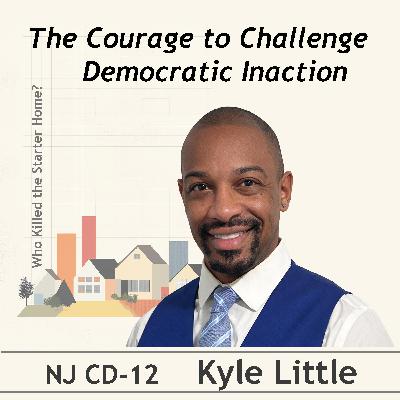
Kyle Little isn't just seeking a seat; he’s calling out a party he says has grown "reactive" and passive in the face of crisis. As the first candidate to jump into the NJ-12 race, challenging the status quo long before the seat was "open," Kyle is demanding a new era of forceful messaging to shut down divisive rhetoric and own the Democratic narrative.
A small business owner, personal trainer and adjunct professor, his vision ranges from securing federal funding to transform Trenton into a world-class capital we can be proud of, to his unique use of entertainment and the arts, like spoken word poetry slams, as a tool for activism and community unity.
Please note that the views expressed by the candidate are his own and do not necessarily reflect the opinions of this podcast. Given the nature of these long-form interviews, we cannot independently fact-check every claim made during the conversation. We encourage listeners to research the candidates and issues further as we approach the primary.
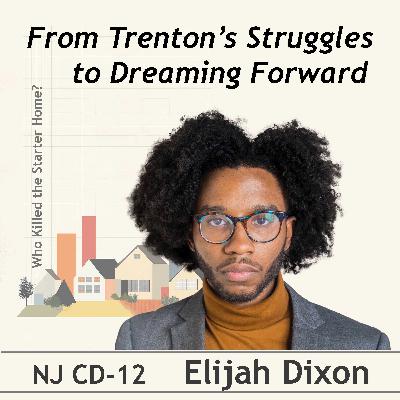
On this podcast we usually focus on housing policy, but we are taking some time to host special conversations with the candidates running for New Jersey’s 12th Congressional District. While our listeners outside of New Jersey may not care about this specific election, they may be fascinated to hear that we have 17 courageous people putting themselves in the spotlight and offering their vision and ideas for the future of their country. Housing issues are inevitably coming up, so we aren’t straying too far off-topic.
Our guest today is Elijah Dixon.
A lot of people get disappointed in politics. Elijah Dixon did too. But having lived the consequences of failed policies, he shifted from frustration to action — working to inspire and build better outcomes on the ground in Trenton.
He’s not just someone who talks — he’s someone who does. That approach has earned him real respect and influence in his community.
This conversation is about building economic power, being bold enough to move past safe talking points, and focusing on the how — how projects actually get done, how communities grow stronger, and how real progress happens on the ground in New Jersey and beyond
Please note that the views expressed by the candidate are his own and do not necessarily reflect the opinions of this podcast. Given the nature of these long-form interviews, we cannot independently fact-check every claim made during the conversation. We encourage listeners to research the candidates and issues further as we approach the primary.
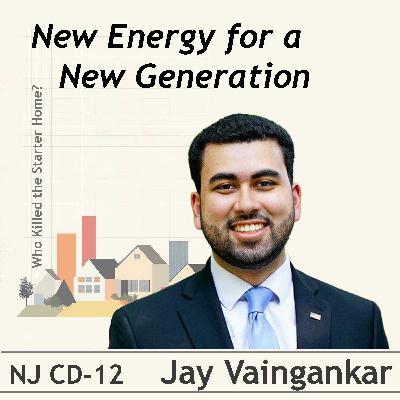
On this podcast we usually focus on housing policy, but today we are starting a special series of conversations with the candidates running for New Jersey’s 12th Congressional District. While our listeners outside of New Jersey may not care about this specific election, they may be fascinated to hear that we have 17 courageous people putting themselves in the spotlight and offering their vision and ideas for the future of their country. Housing issues are inevitably coming up, so we aren’t straying too far off-topic.
Our first guest is Jay Vaingankar, the youngest of the candidates, bringing his Gen-Z perspective to the race. After graduating from the University of Pennsylvania, Jay worked in the Biden administration on COVID-19 operations and at the Department of Energy. He shares how his perspective on policies has been influenced by growing up in a family of immigrants and a very diverse community here in Mercer County.
If elected to Congress, Jay plans to 'major' in energy and climate—leveraging his experience implementing the Inflation Reduction Act—while 'minoring' in immigration reform. In our conversation, he shares his thoughts on why the Democratic party and the Biden Administration had a difficult time getting credit for the work they were doing and why he believes a new generation of leaders is needed to address modern challenges like AI, housing scarcity, and climate change.
Please note that the views expressed by the candidate are his own and do not necessarily reflect the opinions of this podcast. Given the nature of these long-form interviews, we cannot independently fact-check every claim made during the conversation. We encourage listeners to research the candidates and issues further as we approach the primary.
What do you do when the equivalent of a plane full of people moves to your city every single day — not tourists, but people coming to stay? Calgary experienced exactly that. A successful marketing campaign attracted new residents, and suddenly growth wasn’t theoretical — it was reality.
In this episode, I spoke with Dr. Teresa Goldstein, Chief Planner and Director of Community Planning for the City of Calgary. We discuss why flexibility is the foundation of vibrancy, how making the language of zoning understandable helps cities grow gracefully, and what it looks like when government sees its role as a service provider rather than a gatekeeper.
Do you feel like something in our country is seriously broken right now? Like we’re losing a piece of what once made America optimistic and upwardly mobile — the belief that our future could be better than our past?
Yoni Appelbaum has done the research, and the story he tells is unsettling but also hopeful. For most of American history, uniquely in the world, America’s secret sauce was the freedom to move toward opportunity. That mobility gave people the agency to shape their future and even their identity. But over the past 50 years, we’ve become stuck.
Stuck in part because of the purposeful and openly discriminatory use of land. Some of the earliest zoning rules, beginning in 1885 in Modesto, California, were designed to push out Chinese laundry owners by banning the very businesses they operated to serve their customers. Over time, we became very good at building these legal walls. They came to seem normal, appropriate, even “scientific.” The result has been growing separation, rising resentment among those left out, and real strain on the foundations of our democracy.
But here’s the hopeful part: these land-use walls are words on paper, written by people. That means they can be rewritten. We can choose to get unstuck.
In this episode, I talk with Gregg Colburn about why homelessness is not just a personal tragedy, but a policy failure. Professor Colburn has done the research. If we want fewer people on the street, we must create more homes. It’s not rocket science. We’ve tried it, and it works.
In this episode, I talk with Andrew Mikula, who is leading an effort to bring a ballot measure to voters in Massachusetts that would make it possible to create starter homes.
Their proposal doesn’t seem too radical: if you have a plot of land the size of an NBA basketball
court, or can create a lot of that size in an area with existing infrastructure, you should be allowed to build a home on it.
Andrew walks through how his team is approaching this process and what it says about the state of our government that it may be easier to win majority support from voters than to pass state legislation to do the same.
In this episode, I speak with Luca Gattoni-Celli about why we can’t subsidize our way out of the housing crisis and how vacancy chains really work.
We also unpack two issues that feel permanent but are actually new: today’s homelessness crisis and the growing immobility of people who are being pushed away from opportunity because they can’t afford to live anywhere near it.
In this episode I spoke with Casey Anderson who for 8 years chaired the Montgomery County Maryland Planning Board. I came across his recent article "What are planning hearings for?" where he talks about problems he saw that make our public engagement process so dysfunctional.
Casey offers suggestions, but we by no means came up with complete solutions. We hope that this is a start of the conversation.
In this episode, I spoke with Taizo Yamamoto, principal of Yamamoto Architects. They creating beautiful, sustainable housing in Vancouver. He shares how the flexibility of Vancouver’s zoning allows for innovative and green projects. I loved learning about mass timber structures and other ideas that could help create more sustainable buildings and vibrant neighborhoods.
In this episode, I spoke with Alain Bertaud, urban economist and author of Order Without Design, whose career spans more than half a century planning cities across the globe, from communist systems to market economies. The incredible stories he shares illustrate why we are forced to consume more land and space, where the real hidden costs lie, and why common sense so often disappears in housing policy.
Note: About 20 minutes into the recording, we experienced a technical issue that caused some audio inconsistencies. Our apologies, and thank you for sticking with us.
In this episode, I speak with Mike Hathorne, author of the new book The Great Housing Reversal and the New American Dream. We talk about how market signals are clear about the kinds of homes people actually want to live in, yet outdated zoning and rigid development models continue to deliver the opposite. If we want affordable, walkable, human-scale neighborhoods again, we have to start listening to the market instead of silencing it.
This episode is a special one — our first recorded in front of a live audience on November 12th at the Wisconsin Housing and Economic Development Authority conference in Madison. I sat down with Elmer Moore, WHEDA’s executive director, to talk about re-imagining starter homes, the power of combining audacity with innovation, and how WHEDA is putting those words into action to make housing happen.
In this episode, I talk with journalist Benjamin Schneider, author of The Unfinished Metropolis: Igniting the City-Building Revolution.
We explore why cities need room to evolve and innovate, and how that mindset can help bring back starter homes and neighborhood-level creativity. We even dig into the question of where and why one would build an entirely new city and what is an "eco-district."
Every week, 75 to 100 churches close their doors. Some dilapidated buildings will slowly decay; others will become luxury condos with stained-glass windows. Our guest, pastor and property developer Mark Elsdon, isn’t waiting around. He’s building tools to help communities start early and grow something truly unique in God’s backyard — with patience, trust, and purpose.

Comments

Download from Google Play

Download from App Store
 United States