


 Claim Ownership
Citizen One: Exploring Our Urban Future
Subscribed: 2Played: 1
Subscribe

© Douglas Stuart McDaniel
Description
Welcome to Citizen One: Exploring Our Urban Future. I’m Douglas Stuart McDaniel—author, innovation veteran, and accidental urbanist—exploring the forces shaping the cities of tomorrow.
It’s not just a conversation—it’s a call to action. Here, we challenge assumptions, explore bold ideas, and rethink what cities can be—both now and in the future.
multiversethinking.substack.com
It’s not just a conversation—it’s a call to action. Here, we challenge assumptions, explore bold ideas, and rethink what cities can be—both now and in the future.
multiversethinking.substack.com
30 Episodes
Reverse
Two blocks from where I live in El Raval, there’s an archaeological excavation underway. I pass it often enough now that it’s become part of my daily geography — a fenced rectangle of disturbed ground, archaeologists at work, construction paused but not stalled.This started as a straightforward public-space upgrade. The Jardins del Doctor Fleming and Plaça de la Gardunya are being renovated — new paving, lighting, benches, a play area. Functional improvements. El Raval needs public space that works, and it needs it without apology.What makes the site interesting isn’t the renovation. It’s the predictability of what emerged once the pavement came up.Barcelona expects archaeology. It plans for it. The ground here is a record, and every infrastructure project knows it may have to read a few pages before proceeding.At Fleming, those pages belong to the hospital city. Burials associated with the Hospital de la Santa Creu, dating to the 17th and 18th centuries — the cemetery known as El Corralet. By July 2025, archaeologists had documented eighteen burial units containing twenty-five individuals: men, women, and children. The older burials were simple — bodies placed without coffins, the unclaimed poor. The later ones showed a certain dignity: wooden coffins, rosaries and medals still present, arms folded properly. Someone had cared enough, even for the abandoned.These were the ones whose relationship to the city was transactional and final — and whose remains now slow the installation of playground equipment, because Barcelona has decided they are worth documenting before the children arrive.A Ship Beneath the Fish MarketTen minutes’ walk from Fleming, at the foot of La Rambla, the Drassanes Reials — the Royal Shipyards, now the Maritime Museum — stands as one of the great medieval industrial buildings in Europe. Sixteen Gothic stone naves, each sixty metres long, built to produce warships for the Crown of Aragon at scale. At its peak in 1423, twelve galleys could be built simultaneously inside those halls. The Drassanes wasn’t a monument to craftsmanship. It was a factory.In April 2025, three kilometres up the coast, construction crews excavating for a new biomedical research complex broke through into a medieval shipwreck. They named it Ciutadella I. Ten metres long, built of thirty curved wooden ribs and at least seven hull planks, mid-15th century. A merchant vessel, most likely — sunk in a storm when that section of the city was still open water.The ship is five metres below current ground level because Barcelona’s coastline moved. After the city built its first artificial docks in 1439, the old sandbar shifted, the sea receded, and the city grew forward over its own port. The ship became sediment. The sediment became a fish market. The fish market became a construction site.What surrounds it makes it extraordinary: that single excavation contains the remains of 18th-century Bourbon fortifications, the 19th-century fish market, a Civil War air-raid shelter built in 1938, and the 15th-century vessel beneath it all. Five centuries of Barcelona, stacked in one pit.The Drassanes built ships for kings. Ciutadella I carried cargo — the freight that actually made the city’s economy run. The museum holds the reproduction of the famous flagship. The ground beneath a future parking structure held the workhorse.A Battle That Remade the WestIn 218 BCE, Rome fought its first battle on Iberian soil — at an Iberian town called Kissa, in what is now Catalonia. The Roman general Gnaeus Cornelius Scipio defeated the Carthaginian commander Hanno, captured Hannibal’s abandoned baggage, and established the foothold that would eventually become the Roman province of Hispania. Some historians consider it one of the decisive engagements of the ancient Mediterranean world.For two thousand years, no one knew exactly where Kissa was.In 2025, a team from the University of Barcelona confirmed it: Valls, in the Camp de Tarragona, at the Vilar archaeological site. The evidence is unambiguous — Punic coins concentrated in a destruction layer, lead ballista projectiles inside burned houses, a stratigraphic sequence consistent with violent demolition in the fall of 218 BCE. The geography confirms it too: Valls controls the coastal pass toward the interior of Catalonia. Roman troops marching south toward what is now Tarragona would have had to go through here.The city wasn’t abandoned immediately. People kept living in the rubble for another decade or two before finally leaving — still trying to make a life in a place that had become a footnote in someone else’s war.Workers Who Built Their Own SurvivalIn December 2025, construction teams preparing the ground for the new La Sagrera high-speed rail station broke into something not on any map: a Civil War air-raid shelter, built around 1937, absent from the 1938 census of public shelters and from every official record of Barcelona’s wartime civil defense network.Which means it was private. And given the location — directly beneath the former La Sagrera freight station, which the CNT, the anarcho-syndicalist railway workers union, had collectivized in 1936 — it means the workers built it themselves. For themselves. Without asking permission.The structure is unlike any other shelter found in the city. While most of Barcelona’s 1,322 documented wartime shelters were tunnels carved into hillsides or adapted basements, this one was excavated in the open air and built as a poured concrete bunker before being buried under fill. The roof slab is two metres thick, calculated to withstand 100-kilogram bombs. The freight station had already been bombed twice in 1937. The workers knew exactly what was coming.Inside: two main galleries, four large rooms, four latrines, a probable infirmary, and graffiti marking the CNT and the FAI — the Iberian Anarchist Federation. Some of the dates on the walls run as late as 1954. Fifteen years after the war. Six years into Franco’s dictatorship. Someone was still using this space, or still marking it, or perhaps sheltering in it again for different reasons, in a different kind of fear.The high-speed railway to Madrid will eventually run over the exact spot where those workers hid.What the Pattern MeansTaken together — the hospital cemetery, the medieval ship, the Iberian battle site, the anarchist bunker — what emerges is not a collection of curiosities. It’s a pattern.What strikes me about each of these sites is how little drama surrounds any of them. Archaeologists work. Sites are documented. Remains are treated properly. Timelines adjust and then resume. No spectacle. No false choice between memory and progress.This is not Barcelona discovering its past. It’s Barcelona managing it well.When the Jardins del Doctor Fleming reopen, children will play there. Neighbors will sit. The space will feel calmer and safer. None of that is undermined by what lay beneath it. Barcelona understands that improvement doesn’t require amnesia — that public space can be both functional and deep.Two blocks from my apartment, that pattern is playing out again. And in Valls, and in the Ciutadella, and under the future AVE platforms of La Sagrera, it’s playing out too.Quietly. Competently. Without self-congratulation.The ground spoke. The city listened just long enough. Then it continued — better informed.Citizen One is a podcast and Substack about the future of cities. Subscribe at citizenone.substack.com. Next week: Part 3 of the Barcelona series. This is a public episode. If you would like to discuss this with other subscribers or get access to bonus episodes, visit multiversethinking.substack.com
Welcome back to Citizen One: Exploring Our Urban Future. I’m Douglas Stuart McDaniel. Today, I want to tell you a bit about my neighborhood in Barcelona.Not the Barcelona of postcards — not Antoni Gaudí’s spires dissolving into sky, not the wide geometry of the Eixample, not the Gothic Quarter all dressed up for tourists. Those places are real, and they matter. **But they are not where cities do their actual work.**The place I want to talk about is El Raval. Specifically, a district of about 1 square kilometer that sits just west of La Rambla and runs from Plaça de Catalunya down toward the port. With a population of 48-50 thousand people, that density is extremely high by European standards and on par with the density of places like Dhaka. Denser than Manhattan and roughly double Paris city average, El Raval is one of the four neighborhoods of the larger district of Ciutat Vella (Old City). It’s more than 55% foreign-born, with many from Pakistan, Bangladesh, the Philippines, Morocco, India, Italy, Colombia, Uruguay, Peru and Honduras. In the early 20th century, it was called Barrio Chino, or Chinatown. Today, it’s sometimes informally called “Little Pakistan” because of the concentration along Carrer de l’Hospital and surrounding streets. Religiously and culturally you’ll find multiple mosques, South Asian groceries and call shops, Filipino Catholic networks, North African cafés, long-time and elderly Catalan and Spanish residents, a heavily transient EU creative class and university population, and growing short-term rental/tourist turnover pressure. It’s not just diverse — it’s vertically layered. Five floors, one building: an elderly Catalan widow, a Pakistani shopkeeper family, students and digital nomads, undocumented laborers, short-term Airbnbs. That stacking creates a rich and wonderful intensity.The district is anchored by a medieval hospital, a market that has been feeding the city since the 13th century, and an opera house that was bombed or burned three times and was rebuilt on the same address both times. Within that corridor, you can trace almost everything a city is actually for — how it absorbs labor, manages illness, performs culture, feeds its people, and quietly catches whoever falls.I live here. On Carrer de les Cabres — the Street of the Goats — which is either charming or accurate depending on your mood.These next three episodes stay close to home. Walking distance. A few blocks in each direction. That’s a deliberate constraint, because I’ve come to believe that cities reveal themselves most clearly at close range — around obscure addresses and modest street corners, not at their monuments. The monuments tell you what a city wants you to think about it. The street corners tell you how it actually functions.This first episode traces the history of this corridor — the market, the hospital, the opera house, and what it means that they ended up in the same few blocks. The second follows what happens when you disturb the ground two blocks from my apartment and the city’s entire biography starts surfacing: medieval ships, Roman battlefields, anarchist bunkers, hospital cemeteries. The third contracts to the most intimate scale of all — the kitchen, and what it means when a city provisions its people well enough that cooking stops being an act of self-defense.Three episodes. One neighborhood. Close range.What connects them is a single question: what does it look like when urban systems actually work? Not when they’re celebrated or curated or marketed to visitors — but when they’re simply functioning, quietly, in the background of daily life, doing the job the people who live inside them need done.Barcelona is not a perfect city. No city is. But it is a legible one. It has layers it doesn’t hide and infrastructure it hasn’t aestheticized beyond recognition. It manages its history without either freezing it behind glass or bulldozing it for the next project. It nurtures its people at human scale. It has, over centuries, developed a particular competence at absorbing pressure — demographic, cultural, economic — and continuing forward without pretending the pressure was never there.That competence is what this miniseries is about.We’re not here for the landmarks. We’re here to read how it functions. Let’s get started. # El Raval – Inside a City’s Pressure ZoneI’ve inhabited a lot of cities, and I’ve learned something the hard way: cities rarely reveal themselves at their famous monuments.They reveal themselves around obscure addresses and modest street corners.I live in Barcelona, on Carrer de les Cabres in El Raval — a few steps off La Rambla, near the seam where La Rambla de Sant Josep transitions into La Rambla dels Caputxins. On a map it doesn’t look like much of a distinction from the Gothic Quarter on the other side of La Rambla. But if you look at how cities actually work — how labor, culture, illness, ambition, performance, and survival overlap — this is one of those places where everything compresses.This isn’t a definitive portrait of El Raval. It’s a reading of one corridor through the passage of time. A field study in urban literacy. And none of it erases what El Raval also is: a culturally rich lived neighborhood, with families, loyalties, and daily routines that exist alongside everything I’m about to describe.---## El Raval as a System, Not a Reputation_Raval_ derives from the Arabic _rabaḍ_ — used across Al-Andalus and the medieval Iberian south to denote urbanized suburbs beyond a city’s walls. Zones of labor, logistics, care, and circulation. Markets, workshops, travelers, hospitals, ferreterías, and people whose presence was necessary but often inconvenient.That word alone matters, because it reminds us of something easy to forget: Barcelona absorbed Arabic administrative language without ever being governed under Muslim rule. Unlike Valencia or Xàtiva, which fell under Islamic governance for centuries, Barcelona remained north of the frontier. Muslim armies reached the region briefly in the early 8th century, but the Carolingians reclaimed the city in 801 and folded it into the Marca Hispánica — a militarized buffer zone between worlds.That frontier status shaped everything.Barcelona became a fortified city obsessed with walls and thresholds. What didn’t fit inside them — functionally, socially, morally — was pushed outward. The land west of the medieval core became exactly what _rabaḍ_ describes: a necessary exterior.The same etymology runs through La Rambla itself. The name comes from the Arabic _ramla_ — a sandy riverbed, a wadi, seasonal watercourse. Before it was a promenade, La Rambla was a drainage channel, carrying floodwater from the Collserola mountains toward the sea. A soft boundary where water moved, waste flowed, and the city managed what it could not contain. Like _raval_, the word survived because the function it described never stopped being needed.El Raval began as farmland supplying the city with food. By the Middle Ages it had accumulated the institutions cities prefer not to keep too close: hospitals, convents, charitable houses, hostels, slaughterhouses, warehouses. The Hospital de la Santa Creu, founded in the early 15th century, anchored this role physically and symbolically. Care, illness, and death _belonged_ here — not as failure, but as deliberate placement.This was not marginal land in the economic sense. It was central infrastructure held at arm’s length.As Barcelona grew, density increased rather than spreading outward. By the 18th and 19th centuries, El Raval had become one of the most crowded urban districts in Europe. Industrialization didn’t invent the neighborhood’s role — it intensified it. Workshops replaced gardens. Tenements replaced hostels. Labor stacked vertically because proximity mattered more than comfort.El Raval was never a failure. It was an early form of urban planning honest enough to say what it was doing.Modern urban language tends to moralize neighborhoods like this. It describes them as problems to be solved, reputations to be corrected, zones to be cleaned up. That framing misses the point. El Raval wasn’t an aberration in Barcelona’s development. It was the city’s cultural and economic release valve — the place where pressure went so the rest of the city could function as if there were none.Cities survive by externalizing pressure into places designed to absorb it. El Raval did that work for centuries. It housed the arriving, the laboring, the sick, the rehearsing, the failing, and very often, the ascendant.Once you see El Raval as a system rather than a stigma, the map changes. The neighborhood stops being abstract and starts becoming spatial. You can trace its logic block by block. And if you follow where food enters, where illness concentrates, where labor gathers, and where culture performs, you end up in one very specific corridor.---## The Liceu / Hospital / Boqueria AxisCities don’t operate evenly. They operate along corridors.Carrer de les Cabres — the Street of the Goats, a block west of La Rambla — is one of those tiny corridors. Not a grand axis in the Haussmannian sense. A functional one: a tight knot where food, illness, labor, and performance have intersected for centuries.Twenty meters from my door sits La Mercat de la Boqueria, whose origins as an open-air meat market date to at least the early 13th century. Long before it was roofed or aestheticized, this was where livestock entered the city and food was processed at scale. Markets like this demand proximity to labor, transport routes, and waste disposal. They generate noise, smell, and early-morning movement — activities cities historically push to the edges of acceptability.On the opposite corner of my street lies Carrer de l’Hospital, named for the Hospital de la Santa Creu. For centuries it was Barcelona’s primary site for treating the sick, injured, poor, and displaced. Today its former wards house the Biblioteca de Catalunya — a site once dedicat
 1
1In this episode of the Premium Pulp Fiction podcast, my guest is Maksym Van Shamrai — millennial novelist, cultural theorist, and Ukrainian expat.In 2010, Maks had just finished his doctoral studies in Kyiv. His thesis examined something called cultural anthropocentrism — the idea that humans are both the authors of culture and the products of it. Heavy stuff. The kind of thing you wrap in abstract philosophical language until nobody understands it anymore.Then he attended a lecture on the role of poetry in forming personality. At the end, confused by the jargon, he asked the speaker to explain it simply.She smiled and said: “Poetry helps the heart think when the brain is tired.”That sentence cracked something open. Maks realized his ideas about humanity, memory, power, and meaning didn’t want to stay inside academic language anymore. They wanted characters. Danger. Conflict. Emotion.“2010 became the moment,” Maks told me on this week’s podcast, “when my philosophy quietly put on a spacesuit and stepped into fiction.”A Book That Lived Several LivesScions of the Last Hope began in Ukraine under a different title — The Last Crew — written first in Russian, the everyday language of southern Ukraine at the time. By 2011, Maks had moved to Spain, diving deeper into art and culture, meeting the love of his life, learning Spanish at the government language school in Vigo. The manuscript paused at chapter seven. He was absorbing rather than creating.Then came 2022.When the sirens sounded in Kyiv, Maks was working on chapter eleven. Something opened inside him. The book wasn’t just philosophical anymore — it became deeply emotional. He finished the manuscript in Ukrainian, then translated the entire novel into Spanish himself. Not with Google Translate. With dictionaries, with his Spanish family, with random guys at the calisthenics park who could tell him how young people actually spoke.“It was quite a challenge,” he said. “Asking people, asking my family, my friends — which was quite a nice journey.”He wanted to publish first in Ukraine, his home. But Ukrainian publishers had been hit by missiles. The infrastructure was gone. So Spain became the path forward. The Spanish edition, Vástagos de la Última Esperanza, was released in 2025 by Caligrama, an imprint of Penguin Random House.And now Premium Pulp Fiction has acquired the English-language rights.What Survives When a Story Crosses BordersOne of the things I pushed Maks on during our conversation was voice. How do you carry an Eastern European literary sensibility — with its space for silence, moral tension, slow philosophical moments — into English, a language that often rewards acceleration?His answer was precise: “I didn’t want to sound very Spanish or German or whatever. I wanted to sound Ukrainian. Eastern European.”That’s not about being different for its own sake. It’s about protecting the philosophical heart of the book. Scions of the Last Hope isn’t just a space adventure with explosions and heroes. It explores what Maks calls “biopolitical science fiction” — questions about power over human life itself. Who is allowed to live? Whose memory is preserved? Which version of humanity gets a future?These questions need space. They need reflection, not just fast action.“If I remove that deeper, quieter layer,” he said, “the story would lose part of its meaning.”The Seed of the NovelWhen I asked Maks what the book is really about, he offered two questions that haunt the entire narrative:Can you build a new future without carrying the ghosts of the past?When systems of power and survival define humanity, what remains of the human?His answer to the second: Choice. Fragile, constrained, often punished — but not entirely erasable.That’s the seed. Set in 2136, after planetary cataclysm has plunged humanity into collapse, the story follows scientists racing to understand a distant exoplanet that might become humanity’s new home — while navigating corporate intrigue, government conspiracies, and a mystery encoded in a single prehistoric word.It’s dystopian science fiction, yes. But it’s also a reflection on identity, memory, and what it means to remain human when technology and power structures are trying to decide that for you.Eastern European RootsMaks cites Stanisław Lem, the Strugatsky Brothers, Isaac Asimov, and Arthur C. Clarke as influences — but also Ukrainian writer Volodymyr Arenev and Polish author Andrzej Sapkowski (yes, The Witcher). And films: Star Wars, Alien, Prometheus.What unites them? “Humanity facing the big questions,” he said. “I’m always looking for the philosophical point in every single book or movie. Even if there is no philosophical point.”He grew up in a household in Mykolaiv where his father — a professor of physics and mathematics — also played guitar, piano, and accordion, and wrote poetry that he never published. His mother taught primary school. His grandmother taught math and geometry for decades. That combination of science, art, and education runs through everything Maks writes.What It Means to Become a PPF AuthorAt Premium Pulp Fiction, we don’t acquire books because they’re easy. We acquire them because they’re worth the work.Maks didn’t just hand over a manuscript. He entered into a rigorous editorial process — one that asks hard questions about language, identity, rhythm, and what survives translation. We’ve had uncomfortable conversations about pacing. We’ve killed darlings while protecting voice. We’ve worked through what he calls “digestion” — the slow process of adapting tone, idiom, and emotional nuance for a new audience without losing the story’s soul.“It’s like being an actor in the same film, but with a different director,” he said. “The story is the same, the scenes are the same, the characters are the same. But you have to pause, think, process.”That’s what real editing looks like.A Message to Young Ukrainian WritersI asked Maks what he would say to young Ukrainian writers and thinkers during these dark times — with his home city of Mykolaiv under near-constant bombardment, with blackouts lasting 22 hours a day, with even his webmaster in Kyiv apologizing for missed deadlines because there’s no electricity.His answer:“We have to keep being human. Think about imagination, which is very important to create things. Preserve the culture, the identity. Because we are facing challenging times — someone wants to erase our identity. Even when we can speak their language, it doesn’t mean we have to erase our own culture and our own language. It’s a beautiful language.”Then he paused.“Just don’t let imagination slip away from your mind. Keep it inside. Try to develop something interesting, something new, something unknown to the rest of the world.”As his father would say: More poetry.The DedicationAt the end of our conversation, Maks read the dedication of Scions of the Last Hope — first in Ukrainian, then in English. It’s a dedication to his country and his people facing dark times.I won’t reproduce it here. You’ll have to read the book.But I will say this: the imagery, the pain, the journey of Maks, his family, and his people — it’s all there on the page. This isn’t a book that happened in spite of history. It’s a book that happened because of it.The Spanish edition, Vástagos de la Última Esperanza, is available now on Amazon and everywhere books are sold. The English edition from Premium Pulp Fiction is coming later this year.Stay tuned for more updates — and listen to the full conversation on the Premium Pulp Fiction Podcast.Douglas Stuart McDaniel is the founder of Premium Pulp Fiction and host of the Premium Pulp Fiction Podcast. This is a public episode. If you would like to discuss this with other subscribers or get access to bonus episodes, visit multiversethinking.substack.com
In this episode of Citizen One: Exploring Our Urban Future, I sit down with Derek Lumpkins to talk about cities and neighborhoods—but not in the way cities usually get discussed.We didn’t start with master plans or policy language. We started with Roxbury. With lived memory and 150 years of Black history. With what it means to grow up inside a neighborhood that is always being talked about, rarely talked with, and almost never trusted to define itself.Roxbury matters because it exposes something cities prefer to hide: the way stereotypes quietly stand in for governance. How assumptions about race, class, and behavior become shorthand for decisions about investment, policing, education, and opportunity. Not announced. Just understood. Embedded in tone. In posture. In who gets listened to.This is also why Derek’s work in DEI—diversity, equity, and inclusion—matters now more than ever, precisely because the field is under strain.What’s happening to DEI today isn’t subtle. The language remains, but the commitment is thinning. Roles are being eliminated, renamed, or buried inside HR. Expectations remain impossibly high, while power contracts. Derek describes a familiar pattern: organizations say they want honesty, but recoil when that honesty threatens comfort, hierarchy, or control.DEI has become an easy target because it forces proximity. It asks institutions to look at who benefits, who bears risk, and who has historically been excluded from decision-making. And in moments of uncertainty—economic, political, cultural—institutions tend to protect stability over introspection.What gets lost in the backlash is that DEI, at its best, was never about optics. It was about stakeholders. About whether people who live with the consequences of decisions have any real say in how those decisions are made. About whether cities, companies, and governments can move beyond symbolic inclusion toward shared accountability.In this episode, we don’t talk about DEI as a slogan or a checklist. We talk about it as a profession that has been asked to absorb institutional failure while being stripped of real authority. A field that was invited into rooms at the height of moral urgency—and is now being quietly sidelined as political winds shift and budgets tighten.Derek is candid about the toll this takes on practitioners. Many are asked to be translators, buffers, and shock absorbers—expected to carry the emotional weight of structural problems they did not create and are not empowered to fix. Burnout isn’t a failure of commitment. It’s a predictable outcome of being positioned between institutional inertia and lived reality.This is why the current moment matters more than ever.As cities face widening inequality, displacement, and distrust, retreating from equity work doesn’t make those tensions disappear. It simply removes the people trained to name them early, before they harden into crisis. When DEI is reduced to compliance or eliminated entirely, what follows isn’t neutrality—it’s silence.And silence, in cities, commonly benefits the already insulated.What Derek makes clear is that the question isn’t whether DEI “worked.” The question is whether institutions have ever been willing to let it work. Whether they are prepared to move beyond listening toward recognizing the existing agency of a plurality of stakeholders. Whether they are ready to treat marginalized communities not as problems to be managed, but as partners with legitimate claims on the future.That question doesn’t go away just because an acronym falls out of favor.From there, the conversation moved—literally and metaphorically—across borders.We talked about El Raval, my neighborhood here in Barcelona. A neighborhood that tourists experience as “gritty” or “authentic,” that inmobiliarios, or realtors here, talk about its dangers on their clickbait TikTok reels. Residents of El Raval, however, experience this district as layered, culturally rich, both vibrant and fragile, and under constant negotiation. Raval is not broken. It’s over-observed and under-protected. Like Roxbury, it’s a place where outside narratives arrive faster than local agency.That’s where travel enters the frame.One of the sharpest throughlines in this episode is how wealth functions as mobility—not just physical movement, but cognitive freedom. The ability to leave. To compare. To see that the way power operates in one city is not inevitable, just familiar. Travel exposes the lie that “this is just how things are.”For people without that mobility, stereotypes harden into destiny.We talked about Tulsa—not as a historical abstraction, but as an example of how cities remember selectively. How Black prosperity is tolerated until it isn’t. How destruction is framed as tragedy rather than policy. And how the long tail of that violence still shapes who is considered a legitimate stakeholder today.Derek is clear-eyed about this: cities are full of people who care deeply, who want to make things better, who are invited into rooms precisely because they bring credibility or conscience. But too often, they are invited without agency. Asked to absorb risk. Asked to translate harm. Asked to make systems feel humane without being allowed to change how they actually work.That’s not inclusion. That’s extraction.A recurring tension in this conversation is the difference between being a stakeholder and being a symbol. Stakeholders have leverage. They shape outcomes. Symbols are displayed, consulted, thanked—and ignored. Many institutions confuse the two, then act surprised when trust erodes.What makes this episode resonate is that it refuses easy villains. The problem isn’t individual bad actors. It’s structural insulation. The distance between decision-makers and consequences. Between those who benefit from stability and those who pay for it when systems fail.Cities don’t just distribute resources. They distribute exposure.Who is allowed to fail quietly. Who has to fail publicly. Who gets second chances. Who is never supposed to leave.By the end of the conversation, what emerges isn’t a prescription so much as a warning: if cities want legitimacy, they have to relinquish some control. They have to trust people who live with the outcomes. They have to stop treating neighborhoods as problems to be managed and start treating them as partners with memory, intelligence, and agency.Roxbury. Raval. Tulsa.Different geographies. Same fault lines.Cities don’t suffer from a lack of vision. They suffer from a lack of shared power. And until that changes, no amount of rhetoric—no matter how well intentioned—is going to close the distance between those who decide and those who live with the results.That distance is the real line cities keep drawing.And everyone knows who it’s drawn around. This is a public episode. If you would like to discuss this with other subscribers or get access to bonus episodes, visit multiversethinking.substack.com
Welcome back to Citizen One: Exploring Our Urban Future and—I am excited to say—Premium Pulp Fiction. I’m your host, Douglas Stuart McDaniel, and before we go any further, I want to pause for a moment.We’re recording this at the start of a new year, in a world that feels simultaneously exhausted and overheated. Wars that refuse resolution. Cities under pressure from climate, inequality, and political fracture. Technologies advancing faster than our capacity to govern them. Institutions losing credibility while still holding enormous power. For many people listening, this year didn’t begin with hope so much as vigilance.That context matters.Citizen One was never meant to be escapist. It exists because moments like this demand clearer thinking, longer memory, and a willingness to stay present inside complexity rather than retreat from it. The stories we explore here—about cities, systems, culture, and power—are not abstractions. They are the environments we’re already living in, whether we’ve named them yet or not.So if you’re listening from a place of uncertainty, fatigue, or quiet resolve, you’re not alone. This space is for people who are still paying attention, still asking better questions, and still trying to understand how the future is being shaped in real time—often without our consent, but never without consequence.With that in mind, let’s step into today’s episode.Before I begin, I also wanted to share some important context with you. Citizen One is much more than a podcast. It is an emerging media brand where we explore stories at the intersection of innovation, culture, memory, and the past, present and future of cities.But today, we’re stepping into a slightly different kind of narrative frontier. I want to take a moment to introduce Premium Pulp Fiction, our Citizen One literary imprint and publishing empire.This episode is also a crossover—one that connects what we do here at Citizen One with a parallel storytelling project rooted in the same curiosity about systems, human complexity, and consequence, but expressed through fiction.It’s called Premium Pulp — an independent traditional publishing imprint where quality, depth, and risk-bearing imagination come first.At its core, Premium Pulp Fiction publishes speculative fiction, noir-inflected narratives, historical fiction, and narrative nonfiction concerned with power, memory, technology, and the quieter mechanics of how societies endure, adapt, and fail over time.Beginning this year, we will be publishing a very small number of carefully selected titles, and unlike many modern indie or hybrid publishers, we fully finance standard book production. Our authors never pay for book production or global distribution; they also receive the resources to leverage an integrated marketing and publicity ecosystem built from a network of preferred, vetted, award-winning suppliers.Over the last 15–20 years, most small presses have been forced into one of three survival models:1. Author-funded or cost-sharing modelsThese include hybrid presses, “assisted publishing,” or thinly disguised vanity presses. Production costs are shifted to the author—sometimes partially, sometimes entirely—and the imprint’s role becomes administrative rather than editorial. Marketing support, when offered, is usually modular, outsourced, or pay-to-upgrade.2. Grant-subsidized or institutionally anchored pressesUniversity presses, arts-council-backed imprints, or nonprofit literary houses can sometimes fully fund authors, but they rely on external subsidy. Their marketing reach is often limited, conservative, or academically scoped, and publicity ecosystems are modest by design.3. Micro-indies operating on sweat equityThese presses finance production out of pocket, but at minimal levels—basic editing, templated design, limited print runs—and expect authors to self-market aggressively. Publicity ecosystems are informal at best and nonexistent at worst.What almost never exists anymore is a small, independent imprint that does all three of the following at once:* Fully finances production (developmental editing through distribution)* Retains editorial authority and risk (rather than transferring it to the author)* Provides an integrated marketing and publicity ecosystem rather than ad-hoc supportThat model used to be normal. It was called publishing.While publishers exist across a wide range of sizes and models, the largest U.S. trade houses—commonly referred to as the Big Five—retain the scale, capital, and specialized editorial, marketing, and publicity infrastructure required to support broad distribution and coordinated campaigns at volume. Most small and independent presses operate with significantly smaller budgets and far fewer specialized departments, and as a result, authors are often expected to source, coordinate, or directly manage much of their promotional and publicity work themselves.This context is what makes our approach genuinely uncommon. Premium Pulp Fiction is structurally closer to a miniature traditional house than to a contemporary indie press. We’re not simply financing books; we’re absorbing uncertainty so that editorial decisions can be made upstream, slowly, and with coherence.Within that structure, the inclusion of a fully integrated marketing and publicity ecosystem is the clearest outlier.Most small presses either:* hand authors a checklist, or* provide one or two vendor introductions, or* rely on goodwill and improvisationVery few embed authors into a preferred, already-vetted network of publicists, designers, media prep, trailers, and positioning support. Doing so requires long-term relationship capital, not just money.So the honest framing is this:Premium Pulp Fiction is not rare because it’s boutique. It’s rare because it reinstates a publishing contract that the market quietly abandoned—one where the imprint assumes risk, curates taste, and provides infrastructure so authors can focus on the work itself.That isn’t nostalgia. It’s a deliberate structural choice. It’s structural dissent.That structural choice shapes our focus: books built to last—structurally sound, intellectually grounded, and resistant to fashion. That orientation is not accidental. It reflects the belief that long-term relevance and endurance require more than a launch cycle or a marketing push; they require structural coherence, editorial intention, and depth of engagement that only emerges through sustained collaboration between author and editor.Premium Pulp Fiction was founded to support work that understands genre as a working tool rather than a marketing label. We are interested in stories that know where they come from — noir that remembers its debts, historical fiction that treats the past as something lived rather than staged, speculative work that understands systems, worlds, and story ecologies before it imagines their collapse.Handled seriously, genre does more than entertain. When handled carefully — structurally, morally, and contextually — genre becomes a way into complexity rather than a shortcut around it.Our publishing approach intentionally mirrors that complexity. Premium Pulp Fiction operates as an independent traditional imprint: we fully finance book production for our authors, including editorial development, copyediting, cover design, layout and formatting, distribution setup, media kits, and book trailers. This allows editorial decisions to be made on the basis of quality and coherence rather than speed or scale.That work extends beyond production. We focus on positioning, framing, and long-term relevance, with attention to how a book will read five or ten years after publication, not just how it launches. That longer view matters because a great story, like a great city, continues to live and change after its initial debut, shaping and reshaping its readership over time.The kinds of work we seek include:* Speculative fiction grounded in political, economic, and technological reality* Dystopian narratives informed by history rather than abstraction* Noir fiction attentive to power, corruption, and moral compromise* Historical fiction concerned with memory, survival, and unfinished businessWe value narrative control, structural clarity, and voice, and we welcome humor when it emerges from intelligence rather than irony.Most importantly, we do not offer paid publishing packages. Premium Pulp is not a service press. We seek projects that benefit from close editorial engagement and long-term positioning rather than rapid release cycles.This publishing philosophy—production financed in full, editorial risk assumed by the imprint, and a limited annual catalog—creates space for seriousness rather than spectacle. It allows fiction to ask big questions rather than announce its genre category before it earns the right. It aligns with the way Citizen One interrogates systems, but through narrative intelligence rather than analytical exposition.Now, with that foundation in place, I want to introduce the first author signed under this imprint who exemplifies the kind of work Premium Pulp was created to support.Van Shamrai is a Ukrainian science-fiction novelist whose work is shaped by lived historical pressure rather than speculative distance. His fiction emerges from a close engagement with political systems, social fracture, and the long consequences of collective decisions, drawing on both contemporary Ukrainian experience and broader European intellectual traditions. Rather than treating collapse as a sudden event, his writing traces how societies erode over time—through institutional strain, moral compromise, and the accumulation of unresolved choices.His characters move through worlds governed by constraint rather than convenience, where survival is inseparable from memory, responsibility, and inherited obligation. The speculative elements in his work are never decorative; they function as extensions of real historical and civic forces, rendered through disciplined
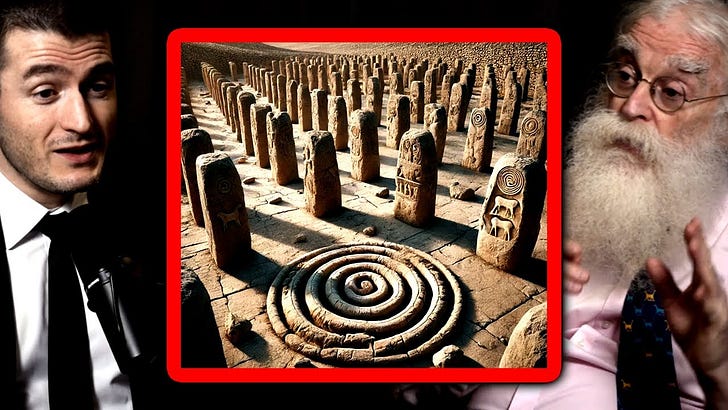
Cities are a form civilization often takes. They were never its starting condition.Since my first travels to Türkiye several years ago—through Istanbul, İzmir, and Ephesus—and also across archaeological sites in Egypt, Jordan, Bahrain, Morocco, and Saudi Arabia, Göbekli Tepe has remained on my research radar**. Not as an archaeological revelation or a sudden conversion to deep prehistory, but because, as a narrative architect, I’m drawn to how settlement systems form—especially the ones hiding in plain sight.**Taş Tepeler has lingered in my mind in precisely this way, not as a city or urban form, but as a system of worldbuilding and story ecology that invites harder questions about how civilizations function beneath their visible forms: coordination, legitimacy, labor, belief, and power.The logic that structures human worlds long before they crystallize into cities.Taş Tepeler offers evidence of something more elusive and, in many ways, more instructive: civilization as coordinated life before urbanization. We don’t see clear evidence of dense settlement cores. No large concentration of permanent housing blocks. No streets, markets, or municipal hierarchy. None of the architectural signals we rely on to tell ourselves that “civilization has begun.”And yet the civic coordination is unmistakable. Across multiple sites, deliberately distributed across the landscape, we see coordination that exceeds kinship or coincidence. A shared symbolic grammar appears again and again, not as local improvisation but as something collectively maintained. Labor is organized at a scale that no single community could sustain alone. People gather repeatedly—on rhythms that imply scheduling, expectation, and return—rather than accident or crisis.Memory here is not stored in text or archive, but anchored in place. That anchoring is not passive. It is actively staged.There is so much exciting work going on now across the Taş Tepeler sites: archaelogical work, paleo-environmental research, cultural heritage management, and ethnoarchaeology. And recent excavations reveal narrative systems embedded directly into architecture: reliefs depicting sequences rather than symbols, animals and humans shown in motion and interaction, vessels and figurines designed to be handled, repositioned, and displayed. These are not static images. They appear to be prompts for retelling.Some installations appear deliberately constructed to accommodate small groups seated together, facing shared visual fields—spaces where stories could be enacted, repeated, and remembered through gesture and movement as much as through speech. If this is not theatre in the modern sense, it is unmistakably performative.In societies without writing, narrative is not entertainment. It is governance. Stories encode precedent, obligation, consequence, and identity. They allow rules to survive complexity without law codes, and memory to persist without archives.Taş Tepeler suggests that long before writing externalized memory onto clay or parchment, humans externalized it into space, sequence, and ritualized performance. Authority does not reside in an office or a law code; it operates across time and distance through participation, repetition, and shared obligation. Nowhere is this clearer than in the way these communities treated their own past.Structures were not simply abandoned when they fell out of use. They were deliberately backfilled—often with more labor than their original construction required—sealed with care, and preserved as memory rather than erased. Human remains were curated, repositioned, and integrated into walls and floors over generations. New structures were built alongside old ones, not on top of them, maintaining a legible landscape of accumulated history.This is not disposal. It is archiving—performed spatially rather than textually. The way human remains appear at Taş Tepeler adds another layer to this memory architecture. Rather than isolated grave fields, fragments of human bones and prepared crania recur in niches, built contexts, and fill deposits. This integration of the human body into the fabric of communal space is not random. It is part of the same durable system of place-based remembrance that we see in architecture, narrative imagery, and the sequencing of built enclosures — a set of conventions that carries memory across generations without text or archive.What emerges is an early form of memory architecture: a system in which collective history is embedded into the built environment itself, allowing authority, identity, and obligation to persist across centuries without documents, institutions, or states.Civilization here is not remembered. It is inhabited. These are not private acts or isolated rituals. They are public behaviors, negotiated in common, and sustained across generations.That is what makes them _civic_—even in the absence of streets, councils, or walls. Settlement is not the outcome of farming. It is the social condition that makes farming useful.While Taş Tepeler is not a city, it is civilization.What Taş Tepeler suggests—quietly, almost reluctantly—is that civilization does not emerge first as a centralized object. It emerges as a distributed system: a network of meaning, obligation, and memory that exists before cities, and in some cases actively resists the gravitational pull toward them.This is where the familiar chicken-and-egg question finally loses its usefulness—not just archaeologically, but conceptually. Did farming produce settlement, or did settlement produce farming? Such a question assumes a linear sequence that the evidence at Taş Tepeler no longer supports. What appears instead is a feedback system already underway—one that begins with repeated aggregation, not merely subsistence innovation.Across multiple sites, we now see clear evidence of deliberately constructed domestic space: oval structures carved directly into bedrock, with hearths, storage areas, food-processing installations, and long-term reuse. These are not seasonal shelters. They are houses. They imply people staying put—day after day, year after year—well before domesticated agriculture enters the picture.What sustains that settlement is not farming, but managed abundance. Wild cereals, legumes, nuts, and game are exploited systematically, supported by water infrastructure carved into bedrock at a scale that allows year-round habitation. In other words, people are not settling because they farm. They are reorganizing subsistence because they have chosen to settle.Agriculture, in this light, is not the spark of civilization. It is one of several stabilizing responses to the pressures created when social life becomes durably collective.This matters enormously for Citizen One—and for how we think about cities more broadly—because the project has never been about equating cities with civilization. It has been about understanding how humans coordinate at scale—how they hold together shared purpose, legitimacy, and restraint—and what happens when those systems harden into infrastructure, bureaucracy, and power.Taş Tepeler reminds us that before civilization was something you could map, administer, or govern, it was something you had to sustain. Together.I seem to arrive at most things this way now—not through epiphany, but through brief conversations that refuse to let go.One of those conversations came by way of Irving Finkel, speaking casually on Lex Fridman’s podcast. Finkel is a senior curator at the British Museum, one of the world’s leading Assyriologists, and someone who has spent decades reading the residue of ancient bureaucracies line by line—cuneiform tablets, seals, inventories, contracts—the administrative afterlife of early civilizations. Fridman, a researcher and long-form interviewer known for giving specialists room to think aloud rather than perform certainty, let the moment pass without interruption.Perhaps without realizing he was lighting a fuse, Finkel mentioned a small object from Göbekli Tepe: a green stone, seal-like, easily overlooked in a plate of excavation photographs. To him, it wasn’t just an oddity. It was a clue. **A raindrop.**And from that raindrop, he suggested, you might reasonably infer a much larger, now-missing system—something like notation, something like administrative marking, something that begins to look uncomfortably close to writing, thousands of years earlier than we are usually prepared to allow.He was careful not to claim proof. He wasn’t rewriting history. He was doing something far more dangerous and far more interesting: asking whether our categories are too small for the evidence we already have.Even if no true writing existed here, the myriad administrative problems that writing later solves may already have been visible here.That question has stayed with me.Years of traveling through places like Istanbul—where time doesn’t move forward so much as stack vertically—and Ephesus, where public life, ritual practice, trade, and power were never separate systems but overlapping expressions of the same social logic, have trained me to be suspicious of clean origin stories. Cities don’t begin when textbooks say they do. They accrete. They remember. They metabolize earlier forms and pretend they invented themselves.Working with Alex McDowell—one of the pioneers of systems-based worldbuilding across film, design, and urban futures—sharpened that instinct. Our collaborations focus on applying narrative worldbuilding methods to real-world future city projects and strategic urban systems, using story not as ornament, but as a tool for systems thinking: a way to test how social behavior, governance, infrastructure, and technology intersect under pressure.In that context, imagining future cities is never about spectacle or prediction. It is about systems literacy. You begin by asking what must already exist—socially, psychologically, infrastructurally—for a place to function at all, and how those conditions
I recorded this episode on Christmas Eve, not out of allegiance to any particular religious institution, but because Christmas Eve still does something rare in the calendar.It creates a pause that doesn’t belong to any authority. It marks an ending without demanding resolution. It gives many of us permission to stop moving for a moment and ask where we actually are.This episode is about time — not as abstraction, not as philosophy, and not as technology — but as lived experience. Specifically, what has happened to our shared sense of time over the last decade, and why so many of us feel so displaced inside it.The story inside this episode begins in 2016.People remember 2016 as a particularly bad year, as if it announced itself. It didn’t. It arrived quietly and then began taking things away with unsettling regularity. Bowie. Prince. Cohen. Fisher. Cultural figures who felt less like celebrities and more like structural supports. By the end of that year, the calendar itself had become suspect. Loss no longer arrived with space around it. Events stacked. Grief turned ambient.In hindsight, that’s why 2016 feels strangely nostalgic now. It was the last time loss still arrived with punctuation. People mourned together. The calendar still felt like a shared object, something communal rather than mechanical.Everything after blurred.COVID flattened time completely. Days lost texture. Weeks collapsed. Months passed without landmarks. “COVID time” entered the language because nothing else could hold the disorientation. When lockdowns lifted, time didn’t recover — it accelerated. Entire years compressed. Memory misfiled whole seasons. The world resumed motion without recovering rhythm.AI followed close behind, not as spectacle or rupture, but as subtraction. Roles disappeared quietly. Skills aged overnight. Many people weren’t fired; they were simply no longer called. By the middle of the decade, millions were still standing where March 2020 had left them, while systems continued advancing without synchronization.By late 2025, another phrase began circulating, first as a joke and then without humor: NPC. Not metaphorically. Literally. Background characters inside someone else’s machine. The comparison resonated because it mapped too well.As time felt less inhabitable, people did what humans have always done. They looked backward. Ancient calendars resurfaced. So did old warnings about time itself. The Book of Enoch reappeared, not for its angels or apocalyptic imagery, but for its insistence that when rulers alter the calendar, disorder follows. Not because the heavens change — but because human reckoning does.By December 2025, attention turned upward again. An interstellar object passed through public consciousness. Astronomers were calm. The math closed. There was no threat. The sky behaved perfectly, which somehow made it worse. Precision without meaning unsettled people already out of sync with the calendar.At the same time, arguments about years returned. Snake. Horse. Collapse. Acceleration. These weren’t predictions. They were attempts to locate ourselves inside time again.The episode closes by asking a quieter question.If earlier countercultural movements, from Timothy Leary onward, tried to escape systems that felt dishonest or misaligned, what does agency look like now that there is no outside left to retreat into?The answer isn’t withdrawal. It’s re-entry.Calendars were never neutral. They were built to make time inhabitable — to space loss, to allow for return, to insist that beginnings and endings mattered. When they fail, people don’t abandon time. They rebuild it together.That is the work waiting for us in 2026.Not to outrun time.Not to optimize it.But to inhabit it again — deliberately, imperfectly, and humanly.Thank you for sharing this pause in time. This is a public episode. If you would like to discuss this with other subscribers or get access to bonus episodes, visit multiversethinking.substack.com
In this episode of Citizen One: Exploring Our Urban Future, I return, unexpectedly, to a place I thought I had metabolized years ago: Western North Carolina. The hills that raised me; the place where the word home was always complicated; the terrain where beauty and hardship braid together in ways outsiders never fully see.This Citizen One episode begins with a simple message from an old friend:“Doug… what’s your take on a tiny-home community? They’re trying to drop one behind my house on McDaniel Road.”And suddenly the personal and the planetary collided. Because this isn’t just a story about a few prefab cottages on a ridge outside Lake Lure. It’s a story about the entire moral geometry of rural America—about extraction disguised as minimalism, about the language developers use to mollify the public, and about the quiet colonialism of modern “intentional communities” that arrive speaking the dialect of simplicity while practicing the economics of speculation.What’s happening on McDaniel Road is the distilled version of trends I’ve studied on five continents:* communities promised belonging, only to receive a branded approximation of it;* locals promised affordability, only to face a market calibrated to outsiders;* land promised stewardship, only to be asked to carry burdens it cannot bear.Tiny homes are not the problem.The operating system beneath them is.In this episode, we dig into the difference between attainable and affordable, between community and inventory, between ownership and subscription living masquerading as freedom. We examine why developers champion sustainability while clear-cutting fragile soils still unstable a year after Hurricane Helene—a storm that inflicted billions in damage across the Blue Ridge, reshaped watersheds, and left entire mountain slopes behaving like unhealed wounds.We examine how a company headquartered twenty minutes down the mountain can build a village whose economic logic actively excludes the very people who live there. How a promise of “simple living” becomes a land-lease model where residents own the house but not the ground beneath it—an elegant trap deployed globally, from Bali to British Columbia, turning the pastoral into a revenue stream and the resident into an annuity.But the point isn’t to demonize a developer.The point is to map a system.A system in which rural counties—already battered by climate events, limited infrastructure, and shrinking civic budgets—are expected to absorb hundreds of new units without sufficient wells, roads, emergency services, or new long-term revenue. A system where “eco-village” becomes a euphemism for Airbnb clusters. A system where crisis becomes an investment thesis.We widen the lens further:* In Santa Fe, twenty years of land speculation forced the city to confront the ethics of redevelopment on its own terms.* In Oregon, co-op models give tiny-home residents actual equity instead of a lifetime lease.* In Austin, a micro-home community builds not amenities but social fabric.* In the Scottish Highlands, “eco-lodges” quietly erode generational land rights.* In New Zealand, tiny homes had to be legally recognized as houses to prevent developers from evading responsibility.Every example is a mirror.Every mirror shows the same thing:When land stays local, communities grow.When land becomes a portfolio, communities hollow out.This episode is not a sentimental elegy for a rural America that never really existed.It’s a field guide for a rural America that could exist—if we stop treating beauty as a commodity and start treating belonging as infrastructure.We talk about density, hydrology, land-use ethics, fire access, stormwater liabilities, emergency-service constraints, septic load, flipped units listed at $423/sq ft, and the absurd contradiction of a developer marketing “freedom” while charging a monthly fee just to exist on the land.But we also talk about grief.About the quiet ache of watching your hometown become someone else’s branding exercise.About the dignity of neighbors who show up to a meeting not as NIMBYs, but as caretakers. About the moral illegibility of a world where a teacher cannot afford to live near her school, but an investor can afford three tiny homes he’ll never step inside.Tiny homes are neither a solution or a threat.They are a diagnostic.They reveal whether a community is building for its own longevity…or for someone else’s weekend itinerary.And so this episode asks the real question—the one beneath all the zoning maps and floodplain studies:Who does this land belong to?Who will it serve?And who will be standing here in twenty years when the soil shifts again?This is not an episode about nostalgia.It’s an episode about stewardship—about the responsibility we owe to the places that shaped us, and the obligation to name what is happening before the branding glosses over the truth.If rural America has a future, it will not be built on the promise of “less.”It will be built on the practice of enough—enough dignity, enough foresight, enough courage to ask:Are we building homes, or just inventory?I’m Douglas Stuart McDaniel, speaking from Barcelona and looking back toward the Blue Ridge.Welcome to Citizen One, Season 2, Episode 7.McDaniel Road. Tiny Homes. Big Ideas. And the unbearably complicated question of belonging. This is a public episode. If you would like to discuss this with other subscribers or get access to bonus episodes, visit multiversethinking.substack.com
In this episode of Citizen One: Exploring Our Urban Future, I take you deep inside the Smart City Expo World Congress in Barcelona—a place that, for one week each year, becomes the beating heart of global urban imagination. It’s a strange crossroads: urbanists, technologists, ministers, consultants, researchers, civic reformers, start-up evangelists, sovereign delegations, and the wandering tribe of people like me who have spent too many years inside megaprojects to believe the sales pitches but still care too much to walk away.This isn’t an episode about glossy renderings, futuristic mobility pods, or the usual chorus of keynote optimism. It’s about the thing humming underneath all of that—the Smart City Industrial Complex, and the uncomfortable contradictions powering it.On the surface, the technology is dazzling. Digital twins modeling entire metro regions in real time. AI mobility engines reshaping how people move. Micro-grids learning from their own failures. Civic data platforms slimming down enough for small towns to actually use. Tools accelerating at a pace dictated by Moore’s Law, not by the slow cultural physics of cities—the lived, human physics that don’t double every 18 months.But the real shift this year wasn’t technological.It was geopolitical.For the first time, the Global South wasn’t standing at the periphery of innovation—it was authoring it. Kenya, Senegal, Vietnam, India, Brazil, the Philippines, Indonesia, Colombia—each arriving not with borrowed blueprints but with sovereign visions rooted in their own cultural, economic, and ecological realities. Less optimization, more dignity. Less prediction, more participation. Less extraction, more agency.And yet the structural tension persists—the one you can feel in your teeth if you’ve ever worked behind the curtain:A global industry built on exporting efficiency too often ends up importing inequality.A planning apparatus fluent in the language of “inclusion” still stumbles when asked for accountability.A vision of urban progress remains draped—sometimes unknowingly—in the selective morality of empire.So this episode asks the question no one wants to say aloud on the Expo floor:Who gets to define the future of cities—and who gets erased in the process?We trace the failures of top-down megaprojects across democracies and monarchies alike—projects that collapse not because of technology, but because no one bothered to ask people what they wanted.We look at the quieter revolutions unfolding in places like Medellín, Vienna, and even here in Barcelona—cities rediscovering that sovereignty begins with citizens, not sensors.Because cities don’t need more dashboards.They need mirrors.They need memory.They need accountability baked into their governance, not patched in as an afterthought.The next urban revolution will not begin in a command center, a render farm, or a procurement office.It will begin the moment citizens decide they will no longer be optimized out of their own streets.Welcome to the reckoning, Citizen One. This is a public episode. If you would like to discuss this with other subscribers or get access to bonus episodes, visit multiversethinking.substack.com
What if cities stopped marketing themselves and started remembering who they are?That’s the question at the heart of this week’s episode of Citizen One:Exploring Our Urban Future, an urbanNext original podcast series. This week, I have a conversation with Ryan Short, author of The Civic Brand and founder of CivicBrand — a firm reshaping how communities think about identity, engagement, and belonging.We talk a lot about “smart cities,” but not enough about honest cities — places that understand their stories, their people, and their contradictions. Ryan’s work cuts through the noise of slogans and “Live-Work-Play” tropes to explore what happens when a city’s brand stops being a product and starts being a practice.In our discussion, we look at how civic identity becomes the connective tissue between design, governance, and culture, and why authenticity is the only sustainable strategy in a time when sameness has become the default design language of the world.The Soul Beneath the BrandRyan and I start with the idea that cities keep rebranding themselves without rediscovering themselves. From High Point, North Carolina’s transformation from “Furniture Capital” to “City of Makers,” to Austin’s self-invented cultural compass, “Keep Austin Weird,” to Santa Fe’s deep commitment to ethical authenticity — each case study reminds us that true identity is participatory, not performative.“If your city looks like everyone else’s,” Ryan says, “you’ve already lost the plot.”We also challenge the limits of the American conversation around place branding. The real test of civic identity isn’t just in neighborhood revitalization projects — it’s in how well a city adapts its story to a global stage without losing its soul.The Global ConversationAs someone who lives and works in Barcelona — the city where Ildefons Cerdà coined the term urbanization — I couldn’t let this episode go by without addressing how The Civic Brand approaches overtourism. Too often, global cities like Barcelona get reduced to case studies in excess, when in truth they remain the birthplaces of civic literacy.Barcelona’s story isn’t one of failure; it’s one of endurance and reinvention — a city that continues to lead the global conversation about livability, culture, and belonging.Ryan’s notion of global civic literacy — cities learning from one another, not mimicking one another — hits a nerve here. Whether it’s Costa Rica’s “Pura Vida” as an organic brand shaped by lived values, or Detroit’s resurrection through creative resilience, each example reveals the same truth: civic identity thrives when rooted in people, not policy.Why It MattersThis episode pushes us to see civic branding not as marketing, but as moral infrastructure — a way for cities to align their policies, design, and collective narrative around honesty and inclusion. It’s a conversation about power, participation, and the future of belonging in an age of AI, digital twins, and rapid urban change.“The future of cities,” Ryan reminds us, “will be co-authored by citizens.”Listen & Share🎧 Citizen One: Exploring Our Urban FutureS2:E5 – Claiming the Soul of a Citywith Ryan Short, author of The Civic BrandAvailable now on Spotify, Apple Podcasts, and CitizenOne.world.Doug’s ReflectionCities are living organisms, not design systems. They remember what we forget. And every effort to brand a city is, at its best, an effort to listen — to hear what the city has been trying to say all along. This is a public episode. If you would like to discuss this with other subscribers or get access to bonus episodes, visit multiversethinking.substack.com
In this episode of Citizen One: Exploring Our Urban Future, an urbanNext original podcast series, host Douglas Stuart McDaniel traces a single day on the Mississippi Gulf Coast into an inquiry about what resilience really means — not as a buzzword, but as a lived condition. The story begins in Old Metairie, Louisiana, in a po’boy shop thick with fried shrimp, football, and loyalty — and follows a meandering road through New Orleans’ neighborhoods, past the jazz-haunted blocks of Tremé, to the rural edges of Hancock County, Mississippi. What begins as a casual weekend detour becomes a meditation on the architecture of survival — one measured not in blueprints or budgets, but in memory, humor, and faith.At the center of the story are two structures that could not be more different: NASA’s Stennis Space Center — a fortress of concrete and control where engines are tested to withstand the violence of liftoff — and Harold and Lillian’s Bar, a battered, 79-year old roadhouse at the edge of the marsh, rebuilt again and again after hurricanes have tried to erase it. Together they frame McDaniel’s exploration of what he calls rural urbanism: the informal systems of adaptation that keep communities alive long after formal ones have failed.The contrast becomes a kind of parable. Stennis represents engineered resilience — redundancy, hard infrastructure, the scientific will to endure. Harold and Lillian’s embodies vernacular resilience — plywood, laughter, and the quiet insistence of people who rebuild without permission. One measures in PSI; the other measures in people. Both are necessary.Threaded through the narrative is the story of Go Home, the bar’s Newfoundland mascot — a dog who once walked patrons safely to their cars and refused to abandon the building during Hurricane Zeta. In the end, “Go Home” becomes more than a name; it’s a philosophy of place. In a region where storms reset the hierarchy with every season, home isn’t a house — it’s whatever still stands when the water recedes. Sometimes it’s a porch, a bar, a jukebox. Sometimes it’s the friend who won’t let you disappear.By the episode’s close, the journey bends back toward Ocean Springs and the basement speakeasy of the Julep Room — buried underneath Aunt Jenny’s Catfish Parlor. A place once haunted by Elvis, it’s a final stop where bourbon, music, and memory converge. McDaniel weaves the day’s encounters into a reflection on endurance and belonging, suggesting that the true test of civilization may not be found in cities at all, but in the small, unpolished systems that hold when everything else breaks.“Go Home” is, at its core, an essay about continuity — about how communities fold grief, humor, and myth into their own foundations. It’s a portrait of the Gulf Coast as both laboratory and metaphor, where rockets and roadhouses exist on the same continuum of faith.The episode closes with a preview of McDaniel’s debut novel, Ashes of Empire: Ghost Emperor — a sweeping historical epic that echoes the same themes: how empires fracture, how myths survive, and how the human will to rebuild never really changes. This is a public episode. If you would like to discuss this with other subscribers or get access to bonus episodes, visit multiversethinking.substack.com
In this episode of Citizen One: Exploring Our Urban Future, an urbanNext original podcast series, I return to my ancestral grounds of East Tennessee to explore the hidden consciousness of a river — and by extension, of every city built upon the bones of older worlds. This podcast essay traces the evolution of what was, for sometime, considered Stephen Holston’s River, and before that, the Cherokee Nvsgi (NUH-skee in the eastern band dialect)—meaning “the curved one”— and on through centuries of renaming, remapping, and reengineering, until it became the domesticated Tennessee River of the modern TVA era.What begins as personal memoir — campfires on the Holston, my great-uncle John Alan Maxwell’s illustrations of Cherokee hunters and frontiersmen — unfolds into a meditation on how naming, mapping, and building alter not only landscapes but collective consciousness. The essay reveals that every act of development, from colonial cartography to contemporary megaprojects, is also an act of translation: an attempt to redefine what a place remembers about itself.In a new novel I am working on, I imagine, beneath Knoxville’s polished surface, a River Serpent stirring — the buried hydrology and spiritual residue of the downstream Cherokee towns and villages of Citico, Chota, and Tanasi, drowned beneath the reservoirs of progress. It is not a monster, but the repressed memory of land and water. The river, I write, “never signed off on any of these modern politics.”In Citizen One terms, the River Serpent represents a city’s unconscious — the underlayer of memory, grief, and adaptation that powers every visible skyline. Just as smart cities claim to sense and respond through data and networks, ancient places once did so through water, myth, ritual, and transportation. Both are systems of awareness; only some of the interfaces have changed.This episode asks:* What do cities forget when they rename their rivers and rearrange their histories?* Can infrastructure be an act of amnesia as much as progress?* And how do we recover the voice of a place when it’s been drowned by its own development?The central line — “You can do surgery with names or you can commit a neat murder” — becomes the moral axis of the discussion. Cities, I would argue, are linguistic organisms. Every boundary, district, and zoning code is a word that can heal or wound the consciousness of the ancestors beneath it or the descendants yet to inherit it.In connecting East Tennessee’s drowned valleys to the global arc of urban transformation, The River Serpent extends Citizen One’s central premise:That cities are not merely built environments but living systems of cognition — layered with myth, memory, and moral consequence.What we choose to call a river, a district, or a nation determines whether we nurture a living system or bury it under another name. The river, like the city, keeps score. This is a public episode. If you would like to discuss this with other subscribers or get access to bonus episodes, visit multiversethinking.substack.com
What if housing were designed not for banks, but for photons? This deceptively simple question sits at the heart of Michael Bell and Eunjeong Seong’s work, and in this episode of Citizen One: Exploring Our Urban Future, they join Douglas Stuart McDaniel to explore how light, not leverage, might reshape the foundations of our cities.Their book, 8 Minutes, 20 Seconds: Housing After Banking, takes its title from the time it takes sunlight to travel from the sun to the earth. It’s a cosmic measure of abundance that reframes housing as energy infrastructure rather than financial collateral. For over a century, mortgage debt, land speculation, and securitization have dictated how homes are built and who gets to live in them. But Bell and Seong argue that in an age of climate crisis and financial fragility, sunlight itself may be the more profound constraint—and the greater opportunity.Personal Memory, Planetary FuturesThe cosmic is always personal. Bell recalls his father’s NASA work in the 1970s, capturing X-ray images of the sun and noting that a solar flare could generate enough energy to power civilization for 2,000 years. It took him decades to fully grasp that lesson: climate change, urban heat sinks, and the precarity of fossil fuels were already being observed before the politics of climate entered public life. That memory threads through the book’s central metaphor: fossil fuels that took millions of years to form have been consumed in just 150 years, while the sun’s energy flows to us continuously, freely, and without depletion.From Fragility to AbundanceHousing today, according to Bell and Seong, is propped up by central banks holding trillions in securitized assets. Land values have skyrocketed past housing values since the 1970s, outpacing the cost of actual structures and embedding scarcity into the DNA of our cities. Housing, as Eunjeong puts it, is a “fragile system,” one that depends on leverage and debt at unsustainable scales. Yet against this fragility stands the constancy of the sun—renewable energy that arrives every eight minutes, inexhaustible and replenishing. Designing with photons shifts the conversation from scarcity to abundance, from fragile debt to resilient infrastructure.The Singularity of Housing FinanceBell and Seong also describe financialized housing as its own kind of singularity—an event horizon where debt, derivatives, and central bank interventions spiral beyond sustainability. Numbers themselves bend space until stability becomes illusion. Like a black hole at the center of urban life, the gravitational pull of housing finance threatens to consume itself. The question becomes: what lies beyond that horizon, and can the light of solar abundance bend the trajectory toward a new civic future?Architecture in Space and TimeAt its core, this is not just an economic critique but a philosophical reorientation. Architecture has always been bound up with space and time—whether through the Renaissance canvas, Picasso’s Cubist experiments, or Einstein’s relativity. Bell and Seong extend this lineage by asking what it means to design when your home is literally recharged by the sun every eight minutes. Housing becomes spacetime choreography: shadow as a design tool, roofs as collectors, facades as thermodynamic instruments. The house ceases to be a fixed asset and instead becomes a living system.Automation and Employment FuturesThis reframing of housing also intersects with the future of work. As automation accelerates, employment itself becomes less stable, and the wage-based housing model—where mortgages are tethered to decades of salaried labor—grows more precarious. Imagine robots fabricating walls while displaced workers become stewards of solar grids—automation dismantles one model of housing but seeds another. Housing, in this light, is not simply shelter but a platform for employment transition—where automation displaces old labor models but also seeds new ones, from energy stewardship to urban technology ecosystems.Reimagining the Solar PolisOut of this emerges the vision of the “solar polis”—a civic imaginarium where zoning follows wattage, not acreage, and homes become nodes in a distributed energy grid. It’s not just about efficiency or green design. It’s about rethinking citizenship, equity, and urban form around an abundant and democratic energy source. The solar polis is both speculative and practical: it asks us to imagine new forms of density and distribution, new settlement patterns, and a new contract between energy, housing, and civic life.Beyond Prefab: Housing as Advanced ManufacturingCrucially, Bell and Seong argue this future won’t come from incremental prefab housing models. Instead, it requires the leap of advanced manufacturing and material science, the same ecosystems that produced aerospace and consumer electronics. Imagine chemically tempered glass that heats and cools, walls that act as energy storage, or modular housing produced with the precision of an iPhone. Housing R&D, they insist, needs to move from the margins of architecture into the center of innovation economies.An Invitation to ReimagineThe conversation in this episode is both urgent and expansive—part history, part projection, part manifesto. It traces the arc from Bretton Woods to the 2008 crash, from the volatility of mortgage-backed securities to the inexhaustible flow of photons. It asks us to consider what happens when automation disrupts labor markets, when density no longer serves as arbitrage for land, and when central banks cannot continue to underwrite fragile systems.This is not collapse but reorientation—an invitation to transform fragility into resilience, scarcity into abundance, and housing into an architecture of light and life itself. This is a public episode. If you would like to discuss this with other subscribers or get access to bonus episodes, visit multiversethinking.substack.com
Welcome back to the Season Two premiere of Citizen One, Exploring Our Urban Future. I'm your host, Douglas Stuart McDaniel, currently back on the Mississippi Gulf Coast. This season, I'm changing up the rhythm and structure of Citizen One a bit. Each episode will include, as always, a deep exploration of urbanism and the past, present, and future of cities, followed by a segment on narrative architecture, a way of framing stories, speculative futures, and imagination around visual storytelling and worldbuilding, one of my favorite topics. A Quick Book UpdateBut first, an update about the book. Due to seismic shifts in the global smart city arena, I regret to inform you that my book, Citizen One, will not be published this fall, but for a very good reason. I freely admit that this feels a bit like when Bill Gates released The Road Ahead in 1995, and he barely mentioned the internet. He had to quickly rewrite a year later to keep up with a fast-moving new reality.However, I'd rather pause a book than miss or gloss over an important shift everyone will be talking about for some time to come about the future of cities. In particular, I'm setting off to do some sorely needed research on AI models that read satellite and geospatial sensor data that inform the resilience of cities. And I'm also working on a deeper focus on people-centered governance over gadget-centered innovation. And that brings me to resilience — not just in manuscripts, but in the everyday fabric of our cities.Waffle House UrbanismThe FEMA Index says it best: if your Waffle House is still open, you’ll survive the storm. If it’s shuttered, it’s already too late. That grim little measure says everything about the American built environment — disposable, fragile, engineered for throughput and profit rather than for people. Waffle House has perhaps become one of the last civic institutions standing — a 24-hour diner doubling as lighthouse, while the rest of the built environment collapses into gas stations, payday lenders, and drive-throughs.Resilience isn’t just an urban design principle. It’s also a narrative one — how we remember, imagine, and refuse to accept sameness as destiny. There are places that prove otherwise — districts where walkability, memory, and human scale still matter. Savannah’s street grid, Portland’s Pearl District, San Francisco’s Mission. They remind us resilience can be designed into the bones of a city rather than outsourced to a 24-hour diner.Introducing Premium Pulp FictionSo I am super excited about this second segment on world building storytelling, we're going back a few millennia for a really good reason. This is about worldbuilding, storytelling, and the launch of Premium Pulp Fiction, beginning with my upcoming historical epic novel, Ashes of Empire: Ghost Emperor, coming in early 2026. So let's dive in. Every city is a story, even ancient Babylon, how it was built, how it worked. What gods were worshiped there. And so as a story, a city is not a metaphor, it's a fact. Cities are imagined before they are built. From the carved thresholds of Petra to the pylons of Luxor, the places we inherit were designed not only to shelter people, but to embody power, belief, and survival.That act of imagining, of turning ideas into places is now what we call world building. And it isn't just ancient. It's the foundation of what I've been working on with my friend and collaborator, Olivier Pron, one of the great concept artists and visual storytellers of our time. Over the summer, as you may have seen in a prior episode, Olivier and I set up camp in the Dordogne in Southwest France for about two weeks, deep in the Le Périgord Noir, a landscape already steeped in its own layers of history, caves, cave paintings, and memory. There we continued developing an AI powered design and storytelling workflow that we're pretty excited about, where we're blending concept art, narrative, and digital tools into something that lets us move seamlessly between page, screen, and sound. It's part cinema, part architecture, and part literature. Because part of what we've done here is developed a platform where it's easy to imagine not just the future of cities, but also their past and present. You want to reimagine a coastal community in Mississippi, or you want to reimagine what Babylon looked like in the third century BCE? That's what we can quickly mock up, prototype and explore from a worldbuilding perspective. And so that process has become the seed for something larger. This new literary line I'm calling Premium Pulp Fiction. These are going to be stories that span genres, historical, speculative futurism, noir, science fiction, but all grounded in the same philosophy of pulp fiction with depth, narrative with muscle, fiction that is as cinematic on the page as it is in your imagination. So when I talk about worldbuilding here, I'm talking about more than ruins or futuristic skylines. I'm talking about storytelling practice, a way of imagining that moves across media, across centuries, and across these genres.And of course, cities are one of our oldest forms of world building, yes, but so are stories. And now with these tools, we can begin to stitch together. And now with these tools, we can begin to stitch them together in new ways that feel both ancient and radically new. So without further ado, what follows is a short three and a half minute book trailer that introduces this first work of fiction that I'm going to be releasing in early 2026. It's a novel born from my obsession with the ruins of ancient cities, empires, and the human cost of ambition. The title is Ashes of Empire, Ghost Emperor, and it begins in Babylon in 323 BCE, where the body of Alexander the Great lies unburied, already rotting, already unraveling the order of the known world. Why It MattersGhost Emperor isn’t just antiquity on fire — it’s a mirror. Alexander’s corpse, contested and dragged across hostile lands, becomes a commentary on today’s fractured empires, the redrawings of borders in blood, and the slow violence of decline. In that sense, it belongs in the same universe as Citizen One — a world asking how we build, govern, and endure when the center no longer holds.Ghost Emperor will go to press in early 2026 under Premium Pulp Fiction, my new literary imprint. Alongside it, I'll be rolling out other titles already in the pipeline. Here on Substack first as audiobooks, ebooks, and Premium Pulp paperbacks. You'll be able to subscribe monthly or annually for exclusive access to every forthcoming release. Think of CitizenOne.World and Premium Pulp Fiction as more than a book of the month club. It's an invitation into the writer's room, into the world-building experience, and gaining a seat at the table as this new literary line starts to take shape in real time.Ghost Emperor will be the first volume in a projected five novel saga. And it reimagines the succession wars of the Diadochi after the death of Alexander the Great not as a footnote to conquest, but as a descent into political horror and mythic grief. This is epic saga-scaled history, rich in blood, betrayal, and the slow collapse of a civilization that mistook ambition for divinity, like Game of Thrones, but without the dragons and greater historical intrigue and betrayal. It’s a prestige historical epic set in the brutal aftermath of Alexander’s death, where commanders become warlords, widows become assassins, and embalmers whisper prophecy over a corpse too heavy to move and too sacred to burn. And what truth emerges? The body is the crown. And whoever buries the king inherits the myth.A Heartfelt Thank YouSo thank you for listening to the unorthodox Season Two premiere of Citizen One, Exploring Our Urban Future. This is the structure I'll return to every week, like a small book with an introduction, a world building or storytelling framework, and always an exploration of urbanism and the future of cities. Together, I hope to form a new multiverse of Citizen One, nonfiction, fiction, speculation, and lived reality woven into one unfolding conversation. And I have to say, this means so much to me. To finally be back here with you, opening a new season, building on years of work, and sharing stories that stretch from Petra in Jordan to the Gulf Coast, from Alexander's empire to the future of AI in our cities.I don't take your time or your attention lightly. Even through the hardest stretches, your encouragement has kept this project alive. And so Season Two opens here — on I-10 asphalt, with the Waffle House light burning against the storm, and in Babylon, where Alexander’s body still waits to be buried. These are the stories of resilience we inherit, and the ones we choose to write.Season Two will be bolder, more personal, and more unflinching in exploring what it means to build, to imagine, and to endure. This is a public episode. If you would like to discuss this with other subscribers or get access to bonus episodes, visit multiversethinking.substack.com
Some places feel like they’ve been waiting for you. Others barely tolerate your presence, indifferent to your wonder. I’ve traveled enough—across continents, cultures, and climates—to know the difference. I’ve stood on volcanic cliffs in the Aegean, wandered the souks of North Africa and the Arabian Peninsula, traced the edges of fjords and desert plateaus, and walked through cities that practically begged to be admired. But admiration isn’t the same as belonging. Most places, no matter how beautiful, remind you that you’re just passing through.But then there are the rare ones, like here in Le Périgord Noir, that refuse to play that game. They don’t care if you’re ready. They just are. And if you’re lucky, they let you feel it—the hum of the earth beneath your feet, the mineral memory in the air, the collapse of centuries into a single breath.The Dordogne valley caught me off guard in a way I didn’t expect. In some respects, it echoes my once-familiar mountains of North Carolina and Tennessee—not in landscape alone, but in something deeper, more atmospheric. The Blue Ridge and Smoky Mountains hold you close with a soft, green hush, like an old song you half-remember. Their beauty is familiar, almost familial—humid, fragrant, and gently worn.But here, in Le Périgord Noir, the feeling turns—earthier, older, more elemental. And not just geologically, but civilizationally. This is a land that remembers. Its caves still cradle the ochre-stained breath of Paleolithic hands, and the hills carry the weight of Roman roads, templar and medieval fortresses, and hamlets both vanished and persistent. Time doesn't layer here—it seeps, settles, seeps forth again. You can feel it in the chill that clings to the stone walls of a half-collapsed barn in which a wild duck nurses her eggs, in the way the path bends not for efficiency but because it always has.The streams smell of limestone and leaf rot, edged with the scent of mushroom caps and waterlogged lichen. Fungi cling to the bases of black oaks, and the sun doesn’t pour through the trees so much as filter—dim, precise, like a cathedral’s light catching dust motes in mid-air. Spruce needles mix with smoke from a distant chimney. Every breath reminds you: something ancient is still alive here.They call it Noir for a reason—not just the color of the soil or the shade of the truffles hidden beneath it, but for the quality of the light itself. The darkness gathers in the understory, where ferns and moss curl low and quiet, and tree trunks rise like stone pillars out of shadow. It’s a darkness that feels cultivated, patient. Above, the canopy breaks open in sudden, holy shafts—sunlight not as warmth, but as revelation. The contrast plays tricks on your sense of depth, as if the forest is folding in on itself, layering time and silence. You walk through it as if trespassing in a forgotten prayer.I’d come to the Dordogne to spend the week with my friend, Olivier Pron—artist, world-builder, philosopher by accident and craftsman by blood—the fire already lit, the wine already breathing as we settled in to discuss a new project. The timeless, family home– built around a medieval bread oven–was perched quietly on land that had been occupied without interruption for half a million years, and it was already speaking to me.The hamlet where Olivier’s family farm sits consists of about five houses, and it isn’t marked by signage or ceremony. It’s not a destination. It’s a slow-breathing fold in the land, tucked just 900 meters from the glittering patience of the Dordogne River. A narrow and crooked paved path winds you into it, though to call it a “road” is already generous. More like a stone-lined vein leading you to the marrow of something older than memory.The first thing you notice is the minerality—a texture in the air, underfoot, in the bones of the buildings. The soil here resists. Orchards struggle. Fruit trees lean slightly off-axis like they’ve grown wise to disappointment. This is no Eden. The land doesn’t yield sweetness easily. But that’s not the point. This isn’t a place of abundance—it’s a place of resilience. The alluvial soils from the Lentinol—a nearby stream that swells and spills into a 100-year-old lake when it rains too hard—remind you that even modest water remembers its path.Five centuries ago, this stream—one that today barely warrants a name on a map—powered eight mills. You don’t need a cathedral to anchor a civilization. Sometimes a mill is enough.And while most of the world has moved on to stainless steel and silicon chips, Le Périgord Noir never quite signed the contract. The rhythms here are older, rooted in muscle, weather, and inheritance. Goat herders still walk the same limestone trails their grandfathers did, guiding shaggy-haired chèvres du Massif Central—hardy climbers with amber eyes and a taste for steep, unforgiving terrain. The sheep—mostly Causses du Lot and Lacaune—graze behind iron gates that haven’t latched properly in decades, their bells a soft metronome under the canopy.These are not ornamental flocks. They are meat, milk, and lanolin—stone-footed workers of the land. The pigs, mostly black-skinned and barrel-bodied, root through oak leaves for acorns, their diet shaping the marbled fat locals swear you can taste in every cured slice. Cattle, thick-necked Limousin and auburn Salers, move slowly through fields bordered by low dry-stone walls. They were bred for this—for hauling, for meat, for enduring long winters without complaint.It isn’t just livestock. There are still true butchers here—not charcutiers in white tile boutiques, but people who know the anatomy of sustenance by feel. Fishermen still know the bends of the Dordogne blindfolded, where catfish nest and perch dart under fallen logs. Beekeepers don’t speak of honey as product, but as weather, memory, and mercy—thick with walnut blossom or light as acacia, depending on what the hills decided that season.Even beneath the soil, the past is patient. Old quarries still yield the golden limestone that built half of southwest France. Truffle hunters work with muttering dogs at dawn, seeking the black diamonds that hide beneath the roots. And though there are computers in homes, satellites overhead, and the occasional drone above a vineyard, none of it alters the fundamental truth: this is a place that never traded its pace for efficiency. It remembers how to feed itself. And how to wait.Artists, of course, are here. How could they not be? Places like this demand translation—through brush, chisel, lens, loom, ink. The land hums in a register that begs to be interpreted, and the people who stay long enough start to listen. You’ll find sculptors working with local limestone in courtyards overgrown with vine, ceramicists glazing earthy reds in half-ruined barns, blacksmiths coaxing iron into hinges and hooks no machine could replicate. Woodworkers still plane walnut by hand. Textile artists dye wool with oak bark and lichen. Even the beekeepers, bakers, and foragers move like quiet choreographers, each action part of an unbroken lineage of making.The houses—thick-walled, slate-topped, soot-stained—weren’t built to impress. They were built to endure. One squats in shadow, shutters drawn like eyelids mid-prayer. Another tilts into the afternoon light, its golden stone façade stitched with rusted iron fixtures that predate the camera by a century or two. You get the feeling they’ll outlast the next four generations without asking for much in return.There’s a rhythm here. A humility. The air smells of woodsmoke, yes—but also wet stone, boiled chestnuts, and cold iron. And it carries the sound of lives not amplified: a rooster’s static crow, a hinge whining its opinion, the deliberate scrape of a chair across tile. Even the ducks eye you sideways, as if to say, you’re late.It’s the absence of performative noise masquerading as progress that defines this place. It doesn’t sell nostalgia. It functions—not as a monument, but as an ancestral memory still in motion. This village isn’t frozen in time. It’s layered with it: 500 years of architecture stacked atop 400,000 years of human presence, whispering in tongues only the patient can hear.This is where Olivier spent the summers of his youth. Long before he was conjuring worlds for film studios or sketching speculative futures, he was running barefoot through these woods, jumping into streams, climbing crumbling stone walls, and disappearing into caves without telling anyone where he was going. The days stretched wide in that distinctly rural, pre-digital way—built from smoke, mischief, and unstructured time. A Goonies-era childhood, but real. Dirt under the fingernails, nettles in the socks, and an unspoken code: you don’t come home until someone calls your name from the window—or until the first bat screeches out of a cave.He introduces me to a few of the friends who were part of that season of his life—no need to say much. Their shared memory hangs in the air like dust caught in sunlight. This isn’t nostalgia; it’s continuity. They know the bends in the river and the bends in each other. There’s a tempo to their interaction that hasn’t changed. The jokes are quicker. The silences are full. Their children are joyful.You get the sense they didn’t just grow up in this place—they grew up with it. And it never let them go.Olivier leads me reverently into his late mother’s atelier, a quiet space still steeped in the scent of clay and smoke. Here, she once fired raku and other ceramics, including a series of figures inspired by the Paleolithic red ochre aurochs of Lascaux and Font-de-Gaume—creatures she shaped with such precision and soul they seem to nearly live and breathe. There’s something in the linear spike of a horn, the taut energy in a painted flank, that echoes the original artists: anonymous, ancient, yet unmistakably human.Despite daytime highs climbing to 33°C in the valley, the woods and streams here carry their own microclimate—cool, shade
In this episode of Citizen One: Exploring Our Urban Future, an urbanNext original podcast series, host Douglas Stuart McDaniel speaks with architect and urbanist Marcella del Signore about her groundbreaking exhibition Emotional Geographies of the Mediterranean, currently featured in the Italian Pavilion at the 2025 Venice Architecture Biennale.Associate Professor and Director of the MS in Architecture and Urban Design program at the New York Institute of Technology and a Founder and Principal of X-Topia, Marcella discusses how emotion—too often overlooked in data-driven design—is in fact central to how we perceive, inhabit, and construct space. Her project combines sensorial mapping, social media sentiment analysis, soundscapes, and walking interviews to chart the emotional layers of Mediterranean coastal cities.Together, Doug and Marcella explore the implications of mapping affective experience in a region shaped by migration, climate crisis, and cultural rupture. The conversation challenges the limitations of Human-Centered Design, proposing instead a shift toward relational-centered urbanism—one grounded in multiplicity, memory, and spatial justice.“Each image, each caption, becomes a subjective map,” Marcella explains. “And when we read them collectively, we begin to see how people feel their way through space.”Concepts like the emotional city or empathetic urbanism are no longer fringe or theoretical indulgences, Doug notes—they are simply new datasets we’ve long neglected. “They’re not woke or woo,” he said, “they’re just new data sets we hadn’t really considered before—just as valid, just as measurable.” Marcella agreed, emphasizing that emotions, sensory input, and embodied experiences are not intangible abstractions but critical indicators of spatial justice, cognitive well-being, and urban livability. This exchange crystallized a shift in discourse: from seeing affect as anecdotal or ornamental, to recognizing it as infrastructural—a vital layer of urban knowledge that expands how we assess, design, and care for cities.In the conversation, the pair critiques dominant architectural practices as "archetype factories"—systems that replicate reductive models of the “user” based on algorithmic patterns, market typologies, and cultural assumptions. These models often flatten human diversity into performative proxies, producing cities that optimize for efficiency rather than experience. In contrast, her work across neurourbanism, sensorial urbanism, and what she calls emotional urbanism seeks to reclaim space as a cognitive and affective ecology. Drawing on neuroscience, environmental psychology, and data-driven mapping of affective responses, she challenges the discipline to move beyond consensus and standardization toward architectures of multiplicity, memory, and perception. “We design not just with data,” she notes, “but with grief, with joy, with friction.” It’s a call to reimagine urbanism not as a delivery mechanism for normative users, but as an open-ended dialogue with the invisible infrastructures of emotion.From post-Katrina New Orleans to her work in Latin America, in the GCC region and Europe, Marcella’s practice asks us to rethink what it means to map, to know, and to study the emotional geography of the city.X-Topia is Marcella del Signore’s interdisciplinary design and research practice operating at the intersection of architecture, urban design, landscape, and emerging technologies. With offices in New York, Rio de Janeiro, Rome, and soon Riyadh, X-Topia blends academic research, public interest design, and speculative urbanism into a hybrid consultancy model.Founded during her time in post-Katrina New Orleans—where she also taught at Tulane for a decade—X-Topia initially focused on urban regeneration and resilience. Over time, it evolved into a platform for advancing sensorial and neurourbanist methods, applying them to both physical master plans and digital user journeys. This is a public episode. If you would like to discuss this with other subscribers or get access to bonus episodes, visit multiversethinking.substack.com
In this episode of Citizen One: Exploring Our Urban Future, an urbanNext original podcast series, I’m joined once again by author, architect, and urban theorist Ioanna Piniara. In Part 2 of our conversation, we dive into the politics of privacy, the afterlife of European modernism, and the spatial logic of neoliberalism. Her new book, We Have Never Been Private: The Housing Project in Neoliberal Europe (Actar Publishers), interrogates the fiction of privacy—not as a universal right, but as a spatial ideology rooted in segregation, individualization, and the instrumentalization of housing as a tool of economic control.Ioanna draws from the Heraclitean tradition of Greek philosophy, where opposing forces are not in conflict but in constant dialogue—each necessary to produce order and transformation. In her view, privacy and collectivity are not binaries to be resolved but dual forces to be designed together. When neoliberal systems elevate privacy as an isolated good, it collapses under its own weight. To reclaim its meaning, she argues, we must reintroduce the collective—not as its opposite, but as its condition. Like Heraclitus’s ever-changing river, the urban realm must balance and invite these tensions to shape a more just and livable order.In Part 1, we examined how the Barbican Estate in London and Berlin’s IBA ’84/’87 subtly codified new forms of social exclusion through architectural language, planning rhetoric, and the cultural myths of middle-class subjectivity. In Part 2, our conversation turns to Athens—and what emerges is a deeply layered portrait of a city caught between its Cold War reconstruction fantasies and its austerity-ravaged present.In this episode, we begin with Ioanna’s description of the Greek antiparochí system, which, beginning in the 1920s, offered a unique response to Athens’s housing crisis. Rather than build public housing, the government enabled private landowners to partner with developers: in exchange for their plots, owners received apartments in the newly built polykatoikíes—multi-story apartment blocks—while the rest were sold. This land-for-flats model fueled rapid urban growth, helped absorb waves of refugees and rural migrants, and shaped Athens into the dense, concrete city we know today. While it succeeded in expanding housing access, it also erased older neighborhoods and disrupted the city’s architectural continuity.Next, we turn to what is now known as One Athens, a luxury residential complex nestled at the foot of Lycabettus Hill—today a gleaming symbol of exclusivity, but originally the headquarters of Doxiadis Associates, one of the most influential planning firms in postwar Greece. Designed in 1957 by the renowned architect Constantinos Doxiadis and completed in 1971, the modernist complex embodied a bold new vision for Athens, steeped in the ideals of technocratic progress and spatial order. Backed in part by Marshall Plan funding, Doxiadis’s work translated American postwar values—suburbanization, private ownership, and efficient planning—into a Greek urban context. It was modernism not just as style, but as ideology.When the offices were vacated in the late 1990s and finally redeveloped in 2014, the transformation marked a dramatic shift. The site’s reinvention as One Athens introduced a new residential scale and typology into a city long shaped by the denser, more collective ‘polykatoikia’ apartment blocks. Once a hub of architectural experimentation, it was rebranded as a walled sanctuary of privilege—its rooftop pools and biometric gates a far cry from the postwar ethos of public-minded reconstruction. In that metamorphosis—from Cold War idealism to speculative real estate—we glimpse the full arc of postwar ambition collapsing into neoliberal exclusion.But Ioanna doesn’t stop there. She draws our attention to Kesarianí, a neighborhood forged in the crucible of refugee displacement and wartime trauma. Here, amid the grid of the Trigono settlement blocks, a different story unfolds—one of collective endurance, mutual support, and what she calls "housing as a resilient commons." These low-rise units, often dismissed in the official discourse of planning, have survived decades of political neglect, economic instability, and bureaucratic invisibility.Rather than being “upgraded” into luxury condos or hollowed out by speculation, the Trigono blocks remain socially vital, thanks in large part to informal solidarities, shared routines, and memory-based place-making. As we discuss in the episode, they challenge the very criteria by which we judge “successful” housing—inviting us to rethink how value is assigned, how privacy is practiced, and how architectural meaning is sustained outside the marketplace.Ioanna’s work illuminates a crucial tension at the heart of contemporary urbanism: the tension between spaces that produce isolated consumers, and those that nurture embedded citizens. What kinds of urban futures are we building, and for whom?Listen to Part 2 of our conversation for a rich, rigorously argued, and emotionally resonant tour through Athens’s architectural rewrites—from Cold War geopolitics to the brutal logics of Airbnb, from elite retreat to refugee resistance.If you missed Part 1, go back to hear our deep dive into London and Berlin’s postwar urban experiments—and how even their most iconic buildings reproduce structures of exclusion.Ioanna Piniara’s We Have Never Been Private is available now from Actar Publishers.#Architecture #Athens #Kesariani #MarshallPlan #AusterityUrbanism #HousingJustice #UrbanCommons #CitizenOne #UrbanFuture #IoannaPiniara #Neoliberalism #SpatialPolitics #SmartCities This is a public episode. If you would like to discuss this with other subscribers or get access to bonus episodes, visit multiversethinking.substack.com
In this episode of Citizen One: Exploring Our Urban Future, an urbanNext original podcast series, author, architect and urban theorist Ioanna Piniara joins me for the first of a two-part conversation spanning European postwar reconstruction, Cold War urbanism, and today’s smart city futures. Her new book, We Have Never Been Private: The Housing Project in Neoliberal Europe (Actar Publishers) challenges the prevailing narrative of privacy as a fundamental right under siege. Instead, Ioanna contends that privacy is a historically constructed spatial and legal fiction—one that has long served as an instrument of neoliberal subject formation, segregation, and accumulation of wealth.In Part 1, we examine two of the three case studies in her book: the Barbican Estate in London and Berlin’s 1980s International Building Exhibition (IBA). Both projects—often lauded for their architectural ambition—emerge under her analysis as mechanisms for reorganizing the city around new forms of social and spatial exclusion. The Barbican’s fortress-like aesthetic, one that has been adored and despised over decades, didn’t just embody Brutalist design—it engineered a new spatial contract for the middle class. The IBA, positioned as a progressive experiment, reveals how even left-liberal planning tools can reproduce segmentation and disparity.The Barbican: A Spatial Contract for the Postwar Middle ClassWe examine how the Barbican’s Brutalist design—often mistaken as an egalitarian gesture of postwar renewal—was in fact a highly coded spatial contract. With over 100 distinct apartment typologies, it enacted class segmentation through spatial form—less about serving functional diversity, more about encoding social hierarchy. Enclosure, density, and inward-facing design consolidated the aesthetic of privatized enclave, while the absence of affordable housing signaled a decisive shift away from social and economic inclusion.Ioanna details how the Barbican turned housing into a device of symbolic capital—projecting stability and distinction for a new professional-managerial class while erasing the working-class presence in central London. The promise of privacy here wasn’t a retreat from capitalism; it was a performance of entitlement inside it.Berlin’s IBA: Critical Reconstruction and the Theatre of ParticipationNext, we shift to West Berlin’s IBA, an exhibition that sought to reconcile the failures of modernist planning with more participatory urbanism. But as Ioanna explains, this was often a performance of inclusivity, not a redistribution of power. While the IBA invited architectural experimentation, it did so within tight ideological boundaries. Participation was procedural rather than structural, aesthetic rather than legal—a gesture without governance teeth.We discuss how the IBA’s “critical reconstruction” became a narrative apparatus—mobilizing memory, identity, and cultural capital to restabilize a city fragmenting under Cold War pressures. Despite its progressive veneer, the project preserved exclusionary dynamics: land remained concentrated, typologies served symbolic functions, and renters were increasingly displaced by speculative ownership.From Welfare Typologies to Data-Driven Urbanism: The Smart City Through a Rearview MirrorThroughout our conversation, we draw connections to contemporary smart city districts—where algorithmic governance and high-tech façades extend the logic of privatized urbanism. Ioanna warns against mistaking data integration for civic openness. From Songdo to NEOM and Masdar City, many of today’s smart city schemes rehearse the same narrative tropes as the Barbican and IBA: the promise of innovation masking systems of control, segmentation, and scarcity.Together, we trace how both historic and futuristic housing models use architecture to encode ideology—through typology, ownership models, and access to privacy. The home, she argues, is not just where we live—it’s where we are made legible to systems of power.Themes Explored in Part 1:* Privacy as legal and spatial construct, not natural right* The production of the “neoliberal subject” through housing typologies* Symbolic capital and its role in architectural authorship* Participation without power as a performative mode of governance* The continuity between welfare-era housing and platform-driven smart cities* Spatial strategies of exclusion, from brutalist enclosure to sensor-based sortingIn Part 2, we’ll look at Ioanna’s third case study of Athens, where overlapping ownership regimes, economic-crisis era redevelopment, and the fragmentation of public authority reveal how legal ambiguity and community cohesion can both obstruct and protect urban life—operating in the legal gray zones where resilience persists beneath visibility.—Subscribe to Citizen One for more episodes at the intersection of design, governance, and the urban futures we’re still trying to imagine—together. This is a public episode. If you would like to discuss this with other subscribers or get access to bonus episodes, visit multiversethinking.substack.com
In this episode of Citizen One: Exploring Our Urban Future, an urbanNext original podcast series, host Douglas Stuart McDaniel speaks with Venezuelan architect and theorist Daniela Atencio, author of Robotic Translations: Design Processes – Latin America, (Actar Publishers) about how Latin America is reprogramming the future of digital design—through resistance, reinvention, and entanglement.Atencio, trained at SCI-Arc and now professor of architecture at the Universidad de Los Andes in Bogotá, Colombia—where she founded the first architectural robotics program in Latin America—challenges the sterile universality of Western architectural robotics labs. Atencio draws from the lived complexity of the Latin American context—where scarcity breeds ingenuity, and every robotic gesture is entangled with human error, material resistance, and historical ghosts. She proposes a radical departure from dominant narratives of control and precision, toward a design ethos informed by chaos theory, mestizaje, and the politics of the glitch.Here, mestizaje becomes a design principle: a hybrid, decolonial logic of making that blends advanced robotics with traditional craft, obsolete machines, and the rhythms of human bodies. Movement is central—not as programmed automation, but as improvisation, dance, and tension. Atencio recalls the Colombian la Jonna dance, a ritual form that resists functionalist motion, as a metaphor for how humans and robots can co-perform—entangled in mutual adaptation, rather than one commanding the other.Together, Atencio and McDaniel unpack how the architectural canon—shaped by American military-industrial legacies and Silicon Valley utopianism—can be decolonized through embodied knowledge, non-linear feedback, and the unlearning of Western binaries. They explore what it means to code with one’s voice, to choreograph through error, and to trust emergent behavior over deterministic scripts.Atencio’s “robotic translations” are exactly that: translations across systems, materials, cultures, and ways of knowing. They carry meaning from one context to another—not to flatten difference, but to expose it, to inhabit it. These are acts of cultural hacking that embrace friction, failure, and feedback as part of the design process. This episode explores what emerges when robots are not tools of control, but collaborators in a messy, bodily, entangled world. This is a public episode. If you would like to discuss this with other subscribers or get access to bonus episodes, visit multiversethinking.substack.com
In this episode of Citizen One: Exploring Our Urban Future, an urbanNext original podcast series, host Douglas Stuart McDaniel sits down with independent researcher Evelyn Meynard to uncover the forgotten legacy of Chilean modernist Emilio Duhart. From his early years in remote Cañete to working under Walter Gropius and Le Corbusier, Duhart’s journey defies the canon of modern architecture—and reveals a rich, symbolically charged Latin American modernism rooted in myth, memory, and political rupture.There are names you expect to find in the story of modern architecture—Le Corbusier, Walter Gropius, Oscar Niemeyer. And then there are the names you have to go looking for. Emilio Duhart is one of those names.Born in remote Cañete Chile, Duhart studied at Harvard, worked under both Gropius and Le Corbusier, and went on to design one of the most symbolically charged buildings in Latin America: the United Nations ECLAC building: the Economic Commission for Latin America and the Caribbean headquarters in Santiago. And yet—outside Chile, his name barely registers.This week, I’m joined by Evelyn Meynard—independent researcher and author of Re-Imagining Modern Architecture: Emilio Duhart 1940–1970. Her book, published by Actar, is part biography, part excavation, part act of repair. And it arrives at a time when the Global South is being reframed not as architectural periphery—but as a site of poetic, ecological, and political intelligence.What Evelyn brings forward isn’t just a forgotten architect. She traces a deeper story—about memory, materiality, silence, and design as a cultural language. Through Duhart’s eyes and journals, she takes us inside Le Corbusier’s atelier in Paris where he worked side by side with the likes of Iannis Xenakis, Balkrishna Doshi, and others.We talk about modernist adobe–not concrete–houses for the Santiago elite in the 1940s. We explore how Duhart was thinking about sustainability and accessibility long before those terms became mainstream—designing passive water systems, integrating landscape and climate into his buildings, and proposing electric transit for the elderly and disabled—decades ahead of his time. We’ll also examine the haunting what-if of his master plan for Santiago: a pedestrian-first, ecologically attuned greenbelt capital that was never built. And yes—we’re going to talk about how Evelyn’s earliest memory of modernism came not from a textbook, but from a school she attended as a child, unknowingly designed by Duhart himself.According to Meynard, When Brasilia was inaugurated, many Europeans came to the inauguration, even Sartre and Simone de Beauvoir. But soon, a series of negative articles from architectural magazines in Europe and North American quickly undercut the achievements of Latin American modernism. She contends that, until the 21st century, few talked again about Latin American architecture. This episode is about more than buildings. It’s about the work of remembering—of rebuilding the archive—and of asking who gets written into the story of our cities, and who gets left out. This is a public episode. If you would like to discuss this with other subscribers or get access to bonus episodes, visit multiversethinking.substack.com

Comments

Download from Google Play

Download from App Store
 United States