


 Claim Ownership
Evidence → Cognition → Discernment™️ - Your Pathway to AI Leadership
Subscribed: 1Played: 2
Subscribe

© FusionBridge Podcasts are the Copyright of Greg Twemlow
Description
XperientialAI — Pathway to AI Leadership explores how people can collaborate with AI without outsourcing judgment. The spine is a three-step method: Evidence → Cognition → Discernment — a bridge from what’s scattered to what’s chosen. Through essays, reflections, and practical examples, I show how the Context & Critique Rule™ keeps thinking visible, decisions explainable, and responsibility human.
347 Episodes
Reverse
This text introduces a philosophical and operational framework called the Discerner’s Codex, designed to help individuals reclaim their cognitive sovereignty from the pressures of artificial intelligence. Greg Twemlow argues that society is trapped in a "Great Synchrony Deception" where human value is incorrectly measured by machine-like speed and constant responsiveness. To counter this, he proposes an Asynchronous Human Tempo that prioritises deep reflection, ethical refusal, and the "speed of truth" over algorithmic efficiency. Key components of this transition include the Sovereign Story Stack™ for protecting authored identity and the Context & Critique Rule™ for managing AI collaborations with rigorous human oversight. Ultimately, the work advocates for a shift toward human flourishing, ensuring that individuals remain the accountable authors of their own impact in a post-synchronous world. Read the article.About the Author - Greg Twemlow writes and teaches at the intersection of technology, education, and human judgment. He works with educators and businesses to make AI explainable and assessable in classrooms and boardrooms — to ensure AI users show their process and own their decisions. His cognition protocol, the Context & Critique Rule™, is built on a three-step process: Evidence → Cognition → Discernment — a bridge from what’s scattered to what’s chosen. Context & Critique → Accountable AI™. © 2025 Greg Twemlow. “Context & Critique → Accountable AI” and “Context & Critique Rule” are unregistered trademarks (™).

This article argues that human consciousness is not an internal possession but a participatory experience shared with the entire natural world. The author describes a "Great Forgetting" where legal, religious, and scientific shifts severed our ancestral connection to the Earth, rebranding the living environment as private property or mere matter. By using the concept of polyphony, the text illustrates how humanity was once part of a universal symphony before rationalism introduced a destructive silence. Modern suffering and ecological crises are framed as biological sorrow resulting from this artificial separation between the self and the Earth Mother. Ultimately, the source calls for a bodily return to kinship, urging readers to move past analytical reporting toward deeply thoughtful attention. We are encouraged to recognise that our survival depends on acknowledging the interconnected ecosystem that sustains both our bodies and our minds. Read the article.About the Author - Greg Twemlow writes and teaches at the intersection of technology, education, and human judgment. He works with educators and businesses to make AI explainable and assessable in classrooms and boardrooms — to ensure AI users show their process and own their decisions. His cognition protocol, the Context & Critique Rule™, is built on a three-step process: Evidence → Cognition → Discernment — a bridge from what’s scattered to what’s chosen. Context & Critique → Accountable AI™. © 2025 Greg Twemlow. “Context & Critique → Accountable AI” and “Context & Critique Rule” are unregistered trademarks (™).
This memo outlines a strategic proposal for executives to manage the cognitive dividend created by the decline of traditional software interfaces and the rise of agentic AI. The author argues that reducing coordination friction will reclaim thousands of hours, which must be treated as strategic capital rather than being wasted on mindless speed. To avoid "organisational noise," the framework suggests redirecting this newfound time toward high-value tasks like precise problem definition and rigorous human verification. By implementing a "Human Pause" for high-stakes decisions, leaders can ensure that AI systems are guided by clear intent and ethical boundaries. Ultimately, the text highlights that future competitive advantages will belong to companies that prioritise human judgment and depth over mere mechanical acceleration. Read the article.About the Author - Greg Twemlow writes and teaches at the intersection of technology, education, and human judgment. He works with educators and businesses to make AI explainable and assessable in classrooms and boardrooms — to ensure AI users show their process and own their decisions. His cognition protocol, the Context & Critique Rule™, is built on a three-step process: Evidence → Cognition → Discernment — a bridge from what’s scattered to what’s chosen. Context & Critique → Accountable AI™. © 2025 Greg Twemlow. “Context & Critique → Accountable AI” and “Context & Critique Rule” are unregistered trademarks (™).
This text explores the anticipated decline of the Software-as-a-Service (SaaS) model as artificial intelligence begins to automate tasks once managed through rigid digital interfaces. The author argues that this shift creates a cognitive energy dividend, liberating workers from the fragmented, high-tempo demands of constant app switching and manual data entry. Organisations are encouraged to adopt a staged portfolio transition to move away from traditional software dependencies while mitigating counterparty risks. For individuals, the transition represents a move from tool fluency to intent literacy, where value is found in human judgment rather than software navigation. Ultimately, the source suggests that reclaiming mental continuity allows for deeper, more meaningful cognition that is no longer dictated by machine-driven workflows. The future of work will therefore be defined by our ability to redirect this newfound capacity toward truth, trust, and discernment. Read the article.About the Author - Greg Twemlow writes and teaches at the intersection of technology, education, and human judgment. He works with educators and businesses to make AI explainable and assessable in classrooms and boardrooms — to ensure AI users show their process and own their decisions. His cognition protocol, the Context & Critique Rule™, is built on a three-step process: Evidence → Cognition → Discernment — a bridge from what’s scattered to what’s chosen. Context & Critique → Accountable AI™. © 2025 Greg Twemlow. “Context & Critique → Accountable AI” and “Context & Critique Rule” are unregistered trademarks (™).

Greg Twemlow argues that the primary danger of artificial intelligence is its excessive speed, which often bypasses critical human thought. Because AI produces polished and fluent results instantly, users frequently mistake this surface-level quality for deep understanding and personal authorship. To counter this "tilted terrain" of effortless acceptance, the author proposes a Context & Critique Rule designed to reintroduce necessary friction into the workflow. This framework utilises a reasoning trail known as a Context & Critique Graph to document the human's specific goals, critiques, and final approval. By making the cognitive process visible, users can confidently defend their work and ensure their judgment leads the machine rather than trailing behind it. This approach shifts the focus from merely prompting a tool to engaging in a traceable act of thinking. Read the article.About the Author - Greg Twemlow writes and teaches at the intersection of technology, education, and human judgment. He works with educators and businesses to make AI explainable and assessable in classrooms and boardrooms — to ensure AI users show their process and own their decisions. His cognition protocol, the Context & Critique Rule™, is built on a three-step process: Evidence → Cognition → Discernment — a bridge from what’s scattered to what’s chosen. Context & Critique → Accountable AI™. © 2025 Greg Twemlow. “Context & Critique → Accountable AI” and “Context & Critique Rule” are unregistered trademarks (™).

Greg Twemlow introduces the Fusion Bridge as a conceptual framework designed to protect human sovereignty in an era of advanced artificial intelligence. He warns against Competent Drift, a phenomenon where the high quality of automated outputs causes people to stop critically examining the reasoning process behind decisions. To counter this, the author proposes the Context & Critique Rule™, which forces a deliberate pause to ensure human judgment and ethical friction remain central to every task. By advocating for a "Decision Trace", Twemlow argues that we must document our cognitive journey rather than just accepting a final product. This approach transforms the user from a passive Passenger into an active Architect, preventing individual intellect from being flattened by algorithmic averages. Ultimately, the text serves as a call to maintain cognitive agency by decoupling human thinking speed from the rapid pace of machine generation. Read the article.About the Author - Greg Twemlow writes and teaches at the intersection of technology, education, and human judgment. He works with educators and businesses to make AI explainable and assessable in classrooms and boardrooms — to ensure AI users show their process and own their decisions. His cognition protocol, the Context & Critique Rule™, is built on a three-step process: Evidence → Cognition → Discernment — a bridge from what’s scattered to what’s chosen. Context & Critique → Accountable AI™. © 2025 Greg Twemlow. “Context & Critique → Accountable AI” and “Context & Critique Rule” are unregistered trademarks (™).

In this reflective essay, Greg Twemlow explores the ethical foundations of ecology by connecting historical perspectives with modern environmental crises. He bridges the scientific coinage of the term by Ernst Haeckel with the poetic observations of Emily Dickinson and the medieval concept of viriditas championed by Hildegard of Bingen. The author argues that modernity and global networks have created a psychological distance that masks our dependence on nature, leading to systemic extraction rather than reciprocity. By highlighting Maria Popova’s work, Twemlow suggests that true homage and visibility are necessary tools to restore our sense of belonging within the "house of life." Ultimately, the text calls for a design-led shift where accountability and conscience are integrated back into our global systems to prevent further ecological looting. Read the article.About the Author - Greg Twemlow writes and teaches at the intersection of technology, education, and human judgment. He works with educators and businesses to make AI explainable and assessable in classrooms and boardrooms — to ensure AI users show their process and own their decisions. His cognition protocol, the Context & Critique Rule™, is built on a three-step process: Evidence → Cognition → Discernment — a bridge from what’s scattered to what’s chosen. Context & Critique → Accountable AI™. © 2025 Greg Twemlow. “Context & Critique → Accountable AI” and “Context & Critique Rule” are unregistered trademarks (™).
Greg Twemlow explores the profound emotional depth of the prose-poem Platero and I, which depicts the quiet bond between a Spanish poet and his donkey. The author argues that this relationship illustrates a love based on attention and fidelity rather than possession or control. By following an arc from tenderness to death, the narrative reveals how sustained companionship creates a lasting ethical commitment to another living being. Twemlow draws a striking parallel between this century-old literature and John Lennon’s final song, "Now & Then," noting their shared resonance in addressing loss. Ultimately, the text invites readers to embrace a slower, more reverent way of seeing the world and those they love. Both works suggest that while life ends, a devoted connection simply changes address rather than fading away. Read the article.About the Author - Greg Twemlow writes and teaches at the intersection of technology, education, and human judgment. He works with educators and businesses to make AI explainable and assessable in classrooms and boardrooms — to ensure AI users show their process and own their decisions. His cognition protocol, the Context & Critique Rule™, is built on a three-step process: Evidence → Cognition → Discernment — a bridge from what’s scattered to what’s chosen. Context & Critique → Accountable AI™. © 2025 Greg Twemlow. “Context & Critique → Accountable AI” and “Context & Critique Rule” are unregistered trademarks (™).

Greg Twemlow argues that the effortless performance of modern AI can lead to competent drift, where users stop questioning the reasoning behind automated outputs. This reliance on configured capability over personal judgment creates a vacuum of responsibility, making it difficult for organisations to justify or explain their decisions. To counter this, the author introduces the Fusion Bridge governance architecture, which mandates a deliberate pause for context and critique before any task is executed. By using a Meta System Instruction, humans are forced to define their intent and assumptions, ensuring that technology remains an extension of human authorship rather than a replacement for it. Ultimately, the source suggests that true accountable AI requires structurally protecting the moment of discernment to prevent momentum from overriding critical thinking. Read the article.About the Author - Greg Twemlow writes and teaches at the intersection of technology, education, and human judgment. He works with educators and businesses to make AI explainable and assessable in classrooms and boardrooms — to ensure AI users show their process and own their decisions. His cognition protocol, the Context & Critique Rule™, is built on a three-step process: Evidence → Cognition → Discernment — a bridge from what’s scattered to what’s chosen. Context & Critique → Accountable AI™. © 2025 Greg Twemlow. “Context & Critique → Accountable AI” and “Context & Critique Rule” are unregistered trademarks (™).

This text argues that OpenAI is facing a terminal crisis due to unsustainable energy costs and the lack of a deep digital ecosystem. The author suggests that while ChatGPT acted as a pioneer, it is now being outpaced by Google’s integrated AI, which functions as an ambient utility rather than a standalone destination. As competitors like Apple and Anthropic gain strategic advantages, OpenAI risks becoming a "stranded asset" trapped in a financial chasm. Ultimately, the source predicts a 2026 "Great AI Correction" where the United States government may be forced to nationalise OpenAI to prevent a systemic economic collapse. This potential State Capture would transform the company into a public utility to secure American technological supremacy. Read the article.About the Author - Greg Twemlow writes and teaches at the intersection of technology, education, and human judgment. He works with educators and businesses to make AI explainable and assessable in classrooms and boardrooms — to ensure AI users show their process and own their decisions. His cognition protocol, the Context & Critique Rule™, is built on a three-step process: Evidence → Cognition → Discernment — a bridge from what’s scattered to what’s chosen. Context & Critique → Accountable AI™. © 2025 Greg Twemlow. “Context & Critique → Accountable AI” and “Context & Critique Rule” are unregistered trademarks (™).

Greg Twemlow argues that we are entering a Third Regime of Human Cognition where artificial intelligence replaces traditional software applications as the primary interface for computation. Historically, users had to contort their thinking to fit the rigid workflows of software, but this new era allows human intent to drive the system directly. As AI functions as an operating system, applications evolve into temporary, modular tools rather than fixed destinations. This shift moves the burden of interpretation and responsibility away from software designers and back onto the individual. Consequently, the role of the Discerner Architect becomes essential, requiring humans to provide the clarity and judgment that automated systems cannot generate themselves. Ultimately, the text suggests that while AI liberates creativity from technical constraints, it demands a higher level of human accountability for the outcomes produced. Read the article.About the Author - Greg Twemlow writes and teaches at the intersection of technology, education, and human judgment. He works with educators and businesses to make AI explainable and assessable in classrooms and boardrooms — to ensure AI users show their process and own their decisions. His cognition protocol, the Context & Critique Rule™, is built on a three-step process: Evidence → Cognition → Discernment — a bridge from what’s scattered to what’s chosen. Context & Critique → Accountable AI™. © 2025 Greg Twemlow. “Context & Critique → Accountable AI” and “Context & Critique Rule” are unregistered trademarks (™).

In an era where artificial intelligence makes execution cheap and abundant, human value is relocating to higher levels of the abstraction stack. This transition marks a fundamental repricing of cognition, where the ability to produce work is less valuable than the judgment and intent required to direct it. As traditional learning through repetition collapses, the text introduces the Discerner Architect as a vital role for overseeing the ethical and strategic consequences of automated outputs. True expertise now resides in discernment, specifically the capacity to evaluate trade-offs and take accountability for what a system normalises. Ultimately, professional relevance in an AI-mediated world depends on authored intent rather than mere velocity. Professionals must shift from being simple executors to becoming masters of context and critique to ensure technology serves meaningful human ends. Read the article.About the Author - Greg Twemlow writes and teaches at the intersection of technology, education, and human judgment. He works with educators and businesses to make AI explainable and assessable in classrooms and boardrooms — to ensure AI users show their process and own their decisions. His cognition protocol, the Context & Critique Rule™, is built on a three-step process: Evidence → Cognition → Discernment — a bridge from what’s scattered to what’s chosen. Context & Critique → Accountable AI™. © 2025 Greg Twemlow. “Context & Critique → Accountable AI” and “Context & Critique Rule” are unregistered trademarks (™).

In this reflective piece, author Greg Twemlow explores the perilous intersection of artificial intelligence and unethical capitalism, comparing the modern digital landscape to a chaotic sea that threatens to commodify human thought. He argues that we are currently undergoing a period of cognitive extraction, where machine learning models strip-mine individual creativity and nuance for corporate profit. To counter this, Twemlow advocates for personal sovereignty as a metaphorical lifeboat, urging individuals to maintain their intellectual agency through deliberate human intervention. He introduces a framework for survival involving context and critique, emphasising that we must decouple our thinking speed from the machine's pace to preserve wisdom. Ultimately, the text serves as a manifesto for accountable AI usage, insisting that users must remain the captains of their own cognition rather than passive data points. Such a disciplined approach ensures that human judgment and dignity are not lost to the automated mediocrity of algorithmic outputs. Read the article.About the Author - Greg Twemlow writes and teaches at the intersection of technology, education, and human judgment. He works with educators and businesses to make AI explainable and assessable in classrooms and boardrooms — to ensure AI users show their process and own their decisions. His cognition protocol, the Context & Critique Rule™, is built on a three-step process: Evidence → Cognition → Discernment — a bridge from what’s scattered to what’s chosen. Context & Critique → Accountable AI™. © 2025 Greg Twemlow. “Context & Critique → Accountable AI” and “Context & Critique Rule” are unregistered trademarks (™).

Greg Twemlow’s article examines the profound relationship between mathematics and reality, questioning whether the universe is merely described by or actually composed of mathematical structures. While acknowledging that math reveals deep cosmic truths, the author warns that treating it as the ultimate reality risks eroding human agency, ethics, and meaning. This philosophical concern is extended to modern artificial intelligence, where the speed of machine output can bypass thoughtful reflection. Twemlow introduces the "Human Pause" and a structured "Context & Critique Rule" to ensure that human discernment remains the primary driver of decision-making. Ultimately, the text argues that while math and AI are powerful keys, human judgment must decide which doors they should open. Read the article.About the Author - Greg Twemlow writes and teaches at the intersection of technology, education, and human judgment. He works with educators and businesses to make AI explainable and assessable in classrooms and boardrooms — to ensure AI users show their process and own their decisions. His cognition protocol, the Context & Critique Rule™, is built on a three-step process: Evidence → Cognition → Discernment — a bridge from what’s scattered to what’s chosen. Context & Critique → Accountable AI™. © 2025 Greg Twemlow. “Context & Critique → Accountable AI” and “Context & Critique Rule” are unregistered trademarks (™).
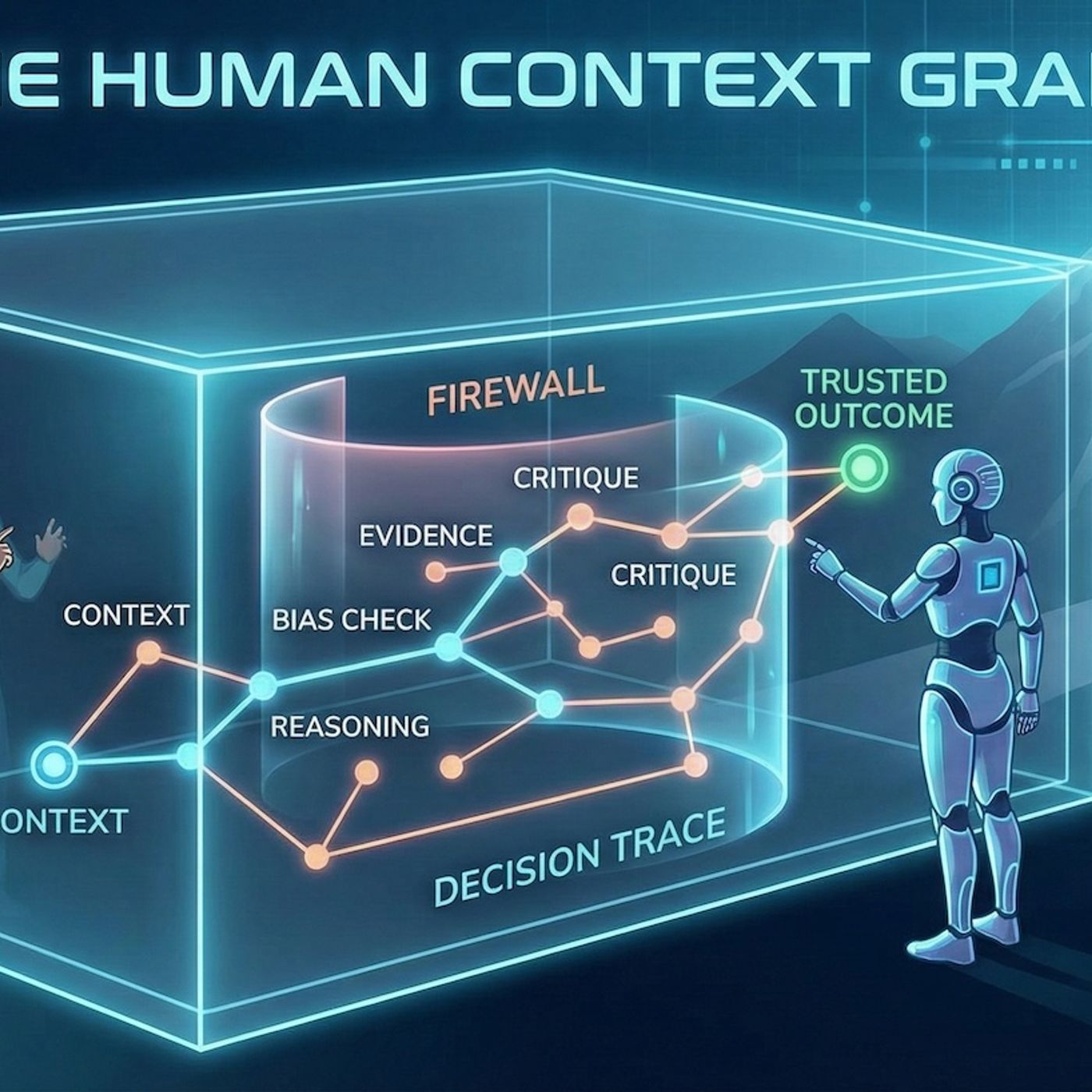
Greg Twemlow explores the critical need for a parallel trust protocol that captures the reasoning process behind decisions made by both humans and machines. He argues that modern software and education systems suffer from a structural flaw by prioritising final outputs while discarding the logic and context that produced them. To address this, Twemlow introduces the Context & Critique Rule™, a framework designed to slow down interactions and foster human agency through a visible decision trace. This human-centric approach mirrors the emerging Context Graph technology in Silicon Valley, which aims to make AI agents more explainable and less brittle. By transforming the "black box" of technology into a "glass box" of transparency, we can audit cognitive biases and ensure accountability. Ultimately, the source suggests that the true value in an AI-driven world lies in understanding the path to a conclusion rather than just the result itself. Read the article.About the Author - Greg Twemlow writes and teaches at the intersection of technology, education, and human judgment. He works with educators and businesses to make AI explainable and assessable in classrooms and boardrooms — to ensure AI users show their process and own their decisions. His cognition protocol, the Context & Critique Rule™, is built on a three-step process: Evidence → Cognition → Discernment — a bridge from what’s scattered to what’s chosen. Context & Critique → Accountable AI™. © 2025 Greg Twemlow. “Context & Critique → Accountable AI” and “Context & Critique Rule” are unregistered trademarks (™).

Greg Twemlow argues that relying on pre-written prompt libraries is an ineffective AI strategy because it prioritises increased output over genuine human cognition. He suggests that simply distributing instructions leads to organisational drift, where the volume of content grows while shared judgment and quality standards decline. To combat this, he proposes the Context & Critique Rule, a discipline that ensures users maintain intellectual ownership by establishing context and applying rigorous evaluation before adopting AI results. His leadership briefing aims to shift organisations from mere tool adoption toward cognitive coherence, ensuring that AI use is grounded in transparent thinking rather than hollow automation. Ultimately, the goal is to foster shared mental frameworks that preserve integrity and professional standards as artificial intelligence scales. Read the article.About the Author - Greg Twemlow writes and teaches at the intersection of technology, education, and human judgment. He works with educators and businesses to make AI explainable and assessable in classrooms and boardrooms — to ensure AI users show their process and own their decisions. His cognition protocol, the Context & Critique Rule™, is built on a three-step process: Evidence → Cognition → Discernment — a bridge from what’s scattered to what’s chosen. Context & Critique → Accountable AI™. © 2025 Greg Twemlow. “Context & Critique → Accountable AI” and “Context & Critique Rule” are unregistered trademarks (™).

Greg Twemlow introduces the Context & Critique SI Library™, a structured framework designed to move beyond shallow AI interactions by enforcing a rigorous "Context → Draft → Critique → Revise" loop. This system utilizes a stable Core System Instruction alongside modular "Module Cards" to ensure that human judgment and accountability remain central to the creative process. By categorising work through specific modes, stakes, and phases, the library helps users maintain transparency and traceability in their decision-making. A key feature, the "Wall" threshold, acts as a final integrity check to guarantee that any shared output is credible and reflects the author’s authentic voice. Ultimately, the methodology seeks to transform AI from a simple search tool into a legible and professional partner for educators and leaders alike. This approach ensures that technological efficiency does not come at the expense of intellectual ownership or critical thinking. Read the article.About the Author - Greg Twemlow writes and teaches at the intersection of technology, education, and human judgment. He works with educators and businesses to make AI explainable and assessable in classrooms and boardrooms — to ensure AI users show their process and own their decisions. His cognition protocol, the Context & Critique Rule™, is built on a three-step process: Evidence → Cognition → Discernment — a bridge from what’s scattered to what’s chosen. Context & Critique → Accountable AI™. © 2025 Greg Twemlow. “Context & Critique → Accountable AI” and “Context & Critique Rule” are unregistered trademarks (™).

Greg Twemlow explores the essential role of structured methodology in safeguarding human meaning and authorship against the rapid, machine-driven pace of artificial intelligence. He draws a striking parallel between the rule-bound techniques of 4,000-year-old Texas rock art and the modern need for cognitive protocols to navigate the widespread diffusion of AI. By comparing ancient artistic consistency to contemporary system instructions, the author argues that repeatable sequences and human-scaled rhythms are vital for preserving judgment over mere speed. His IB137 framework serves as a modern scaffold, offering a disciplined thinking process that prevents automated fluency from replacing genuine individual discernment. Ultimately, the text asserts that as technology becomes ambient, humans must adopt a rigorous "seamanship" of the mind to maintain agency and prevent their decisions from being outsourced to algorithms. Read the article.About the Author - Greg Twemlow writes and teaches at the intersection of technology, education, and human judgment. He works with educators and businesses to make AI explainable and assessable in classrooms and boardrooms — to ensure AI users show their process and own their decisions. His cognition protocol, the Context & Critique Rule™, is built on a three-step process: Evidence → Cognition → Discernment — a bridge from what’s scattered to what’s chosen. Context & Critique → Accountable AI™. © 2025 Greg Twemlow. “Context & Critique → Accountable AI” and “Context & Critique Rule” are unregistered trademarks (™).

In this creative narrative, author Greg Twemlow imagines a meeting in Havana with Thomas Hudson, the protagonist of Ernest Hemingway’s posthumous novel Islands in the Stream. Their conversation serves as a vehicle to explore Twemlow’s Earth Mother Manifesto, which posits that modern humanity suffers from a profound sense of civilisational orphanhood due to its detachment from the natural world. By pairing his philosophy with Hudson’s stoic grief, the author argues that we have mistakenly traded a sacred connection to nature for mere resource extraction. The dialogue emphasises that the environment is a sovereign divinity rather than a property to be owned, suggesting that our current loneliness stems from this spiritual severance. Ultimately, the text uses this fictional encounter to advocate for a new theology that recognises nature’s indifference and our own inherent smallness within the global ecosystem. Read the article.About the Author - Greg Twemlow writes and teaches at the intersection of technology, education, and human judgment. He works with educators and businesses to make AI explainable and assessable in classrooms and boardrooms — to ensure AI users show their process and own their decisions. His cognition protocol, the Context & Critique Rule™, is built on a three-step process: Evidence → Cognition → Discernment — a bridge from what’s scattered to what’s chosen. Context & Critique → Accountable AI™. © 2025 Greg Twemlow. “Context & Critique → Accountable AI” and “Context & Critique Rule” are unregistered trademarks (™).

Greg Twemlow argues that the dominance of major retail aggregators like Amazon is being threatened by the rise of AI buying agents. These autonomous bots allow consumers to engage in "headless" commerce, bypassing traditional digital storefronts to purchase goods directly from manufacturer databases. While this shift eliminates the "middleman tax" and restores brand sovereignty, it removes the trust layer and logistical efficiency provided by large platforms. The author suggests that smart contracts will likely replace traditional consumer protections, though the push for direct-to-consumer shipping may lead to increased environmental costs. Ultimately, the friction of manual checkout is the only remaining barrier protecting current e-commerce giants from total algorithmic disintermediation. Read the article.About the Author - Greg Twemlow writes and teaches at the intersection of technology, education, and human judgment. He works with educators and businesses to make AI explainable and assessable in classrooms and boardrooms — to ensure AI users show their process and own their decisions. His cognition protocol, the Context & Critique Rule™, is built on a three-step process: Evidence → Cognition → Discernment — a bridge from what’s scattered to what’s chosen. Context & Critique → Accountable AI™. © 2025 Greg Twemlow. “Context & Critique → Accountable AI” and “Context & Critique Rule” are unregistered trademarks (™).

Comments

Download from Google Play

Download from App Store
 United States