


 Claim Ownership
Insight World Podcast
Subscribed: 0Played: 5
Subscribe

© Insight World
Description
5 Episodes
Reverse

This is a public episode. If you would like to discuss this with other subscribers or get access to bonus episodes, visit 1insightworld.substack.com

What happens when energy and climate reshape global power? In this audiobook summary of The New Map by Daniel Yergin, we explore the clash of nations over oil, gas, and renewables. From Iran’s defiance in the Strait of Hormuz to Saudi Arabia’s Vision 2030 and China’s renewable surge, uncover the forces driving the Middle East and beyond. 🎧 🔴 Subscribe: https://www.youtube.com/@1InsightWorld?sub_confirmation=1 💬 Comment: How will your country navigate this new energy map? 📱 Follow us on X: https://x.com/1InsightWorld #Geopolitics #Energy #Audiobook This is a public episode. If you would like to discuss this with other subscribers or get access to bonus episodes, visit 1insightworld.substack.com

This is a public episode. If you would like to discuss this with other subscribers or get access to bonus episodes, visit 1insightworld.substack.com
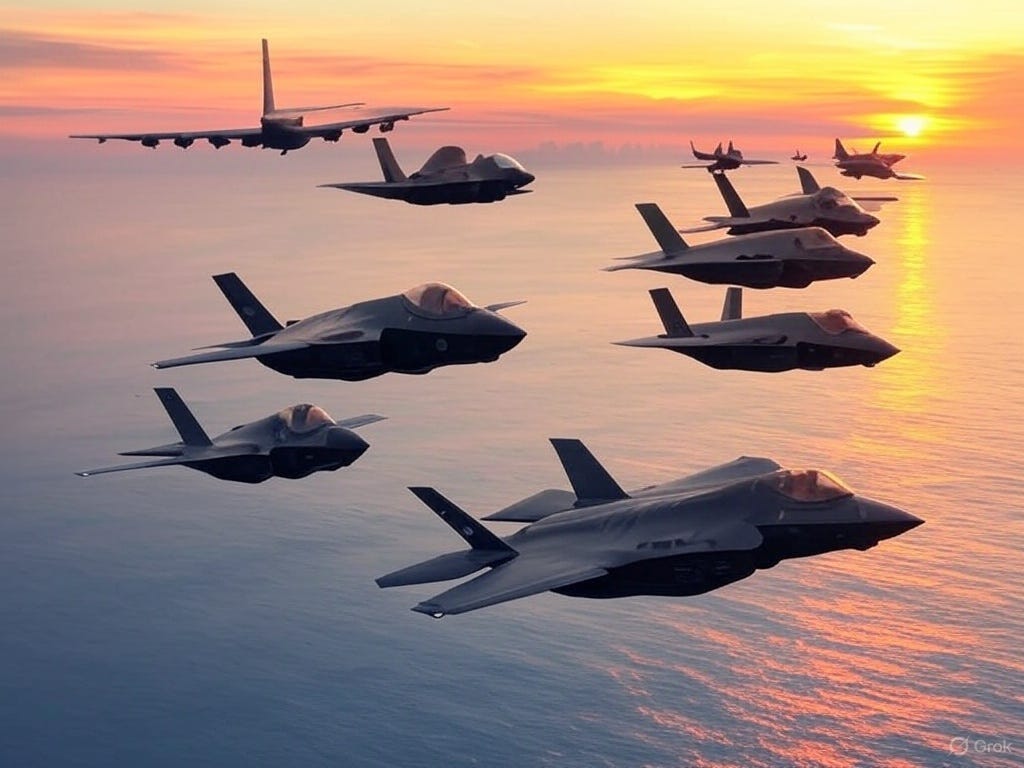
**Published: March 6, 2025**Last week, the Mediterranean Sea bore witness to one of the most significant military events in recent years: a joint air exercise between Israel and the United States, marking the resumption of high-profile strategic cooperation after a two-year hiatus. Featuring dozens of advanced fighter jets, strategic B-52 bombers, and aerial refueling tankers, this maneuver was not only a technical and logistical feat but also carried profound military and political implications in a region fraught with tension. In this article, we delve into the details of the exercise—from equipment types and troop numbers to its military and political objectives—offering a comprehensive analysis. Was this a routine drill, or a signal of readiness for an imminent confrontation, particularly with Iran?Thanks for reading! Subscribe for free to receive new posts and support my work. Strategic Context: Why Now?The joint Israel-US exercise, conducted in late February or early March 2025 (last week relative to the current date), unfolded against a backdrop of persistent Middle Eastern volatility. Since Hamas’s October 7, 2023, attack on Israel and the ensuing Gaza war, overt military collaboration between Israel and the US had been somewhat sidelined by operational priorities and crisis management. However, with the Gaza conflict relatively subsiding and strategic priorities shifting, the two powers have once again showcased their military prowess.The timing aligns with intensified high-level political and military dialogues. A recent phone call between US Defense Secretary Pete Hegseth and Israeli Defense Minister Yisrael Katz underscored the need for close cooperation to counter regional threats, notably from Iran. Additionally, internal shifts within the Israeli military—such as the resignation of Chief of Staff Herzi Halevi and the appointment of Eyal Zamir on March 5, 2025—may have spurred Tel Aviv to demonstrate strength and stability.Politically, the potential return of Donald Trump to the White House in January 2025 (assuming a November 2024 election victory) casts a shadow over this exercise. A more aggressive US stance toward Iran under a new administration could set the stage for heightened military pressure on Tehran, making this drill a possible precursor to such a policy shift. Military Details of the Exercise Location and DurationThe exercise took place over the Mediterranean Sea, likely extending into Israeli airspace. The Mediterranean’s strategic location—bridging Europe, North Africa, and the Middle East—makes it a perennial choice for such joint maneuvers. Based on patterns from previous exercises like Juniper Oak in January 2023, the operation likely spanned 3 to 7 days. Assuming it began in late February (around February 26 to March 4), this timeframe aligns with initial reports of a “last week” exercise. Equipment and ArmamentReports from media and social media posts indicate the deployment of some of the most advanced military assets:- **Fighter Jets**: Dozens of fighters participated, likely including the F-35 Lightning II (stealth-capable), F-15 Eagle, and F-16 Fighting Falcon from both the Israeli Air Force (IAF) and US Air Force (USAF). The F-35, with its stealth and precision strike capabilities, is a cornerstone of modern air operations.- **Bombers**: Strategic B-52 Stratofortress bombers, deployed from US bases in Europe or the Middle East, were a highlight. With a range exceeding 14,000 kilometers and a payload capacity of 32 tons, the B-52 symbolizes long-range strike power.- **Tankers**: Aerial refueling aircraft, such as the KC-135 Stratotanker or KC-46 Pegasus, supported extended missions. These assets are critical for simulating operations requiring significant range, like strikes on distant targets.- **Other Assets**: Reconnaissance aircraft (e.g., E-3 Sentry AWACS) and command-and-control systems may have been involved, though initial reports did not confirm their presence. Troop NumbersExact personnel figures remain undisclosed, but given the “large-scale” nature described, estimates range from 1,000 to 7,000 troops. For context, Juniper Oak 2023 involved 6,400 US and 1,100 Israeli personnel, including pilots, technicians, and logistics staff managing complex operations like mid-air refueling. Scenarios and DrillsThe exercise encompassed multiple operational scenarios:- **Joint Strikes**: Fighters and bombers conducted simulated attacks on hypothetical sea and land targets, testing deep-strike capabilities.- **Aerial Refueling**: A key component, refueling drills enabled long-range mission simulations, critical for operations beyond Israel’s immediate vicinity.- **Air Defense and Interception**: Scenarios likely included intercepting enemy aircraft or missiles, enhancing defensive coordination. Military and Political Objectives Military GoalsFrom a military perspective, the exercise pursued several aims:1. **Interoperability**: Strengthening IAF-USAF coordination for joint wartime missions, including real-time data sharing and synchronized strikes.2. **Long-Range Operations**: The presence of B-52s and tankers suggests a focus on missions targeting distant objectives, potentially simulating strikes on Iran.3. **Advanced Systems Testing**: Deploying F-35s and other cutting-edge platforms tested stealth, precision, and resilience against electronic warfare. Political GoalsPolitically, the exercise sent multifaceted messages:1. **Warning to Iran**: Amid ongoing tensions over Iran’s nuclear program and proxy activities (e.g., Hezbollah, Houthis), the drill signaled readiness for military action. The B-52’s nuclear-capable status (though likely carrying conventional munitions here) amplified this message.2. **Alliance Reaffirmation**: It reaffirmed US commitment to Israel’s security, countering criticisms of Tel Aviv’s Gaza policies in some Washington circles.3. **Regional Influence**: Gulf Arab states like the UAE and Bahrain, warming to Israel, may view this as bolstering a broader anti-Iran coalition. Technical Analysis: Capabilities and Limitations F-35’s RoleThe F-35, a fifth-generation stealth fighter, likely played a central role. Capable of carrying air-to-ground missiles like the JSM and GBU-39 bombs, it excels at penetrating advanced air defenses. Its 2,200-kilometer range (without refueling) and 8-ton payload make it ideal for precision strikes, though it relies on tankers for extended missions and incurs high maintenance costs (around $35,000 per flight hour).### B-52: Strategic PowerhouseThe B-52, a Cold War-era bomber modernized for contemporary use, offers unmatched range and payload. Armed with AGM-86 cruise missiles (2,400-kilometer range) or JDAM bombs, it can strike from afar. However, its vulnerability to modern air defenses (e.g., Iran’s S-300) necessitates fighter escorts and electronic countermeasures, likely rehearsed here. Aerial Refueling: Long-Range EnablerTankers like the KC-135 (carrying 90 tons of fuel) were pivotal, enabling sustained operations. Refueling drills, possibly under adverse conditions, tested pilot skill and inter-unit coordination, critical for missions spanning 1,800 kilometers—like a potential strike on Tehran. Scenario: Strike on IranA likely scenario was simulating an attack on Iran’s nuclear or missile sites. With Tehran’s uranium enrichment advancing (per IAEA February 2025 reports), this drill may have targeted:- **Targets**: Natanz, Fordow, or western missile bases.- **Route**: Flights from Israel or US Gulf bases, possibly via Jordan or Iraq.- **Tactics**: F-35s penetrating defenses, supported by B-52 missile strikes.Iran’s S-300 and Bavar-373 systems pose challenges, requiring precise execution and potentially triggering a retaliatory barrage. Scenario: Defense Against HezbollahAnother scenario may have focused on countering Hezbollah’s missile and drone threats from Lebanon. Since the Gaza war, Hezbollah has launched over 10,000 projectiles, menacing Israel’s north:- **Targets**: Intercepting short-range ballistic missiles and suicide drones.- **Tactics**: F-15s and F-16s patrolling, coordinated with Iron Dome and Arrow-3 defenses.- **US Role**: AWACS providing early warning.This bolsters Israel’s confidence in US support amid escalation risks. Scenario: Regional DeterrenceA third possibility was a “flag-showing” operation to deter Iran, Syria, and even Russia (with its Mediterranean presence), discouraging provocations through a display of overwhelming force. Challenges and Constraints Logistical Hurdles- **International Coordination**: Flights over the Mediterranean required cooperation with nations like Cyprus, Greece, and Turkey, complicated by Ankara’s tensions with Israel.- **Costs**: High operational expenses (e.g., $70,000 per B-52 flight hour) reflect significant investment.- **Weather**: Late winter storms could have disrupted operations. Political Limits- **Allied Reactions**: Jordan might resist overflights if perceived as prelude to an Iran strike.- **US Domestic Pressure**: Progressive factions may decry the drill as belligerent, pressuring the administration. Regional Impact Iran’s Likely ResponseIran, an implicit target, may retaliate with:- **Missile Drills**: Firing ballistic missiles like Sejjil or Khorramshahr to showcase deterrence.- **Proxy Escalation**: Arming Hezbollah with advanced weapons like Fateh-110 missiles.- **Diplomatic Push**: Condemning the exercise internationally, seeking Russian and Chinese backing. Arab States: Balancing ActGulf nations like Saudi Arabia and the UAE may quietly welcome the pressure on Iran but adopt cautious public stances to avoid Tehran’s ire. Russia: Silent PlayerRussia, with bases in Syria (Tartus, Hmeimim), likely monitored closely. While silent so far, it may bolster its Mediterranean presence to counterbalance. Future of Israel-US Military TiesThis exercise underscores the deepening

The Tariff Tug-of-War: What Trump’s Second Term Means for U.S. and Canadian Economies This is a public episode. If you would like to discuss this with other subscribers or get access to bonus episodes, visit 1insightworld.substack.com
Comments

Download from Google Play

Download from App Store
 United States