


 Claim Ownership
The Pieces AI productivity podcast
Subscribed: 1Played: 0
Subscribe

© Pieces for Developers
Description
Interviews with world-class AI experts discussing topics including:
- How AI makes them or their customers more productive
- Future trends in AI
- The real world experiences of experts getting hands on with AI to solve real problems
https://pieces.app
- How AI makes them or their customers more productive
- Future trends in AI
- The real world experiences of experts getting hands on with AI to solve real problems
https://pieces.app
10 Episodes
Reverse
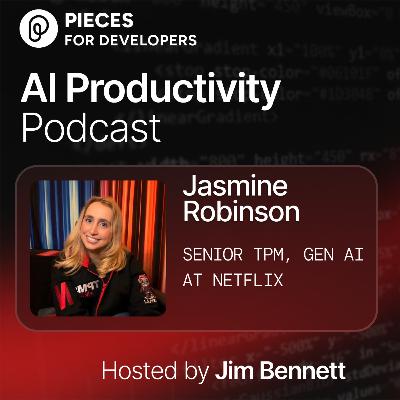
Welcome to the Pieces AI productivity podcast, where we dig into how experts use AI to be more productive, as well as geeking out in general on different AI topics.📽️ In this episode, Jim is joined by Jasmine Robinson, a Senior TPM for GenAI at Netflix, and a self-confessed AI fangirl. Jasmine talks in depth about why she’s so bullish about AI, from discovering tools like ChatGPT and GitHub copilot 2 years ago, to leading the charge to get these tools established in the Netflix developer workflows. She talks about the way she uses AI to boost her productivity, with it automating the boring tasks.She also has analyzed the developers she works with and has categorized them by their feeling towards AI. Jasmine also talks about how chatbots can change the way we interact with media like this podcast, books, meetings and more, as well as concluding that AI won’t replace software developers any time soon because the AI companies are still hiring!🌐 Links:Connect with Jasmin on LinkedInJasmine’s blogGenAI secret sauce👉 Try Pieces for free: https://pieces.app💡 Learn more about Pieces features: https://pieces.app/featuresConnect with Pieces:X: https://x.com/getpiecesBluesky: https://bsky.app/profile/getpieces.bsky.socialLinkedIn: https://www.linkedin.com/company/getpieces/Instagram: https://www.instagram.com/getpieces/Discord: https://pieces.app/discordIn this episode:0:00:00 - Intro0:02:56 - Why Jasmine is so excited about AI0:03:36 - Developers are safe from AI as OpenAI and Anthropic are still hiring0:05:31 - Automating knowledge mining with AI from meetings or websites0:17:36 - LARPing through books with AI generated chat or game experiences0:20:32 - Using AI to practice difficult conversations0:25:44 - AI is democratizing development, especially to help vibe coders0:29:44 - AI to help developer education, and it’s not just Clippy!0:32:46 - What percentage of developers are pro vs anti AI and to what level0:46:36 - What would Jasmine do if she could automate everything?

Welcome to the Pieces AI productivity podcast, where we dig into how experts use AI to be more productive, as well as geeking out in general on different AI topics.🧠 🤖 In todays episode, Jim is joined by Jen Fox, who works on Human-AI interaction at Microsoft. Jen gives an overview of her backstory in particle physics, and why she loves being an educator. Jen then talks about the Core AI team at Microsoft, how to consolidate enthusiasm for AI with a passion for stopping climate change. Finally Jen teaches Jim all about the work she’s doing on human-AI interaction, diving into what jobs AI can do, and what jobs humans should do as caretakers, along with how AI helps under-resourced folks scale quickly.🌐 Links:Connect with Jen on LinkedInFollow Jen on BlueskyFollow Jen on InstagramBuy Jen’s book on breadboardingWatch Jen’s content on YouTubeJen’s projects on Hackster👉 Try Pieces for free: https://pieces.app💡 Learn more about Pieces features: https://pieces.app/featuresConnect with Pieces:X: https://x.com/getpiecesBluesky: https://bsky.app/profile/getpieces.bsky.socialLinkedIn: https://www.linkedin.com/company/getpieces/Instagram: https://www.instagram.com/getpieces/Discord: https://pieces.app/discordIn this episode:0:00:00 - Intro0:01:54 - Jen’s back story and why she loves educating folks0:05:36 - The Core AI team at Microsoft0:07:12 - AI, climate change, and how tech companies are turning to nuclear0:13:51 - Human AI interaction, and how AI unlocks different ways to interact with a computer0:23:20 - Can AI replace human empathy?0:31:20 - How AI can help under-resourced groups by enabling scale0:38:43 - Humans as caretakers, and what humans can do that AI cannot
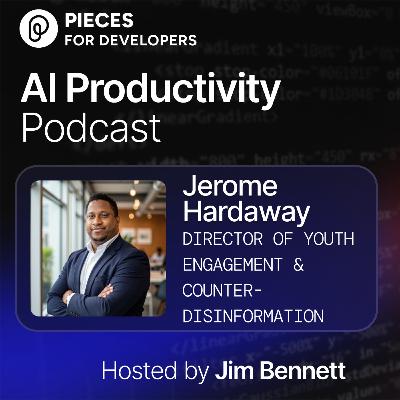
Welcome to the Pieces AI productivity podcast, where we dig into how experts use AI to be more productive, as well as geeking out in general on different AI topics.⚖️ In todays episode, Jim talks to Jerome Hardaway, director of youth engagement and counter-disinformation at Civic Influencers. Jerome is using a range of AI tools to detect mis- and disinformation in online content, and help young people in the 18-29 demographic get access to factual information to help them make informed choices as they engage with politics, rather than follow the opinions of influencers who may be intentionally spreading disinformation.Jerome discusses how young people get their information and viewpoints from social media, rather than traditional news sources, trusting people due to having similar tastes in food, clothing, or technology, rather than trusting more reputable sources and doing factual research. Jerome talks about how he uses AI to sport patterns, and literally sees trends in data spiking from events in popular culture, such as how an episode of love is blind can cause young people to discuss if it is ok to lie to a partner about who you are.🌐 Links:Connect with Jerome on LinkedInFollow Jerome on BlueskyCivic InfluencersVets who code👉 Try Pieces for free: https://pieces.app💡 Learn more about Pieces features: https://pieces.app/featuresConnect with Pieces:X: https://x.com/getpiecesBluesky: https://bsky.app/profile/getpieces.bsky.socialLinkedIn: https://www.linkedin.com/company/getpieces/Instagram: https://www.instagram.com/getpieces/Discord: https://pieces.app/discordIn this episode:0:00:00 - Intro0:01:29 - Misinformation and Disinformation on social media0:08:21 - Can AI understand the language used by youth cultures?0:10:29 - How ad data from TikTok is better than research data0:13:59 - Influencers blame their audiences for not doing research, and are happy to spread disinformation for money0:16:38 - Using psy-ops techniques from the CIA to influence people0:22:51 - Youth trusts social media rather than doing basic research0:29:13 - Analyzing viewpoints on acceptable behaviors based off Love is Blind and toxic masculinity0:41:18 - How to bring factual information to social media through overlays or empowering influencers0:52:14 - To spread trust, you need human interaction0:57:38 - What is ‘truth’?1:03:53 - Data tells the story of truth, such as racial discrimination in the US Marine Corps via rules on shaving
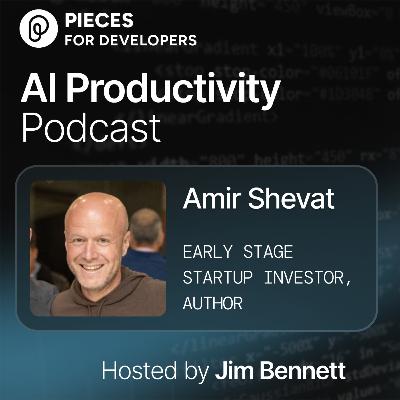
Welcome to the Pieces AI productivity podcast, where we dig into how experts use AI to be more productive, as well as geeking out in general on different AI topics.💰 In todays Episode, Jim talks to Amir Shevat, an early stage startup investor at Darkmode Ventures, an investor in companies like Bluesky, Tessl, and Daytona. Amir has a long history in the tech industry, working at Microsoft, Google, Slack, Twitch, and Twitter, so is well placed to understand the current tech environment and put his money where his mouth is, making small early stage investments in companies. Amir talks about how vibe coding is an interesting idea, and how we need an incentive model for AI tools, rather than guardrails, to guide their behavior.Jim and Amir also chat about organic applications, evolving over time with AI, the importance of platforms as the basis for AI applications, and how AI is as expensive as it will ever be, so investing in AI companies makes sense now as their costs will come way down over time. Amir also shares his take on what types of companies he is interested in investing in.🌐 Links:Connect with Amir on LinkedInFollow Amir on BlueskyDarkmode VenturesBlueskyDaytona👉 Try Pieces for free: https://pieces.app💡 Learn more about Pieces features: https://pieces.app/featuresConnect with Pieces:X: https://x.com/getpiecesBluesky: https://bsky.app/profile/getpieces.bsky.socialLinkedIn: https://www.linkedin.com/company/getpieces/Instagram: https://www.instagram.com/getpieces/Discord: https://pieces.app/discordIn this episode:0:00:00 - Intro0:02:09 - Vibe coding0:05:33 - Running AI code in a sandbox to test your vibe coded applications0:07:29 - Genetic algorithms and organic coding0:09:06 - Incentives not guardrails to guide both AI and people0:11:15 - Social media with the user as the product, and the rise of Bluesky0:18:32 - What Amir looks for when investing in a company0:23:37 - Companies still need someone who understands the domain to drive growth0:26:46 - Ideas that Amir wouldn’t invest in yet0:31:20 - The cost of AI, and how specialised models would help reduce cost
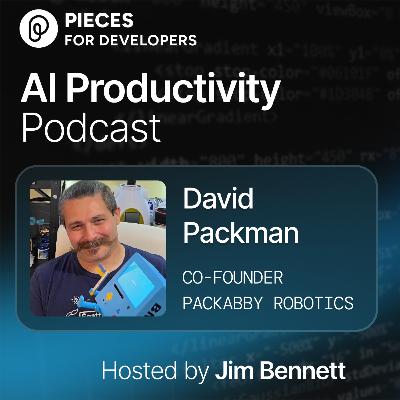
Welcome to the Pieces AI productivity podcast, where we dig into how experts use AI to be more productive, as well as geeking out in general on different AI topics.🤖 In todays episode, Jim is joined by David Packman, the co-founder of Packabby robotics, a company that makes social companion robots powered by AI. Jim and David reminisce on Clippy (it looks like you’re writing a letter), and talk about how AI in particular in cute robots provides a much needed social interaction for people on the spectrum who need a way to practise socializing, or for anyone who wants to talk through something with someone who won’t judge.David also talks about the power of social robots with long-term memory, and how enabling what appears to be simple memories, such as remembering what changes you make to a recipe, can unlock a whole new powerful capability in your robot, just like how the Pieces Long-Term Memory enables a new style of AI prompts to retrieve relevant information for you about your activities.🌐 Links:Packabby RoboticsConnect with David on LinkedInMini Moe on IndiegogoBuild a 3D Printed ClippyInstructions to build Clippy👉 Try Pieces for free: https://pieces.app💡 Learn more about Pieces features: https://pieces.app/featuresConnect with Pieces:X: https://x.com/getpiecesBluesky: https://bsky.app/profile/getpieces.bsky.socialLinkedIn: https://www.linkedin.com/company/getpieces/Instagram: https://www.instagram.com/getpieces/Discord: https://pieces.app/discordIn this episode:0:00:00 - Intro0:01:49 - Why and how David built Clippy0:08:49 - Introducing Mini Moe, a small robot companion0:14:18 - Why humans like interacting with anthropomorphic characters0:24:33 - Using decision trees to handle difficult questions0:32:05 - Whiskas, the cooking robot0:36:42 - Long-Term memory is important for social robots0:42:59 - Get you brown Mini Moe0:46:29 - More on conversational and long-term memory
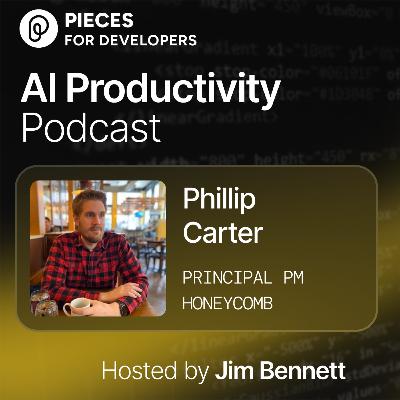
Welcome to the Pieces AI productivity podcast, where we dig into how experts use AI to be more productive, as well as geeking out in general on different AI topics.🔎 In this episode, Jim is joined by Phillip Carter, Principal PM at Honeycomb and observability geek. Phillip talks about observability, and how much of an impact bad observability can have on teams. Jim and Phillip then talk about how AI can try to help with adding observability, and how that really a lot of the time the problems are best solved by humans - as they understand the constraints of systems better than an AI can. For example, can an AI developer tool add the right logging, but if it does will it add too much and cost a fortune on your observability platform side? All this and more in this episode.🌐 Links:Connect with Phillip on LinkedInFollow Phillip on BlueSkyHoneycombOpen Telemetry👉 Try Pieces for free: https://pieces.app💡 Learn more about Pieces features: https://pieces.app/featuresConnect with Pieces:X: https://x.com/getpiecesBluesky: https://bsky.app/profile/getpieces.bsky.socialLinkedIn: https://www.linkedin.com/company/getpieces/Instagram: https://www.instagram.com/getpieces/Discord: https://pieces.app/discordIn this episode:0:00:00 - Intro0:03:38 - Phillips initial thoughts in AI in coding from 20220:04:44 - Can I help spot patterns in observability data0:13:12 - A future where AI can preemptively find incidents0:19:35 - How can AI developer tools help add observability to your code?0:23:51 - AI is great for adding decent logging and metrics to legacy apps0:26:43 - AI doesn’t understand your business context and constraints like cost0:28:22 - AI developer tools lack context of decisions in collaboration tools (unlike Pieces!)0:31:35 - Could AI agents ensure observability is included in your code?0:32:46 - Humans are more important than AI0:37:42 - Adding code to Honeycomb that AI would fail to do right0:42:34 - AI cannot replace junior engineers because where would senior engineers come from?

Welcome to the Pieces AI productivity podcast, where we dig into how experts use AI to be more productive, as well as geeking out in general on different AI topics.💩 In this episode, Jim is joined by Shaundai Person, a senior software engineer in the productivity engineering team at Netflix, described as a colonoscopy org! Shaundai talks about her team and their goals for building a common set of practices for good engineering culture at Netflix, with the main theme being that the number one driver for good productivity is having a good community of humans who are able to support each other, as well as not being afraid to question each other to bring the team up.Jim and Shaundai then dig into AI for productivity. Shaundai is a big AI fan as a tool to help, and describes the Shaundai Hierarchy of Needs for developers - with AI being a part of the pyramid as one of the needs of developers to help them achieve innovation.🌐 Links:Connect with Shaundai on LinkedInFollow Shaundai on BlueSkyShaundai’s YouTube channelFollow Shaundai on TikTokPaved pathsThe Netflix culture memoMaslow’s hierarchy of needs👉 Try Pieces for free: https://pieces.app💡 Learn more about Pieces features: https://pieces.app/featuresConnect with Pieces:X: https://x.com/getpiecesBluesky: https://bsky.app/profile/getpieces.bsky.socialLinkedIn: https://www.linkedin.com/company/getpieces/Instagram: https://www.instagram.com/getpieces/Discord: https://pieces.app/discordIn this episode:0:00:00 - Intro0:03:19 - The colonoscopy org at netflix0:05:58 - The Paved Path in platform engineering0:14:58 - How productivity orgs build a community of humans lifting each other up0:17:48 - Soft skills get you further than tech skills, and Shaundai learned hers in sales0:21:18 - The Netflix culture memo and farming for dissent amongst a larger team0:29:08 - How does AI fit into a human centric tech environment?0:32:28 - Maslow’s hierarchy of needs for a tech environment0:37:33 - To use AI you still have to know the fundamentals0:38:58 - The Shaundai hierarchy of needs, with communication at the bottom0:41:20 - Having and being able to articulate your soft skills is way more important than code0:44:20 - $1,000 to know where to hit the machine with a hammer0:45:15 - AI is good at bringing together data, but can’t innovate. Humans are needed0:48:00 - Can humans tell AI generated content from human? Jim’s kid says no after a science fair project.
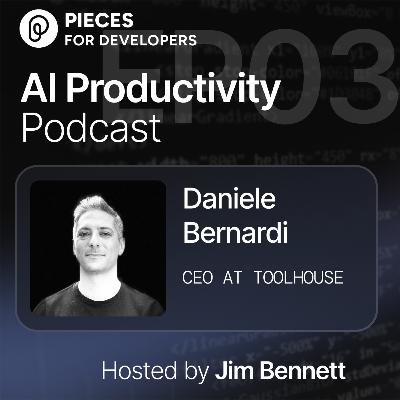
Welcome to the Pieces AI productivity podcast, where we dig into how experts use AI to be more productive, as well as geeking out in general on different AI topics.🇮🇹 We start this episode with a quick Italian lesson, then dive into learning about how developers can be more productive with AI by using Toolhouse to provide all the plumbing and connections their apps need to run tools from AI in only 3 lines of code. Jim and Daniele also discuss the democratization of AI, and how the large US tech companies are focused on large profits, allowing smaller AI companies to lean heavily into the non-US markets and provide better, cheaper LLMs. They also discuss Groq, different models like DeepSeek, and some very interesting ideas for AI apps for first responders.🌐 Links:Connect with Daniele on LinkedInFollow Daniele on BlueSkyToolhouseGroq👉 Try Pieces for free: https://pieces.app💡 Learn more about Pieces features: https://pieces.app/featuresConnect with Pieces:X: https://x.com/getpiecesBluesky: https://bsky.app/profile/getpieces.bsky.socialLinkedIn: https://www.linkedin.com/company/getpieces/Instagram: https://www.instagram.com/getpieces/Discord: https://pieces.app/discordIn this episode:0:00:00 - A quick Italian lesson0:00:22 - Intro to Daniele0:01:05 - Intro to Toolhouse0:05:24 - The complexities of building AI apps and shipping them to production0:07:20 - Toolhouse Prompt Studio0:10:08 - Groq, the Ferrari of LLM hardware makes streaming responses irrelevant0:19:40 - Example Toolhouse apps - AI for first responders, custom newsletters0:25:20 - AI is for everybody, not just the people who can afford the US costs0:40:00 - There is a tech revolution coming so we don’t have countries without AI depending on those that do0:41:20 - Productivity is a small part of AI0:43:30 - Making AI growth sustainable0:47:17 - Do the right thing, and the money will follow
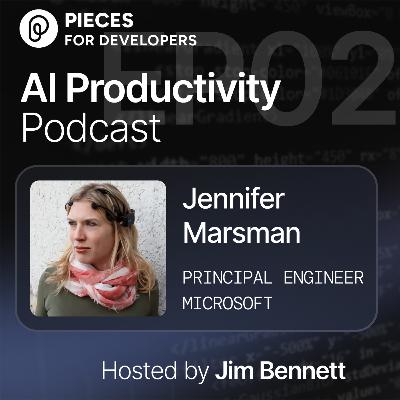
Welcome to the Pieces AI productivity podcast, where we dig into how experts use AI to be more productive, as well as geeking out in general on different AI topics.🇬🇧 In this episode, Jim is at NDC London, and spent some time chatting with Jennifer Marsman, Principal Engineer at Microsoft. They talk about how AI is a great assistant to do the busy work, so you can be creative and in control. They also dive into Phi-4, talk a bit about luddites, and Jennifer shares how AI helps with both bedtime stories, and managing medication for her dog!🌐 Links:Connect with Jennifer on LinkedInFollow Jennifer on XJennifer’s talk at NDC LondonJennifer’s lie detection with ML talk at NDC London 2017WordleGPT:PhiRecyclingPhi-4Textbooks are all you need👉 Try Pieces for free: https://pieces.app💡 Learn more about Pieces features: https://pieces.app/featuresConnect with Pieces:X: https://x.com/getpiecesBluesky: https://bsky.app/profile/getpieces.bsky.socialLinkedIn: https://www.linkedin.com/company/getpieces/Instagram: https://www.instagram.com/getpieces/Discord: https://pieces.app/discordIn this episode:00:00 - Intro01:16 - The ways Jennifer uses AI to be more productive - writing poems and bedtime stories02:14 - Using AI to convert time-based rules into a schedule03:44 - AI is great for busy work, so we can do the fun stuff!04:37 - Jennifer and Jim agree that AI is best as a copilot, not a pilot05:00 - Humans are better than AI at creativity, AI is just a tool07:40 - Not all problems need AI, sometimes code is better11:15 - Phi-4, trained on textbook quality data and runs on device13:30 - Phi-4 for trash sorting16:00 - Phi-4 is available in Pieces! 🎉16:22 - How Phi-4 was trained on synthetic data18:50 - How do engineers gain skills to review AI generated code?
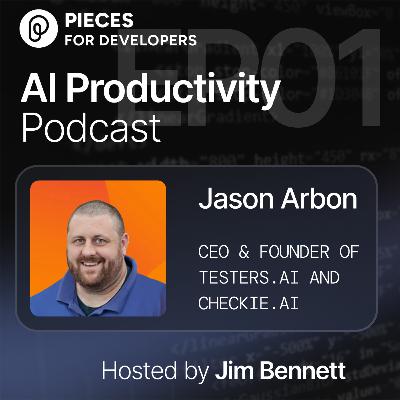
Welcome to the Pieces AI productivity podcast, where we dig into how experts use AI to be more productive, as well as geeking out in general on different AI topics.In this episode, Jim geeks out with Jason Arbon, a tester who has worked on Bing search and Google Chrome. Jason is now the CEO and founder of Testers.ai and Checkie.ai, two services that use AI Agents to test your products.Jim and Jason dive into how AI can make testers more productive, looking at how AI can create user personas and use these to review websites with a higher degree of empathy than humans, how sometimes giving the AI less context is better so it doesn’t hallucinate, and how it’s likely AI will take over all software development in the next 2 years, so we should all make as much money now as possible before the inevitable singularity.🌐 Links:Connect with Jason on LinkedInFollow Jason on XTesters.aiCheckie.ai👉 Try Pieces for free: https://pieces.app💡 Learn more about Pieces features: https://pieces.app/featuresConnect with Pieces:X: https://x.com/getpiecesBluesky: https://bsky.app/profile/getpieces.bsky.socialLinkedIn: https://www.linkedin.com/company/getpieces/Instagram: https://www.instagram.com/getpieces/Discord: https://pieces.app/discordIn this episode we cover:0:00:00 - Intro0:01:00 - Capturing context from everything you do, and how do you use it well?0:03:40 - Humans expectations of AI have gone to infinite0:10:00 - Selling an ATM to a teller, how can you sell AI to folks whose job will be replaced by AI0:11:01 - Is AI better than humans at user empathy? Yes!0:14:20 - Creating user personas with AI and testing your site with them0:21:57 - LLMs can work better if your prompts are less detailed0:26:30 - “What didn’t I think off” as a follow-on prompt0:28:15 - How do we deal with our ego around AI being smarter than us0:30:30 - How will humans learn to review AI generated code if we don’t learn to code as AI does it all0:34:50 - AI generated code, regulatory compliance, and ensuring code quality0:39:55 - Hacks via bad LLM suggestions and validating the responses for security and correctness with multiple LLMs0:47:55 - Human-in-the-loop for quality validation0:49:40 - AI can continuously test, giving faster feedback before, during, and after a sprint0:52:20 - The biggest blocker in testing is waiting for requirements specs, but AI can generate these0:57:36 - Where do humans fit into an AI future?
Comments

Download from Google Play

Download from App Store
 United States