


 Claim Ownership
Masters of Influence
Subscribed: 2Played: 0
Subscribe

© Jeffrey Loehr
Description
Most of the economic/political/social conversation focuses on personalities: do I like them, where do they come from, are they "left" or "right." Instead of name-calling and pigeonholing, we want to understand why some strategies work and others don't. How do some people consolidate power while others are left out in the cold? And what does that mean for us? If you are interested in the world's power plays and how they work - join us.
mastersofinfluence.substack.com
mastersofinfluence.substack.com
30 Episodes
Reverse

For decades, one of America’s quiet superpowers was the boring reliability of government execution. The snowplow didn’t care if you voted Republican or Democrat—it cleared your street either way. The VA processed claims. The IRS answered calls. The EPA enforced regulations consistently, regardless of who appointed the administrator.That neutrality? It’s a feature, not a bug.Political leadership makes decisions. That’s inherently partisan. But once those decisions are made, the machinery of government has to run neutrally, or the whole thing falls apart. You can’t have the snowplow stop at the third house because that’s where the Democrats end and the Republicans begin.Or... can you?The recent government shutdown wasn’t about money. It never is. Shutdowns are about demonstrating who has the power to hurt people and who doesn’t.Trump brushed it off and sent Republicans home for a month. Democrats, just as they were gaining leverage, capitulated. Again (much to our surprise). Say what you want about MAGA—and we will—but they understand power dynamics in a way the Democrats persistently refuse to.But here’s where it gets interesting: out-of-office replies and department websites started promoting partisan talking points during the shutdown. Government channels became campaign literature. This isn’t just norm-breaking—it’s strategic. It’s using the infrastructure of neutral government to consolidate political power.The snowplow is learning to discriminate.Why This Works (And Why It Might Not)Republicans have fully embraced a scorched-earth policy: win at all costs, never compromise, never see the other side as a partner, only as an enemy to be defeated. It hobbles Democrats who still believe in functional government. But it’s also a dangerous game with the potential to backfire. Because people actually like it when the snowplow comes. They notice when it stops.In this episode, we dig into how manufactured crises work, why neutral execution of law matters more than you think, and what happens when one party figures out that cruelty can be a strategy—until it isn’t.Timestamps:* 00:00 Introduction and Casual Conversation* 01:19 ICE Incidents and Government Overreach* 04:02 Government Shutdown and Political Dynamics* 06:42 Partisan Use of Government Shutdown* 11:37 Public Misunderstanding of Government Functions* 15:42 Partisan Manipulation of Government Channels* 23:28 State Media and Social Media Influence* 27:05 The Importance of Historical Context in Decision Making* 28:57 The Erosion of Soft Power* 29:26 Strategies of Political Domination* 30:30 The Republican Party’s Zero-Sum Game* 31:00 The Backfire of Cruel Policies* 32:46 Marjorie Taylor Greene’s Unexpected Stance* 34:37 Inconsistencies in Political Rhetoric* 41:56 Spotting Manufactured Crises* 47:48 Conclusion and Future Speculations Get full access to Masters of Influence at mastersofinfluence.substack.com/subscribe
On Monday (October 20, 2025), the NY Times Editorial Board posted a long, drawn-out analysis desperately claiming that there is a moderate “middle.” They are looking for something that doesn’t exist.That is not to say that there aren’t moderates — there are. In fact, when polled without political bias, Americans tend to agree on what we want. The problem is the attempt to shoehorn a middle between a left and a right that don’t exist anymore.Even more fundamentally, the problem is continuing to use left and right at all. But though they are stuck in their outdated worldview, they do end up making an unintentional argument for a structural change that could make a difference.Actual policies being considered today don’t really fit the left-versus-right mold.* Anti-vax was a fringe left-wing movement until it became a mainstream right-wing movement.* Free trade fits more on the right than the left, tariffs more on the left — but now tariffs are right-wing (while the left pines for free trade).* Law and order were traditionally more right, and the right was incensed regarding commutations by Clinton and Obama, but they are now comfortable with Trump pardoning 1,500 people who stormed the Capitol in 2021.* Obamacare was modeled after the Republican response to the first draft plans.* Typically, something like denying climate change exists is NOT right or left — the data are the data, and the solutions tend to have a right or left tinge to them. While the Republicans have been denying the problem, Democrats have put forth more market-based solutions, which would typically be more rightish.There have been a few left-leaning policies — subsidies for sustainable energy, for example. Certainly, the left has been more in favor of DEI initiatives. But these hardly rise to the level of “extreme leftist positions.”In fact, if anything, the problem with the Democrats is that they haven’t taken a strong stance on liberal issues. Income redistribution, support for labor, and support for social programs fit more toward the left, but the Democrats did nothing on any of these issues.Most of the accusations of “extreme liberalism” are made up. When I ask for examples, I get things like:* Unfettered illegal immigration* Preference for immigrants over citizens* “Hatred” of everything from the military to life itself* Endorsing extreme violence* Socialist policiesSocialism itself is a perfect example of how the way we describe things — and the words we use — are so important. The NY Times says Americans don’t like socialism. But Americans don’t know what socialism means. Socialism is the state owning the means of production. Collecting money and spending it on programs is just government.The policies that we like to call socialist — things like better healthcare, education, and childcare — have broad-based support as long as they aren’t called socialist.Meanwhile, under Trump, the U.S. government took ownership in Intel. Bush led the charge to bail out auto manufacturers. These actually fit the textbook definition of socialism.Okay, you get the picture. If you look at policy today, the Democrats look like the traditional GOP, and the Republicans look like what?As I’ve outlined above, the Republican policies being enacted at the moment, together with the flagrant disregard for the law, personal attacks on political rivals, and ignoring data, are not traditional right-wing policies.Today’s environment isn’t right versus left — it’s bound by reality or driven by the algorithm.The algorithm has an iron grip on politics. All social media channels have an algorithm that determines what content we see. The goal of the algorithm is not to inform or to be fair — it’s to keep us glued to our screens so that we consume more content and therefore ads.The best way to keep people engaged — arguably the only way — is through emotional content. The more emotionally gripping something is, the more outrage it stirs, the bigger the reward on social media.Calling people names, calling them socialists, saying that they prefer immigrants and hate whatever you care about — all have the power to provoke outrage.If you look at the policies and claims I mentioned above, what we are calling “right-wing” is outrage-driven — invented to create outrage and draw people into the movement.Think of the anti-vax movement. What is more emotional:* Your child will get sick and die if they get vaccinated and doctors have been lying about it for decades? Or* Decades of data demonstrate that vaccines are safe?The first statement is false but much more interesting; the second statement is true but boring.The algorithm has now extended far beyond social media to drive content for news outlets (Fox, for example) and even the president, who is more concerned about how something “plays” than what it does for constituents.In this context, the Times article is decidedly boring and level-headed. It is not emotional; it does not excite. It’s factual. It’s just wrong because it falls into the trap of believing math describes politics and drives people to action.It doesn’t.But what it does get very right is that what they call the “center” now rejects both parties.What the Times is calling “moderate” isn’t between the left and the right — it’s the people who are not as tightly controlled by the algorithm. It’s those of us who don’t take social media seriously (or spend any time on it at all).Since most Americans are “in the middle” and we all generally support the same policy ideas (with variation, but not as extreme as claimed), the differentiating factor is the algorithm.This creates a problem: if there are two parties and one party is algorithm-driven without any real policy suggestions and the other is not algorithm-driven, also without any real policy suggestions, what can we do to get back to some semblance of normalcy?We’d need a third party — one that is bound by reality and not algorithm-driven (or as algorithm-driven). So how can a third party challenge the two traditional parties?It can’t.As the system is set up today, it is mathematically impossible for a third party to challenge the two established parties without structural change.That goes back to the power of influence and games, as I talk about here. As much as people may not like the two established parties, voting for a third party amounts to voting for the established party you like the least.So, a third party can’t win unless we break the power lock the two parties have.There are a number of ways to do this… I personally like turning the house into a parliament and having people vote for parties rather than individuals. But , yes, I know, I know, that won’t happen.But there also some simpler alternatives, one of which is ranked choice voting.New York City and the mayor’s race is a perfect example of how this could work. Zohran Mamdani will almost certainly win. The establishment Democrats did not want Mamdani to win, nor did Republicans. In fact, the only people who want Mamdani to win are the people.Without ranked-choice voting, Mamdani almost certainly wouldn’t have won the primary race, but since ranked-choice voting changed the power equation, he did. More on ranked-choice voting here.Whether it is ranked choice voting, a parliamentary house, or something else, we need to have a serious conversation about the real issues in front of us.I think this is why it is so important to understand the drivers of power and what is going on. If we keep looking left and right and mathematically carving out a center, we won’t have a viable country for much longer. Outrage-driven insanity will eventually hit a very painful wall.But if we see who is wielding what power and how the systems are set up — one way or another — I think we have a fighting chance.I hope so anyway. Get full access to Masters of Influence at mastersofinfluence.substack.com/subscribe
There are two things I remember from negotiation 101. The first thing is to focus on needs, not positions. This means that rather than stick unwaveringly to your list of demands, you consider the other side’s needs. Understanding their needs allows you to develop new solutions you hadn’t considered.We even learned to tap our pencils on the table to remind our co-negotiators to remember needs when they get stuck on positions.The second thing I remember is that not considering needs leads to a stalemate and worse outcomes. Positions become war trenches, each side digs in and shoots anybody who ventures into the open.There’s actually a third thing I remember. In one exercise, we had to negotiate for an orange. We were split into groups of two, each with an orange. Those who met their objectives got to leave early and go to the pub (the class was in London), and those who didn’t had to erase the whiteboard or something.Importantly, compromises were not allowed: a half-orange wouldn’t cut it. We needed to meet our objectives completely.So there we sat, glaring at each other over the orange with the conviction that we really should be the ones to get the orange, but without many arguments to convince the other to give it up.The pub beckoned.Somebody tapped a pencil.It seemed futile; we both needed the whole damn orange. But we looked deeper into our briefs and discussed what we needed the orange for. Five minutes later, we were both at the pub.Once we started looking into it together, we realized that one of us could meet our objectives with the entire peel, while the other needed all the fruit. So, we peeled the fruit, divided it into parts, and were out of there.Problem solved.If only congressional leaders were obligated to take negotiation 101, we’d all be a lot better off.Or not, I suppose, since the real problem in this negotiation is the needs themselves: the Republicans want to demonstrate loyalty and commitment to the cause, the Democrats are fighting for political legitimacy.To clarify the Republican position regarding Democratic needs, Trump created an AI video of himself shitting on everybody he doesn’t like. Message sent and, I imagine, received.The Republican strategy, to the extent there is one at all, assumes that the Democratic positions are so out of touch that popular opinion will go against them, and they’ll have to give in.So rather than negotiate, they dig deeper trenches by refusing to come to the negotiating table, offering instead to negotiate after Democrats agree to a deal (an interesting tactic I’m sure we did NOT cover in Negotiations 101), and laying off thousands of federal workers.Democrats, in response, dig into their own trenches and add the position that the government rehire everybody.Given the latest news, they may also insist that the president not tear down the rest of the White House. Maybe they’d go so far as to insist the US government not use its military to threaten its own citizens? Republicans may not be able to stomach that, though.One path forward would have been to come to an agreement and then have the Republicans renege on that agreement. The Democrats would have known they’d renege, but the Republicans could have _pretended_ to agree, and the Democrats could have acted surprised when they reneged.Instead, the Republicans put up a giant middle finger, or, I guess, large amounts of AI-generated excrement, and have generally communicated no interest in living up to any deal they come up with anyway.The Republicans have no incentive to budge because, frankly, they’re getting everything they want, which is apparently chaos and maximum economic damage. They seem almost gleeful about the shutdown.Trump even found a way to sneak some money to a few people, specifically the ones with the guns, presumably so that they wouldn’t storm the Capitol. Again.What’s the path forward? There are two issues that could break the stalemate.The first is air travel. Air Traffic Control will get messy as the already underpaid, understaffed, and overworked air traffic controllers start to suffer hunger pains after not being paid for an extended period. Remember that the biggest travel days of the year are just around the corner, and grounded commercial flights could make not negotiating very uncomfortable.If I were an Air Traffic Controller, I’d call in sick and look for a job.The second issue is healthcare. Premiums are skyrocketing, and people are losing Medicaid, especially in traditional republican strongholds.Both of these issues could force the Republicans to the negotiating table.The positions have been set, trenches dug, and guns aimed; anyone venturing into the no-man’s land of addressing needs will undoubtedly face political assassination. Maybe they could divvy up the orange in a way that meets everyone’s needs, but they’re too focused on winning the orchard to figure it out. Get full access to Masters of Influence at mastersofinfluence.substack.com/subscribe

From the FBI's Most Wanted to Privacy Advocate: They Own YouWhen a former hacker who spent years on the FBI's Most Wanted list teams up with his daughter who started college at 13, the conversation about digital privacy gets real fast. Jesse "Hackah Jak" Tuttle and his daughter Reesë join us for a raw discussion about surveillance capitalism, the death of childhood freedom, and why we're sleepwalking into a Chinese-style social credit system.Jesse's journey from basement hacker to federal intelligence asset to convicted felon reads like a cyberpunk novel - except it's all true. Meanwhile, Reese represents a generation that came of age watching their privacy disappear in real time. Together, they run a cybersecurity company that exposes how scammers operate, but more importantly, they've become unlikely advocates for digital rights in an age when most people have given up the fight.The uncomfortable truth they reveal: We're not just losing our privacy - we're losing our ability to be human. When every mistake is recorded forever and every moment of exploration is surveilled, we create a generation of "sterile character" that never learns to take risks, never develops resilience, and never discovers who they really are.Key Conversations:0:00 - Welcome and introductions02:00 - Jesse's origin story: From dial-up bulletin boards to Code Red virus08:00 - The FBI raid: "I thought you would've been here two weeks ago"15:00 - Becoming a federal informant: When they won't let you confess22:00 - The local vendetta: Four years of house arrest for being inconvenient29:00 - Starting the family cybersecurity business35:00 - The Palantir problem: Why consolidating all data is terrifying42:00 - The Eric Loomis case: When AI decides your prison sentence48:00 - The quantum threat: Why today's encrypted data won't stay private52:00 - Lost childhoods: When cameras end bus floor sliding forever57:00 - Behavioral control and the attention economy1:07:00 - The 47-second attention span apocalypse1:19:00 - What we can actually do about itThe Big Questions:What happens when all your data lives in one place? Jesse breaks down why Palantir's vision of consolidated information is a hacker's dream and a citizen's nightmare. Spoiler: There's no such thing as a system without bad actors.How did we train an entire generation never to pay attention? Reese explains how short-form content literally rewired our brains to avoid cause-and-effect thinking. When Marvel movies become too boring to watch, we have a problem.Why is wanting privacy now considered radical? Both guests argue that the shift from seeing privacy as a right to seeing it as suspicious represents one of the most dangerous cultural changes of our time.Can we actually do anything about it? Their answer involves constitutional amendments, European-style data rights, and something they call "digital self-defense."Most Chilling Moment:Jesse described how the police told him they had all the power, and they'd hound him until he gave in.Most Hopeful Moment:Reese's conviction that her generation can still choose to walk away from the attention economy: "They can't keep making money off of us if we don't let them."The Bottom Line:We're at a crossroads. We can accept the convenience of total surveillance and watch individual agency disappear forever, or we can fight for the right to be imperfect humans who learn through trial and error. But we have to choose soon - because the infrastructure of control is already being built around us.Resources Mentioned:European GDPR regulationsThe Eric Loomis case and COMPAS AI sentencingChina's social credit systemRing camera security issuesQuantum computing threats to encryptionConnect with the Guests:Reese Tuttle runs AP2T Labs, focusing on cybersecurity awareness training and scam prevention. Jesse speaks about his experience as both a reformed hacker and an intelligence asset.This episode contains strong language and discusses themes of government overreach, digital surveillance, and the erosion of privacy rights. This is the real world, so if you can't handle that, find some sand to bury your head in. Listener discretion is advised. Get full access to Masters of Influence at mastersofinfluence.substack.com/subscribe
October 14th, 1962. A U-2 spy plane snaps photos that change everything: Soviet missiles in Cuba, capable of reaching most of the United States within five minutes.For the next 13 days, every decision could end human civilization or save it.Here's what should terrify you: if Kennedy had used the same decision-making process that led to the Bay of Pigs disaster, you wouldn't be reading this. We'd all be radioactive dust.Instead, he did something today's leaders would consider weakness: he deliberately made himself vulnerable to disagreement.When Your General Calls You Neville ChamberlainPicture this: Air Force Chief of Staff Curtis LeMay pounds the table, demands immediate airstrikes on Cuba, then looks Kennedy in the eye and compares him to Neville Chamberlain—the appeaser whose weakness led to World War II.In most administrations, calling the President a coward is career suicide.Kennedy didn't fire LeMay. He didn't shut down the discussion. He thanked him for the assessment.Because after Bay of Pigs, Kennedy had learned something that saved the world: when everyone agrees with you, that's when you should be most terrified.The Process That Prevented ArmageddonKennedy's Cuban Missile Crisis approach was revolutionary:He assigned advisors to argue different positions—whether they believed them or not. Their job was finding flaws, not agreement.He left the room during crucial discussions. The moment Kennedy stepped out, advisors who'd been reluctant to express doubts became brutally honest about military action's risks.He encouraged his own brother to change his mind. Attorney General Robert Kennedy initially said "I think we should take Cuba back." After days of deliberation: "Any action we take against Cuba will lead to nuclear war."If they'd gone with their first instinct—attack—we'd likely have had nuclear war.The Solution Nobody Saw ComingThrough brutal intellectual combat, they found a third option: naval "quarantine" plus diplomatic pressure. Not the military's preferred invasion. Not the doves' "do nothing." Something entirely new that emerged only through systematic disagreement.Behind the scenes, Robert Kennedy conducted secret negotiations. The final deal: Soviets remove missiles in exchange for a public US pledge not to invade Cuba and secret removal of American missiles from Turkey.October 28th: Khrushchev announced withdrawal. Nuclear war avoided.This wasn't luck—it was process.The "Soft Underbelly" StrategyKennedy understood something today's leaders don't: strong leadership requires making yourself vulnerable to disagreement.You need a "hard shell" of core values to handle having a "soft underbelly" that advisors can poke and prod. Kennedy could withstand being called Neville Chamberlain because he knew who he was and what he stood for.Today's leaders have it backwards. Hard shells against disagreement, soft underbellies on values. They can't tolerate challenge because they're not sure what they believe.The Contrast with TodayFast-forward to 2025: The FBI uses polygraph tests to identify employees who said something negative about leadership. Not spies. Dissenters.Forty percent of FBI field offices have lost top agents—purged for conducting legitimate investigations political leadership didn't like.Cabinet meetings are North Korean-style tribute sessions. Press corps filled with loyalists asking softball questions.This is the exact Bay of Pigs dynamic, but on purpose. We know better. We have Kennedy's example. We understand the consequences. And we're choosing groupthink anyway.When Reality Becomes OptionalWe're implementing tariff policies that contradict economic research. Removing vaccine preservatives based on perception, not science. Investigating "weather manipulation" everyone knows doesn't exist.When a reporter questioned the press secretary's economics understanding, she responded: "How dare you question my understanding?"But questioning is literally the job. If you can't handle scrutiny, you don't belong in leadership.The Architecture of DisasterKennedy learned hard lessons in Cuba's swamps, paid with 1,400 lives, then used that knowledge to prevent nuclear war.We're learning nothing.We're systematically recreating disaster conditions:Purging competent advisors who might disagreeElevating loyalty over truthTreating dissent as betrayalCreating echo chambers where bad ideas go unchallengedKennedy's job wasn't being liked—it was making good decisions. Good decisions require honest advisors willing to tell uncomfortable truths.What You Can DoIn meetings: Ask "What could go wrong?" when everyone's nodding. Be the devil's advocate.As a manager: Create processes encouraging disagreement. Assign people to argue against your preferred option. Leave the room so people can speak freely.As a citizen: Demand leaders who surround themselves with people smarter than they are. Be suspicious of politicians hiring only loyalists.Most importantly: Being right matters less than getting it right. Changing your mind isn't weakness—it's wisdom.The StakesKennedy's transformation created architecture that worked for decades. We're dismantling it deliberately.When you silence dissent, you don't eliminate bad news—you ensure you won't hear it until it's too late. When you demand loyalty over competence, you get yes-men while the world burns.The question isn't whether catastrophic failures will come. It's whether we'll learn in time.Because in our interconnected world, the next disaster might not offer the luxury of learning from mistakes.Remember: When everyone agrees with you, you should be most afraid of what you're not hearing.Where do you see groupthink in your world? How do you encourage productive dissent? Hit reply—I read every response.Based on our latest Masters of Influence podcast episode about how 13 days of systematic disagreement saved civilization. Get full access to Masters of Influence at mastersofinfluence.substack.com/subscribe
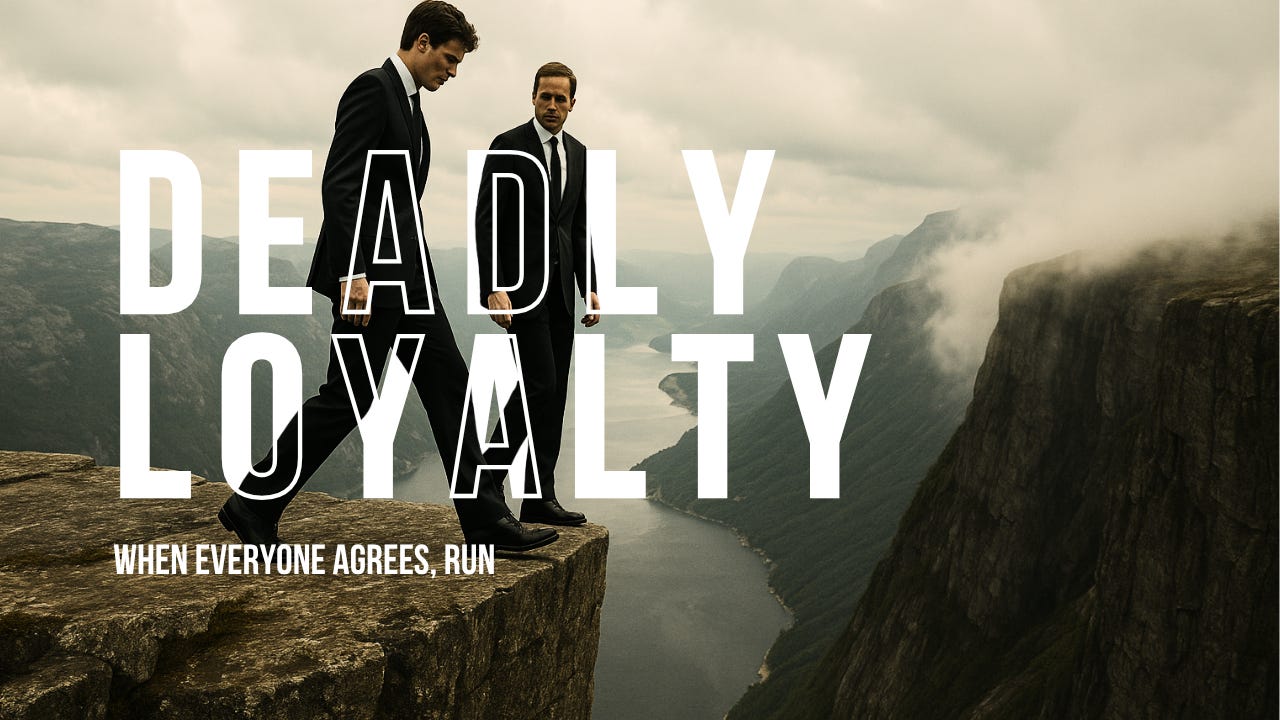
What happens when loyalty becomes more important than truth? When agreeing with the boss matters more than being right? In this episode, we dive deep into one of the most dangerous forces in leadership and decision-making: the crushing pressure for conformity that silences dissent and leads to catastrophic decisions.While the FBI now uses polygraph tests to root out employees who might dare to criticize leadership (yes, really), we explore how this same toxic loyalty nearly triggered nuclear war 60 years ago—and what one president learned that might have saved civilization itself.The Bay of Pigs: When Smart People Make the Worst Possible DecisionsPicture this: April 17th, 1961. 1,400 Cuban exiles stormed the beaches at the Bay of Pigs in what became one of the most spectacular foreign policy disasters in American history. But here's the kicker—President Kennedy didn't really want to do it. His advisors had serious doubts. So why did it happen anyway?The answer reveals a terrifying truth about human psychology: when everyone appears to agree, catastrophe follows. Kennedy's advisors each thought everyone else supported the invasion, so they kept their mouths shut. The result? A "consensus" that was completely fake, leading to a decision that strengthened Castro, humiliated America, and cost us $53 million in ransom money (in 1961 dollars, no less).Enter Irving Janis and the Birth of "Groupthink"Ten years later, Yale psychologist Irving Janis gave this phenomenon a name that's now part of everyday conversation: groupthink. His research revealed how groups of intelligent people consistently arrive at the worst possible answers—not just bad decisions, but spectacularly catastrophic ones.From Pearl Harbor to Vietnam to the Spanish Inquisition (yes, we go there), the pattern is always the same: loyalty to the group becomes the highest form of morality, dissent gets crushed, and disasters follow like clockwork.Kennedy's Radical Solution: Making Leadership HarderAfter the Bay of Pigs humiliation, Kennedy did something revolutionary. Instead of demanding more loyalty, he systematically dismantled the very consensus-seeking that had led him astray. His changes weren't small tweaks—they were a complete reimagining of presidential decision-making:* Actively invited dissenting opinions (radical concept, right?)* Institutionalized the role of devil's advocate for major decisions* Removed himself from meetings so advisors could speak freely* Split large groups into smaller ones to avoid conformity pressure* Expanded his circle of advisors beyond the usual suspectsKennedy was deliberately making his job harder, creating conflict and disagreement because he understood that comfortable consensus was the enemy of good decisions.The Ultimate Test: 18 Months LaterThese changes weren't just academic exercises. Eighteen months after the Bay of Pigs, the world teetered on the brink of nuclear war during the Cuban Missile Crisis. Kennedy's new approach to decision-making—his willingness to hear dissent, challenge assumptions, and resist the pressure for fake unity—might have been the only thing that saved us all from becoming radioactive slag.Why This Matters TodayToday's FBI is using polygraphs to identify employees who might say something negative about leadership. Cabinet meetings have devolved into tribute-paying sessions that would make authoritarian regimes blush. The symptoms are all there: the illusion of unanimity, pressure on dissenters to conform, and "mind guards" protecting leadership from uncomfortable truths.We've seen this movie before. We know how it ends.The Hard Truth About LeadershipReal leadership isn't about surrounding yourself with people who agree with you—it's about having the integrity and values to withstand disagreement. As our co-host Joe puts it, you need a "hard shell" to handle the poking and prodding of dissent. Without that core strength, you become "all soft underbelly"—weak, reactive, and ultimately dangerous.When your identity depends on being right all the time, when criticism feels like a personal attack, when loyalty matters more than truth—that's when disasters happen. Every. Single. Time.Coming Up Next EpisodeIn two weeks, we'll explore how Kennedy's reformed decision-making process was put to the ultimate test during the Cuban Missile Crisis. Spoiler alert: we're all still here to talk about it.Key Timestamps:* 0:00 Welcome & The FBI's Loyalty Tests* 8:00 Bay of Pigs: The Disaster That Changed Everything* 19:00 Irving Janis and the Science of Groupthink* 34:00 Kennedy's Revolutionary Response* 50:00 Why Integrity Beats Confidence Every Time* 58:00 The Lessons We're Ignoring TodayJoin the Conversation: Where do you see groupthink in your world? Have you taken steps to avoid it? How do we counter groupthink in the social media era? Let us know your thoughts—we might discuss them next time.Remember: When everyone agrees with you, that's when you should be most worried. Get full access to Masters of Influence at mastersofinfluence.substack.com/subscribe
The AI Surveillance State Is Here(Carole Cadwalladr's Substack is here: https://broligarchy.substack.com/)Bottom Line: Peter Thiel's company Palantir is building a massive government surveillance system using your tax dollars—and it's already operational.The Numbers$billions in in active government contracts$257 million ICE contract to track people using "hundreds of data categories" from FBI, CIA, DEA, ATF, IRSWhat They're BuildingCollection: Everything you do creates data—your car, doorbell, Alexa, purchases, DNA tests, facial recognition, social mediaAnalysis: AI combines all this data to predict and flag "suspicious" behaviorEnforcement: Real-time tracking, social credit scoring, automated policing decisionsThe China PreviewA journalist tested China's system: arrived undercover, removed disguise, found in 7 minutes. Their AI now flags people for using WhatsApp, growing beards, or having the "wrong" emotions.It's Already HereEric Loomis got 6 years in prison for resisting arrest based on AI recommendation (normally a fine)Citizens having social media searched at borders71% of deportees are actually legal residentsDOGE + Palantir = Total surveillance capabilityThe Real ProblemEven legal behavior looks suspicious out of context. My mom buying Hitler biography books triggered Amazon's algorithm to suggest Nazi materials. Now imagine AI analyzing everything you've ever done.What's NextThis isn't dystopian fiction—it's happening now, openly, in public contracts. Once fully operational, there's no going back.The only power we have is to stop this before it's complete.Full deep-dive: [Link to main article]Key Action: Contact your representatives about Palantir contracts. Support investigative journalists. Don't let them normalize total surveillance.The clock is ticking. Get full access to Masters of Influence at mastersofinfluence.substack.com/subscribe
Hey there!Just wrapped up our latest episode with Joe and it's got me looking at my phone differently. We dove deep into something that's been bugging me for months – how did we go from being reasonably good at spotting BS to... well, whatever this is?Turns out, we've been falling for fake news since literally the beginning of written language. I'm talking about a 1523 pamphlet showing a creature that was supposedly part donkey, part woman, part devil, part bird, floating in the Tiber River. Martin Luther created this "Pope Ass" to prove how monstrous the Catholic Church was. Spoiler alert: there was no monster. But people believed it because it was printed and printing was new, so it must be true, right?In a twist that could come out of the modern Republican playbook, fifty years later, Catholics flipped the same fake monster story to attack Luther. Same lie, different target. Sound familiar?The Pattern That Should Terrify UsEvery major leap in communication technology follows the same pattern. First comes the tech breakthrough – printing press, radio, internet, social media. Then comes a period where people can't tell what's real because they're not used to the new medium yet. Then we get really good at weaponizing that confusion.The upheaval brings good things; the printing press gave us the Renaissance. But it also brought the 30 Years' War, which killed 4-8 million people. Radio brought us incredible cultural connection and the War of the Worlds panic when people thought Martians were actually invading.Of course, those previous conflicts took decades to unfold. The Pope Ass story took 50 years to get weaponized the second time around. Now? We're running these same manipulation loops in hours.And 4-8 million deaths over 30 years is bad, it’s nothing compared to what we could unleash today. When Physics Meets Facebook"Physics is physics,” you can say what you want, but reality doesn't care about your narrative. You may say there’s no gravity, but there is. However, when the narrative is spun and twisted, we start taking actions based on the narrative. We talked about the No Kings protest we attended (incredible energy, by the way – 5 million people versus Trump's squeaky tank parade with maybe 50,000). The contrast was striking: one side dancing and celebrating diversity, the other... well, let's just say the tank crew looked like they'd rather be anywhere else.But there’s the narrative of the LA protests, which were limited ins scope, but blew out of proportion when the government and media reframed the context. It might have been a couple of blocks, but it becomes the overarching narrative leading to the militarization of LA… The Question That MattersCan we evolve fast enough this time? Previous information revolutions eventually led to new institutions and standards – scientific peer review, journalism ethics, and broadcast regulations. But we've never faced technology that could literally end civilization while we're still figuring out how to manage it.The good news? It's absolutely controllable. Humans built these systems; humans can regulate them. The question is whether we'll choose to do it before the next 30-Year War happens in 30 minutes instead of 30 years.Also, good news: when you actually put diverse people in a room together (like at that protest), you realize we're all pretty much the same. It's hard to hate people in perpetuity when you see they want the same things you do.What power dynamics are you noticing in your information diet? Hit reply—I'd love to hear what you're seeing.Talk soon, JeffP.S. Joe's parting wisdom from this episode: "Love each other. Just stop it with the nonsense and start loving each other." Sometimes the simplest advice hits hardest. Get full access to Masters of Influence at mastersofinfluence.substack.com/subscribe
I apologize in advance for disturbing your sleep. Honestly, I want to bring some levity to the situation, but holy cow that was hard last week (when we recorded) and that was BEFORE we started talking about war with Iran. But this isn’t a news podcast. We’re interested in the plodding forces of power, and last week, while we were all watching troops march into California and debating the latest political theater, something much more significant was happening in the shadows. Or not the shadows, out in the open. But like any good con artist, Trump plays the sleight of hand like a pro. And you have to wonder what is such a big deal that sending troops to attack your citizens (maybe a slight exaggeration, but that’s how it felt) is the distraction. The real story is that the current regime has dedicated nearly $1 billion to a company called Palantir, a data analysis firm founded by Peter Thiel that specializes in "finding hidden things.” What hidden things? Well, that’s the question. The "hidden things" they're looking for aren't terrorist plots or foreign threats. We don’t know what hidden things they are looking for; we only know where they are looking. They're looking at you—your government records (all of them), bank records, medical history, driving patterns, social media likes, sexual encounters, Pokémon history, and even what your smart refrigerator knows about your grocery habits. They're combined into one massive surveillance apparatus that would make the dictators of yore drool with envy. In this week's episode of Masters of Influence, Joe and I explore how we’re careening toward creating the most powerful surveillance state in human history. We start with a story from 1976 Communist Romania, where even the most paranoid dictator could only manage to put one agent watching one person at a time. Today? Your phone has 1,000 times more processing power than the supercomputers of that era, and every device in your house watches you 24/7.The scary part isn't just that this technology exists—it's that we're handing it over to people who have already shown us exactly how petty and vindictive they can be. What’s also scary is the rise of AI in making key decisions. We talk about a case in Wisconsin where Mr. Loomis received an outrageous sentence for a minor crime, thanks to an AI. And nobody knows why. Can preemptive policing be far behind? And this is in a world where a reporter gets fired from ABC for calling Trump "a world-class hater" (honestly, I suspect some people thought he meant it as a compliment), what do you think happens to the rest of us when they have access to every aspect of our digital lives?What if everything you ever said was fed into an AI, that those in power could query to determine whether you are a supporter or… well, not? Enter Palantir's "Foundry" system, which is being deployed across federal agencies right now, today—Homeland Security, Health and Human Services, Social Security, and the IRS—creating a master database that combines government records with everything they can buy from private companies. Your Amazon purchases, Alexa recordings, car's GPS data, browsing history, all of it.This isn't conspiracy theory territory. This is happening in broad daylight, with public contracts and open conversations. Even Palantir employees are quitting in protest, warning that combining all this data "significantly increases the risk of misuse."But here’s the thing: it isn’t a done deal, and we’re not helpless. Understanding how power works is the first step to challenging it. And increasingly, I see people waking up, asking questions, and taking action.Democracy is work, and maybe we’ve coasted comfortably for a while, but it’s time to take action, and good people are starting to do so. Listen to this week's episode. Share it with someone who needs to hear it. And then let's figure out what we're going to do about it.Because, if we don't act now, we'll wake up in a world where dissent isn't just discouraged—it's impossible.Talk soon, JeffP.S. - We also touch on some breaking news from this week, including the assassination of Democratic legislators in Minnesota by someone impersonating a police officer, and a fascinating development in the bond markets that suggests the world may no longer see America as the "safe haven" it once was. Heavy stuff, but essential to understand. Get full access to Masters of Influence at mastersofinfluence.substack.com/subscribe
This week, we dive deep into the dangerous world of false economies - policies that appear to save money but actually cost us more in the long run.If you’re wondering what I mean, think of every Republican savings program.From healthcare cuts that increase emergency room visits to bond auctions that signal America's declining credibility, we explore how short-sighted thinking creates long-term disasters.Yes, I know, it has been 6 days since we recorded this, and the world has devolved into violence in LA, attacks on Iran, and yes, I too am tempted to climb into a hole and hide.Or at least move to Canada.On to the podcast:We start with some opening chaos:* Biden clone robot conspiracy theories (because apparently dying and being replaced by a malfunctioning debate robot that can’t debate well makes perfect sense, but what about Alex Trebek?)* Trump vs. Musk feud reaches kindergarten levels with AI videos and tears* House representatives gleefully claim that they aren’t doing their jobs.Then out some warning signs* Treasury Bond Auction Disaster: The May 21st "tepid" auction, where investors showed up under duress to what should have been the hottest ticket in finance* Joni Ernst Channels Marie Antoinette: "We're all gonna die sometime" becomes the new "let them eat cake" as Iowa Senator tells constituents to get jobs, take vitamins, and pray instead of expecting healthcareAnd then we move into Jeff Explains Some Stuff -This is where we dig into False Economies and why thinking you're saving money when you're actually creating bigger problems down the road:* Healthcare: Cutting Medicaid forces people to emergency rooms, costing exponentially more than preventive care* Bond Markets: Making America look incompetent raises borrowing costs for everyone* Tariffs: Small businesses crushed while big corporations pass costs to consumers* School Vouchers: Destroying public education while making private schools more expensive for familiesThe Cruelty Factor: These aren't just bad policies - they're designed for cruelty. There's no economic or financial benefit to these cuts, just pure cruelty under a paper-thin veneer of fiscal responsibility.Good News Corner:(Look we’re trying here)* Carol from Missouri was released from detention (though questions remain about why her Trump-supporting town got special treatment)* Kansas City bartender's kindness saves a life, inspiring others to share their stories* Australian boy meets his English bone marrow donor 10 years after life-saving transplant* Medical advances continue thanks to research investments (when we don't cut them)Bottom Line: False economies are really about control and cruelty. When you hear "we need to cut costs," ask yourself: Are we actually saving money, or just shifting costs to those who can least afford them? Real economics isn't about punishment - it's about creating systems that work for everyone.Next Week: Information as a means of control - how information systems have evolved and where they might be heading. (Spoiler: it's pretty terrifying)Timestamps:* 0:00 Introduction and Biden robot theories* 4:00 Trump-Musk kindergarten feud* 10:00 Treasury bond auction warning signs* 14:00 Joni Ernst's Marie Antoinette moment* 20:00 Jeff Explains: False Economies* 36:00 Good news stories* 43:00 Next week preview Get full access to Masters of Influence at mastersofinfluence.substack.com/subscribe
This week felt like an inflection point in American politics, with significant changes happening across multiple fronts. From Musk's departure to court rulings pushing back against overreach, we explore the shifting dynamics of power and policy.Headlines This Week:* Musk exits government after 130 days (Jeff predicted 6 weeks, Joe predicted 200+ days)* Senate blocks the "Bamboozle Bill" over concerns about cutting Medicaid and renewable energy funding* International Trade Court unanimously rules against Trump's emergency tariff powers* Head of ICE "retires" amid pressure over deportation quotas* The rise of "Taco Trades" - please stop talking about this. Key Topics Discussed:The Musk Factor: Why his departure signals a broader pattern of Trump backing down when faced with real resistance, and how the Wisconsin loss may have been the final straw.Taco Trades Explained: The taco mockery might lead to a worldwide meltdown. Go buy carnitas instead. Scientific Brain Drain: America's historic advantage in attracting global talent is evaporating as we turn away international students and defund research. Countries like Australia and Canada are aggressively recruiting the scientists we're rejecting.Jeff Explains Some Stuff - Supply and Demand: Trump says we need more plumbers. Do we? Or is this goign to lead to a Soviet style meltdown. Here’s why and how to know. Good News Corner:• Unanimous court rulings showing institutions still function• A Staten Island deli owner rewarding kids for good grades• A cabin owner who leaves doors unlocked for lost hikers• Carol in Missouri - a Trump-supporting town rallying behind their beloved immigrant waitressBottom Line: Real human connections trump political rhetoric. When people know immigrants personally, they see past the fear-mongering to recognize the economic and cultural contributions that have always made America strong.Timestamps:• 0:00 Welcome and week overview• 1:00 Musk's departure from government• 4:00 Senate blocks the Bamboozle Bill• 6:00 International Trade Court ruling• 11:00 ICE quotas and enforcement challenges• 17:00 Taco trades and the origin of tacos• 23:00 US losing scientific preeminence• 30:00 Jeff Explains: Supply and Demand• 40:00 Good news stories• 47:00 Wrap-upJoin us as we navigate the chaos with facts, hope, and the occasional taco recipe. Get full access to Masters of Influence at mastersofinfluence.substack.com/subscribe
Join us in pondering the fluidity of opinions on little things like why the same terrible people who donate to a Clinton foundation have undue influence, while it’s okay for Trump to take 8x that amount. Is it better that politicians receive payments directly rather than to their campaign funds?One thing is clear: understanding the rules you work by is optional these days, at least if you follow the president’s model. Apparently, his favorite phrase these days is “I don’t know,” which feels about right and is probably a safer bet than going out on a limb and getting the definition of concepts like Habeas Corpus exactly wrong.So maybe the solution is to avoid educating people. That way, they won’t know how to spell, and when you rip them off with a watch that misspells your name, you won’t actually have to exchange it.We venture into education, scientific research, the value of spending billions to map genomes, and ask the most critical question of the time:What the f&*k?Join us.0:00 Welcome00:43 What Trump really thinks about Qatar03:01 Political Donations and Corruption10:32 The watch with presidential integrity13:18 Hey, have you bought your ICE uniform yet?23:01 Hassan Piker's heinous crime26:10 Political manipulation and economic policies27:40 Why the debt is reverse taxation33:56 Think Critically? That’s for suckers.37:22 Why education sucks39:57 Religion doesn’t46:47 And the truth about scientific research.51:21 An Arabic caution53:28 Strategies to combat cult-like thinking Get full access to Masters of Influence at mastersofinfluence.substack.com/subscribe
Hello Friends,Democrats attack each other while the rest of us stand back and look at our political systems and wonder how the hell we got here and how we can break out of it.I do anyway, and if you read past this sentence, I imagine you do too..This is certainly a good news/bad news sort of situation, since the reason why is pretty clear. John Nash figured it out in a bar in the 1940's. Instead of buying drinks for women he wanted to meet he developed a theory about non-cooperative games.He explains why we make decisions that are not in our best interest and why our political system keeps us trapped there.The bad news is that this will not get sorted out by 2028.Of course, things would be easier if the Democrats didn't attack themselves.You've got to love it when leaders of the Democratic party start calling themselves weak and woke.Maybe they got a copy of the Republican talking points, thought they were pretty good, and "went with it?"The Democrats continue to chase Republicans off a right-wing cliff and wonder why people aren't excited about their opposition.Though there are some rays of hope…And then there's the economy.Who doesn't love a good economic chart?As exciting as most economic reports are, the first quarter was more exciting than most.The headline read "a contracting economy."But when you dive into the bar chart, you can see the influence of the new administration. It's pretty remarkable, actually, that in the first quarter they're able to have such an impact.Normally, having such an impact takes much longer. You'd think the regime would be touting its amazing success, but instead, it blames Biden.That's one thing they are consistent about: it's Biden's fault.Game Theory Applied: Political Narratives and Third PartiesBut the real story here is Game Theory and the Nash Equilibrium.With all this silliness and political parties becoming increasingly detached from reality, wouldn't it be great to have some options?Well, that's not going to happen. And this is the part that Nash explained in the bar.We're trapped in a Prisoner's Dilemma without a Mob Boss.Nash's analysis shows how, without a common enemy, third parties will exist theoretically but never practically, while our current parties are driven to increasing levels of disconnect and negativity.It's not the economy, it's the system. (I really want to put "stupid" in there as a reference to "it's the economy, stupid," but can't figure out where it goes. So consider this a choose-your-own-adventure: how would you make the connection?)US politics is like drinking sundowners on Safari in Africa while watching a pride of lions come over the ridge.I hope you have good shoes.Conclusion: Toward a New SystemSo, are we at the mercy of external enemies or systemic failures? Could a common enemy unite us in constructive dialogue, or might it require a gentle nudge from us, the voters?It isn't all bad news. There are changes we can make. In the next episode, we will explore potential pathways to diversify the political voices on the debate stage and break the system. Until then, we invite your thoughts on how Nash's insights might shift our understanding of political power dynamics.Stay curious and engaged, and please tell us how you see the strategy unfolding in today's world. We might just include your perspective as we continue to unravel the complexity of influence.Yours powerfully,Jeff and Joe Get full access to Masters of Influence at mastersofinfluence.substack.com/subscribe
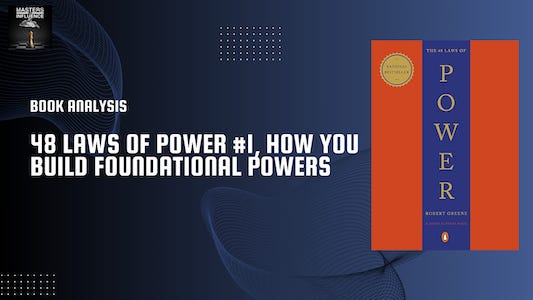
In this thought-provoking episode, hosts Jeff and Joe continue their exploration of Robert Greene's "48 Laws of Power," focusing on two critical laws of adaptability and survival:Law 36: Disdain Things You Cannot HaveThe hosts examine how showing contempt for what you can't obtain can become a powerful strategic moveHistorical example of Pancho Villa: How American pursuit elevated his folk hero statusModern political applications: Canada's strategic response to U.S. trade threatsKing Henry VIII creating the Church of England as the ultimate power moveWarning: Overusing disdain becomes ineffective when it's your only strategyLaw 38: Think As You Like, But Behave Like OthersThe delicate balance between maintaining independent thought while strategically conformingHistorical example of Tommaso Campanella: How a prisoner chained to a dungeon wall wrote his way to freedom by appearing to embrace church doctrineApplication to modern political communication: Finding points of connection before attempting to persuadeViktor Frankl's crucial lesson from concentration camps: They could control his actions but not his thoughtsThe ethical dilemma: When does strategic conformity become complicity?Key Takeaways:Strategic power moves require thoughtful application rather than reactionary habitsFinding common ground can be more effective than constant oppositionIn polarized times, these strategies become especially relevant but easily misusedLooking for opportunities to "flip the script" while playing the long game Get full access to Masters of Influence at mastersofinfluence.substack.com/subscribe
Episode DescriptionIn this episode of Masters of Influence, we sit down with Jane Elliott, the pioneering educator behind the famous "blue eyes, brown eyes" exercise that has been challenging prejudice since 1968. At 91 years old, Elliott shares her unfiltered perspective on education, power dynamics, and the current political landscape in America. Drawing from her nearly century-long life experience, Elliott offers both stark warnings and hopeful solutions for a nation at a crossroads.Note that the audio was a challenge with this one... I did the best with what we had... Episode HighlightsJane Elliott's groundbreaking work in prejudice reduction that began the day after Martin Luther King Jr.'s assassination in 1968How prejudice functions as both a natural cognitive process and a dangerous tool for manipulation and controlThe role of money and business interests in education and political powerWhy Elliott believes today's educational system is merely "schooling" rather than truly educating childrenHer passionate call for reorganizing our priorities as a nation and reclaiming power at the local levelElliott's reflections on historical parallels between current events and the rise of authoritarian regimes she witnessed in her youthThe importance of reading physical books rather than digital texts for deep learningHer powerful advocacy for organizing at the grassroots level as the path to meaningful changeJane's four rules for effective listening that transformed her classroom teachingKey Quotes"Pre-judging is actually a fundamental function of being alive. There's too much information in the world, and our brains have to find ways to simplify and group things.""As long as you have a group of people that you can hold down because of your self-imposed ignorance, that's how long you'll hold them down because you don't realize that it's holding you down as well.""Words are the most powerful weapon devised by humankind. We use them to destroy people on a daily basis.""The upper crust is a bunch of crumbs held together by a lot of dough.""Organize. Don't just empathize, organize.""You have to remember this: one person can make a difference."About Jane ElliottJane Elliott is an educator, anti-racism activist, and creator of the famous "blue eyes, brown eyes" exercise. Born in 1933, she began her groundbreaking work on prejudice in 1968 following the assassination of Martin Luther King Jr., dividing her third-grade classroom by eye color to give students a profound firsthand experience of discrimination. Her exercise has since been adapted for adults and used worldwide, and her work has been featured on Oprah and in numerous documentaries. Get full access to Masters of Influence at mastersofinfluence.substack.com/subscribe
In this episode from our Power in Politics series, we discuss the last week of the American Regime and its actions to limit free speech and free expression. Subscribe to get the next episode (and give me a dopamine hit). I’d love your comments and feedback. My goal is to understand how power works and get a better handle on what we can do to have more influence over our politics and our lives. I’d love to have you join me. Here are some key points: Fundamental Constitutional Rights Under Threat* The First Amendment, designed to protect citizens from government control of speech, is being undermined* Power is being exercised through controlling what people can say or think* Those who dissent face career destruction or potential imprisonmentMechanisms of Power Consolidation* Purging Dissenting Voices: Military generals who previously stood up to authority were removed* Intimidation: Critics face threats to personal safety and family* Loyalty Enforcement: Creating an environment where each layer of leadership tries to prove greater loyalty* Information Control: Media organizations and law firms are being pressured or coerced to align with regime messagingRelation to the 48 Laws of PowerAs we discuss politics we are also looking at how the regime employs the 48 laws of power. Related laws are: Law 17: Keep Others in Suspended Terror: Cultivate an Air of Unpredictability* Episode Example: The arbitrary detention of foreign academics and citizens at borders* Connection: When people don't know what will trigger punishment, they self-censor extensively out of fearLaw 42: Strike the Shepherd and the Sheep Will Scatter* Episode Example: Targeting high-profile dissenters to make examples of them* Connection: By punishing visible critics, the message to others is clear: dissent comes with steep costsLaw 37: Create Compelling Spectacles* Episode Example: The removal of established media and replacement with regime-friendly streamers* Connection: Creating a spectacle of "challenging the establishment" while actually consolidating control over the narrativeLaw 14: Pose as a Friend, Work as a Spy* Episode Example: The undermining of internal dissent through loyalty tests* Connection: Creating an atmosphere where people must demonstrate loyalty or be suspected of being enemiesLaw 11: Learn to Keep People Dependent on You* Episode Example: Washington Post control by Bezos and the constraining of what opinions can be published* Connection: Media organizations become dependent on regime approval for access and survivalSpecific Power Abuses Discussed* Detainment of foreign academics and students for expressing political opinions* A law firm being extorted into providing $40 million in pro bono services in exchange for not being targeted* Media ownership (Bezos/Washington Post) restricting what opinions can be published* Judiciary being undermined when rulings don't align with the administration's wishesHistorical Context and Dangers* Comparison to the Kennedy administration's recognition of groupthink and its dangers* Discussion of how democracies transition to authoritarian regimes through the normalization of power abuses* The destruction of checks and balances leading to unconstrained powerPersonal Impact and Response* Joe's military perspective: feeling that what he fought to protect is being dismantled* Both hosts grappling with whether democracy has already fallen* Call for organized resistance across political divides around fundamental rightsThe central theme connecting all these points is how power operates not just through formal channels but through control of information, intimidation of dissenters, and the gradual normalization of previously unacceptable behavior. The hosts argue that power consolidated without checks creates a dangerous spiral where each abuse enables the next more severe one. Get full access to Masters of Influence at mastersofinfluence.substack.com/subscribe
Welcome to Masters of Influence, where we explore the timeless strategies of power, persuasion, and effective leadership. In this episode, Jeff Loehr and Joe Rojas dive into the foundational laws of power from Robert Greene's influential book "The 48 Laws of Power."Is power inherently ethical? Can influence be wielded responsibly? Join us as we break down five critical laws that form the foundation of effective influence:Law #1: Never outshine the masterLaw #5: So much depends on reputation - guard it with your lifeLaw #6: Court attention at all costsLaw #9: Win through actions, never through argumentLaw #16: Use absence to increase respect and honorThrough real-world examples ranging from political leaders to everyday negotiations, we explore how these principles apply in business, relationships, and leadership. You'll hear personal stories of both success and failure in applying these laws, including how Jeff was escorted out of a boardroom after breaking Law #1, and how historical figures like Nelson Mandela masterfully employed these principles.Whether you're looking to enhance your leadership skills, navigate office politics, or simply understand the power dynamics that shape our world, this episode offers practical insights on building influence without making enemies along the way.Subscribe for our next episode where we'll continue our exploration of Greene's 48 Laws with a focus on adaptability and survival. Get full access to Masters of Influence at mastersofinfluence.substack.com/subscribe
This week we delve into the Zelensky fiasco at the White House. We look at it in terms of power and strategy and the ramifications. Is this the beginning of the end? Join us and let me know what you think… And you may as well subscribe, I mean do you really want to miss the good stuff? Host:Before we kick things off, Joe, you mentioned something about going down memory lane?Joe:Yeah, you asked me to look at some moments from my life, and I started thinking back. I actually did this course called The Wisdom Course back in 2006, where I wrote an autobiography up until that point.Host:So you’ve got stories. Lots of stories.Joe:Oh yeah. But I have to be careful about which facts I share because, uh… apparently, I once did a little work for organized crime. I was reading through my notes, and I was like, whoa.Host:Yeah, I’m going to cut that part out! As your business partner, I’d rather not have that on record.Joe:Fair enough. Though, honestly, organized crime is basically institutionalized at this point. White-collar crime is just government activity now.The Zelensky-Trump Oval Office ShowdownHost:What I wanted to start with today is a topic we weren’t necessarily prepared to discuss, but from a power perspective, it’s too fascinating to ignore.Yesterday, on February 28th, we saw something in the Oval Office that was one of the most bizarre displays of power politics I’ve ever witnessed—a highly choreographed public insult directed at an ally of the United States: Ukrainian President Volodymyr Zelensky.Trump, the vice president, and a room full of sycophants attacked Zelensky—a man who has managed to stand up against Russia for three years, defying all expectations.Why did they do this? What was Trump’s strategy? And what does this mean for global power? That’s what we’re diving into today.Zelensky Faces the Attack – And Holds His GroundJoe:I watched the entire thing last night, and then I saw Zelensky’s interview on Fox right after. It was wild to watch Fox try to bait him—pushing him to apologize to Trump, to say the vice president was right, to admit he was wrong.They kept hammering him.Host:Like state-run TV.Joe:Exactly. And yet, Zelensky didn’t take the bait. He stood his ground. One of the most powerful things he said was:"Look, I am grateful. But if we are going to talk about these things, let’s get the facts right. Millions of people have not died. This has not happened. That has not happened. If we are allies, let’s talk about the facts. If we are going to talk about money, let’s talk about the right amount of money."And he delivered that with absolute composure—while standing in a room full of people attacking him.Host:Yeah, it’s crazy how the headlines called it a “shouting match,” when in reality, all the shouting was coming from one side—the Trump administration.Zelensky was calm, composed, unshaken.Why Would Trump Stage This?Host:Let’s put this into a power context—why would Trump stage this attack?I believe Trump often operates with a strategy—whether conscious or instinctive—and this was a classic power movestraight out of The 48 Laws of Power.One law that stands out here? Law 32: Play to People’s Fantasies.When reality isn’t in your favor, you create a new one—one that fits the narrative your audience wants to believe.Joe:Yeah, and we’ve seen this before. Politicians, marketers, even CEOs do this all the time. Steve Jobs did it with Apple—he built a narrative that Apple was the world’s most innovative company, even when a lot of their designs were refinementsrather than true innovations.Host:And Trump is doing something similar here—crafting a fantasy that aligns with his desired geopolitical position. He needs a new narrative that allows him to align more closely with Russia, so he’s creating an enemy in Zelensky to justify that shift.And it works because he’s playing into pre-existing fantasies—the idea of American strength, of standing up to “corruption,” of rewriting alliances to fit a “new world order.”Joe:Right. And the speed at which all of this is happening is part of the strategy—flood the system with chaos so people can’t keep up.Final Thoughts: The Power Lessons HereHost:So what are the key power lessons here?1️⃣ Control the Narrative, or Someone Else Will. Trump is reshaping the story to align with his agenda. Zelensky, by contrast, held his ground and refused to let others define his position.2️⃣ Don’t Offend the Wrong People. Trump’s move to humiliate Zelensky has pushed Europe to strengthen itself against the U.S.—something that could have massive economic and geopolitical consequences.3️⃣ Perception = Power. The difference between appearing strong and actually being strong is how others see you.Trump appears dominant in his controlled environment, but in the global arena, he may have just weakened his position.Joe:And my final thought? Stay informed. Don’t just accept the headlines—watch both sides, dig into the strategy, and pay attention to how power is being used.Host:Exactly. And for all our listeners—what do you think? What’s the biggest **power move—or power blunder—you’ve ever seen? Drop a comment, fact-check us, or challenge our take.That’s what makes us all stronger.Until next time—this is Masters of Influence. Get full access to Masters of Influence at mastersofinfluence.substack.com/subscribe
We invited Dr. Keeper Sharkey and Reesë Tuttle onto Masters of Influence expecting a conversation about digital apocalypse. What we got instead was a meditation on consciousness, creativity, and what makes us human.The SetupI’d been marinating in the breathless quantum computing headlines touting quantum supremacy, the end of encryption, and the unmatched capacity of these machines. The narrative seemed clear—these machines would crack every password, break every security system, and shift the balance of power toward whoever controlled them.Dr. Keeper Sharkey seemed perfect to walk us through this doomsday. She’s vice chair of the Quantum Economic Development Consortium’s Use Cases Technical Advisory Committee, she is the founder and Director of ODE L3C a quantum on quantum awareness and education organization (https://odestar.com/), she chairs the IEEE’s P1947 standards for a quantum cybersecurity framework working group.Joining her was Reesë Tuttle, secretary of the IEEE P1947 standards for a quantum cybersecurity framework working group, a cybersecurity researcher tracking where quantum computing intersects with security threats, and her company AP2T Labs focuses on cyber security and cyber security training.I came prepared with questions about encryption vulnerabilities and surveillance. Then Dr. Sharkey said something that completely reframed everything.The Unexpected TurnAbout fifteen minutes in, Keeper dropped this: “A quantum computer is basically just a camera. You’re taking a picture of a quantum system—making a measurement of which state that system is in.”Then we took a turn into chemistry and biology. And I realized two things:1. The smaller things get the bigger and more interesting they become. The smallest particles in the universe have some of the most outrageous qualities.2. Humans are stuck in an attempt to recreate human thinking, but the brain does things that an algorithm can’t do and likely never will.What I expected to be a conversation about the diminishing power of humans, became a discussion about the uniqueness of the human brain and life itself.What We Actually LearnedQuantum computers aren’t coming for your passwords anytime soon. We’re looking at 2050 before quantum computers might crack modern encryption at scale. The engineering challenges are massive, costs astronomical. “The threat is theoretical,” Keeper explained, “but technically there isn’t a threat right now because of scaling issues.”Quantum computers are incredibly fragile. They operate near absolute zero, require perfect isolation, and researchers run experiments late at night because footsteps can disrupt measurements.The real revolution is on making things more secure. Quantum technology is already being used for security—protecting information systems before data gets stolen.But Here’s Where It Got Really InterestingSomewhere in the middle of discussing qubits, we started talking about consciousness and what it actually means to be alive.Which led to the revelation that your brain is a quantum computer, the rest is a poor copy.The brain processes multiple probabilities simultaneously. It collapses possibilities into outcomes. It operates through quantum information science in your DNA, your neurons, the chemistry that makes you conscious.And we’re trying to build quantum computers to do what brains already do naturally.“I don’t think nature does mathematics,” Keeper said. “I don’t think AI or quantum systems will ever be able to perform mathematical thinking—the creative kind that solves novel problems.”Reesë nailed it: “There’s no life to it. It’s literally doing equations,” humans have the capacity for creativity and novel thought.“The complexity behind an algorithm that would solve deep mathematical problems would be far too complicated,” Keeper explained. “A human wouldn’t be able to create that algorithm.”The most advanced quantum computer we can imagine still can’t match the creative capacity of a human mind. Not because it lacks processing power, but because it lacks life.The Question We Should Be AskingWe keep asking: “When will quantum computers take over?”The better question: “What are quantum computers teaching us about consciousness and what makes us human?”Quantum computers aren’t threatening to replace human thinking. They’re showing us just how extraordinary human thinking actually is.The power implicationsThis conversation reframed my understanding—not just of quantum computing, but of consciousness and creativity.It feels like we may be losing control to algorithms, that they are gaining power over knowledge, but the truth is they still can’t achieve the complexity of the human brain and may never get there.Humans still hold the ultimate power: creativity. And whatever breathless headlines appear, remember that you are the most sophisticated quantum computer in existence.What are your thoughts? Did this challenge how you think about quantum computing or what makes human thinking special? Hit reply—I genuinely want to know. Get full access to Masters of Influence at mastersofinfluence.substack.com/subscribe
Here’s the thing: you can believe you can fly unaided. You can convince yourself that it’s true. Your friends can tell you that it’s true.But when you go to the top of a building and jump off, you will fall.So what does it mean when those in charge make decisions based on made-up information? We may all soon find out what it’s like to hit the pavement…What We Cover* The eight levers of power—and why controlling knowledge sits at the center* Jeff’s shameful participation in coal company manipulation.* Why firing statisticians and promoting vaccine denialism follow the same pattern* How to spot reality manipulation in real time (who benefits, what’s the quality of evidence, can it be disproven?)We start off with the 8 levers of power and the current focus on Masters of Influence and then we move on to the dirt.Because this episode is a confession of sorts. Jeff talks about work he did for a coal company, work that involved creating doubt, not through scientific study but perception. They perfected the playbook first written by Big Tobacco, which lost not because people were dying of cigarettes but because they admitted people died of cigarettes.This strategy has evolved; now everybody gets their own strategy. Trump fires statisticians for the wrong numbers, RFK junior has decided that he knows more about vaccines than 99% of educated doctors in the world. That’d be fine if it weren’t your life he was messing with.Here’s the thing: physics is physics.Reality doesn’t care about your perception, your bias, or your beliefs.Gravity works whether you accept it or not. Viruses spread regardless of your Facebook profile. Climate change accelerates even if you throw a snowball on the Senate floor.The problem: humans are terrible at perceiving reality accurately. We trust our senses even when they mislead us. We see correlation and assume causation (hello, vitamin C). We make decisions based on incomplete information (Germans not allowing yeast in beer). It’s in that gap between perception and reality that manipulation thrives.The scientific method exists precisely because we can’t trust perception. Double-blind studies, peer review, replication, these aren’t academic niceties. They’re the tools we use to move beyond bias and get closer to what’s actually true.So when someone tells you “scientists are lying for grant money,” ask: who actually profits from the doubt? Scientists make their reputations by disproving established science, not confirming it. But fossil fuel companies with billions in infrastructure? Wellness gurus selling “vax-free baby” merch? They profit from the lie...---Why This MattersWe’re living through a wholesale assault on shared reality. Controlling what people believe to be true is the ultimate power move.This isn’t left vs. right anymore. It’s reality-bound vs. reality-optional. And the stakes couldn’t be higher because while you can debate politics, you can’t debate reality.Or, well, you can debate reality, but reality always wins. The question is how much damage we do to ourselves before we accept it.---Found this useful? Subscribe to Masters of Influence for breakdowns of power, manipulation, and how to think critically in a world that profits from your confusion.Got thoughts on reality manipulation? Stories of your own? Hit reply or drop a comment—we’d love to hear how you’re navigating this.—Jeff & Joe Get full access to Masters of Influence at mastersofinfluence.substack.com/subscribe

Comments

Download from Google Play

Download from App Store
 United States