


 Claim Ownership
Intersectional Psychology
Subscribed: 14Played: 26
Subscribe

© Copyright 2025 All rights reserved.
Description
The podcast that explores psychology’s role in promoting social justice. Because everyone deserves to live with their optimal mental health.
Content includes up-to-date peer-reviewed research, interviews with experts and people with lived experience, and a monthly guided mindfulness/relaxation session.
Bonus content available weekly on Patreon.
We are committed to the Cite Black Women praxis.
Content includes up-to-date peer-reviewed research, interviews with experts and people with lived experience, and a monthly guided mindfulness/relaxation session.
Bonus content available weekly on Patreon.
We are committed to the Cite Black Women praxis.
37 Episodes
Reverse
What happens when feminism is treated as universal — despite emerging from very unequal histories and contexts?
In this episode of Intersectional Psychology, I compare Anglo-American feminism and African feminisms, asking what gets lost when Western feminist frameworks are exported as the default lens for understanding gender, power, and justice.
Drawing on African feminist scholarship and decolonial theory, this episode explores how feminism looks different when it is shaped by colonial histories, economic inequality, community-based survival, and collective responsibility — rather than liberal individualism.
🎁 Support the podcast and get exclusive bonus content at Patreon.com/IntersectionalPsychology.
🌈 If this episode resonates, please share it, rate the show, and send us your thoughts.
📄 Download a transcript of this episode on IntersectionalPsychology.com.
⏳ Chapter Timestamps
00:00:00 Pre-credit teaser
00:01:22 Land acknowledgement
00:01:50 Title credits
00:02:17 Introduction to African vs Anglo-American feminism
00:04:18 Anglo-American feminism: Who is it really for?
00:07:42 The problem with universal womanhood
00:09:46 African feminism: Context is not optional
00:13:15 Why Anglo-American feminism still falls short
00:16:18 Intersectionality: Why this is personal
00:17:55 South Africa, apartheid, and compounded oppression
00:22:28 Why African feminism matters
00:26:32 End credits
Stay connected
🔗 Subscribe wherever you get your podcasts
📮 Got feedback or questions? Reach out at @IntersectionalPsychology or IntersectionalPsychologyPod[@]gmail.com
You can contribute to the Palestine Children's Relief Fund at https://www.pcrf.net/
References
Ahmed, S. (2000). Whose Counting? Feminist Theory, 1(1), pp. 97-103 [online]. Available at: https://doi.org/10.1177/14647000022229083 (Accessed 10 July 2024)
Bakare-Yusuf, B. (2003). Beyond Determinism: The Phenomenology of African Female Existence. Feminist Africa, 2 [online]. Available at: https://www.jstor.org/stable/48724973 (Accessed 10 July 2024)
Bakare-Yusuf, B. (2004) '"Yoruba's don't do gender": A critical review of Oyeronke Oyěwùmí's The Invention of Women: Making an African Sense of Western Gender Discourses', in Arnfred et al. (2004) African Gender Scholarship: Concepts, Methodologies and Paradigms. Dakar: Council for the Development of Social Science Research in Africa.
Camminga, B. (2020) 'Disregard and danger: Chimamanda Ngozi Adichie and the voices of trans (and cis) African feminists', The Sociological Review, 68(4), pp. 817-833. Available at: https://doi.org/10.1177/0038026120934695 (Accessed 10 July 2024)
Carrera-Fernández, M. V., & DePalma, R. (2020). Feminism will be trans-inclusive or it will not be: Why do two cis-hetero woman educators support transfeminism? The Sociological Review, 68(4), pp. 745-762 [online]. Available at: https://doi.org/10.1177/0038026120934686 (Accessed 10 July 2024)
Connell, R.W. (1985) 'Theorising gender', Sociology, 19(2), pp. 260-272.
Crenshaw, K. (1991) 'Mapping the Margins: Intersectionality, Identity Politics, and Violence Against Women of Colour', Stanford Law Review, 43(6), pp. 1241-1299 [online]. Available at: https://www.jstor.org/stable/1229039 (Accessed 10 July 2024)
DiAngelo, R. (2018) White fragility: why it's so hard to talk to white people about racism. Boston: Beacon Press.
Dosekun, S. (2019) 'African feminisms', in Yacob-Haliso, O. & Falola, T. (eds.), The Palgrave Handbook of African Women’s Studies [online]. Available at: https://doi.org/10.1007/978-3-319-77030-7_58-1 (Accessed 10 July 2024)
Eddo-Lodge, R. (2017) Why I'm No Longer Talking to White People about Race. London: Bloomsbury Circus.
Garutsa, T.C. & Nekhwevha, F. (2019) 'Decreasing Reliance of Indigenous Knowledge Systems in Rural Households: The Case of Khambashe, Eastern Cape, South Africa', Africa Insight, 49(1) [online]. Available at: https://www.ajol.info/index.php/ai/article/view/188718 (Accessed 10 July 2024)
Gqola, P.D. (2001) 'Defining people: Analysing power, language and representation in metaphors of the New South Africa', Transformation 47, pp. 94-106 [online]. Available at: https://www.africabib.org/htp.php?RID=P00021717 (Accessed 10 July 2024)
Gqola, P.D. (2005) 'Through Zanele Muholi's eyes: re/imagining ways of seeing Black lesbians', in Tamale, S. (ed.) African Sexualities: A Reader. Wantage: Pambazuka Press. pp. 622-629.
Hill Collins, P. (1996) What's in a Name? Womanism, Black Feminism, and Beyond', The Black Scholar, 26(1), pp. 9-17 [online]. Paradigm Publishers. Available at: http://www.jstor.org/stable/41068619 (Accessed 10 July 2024)
Kisiang'ani, E.N.W. (2004) 'Decolonising Gender Studies in Africa', in Arnfred et al. (2004) African Gender Scholarship: Concepts, Methodologies and Paradigms. Dakar: Council for the Development of Social Science Research in Africa.
Lewis, D. (2004) 'African Gender Research and Postcoloniality: Legacies and Challenges', in Arnfred et al. (2004) African Gender Scholarship: Concepts, Methodologies and Paradigms. Dakar: Council for the Development of Social Science Research in Africa.
Lewis, D. (2001) 'Introduction: African Feminisms', in Agenda: Empowering Women for Gender Equity, 2001, No. 50, African Feminisms One, pp. 4-10 [online]. Taylor & Francis. Available at: https://www.jstor.org/stable/4066401 (Accessed 10 July 2024)
Lewis, D. (2011) 'Representing African sexualities', in Tamale, S. (ed.) African Sexualities: A reader, pp. 199-216. Wantage: Pambazuka Press.
Mazibuko, M. (2020) 'Being a Feminist in the Fallist Movement in Contemporary South Africa', Critical Times, 3(3), pp. 488–495 [online]. Available at: https://doi.org/10.1215/26410478-8662368 (Accessed 10 July 2024)
Mbugua, A. (2011) 'Gender dynamics: a transsexual overview', in Tamale, S. (ed.) African Sexualities: A Reader, pp. 238-246. Wantage: Pambazuka Press.
Msimang, S. (2002) 'Introduction: African Feminisms II: Reflections on Politics Made Personal', Agenda: Empowering Women for Gender Equity, 54, pp. 3-15 [online]. Taylor & Francis. Available at: https://www.jstor.org/stable/4548069 (Accessed 10 July 2024)
Nkealah, N. (2017) 'Cameline Agency: A New Agenda for Social Transformation in South African Women’s Writing 2012–2014', Current Writing: Text and Reception in Southern Africa, 29(2), pp. 121-130. Available at: https://doi.org/10.1080/1013929X.2017.1347426 (Accessed 10 July 2024)
Oyěwùmí, O. (2004) 'Conceptualising Gender: Eurocentric Foundations of Feminist Concepts and the Challenge of African Epistemologies', in Arnfred et al. (2004) African Gender Scholarship: Concepts, Methodologies and Paradigms. Dakar: Council for the Development of Social Science Research in Africa.
Oyěwùmí, O. (1997) The Invention of Women: Making an African sense of Western gender discourses. Minneapolis: University of Minnesota Press.
Saad, L.F. (2020) Me and White Supremacy: Combat Racism, Change the World, and Become a Good Ancestor. Naperville: Sourcebooks.
See Privacy Policy at https://intersectionalpsychology.com/privacy-policy/
⚠ Content note: This episode discusses suicide, and references factors contributing to suicide, including mental illness, trauma, violence, and poverty. If you’re unable to engage with these topics right now, you are welcome to skip this episode or come back to it when you feel better resourced.
On this World Suicide Prevention Day, we explore the real stories behind the statistics. Suicide is never about one thing — it's shaped by pain, pressure, stigma, and systems that make it hard to ask for help. In this episode, we unpack the myths, talk honestly about why suicide happens, and share how we can respond with compassion and support.
🆘 Need Support?
☎ South Africa: Call SADAG’s Suicide Helpline at 0800 567 567 (24/7).
📱 International: In the US, dial or text 988. In the UK & Ireland, call 116 123.
🌐 For more countries, visit findahelpline.com.
🌈 If this episode resonates, please share it, rate the show, and send us your thoughts. Together we can break the silence and change the narrative.
📄 Download a transcript of this episode on IntersectionalPsychology.com.
⏳ Chapter Timestamps
00:00:00 Land acknowledgement
00:00:28 Title credits
00:00:58 Content note
00:01:44 Welcome and introduction
00:03:47 Suicide worldwide
00:05:37 Breaking the stigma|
00:14:04 Why suicide happens: Factors and stressors
00:23:51 Changing the narrative (Language matters)
00:27:40 Identifying warning signs
00:28:51 How to help: Mental health first aid
00:31:33 Self-care for those in crisis
00:33:15 Self-care for those offering support
00:35:18 Prevention and systemic change
00:37:06 End credits
Exclusive bonus content
🎁 Patreon.com/IntersectionalPsychology - Extended and bonus episodes
Stay connected to Aurora and Intersectional Psychology
🔗 Subscribe wherever you get your podcasts
📮 Got feedback or questions? Reach out at @IntersectionalPsychology
You can contribute to the Palestine Children's Relief Fund at https://www.pcrf.net/
📚 References
Brown, A.(2024). Suicide Prevention Handbook. Intersectional Psychology.
International Association for Suicide Prevention. (2025). Change the Narrative - World Suicide Prevention Day 10 September [online]. IASP. Available at: https://www.iasp.info/wspd/theme/
Mkhwanazi, S., Sikweyiya, Y., & Gibbs, A. (2025). Exploratory analysis of risk factors for suicidal ideation among young men in urban informal settlements in Durban, South Africa: A cross-sectional study. SSM - Mental Health, 7, 100417 [online]. Available at: https://doi.org/10.1016/j.ssmmh.2025.100417
Mngoma, N.F., & Ayonrinde, O.A. (2023). Mental distress and substance use among rural Black South African youth who are not in employment, education or training (NEET). The International Journal of Social Psychiatry, 69(3), 532–542 [online]. Available at: https://doi.org/10.1177/00207640221114252
Shoib, S., Amanda, T.W., Saeed, F., Ransing, R., Bhandari, S.S., Armiya'u, A.Y., Gürcan, A., & Chandradasa, M. (2023). Association Between Loneliness and Suicidal Behaviour: A Scoping Review. Turk Psikiyatri Derg, 34(2), 125-132 [online]. Available at: hhtp://doi.org/10.5080/u27080
World Health Organization. (2025) Suicide [online]. [25 March 2025]. WHO. Available at: https://www.who.int/news-room/fact-sheets/detail/suicide
See Privacy Policy at https://intersectionalpsychology.com/privacy-policy/
⚠ Content note: This episode references anti-gender movements and the concepts of hate crimes and hate speech. If you’re unable to engage with these topics right now, you are welcome to skip this episode or come back to it when you feel better resourced.
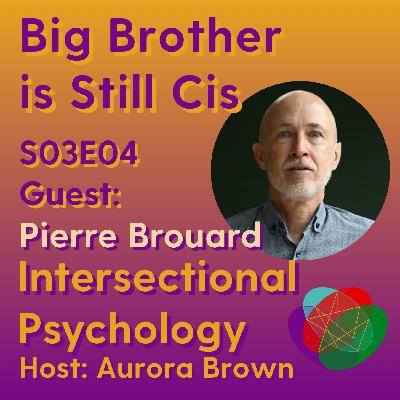
From troll farms to toxic platforms, anti-gender movements are pushing disinformation and harassment harder than ever. The result? Real harm to queer lives and mental health. But resistance is possible — and joy is non-negotiable.
In this episode of Intersectional Psychology, Aurora chats with Clinical Psychologist Pierre Brouard about the digital battlefield we’re living in and how to survive it with your sanity intact.
FREE Download of PATHSA's Brief Guide to Dealing with Anti-Trans Disinformation and Intimidation:
📥 https://pathsa.org.za/wp-content/uploads/2025/02/A-Brief-Guide-Dealing-with-Anti-Trans-Disinformation-and-Intimidation-PATHSA.pdf
📄 Download a transcript of this episode on IntersectionalPsychology.com.
⏳ Chapter Timestamps
00:00:00 Land acknowledgement
00:00:28 Title credits
00:00:58 Content note
00:01:28 Welcome and introduction
00:03:05 Queer Psychology, but make it radical
00:11:45 Big Brother is still cis
00:17:39 Platforms of harm, laws of hope
00:21:32 Receipts, resistance, and raising hell
00:35:14 Don't feed the trolls, but don't starve yourself either
00:46:05 WhatsApp isn't your therapist (and other online survival truths)
00:55:14 Finding your people, flipping the script
01:01:46 End credits
Whether you’re a health provider facing harassment, a trans or gender-diverse person navigating toxic platforms, or simply an ally wanting to do better online, this conversation is a survival guide for the age of disinfo.
Connect with Pierre Brouard
📸 @pierrewaldemar
🌐 https://pathsa.org.za/
Exclusive bonus content
🎁 Patreon.com/IntersectionalPsychology - Extended and bonus episodes
Stay connected to Aurora and Intersectional Psychology
🔗 Subscribe wherever you get your podcasts
🌈 Share this episode with someone who loves to learn
📮 Got feedback or questions? Reach out at @IntersectionalPsychology
You can contribute to the Palestine Children's Relief Fund at https://www.pcrf.net/
See Privacy Policy at https://intersectionalpsychology.com/privacy-policy/
Content note: This episode discusses misogynistic and queermisic legislation, language, and movements. If you’re unable to engage with these topics right now, you are welcome to skip this episode or come back to it when you feel better resourced.
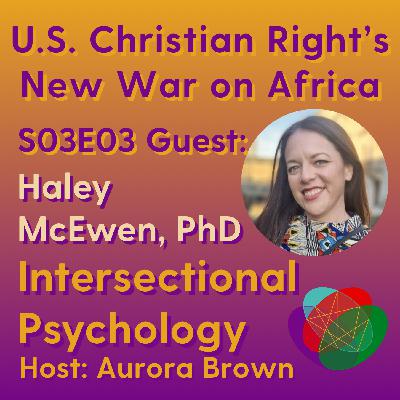
What do glossy pamphlets, moral panic, and abstinence-only sex ed have in common? They’re all part of the U.S. Christian Right’s campaign to export “pro-family” politics to Africa — and it’s causing real harm. In this episode, we expose how conservative religious groups from the Global North are funding anti-LGBTQIA+ laws, sabotaging reproductive rights, and co-opting decolonial language to disguise a new kind of moral imperialism.
Sociology postdoctoral researcher and author Haley McEwen joins us to discuss the USA and African pro-family movements. We dig into who these groups are, how they operate, and what it takes to resist their growing influence — all through a trans-inclusive, African-centred lens.
Connect with Haley
🌐 https://www.linkedin.com/in/haley-mcewen-73999543/
🎬 https://www.youtube.com/watch?v=86BTvFWoDFE
Buy Haley's book in print or eBook format
📗 https://link.springer.com/book/10.1007/978-3-031-46653-3
📕 https://www.takealot.com/the-u-s-christian-right-and-pro-family-politics-in-21st-century-/PLID93983844
Exclusive bonus content
🎁 Patreon - Extended and bonus episodes
Stay connected
🔗 Subscribe wherever you get your podcasts
🌈 Share this episode with someone who loves to learn
📮 Got feedback or questions? Reach out at @IntersectionalPsychology
📄 Download a transcript of this episode.
⏳ Chapter Timestamps
00:00:00 Land acknowledgement
00:00:28 Title credits
00:00:58 Welcome and introduction
00:02:37 About the work of Dr Haley McEwen
00:04:28 Exporting "Eden": God, guns, and glossy pamphlets in Africa
00:16:38 Not your Mama's family values: The dark politics behind the "pro-family" agenda
00:25:36 The Gospel according to Gaslight: How the Christian Right twists decolonial rhetoric
00:46:14 Power, protest, and possibility: Resisting the Christian Right's global agenda
00:58:12 End credits
Contribute to the Palestine Children's Relief Fund: https://www.pcrf.net/
📌 References
McEwen, H. (2023) The U.S. Christian Right and Pro-Family Politics in 21st Century Africa. Palgrave Macmillan.
Pontsho Pilane, investigative journalist, author, and advocacy manager. https://mg.co.za/author/pontsho-pilane/
Rev. Dr Kapya John Kaoma, theologian and researcher. https://thebtscenter.org/rev-dr-kapya-john-kaoma/
Prof. Jeff Sharlet, author, journalist, and academic. https://english.dartmouth.edu/people/jeff-sharlet
See Privacy Policy at https://intersectionalpsychology.com/privacy-policy/
Content note: This episode references transphobic arguments and objections to gender-affirming health care (GAHC) in our discussion and explanation of the guidelines for GAHC. If you’re unable to engage with these topics right now, you are welcome to skip this episode or come back to it when you feel better resourced.
In this powerful follow-up, host Aurora Brown and Dr Anastacia Tomson, MD, dive deeper into the complexities of gender-affirming healthcare in South Africa. They tackle systemic barriers, debunk pervasive myths, and explore how institutions — from clinics to workplaces — can truly support trans and gender-diverse (TGD) communities. Dr Tomson’s insights blend clinical expertise with lived experience, offering actionable steps towards dignity-centered care.
Connect with Anastacia
📸 @anaphylaxus
🌐 anastaciatomson.com / myfamily.gp
🎁 This extended audio is ad-free and includes Patreon-exclusive bonus content.
📄 Download a transcript of this episode on IntersectionalPsychology.com.
⏳ Chapter timestamps
00:00:00 Land acknowledgement
00:00:28 Patreon bonus announcement
00:01:31 Title credits
00:01:52 Welcome and introduction
00:03:15 Health disclaimer
00:04:10 The truth about the access to GAHC (Part 2)
00:08:01 Why GAHC is primary health care
00:14:26 Psychosocial support for TGD people
00:19:05 The truth about GAHC for non-binary people
00:21:59 The truth about TGD people in sports
00:29:16 The uniqueness of every transition pathway
00:32:01 How institutions can support gender transitions
00:36:29 The truth about voice therapy in GAHC
00:40:58 A future for everyone (Part 2)
00:45:37 End credits
Stay connected
🌈 Share this episode with someone who loves to learn
📮 Got feedback or questions? Reach out at @IntersectionalPsychology
You can contribute to the Palestine Children's Relief Fund at https://www.pcrf.net/
📌 Featured Resources
Tomson, A., McLachlan, C., Wattrus, C., Adams, K., Addinall, R., Bothma, R., Jankelowitz, L., Kotze, E., Luvuno, Z., Madlala, N., Matyila, S., Padavatan, A., Pillay, M., Rakumakoe, M., Tomson-Myburgh, M., Venter, W., & de Vries, E. (2021). Southern African HIV Clinicians Society gender-affirming healthcare guideline for South Africa. Southern African Journal of HIV Medicine, 22(1). doi:https://doi.org/10.4102/sajhivmed.v22i1.1299
Tomson, A. (2020). Always Anastacia. Jeppestown: Jonathan Ball Publishers.
📚 References
McKinney, A. Among the Stars, no piano edit. ZapSplat. https://www.zapsplat.com/music/among-the-stars-no-piano-soothing-ambient-choir-portrays-panoramic-space-good-for-landscapes/
Miles, D. Shades of Orange. ZapSplat. https://www.zapsplat.com/music/shades-of-orange-a-serene-relaxing-warm-ambient-piece-with-slow-mellow-chords-perfect-for-relaxation-meditation-etc/
Wall, C.S.J., Patev, A.J., & Benotsch, E.G. (2023). Trans broken arm syndrome: A mixed-methods exploration of gender-related medical misattribution and invasive questioning. Social science & medicine (1982), 320, 115748. https://doi.org/10.1016/j.socscimed.2023.115748
See Privacy Policy at https://intersectionalpsychology.com/privacy-policy/
Content note: This episode discusses transphobic objections to gender-affirming health care (GAHC) in our explanation of the guidelines for GAHC. If you’re unable to engage with these topics right now, you are welcome to skip this episode or come back to it when you feel better resourced.
What if the evidence does exist — and it’s just being willfully ignored?
In this episode, clinical psychologist and PsySSA SGD executive member Thembisile Dlamini joins us to unpack the Practice Guidelines for Psychology Professionals Working with Sexually and Gender-Diverse People (2nd edition). These groundbreaking guidelines, published by the Psychological Society of South Africa and the African LGBTQIA+ Human Rights Project, are the only comprehensive, evidence-based mental health guidelines of their kind on the African continent. Together, we explore the real research behind gender-affirming care, the values that underpin the guidelines, and the very deliberate misinformation being spread by anti-trans movements.
We also discuss the role of psychology professionals in countering stigma, upholding self-determination, supporting diverse family structures, and advocating for social justice. If you’re a mental health practitioner, an LGBTQIA+ ally, or someone navigating your own identity, this conversation is for you. Thembisile brings warmth, insight, and clarity to a subject that is too often clouded by fearmongering and bad-faith debate. Spoiler: the evidence is real, the guidelines are robust, and gender-affirming care is mental health care.
Connect with Thembisile
📸 @mindmatters.with.thembi
🌐 https://www.psyssa.com/about-us/psyssa-structures-2/divisions/sexuality-and-gender-division-sgd/
📗 Free download of the PsySSA Practice Guidelines for Psychology Professionals Working with Sexually and Gender-Diverse People, 2nd edition
Exclusive bonus content
🎁 Patreon - Ad-free and bonus episodes
Stay connected
🔗 Subscribe wherever you get your podcasts
🌈 Share this episode with someone who loves to learn
📮 Got feedback or questions? Reach out at @IntersectionalPsychology or intersectionalpsychologypod[at]gmail.com
You can contribute to the Palestine Children's Relief Fund at https://www.pcrf.net/
📄 Download a transcript of this episode.
⏳ Chapter Timestamps
00:00:00 Land acknowledgement
00:00:28 Title credits
00:00:58 Health disclaimer
00:01:59 Announcement
00:03:00 Welcome and introduction
00:06:19 Introducing PsySSA's practice guidelines for psychology professionals working with sexually and gender diverse people, 2nd edition
00:15:41 Affirmation is the first step (Guidelines 1-3)
00:26:22 It goes all the way to the top! (Guidelines 4-6)
00:35:49 Love, families, and finding your people (Guidelines 7-9)
00:46:14 The work starts with us (Guidelines 10-12)
00:59:31 End credits
📌 References
Psychological Society of South Africa. (2025). Practice Guidelines For Psychology Professionals Working With Sexually And Gender-Diverse People. Johannesburg: Psychological Society of South Africa (PsySSA).
See Privacy Policy at https://intersectionalpsychology.com/privacy-policy/
Content note: This episode references transphobic arguments and objections to gender-affirming health care (GAHC) in our discussion and explanation of the guidelines for GAHC. If you’re unable to engage with these topics right now, you are welcome to skip this episode or come back to it when you feel better resourced.
This episode kicks off a multi-part series on the health of trans and gender-diverse (TGD) communities in South Africa. Dr Anastacia Tomson — medical doctor, activist, and lead author of South Africa's groundbreaking gender-affirming healthcare guidelines — joins us to dispel myths, clarify misconceptions, and highlight the life-saving importance of evidence-based, compassionate care.
Connect with Anastacia
📸 @anaphylaxus
🌐 myfamily.gp
Exclusive bonus content
🎁 Patreon - Ad-free and bonus episodes
Stay connected
🔗 Subscribe wherever you get your podcasts
🌈 Share this episode with someone who loves to learn
📮 Got feedback or questions? Reach out at @IntersectionalPsychology
You can contribute to the Palestine Children's Relief Fund at https://www.pcrf.net/
📄 Download a transcript of this episode on IntersectionalPsychology.com.
⏳ Chapter timestamps
00:00:00 Land acknowledgement
00:00:28 Title credits
00:00:43 Health disclaimer
00:01:38 Welcome and introduction
00:05:11 About the work of Dr Anastacia Tomson
00:11:16 The real values underpinning gender-affirming health care (GAHC)
00:19:27 The actual access to GAHC
00:23:32 Gender-inclusive language 101
00:27:01 Non-medical gender-affirming practices
00:33:23 What is hormone therapy actually?
00:41:38 What is gender-affirming surgery actually?
00:50:59 A future for everyone
00:56:17 End credits
📌 Featured Resources
Tomson, A., McLachlan, C., Wattrus, C., Adams, K., Addinall, R., Bothma, R., Jankelowitz, L., Kotze, E., Luvuno, Z., Madlala, N., Matyila, S., Padavatan, A., Pillay, M., Rakumakoe, M., Tomson-Myburgh, M., Venter, W., & de Vries, E. (2021). Southern African HIV Clinicians Society gender-affirming healthcare guideline for South Africa. Southern African Journal of HIV Medicine, 22(1). https://doi.org/10.4102/sajhivmed.v22i1.1299
Tomson, A. (2020). Always Anastacia. Jeppestown: Jonathan Ball Publishers.
📚 References
McKinney, A. Among the Stars, no piano edit. ZapSplat. https://www.zapsplat.com/music/among-the-stars-no-piano-soothing-ambient-choir-portrays-panoramic-space-good-for-landscapes/
Miles, D. Shades of Orange. ZapSplat. https://www.zapsplat.com/music/shades-of-orange-a-serene-relaxing-warm-ambient-piece-with-slow-mellow-chords-perfect-for-relaxation-meditation-etc/
See Privacy Policy at https://intersectionalpsychology.com/privacy-policy/
Aurora and Neesha delve deeper into trauma-informed counselling for children in South Africa. They discuss the lingering effects of systemic oppression, practical approaches to trauma care for young clients, and how parents and professionals can support healing. Neesha also shares essential self-care strategies for those working in emotionally demanding fields.
Download a transcript of this episode on IntersectionalPsychology.com.
Connect with Neesha
📧 neeshachhibarc@gmail.com
📸 Instagram.com/neeshachhiba_rc_counselling
Exclusive bonus content
🎁 Patreon - Ad-free and exclusive bonus episodes
👇 Chapter timestamps
00:00:00 Land acknowledgement
00:00:28 Title credits
00:00:49 Welcome and introduction
00:01:17 Power, freedom, and difference in mental health care
00:09:36 Trauma-informed mental health care with children
00:20:11 How parents can support the mental health of their children
00:29:11 Trauma-informed self care
00:33:07 Navigating the future of child mental health care
00:34:37 End credits
Stay connected
🎞 Watch the YouTube video of this episode
🔗 Subscribe wherever you get your podcasts
🌈 Share this episode with someone who loves to learn
📮 Got feedback or questions? Reach out at @IntersectionalPsychology
You can contribute to the Palestine Children's Relief Fund at https://www.pcrf.net/
This episode of Intersectional Psychology was researched, written, recorded, and edited by Aurora Brown.
📚 References
Cochrane, L. and Chellan, W. (2017). "The Group Areas Act affected us all": Apartheid and Socio-Religious Change in the Cape Town Muslim Community, South Africa, Oral History Forum D’histoire Orale, 2. http://www.oralhistoryforum.ca/index.php/ohf/article/download/644/724.
DeepTheme Audio. Analog Bubbles. ZapSplat. https://www.zapsplat.com/music/analog-bubbles-dreamy-calm-and-carefree-musical-bumper-stinger-intro-outro/
Miles, D. Shades of Orange. ZapSplat. https://www.zapsplat.com/music/shades-of-orange-a-serene-relaxing-warm-ambient-piece-with-slow-mellow-chords-perfect-for-relaxation-meditation-etc/
Ngubane, N.P. and De Gama, B.Z. (2024). The influence of culture on the cause, diagnosis and treatment of serious mental illness (Ufufunyana): Perspectives of traditional health practitioners in the Harry Gwala District, KwaZulu-Natal, Culture Medicine and Psychiatry, 48(3), pp. 634–654. https://doi.org/10.1007/s11013-024-09863-7.
Perks, B. (2024). Trauma Proof. ITHAKA.
Yehuda, R. (2022). How parents' trauma leaves biological traces in children, SCIAM.
See Privacy Policy at https://intersectionalpsychology.com/privacy-policy/
In this episode, Aurora sits down with Registered Counsellor Neesha Chhiba to explore decolonial approaches to counselling children in South Africa. They discuss the historical, socioeconomic, and cultural factors shaping mental health challenges, the limitations of Western-centric psychology, and practical ways to integrate culturally responsive care into practice.
Connect with Neesha
📧 neeshachhibarc@gmail.com
📸 Instagram.com/neeshachhiba_rc_counselling
Stay connected
🔗 Subscribe wherever you get your podcasts to catch every episode
🌈 Share this episode with someone who loves to learn
📮 Got feedback or questions? Reach out at @IntersectionalPsychology
🎁 Support this podcast and access bonus content, including additional episodes and interviews, as well as more guided mindfulness sessions, go to Patreon.com/IntersectionalPsychology. As an independent media creator, I really appreciate your support.
You can contribute to the Palestine Children's Relief Fund at https://www.pcrf.net/
Download a transcript of this episode on IntersectionalPsychology.com.
👇 Chapters
00:00:00 Land acknowledgement
00:00:28 Title credits
00:00:52 Welcome and introduction
00:01:54 About the work of Neesha Chhiba
00:12:43 Factors impacting the mental health of children in South Africa
00:29:30 Decolonial practice with children
00:42:34 End credits
📚 References
Cochrane, L. and Chellan, W. (2017). "The Group Areas Act affected us all": Apartheid and Socio-Religious Change in the Cape Town Muslim Community, South Africa, Oral History Forum D’histoire Orale, 2. http://www.oralhistoryforum.ca/index.php/ohf/article/download/644/724.
DeepTheme Audio. Analog Bubbles. ZapSplat. https://www.zapsplat.com/music/analog-bubbles-dreamy-calm-and-carefree-musical-bumper-stinger-intro-outro/
Miles, D. Shades of Orange. ZapSplat. https://www.zapsplat.com/music/shades-of-orange-a-serene-relaxing-warm-ambient-piece-with-slow-mellow-chords-perfect-for-relaxation-meditation-etc/
Ngubane, N.P. and De Gama, B.Z. (2024). The influence of culture on the cause, diagnosis and treatment of serious mental illness (Ufufunyana): Perspectives of traditional health practitioners in the Harry Gwala District, KwaZulu-Natal, Culture Medicine and Psychiatry, 48(3), pp. 634–654. https://doi.org/10.1007/s11013-024-09863-7
Perks, B. (2024). Trauma Proof. ITHAKA.
Yehuda, R. (2022). How parents' trauma leaves biological traces in children, SCIAM.
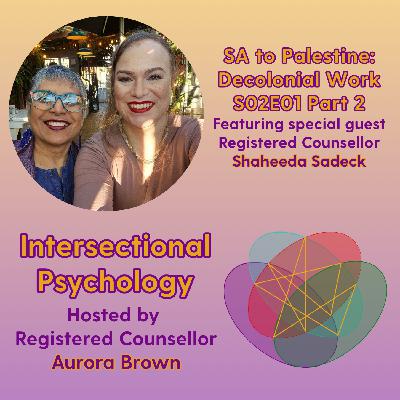
Content note: This episode includes discussions of apartheid, colonialism, Gaza, genocide, and gender-based violence. If you’re unable to engage with these topics right now, you are welcome to skip this episode or come back to it when you feel better resourced.
In this powerful episode, activist and Registered Counsellor Shaheeda Sadeck joins us again to discuss the underreported realities of Islamophobia in South Africa, the mental health struggles of lesbian Muslim women, and why South Africa has taken such a bold stance against the genocide in Gaza. From hate crimes against mosques to the legacy of apartheid and its parallels with Palestinian oppression, this conversation bridges faith, justice, and decolonial psychology.
Shaheeda also shares insights from her groundbreaking research on queer Muslim women in Cape Town and the urgent need for mental health practitioners to advocate for Palestinian liberation.
Stay connected
🔗 Subscribe wherever you get your podcasts
🌈 Rate and share this episode
📮 Got feedback or questions? Reach out at @IntersectionalPsychology
🎁 Support this podcast and access bonus content, including additional episodes and interviews, as well as more guided mindfulness sessions, go to Patreon.com/IntersectionalPsychology. As an independent media creator, I really appreciate your support.
You can contribute to the Palestine Children's Relief Fund at https://www.pcrf.net/
Download a transcript of this episode on IntersectionalPsychology.com.
Extras
📌 Support the Institute for Healing of Memories (IHOM): https://healing-memories.org/donate/
👇 Chapters
00:00:00 Land acknowledgement
00:00:28 Title credits
00:00:44 Content note
00:01:14 Welcome and introduction
00:01:53 Impact of Islamophobia on the mental health of Muslims in South Africa
00:09:51 Mental health challenges of Queer Muslims in Cape Town
00:19:38 From South Africa to Palestine: Ongoing decolonial work
00:24:52 Why healthcare workers must speak up for Palestine
00:38:40 The healing of memories
00:45:32 End credits
This episode of Intersectional Psychology was researched, written, recorded, and edited by Aurora Brown.
🎶Additional music credits
BIIANSU. Ptem. ZapSplat. https://www.zapsplat.com/music/ptem-dark-pads-fading-in-and-out-with-a-fast-paced-gated-effect/
DeepTheme Audio. Analog Bubbles - Alternative Version 4. ZapSplat. https://www.zapsplat.com/music/analog-bubbles-dreamy-calm-and-carefree-musical-bumper-stinger-intro-outro/
DeepTheme Audio. Into the Blue. ZapSplat. https://www.zapsplat.com/music/into-the-blue-ambient-calm-warm-pads-serious-musical-bumper-stinger-intro-outro/
Miles, D. Shades of Orange. ZapSplat. https://www.zapsplat.com/music/shades-of-orange-a-serene-relaxing-warm-ambient-piece-with-slow-mellow-chords-perfect-for-relaxation-meditation-etc/
ZapSplat. Among the Stars, no piano edit. https://www.zapsplat.com/music/among-the-stars-no-piano-soothing-ambient-choir-portrays-panoramic-space-good-for-landscapes/
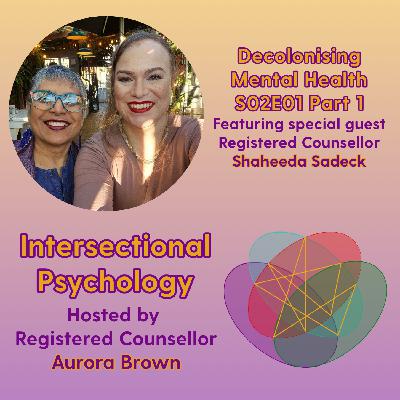
Content note: This episode includes discussions of apartheid, colonialism, grief and loss, gender-based violence, and intergenerational trauma. If you’re unable to engage with these topics right now, you are welcome to skip this episode or come back to it when you feel better resourced.
In this powerful conversation, activist and Registered Counsellor Shaheeda Sadeck joins me to unpack what decolonial mental health looks like in practice — from schools and communities to spiritual spaces and activist networks.
We talk about the psychological legacy of apartheid, Shaheeda's work with marginalised communities in Cape Town, how social practice and multiculturalism enhance psychology, and the role of traditional healing in mental healthcare. You’ll walk away from this conversation inspired, challenged, and ready to rethink what healing really means.
Stay connected
🔗 Subscribe wherever you get your podcasts
🌈 Rate and share this episode
📮 Got feedback or questions? Reach out at @IntersectionalPsychology
🎁 Support this podcast and access bonus content, including additional episodes and interviews, as well as more guided mindfulness sessions, go to Patreon.com/IntersectionalPsychology. As an independent media creator, I really appreciate your support.
You can contribute to the Palestine Children's Relief Fund at https://www.pcrf.net/
Download a transcript of this episode on IntersectionalPsychology.com.
Extras
📌 Support the Institute for Healing of Memories (IHOM): https://healing-memories.org/donate/
👇 Chapters
00:00:00 Land acknowledgement
00:00:28 Title credits and content note
00:01:13 Welcome and introduction
00:05:06 About the work of Shaheeda Sadeck
00:19:16 The historical, socioeconomic, and cultural factors impacting mental health
00:26:12 Decolonising mental health explained
00:38:13 How social practice and multiculturalism enhance psychology
00:47:02 End credits
This episode of Intersectional Psychology was researched, written, recorded, and edited by Aurora Brown.
What is intersectional psychology — and why does it matter so much for mental health today?
In this Best of Season 1 episode, Aurora Brown brings together key moments from all four episodes of Dissecting Intersectional Psychology, offering a rich and accessible introduction to intersectionality, social justice, and their ethical relevance to psychology and counselling practice.
This episode also grapples honestly with psychology’s history — including its complicity in systems like apartheid and eugenics — and asks what accountability, repair, and ethical practice require of us today. Along the way, Aurora reflects on coalition-building, civil disobedience, and how mental health professionals can engage in advocacy without abandoning care, nuance, or humility.
Whether you’re a psychology professional, student, activist, or someone navigating the mental health system yourself, this episode offers language, frameworks, and courage for thinking differently about care.
Aurora will be taking a short recording break over the festive season, but episodes will continue to drop — starting with this Season 1 retrospective.
🎁 Support the podcast and get exclusive bonus content
Patreon.com/IntersectionalPsychology
🌈 If this episode resonates, please share it, rate the show, and send us your thoughts.
📄 Download a transcript of this episode on IntersectionalPsychology.com.
⏳ Chapter Timestamps
00:00:00 Land acknowledgement
00:00:28 Title credits
00:01:23 Welcome and introduction
00:03:33 Intersectionality in practice
00:12:47 Practical social justice advocacy in psychology
00:22:10 Psychology's historical missteps
00:34:24 Civil disobedience and systemic change
00:43:21 The empathetic, ethical, and empowered counsellor
00:53:12 End credits
Stay connected to Aurora and Intersectional Psychology
🔗 Subscribe wherever you get your podcasts
📮 Got feedback or questions? Reach out at @IntersectionalPsychology or IntersectionalPsychologyPod[@]gmail.com
You can contribute to the Palestine Children's Relief Fund at https://www.pcrf.net/
What would psychology look like if it actually cared about (social) justice? We’re gonna talk about what an actual model of Intersectional Psychology should do — and how to make it work.
To support this podcast and get access to bonus content, including additional episodes and interviews, as well as more guided mindfulness sessions, go to Patreon.com/IntersectionalPsychology. As an independent media creator, I really appreciate your support.
Download a transcript of this episode on IntersectionalPsychology.com.
This episode of Intersectional Psychology was researched, written, recorded, and edited by Aurora Brown.
Are you a healthcare provider in need of CPD points? You might prefer to watch a different version of this episode here and then answer a short quiz to earn 2 Clinical CEUs and 1 Ethics CEU, accredited by the Health Professions Council of South Africa (HPCSA).
Chapter timestamps
00:00:00-00:01:17 Title cards and announcements
00:01:18-00:04:26 Welcome and introduction
00:04:27-00:13:34 Previously on Intersectional Psychology
00:13:35-00:18:31 Why we need an intersectional model
00:18:32-00:54:03 The model of Intersectional Psychology?
00:54:04-01:01:59 Bringing the model to life: A case study
01:02:00-01:14:39 "But what if...?"
01:14:40-01:26:13 The empathetic, ethical, and empowered counsellor
01:26:14-01:29:03 End credits
You can contribute to the Palestine Children's Relief Fund at https://www.pcrf.net/
References
Adams, G., Estrada-Villalta, S., Sullivan, D., & Markus, H.R. (2019). The psychology of neoliberalism and the neoliberalism of psychology. Journal of Social Issues, 75(1), 189–216 [online]. Available at: https://doi.org/10.1111/josi.12305
American Psychological Association. (2017). Ethical Principles of Psychologists and Code of Conduct. Washington: American Psychological Association. Available at: http://www.apa.org/about/policy/multicultural-guidelines.pdf
American Psychological Association. (2017). Multicultural Guidelines: An Ecological Approach to Context, Identity, and Intersectionality. Washington: American Psychological Association.
American Psychological Association, APA Task Force on Human Rights. (2021). Moving Human Rights to the Forefront of Psychology: The Final Report of the APA Task Force on Human Rights. Retrieved from https://www.apa.org/about/policy/report-human-rights.pdf
Bharat, B., Chenneville, T., Gabbidon, K., & Foust, C. (2021). Considerations for psychological research with and for people of color and oppressed intersecting identities in the United States. Translational Issues in Psychological Science, 7(4), 363–377 [online]. Available at: https://doi.org/10.1037/tps0000285
Boonzaier, F., & van Niekerk, T. (Eds.). (2019). Decolonial feminist community psychology. Cham: Springer Nature Switzerland AG.
Borgos, A. (2019). Psychology and Politics: Intersections of Science and Ideology in the History of Psy-Sciences. Budapest: Central European University Press.
Brown, J.M., Naser, S.C., Brown Griffin, C., Grapin, S.L., & Proctor, S.L. (2022). A multicultural, gender, and sexually diverse affirming school-based consultation framework. Psychology in the Schools, 59(1), 14–33 [online]. Available at: https://doi.org/10.1002/pits.22593
Burnes, T. R., & Christensen, N. P. (2020). Still wanting change, still working for justice: An introduction to the special issue on social justice training in health service psychology. Training and Education in Professional Psychology, 14(2), 87–91. Available at: https://doi.org/10.1037/tep0000323
Canetto, S.S. (2019). Teaching about women and gender from a transnational and intersectional feminist perspective. International Perspectives in Psychology: Research, Practice, Consultation, 8(3), 144–160 [online]. Available at: https://doi.org/10.1037/ipp0000111
Cavé, J. (2024) Integrative Brain Based Approach Level I (Training Manual). Johannesburg: Impact Training.
Eaton, A.A., Grzanka P.R., Schlehofer, M.M., Silka, L. (2021) Public psychology: Introduction to the special issue. American Psychology, 76(8), 1209-1216. Available at: https://doi.org/10.1037/amp0000933
Flynn, A.W.P., Domínguez, S., Jordan, R.A.S., Dyer, R.L., & Young, E.I. (2021). When the political is professional: Civil disobedience in psychology. American Psychology, 76(8), 1217-1231 [online]. Available at: https://doi.org/10.1037/amp0000867
Hailes, H.P., Ceccolini, C.J., Gutowski, E., & Liang, B. (2021). Ethical guidelines for social justice in psychology. Professional Psychology: Research and Practice, 52(1), 1–11 [online]. Available at: https://doi.org/10.1037/pro0000291
HCPC. (2024). Standards of conduct, performance and ethics. London: UK Health & Care Professions Council. https://www.hcpc-uk.org/standards/standards-of-conduct-performance-and-ethics/
Health Professions Act 56 of 1974, s. 57 (Act 29/2007). Government Gazette. Available at https://www.gov.za/documents/medical-dental-and-supplementary-health-service-professions-act-16-oct-1974-0000
Helms, J. E. (2015). A legacy of eugenics underlies racial-group comparisons in intelligence testing. Industrial and Organizational Psychology: Perspectives on Science and Practice, 5, 176–179 [online]. Available at: https://doi.org/10.1111/j.1754-9434.2012.01426.x
HPCSA. (2019). Minimum standards for the training of Clinical Psychology. Johannesburg: Health Professions Council of South Africa Professional Board for Psychology [online]. Available at: https://www.hpcsa.co.za/Content/upload/psb/guidelines/Minimum_standards_for_the_training_of_Clinical_Psychology.pdf
HPCSA. (2019). Minimum standards for the training of Counselling Psychology. Johannesburg: Health Professions Council of South Africa Professional Board for Psychology [online]. Available at: https://www.hpcsa.co.za/Content/upload/psb/guidelines/Minimum_standards_for_the_training_of_Counselling_Psychology.pdf
HPCSA. (2019). Minimum standards for the training of Educational Psychology. Johannesburg: Health Professions Council of South Africa Professional Board for Psychology [online]. Available at: https://www.hpcsa.co.za/Content/upload/psb/guidelines/Minimum_standards_for_the_training_of_Educational_Psychology.pdf
HPCSA. (2019). Minimum standards for the training of Industrial Psychology. Johannesburg: Health Professions Council of South Africa Professional Board for Psychology [online]. Available at: https://www.hpcsa.co.za/Content/upload/psb/guidelines/Minimum_standards_for_the_training_of_Industrial_Psychology.pdf
HPCSA. (2019). Minimum standards for the training of Registered Counsellor. Johannesburg: Health Professions Council of South Africa Professional Board for Psychology [online]. Available at: https://www.hpcsa.co.za/Content/upload/psb/guidelines/Minimum_standards_for_the_training_of_Registered_Counsellor.pdf
HPCSA. (2019). Psychometry: Framework for Education, Training, Registration and Scope of Psychometry. Johannesburg: Health Professions Council of South Africa Professional Board for Psychology [online]. Available at: https://www.hpcsa.co.za/Content/upload/psb/guidelines/Minimum_standards_for_the_training_of_Psychometrist.pdf
HPCSA. (2021). General Ethical Guidelines for the Healthcare Professions (Booklet 1). Johannesburg: Health Professions Council of South Africa Professional Board for Psychology [online]. Available at: https://www.hpcsa.co.za/Uploads/professional_practice/ethics/Booklet_1_Guidelines_for_Good_Practice_vDec_2021.pdf
HPCSA. (2022). Minimum standards for the training of Neuropsychology. Johannesburg: Health Professions Council of South Africa Professional Board for Psychology [online]. Available at: https://www.hpcsa.co.za/Content/upload/professional_boards/psb/guidelines/NEUROPSYCHOLOGY_Minimum_standards_19022024.pdf
HPCSA. (2023). Minimum standards for the training of Research Psychologists. Johannesburg: Health Professions Council of South Africa Professional Board for Psychology [online]. Available at: https://www.hpcsa.co.za/Content/upload/professional_boards/psb/guidelines/Research_Psychology_Minimum_Standards.pdf
Huminuik, K. (2024). The five connections: A human rights framework for psychologists. International Journal of Psychology, 59(2), 218–224 [online]. Available at: https://doi.org/10.1002/ijop.12908
Joyce, P. (1999). A Concise Dictionary of South African Biography. Cape Town: Francolin. pp. 275–276.
Kessi, S., & Boonzaier, F. (2018). Centre/ing decolonial feminist psychology in Africa. South African Journal of Psychology, 48(3), 299–309 [online]. Available at: https://doi.org/10.1177/0081246318784507
National Health Act 61 of 2003, s. 37 (Act 12/2013). Government Gazette. Available at https://www.gov.za/documents/national-health-amendment-act
Neville, H.A., Ruedas-Gracia, N., Lee, B.A., Ogunfemi, N., Maghsoodi, A.H., Mosley, D.V., LaFromboise, T.D., & Fine, M. (2021). The public psychology for liberation training model: A call to transform the discipline. American Psychologist, 76(8), 1248–1265. https://doi.org/10.1037/amp0000887
Prilleltensky, I. (2008). The role of power in wellness, oppression, and liberation: The promise of psychopolitical validity. Journal of Community Psychology, 36(2), 116–136 [online]. Available at: https://doi.org/10.1002/jcop.20225
Psychological Society of South Africa. (2017). Practice Guidelines For Psychology Professionals Working with Sexually and Gender-Diverse People. Johannesburg: Psychological Society of South Africa.
Regulation of Gatherings Act 205 of 1993, s. 531 (Act 15/2013). Available at: https://www.gov.za/documents/regulation-gatherings-act
Newson, J.J., Sukhoi, O., Taylor, J., Topalo, O., & Thiagarajan, T.C. (2024) Mental State of the World 2023. Sapien Labs: Global Mind Project [online]. Available at: https://sapienlabs.org/wp-content/uploads/2024/03/4th-Annual-Mental-State-of-the-World-Report.pdf
Thiagarajan, T. & Newson, J. (2024). The Mental State of the World in 2023: A Perspective on Internet-Enabled Populations. Global Mind Project.
Yakush
CW/TW 01: This episode contains a discussion of the ongoing genocide in Gaza from 00:21:58 to 00:30:16.
CW/TW 02: This episode also contains brief references to sexual assault and queerphobic hate crimes and hate speech from 00:37:24 to 00:42:20.
How do activism and social justice advocacy fit into the scope of practice for mental health professionals? Is it our responsibility? Get up to date with evolving best practices, legal frameworks, and national and international guidelines.
Read a transcript of this episode on intersectionalpsychology.com.
Are you a healthcare provider in need of CPD points? You might prefer to watch a different version of this episode here and then answer a short quiz to earn 2 Clinical CEUs and 1 Ethics CEU, accredited by the Health Professions Council of South Africa (HPCSA).
Chapter timestamps
00:00:00-00:04:13 Welcome to this episode of Intersectional Psychology
00:04:14-00:16:09 Framing the question
00:16:10-00:36:58 Psychology's historical missteps
00:36:59-00:43:01 Why intersectionality is essential to psychological practice
00:43:02-00:48:01 Case studies and practical applications
00:48:02-01:02:48 Activism and advocacy
01:02:48-01:14:02 Civil disobedience and systemic change
01:14:03-01:19:20 The challenges and controversies
01:19:21-01:21:10 Making intersectionality non-negotiable
01:21:11-01:23:48 Psychology's role in the bigger picture
01:23:49-01:26:38 End credits
This podcast centres the voices and experiences of marginalised people for an audience that includes many marginalised people. Comments have therefore been disabled on this channel to safeguard the mental health and dignity of our guests and audience. You are, however, welcome to email me at the address on this channel's page if you have any questions, comments, or suggestions.
You can contribute to the Palestine Children's Relief Fund at https://www.pcrf.net/
References
Adams, G., Estrada-Villalta, S., Sullivan, D., & Markus, H.R. (2019). The psychology of neoliberalism and the neoliberalism of psychology. Journal of Social Issues, 75(1), 189–216 [online]. Available at: https://doi.org/10.1111/josi.12305
American Psychological Association. (2017). Ethical Principles of Psychologists and Code of Conduct. Washington: American Psychological Association. Available at: http://www.apa.org/about/policy/multicultural-guidelines.pdf
American Psychological Association. (2017). Multicultural Guidelines: An Ecological Approach to Context, Identity, and Intersectionality. Washington: American Psychological Association.
American Psychological Association, APA Task Force on Human Rights. (2021). Moving Human Rights to the Forefront of Psychology: The Final Report of the APA Task Force on Human Rights. Retrieved from https://www.apa.org/about/policy/report-human-rights.pdf
Bharat, B., Chenneville, T., Gabbidon, K., & Foust, C. (2021). Considerations for psychological research with and for people of color and oppressed intersecting identities in the United States. Translational Issues in Psychological Science, 7(4), 363–377 [online]. Available at: https://doi.org/10.1037/tps0000285
Boonzaier, F., & van Niekerk, T. (Eds.). (2019). Decolonial feminist community psychology. Cham: Springer Nature Switzerland AG.
Borgos, A. (2019). Psychology and Politics: Intersections of Science and Ideology in the History of Psy-Sciences. Budapest: Central European University Press.
Brown, J.M., Naser, S.C., Brown Griffin, C., Grapin, S.L., & Proctor, S.L. (2022). A multicultural, gender, and sexually diverse affirming school-based consultation framework. Psychology in the Schools, 59(1), 14–33 [online]. Available at: https://doi.org/10.1002/pits.22593
Burnes, T. R., & Christensen, N. P. (2020). Still wanting change, still working for justice: An introduction to the special issue on social justice training in health service psychology. Training and Education in Professional Psychology, 14(2), 87–91. Available at: https://doi.org/10.1037/tep0000323
Canetto, S.S. (2019). Teaching about women and gender from a transnational and intersectional feminist perspective. International Perspectives in Psychology: Research, Practice, Consultation, 8(3), 144–160 [online]. Available at: https://doi.org/10.1037/ipp0000111
Cavé, J. (2024) Integrative Brain Based Approach Level I (Training Manual). Johannesburg: Impact Training.
Eaton, A.A., Grzanka P.R., Schlehofer, M.M., Silka, L. (2021) Public psychology: Introduction to the special issue. American Psychology, 76(8), 1209-1216. Available at: https://doi.org/10.1037/amp0000933
Flynn, A.W.P., Domínguez, S., Jordan, R.A.S., Dyer, R.L., & Young, E.I. (2021). When the political is professional: Civil disobedience in psychology. American Psychology, 76(8), 1217-1231 [online]. Available at: https://doi.org/10.1037/amp0000867
Hailes, H.P., Ceccolini, C.J., Gutowski, E., & Liang, B. (2021). Ethical guidelines for social justice in psychology. Professional Psychology: Research and Practice, 52(1), 1–11 [online]. Available at: https://doi.org/10.1037/pro0000291
HCPC. (2024). Standards of conduct, performance and ethics. London: UK Health & Care Professions Council. https://www.hcpc-uk.org/standards/standards-of-conduct-performance-and-ethics/
Health Professions Act 56 of 1974, s. 57 (Act 29/2007). Government Gazette. Available at https://www.gov.za/documents/medical-dental-and-supplementary-health-service-professions-act-16-oct-1974-0000
Helms, J. E. (2015). A legacy of eugenics underlies racial-group comparisons in intelligence testing. Industrial and Organizational Psychology: Perspectives on Science and Practice, 5, 176–179 [online]. Available at: https://doi.org/10.1111/j.1754-9434.2012.01426.x
HPCSA. (2019). Minimum standards for the training of Clinical Psychology. Johannesburg: Health Professions Council of South Africa Professional Board for Psychology [online]. Available at: https://www.hpcsa.co.za/Content/upload/psb/guidelines/Minimum_standards_for_the_training_of_Clinical_Psychology.pdf
HPCSA. (2019). Minimum standards for the training of Counselling Psychology. Johannesburg: Health Professions Council of South Africa Professional Board for Psychology [online]. Available at: https://www.hpcsa.co.za/Content/upload/psb/guidelines/Minimum_standards_for_the_training_of_Counselling_Psychology.pdf
HPCSA. (2019). Minimum standards for the training of Educational Psychology. Johannesburg: Health Professions Council of South Africa Professional Board for Psychology [online]. Available at: https://www.hpcsa.co.za/Content/upload/psb/guidelines/Minimum_standards_for_the_training_of_Educational_Psychology.pdf
HPCSA. (2019). Minimum standards for the training of Industrial Psychology. Johannesburg: Health Professions Council of South Africa Professional Board for Psychology [online]. Available at: https://www.hpcsa.co.za/Content/upload/psb/guidelines/Minimum_standards_for_the_training_of_Industrial_Psychology.pdf
HPCSA. (2019). Minimum standards for the training of Registered Counsellor. Johannesburg: Health Professions Council of South Africa Professional Board for Psychology [online]. Available at: https://www.hpcsa.co.za/Content/upload/psb/guidelines/Minimum_standards_for_the_training_of_Registered_Counsellor.pdf
HPCSA. (2019). Psychometry: Framework for Education, Training, Registration and Scope of Psychometry. Johannesburg: Health Professions Council of South Africa Professional Board for Psychology [online]. Available at: https://www.hpcsa.co.za/Content/upload/psb/guidelines/Minimum_standards_for_the_training_of_Psychometrist.pdf
HPCSA. (2021). General Ethical Guidelines for the Healthcare Professions (Booklet 1). Johannesburg: Health Professions Council of South Africa Professional Board for Psychology [online]. Available at: https://www.hpcsa.co.za/Uploads/professional_practice/ethics/Booklet_1_Guidelines_for_Good_Practice_vDec_2021.pdf
HPCSA. (2022). Minimum standards for the training of Neuropsychology. Johannesburg: Health Professions Council of South Africa Professional Board for Psychology [online]. Available at: https://www.hpcsa.co.za/Content/upload/professional_boards/psb/guidelines/NEUROPSYCHOLOGY_Minimum_standards_19022024.pdf
HPCSA. (2023). Minimum standards for the training of Research Psychologists. Johannesburg: Health Professions Council of South Africa Professional Board for Psychology [online]. Available at: https://www.hpcsa.co.za/Content/upload/professional_boards/psb/guidelines/Research_Psychology_Minimum_Standards.pdf
Huminuik, K. (2024). The five connections: A human rights framework for psychologists. International Journal of Psychology, 59(2), 218–224 [online]. Available at: https://doi.org/10.1002/ijop.12908
Joyce, P. (1999). A Concise Dictionary of South African Biography. Cape Town: Francolin. pp. 275–276.
Kessi, S., & Boonzaier, F. (2018). Centre/ing decolonial feminist psychology in Africa. South African Journal of Psychology, 48(3), 299–309 [online]. Available at: https://doi.org/10.1177/0081246318784507
National Health Act 61 of 2003, s. 37 (Act 12/2013). Government Gazette. Available at https://www.gov.za/documents/national-health-amendment-act
Neville, H.A., Ruedas-Gracia, N., Lee, B.A., Ogunfemi, N., Maghsoodi, A.H., Mosley, D.V., LaFromboise, T.D., & Fine, M. (2021). The public psychology for liberation training model: A call to transform the discipline. American Psychologist, 76(8), 1248–1265. https://doi.org/10.1037/amp0000887
Prilleltensky, I. (2008). The role of power in wellness, oppression, and liberation: The promise of psychopolitical validity. Journal of Community Psychology, 36(2), 116–136 [online]. Available at: https://doi.org/10.1002/jcop.20225
Psychological Society of South Africa. (2017). Practice Guidelines For Psychology Professionals Working with Sexually and Gender-Diverse People. Johannesburg: Psychological Society of South Africa.
Regulation of Gatherings Act 205 of 1993, s. 531 (Act 15/2013). Available at: https://www.gov.za/doc
What is social justice in psychology, and what does social justice mean in the context of counselling practice? By understanding this, you can assess and support people holistically. Considering the social determinants of mental health leads to more accurate case conceptualisation, a stronger therapeutic alliance, and improved client outcomes.
You can download a transcript of this episode on intersectionalpsychology.com.
Are you a healthcare provider in need of CPD points? You might prefer to watch a different version of this episode here and then answer a short quiz to earn 2 Clinical CEUs, accredited by the Health Professions Council of South Africa (HPCSA).
Chapter timestamps
00:00:00-00:08:06 Welcome to social justice in psychology
00:08:07-00:15:02 Why psychology and social justice are BFFs
00:15:03-00:19:23 Barriers to advocacy
00:19:24-00:35:21 Practical advocacy
00:35:22-00:37:41 Challenges and risks
00:37:42-00:40:54 The call to action
00:40:55-00:43:44 End credits
You can contribute to the Palestine Children's Relief Fund at https://www.pcrf.net/
References
Abraham, M.S., Harrison, G., Peralta, S., Wells, J., & Hunter, B. (2022). Recommendations for Integrating a Social Justice Framework into Clinical Practice: A qualitative analysis with implications for psychology training programs. Journal for Social Action in Counseling & Psychology, 14(1), 17–36 [online]. Available at: https://doi.org/10.33043/JSACP.14.1.17-36
Andrews, E.E., Pilarski, C.R., Ayers, K., & Dunn, D.S. (2023) Advocacy: The seventh foundational principle and core competency of rehabilitation psychology. Rehabilitation Psychology, 68(2), 103-111 [online]. Available at: https://doi.org/10.1037/rep0000492
Brewster, M. E., & Molina, D. A. L. (2021). Centering Matrices of Domination: Steps Toward a More Intersectional Vocational Psychology. Journal of Career Assessment, 29(4), 547-569. https://doi.org/10.1177/10690727211029182
Burnes, T. R., & Christensen, N. P. (2020). Still wanting change, still working for justice: An introduction to the special issue on social justice training in health service psychology. Training and Education in Professional Psychology, 14(2), 87–91. Available at: https://doi.org/10.1037/tep0000323
Calvez, S., & Cummings, J. A. (2022). Getting on the path to indigenisation: Embracing (re)conciliation in Canadian psychology. Canadian Psychology / Psychologie canadienne, 63(4), 569–575 [online]. Available at: https://doi.org/10.1037/cap0000344
Cole, E. R. (2020). Demarginalising women of color in intersectionality scholarship in psychology: A Black feminist critique. Journal of Social Issues, 76(4), 1036–1044. Available at: https://doi.org/10.1111/josi.12413
Coles, S. M., & Pasek, J. (2020). Intersectional invisibility revisited: How group prototypes lead to the erasure and exclusion of Black women. Translational Issues in Psychological Science, 6(4), 314–324. Available at: https://doi.org/10.1037/tps0000256
Crenshaw, K. (1991) 'Mapping the Margins: Intersectionality, Identity Politics, and Violence Against Women of Colour'. Stanford Law Review, 43(6), pp. 1241-1299 [online]. Available at: https://www.jstor.org/stable/1229039
Crenshaw, K. (2014) The structural and political dimensions of intersectional oppression. Intersectionality: Foundations & Frontiers Reader. New York: Westview Press.
Elmadani, A., & Post, P. (2023). Factors related to social justice advocacy among play therapists. International Journal of Play Therapy, 32(4), 208–217 [online]. Available at: https://doi.org/10.1037/pla0000206
Gqola, P.D. (2015) Rape: a South African nightmare. Cape Town: Melinda Ferguson Books.
Hill Collins, P., & Bilge, S. (2020). Intersectionality, 2nd ed. Malden: Polity Press.
Shin, R.Q., Welch, J.C., Kaya, A.E., Yeung, J.G., Obana, C., Sharma, R., Vernay, C.N., & Yee, S. The intersectionality framework and identity intersections in the Journal of Counseling Psychology and The Counseling Psychologist: A content analysis. Journal of Counselling Psychology, 64(5), 458-474 [online]. Available at: https://doi.org/10.1037/cou0000204
Hoefer, R. (2019) The Dangers of Social Justice Advocacy. Social Work, 64(1), 87-90 [online]. Available at: https://doi.org/10.1093/sw/swy047
Kozan, S., & Blustein, D. L. (2018). Implementing social change: A qualitative analysis of counseling psychologists’ engagement in advocacy. The Counseling Psychologist, 46(2), 154–189 [online]. Available at: https://doi.org/10.1177/0011000018756882
Lee, E., Greenblatt, A., Hu, R., Johnstone, M., & Kourgiantakis, T. (2022) Microskills of broaching and bridging in cross-cultural psychotherapy: Locating therapy skills in the epistemic domain toward fostering epistemic justice. American Journal of Orthopsychiatry, 92(3), 310-321 [online]. Available at: https://doi.org/10.1037/ort0000610
Mallinckrodt, B., Miles, J.R., & Levy, J.J. (2014). The scientist-practitioner-advocate model: Addressing contemporary training needs for social justice advocacy. Training and Education in Professional Psychology, 8(4), 303-311 [online]. Available at: https://doi.org/10.1037/tep0000045
Rosenthal, L. (2016). Incorporating intersectionality into psychology: An opportunity to promote social justice and equity. American Psychologist, 71(6), 474–485 [online]. Available at: https://doi.org/10.1037/a0040323
Truth, S. (1851) 'Women's Rights Convention', Anti-Slavery Bugle (New-Lisbon, OH), 21 June, 4 [online]. Available at: https://chroniclingamerica.loc.gov/lccn/sn83035487/1851-06-21/ed-1/seq-4/#date1=06%2F01%2F1851&index=2&date2=12%2F31%2F1851&searchType=advanced&language=&sequence=0&words=Ohio+right+rights+Rights+Sojourner+Truth+Women+women&proxdistance=5&rows=20&ortext=&proxtext=sojourner+truth+&phrasetext=&andtext=women%27s+rights+ohio&dateFilterType=range&page=1
Explore the concept of intersectionality in psychology, from its roots in Black feminist activism through to its importance to mental health practice in a diverse, multicultural society.
You can also read a transcript of this episode.
Are you a healthcare provider in need of CPD points? You might prefer to watch a different version of this episode here and then answer a short quiz to earn 2 Clinical CEUs, accredited by the Health Professions Council of South Africa (HPCSA).
Visual References
00:45:15.560 - The difference between equality, equity and reality: https://intersectionalpsychology.wordpress.com/wp-content/uploads/2025/04/equality_equity_reality.webp
00:48:43.200 - The difference between equality, equity, and liberation: https://intersectionalpsychology.wordpress.com/wp-content/uploads/2025/04/equality_equity_liberation.webp
Chapter Timestamps
00:00:00-00:05:05 Introduction
00:05:06-00:25:53 What is intersectionality really all about?
00:25:54-00:28:49 Why psychology needs intersectionality
00:28:50-00:36:24 Intersectionality in practice
00:36:25-00:49:18 Challenges and pushbacks
00:49:19-00:58:03 Moving forward (to transform psychology)
00:58:04-01:00:54 End credits
You can contribute to the Palestine Children's Relief Fund at https://www.pcrf.net/
References
Brewster, M. E., & Molina, D. A. L. (2021). Centering Matrices of Domination: Steps Toward a More Intersectional Vocational Psychology. Journal of Career Assessment, 29(4), 547-569. https://doi.org/10.1177/10690727211029182
Cole, E. R. (2020). Demarginalising womxn of color in intersectionality scholarship in psychology: A Black feminist critique. Journal of Social Issues, 76(4), 1036–1044. https://doi.org/10.1111/josi.12413
Coles, S. M., & Pasek, J. (2020). Intersectional invisibility revisited: How group prototypes lead to the erasure and exclusion of Black womxn. Translational Issues in Psychological Science, 6(4), 314–324. https://doi.org/10.1037/tps0000256
Crenshaw, K. (1991). Mapping the Margins: Intersectionality, Identity Politics, and Violence Against Womxn of Colour. Stanford Law Review, 43(6), pp. 1241-1299 [online]. Available at: https://www.jstor.org/stable/1229039 (Accessed 10 July 2024)
Crenshaw, K. & Grzanka, P.R. (2014). The structural and political dimensions of intersectional oppression. Intersectionality: Foundations & Frontiers Reader. New York: Westview Press.
Elmadani, A., & Post, P. (2023). Factors related to social justice advocacy among play therapists. International Journal of Play Therapy, 32(4), 208–217 [online]. Available at: https://doi.org/10.1037/pla0000206
Gqola, P.D. (2015). Rape: A South African nightmare. Cape Town: Melinda Ferguson Books.
Grzanka, P.R. (2018). Intersectionality and feminist psychology: Power, knowledge, and process. In C.B. Travis, J.W. White, A. Rutherford, W.S. Williams, S.L. Cook, & K.F. Wyche (Eds.), APA handbook of the psychology of womxn: History, theory, and battlegrounds, 585–602. American Psychological Association [online]. Available at: https://doi.org/10.1037/0000059-030
Grzanka, P.R., Flores, M.J., VanDaalen, R.A., & Velez, G. (2020). Intersectionality in psychology: Translational science for social justice [Editorial]. Translational Issues in Psychological Science, 6(4), 304–313 [online]. Available at: https://doi.org/10.1037/tps0000276
Hill Collins, P., & Bilge, S. (2020). Intersectionality, 2nd ed. Malden: Polity Press.
Shin, R.Q., Welch, J.C., Kaya, A.E., Yeung, J.G., Obana, C., Sharma, R., Vernay, C.N., & Yee, S. (2017) The intersectionality framework and identity intersections in the Journal of Counseling Psychology and The Counseling Psychologist: A content analysis. Journal of Counselling Psychology, 64(5), 458-474 [online]. Available at: https://doi.org/10.1037/cou0000204
Mallinckrodt, B., Miles, J.R., & Levy, J.J. (2014). The scientist-practitioner-advocate model: Addressing contemporary training needs for social justice advocacy. Training and Education in Professional Psychology, 8(4), 303-311 [online]. Available at: https://doi.org/10.1037/tep0000045
Truth, S. (1851) 'Womxn's Rights Convention', Anti-Slavery Bugle (New-Lisbon, OH), 21 June, 4 [online]. Available at: https://chroniclingamerica.loc.gov/lccn/sn83035487/1851-06-21/ed-1/seq-4/#date1=06%2F01%2F1851&index=2&date2=12%2F31%2F1851&searchType=advanced&language=&sequence=0&words=Ohio+right+rights+Rights+Sojourner+Truth+Womxn+womxn&proxdistance=5&rows=20&ortext=&proxtext=sojourner+truth+&phrasetext=&andtext=womxn%27s+rights+ohio&dateFilterType=range&page=1
Content Note: This episode discusses gender-based violence, rape culture, and femicide. Please take care of yourself while listening.
South Africa doesn’t just have a “violence problem.” It has a patriarchy problem.
In this episode, Aurora unpacks how gender-based violence is sustained — not only through individual perpetrators, but through systems: colonial legacies, racial capitalism, religious discourse, media narratives, workplace hierarchies, and everyday gender socialisation.
🎁 Support the podcast and get exclusive bonus content at Patreon.com/IntersectionalPsychology.
🌈 If this episode resonates, please share it, rate the show, and send us your thoughts.
📄 Download a transcript of this episode on IntersectionalPsychology.com.
⏳ Chapter Timestamps
| 00:00:00 Content note
| 00:00:24 Pre-credit teaser
| 00:02:08 Land acknowledgement
| 00:02:36 Title credits: Patriarchy, gender-based violence, and the architecture of fear in South Africa
| 00:03:00 Welcome and introduction
| 00:04:53 Patriarchy as a system, not a personality flaw
| 00:06:14 “#MenAreTrash” and why “#NotAllMen” misses the point
| 00:08:58 Toxic gendering starts early — and it stays loyal
| 00:11:05 Colonial patriarchy vs African patriarchy: a false binary
| 00:14:28 Calling out offenders: Justice, risk, and survival
| 00:17:37 Religion: Tool of control or site of resistance?
| 00:24:16 Patriarchal institutions and structures
| 00:31:34 Media, fear, and the psychology of spectacle
| 00:35:11 GBV as a racial and class phenomenon
| 00:39:08 What do we do with all this?
| 00:43:00 End credits
Stay connected
🔗 Subscribe wherever you get your podcasts
📮 Got feedback or questions? Reach out at @IntersectionalPsychology or IntersectionalPsychologyPod[@]gmail.com
You can contribute to the Palestine Children's Relief Fund at https://www.pcrf.net/
References
Ademiluka, S.O. (2018) 'Patriarchy and Women Abuse: Perspectives from Ancient Israel and Africa', Old Testament Essays, 31(2), pp. 339-362 [online]. Available at: https://scielo.org.za/scielo.php?pid=S1010-99192018000200004&script=sci_abstract (Accessed 21 July 2024)
Adisa, T.A., Cooke, F.L. and Iwowo, V. (2020) 'Mind your attitude: the impact of patriarchy on women’s workplace behaviour', Career Development International, 25(2), pp. 146-164 [online]. Available at: https://doi.org/10.1108/CDI-07-2019-0183 (Accessed 21 July 2024)
Akala, B.M. (2018) 'Challenging Gender Equality in SA Transformation Policies - a Case of the White Paper: A Programme for the Transformation of Higher Education', SA Journal of Higher Education, 32(3), pp. 226-48. Available at: https://doi.org/10.20853/32-3-1521 (Accessed 21 July 2024)
Bhana, D., Moosa, S., Xu, Y., and Emilsen, K. (2022) 'Men in early childhood education and care: on navigating a gendered terrain', European Early Childhood Education Research Journal, 30(4), pp. 543–556 [online]. Available at: https://doi.org/10.1080/1350293X.2022.2074070 (Accessed 21 July 2024)
Boonzaier, F. (2014) 'Talking against dominance. SA women resisting dominant discourse in narratives of violence', in Lafrance, M.N. and McKenzie-Mohr, S. (eds.), Creating counter-stories: Women voicing resistance, pp. 102–120. Routledge Press.
Boonzaier, F. (2017) 'The Life and death of Anene Booysen: Colonial discourse, GBV and media representations', SA Journal of Psychology, 47(4), pp. 470–481 [online]. Available at: https://journals.sagepub.com/doi/10.1177/0081246317737916 (Accessed 21 July 2024)
Boonzaier, F.A. (2023) 'Spectacularising narratives on femicide in South Africa: A decolonial feminist analysis', Current Sociology, 71(1), pp. 78-96 [online]. Available at: https://doi.org/10.1177/00113921221097157 (Accessed 21 July 2024)
Burchardt, M. (2018) 'Saved from hegemonic masculinity? Charismatic Christianity and men’s responsibilisation in South Africa', Current Sociology, 66(1), pp. 110-127 [online]. Available at: https://doi.org/10.1177/0011392117702429 (Accessed 21 July 2024)
Canham, H. and Maier, C. (2018) 'Women bankers in black and white: exploring raced, classed and gendered coalitions', Social Dynamics, 44(2), pp. 322–340. Available at: https://doi.org/10.1080/02533952.2018.1487749 (Accessed 21 July 2024)
Coetzee, A. and du Toit, L. (2018) 'Facing the sexual demon of colonial power: Decolonising sexual violence in South Africa', European Journal of Women’s Studies, 25(2), pp. 214-227 [online]. Available at: https://doi.org/10.1177/1350506817732589 (Accessed 21 July 2024)
Dawood, Q. and Seedat-Khan, M. (2022) 'The unforgiving work environment of black African women domestic workers in a post-apartheid South Africa', Development in Practice, 33(1), pp. 168-179 [online]. Available at: https://doi.org/10.1080/09614524.2022.2115977 (Accessed 21 July 2024)
du Toit, L. (2012) 'Sexual specificity, rape law reform and the feminist quest for justice', SA Journal of Philosophy, 31(3), pp. 465–483 [online]. Available at: https://doi.org/10.1080/02580136.2012.10751788 (Accessed 21 July 2024)
du Toit, L. (2014a) 'Shifting Meanings of Postconflict Sexual Violence in South Africa', Signs: Journal of Women in Culture and Society, 40(1), pp. 101-123 [online]. Available at: https://www.journals.uchicago.edu/doi/abs/10.1086/676895 (Accessed 21 July 2024)
du Toit, L. (2014b) 'Human rights discourse: friend or foe of African women's sexual freedoms?', Acta Academica, 46(4), pp. 49-70.
Dube, B. (2019) 'The Exclusion of Black Men in SA Gender Discourses: Rethinking Gender, Patriarchy and Male Privilege', Africa Insight, 49(1), pp. 37-51.
Dunham, C.C. and Flores-Yeffal, N.Y. (2019) 'Household Decision-Making Between Older Adult Women and Men in the Western Cape of South Africa', Gender Issues 36(3), pp. 253–268 [online]. Available at: https://doi.org/10.1007/s12147-018-9220-6 (Accessed 21 July 2024)
Elboubekri, A. (2015) 'Is patriarchy an Islamic legacy? A reflection on Fatima Mernissi's Dreams of Trespass and Najat El Hachmi's The Last Patriarch', Journal of Multicultural Discourses, 10(1), pp. 25-48 [online]. Available at: https://doi.org/10.1080/17447143.2015.1008496 (Accessed 21 July 2024)
Fakunmoju, S.B., Abrefa-Gyan, T., Maphosa, N. and Gutura, P. (2021) 'Rape Myth Acceptance: Gender and Cross-National Comparisons Across the United States, South Africa, Ghana, and Nigeria', Sexuality & Culture, 25(1), pp. 18–38 [online]. Available at: https://doi.org/10.1007/s12119-020-09755-z (Accessed 21 July 2024)
Fakunmoju, S.B. and Rasool, S. (2018) 'Exposure to Violence and Beliefs About Violence Against Women Among Adolescents in Nigeria and South Africa', Reproductive Health in Sub-Saharan Africa, 8(4), pp. 1-17 [online]. Available at: https://doi.org/10.1177/2158244018817591 (Accessed 21 July 2024)
Gqola, P.D. (2015) Rape: A SA Nightmare. Johannesburg: MF Books.
Gqola, P.D. (2021) Female Fear Factory: Gender and Patriarchy Under Racial Capitalism. Johannesburg: MF Books.
Gouws, A. (2022) 'Rape is endemic in South Africa. Why the ANC government keeps missing the mark', The Conversation [online]. 4 August 2022. Available at: https://theconversation.com/rape-is-endemic-in-south-africa-why-the-anc-government-keeps-missing-the-mark-188235 (Accessed 23 July 2024)
Haddad, B. (2004) 'The Manyano Movement in South Africa: Site of Struggle, Survival, and Resistance', Agenda: Empowering Women for Gender Equity, 61, Religion & Spirituality, pp. 4-13 [online]. Available at: https://www.jstor.org/stable/4066591 (Accessed 21 July 2024)
Inggs, J. (2021) 'Weak or Wily? Girls' Voices in Tellings and Retellings of African Folktales for Children', Children's Literature Education, 52(3), pp. 342–356 [online]. Available at: https://doi.org/10.1007/s10583-020-09421-w (Accessed 21 July 2024)
Jakobsen, W. T. and Pillay, M. N. (2022) 'Re-membering Tutu’s liberation theology: Toward gender justice from theo-ethical feminist perspectives', Anglican Theological Review, 104(3), pp. 330-340 [online]. Available at: https://doi.org/10.1177/00033286221079226 (Accessed 21 July 2024)
Jarvis, J. (2020) 'Empathetic-Reflective-Dialogical Restorying for decolonisation: an emancipatory teaching-learning strategy for Religion Education', British Journal of Religious Education, 43(1), pp. 68–79 [online]. Available at: https://doi.org/10.1080/01416200.2020.1831439 (Accessed 21 July 2024)
Khelghat-Doost, H. and Sibly, S. (2020) 'The Impact of Patriarchy on Women's Political Participation', International Journal of Academic Research in Business and Social Sciences, 10(3), pp. 396–409 [online]. Available at: http://dx.doi.org/10.6007/IJARBSS/v10-i3/7058 (Accessed 21 July 2024)
Lecoutere, E. and Wuyts, E. (2021) 'Confronting the Wall of Patriarchy: Does Participatory Intrahousehold Decision Making Empower Women in Agricultural Households?', Journal of Development Studies, 57(6), pp. 882-905 [online]. Available at: https://doi.org/10.1080/00220388.2020.1849620 (Accessed 21 July 2024)
Mayeza, E., Bhana, D. and Mulqueeny, D. (2021) 'Normalising violence? Girls and sexuality in a SA high school', Journal of Gender Studies, 31(2), pp. 165-177 [online]. Available at: https://doi.org/10.1080/09589236.2021.1881460 (Accessed 21 July 2024)
Mayson, C. (2004) 'A New Re-Formation: Religion, the State and Gender', Agenda: Empowering Women for Gender Equity, 61, Religion & Spirituality, pp. 53-59 [online]. Available at: https://www.jstor.org/stable/4066600 (Accessed 21 July 2024)
Mfecane, S. (2020) 'Decolonising Men and Masculinities Research in South Africa', SA Review of Sociology, 51(2), pp. 1-15 [online]. Available at: https://doi.org/10.1080/21528586.2020.1803763 (Accessed 21 July 2024)
Mitchell, L.M. (2023) 'Hashtag Activism and #MeToo in South Africa: Mobilisation, Impact, and Intersectional Feminism', in Cheema, I.S. (ed.), The Other #MeToos. New York: Oxford Academic [online]. Available at: https://doi.org/10.1093/oso/9780197619872.003.0008 (Accessed 23 July 2024)
Mokwena, M. (2004) Interrogating Traditional African Spirituality through a Gendered L
Content Note: This episode discusses masculinity, power, and gender-based violence at a structural and analytical level. There are no graphic descriptions, but some themes may be challenging. Please take care of yourself while listening.
Masculinity is often treated as a personality trait — something individual men have or don’t have, something that can be improved with better intentions.
In this episode of Intersectional Psychology, we take a different approach.
Drawing on feminist, decolonial, and African scholarship, we explore masculinity as a social structure — a hierarchy that organises power, normalises silence, and continues to shape institutions, relationships, and everyday life, even when men see themselves as “good people.”
🎁 Support the podcast and get exclusive bonus content at Patreon.com/IntersectionalPsychology.
🌈 If this episode resonates, please share it, rate the show, and send us your thoughts.
📄 Download a transcript of this episode on IntersectionalPsychology.com.
⏳ Chapter Timestamps
00:00:00 Pre-credit teaser
00:01:42 Land acknowledgement
00:02:10 Title credits: Masculinities, power, and the myths of the "Good Guy"?
00:02:32 Welcome and introduction
00:04:11 What do we mean by "masculinity"?
00:05:31 Hegemonic masculinity: The gold standard?
00:07:38 Complicit masculinity: The "good guys"?
00:09:44 Marginalised masculinity: Power without privilege
00:11:54 Subordinate masculinity: Policed and punished
00:13:59 Ratele and the decolonial turn
00:15:46 Violence, gender, and accountability
00:17:16 Alternative masculinities: Yes, they exist
00:21:30 End credits
Stay connected
🔗 Subscribe wherever you get your podcasts
📮 Got feedback or questions? Reach out at @IntersectionalPsychology or IntersectionalPsychologyPod[@]gmail.com
You can contribute to the Palestine Children's Relief Fund at https://www.pcrf.net/
See Privacy Policy at https://intersectionalpsychology.com/privacy-policy/
This mini episode shares updates for Intersectional Psychology in 2026, including a new biweekly release schedule, ongoing Patreon benefits, and a preview of upcoming series on GBV, disability, democracy, climate justice, migration, and the return of Intersectional Scenes.
🎁 Support the podcast and get exclusive bonus content at Patreon.com/IntersectionalPsychology.
📄 Download a transcript of this episode on IntersectionalPsychology.com.
Stay connected
🔗 Subscribe wherever you get your podcasts
📮 Got feedback or questions? Reach out at @IntersectionalPsychology or IntersectionalPsychologyPod[@]gmail.com
You can contribute to the Palestine Children's Relief Fund at https://www.pcrf.net/
See Privacy Policy at https://intersectionalpsychology.com/privacy-policy/
Season 3 of Intersectional Psychology focuses on trans and gender-diverse healthcare, rights, and resistance, with a particular emphasis on South Africa and the African continent. This episode challenges myths and centres lived experience, offering evidence-based insight and a clear-eyed look at the political realities shaping care and access today.
🎁 Support the podcast and get exclusive bonus content at Patreon.com/IntersectionalPsychology.
🌈 If this episode resonates, please share it, rate the show, and send us your thoughts.
📄 Download a transcript of this episode on IntersectionalPsychology.com.
⏳ Chapter Timestamps
00:00:00 Land acknowledgement
00:00:28 Title credits
00:01:09 Introduction to transgender health and rights
00:02:02 The actual access to gender-affirming health care (GAHC)
00:04:49 Affirmation is the first step
00:06:41 Non-medical gender-affirming practices
00:11:19 It goes all the way to the top!
00:14:40 What is hormone therapy in GAHC actually?
00:20:26 What is gender-affirming surgery actually?
00:22:31 Exporting "Eden": God, guns, and glossy pamphlets in Africa
00:30:11 Platforms of harm, laws of hope
00:33:12 The Gospel according to gaslight
00:41:01 Receipts, resistance, and raising hell
00:51:43 Don't feed the trolls, but don't starve yourself either
00:56:54 Love, families, and finding your people
01:00:11 End credits
Stay connected to Aurora and Intersectional Psychology
🔗 Subscribe wherever you get your podcasts
📮 Got feedback or questions? Reach out at @IntersectionalPsychology or IntersectionalPsychologyPod[@]gmail.com
You can contribute to the Palestine Children's Relief Fund at https://www.pcrf.net/
See Privacy Policy at https://intersectionalpsychology.com/privacy-policy/

Comments

Download from Google Play

Download from App Store
 United States