


 Claim Ownership
The Honest Catapult
Subscribed: 0Played: 0
Subscribe

© Santiago Duran
Description
Do you feel like everyone’s talking but no one’s saying anything? The Honest Catapult is different. Deep, unfiltered dives into the ideas shaping our world—from psychology and parenting to marketing, business, and beyond. No fluff, no echo chambers, just critical opinions truth, launched straight at you. 🚀
28 Episodes
Reverse
In this episode of The Honest Catapult, we dive deep into the recent lawsuits against Meta and YouTube and why they are fundamentally missing the point. We’ve seen this script before: a "War on Drugs" that attacks the substance rather than the compulsion. Now, social media has become the new "Schedule I" substance of the digital age.As a clinical psychologist and marketing scientist, I explore how the pursuit of "more time of consumption" isn't just a social media glitch—it’s the foundational architecture of the modern economy, from Amazon’s one-click buying to Spotify’s predictive playlists.We also discuss why the "opposite of addiction is connection," drawing on Johann Hari’s groundbreaking work in Chasing the Scream. We examine the real root of our digital dependency: the deterioration of the social nucleus and the "death" of the American nuclear family. Is the algorithm really the villain, or are we just living in a "Rat Park" that has become increasingly cold and isolated?It’s time for an honest look at addiction, consumption, and the voids we are trying to fill.CHAPTERS00:00, The Digital Skeleton in the Closet,"The hosts discuss our obsession with diagnosing screen addiction as a medical issue, similar to a broken bone."01:14, Lawsuits and Digital Fentanyl,"A look at the legal battles against tech giants and the narrative of social media as an "illegal drug."01:54, Inverting the Assumption: Meet Santiago Duran,Introduction to Duran’s unique perspective as both a former Google/Riot Games executive and a clinical psychologist.02:51, The Public Health Whiskey Test,"A hypothetical scenario comparing two types of drinkers to define what ""addiction"" actually means clinically."04:15, The Substance Fallacy,"Explaining why addiction resides in the relationship with a behavior and the deterioration of" "life spheres," "not the substance itself."05:07, The Refrigerator Analogy,Why blaming a smartphone for doom-scrolling is like blaming a fridge for binge eating.06:06, High-Velocity Compulsive Consumption,Duran’s macroeconomic argument: how the global economy relies on us buying things compulsively to survive.07:22, The Cannabis Ledger,Using the legalization of marijuana as an example of the state prioritizing tax revenue over public health data.08:33, A Structural Problem of the Self,Moving from economics to psychology: defining addiction as a lack of internal structural integrity to handle discomfort.10:14, The Opposite of Addiction is Connection,"A deep dive into the" "Rat Park" "experiment and how the social environment dictates addictive behavior."12:06, The Modern Bare Cage,How modern remote work and suburban isolation mirror the conditions of the isolated rats in the original experiments.13:00, The Architecture of Digital Exploitation,"How features like ""One-Click Buy"" and ""Autoplay"" are engineered to remove ""cognitive friction"" and bypass impulse control."15:06, The Map and the Destination,"Duran’s analogy that algorithms are just" "maps"" that find the most efficient route to fill our internal voids."15:58, The Death of the Social Nucleus,A sociological look at how the breakdown of extended kinship networks has left us more vulnerable to digital substitutes.17:15, Conclusion: Building a Life Robust Enough,"Final thoughts on why the cure for addiction is rebuilding social fabric and embracing the ""messy friction"" of real life."
A CEO, a Project Manager, and an HRBP walk into LinkedIn..." It sounds like the start of a joke, but for most professionals, it's the start of a very dry, very bureaucratic Tuesday.In this Deep Dive, we explore a personal (and slightly embarrassing) confession: the time I fell for a flat-earth joke and accidentally discovered the ultimate LinkedIn growth hack. We’re moving past the "humbled to announce" era and looking at why the 2026 algorithm—and more importantly, human psychology—is rewarding those who dare to be funny.In this episode, we discuss:The Flat-Earther Incident: How a misread joke led to 10X more engagement than my previous five posts combined.The Hard Data: Why humorous posts are seeing a 65% lift in engagement and a 129% boost for B2B video ads this year.The Psychology of the "Professional Laugh": How humor acts as a pattern interrupt, lowering defenses and releasing the dopamine necessary for brand recall.Authenticity vs. The Mask: Why the "highly worn" corporate polish is failing and how satire creates a bridge for sincere, high-value interactions.Whether you're a consultant, a marketer, or just tired of the "Bureau of Professional Engagement," this episode is your permission slip to stop taking the feed so seriously and start getting real results.Launch your truth. Be the catapult.Chapters:00:00 – Introduction: The Flat-Earth IncidentAn opening hook detailing the "agentic AI" post that started it all and the surprising 10X engagement that followed.04:20 – The Satire Strategy: Lessons from "Useless Friday Tips"A look at how sharp observational humor and satirizing work absurdities can point out profound business truths.08:15 – Hard Data: The 65% Engagement LiftBreaking down the 2026 statistics on B2B ad performance, the power of memes, and the "relevance trap" to avoid.13:40 – The Psychology of the Professional LaughA deep dive into why humor acts as a pattern interrupt, lowers reader defenses, and uses dopamine to boost brand recall.19:10 – Cracking the 2026 Algorithm: Dwell Time & Meaningful CommentsExplaining how humorous content secures the "61-second dwell time" and triggers the conversational comments the platform prioritizes.24:45 – Format Mastery: Why PDF Carousels are the Gold StandardHow to use the highest-performing LinkedIn formats as the perfect vessels for satirical and engaging content.28:30 – Conclusion: Returning the Human Factor to CorporateFinal thoughts on professional rebellion, authenticity, and why the "Honest Catapult" approach requires taking the work seriously without taking ourselves too seriously.
Is waking up at 5:00 AM a strategic masterstroke or just performative exhaustion? In this episode of The Honest Catapult, we catapult one of the most toxic myths of modern hustle culture: the moral superiority of the early riser.We dive deep into the "Agricultural Fallacy" that keeps corporate teams chained to medieval schedules and explain why a rigid 7:00 AM start time is actually a productivity killer. We explore the biological imperative of the 8-hour sleep cycle and the fascinating macroeconomic logic behind the 9-to-5 workday—revealing how protecting your free time is what actually moves the needle for the global economy.Finally, we move beyond the critique to offer a real-world solution. Drawing from high-stakes publishing wins at Riot Games, we discuss how Agile frameworks and Scrum rituals can compress 3 weeks of work into 5 days.In this episode, you’ll learn:Why "The 5 AM Club" is often a mask for diminishing returns and catastrophic presenteeism.The Henry Ford logic: Why leisure time is a requirement for a thriving economy.How to apply Sprints, Backlogs, and 15-minute Stand-ups to any industry—not just coding.The strategic importance of "resting fiercely" to maintain a high-value output.Stop managing hours. Start managing impact. It’s time to let your team sleep, let them live, and watch your business reach new heights.References Mentioned:Walker, Matthew. Why We Sleep: Unlocking the Power of Sleep and Dreams. 2017.Ford, Henry. World's Work Magazine ("Why I Favor Five Days' Work With Six Days' Pay"). 1926.Beck, Kent, et al. Manifesto for Agile Software Development. 2001.
The traditional storytelling is dead!. OK, close to its death. In these episode, Santiago Durán examines a fundamental shift in modern marketing where traditional, linear storytelling is being replaced by Affective Vibe Construction (AVC). New Paradigm: This new paradigm prioritizes aesthetic cohesion and emotional resonance over chronological plots to better suit the rapid, fragmented nature of digital consumption. The text explains that "the vibe" functions as a pre-rational signal that fosters trust and community belonging without requiring deep cognitive investment from the audience. Business Case: Using A24 as a primary case study, Durán illustrates how brands can transform into lifestyle cults by providing consistent atmospheric frequencies rather than structured narratives. The how to: Ultimately, the sources argue that surviving the modern attention economy requires moving away from being a mere author toward becoming a host of participatory, sensory-driven experiences.Here are the main critiques:1. The Crisis of Chronology and Attention: Traditional storytelling relies on a "silent social contract" where the audience grants undivided attention in exchange for a linear arc (beginning, middle, and end).• The "Down Payment" Problem: Linear narratives require an investment of time—a "down payment"—that modern audiences, conditioned by "doomscrolling" and "informational saturation," are no longer willing to make.• Incompatibility with Consumption: The requirements of a traditional narrative (sustained attention and sequential engagement) are fundamentally incompatible with how people now consume content. Users have become "content grazers" who snack on debris rather than sitting for a full meal.2. The Obsolescence of "Coherence" (Logic vs. Feeling)Traditional storytelling prioritizes Coherence (logical sense and linear progression), which is viewed as outdated compared to Cohesion (emotional and aesthetic consistency).• Rejection of Logic: The "Vibe" paradigm argues that content does not need to make logical sense or follow a plot to be successful; it simply needs to feel right.• Non-Linearity: Because digital consumption is chaotic and non-sequential, a rigid chronological structure feels "old" and creates friction. The audience does not want to be told what happened (plot); they want to be shown how it feels (frequency).3. The Failure of Top-Down Authority: Traditional narrative building is critiqued as a "High-Specification" model where a brand acts as the sole author, dictating a specific meaning to a passive audience.• Loss of Control: The modern "zeitgeist" rejects prescribed meaning. Audiences no longer want to be passive recipients of a story packaged by a creative director; they want "building blocks" to construct their own identities.• Gatekeeping vs. Participation: Traditional movie studio narratives, for example, relied on exclusivity and gatekeeping. The new model succeeds by relinquishing control and allowing the audience to "vibe-code" the meaning themselves.4. Operational Inefficiency and "Schizophrenia": From an operational standpoint, attempting to maintain a linear narrative across thousands of fragmented media silos is inefficient.• Scaling Friction: Large enterprises lose billions trying to maintain narrative "quality control" through manual human reviews, which is impossible in a high-velocity environment.• Brand Schizophrenia: Traditional brands often try to adapt their story to the day of the week (e.g., "fun" on Friday, "serious" on Monday). The texts critique this as "schizophrenia, not strategy," arguing that brands should instead maintain a single, rigid emotional frequency.5. Irrelevant Metrics: Finally, the metrics used to evaluate traditional storytelling, such as "Completion Rates," are critiqued as belonging to the "wrong century." Since users rarely "complete" stories in a linear fashion anymore, these metrics fail to capture the value of "fixation" or "aesthetic recall".
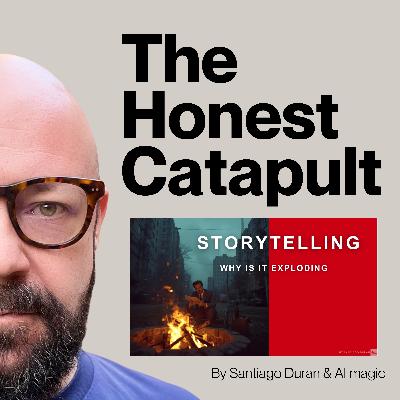
As #AI has completely depreciated many hard skills (coding, UX, etc.) in the professional market, there is one "Soft Skill" that has arisen: Storytelling. In this episode of The Honest Catapult, we tear down the corporate façade of 2026 to reveal why narrative competence is no longer optional—it is the ultimate competitive advantage.We dive deep into the strategic insights of Santiago Duran, a Clinical Psychologist and Marketing Science expert who argues that we are witnessing a fundamental "restructuring of value." As technical execution becomes a commodity, the ability to generate human meaning and "vibe" has become the new hard currency.In this episode, we explore:The Death of the Traditional Resume: Why listing "tasks performed" is a relic of the past and how the "Narrative CV" is the only way to bypass AI gatekeepers and connect with human recruiters.The Science of Vibe (AVC): A breakdown of Affective Vibe Narrative Construction—moving beyond the "Hero’s Journey" to build emotional realities that stick.The Personal Myth: How to descend into your subconscious "operating system" to identify the self-limiting stories that are sabotaging your leadership and growth.Panic Buying Narrative: Why global giants like Google and Microsoft are restructuring entire divisions around storytelling while most professionals are still playing by 2024 rules.If you don't take control of your story, an algorithm will default you into a category where you don’t belong. It's time to stop treating your career like an accident and start architecturalizing your narrative.Take control of your story. Take control of your career.
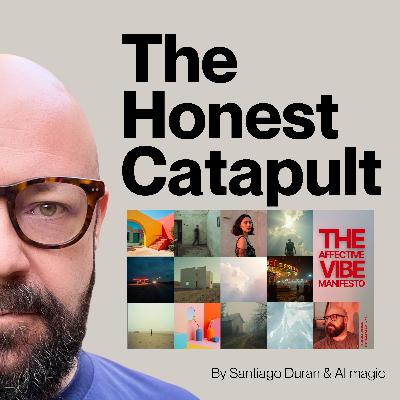
Is the traditional narrative arc flatlining? In the chaos of 2025, the "hero’s journey" has been hijacked by a new force: The Vibe.In this episode of The Honest Catapult, we attend the highly aesthetic funeral of linear storytelling. We dive deep into the research of Santiago Duran to explore the Affective Vibe Construction (AVC) paradigm. Discover why global brands are losing $1 billion annually to "content friction" and why the next era of marketing isn't about telling a story—it’s about orchestrating a frequency.What we cover in this deep dive:The Crisis of Chronology: Why media fragmentation has turned us all into "content grazers" and rendered the 30-second ad a relic of the past.Vibe Coding: How the world of AI software development is providing a new blueprint for brand building based on "flow" rather than rigid specs.The Science of the Sensation: Breaking down Gestalt Fluency and Affective Logic—the psychological shortcuts that allow brands to bypass the rational brain.Cohesion vs. Coherence: Why your content doesn’t need to make logical sense as long as it feels like it belongs to the same "soul".The A24 Case Study: How a film studio became a cultural movement by selling "subterranean sophistication" instead of just movies.Measuring A-ROI: Moving beyond completion rates to track Sentiment Intensity and Aesthetic Recall.Keywords & Topics:Digital Marketing 2025, Brand Strategy, Affective Vibe Construction, Narrative Theory, Gen Alpha Lexicon, Media Fragmentation, Vibe Coding, Content Friction, Short-form Video Strategy, A24 Marketing, Luxury Branding, Gestalt Fluency, Consumer Psychology.Notable Quotes:"The vibe travels so fast it 'pre-travels.' You aren't processing information; you're confirming a frequency you were already tuned into.""Stop trying to be the author of the story and start being the architect of the atmosphere."
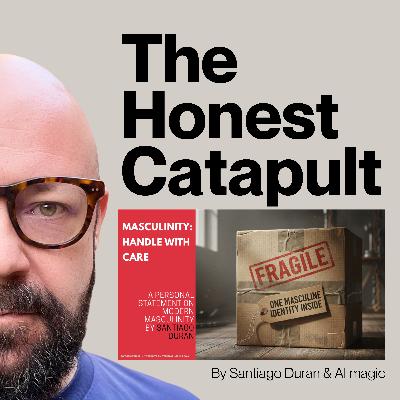
In this essential episode, we go beyond the surface of Santiago Duran's groundbreaking essay, "MASCULINITY: HANDLE WITH CARE." Duran argues that despite talk of "new standards," modern masculinity remains a high-pressure, defensive state. We explore:The meaning of the "fragile cage" and the restrictions it places on male emotional expression.The societal demand for men to be a "Success Object," where worth is tied solely to achievement.The deep-rooted expectation of male disposability and the myth of heroic sacrifice.How acknowledging vulnerability is often weaponized as a sign of weakness.This is a vital conversation for anyone ready to dismantle the burden of silent suffering and foster true, honest connection.Have you felt the intense pressure to achieve? To be silent? To sacrifice? "MASCULINITY: HANDLE WITH CARE," illuminates the high cost of modern manhood. Duran challenges the notion that masculinity can be "fixed" without first recognizing the deep-seated pain. We tackle the core topics: the cruel paradox of being told to open up, only to be punished when you do; the relentless focus on men as a "Success Object"; and the ingrained expectation of male disposability. This episode is a call to action: to stop defending the "fragile cage" and embrace the power of recognizing your own pain.-----------I love sharing insights, ideas, and experiences that spark conversations and inspire new perspectives. If you've found value in my content you can contribute here:👉 https://linktr.ee/duranpsicologiaYour support helps me continue creating meaningful content.
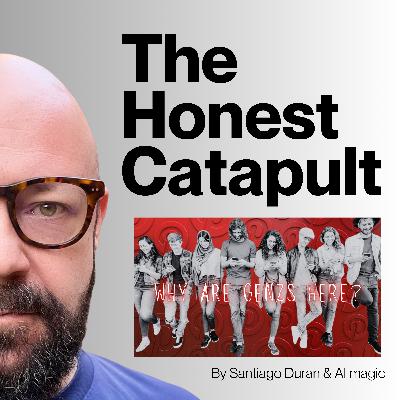
Ever wonder why Gen Z is leaving TikTok's endless scroll for Pinterest's curated boards? In this episode, we're diving into the paradox of a generation that grew up online but is now prioritizing privacy and mental health over public performance.While platforms like Instagram and TikTok thrive on documentation and self-promotion, we'll explore why Gen Z is gravitating towards Pinterest, a space centered on personal discovery and intentional sharing. We'll break down how this shift is about more than just trends—it’s a conscious choice to escape the competitive, performative pressure of mainstream social media.Tune in to discover how this generation is redefining online expression and creating a digital refuge focused on visual discovery and positive engagement.
Media agencies: the misunderstood monsters of advertising. Are they ruthless financial machines feeding off client budgets, or the silent strategists who actually hold the keys to brand growth?In this episode, I take you on a historical journey from the birth of media shops in the 70s, to my own baptism by fire in Colombia’s first media agency, to the digital-first transformations that reshaped entire markets. You’ll hear the untold story of why creatives despised us, why media outlets feared us, and why clients—despite the criticism—could never let us go.This isn’t just a defense of media agencies; it’s a love letter to their power, their flaws, and their future. If you’ve ever wondered whether media agencies are villains, heroes, or the “perfect monsters” of the marketing world—this one will change how you see the industry forever.Support My WorkI love sharing insights, ideas, and experiences that spark conversations and inspire new perspectives. If you've found value in my content and would like to support my work, you can contribute here:👉 PayPal.Me/santigoatYour support helps me continue creating meaningful content. Every contribution, big or small, is truly appreciated. Thank you!
Based on the article "The Creative Dilemma: Natural Intelligence vs. Artificial Incompetence," this episode explores the contrast between human creativity and AI-generated content. The author, a psychologist with experience in advertising, acknowledges AI's efficiency and utility but argues it falls short in producing truly original, impactful creations. The piece highlights three core human capacities—free association of ideas, slow thought leading to originality, and the role of incoherence or "happy accidents"—that are either absent or diminished in AI's algorithmic processes. It concludes that despite AI's "good-enough" output dominating various industries, it lacks the unique, personal, and transformative essence of human-made art. The author asserts that this shift compromises the depth and originality of creative output in favor of speed and volume.Support My WorkI love sharing insights, ideas, and experiences that spark conversations and inspire new perspectives. If you've found value in my content and would like to support my work, you can contribute here:👉 PayPal.Me/santigoatYour support helps me continue creating meaningful content. Every contribution, big or small, is truly appreciated. Thank you! 🙌
In this episode, we explore a sharply critical editorial that tackles the overuse and superficial application of the term “AI” in today’s business and marketing landscape. The author draws parallels to past tech clichés like “there’s an app for that,” expressing frustration at how companies and self-proclaimed thought leaders use the term to signal innovation without substance.While recognizing the transformative potential of AI—and even using it personally—the article warns that the term is becoming diluted by hype, turning genuine progress into a kind of corporate theater where performance trumps understanding.We discuss how this trend risks overshadowing the real value of AI by making it harder to distinguish true innovation from opportunistic branding. The conversation calls for greater clarity and intentionality in how we talk about and apply AI, ensuring the term retains its meaning and impact only when it brings real solutions and insight to the table.Support My WorkI love sharing insights, ideas, and experiences that spark conversations and inspire new perspectives. If you've found value in my content and would like to support my work, you can contribute here:👉 PayPal.Me/santigoatYour support helps me continue creating meaningful content. Every contribution, big or small, is truly appreciated. Thank you!
In this episode, a deep dive in to my latest article Primed and Prompted: How I Tricked Myself—and My AI. Here is an extract: "Primes" and "prompts" fundamentally shape perception and behavior by acting as subtle cues or inputs that guide how information is processed and what kind of response is generated, whether in human minds or #AI systems Although their underlying mechanisms differ, their effects are "uncannily similar. Insight: In both cases, whether prompting machines or priming minds, the process involves "engineering a response space" by "shaping, intentionally or not, the bounds of what can be said or thought next". Both systems are, in a sense, "predictive engines, responding to prior information in patterned ways". The author realized that generative #AI is not just a "mirror of data" but "a mirror of cognition," highlighting how "much of what we call 'truth' is contingent on framing, and how easily we can fall into echo chambers". The more precisely a question is asked, the "more likely we are to hear what we want to hear". Enjoy 🔊 Support My WorkI love sharing insights, ideas, and experiences that spark conversations and inspire new perspectives. If you've found value in my content and would like to support my work, you can contribute here:👉 PayPal.Me/santigoatYour support helps me continue creating meaningful content. Every contribution, big or small, is truly appreciated. Thank you!
Is that $6 million banana taped to a wall really "art" — or is it a tax strategy in disguise?In this episode, we dive deep into the shadowy brilliance of the contemporary art market, where creativity collides with capitalism, and a painting’s true value has less to do with brushstrokes and more to do with branding.We explore how the romantic idea of the “mecenas” has been replaced by billionaires who use art to diversify portfolios, dodge taxes, and signal elite status. Alongside them, a tight network of artists-as-brands, hype-building galleries, and auction houses operate in perfect sync — turning speculation into prestige and tax write-offs into cultural legacy.Coining and unpacking the concept of Hamparte (art with no artistic merit, just market muscle), we challenge the idea that genius is what's hanging on those white walls… or if it's just a well-executed marketing scheme.🎨 Is this the death of art as we knew it — or just the next phase of its evolution?💬 Plus:Why Basquiat became the ultimate capitalist flexHow aer galeries are used to legitimize inflated valuationsWhether there's still hope for raw, authentic artistic expression in the marginsIf you’ve ever side-eyed a minimalist canvas priced like a Manhattan penthouse, this conversation is for you.🔗 Listen now and join the debate.#ArtMarket #ContemporaryArt #Hamparte #Basquiat #CulturalCapital #TaxLoopholes #PodcastSupport My WorkI love sharing insights, ideas, and experiences that spark conversations and inspire new perspectives. If you've found value in my content and would like to support my work, you can contribute here:👉 PayPal.Me/santigoatYour support helps me continue creating meaningful content. Every contribution, big or small, is truly appreciated. Thank you!
In this provocative episode, we dive into the complex and often controversial world of data-driven advertising—a system built on our clicks, preferences, and digital behavior.Author Santiago Duran offers a sharp, honest article to inspire our conversation. The question of how personal data powers the modern advertising machine, enabling hyper-targeted campaigns that promise more relevant experiences for consumers—and better results for businesses. But is this really a win-win? is our focus.We explore the double-edged nature of data-driven advertising:📊 Is it truly better for users—or just more manipulative?🏢 Does it level the playing field for small businesses—or reinforce the power of tech giants?🔐 What are the ethical limits of personalization, privacy, and consent?💡 Can we design ad ecosystems that are transparent, fair, and still effective?From cookies to algorithms, from consumer trust to brand accountability, this episode challenges us to think critically about the value exchange behind every ad we see—and what kind of digital economy we want to build.If you’ve ever wondered whether data-driven marketing serves you—or just sells you—this is a conversation you need to hear.Support My WorkI love sharing insights, ideas, and experiences that spark conversations and inspire new perspectives. If you've found value in my content and would like to support my work, you can contribute here:👉 PayPal.Me/santigoatYour support helps me continue creating meaningful content. Every contribution, big or small, is truly appreciated. Thank you! 🙌
In this episode, we explore one of the most transformative economic shifts impacting Latin America today: nearshoring—the strategic relocation of business operations closer to home, particularly to countries like Mexico, Colombia, and Brazil.Host Santiago Duran unpacks how nearshoring is more than just a supply chain strategy—it's a tectonic force reshaping industries, labor markets, and geopolitical relationships across the region. From manufacturing to tech services, Latin America is becoming an increasingly attractive partner for North American companies seeking agility, resilience, and cost efficiency in a post-globalized world.But what does this mean for Latin American economies? Who benefits? And are we truly ready?This episode explores:How global disruptions (pandemics, geopolitics, climate) accelerated the nearshoring waveThe sectors most impacted and how local talent is adaptingThe risks of building economies on shifting ground—and what sustainable growth actually requiresWhy governments, educators, and businesses must align to seize the momentNearshoring isn't a trend—it's a seismic shift. And in this conversation, we examine whether Latin America is positioned to lead this new economic era or risk being reshaped by it.--------Support My WorkI love sharing insights, ideas, and experiences that spark conversations and inspire new perspectives. If you've found value in my content and would like to support my work, you can contribute here:👉 PayPal.Me/santigoatYour support helps me continue creating meaningful content. Every contribution, big or small, is truly appreciated. Thank you!
In this episode, we unpack a provocative article that challenges the current obsession with performance marketing metrics—like clicks, conversions, and ROI—as the sole indicators of success. The author argues that this narrow focus often leads brands to pursue short-term wins without ever establishing a clear direction, comparing it to driving fast without knowing where you're going.We explore the core message: that a strong, clearly articulated brand strategy—anchored in identity and purpose—acts as a North Star, guiding everything from campaigns to culture. The article warns that while metrics offer valuable feedback, they can’t set the destination, nor can they build enduring brand equity.The conversation turns to the idea that intentional branding and consistency are what fuel long-term impact. And while great branding can weather weak execution, no amount of clever marketing can rescue a brand that lacks a solid foundation. Whether you're a CMO or just brand-curious, this episode offers a compelling case for stepping back from the data dashboard to ask the bigger questions about who you are—and why it matters.I love sharing insights, ideas, and experiences that spark conversations and inspire new perspectives. If you've found value in my content and would like to support my work, you can contribute here:👉 PayPal.Me/santigoatYour support helps me continue creating meaningful content. Every contribution, big or small, is truly appreciated. Thank you!
In this eye-opening episode, we dive deep into one of the most urgent—and often misunderstood—challenges facing the tech ecosystem in Latin America: the widening gap between the surging demand for tech professionals and the limited supply of skilled talent.Author Santiago Duran brings a couple of articles that we unpack, telling the real story behind this talent drought, with a candid conversation that explores why so many promising individuals still feel locked out of tech careers, despite the industry's promise of economic mobility and global opportunity. Together we deconstruct three persistent myths that are holding back the region’s tech potential:💡 That tech is only for "geniuses" or a gifted few🚫 That women don't belong or won't succeed in tech💸 That breaking into the field requires unaffordable educationBut it’s not all doom and gloom. This episode also spotlights hopeful solutions and bold innovators—from coding bootcamps to hybrid learning models—who are reshaping the narrative and creating accessible, skills-based pathways into tech.We ask: What would it take to unlock Latin America's tech superpower? And how can we change cultural narratives to reflect the reality that tech isn't just a career for the elite—it’s a lifeline for the next generation?Whether you're a tech recruiter, educator, or someone thinking of switching careers, this is a conversation you won’t want to miss.Support My WorkI love sharing insights, ideas, and experiences that spark conversations and inspire new perspectives. If you've found value in my content and would like to support my work, you can contribute here:👉 PayPal.Me/santigoat Your support helps me continue creating meaningful content. Every contribution, big or small, is truly appreciated. Thank you!
In this episode, we dive into a recent market analysis exploring the Mexican EdTech landscape—its current size, competitive dynamics, and key players. The discussion centers on TripleTen’s positioning within this environment, highlighting its strengths and the opportunities that lie ahead.We take a closer look at how TripleTen compares to local and global competitors, examining differences in course offerings, communication strategies, and overall market presence. One standout feature is TripleTen’s job guarantee, which gives it a competitive edge—but the report also emphasizes the need to increase local relevance and brand differentiation in a crowded, noisy space.To wrap it up, we explore the strategic recommendations outlined in the report for TripleTen to grow its market share and build a stronger foothold in Mexico’s fast-evolving EdTech ecosystem.Support My WorkI love sharing insights, ideas, and experiences that spark conversations and inspire new perspectives. If you've found value in my content and would like to support my work, you can contribute here:👉 PayPal.Me/santigoatYour support helps me continue creating meaningful content. Every contribution, big or small, is truly appreciated. Thank you! 🙌
In this episode, we critically examine an article that delves into the complex dynamics of vulnerability, kindness, and generosity in today’s professional world. While these values are often praised as essential for human connection and success, the reality is that practicing them can sometimes come with risks.The discussion explores the role of psychological safety as a key factor in enabling these qualities to thrive without backfiring. However, the episode also challenges the assumption that psychological safety should be universally applied, questioning its cultural and philosophical limitations.Ultimately, we seek to strike a balance: How can we create environments where openness is encouraged, but resilience is also cultivated? And what happens when kindness is met with skepticism rather than reciprocity?Support My WorkI love sharing insights, ideas, and experiences that spark conversations and inspire new perspectives. If you've found value in my content and would like to support my work, you can contribute here:👉 PayPal.Me/santigoatYour support helps me continue creating meaningful content. Every contribution, big or small, is truly appreciated. Thank you! 🙌
n this episode, we engage in a thought-provoking discussion on an article by Santiago Duran, a clinical psychologist with a background in marketing, who argues that every human relationship is fundamentally a transaction.Drawing from two key influences, he examines how institutional power, as explored by Michel Foucault, shapes our definitions of “normal” and “abnormal,” and how Family Constellation Therapy reveals the hidden dynamics of order and balance in relationships.Expanding the idea of transactions beyond economics, Duran explores how reciprocity and mutual benefit—whether emotional or practical—are at the core of all interactions. He challenges the ideal of absolute independence, advocating instead for healthy interdependence and fair exchanges.Finally, the episode questions whether the push to “humanize” interactions can sometimes introduce biases that undermine fairness and efficiency. By understanding the transactional nature of relationships, could we actually improve the way we connect with others?Support My WorkI love sharing insights, ideas, and experiences that spark conversations and inspire new perspectives. If you've found value in my content and would like to support my work, you can contribute here:👉 PayPal.Me/santigoatYour support helps me continue creating meaningful content. Every contribution, big or small, is truly appreciated. Thank you! 🙌

Comments

Download from Google Play

Download from App Store
 United States