


 Claim Ownership
Deep Dive
Subscribed: 0Played: 3
Subscribe

© _Arya_
Description
Why do we say "bless you" when someone sneezes? What makes time feel slower when we’re bored? Is déjà vu just a brain glitch—or something more? The Inquisitive Mind is your weekly dive into the fascinating questions we all encounter but rarely explore. Hosted with curiosity and a touch of wit, each episode unpacks the mysteries, oddities, and overlooked wonders of everyday life. If you've ever wondered "why is that?"—this podcast is for you.
11 Episodes
Reverse
Why do we know the perfect moment to bid at an auction, hire a candidate, or even pop the champagne? In this episode of Deep Dive, we unpack the theory of optimal stopping—a branch of decision science that pinpoints exactly when to act for the best payoff. From the classic “secretary problem” to real-world applications in finance, dating apps, and bargain hunting, discover how mathematicians model risk, reward, and timing. You’ll learn why sometimes the best choice is to walk away—and how this counterintuitive logic can help you make smarter decisions in everyday life.
Why do so many ancient civilizations speak of creation from a cosmic void, gods born of clay, and heroes who defy fate? In this episode of Deep Dive, we journey through comparative mythology to uncover the shared archetypes and motifs that span continents and millennia. From the flood tales of Mesopotamia and the world-egg of India to the twin-hero myths of the Americas, we’ll explore how linguistic clues, structural patterns, and even psychoanalytic insights reveal a universal human imagination at work. Join us as we map the threads that tie Zeus to Odin, Isis to Inanna, and uncover what these resonant stories tell us about our collective quest for meaning.
What is it about creaking floorboards, half‑seen shapes, and whispered legends that quickens our pulse? In this episode of Deep Dive, we venture into the evolutionary roots of fear and our fascination with ghosts. You’ll learn how ancient survival mechanisms—like hyper‑vigilance to ambiguous stimuli—prime us to detect threats in the dark, why storytelling amplifies supernatural beliefs, and how modern neuroscience explains chills down the spine. We’ll speak with psychologists, anthropologists, and paranormal investigators to understand why the unknown still haunts us—and how confronting those fears can unlock resilience, creativity, and wonder. Tune in for spine‑tingling tales, cutting‑edge research, and practical tips to harness fear rather than be paralyzed by it.
In an age of constant notifications, endless newsfeeds, and 24/7 connectivity, our brains are pushed to the breaking point. In this episode of Deep Dive, we explore the science of information overload—what happens in your mind when you’re bombarded with data, why multitasking actually backfires, and how chronic digital bombardment fuels stress, decision fatigue, and burnout. You’ll hear from cognitive psychologists about attention bottlenecks, learn practical strategies to reclaim mental bandwidth, and discover why doing less can sometimes achieve more. Tune in to understand the hidden costs of our hyper‑connected world and take away actionable tips for a healthier information diet.
Why do we default to weather updates or “How’ve you been?” when the room goes silent? In this episode of Deep Dive, we explore how small talk evolved as a social survival tool—softening tension, building alliances, and helping our ancestors navigate uncertain situations. Discover the hidden evolutionary logic behind every “Hi, how are you?” and learn why idle chatter still feels so essential today.
Can a tolerant society remain tolerant if it tolerates intolerance? In this thought-provoking episode of Deep Dive, we explore the Paradox of Tolerance—a philosophical dilemma introduced by Karl Popper that still haunts modern democracies. We unpack the tension between free expression and social harm, the limits of open-mindedness, and how liberal values can be both a strength and a vulnerability in the face of extremism. This is where political theory, ethics, and current events collide.
Ever wonder why a simple swipe can spark so much excitement—or anxiety? In this episode of Deep Dive, we trace today’s dating apps back to ancient mate-selection strategies. Discover how your brain’s primal wiring for health, status, and trust still drives
Ever wonder why a simple swipe can spark so much excitement—or anxiety? In this episode of Deep Dive, we trace today’s dating apps back to ancient mate-selection strategies. Discover how your brain’s primal wiring for health, status, and trust still drives every match, message, and ghost—and learn how to hack those instincts for better connections.
Why do our minds spiral into endless "what ifs"? In this episode of Deep Dive, we explore how overthinking — once a survival advantage that helped our ancestors anticipate dangers — has become a source of modern stress and anxiety. We'll trace the evolutionary roots of rumination, understand why our brains are wired to expect the worst, and uncover strategies to break free from the mental loops that no longer serve us. Prepare to rethink the way you think!
Have you ever been certain that the Monopoly Man wears a monocle, or that Darth Vader said, “Luke, I am your father”? You're not alone. Welcome to the Mandela Effect—a phenomenon where large groups of people share the same false memory. In this episode of The Inquisitive Mind, we delve into the psychology behind these collective misrememberings. We'll explore how our brains can create vivid yet inaccurate memories, the role of social and cognitive reinforcement, and how the digital age amplifies these effects. Join us as we unravel why our memories aren't as reliable as we think and what this means for our understanding of reality.
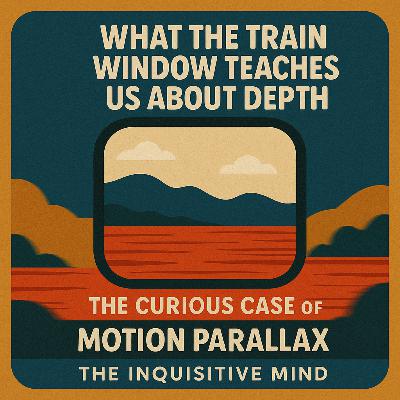
Why do nearby trees whiz by while distant mountains seem to move slowly when you look out a train window? Welcome to the world of motion parallax—a fascinating visual phenomenon that helps your brain judge depth and distance in motion. In this episode of Deep Dive, we explore the "Train Window Effect" and how your perception is shaped by relative motion. From its role in virtual reality to its evolutionary importance in animals and humans, we unravel how your brain turns movement into a 3D understanding of the world. Prepare to never look out a moving window the same way again.
Comments

Download from Google Play

Download from App Store
 United States