


 Claim Ownership
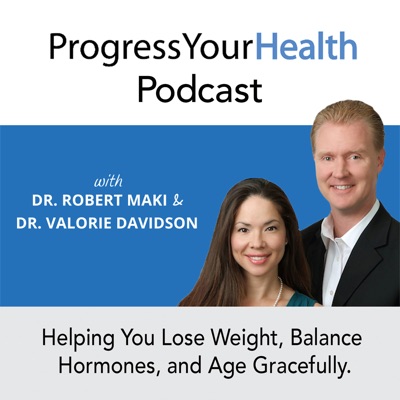
Progress Your Health Podcast
Subscribed: 165Played: 1,776
Subscribe

© 2025 Progress Your Health, Inc
Description
Struggling with stubborn weight gain, exhaustion, poor sleep, anxiety, low libido, brain fog, or hot flashes? These aren’t “just aging,” they’re signs of hormone imbalance. The Progress Your Health Podcast is your go-to resource for perimenopause, menopause, thyroid health, and hormones hosted by Doctors and hormone experts Dr. Valorie Davidson and Dr. Robert Maki.
We translate complex hormone science into simple, actionable steps to help you:
Balance hormones naturally
Lose weight and improve metabolism
Boost energy and mood
Sleep better and reduce night sweats
Restore libido and confidence
ge with strength, clarity, and vitality
We cover common hormonal conditions including:
Perimenopause + Menopause
Thyroid Disorders (Hypothyroidism, Hashimoto’s)
Adrenal Issues + Cortisol Imbalances
PMS + PCOS
Estrogen Dominance + Low Progesterone
Testosterone Imbalance in Women
Hormone Replacement Therapy (HRT)
With real patient examples, research backed strategies, and candid conversations, this podcast gives you the clarity and confidence you’ve been missing.
New episodes help you take control of your hormones, feel like yourself again, and finally make progress with your health.
Subscribe and start your transformation today.
We translate complex hormone science into simple, actionable steps to help you:
Balance hormones naturally
Lose weight and improve metabolism
Boost energy and mood
Sleep better and reduce night sweats
Restore libido and confidence
ge with strength, clarity, and vitality
We cover common hormonal conditions including:
Perimenopause + Menopause
Thyroid Disorders (Hypothyroidism, Hashimoto’s)
Adrenal Issues + Cortisol Imbalances
PMS + PCOS
Estrogen Dominance + Low Progesterone
Testosterone Imbalance in Women
Hormone Replacement Therapy (HRT)
With real patient examples, research backed strategies, and candid conversations, this podcast gives you the clarity and confidence you’ve been missing.
New episodes help you take control of your hormones, feel like yourself again, and finally make progress with your health.
Subscribe and start your transformation today.
200 Episodes
Reverse
Protecting your `heart health` is crucial, especially during `menopause`, when risks can increase. In this `women’s health` episode, Dr. Valorie Davidson and Dr. Robert Maki share essential `health tips` and insights into how `hormones` impact cardiovascular well-being. Learn about important lab tests and supplements to safeguard your heart. You’ll learn: ● Why heart disease in women is often a “silent” problem until it’s serious ● The difference between general “heart disease” and atherosclerosis ● Coronary calcium scores: what they are, what the numbers mean, and when to consider one ● Why total cholesterol alone is useless (and often scary for
Can You Do Rhythmic Dosing After a Hysterectomy? Short answer: Yes, but there are some other factors to take into consideration to make sure someone is a good candidate. In this episode, Dr. Valorie and Dr. Maki explain how rhythmic dosing works without a uterus, why it can be an excellent option after total hysterectomy (with oophorectomy) or surgical menopause, and when a simpler static approach might be better. We cover candidates, myths (like “no uterus = no progesterone”), brain and bone benefits, and how to personalize dosing for real-life outcomes—sleep, mood, cognition, libido, and long-term bone strength. What you’ll
Confused by your DEXA scan results? Not sure if your T-score is “normal,” “osteopenia,” or “osteoporosis”or what to actually do about it? In this episode, Dr. Valorie Davidson and Dr. Robert Maki walk through three real viewer examples to show You exactly how to interpret bone density scores in your 50s and beyond. You’ll learn: ● How to read your DEXA scan: T-score vs Z-score in plain English ● The cutoffs: ○ 0 to -0.9 → normal bone density ○ -1.0 to -2.4 → osteopenia ○ ≤ -2.5 → osteoporosis ● Why two women in their early 50s can have
Many women confuse cycling static HRT with rhythmic dosing, but they’re not the same thing. In this episode, Dr. Valorie Davidson and Dr. Robert Maki from Progress Your Health break down the difference between the two, why it matters for your safety, and how to do hormone therapy the right way. In this video, you’ll learn: ● What “rhythmic dosing” actually means ● Why cycling your static HRT is not rhythmic dosing ● How improper dosing can impact mood, energy, and breast tenderness ● The risks of trying to adjust hormones on your own ● Why rhythmic dosing must follow

In Part 2, we go symptom-by-symptom so you can sleep through the night again. Dr. Valorie and Dr. Maki cover night sweats, frequent urination, heart palpitations, muscle cramps, headaches, itchy skin, vivid dreams, and when to suspect sleep apnea (under-recognized in women). You’ll hear practical tactics—electrolytes, targeted magnesium types, phosphatidylserine timing, glycine, L-theanine, and smart melatonin use—plus when HRT helps and how to pair data (CGM, wearables) with your sleep plan. You’ll also discover practical, science-backed fixes like: Smart electrolyte balance & targeted magnesium types Phosphatidylserine timing for cortisol control Glycine, L-theanine, and optimal melatonin use
Why midlife wrecks your sleep—and how to fix it naturally. In Part 1, Dr. Valorie and Dr. Maki unpack the hormone triad behind women’s insomnia: shifting estrogen/progesterone, cortisol dysregulation, and blood sugar/insulin resistance. You’ll learn the difference between trouble falling vs. staying asleep, how low progesterone affects GABA (hello 2–3 a.m. wake-ups), and the daily habits that reset your circadian rhythm. What you’ll learn ● The hormone triad driving midlife sleep loss ● “Vampire / Zombie / Ghoul” sleep patterns—what they mean ● Why blood sugar swings trigger nighttime cortisol spikes ● Morning fixes that help nights: protein breakfast, light
Are you worried about bone loss, osteopenia, or osteoporosis? In this episode, Dr. Valorie Davidson and Dr. Maki from Progress Your Health dive deep into what women can do—beyond medication—to protect and rebuild bone density through hormones, nutrition, supplements, and lifestyle. Learn how to: ● Understand your DEXA scan and what your T-score really means ● Support bone strength through weight-bearing exercise & muscle building ● Use HRT (estrogen, progesterone, testosterone) to slow post-menopausal bone loss ● Balance calcium, magnesium, vitamin D + K2, and collagen the right way ● Avoid common pitfalls with over-supplementation ● Discover why healthspan +
Learn how to read a DEXA scan—step by step. In this live session, Dr. Valorie and Dr. Maki walk through real patient case studies and show you exactly how to interpret T-scores, Z-scores, and FRAX so you can understand osteopenia vs osteoporosis, track progress over time, and focus on what actually moves the needle for stronger bones. What you’ll learn ● T-Score vs Z-Score: What they measure and which one matters most for decisions ● FRAX (hip & major fracture risk): When it’s useful—and when it’s misleading ● Case studies over multiple years: How lifestyle, protein intake, weight-bearing exercise, and
In this episode, Dr. Robert Maki walks through his exact testosterone rhythmic dosing protocol—how he cycles doses daily across a 26 to 28-day month and seasonally (25% / 50% / 75%) to align with Dr. Valorie’s cycle. We cover why this “rhythm over static” approach is designed to preserve receptor sensitivity (avoiding the down-regulation common with large, infrequent injections), plus practical details like application sites, off-days, and lab targets. What you’ll learn: ● The men’s “rhythm”: monthly sync with partner + annual seasons (lowest winter → highest fall) ● Why off-days on 14 & 28 help up-regulate receptors ● The
In this episode, Dr. Valorie Davidson and Dr. Robert Maki break down exactly how Dr. Valorie runs her personal rhythmic dosing—including the day-by-day estradiol (E2) and progesterone (P4) schedule that recreates a 28-day ovarian cycle. If you’ve heard us talk about “In-Betweeners” (women transitioning from late perimenopause into early menopause) and wondered how rhythmic dosing actually works in real life, this walkthrough is for you. What you’ll learn ● The difference between static vs rhythmic HRT—and why some In-Betweeners thrive on a cyclical protocol ● How a day-12 estradiol surge (with a softer “landing” on day 13) can mimic physiology
Estrogen dips can trigger migraines—especially in perimenopause. Here’s how to spot it and what helps. Dr. Valerie Davidson and Dr. Robert Maki explain why sudden drops in estradiol can spark headaches/migraines in cycling women, perimenopause, and menopause, plus what to do if HRT dosing (patch vs BiEst vs rhythmic) is making things worse. They also cover DIM (diindolylmethane)—when it helps vs when it can exacerbate low-estrogen symptoms, and supportive options like magnesium glycinate, B-complex, Vitamin D, and blood sugar balance. What you’ll learn ● How luteal-phase and ovulation-time estrogen drops trigger migraines ● Why perimenopause creates spike-and-crash estradiol patterns (and
Should you use estradiol cream on your face? Dr. Valerie Davidson and Dr. Robert Maki explain why estriol (E3) is a gentler, safer alternative for wrinkles, melasma, vaginal health, and hormone balance during perimenopause and menopause. They share the risks of estradiol absorption, why it can throw off your HRT program, and why estriol is often the better choice—for both skin care and vaginal tissues. You’ll also learn about systemic vs local hormone use, melasma risk, and the real-world challenge of getting access to estriol. If you have a question, please visit our website and click Ask the Doctor a
If you’ve ever wondered which blood tests actually matter for women’s hormones and longevity, this episode is your roadmap. Dr. Valorie Davidson and Dr. Robert Maki walk through real labs—from CBC/CMP to cholesterol, estradiol/FSH/LH, DHEA, testosterone, insulin, and apolipoprotein B (ApoB). You’ll learn how to spot insulin resistance (TG/HDL ratio), why ApoB beats total cholesterol for risk, how liver markers (AST/ALT/GGT) fit in, and how rhythmic dosing can mimic the natural ovarian cycle. We also cover hs-CRP vs ESR, vitamin D ranges, pregnenolone, and why individualized care wins over one-size-fits-all. What you’ll learn: ● How to read CBC/CMP for nutrition,
Are you experiencing bleeding or spotting while on hormone replacement therapy (HRT)? In this episode, Dr. Valorie Davidson and Dr. Robert Maki from Progress Your Health dive deep into one of the most common — and frustrating — concerns women face on HRT: when and how to adjust estrogen, progesterone, or testosterone. Using a real-world patient example (shared with permission and anonymized), we break down: ● Why some women continue bleeding on HRT despite progesterone support ● The role of estradiol sensitivity and early heavy periods in predicting uterine response ● Static vs rhythmic dosing for estrogen — and how
Can you use rhythmic-dosing HRT after a uterine (endometrial) ablation? In this episode, Dr. Valorie Davidson and Dr. Robert Maki explain why—and how to do it safely. Can you do rhythmic dosing HRT after a uterine (endometrial) ablation? Short answer: yes—and in this episode Dr. Valorie Davidson and Dr. Robert Maki explains why. We unpack how rhythmic dosing works post-ablation, what to expect if you don’t bleed, how estrogen and progesterone balance drives symptoms, and why individualized monitoring (including occasional ultrasounds) can give peace of mind. If you’ve worried that higher physiologic estradiol might “recreate old problems,” we cover how
Surgical menopause happens fast—especially if both ovaries are removed (oophorectomy). In this episode, Dr. Valorie Davidson and Dr. Robert Maki explain how surgical menopause differs from “natural” menopause, why symptoms can arrive abruptly, and how to think about HRT options (rhythmic vs static), bone density, brain health, and long-term prevention. If you’ve had your ovaries removed—or you’re facing that decision—this is for you. What you’ll learn: ● Surgical vs “natural” menopause: why timing and symptom intensity differ ● Oophorectomy, hysterectomy & endometriosis: when and why surgery happens ● Symptom timelines after ovary removal (often within weeks) and what that means
Are you stuck in the in-between—not fully in perimenopause, but not quite in menopause either? In this episode, Dr. Valorie Davidson and Dr. Robert Maki from Progress Your Health dive deep into the gray area of women’s health that often gets overlooked. We cover: ✅ The most common in-betweener symptoms (hot flashes, brain fog, low libido, weight gain, hair & skin changes, sleep problems). ✅ Why the in-between phase is often the most challenging and overlooked in women’s health. ✅ How HRT (Hormone Replacement Therapy) and bioidentical hormones may help—and when to be cautious with estrogen. ✅ Lifestyle, supplementation, and
In this episode, Dr. Valorie Davidson and Dr. Robert Maki from Progress Your Health respond to a powerful listener comment about estradiol levels and hormone replacement therapy (HRT). Many women feel dismissed when it comes to their hormone care—and this conversation gets right to the heart of it. We cover: ● Why some women feel terrible when their estradiol drops below 60—and why that number matters for hot flashes, sleep, energy, and exercise tolerance. ● The link between estrogen decline and rising cholesterol, cardiovascular risk, osteoporosis, dementia, and metabolic health. ● Static dosing vs. rhythmic dosing of estrogen—why it matters
Should You Aim for the Minimum or Optimal HRT Dose? Should women on hormone replacement therapy (HRT) use the minimum dose to manage symptoms—or aim for an optimal dose to support long-term bone, brain, and heart health? This is a common and important question. In this episode of the Progress Your Health Podcast, Dr. Valorie Davidson and Dr. Robert Maki break it down in a clear, practical way. Static vs. Rhythmic Hormone Dosing Not all hormone dosing approaches are the same. In this episode, we explain the key differences between static dosing and rhythmic (cyclical) dosing, and why this distinction
Exciting Announcement! We’re launching the Progress Your Hormones Community today—a space designed to empower women with expert guidance and support for navigating perimenopause and menopause. Get access to live office hours, hormone hot seats, lab interpretation, and more! If you have a question, please visit our website and click Ask the Doctor a question. Join the Progress Your Hormones Community Stay Connected Instagram: @drvalorie TikTok: @drvaloried Disclaimer: All content in this blog, including text, images, audio, video, or other formats, was created for informational purposes only. This video, website, and blog aim to promote consumer/public understanding and general knowledge of various health topics.


Download from Google Play

Download from App Store
 United States
This really resonates with me. I went through hair thinning that I later learned was tied to thyroid and stress hormones, and it was scary seeing hair everywhere. Once I focused on fixing the root cause and supporting my hair externally, things slowly improved. Along the way, I also found gentle, repair-focused haircare like https://evahairglam.com/ helpful for keeping my hair stronger and healthier while my hormones were getting back into balance. It’s reassuring to know hair loss isn’t something women just have to accept.