DiscoverThe Rabbi, The Imam and The Power of Dialogue
The Rabbi, The Imam and The Power of Dialogue
Claim Ownership

The Rabbi, The Imam and The Power of Dialogue

Author: Mark Schweiger and Larchmont Productions

Subscribed: 10Played: 94
Share

Description

Since October 7th many Muslims and Jews the world over have stopped talking and in some cases turned on each other.


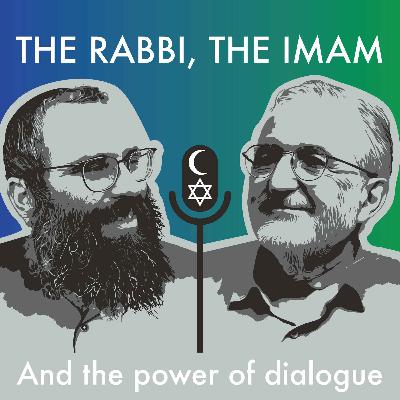
Amid this turmoil a Rabbi and an Imam managed to keep their friendship alive and have launched this podcast to show the power of dialogue in bridging divides between the two communities.

This bi-weekly podcast will explore how Imam Nasser Kurdy and Rabbi Dovid Lewis have, despite their many disagreements, managed to stay friends while war rages thousands of miles away.


They are two men of faith who speak to each other in 'good faith.'


Imam Nasser Kurdy, originally from Jordan, is a Manchester-based surgeon and lay Imam.

Rabbi Dovid Lewis, is a native Mancunion and has led the south Manchester Jewish Community since 2011.


They’ve been friends since 2012, but became closer after Nasser was stabbed in his neck outside his mosque (as reported in The Guardian) in South Manchester in 2017. 


Together, they’ve championed dozens of interfaith initiatives across schools and premiership football clubs in the north west of England since October 7th. For example, they recently co-led an assembly for teenagers on navigating difficult conversations about Israel-Palestine.


Imam Nasser Kurdy: "The Israeli-Palestinian conflict affects relationships within our local communities. Jews and Muslims are having great difficulty speaking to each other. There's no dialogue. Hence this podcast, it's about dialogue."


Rabbi Dovid Lewis: "In our own communities, we might like to think we are influential: Nasser leads the mosque, I lead the synagogue. However, neither of us are able to make a direct difference to what's happening in Israel, Palestine, Gaza, the West Bank. But what is our responsibility? It is to make sure that it doesn't spill over into our communities, into the friendships that we have made with one another."


Subscribe now to join the conversation


This is a Mark Schweiger and Larchmont Productions co-production.


Hosted on Acast. See acast.com/privacy for more information.
11 Episodes
Reverse
When a newspaper article about the Rabbi and the Imam's interfaith work and friendship went public, most of the response was positive.But buried in the Facebook comments was something darker: a stranger claiming that the Imam could not wait to take the Rabbi somewhere to be butchered, with the remark followed by a smiley face.​Rabbi Dovid shared the comment with his wife. She stopped what she was doing, looked up at him, and said:​"So you're now going to go and sit in a studio with this guy? With a man whose faith, honestly and theologically, believes you have a responsibility to kill him?"​That question sits at the heart of this episode.​Does one religion really mandate the death of the other?If so, what does it mean for their friendship?Rather than brushing the comment aside, the Rabbi and the Imam use it as a chance to examine one of the most misunderstood and weaponised narrations.​What We Get Into:The Comment ItselfThe exact words, the immediate emotional reaction, and why Dovid says: "It only takes one. And the person is still dead. It does not matter whether or not he was misrepresenting his faith."​The Hadith That Extremists Love to QuoteNasser traces the origin of the quote, its context as an end‑of‑times prophecy, and delivers a direct verdict on its relevance today.Al‑Wala Wal‑Bara, Allegiance & DisassociationNasser clarifies the distinction between friendship and total allegiance, and why the two are not the same thing.Judaism's Red LinesDovid explains which theological positions would constitute a genuine barrier in Jewish law.Politics Poisoning ReligionThey examine how the conflict in the Middle East does not just colour geopolitics; it colours how people read their own scripture, and how dangerous that is.​This podcast was filmed in a studio in south Manchester and is now available to watch here on our new Youtube channelThis is a Mark Schweiger and Larchmont Productions co-production.If you have any comments or suggestions about the podcast please email: mark@schweigers.uk or philip@larchmontfilms.com Hosted on Acast. See acast.com/privacy for more information.
In this exclusive episode, Chief Constable Sir Stephen Watson of Greater Manchester Police (GMP) joins Rabbi Dovid Lewis and Imam Nasser Kurdy to discuss the major way in how UK forces are policing protests related to the Israel-Hamas war.Following a pivotal joint statement issued with Met Police Commissioner Sir Mark Rowley in December 2025, police strategy has shifted.Sir Stephen explains why certain chants and slogans - previously tolerated at pro-Palestinian marches - may now cross the threshold into hate crime or public order offences.They explore how this new approach aims to balance the democratic right to protest, with the urgent need for community safety, specifically addressing the rising fear of antisemitism within the Jewish community and maintaining community cohesion for all, including the Muslim community.This conversation dives into the "why" behind the change:How police now assess the context and intent of language like "globalise the intifada".The warning that enforcement will be more "decisive" against hate speech.The reality of policing London and Manchester during a time of heightened terrorist threat.Key Topics Discussed:00:00 - Introduction: Policing protests in a time of global conflict.05:12 - Hate Crime Legislation: How police determine if language is criminal.12:45 - Community Safety: Is the fear in the Jewish community justified?18:30 - Free Speech vs. Hate Speech: Where is the legal line?24:10 - Context and Intent: Why it matters when policing marches.31:00 - Extremism: How a small minority hijacks legitimate causes.40:15 - Community Cohesion: Are we losing the middle ground?This podcast was recorded in a studio in south Manchester and is now available to watch here on our new Youtube channelThis is a Mark Schweiger and Larchmont Productions co-production.If you have any comments or suggestions about the podcast please email: mark@schweigers.uk or philip@larchmontfilms.com Hosted on Acast. See acast.com/privacy for more information.
A mysterious letter arrived at the end of last year New Year with huge news from the King. In this special episode, we reveal why Imam Nasser was awarded an MBE and what this recognition means for the future of Muslim Jewish dialogue.From a local initiative to visiting the House of Lords and Buckingham Palace, join Rabbi Dovid and Imam Nasser as they discuss this incredible milestone and ask you to help shape their next conversation.This is a Mark Schweiger and Larchmont Productions co-production.If you have any comments or suggestions about the podcast please email: mark@schweigers.uk or philip@larchmontfilms.com Hosted on Acast. See acast.com/privacy for more information.
Recorded on Monday 15th December - 1st day of Chanukah Rabbi Dovid Lewis and Imam Nasser Kurdy respond to the anti-semitic terrorist attack on Bondi Beach in Australia on Sunday 14th December, which claimed the life of Dovid’s second cousin, Rabbi Eli Schlanger, and fourteen others attending the menorah-lighting celebration on the first night of Chanukah, including another rabbi and a Holocaust survivor.Dovid and Nasser talk about: how their Sundays unfolded; the ‘stranger’ who reached out to console Dovid; Nasser’s reflections on the extraordinary bravery of Ahmed Al Ahmed, the Muslim man who ran towards the gunman in Bondi and saved many lives; and, together, they try to find hope and inspiration in the story and message of Chanukah – known as the 'Festival of Lights'.This is a Mark Schweiger and Larchmont Productions co-production.If you have any comments or suggestions about the podcast please email: mark@schweigers.uk or philip@larchmontfilms.com Hosted on Acast. See acast.com/privacy for more information.

After a short break Imam Nasser Kurdy and Rabbi Dovid Lewis are back for a brand new series. From their time off‑air, they’ve plenty to talk about and reflect on: from the terror attack on Manchester’s Heaton Park Synagogue, and the tense vigil that followed, to how they moved an audience member to tears at an inter‑faith event, and how Nasser made history at one of British Jewry’s oldest institutions. All is explained in this edition of The Rabbi, The Imam and The Power of Dialogue.This is a Mark Schweiger and Larchmont Productions co-production.If you have any comments or suggestions about the podcast please email: mark@schweigers.uk or philip@larchmontfilms.com Hosted on Acast. See acast.com/privacy for more information.
Imran Ahmed, CEO and founder of the Center for Countering Digital Hate talks to Rabbi Dovid Lewis and Imam Nasser Kurdy about why social media algorithms are helping to drive us further apart by feeding our urge to click and share only the most biased and distressing news.Imran is the go-to expert for governments and policy makers around the world who want to understand the way social media firms capture our attention by keeping us in a constant state of anxiety and anger, and often spread misinformation and disinformation.He recently gave expert evidence before a parliamentary inquiry into the social media's role in the 2024 UK summer riots.He's guested on the BBC and NBC, and is regularly quoted in the New York Times, the Sunday Times, the Guardian, the Independent, just to name a few.Although Imran is currently living in the United States he is a native of Manchester and this podcast draws on his deep connection to the city, with the many personal relationships he developed in his formative years with members of the Jewish and Muslim communities there.The wide-ranging conversation addresses the complexities of establishing truth during events like the Gaza war, and the challenges Jews and Muslims face when trying to connect in digital spaces. But it's not all doom and gloom as he suggests ways in which the two faiths can still build real understanding across community lines.This is a Mark Schweiger and Larchmont Productions co-production.If you have any comments or suggestions about the podcast please email: mark@schweigers.uk or philip@larchmontfilms.com Hosted on Acast. See acast.com/privacy for more information.
Dovid and Nasser discuss the difficulties of showing empathy between Muslims and Jews, especially during times of conflict. They share their own experiences and explain how personal pain can make it hard to recognise the suffering of others. Drawing on lessons from their faiths, they highlight the value of compassion and respect for others, and offer advice on how listeners can develop empathy towards people from different backgrounds.This is a Mark Schweiger and Larchmont Productions co-production.If you have any comments or suggestions about the podcast please email: mark@schweigers.uk or philip@larchmontfilms.com Hosted on Acast. See acast.com/privacy for more information.
Zionism is a deeply complex and contested word, which acts as idea, a movement and a label.For many Jews Zionism represents the fulfilment of a centuries-old longing for self-determination, safety, and a homeland in Israel.It has served as a unifying force, giving a sense of purpose, identity, and collective belonging. For these people, Zionism is a source of pride and connection—spiritually, culturally, and historically.At the same time, Zionism is a source of profound division—between Jews and non-Jews, Israelis and Palestinians, and even within Jewish and broader communities.Its association with nationalism, the founding of the State of Israel, and the ongoing Israeli-Palestinian conflict makes it a flashpoint for political, religious, and ethical debates.For Palestinians and many others, Zionism is linked to displacement, loss, and ongoing struggle, while for some Jews it has come to mean different things depending on their relationship to Israel and diaspora life.In this episode The Rabbi and The Imam discuss the origin of the word Zionism, how its meaning has evolved through the centuries - from its ancient religious roots to modern political manifestations - and what it means to both of them today.On this journey Nasser explains why his upbringing initially made him an anti-Zionist, Dovid tries to distinguish between religious and political zionists, and both discuss how the idea of Zionism has been weaponised by all sides in this conflict.Links to topics mentioned in the show RootsThis is a Mark Schweiger and Larchmont Productions co-production.If you have any comments or suggestions about the podcast please email: mark@schweigers.uk or philip@larchmontfilms.com Hosted on Acast. See acast.com/privacy for more information.
Whose side are you on?

Whose side are you on?

2025-05-2134:01

Imam Nasser Kurdy and Rabbi Dovid Lewis explore the roots of their connections to the land at the heart of the Israeli-Palestinian conflict, questioning whether an attachment to a land is about ownership, heritage or spiritual longing. They discuss what it means to care so deeply about a place neither was born in, and how faith and religion have shaped their perspectives as a pro-Palestine Muslim and a pro-Israel Jew - both living in Manchester. Can a sense of belonging be shared by different peoples with overlapping histories?This is a Mark Schweiger and Larchmont Productions co-production.If you have any comments or suggestions about the podcast please email: mark@schweigers.uk or philip@larchmontfilms.com Hosted on Acast. See acast.com/privacy for more information.
In this first episode we get to know Imam Nasser Kurdy and Rabbi Dovid Lewis; how they met, whether Kosher food is also Halal, how Nasser’s stabbing changed their relationship and why October 7th changed everything in their lives.Background to podcastIn the very best of times, it’s rare for an Orthodox Rabbi and Imam to become such good friends - but how much more so since October 7th?Since that day, Muslims and Jews the world over have stopped talking to each other, and in some cases turned on each other - leaving communities worldwide heartbroken. Yet Nasser and Dovid, religious neighbours in south Manchester, England, not only choose to keep their friendship alive but are trying to use it as a force for good.This is how our podcast came about.This bi-weekly series (every two weeks) will explore how a 'pro-Palestine' Muslim and a 'pro-Israel' Jew, have maintained a friendship through open and honest dialogue, even as war rages thousands of miles away and is affecting relationships within their local communities.If you have any questions, comments or suggestions about the podcast please email mark@schweigers.uk or philip@larchmontfilms.comThis is a Mark Schweiger and Larchmont Productions co-production.If you have any comments or suggestions about the podcast please email: mark@schweigers.uk or philip@larchmontfilms.com Hosted on Acast. See acast.com/privacy for more information.
Trail for a new podcast series about The Rabbi, The Imam and the Power of Dialogue.This is a Mark Schweiger and Larchmont Productions co-production.If you have any comments or suggestions about the podcast please email: mark@schweigers.uk or philip@larchmontfilms.com Hosted on Acast. See acast.com/privacy for more information.
Comments 
loading