


 Claim Ownership
The Trial Bible | A Podcast for Trial Lawyers
Subscribed: 0Played: 0
Subscribe

Description
Welcome to The Trial Bible – your front-row seat to the courtroom strategies behind today’s biggest verdicts.
In each episode, we sit down with top trial attorneys from across the country to dissect their recent wins. You’ll hear the real stories behind headline-making cases, the key jury instructions that swayed the outcome, and the battle-tested tools that helped them hit big.
Whether you're a practicing attorney, law student, or just a fan of high-stakes storytelling, this is your guide to what really works in the courtroom. Let’s get into it.
In each episode, we sit down with top trial attorneys from across the country to dissect their recent wins. You’ll hear the real stories behind headline-making cases, the key jury instructions that swayed the outcome, and the battle-tested tools that helped them hit big.
Whether you're a practicing attorney, law student, or just a fan of high-stakes storytelling, this is your guide to what really works in the courtroom. Let’s get into it.
8 Episodes
Reverse
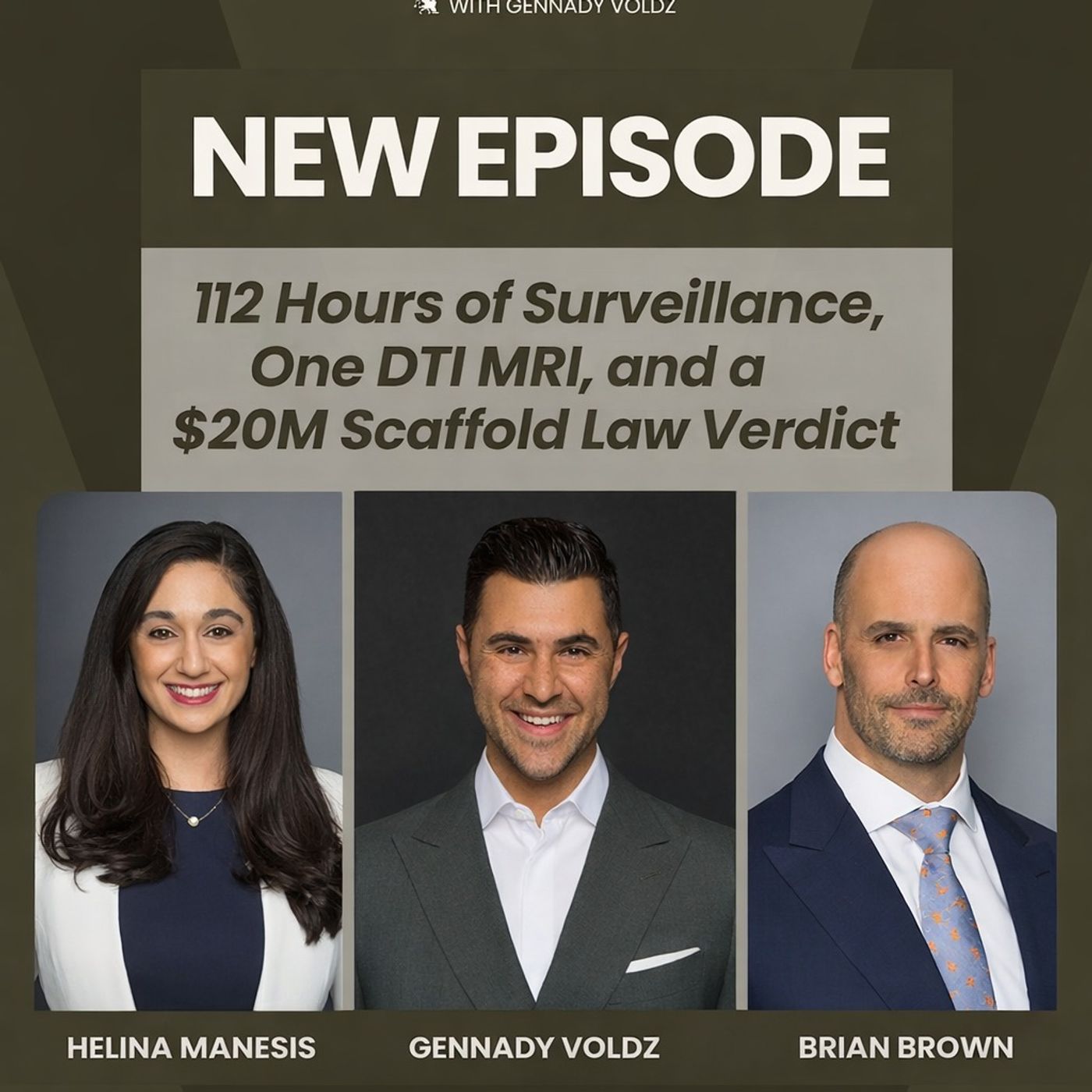
The conversation explores:How seasoned labor law litigators evaluate Labor Law §240(1) and §241(6) cases from day oneWhy this “classic scaffold law case” was anything but simpleThe strategic decision-making behind summary judgment, damages-only trial prep, and putting the plaintiff on firstHow a late-developing DTI MRI transformed the case into a true TBI trial — and how the jury was taught to understand “invisible” brain injuriesNeutralizing 112 hours of defense surveillance by calling the investigator as a witnessUsing coworker testimony, biomechanics, and initial presentation to anchor causationHandling prior injuries, degeneration defenses, and credibility attacks head-onTrial teamwork, co-counsel dynamics, and expert sequencingJury selection challenges, credibility battles, and the moments counsel knew they were winningHelena and Brian also break down the economics of union labor damages, life care planning without fluff, expert cross-examination wins, and the high-stakes settlement negotiations that stalled just days before verdict — with no high-low agreement in place.This episode is a masterclass in labor law trial strategy, TBI litigation, and how real verdicts are won — not assumed. If you try construction accident cases, damages-only trials, or brain injury cases, this is one you don’t want to miss.
In this powerful episode of Trial Bible, host Gennady Voldz sits down with trial attorney Brian Ward to break down one of the most emotionally devastating civil cases in recent memory.A San Bernardino jury returned a $110.8 million verdict after finding that two young men were innocent victims of a deadly off-duty pursuit that ended in fire, catastrophic injury, and death.Brian walks listeners through the case of D’Son Woods and Glen Bolden, two young men whose lives were forever altered after being chased by an off-duty corrections officer who escalated a brief encounter into a high-speed pursuit.With no dashcam footage, no testimony from the officer, and major gaps in the timeline, Brian explains how his team built a liability case using policy manuals, focus groups, forensic reconstruction, and careful jury selection.The conversation explores the strategic decisions that shaped the trial, including how to handle damaging facts like alcohol, how to avoid over-villainizing a defendant when vicarious liability is at stake, and how jury instructions can make or break a case.Most importantly, Brian explains why securing a finding of zero percent comparative fault mattered more to the family than any dollar amount, and why some verdicts matter even before a check is written.WHAT YOU’LL LEARNHow to try a case when neither the driver nor the primary wrongdoer can testifyWhy making a defendant look “too extreme” can destroy vicarious liabilityHow focus groups can reveal the exact line between credibility and overreachHow to handle bad facts without letting them become the trialWhy jury instructions can silently reshape deliberationsHow to present damages when the story spans months of medical tortureWhy verdicts can change a community’s narrative even when collection is delayedKEY MOMENTS- Introduction to D’Son Woods and Glen Bolden and the human story behind the case- The gas station encounter and the moment the pursuit begins- What the surveillance footage shows and what it never captures- The off-duty officer, the uniform windbreaker, and why it mattered- Focus group lessons that changed the liability strategy- Voir dire in San Bernardino and addressing alcohol head-on- The fight over peace officer authority and jury instructions- The phase one verdict and the zero percent negligence finding- The damages phase and how the jury arrived at nine figures- Why the verdict matters even as the case moves into appeal🧰 PJI / LEGAL FRAMEWORK DISCUSSED* Vicarious liability and the going-and-coming rule* Ratification as a theory of employer responsibility* Comparative fault and zero negligence findings* Damages proof in bifurcated trialsGUEST:Brian Ward— AttorneyWebsite: https://www.tl4j.com/brian-ward/ HOST: Gennady Voldz– Plaintiff’s Trial AttorneyLinkedIn: https://www.linkedin.com/in/gennady-voldz-esq-74414943/ Voldz Law: https://voldzlaw.com/ CONTACT / SHARE A CASE: trialbible@voldzlaw.com 📩 Subscribe & Share:If this episode resonated with you, forward it to a fellow trial lawyer or leave us a review. Because winning cases doesn’t just come from knowing the law—it comes from knowing the fight.
A 67-year-old nursing-home resident on Coumadin suffers a fall. No timely CT. A slow intracranial bleed. Sparse records (“s/p fall”). Defense says “coincidence.” Using PHL §2801-d, a disciplined verdict sheet, and visible causation, Elliott Sinel secures a $10M Bronx verdict. This is a masterclass on burden-shifting statutes, voir dire in elder-care cases, and the power of starting with their nurse.What you’ll learnDeploy PHL §2801-d and plead death as an injurySequence witnesses to lock in departures through the defense nurseTranslate complex medicine into visuals jurors trustMap witnesses to verdict-sheet questions—then close by walking themHumanize damages when medical proof is thinGuestElliott Sinel — Plaintiff’s Trial Attorney (Nursing-Home/Healthcare Negligence)LinkedIn: https://www.linkedin.com/in/elliot-sinel-14561b303/Website: https://www.nycbedsorelawyer.com/HostGennady Voldz– Plaintiff’s Trial AttorneyLinkedIn: https://www.linkedin.com/in/gennady-voldz-esq-74414943/ Voldz Law: https://voldzlaw.com/ConnectQuestions or case stories for the show? trialbible@voldzlaw.com
Medical malpractice trials are often cast as a “battle of the experts.” But in this case, Marijo Adimey showed that the most powerful evidence isn’t just expert testimony—it’s the story jurors can see for themselves. Through complex imaging, careful cross-examination, and relentless preparation, she proved that “the treating doctor’s note in the patient’s chart cannot be right,” guiding a Nassau County jury to a record-setting $60M verdict.In this episode of Trial Bible, host Gennady Voldz unpacks how Marijo turned a tragic spinal infarct after a routine procedure into a case study in storytelling: ruling out every alternative cause, simplifying complex medicine into visuals jurors could understand, and connecting them emotionally to a family’s lifelong struggle. Along the way, Marijo shares candid lessons about reputation, credibility, and thriving as one of the few female trial lawyers in a male-dominated courtroom.WHAT YOU’LL LEARN:Make causation visible: Real MRIs/angiograms + clean annotations so jurors see the mechanism.Flip “sharp practice”: Convert improper argument into a credibility win.Preparation beats bias: Master every page, every image, every objection.Ask for metadata early when EMR accuracy is in play.Write depo questions for trial, verbatim—so impeachment lands cleanly.Don’t overuse ‘liar’. Show impossibility; let jurors reach the conclusion.Prep for electronics, bring blowups. Courtroom tech fails—posters don’t.Guard your emotions. If you react, channel it into structure the next morning.RESOURCESLearn More about Marjio Ademy here: https://www.gairgair.com/marijo-c-adimey.html Trial Bible is built by and for trial attorneys. If you have a case story to feature—or a question you’d like answered on the show—connect with us at trialbible@voldzlaw.com
Three trials. One week. Three six-figure wins. In this episode of Trial Bible, host Gennady Voldz sits down with his friend and fellow litigator Peter Kolp — the courtroom speedster who has mastered the art of the one-day trial. Known for pulling off a “3 Pete” with three victories in just five days, Peter reveals how to condense a full-blown trial into hours without sacrificing impact — or dollar signs.From finding judges open to one-day formats to preparing clients for concise, credible testimony, Peter walks us through the mechanics of New York’s Summary Jury Trials (SJTs). He breaks down each of the three cases from his legendary week, sharing how shoulder tears, knee injuries, and liability disputes turned into verdicts of $213K, $250K, and $300K.Get ready for a masterclass as Peter reveals exactly how he won three six-figure verdicts in a single week, breaking down real cases from start to finish. You’ll hear how summary jury trials work, why they’re gaining traction in today’s short-attention-span world, and the art of capturing a jury’s attention in under an hour.Peter and Gennady dive deep into trial prep, jury selection strategies, and the tools they use to present complex medical evidence with powerful simplicity. Plus, you’ll learn why understanding your client on a human level just might be the biggest secret to courtroom success.WHAT YOU’LL LEARNWhat a Summary Jury Trial is — and how it works in New York [00:04:18 – 00:08:00]Why judge selection can make or break a one-day verdict [00:15:26 – 00:18:12]How to build instant relatability with jurors in voir dire [00:08:42 – 00:14:10]Common defenses you’ll see in rear-end and soft tissue cases — and how to address them [00:20:44 – 00:23:55]Strategies for reframing treatment delays and preexisting conditions [00:22:12 – 00:26:00]How to teach anatomy in plain language for maximum juror retention [00:28:12 – 00:32:48]The key to preparing clients for concise, credible testimony [00:56:10 – 00:58:45]Negotiating strong high–low parameters with insurance defense counsel [01:20:12 – 01:23:40] 📍 KEY MOMENTS2:05 – Meet “The Master of the One-Day Trial”4:18 – Anatomy of a Summary Jury Trial: time limits, packets, and parameters8:42 – Voir dire in under an hour: golden ticket analogy + juror buy-in15:26 – Why SJT cases need judges open to the one-day format20:44 – Common defenses you’ll hear over and over — and how to counter them28:12 – Using props and analogies to explain soft tissue injuries34:50 – Case 1: Chanda v. Singh – liability + damages, shoulder tear, $300K verdict46:18 – Case 2: Abbott – damages only, double shoulder injury, $213K verdict57:06 – Why walking with your client can change your case prep1:06:30 – Case 3: John – damages only, knee surgery, $250K verdict1:14:55 – Why meniscus injuries often mean future knee replacements1:20:12 – Negotiating high–low parameters without giving away leverage1:26:08 – Why SJTs work in today’s short-attention-span world 🧰 PJI HIGHLIGHTS FOR YOUR REFERENCESerious Injury – Permanent Consequential Limitation of Use (PJI 2:88E)Serious Injury – Significant Limitation of Use (PJI 2:88F) 🔎 GUEST CONTACTPeter Kolp – Trial Attorneyhttps://kolplaw.com/
Two men. Two amputations. One dangerous subway station. In this episode of Trial Bible, host Gennady Voldz welcomes legendary trial attorney Peter S. Thomas to break down how he secured a $103.6 million verdict against the New York City Transit Authority—turning a tragic pattern of negligence at the Spring Street station into a mandate for change. Peter unpacks the strategy behind taking over a retrial, reframing a case involving intoxicated plaintiffs, and exposing the devastating consequences of unchecked speed policies in the subway system. This isn’t just a verdict—it’s a cultural reckoning. WHAT YOU’LL LEARN: Why Peter threw out the old trial transcript and started fresh How to reframe juror bias about intoxicated plaintiffs The data-driven strategy behind challenging subway speed policies How to cross-examine for maximum outrage (and impact) The difference between a real study and a “rail sim” How demonstrative evidence and real-time vulnerability drive damage awards Jury conditioning techniques that make asking for 9-figure verdicts possible 📍 KEY MOMENTS: – Trial setup: Two cases, one station, two amputations– Why Peter ignored the prior transcript entirely – Jury selection: owning the facts about alcohol – “You’ve all broken the law”: Crosswalk analogy + relatability – The “struck list” and statistical smoking gun – The aha cross: “Would you slow down 3, 2, or 1 MPH to save a life?” – Transit’s refusal to change policy, even for 12 dangerous stations – Qualified immunity dismantled: no real study, no defense – Defense toxicologist admits: alcohol ≠ fault – Live prosthetic reveal + emotional damage testimony – How to condition a jury for a 9-figure number – The final verdict: $103.6 million – Trial self-care: Peter’s unexpected secret weapon – The ripple effect: gates begin appearing in subway stations 🧰 PJI HIGHLIGHTS FOR YOUR REFERENCE: Duty to a Passenger – PJI 2:161 Comparative Negligence – Intoxicated Person - PJI 2:45 Qualified Immunity - PJI 2:225b Damages: Past Pain & Suffering – PJI 2:280 Damages: Future Pain & Suffering - PJI 2:281 🔎 GUEST CONTACT: Peter S. Thomas – Trial Attorney [Check him out on LinkedIn] https://www.linkedin.com/in/peter-thomas-b9850514/📩 SUBSCRIBE & SHARE: This episode isn’t just about two cases—it’s about preventing the next one. Share this episode with a colleague who believes in changing the system through the courtroom. Justice rides with those who speak up.
In this gripping episode of Trial Bible, host Gennady Voldz sits down with seasoned trial attorney Daniel A. Thomas to dissect the $287 million verdict in a case that rocked Harley-Davidson. What started as a freedom ride on a Harley Tri Glide trike ended in tragedy—and a courtroom battle that revealed a pattern of corporate deception, buried evidence, and a calculated attempt to silence justice.Daniel walks us through how he and co-counsel Paul Edelstein proved a product defect that Harley claimed “couldn’t happen,” uncovered 90+ hidden complaints, and persuaded a jury to deliver one of the most emotional and punitive product liability verdicts in recent memory.What you’ll learn:The recall that wasn’t: How Harley-Davidson misled customers and regulatorsLeveraging pre-impact terror as a legitimate and powerful damages claimHow storytelling and emotional connection influenced the juryUsing Excel metadata to uncover hidden truths during discoveryJury selection strategies for out-of-town trial lawyersThe psychological edge of preparation, sleep, and presence in courtHow to make punitive damages real, reasonable, and persuasiveKEY MOMENTS:0:00 – Welcome + Case Intro: Harley Trike turned tragedy5:42 – Corporate Goliaths vs. Trial Davids15:18 – Discovering the hidden Excel layers that changed everything27:33 – Jury selection in small towns as a city lawyer34:25 – Humanizing damages through neuroscience and “time dilation”41:00 – Harley’s odd trial tactics: Waived opening and no cross48:50 – The bag-on-handlebar theory that backfired55:01 – Final summation strategy and verdict reveal58:20 – How to stay sharp during long trials1:04:45 – $287M Verdict: The moment Harley’s narrative collapsed1:09:30 – Why wins like this change more than one life🧰 PJI HIGHLIGHTS MENTIONED:Negligent Manufacture: PJI 2:125Negligent Design: PJI 2:126Punitive Damages: PJI 2:278Pre-Impact Terror (Conscious Pain & Suffering): PJI 2:320🔎 GUEST CONTACT:Daniel A. Thomas — Trial AttorneyEmail: [you can insert if applicable]Website: [optional]📩 Subscribe & Share:If this episode resonated with you, forward it to a fellow trial lawyer or leave us a review. Because winning cases doesn’t just come from knowing the law—it comes from knowing the fight.
In this special behind-the-scenes kickoff of The Trial Bible, producer Rita Richa sits down with Gennady Voldz — the podcast’s main host and a seasoned trial attorney — to introduce the story behind the show.Gennady Voldz is the founder of Voldz Law, P.C., is a skilled New York City trial lawyer based in New York City who passionately advocates for individuals hurt due to negligence. With a proven track record of winning jury verdicts and challenging settlement negotiations, Gennady has recovered millions of dollars for his clients.On this episode, Gennady shares his journey into trial law, shaped by his family's pursuit of a better life, and how emotional intelligence became a powerful asset in the courtroom. From early wins to hard-fought losses, he reflects on the experiences that inspired him to create The Trial Bible: a resource designed to educate and empower fellow trial attorneys through shared experiences, practical strategies, and honest conversations.Key Moments and Takeaways For Trial Attorneys:- Gennady’s path to trial law was fueled by family values, resilience, and a passion for storytelling.- Emotional intelligence and strong public speaking skills are critical for success in trial law.- Every trial — win or lose — is a learning opportunity that sharpens future strategies.- The challenges of COVID-19 also opened doors for personal and professional growth.- The Trial Bible was created to educate trial attorneys through real-world insights and lessons.- Gennady’s love of acting translates into a deeper connection with juries and clients.- Losses often teach more valuable lessons than victories.- Helping even one attorney improve their craft makes the effort worthwhile.This episode sets the foundation for what’s ahead: education, real-world wisdom, and lessons learned from the trenches. Whether you're a seasoned litigator or just beginning your career, The Trial Bible is your guide to sharpening your skills and mastering the art of trial law — one case at a time.
Comments

Download from Google Play

Download from App Store
 United States