


DEI After 5 with Sacha
Subscribed: 4Played: 173
Subscribe

© Sacha Thompson
Description
DEI After 5 is where inclusion meets real life. Hosted by Sacha Thompson, this weekly podcast explores how current events shape our workplaces and communities—with practical insights and honest reflection.
deiafter5.substack.com
deiafter5.substack.com
25 Episodes
Reverse

When I think about the leaders, teams, and individuals I’ve supported over the years, one truth keeps showing up: mindset is the gateway to transformation. Whether we’re talking about happiness, resilience, purpose, or even navigating workplace stress, the way we frame our experiences shapes the way we move through them. Coaching becomes the vehicle—not because it provides all the answers, but because it gives us the space to ask better questions, build awareness, and shift how we see ourselves and the world around us.Positive psychology gives us a grounding point. At its core, it’s the study of how humans thrive—how joy, connection, meaning, and accomplishment support well-being. What I appreciate most is how it pushes us away from the idea that happiness lives in external markers: the job title, the car, the “perfect” life. It pushes us back toward ourselves. Toward intrinsic motivation. Toward values. Toward the understanding that we create peace from the inside out, not the outside in.And peace isn’t perfection—it’s honest alignment.It’s the moment you realize you can’t keep performing your way into happiness. It’s when you stop arranging your life around the expectations of others and start tuning into who you are, what you need, and what truly matters. That’s where mindset shifts become powerful. A growth-oriented mindset doesn’t ask you to ignore the hard stuff; it asks you to meet it with curiosity instead of fear. It reminds you that setbacks aren’t stop signs—they’re information.So much of the work I do—especially with leaders navigating complex or uncertain environments—comes back to this idea of intentionally cultivating positive emotions. In one of my conversations on the podcast, we talked about the ten positive emotions highlighted in positive psychology: love, joy, serenity, awe, hope, amusement, and others. These emotions aren’t trivial. They’re not fluffy. They’re “peace builders.” They fuel resilience, deepen relationships, and help us shift out of survival mode.Many people are surprised when I say your peace is a skill you can practice.Your joy is a skill.Your optimism and purpose? Skills too.That’s where coaching sits at the intersection of science and lived experience. I often ask clients to identify their joy triggers—small, accessible moments that reset their emotional baseline. A few minutes of anticipation about something exciting. A memory that brings a smile. The comfort of a pet. A moment of gratitude. These tiny shifts matter because they interrupt stress patterns and create room for us to breathe again.This is especially important during tough seasons. I think about a client struggling through a toxic return-to-office mandate. Their stress levels were sky-high. Instead of pushing them to “push through,” we centered on finding small ways to reclaim joy. For them, it was their dogs. That tiny moment of lightness became an anchor in the chaos—proof that even in hard situations, access to joy is still possible.But access to joy isn’t the same for everyone.In fact, it’s not evenly distributed.When I talk to people navigating workplace inequities—especially Black women, women of color, and people whose identities are marginalized—I hear the same themes over and over: exhaustion, suppression of emotion, carrying “strength” as a requirement, not a choice. Generational trauma plays a role here too. Many of us were raised in families where pain was minimized, emotions were tucked away, and pushing through was considered a virtue. That survival mindset served its purpose, but it can keep us from healing.And healing is essential.Not optional. Not indulgent. Essential.Resilience isn’t built from pretending we’re not hurting. It grows when we acknowledge our wounds, seek support, and allow ourselves to process what we’ve been carrying. Coaching helps with the “what’s next”—the forward movement. Counseling helps with the “what happened”—the deeper unpacking. Both matter. Both create room for joy, peace, and clarity to take root.I’ve seen the power of healing and mindset shifts change how people show up in their work and their leadership. When we stop compartmentalizing—when we admit that the personal impacts the professional—everything shifts. Leaders become more human-centered. Teams become more connected. People feel safer to speak, contribute, and grow.Purpose ties it all together.Purpose isn’t a destination; it’s a continual unfolding. It requires presence, emotional honesty, and the willingness to dance in the rain instead of waiting for the storm to pass. Mindset gives us the tools to do that—tools that help us recognize meaning in the midst of uncertainty, and joy in the midst of change.Every conversation I have—whether I’m coaching a leader through a career pivot, talking with a parent trying to support their child, or reflecting on my own journey—comes back to the same truth:You can’t unlock your purpose, your peace, or your joy without unlocking your mindset.And coaching gives you the structure and support to do just that. It helps you slow down, reflect, challenge old narratives, and take intentional steps forward. It helps you build habits that sustain your well-being—not just when things are calm, but especially when life feels heavy.If there’s one thing I want people to walk away with, it’s this:You deserve access to joy.You deserve healing.You deserve support.And you deserve to feel grounded in who you are becoming.Unlocking the power of coaching and mindset isn’t just about performance or productivity—it’s about creating a life that feels aligned, meaningful, and emotionally whole. When you give yourself permission to do that work, everything else begins to shift.Because when your mindset expands, your world expands with it. This is a public episode. If you'd like to discuss this with other subscribers or get access to bonus episodes, visit deiafter5.substack.com/subscribe
If there’s one leadership skill that keeps coming up in every conversation I have—with clients, podcast guests, and leaders navigating the post-pandemic workplace—it’s empathy. Not the “I feel sorry for you” kind. Not sympathy. Real empathy. The kind that helps you actually feel with people, not just observe their struggle from the outside.This skill isn’t soft. It isn’t optional. And it definitely isn’t something you can toggle on only when it’s convenient. Empathy is a leadership muscle. And like any muscle, if you don’t build it intentionally, it won’t be there when you need it.Empathy Isn’t About Fixing—It’s About ConnectingIn my conversation with consultant and engineer Erin Thorpe on DEI After 5, she described the trap so many leaders fall into: problem-solving their way through people issues.Think of it like having a hammer. It’s useful for certain tasks. But if everything is treated like a nail, you’re going to do more harm than good.No one wants to be “fixed.”People want to be understood.Empathy is the tool leaders often overlook in their toolbox—the one that helps you slow down, get curious, and genuinely connect with the human in front of you. It asks you to step into their world long enough to understand what’s happening beneath the surface.The First Step: Build Your Emotional CapacityBefore leaders can extend empathy to others, they have to be willing to feel their own emotions. And let’s be honest: many of us were taught to leave feelings at the door and “be professional.”But today’s workplace doesn’t reward emotional disconnection. It demands emotional capacity.Start small. Erin talked about using the shower as a safe place to acknowledge your emotions—no emails, no team requests, no interruptions. Just you and whatever’s bubbling up. Practicing this regularly makes it easier to hold space when your team brings their emotions to you.Because here’s the truth:You can’t support what you don’t understand.And you can’t understand what you refuse to feel.Name the Emotion Before You Respond to ItMost people can identify four emotions: happy, sad, angry, frustrated. But there are layers beneath each one. Tools like the “emotion wheel” can help you name what’s actually going on—disappointment, overwhelm, shame, discouragement, excitement, anticipation.Being able to name an emotion helps you regulate it. And if you can regulate yours, you’ll be far better equipped to support someone else.This is why emotional intelligence is so tied to effective leadership. It’s not about perfect composure—it’s about honest awareness.Your Body Already Knows What’s Going OnVerbal communication only tells part of the story. The rest shows up in body language—crossed arms, fidgeting, leaning away from the screen, avoiding eye contact, a quick smirk that flashes and disappears. Most leaders notice these cues without knowing what to do with them.Here’s where empathy comes in.Instead of assuming, lead with curiosity:* “I’m picking up something—what’s coming up for you right now?”* “I noticed you leaned back when that topic came up. Tell me more.”When you see a cue, don’t ignore it. Check it, explore it, understand it.This attention doesn’t slow down productivity. It accelerates it. People work better when they feel seen.Emotions Are a Part of InclusionEveryone expresses emotions differently. Some people shut down. Some people get loud. Some tear up. Some fling a hammer across the room (yes, that actually happens on job sites).What matters is this:Emotions are human.And inclusion is not possible without making room for that humanity.Too often, tears get labeled as “unprofessional,” especially for women. Anger gets labeled as “aggressive,” especially for women of color. Both interpretations are rooted in bias, not truth.You can’t build an inclusive workplace while demanding emotional sameness.True inclusion means creating space for people to show up as they are—and not punishing them for it.People Need to Feel Valued, Seen, Heard, and ConnectedIf one of these is missing, belonging breaks down:* Valued – “I matter to this team.”* Seen – “You notice and respect who I am.”* Heard – “My voice isn’t dismissed.”* Connected – “I’m part of something here.”Leaders who get this right don’t just improve culture—they increase retention, commitment, innovation, and trust. The emotional connection people feel at work directly impacts how they show up.And part of that connection comes from modeling it yourself. You can’t pour from an empty cup. You have to know what you need, too.Empathy Starts Small—but Consistency MattersBuilding this muscle doesn’t require grand gestures. Start with manageable habits:* Check in with your own emotions daily.* When irritation rises, pause for 30 seconds instead of responding immediately.* Take a sip of water or walk for two minutes when overwhelmed.* Ask your team questions that go beyond the task list:“What’s weighing on you today?”“What support would feel most helpful right now?”These small practices build your capacity to respond instead of react—especially in moments where emotions are high.Why Empathy Matters Now More Than EverThis workforce is different. Expectations are different. The world is different.Employees want leaders who:* recognize their humanity* listen without judgment* acknowledge emotions without making them “a problem to fix”* create psychological safety* value the whole person, not just the role they fillThat’s the leader people remember.That’s the leader people trust.And that’s the leader organizations need if they want to move forward—especially in times of uncertainty.The Bottom LineEmpathy isn’t a soft skill.It’s a leadership advantage.It helps you understand people more deeply, build trust more quickly, and create workplaces where folks feel safe enough to speak up, take risks, and grow.It requires curiosity.It requires practice.It requires emotional awareness—your own and others’.But the more you develop this muscle, the more natural it becomes.And the more natural it becomes, the more powerful your leadership will be.If you’d like support helping your leaders strengthen their empathy muscle, deepen psychological safety, and build truly inclusive team cultures, I’m here to help. Let’s talk about what that can look like for your organization. This is a public episode. If you'd like to discuss this with other subscribers or get access to bonus episodes, visit deiafter5.substack.com/subscribe
Leadership today demands more than vision or authority—it requires trust. In workplaces where uncertainty and change are constant, the leaders who succeed are those who create environments where people feel safe, supported, and empowered to deliver their best work. As Damian Goldvarg shared in our recent conversation, effective leadership is not about control—it’s about cultivating trust and accountability so that teams can thrive without micromanagement.Trust is not a soft skill—it’s a strategic one. When leaders trust their teams, they create the conditions for psychological safety, innovation, and shared ownership. When that trust is missing, fear fills the void. Micromanagement takes over, creativity stalls, and engagement plummets.The foundation of effective leadership lies in understanding that trust enables accountability without micromanagement. Teams that operate from a place of trust know what’s expected of them and have the confidence to deliver. They hold themselves accountable not because they’re being watched, but because they’re invested in the outcome.Trust Is a Choice We MakeTrust doesn’t happen by default—it’s a choice, an intentional decision we make every day in our interactions. Some people give it freely; others hold it close, shaped by past experiences or team dynamics. For leaders, understanding their own relationship with trust is the first step toward building it.When leaders choose to trust, they communicate belief in their team’s competence and integrity. When they don’t, that skepticism often gets mirrored back. The energy of distrust—whether it shows up in tone, body language, or behavior—can create a cycle of fear and disengagement.That’s why the most effective leaders cultivate self-awareness and curiosity. Instead of asking, “Why did this go wrong?” they ask, “What’s behind this?” or “What support might be needed here?” This shift from judgment to inquiry transforms how teams operate.Embrace Discomfort to Build TrustBuilding trust often means stepping into uncomfortable territory. Whether it’s addressing performance issues, navigating layoffs, or discussing mental health, leaders must be willing to engage in conversations that stretch them.Avoiding discomfort may protect leaders from awkward moments—but it prevents growth. In contrast, embracing discomfort builds credibility. When leaders demonstrate that they’re willing to have hard conversations with honesty and care, they model the very accountability they expect from others.As Damian noted, discomfort is not a signal to retreat—it’s an invitation to deepen trust. Asking questions like “What’s the worst that can happen?” or “What do you need from me right now?” helps to reframe fear into opportunity.Developing Your Inner Coaching VoiceLeadership requires a new kind of fluency—one rooted in self-reflection and emotional intelligence. The inner coaching voice is that quiet guide that helps leaders pause, assess, and respond rather than react.When we work with external coaches, over time we begin to internalize their guidance. That becomes our inner coach—the voice that reminds us to breathe before responding, to question assumptions, to align actions with values. Developing this inner voice helps leaders model what self-accountability looks like.It also helps leaders navigate emotional triggers and stay grounded when challenges arise. Leaders who can name their emotions, understand their impact, and stay centered during conflict create stability for others. They embody psychological safety in action.Human-Centered Leadership Is the FutureThe traditional command-and-control models of leadership no longer work in a world where people crave meaning, connection, and trust. Human-centered leadership focuses on people first—recognizing that performance follows well-being.This kind of leadership blends empathy, coaching, and emotional intelligence with clarity and accountability. It’s not about being “soft”; it’s about being real. It’s about knowing when to step in and when to step back. It’s about trusting your people enough to let them lead, and supporting them when they stumble.When leaders model trust, they give their teams permission to take risks, share ideas, and own outcomes. The result? Stronger performance, higher engagement, and cultures where accountability is shared, not enforced.The Bottom LineBuilding trust and accountability isn’t a one-time initiative—it’s an ongoing practice. It requires courage, curiosity, and compassion. It asks leaders to look inward before pointing outward.When we choose trust, we create psychological safety. When we embrace discomfort, we strengthen relationships. And when we lead with humanity, we build organizations where people—and results—thrive.If you’re ready to explore what it looks like to build a Culture of Care in your organization—and the role the leader-as-coach plays in making that happen—reach out to learn more about our upcoming programs. Let’s build workplaces rooted in trust, accountability, and care—together. This is a public episode. If you'd like to discuss this with other subscribers or get access to bonus episodes, visit deiafter5.substack.com/subscribe
In this episode of DEI After Five, host [Host Name] welcomes author and organizational psychologist Damian Goldvarg to discuss his book, "Lead with a Coaching Mindset." The conversation focuses on the urgent need for a shift in leadership from project management to a more human-centered approach, especially in today's complex times. Damian shares his extensive background in psychology and leadership development, highlighting his experience training leaders around the world for over two decades. Tune in to discover valuable insights on how adopting a coaching mindset can transform leadership practices and foster more effective team dynamics. This is a public episode. If you'd like to discuss this with other subscribers or get access to bonus episodes, visit deiafter5.substack.com/subscribe
Let’s be honest—most onboarding experiences are forgettable at best and overwhelming at worst. Yet for many organizations, the way they welcome new employees hasn’t kept up. Traditional onboarding often feels like a box to check—an administrative marathon of paperwork, policies, and PowerPoints. But in a world where people are craving connection, clarity, and belonging, that approach simply doesn’t work anymore.As discussed in a recent DEI After 5 episode, embracing change—especially when it comes to how we onboard—can be a powerful catalyst for growth, both for individuals and organizations.Why Onboarding Needs to ChangeWe know that employees decide whether they’ll stay with an organization within their first few months—and for Generation Z, that decision happens even faster. According to recent data, 20% of Gen Z employees quit because of poor onboarding, and 8% leave within the first 90 days if the experience doesn’t meet expectations. That’s not just a retention problem—it’s a culture problem.Gen Z and younger millennials are entering the workforce with a clear set of values. They want to understand what a company stands for from day one. In fact, 62% of women and 42% of men in Gen Z expect to learn about their organization’s diversity, equity, and inclusion (DEI) policies during onboarding. This isn’t just a “nice-to-have” feature—it’s foundational to how they decide whether they belong.When onboarding fails to answer those deeper questions—Do I fit here? Is this a place where I can grow? Will my voice matter?—employees start to disengage before they’ve even begun.From Administrative to TransformationalEffective onboarding is no longer about checklists—it’s about connection. It’s an invitation to embrace change, to build trust, and to set the tone for psychological safety from day one.Organizations that get this right are moving from “orientation sessions” to onboarding experiences—interactive, personalized, and grounded in the company’s values and culture. Instead of overwhelming new hires with information, they’re creating space for exploration and engagement.In the podcast, we explored how today’s employees are wired for interactivity. They grew up in digital spaces that reward curiosity and participation. Sitting through hours of dense slides? That’s a fast track to disengagement. In fact, 75% of Gen Z admits to skipping or fast-forwarding through boring onboarding content.Modern onboarding should mirror how people learn and connect today:* Short, engaging videos that bring your culture and values to life.* Interactive learning tools that reinforce understanding instead of memorization.* Opportunities for dialogue, where new hires can safely ask questions without fear of judgment.* Stories and experiences that show—not just tell—how your organization lives its values.Psychological Safety Starts on Day OneA powerful theme from the podcast was the link between effective onboarding and psychological safety. When employees feel comfortable asking questions, sharing feedback, or admitting what they don’t know, they’re more likely to succeed—and stay.But when onboarding is rigid or transactional, it sends an early signal: “We care more about compliance than connection.” And that’s where disengagement begins.By reframing onboarding as the first act of culture-building, organizations can demonstrate trust and transparency immediately. That first impression becomes the foundation for engagement, innovation, and long-term commitment.Embracing Change for GrowthEmbracing change—whether in how we work, lead, or onboard—requires adaptability and courage. It’s about stepping outside of what’s comfortable to build something that actually resonates.The most successful organizations are those that view onboarding not as a one-time event, but as an evolving process of integration and growth. They understand that people don’t just need information—they need belonging.When leaders create space for new hires to feel seen, supported, and empowered, they set the stage for resilience, innovation, and shared success. Change, after all, is only disruptive when we resist it. When we lean into it, it becomes the very thing that helps us grow.If you want to learn more about how to create a culture of care, foster psychological safety, and design workplaces where people thrive from day one, subscribe to our YouTube channelSacha Thompson, founder of The Equity Equation, boasts 20+ years of experience spanning education, non-profit, and tech sectors. With a fervent commitment to inclusive leadership and workplace equity, Sacha specializes in fostering psychological safety for all team members. Her transformative coaching and consultancy services have earned her recognition in Forbes, Newsweek, and Business Insider. A seasoned speaker on psychological safety and leadership, Sacha is dedicated to building inclusive cultures and driving organizational success. She was most recently featured in Success, NBC News, Newsweek, and Business Insider. This is a public episode. If you'd like to discuss this with other subscribers or get access to bonus episodes, visit deiafter5.substack.com/subscribe
In this episode of DEI After 5, Sacha reflects on the future of diversity, equity, and inclusion (DEI) work in organizations. Addressing a recent question posed by a caller, the discussion emphasizes that while the specific terminology around DEI may evolve, the essence of the work remains crucial due to our inherent diversity as humans. She notes a shift in organizational needs, moving away from one-off workshops towards a deeper focus on cultural transformation, rebuilding trust, and addressing past harms. This episode explores the importance of psychological safety and the end goals of DEI efforts, particularly regarding representation and inclusivity in the workplace. Tune in for insights on creating effective and lasting change in organizational culture. This is a public episode. If you'd like to discuss this with other subscribers or get access to bonus episodes, visit deiafter5.substack.com/subscribe
Artificial Intelligence (AI) is transforming how we work, hire, and even how we define success—but it’s also quietly reshaping conversations around diversity, equity, and inclusion (DEI). While AI promises efficiency and data-driven insights, it also poses serious risks when bias goes unchecked. On a recent episode of DEI After 5, I sat down with Dr. Alexandra Zelin to unpack what this means for today’s workplaces—and for the future of inclusive leadership.The Promise and Peril of AI in the WorkplaceAI’s rise has brought undeniable innovation. From streamlining hiring processes to identifying performance trends, organizations are using AI tools to make quicker, more “objective” decisions. But as Dr. Zelin pointed out, objectivity is an illusion if the data behind these systems isn’t diverse or equitable.AI learns from the data it’s fed. When that data reflects historical inequities—like the underrepresentation of women and people of color in leadership roles—it doesn’t correct the problem; it reinforces it. We’ve seen this play out in hiring algorithms that favor men’s resumes or in medical research where AI models fail to recognize symptoms in women or nonwhite patients because the training data lacked diversity.Simply put: if the inputs are biased, the outputs will be too.Why Diverse Data MattersDiverse data isn’t just a technical issue—it’s an ethical one. When data reflects only a narrow slice of the population, it limits opportunity for everyone else. Dr. Zelin used Amazon’s hiring experiment as a cautionary tale: when the company trained an algorithm on resumes from existing employees (mostly white men), the system learned to favor similar candidates. Instead of broadening opportunity, it replicated exclusion.This is why diversity in AI data sets is critical. It’s not enough for technology to be innovative—it must also be inclusive. That means bringing in voices from underrepresented groups not just as subjects of the data, but as creators, testers, and decision-makers in the design process.The Role of History in Modern DataData doesn’t exist in a vacuum. Historical context shapes it—and ignoring that context can lead to devastating blind spots. Consider how redlining continues to influence school funding and neighborhood investment, or how standardized tests like the SAT privilege certain cultural experiences. These systemic biases become baked into the data that AI learns from, creating a self-reinforcing cycle.If we don’t account for those historical inequities, AI will simply digitize discrimination under the guise of neutrality. That’s why inclusive design and critical data review are so important—because fairness isn’t automatic. It has to be built.Laws Are Catching UpSome progress is being made. New York City, for example, has passed legislation requiring companies to disclose when they use AI in hiring and to conduct equity audits of their systems. These laws are a step toward greater transparency and accountability, helping ensure that technology doesn’t operate unchecked behind closed doors.While these regulations don’t yet capture the full complexity of intersectional discrimination, they open the door to necessary scrutiny. They challenge organizations to look beyond surface-level diversity numbers and confront systemic barriers that limit access and opportunity.AI and Workplace Equity AnalysisBeyond hiring, AI can also be used for good—to uncover inequities within organizations. When trained responsibly, AI can analyze patterns in promotions, pay, and engagement to reveal where disparities exist. It can help organizations ask better questions: Who gets access to stretch assignments? Whose feedback is taken seriously? Who’s being left behind?But again, AI is a tool, not a cure. It requires human oversight, context, and ethical interpretation. Numbers alone can’t tell the full story of someone’s experience at work. Humans must interpret what the data means—and decide what to do about it.Human Oversight Is Non-NegotiableOne of the most important takeaways from my conversation with Dr. Zelin is that AI needs human interpretation. Technology can process information at lightning speed, but it can’t understand nuance, empathy, or lived experience. Both humans and AI are capable of bias—the difference is that humans can reflect, adjust, and make meaning.That’s why the future of inclusive workplaces isn’t about replacing human judgment with algorithms—it’s about using AI to support it. AI can flag patterns and inconsistencies, but humans must provide the context and compassion to respond appropriately.Building an Inclusive AI FutureAI can either amplify inequality or accelerate inclusion—it depends on how we build and use it. The key lies in:* Diversifying data sources to ensure AI reflects a wide range of experiences and identities.* Embedding transparency through regular audits, equity impact assessments, and open reporting.* Keeping humans in the loop, especially those who understand the social and cultural dimensions of bias.* Acknowledging history and the systems that shaped today’s inequities.If we get this right, AI can be a powerful partner in advancing equity and belonging at work. But that starts with leadership that values inclusion as much as innovation.The goal isn’t just smarter technology—it’s fairer outcomes. This is a public episode. If you'd like to discuss this with other subscribers or get access to bonus episodes, visit deiafter5.substack.com/subscribe
Artificial intelligence is changing everything.How we work, how we make decisions, and how we connect with one another. But as powerful as AI is, it also carries the risk of reinforcing the very inequities many of us have spent years trying to dismantle.Inclusion in AI isn’t just a technical issue — it’s a human one. As we continue to integrate AI into everyday life — from hiring and lending to healthcare and education — we must ensure these systems reflect the full diversity of the people they serve.The Problem with Biased DataAI systems are only as good as the data we feed them. When that data is incomplete or biased, the results can be harmful.A facial recognition system trained primarily on lighter skin tones struggles to identify darker ones.A healthcare algorithm trained on white patients misdiagnoses patients of color.These aren’t “what if” scenarios — they’re real-world examples of what happens when inclusion isn’t built in from the start.Bias in AI happens when development teams lack diversity, when datasets don’t represent real populations, and when ethical concerns are treated as add-ons instead of fundamentals.Valuing Diversity in AI DevelopmentInclusion starts with who’s at the table.When teams are diverse across race, gender, culture, and lived experience, they bring perspectives that identify blind spots others might miss.This isn’t just about fairness — it’s about better outcomes. Diverse teams design more adaptive, ethical, and market-ready tools.Organizations must embed values, equity, and accountability into their AI strategies — not as PR afterthoughts but as guiding principles. A truly inclusive culture listens to those most impacted, prioritizes accessibility, and makes ethical conversations part of how innovation happens.Empowering Communities to Lead SolutionsCommunities know their own needs best. When we empower them with the tools and data to solve problems, solutions become more sustainable and relevant.In AI, this means involving communities in design, not just testing.When farmers use AI to predict droughts based on local data — or healthcare systems integrate community health data into diagnostics — the outcomes are more accurate, fair, and impactful.Consumers also play a role by being conscious of how our data is used and advocating for transparency and fairness. Inclusion in AI is a collective effort — not just a corporate one.Inclusive Culture = Responsible AIResponsible AI starts with culture. Psychological safety within organizations allows people to raise concerns about bias or harm without fear. That’s how innovation and accountability grow together.True AI governance requires more than just engineers — it needs ethicists, sociologists, and community voices. Responsible AI isn’t just about algorithms; it’s about aligning technology with human values like fairness, trust, and equity.Inclusion Drives Business SuccessLet’s be clear — inclusion isn’t just a moral imperative. It’s a strategic advantage.Inclusive organizations make better decisions, innovate faster, and attract top talent. In AI and data science, diversity of thought leads to better products and fewer ethical pitfalls.When technical and non-technical teams collaborate effectively, they build tools that serve broader audiences and strengthen brand trust — the foundation for sustainable growth.The Power of Community ConnectionAt the heart of all innovation is connection.AI may be powered by data, but its impact is deeply human. Strong communities — within organizations and across sectors — are what make inclusive, ethical technology possible.When people feel connected, supported, and valued, they bring the creativity and courage needed to build tools that reflect the world we want, not just the one we have.Community isn’t just about belonging; it’s about resilience — aligning purpose with progress.Final ThoughtInclusion in AI is not optional — it’s essential.It’s how we ensure technology serves humanity, not the other way around.By valuing diversity, empowering communities, and building inclusive cultures, we can create AI systems that are ethical, responsible, and reflective of the best of who we are.Innovation and inclusion must move forward together.What’s your take?Have you seen examples — good or bad — of how AI is impacting inclusion in your industry? Share your thoughts in the comments or reply to this week’s DEI After 5 episode featuring Catherine Goetz. This is a public episode. If you'd like to discuss this with other subscribers or get access to bonus episodes, visit deiafter5.substack.com/subscribe
In today’s diverse and interconnected world, effective marketing requires more than clever slogans or broad demographic data—it requires understanding people. That was the heart of my conversation with Hernan Tagliani, who emphasized why representation and cultural relevance are critical to building authentic connections with consumers.Too often, brands rely on general market research and assume it will apply to multicultural audiences. The result? Campaigns that fall flat because they treat groups like the Hispanic community, for example, as one-dimensional. The reality is far more complex—language, culture, regional differences, and generational dynamics all influence consumer behavior.Why Cultural Nuance MattersA common misstep brands make is translating a campaign into another language and calling it multicultural marketing. But language alone isn’t enough. Culture outweighs translation. A campaign that resonates in Mexico may not land the same way in Miami or Los Angeles, even though the audience may all identify as Hispanic. Similarly, Caribbean, American-born Black, and African immigrants each bring unique lived experiences that shape their consumer behavior. To ignore these nuances is to miss the heart of what truly connects with people.Research Beyond the BasicsReal engagement begins with research that goes deeper than age, income, or education levels. Hernan shared how understanding that many Hispanic consumers live in multigenerational households can shape campaigns that speak to both younger and older family members. Or how knowing that Hispanic consumers are highly active online informs where and how brands should show up. When companies commit to uncovering the “DNA” of their consumers—what drives them, what matters most, what builds loyalty—they uncover opportunities that generic data will never reveal.Representation at the TableRepresentation isn’t just about the people in ads—it’s about who makes the decisions. Diverse voices in marketing teams and leadership are essential to asking the right questions and challenging assumptions. Without them, brands risk missing cultural signals, alienating customers, and leaving revenue on the table. The data is clear: diverse communities, especially Latino and Black consumers, are not niche markets. They represent trillions in spending power and are driving much of the population and workforce growth in the U.S.Multicultural Marketing Drives GrowthBetween 2010 and 2030, Latinos alone are expected to account for more than half of new homeowners in the U.S. By 2045, White consumers will no longer be the majority. These demographic shifts aren’t projections to consider “someday.” They are happening now. Brands that fail to reallocate budgets and strategies to align with multicultural growth are actively missing opportunities to build long-term loyalty and market share.And let’s not forget: we live in a global economy. Consumers don’t only compare brands locally—they compare experiences worldwide. A marketing campaign must resonate not just across borders of language, but across borders of culture and identity.Moving Beyond QuotasThis isn’t about checking a diversity box. It’s about building campaigns and teams that reflect the audiences we want to reach. It’s about making cultural relevance and representation part of the core business strategy, not an afterthought. Hernan put it plainly: if you’re not prioritizing multicultural marketing, you’re already behind your competition.Final ThoughtsMarketing is, at its core, about connection. That connection comes from understanding people not as statistics, but as individuals with unique stories, cultures, and preferences. By investing in research, elevating diverse voices, and tailoring strategies to cultural realities, brands can create campaigns that don’t just sell products but foster trust, loyalty, and meaningful relationships.Representation isn’t just powerful—it’s profitable. And in today’s marketplace, it’s no longer optional. This is a public episode. If you'd like to discuss this with other subscribers or get access to bonus episodes, visit deiafter5.substack.com/subscribe
In today’s marketplace, the role of multicultural consumers isn’t just important—it’s essential. During this week’s DEI After 5 episode, I sat down with Hernan Tagliani, an expert in multicultural marketing, to unpack why brands must stop treating cultural celebrations like Hispanic Heritage Month as optional or seasonal gestures.We started by calling out something many of us notice: some companies go all out for certain commemorative months but remain silent during others. That silence is not neutral. It sends a message about who and what a brand values. Hernan pointed to companies like E.L.F. Beauty that have made multicultural marketing a core part of their DNA—and the results show in their growth. Contrast that with brands that shy away or do nothing, and you see the difference between thriving and being left behind.The data is clear. Forty-four percent of consumers today identify as multicultural, and that number will reach 48% by 2027. Among Millennials and Gen Z—the generations already shaping culture and purchasing power—over half identify as multicultural. That’s not a niche market; that’s the market. Ignoring it isn’t just a missed opportunity, it’s a risk to your brand’s relevance.Hernan also highlighted the growth within the Hispanic community in particular. Sixty-seven percent of Hispanics in the U.S. are U.S.-born, and more than half live in middle and upper-class households. Eleven percent are considered affluent. This is a demographic with spending power, influence, and an expectation that brands will see them, respect them, and engage authentically.And here’s the key word: authenticity. Consumers today are savvy. They know when a brand is simply checking a box versus making a real commitment. The Target backlash we discussed is a good reminder: you can’t claim to support diverse communities in your marketing and then pull back when there’s pushback. That erodes trust quickly.So what does authenticity look like? It’s about weaving diversity into your strategy year-round, not just during heritage months. It’s about investing in diverse businesses, elevating diverse voices, and building marketing campaigns that reflect the lived realities of your consumers. It’s about being bold—loud and proud, as Hernan says—because your consumers are watching, and they want to know if you’re willing to stand by your values.The bottom line is this: engaging multicultural consumers isn’t just a marketing tactic; it’s a business imperative. The brands that embrace inclusivity and cultural relevance authentically will not only deepen loyalty but also drive long-term growth. The ones that don’t will find themselves struggling to keep up in a marketplace that’s moving on without them.As Hernan reminds us, the time for action is now. Cultural celebrations are not checkboxes on a calendar—they are opportunities to connect, to engage, and to grow. Brands that take them seriously, with authenticity and courage, will thrive in the diverse future that’s already here. This is a public episode. If you'd like to discuss this with other subscribers or get access to bonus episodes, visit deiafter5.substack.com/subscribe
When we talk about psychological safety, most people immediately think about the workplace. But if we’re being honest, psychological safety has always extended far beyond the office walls. It’s about how safe we feel in our neighborhoods, in our homes, and in our communities—and how those experiences shape how we show up everywhere else.In this week’s episode of DEI After 5, I share a very real moment that brought this into focus for me. I’ve lived in the D.C. area for over twenty years, but when I had to drive into the city recently for a client session on psychological safety, my anxiety was high. Not because of crime—crime in D.C. is actually down—but because of the heightened military and police presence across certain parts of the city. That presence, built on the false narrative of rising violence, has been used to intimidate rather than to protect.For me, it wasn’t just about traffic or parking. It was about being watched. It was about the Barbados sticker on my car, and the quiet worry that ICE or another agency could decide to pull me over for no reason other than who I am and what I represent. Friends of mine who live in the city have already experienced this—being stopped for broken taillights or small infractions that seem less about safety and more about control.And there I was, driving into the city to lead a session on psychological safety at a leadership institute. The irony wasn’t lost on me. How could I talk about the importance of people feeling safe to speak up at work, when outside the office, entire communities are being made to feel unsafe just for existing?That’s the tension I unpack in this episode. Psychological safety doesn’t stop when the workday ends. It’s affected by where we live, who we are, and what systems are in place around us. If the environment we move through every day is filled with intimidation or fear, that reality follows us into our workplaces, into our relationships, into the ways we see ourselves.So, how do we care for ourselves when the environment around us doesn’t feel safe? For me, it meant leaning into emotional intelligence—recognizing my anxiety, then doing what I could to regulate it. On the drive, I played music that brought me joy. Before my session, I dimmed the lights in the waiting room and sat quietly with some water to calm my system. These may sound like small things, but they were the self-care practices I needed in that moment to create a sense of safety for myself.And just as importantly, how do we stay attuned to the experiences of others? In a conversation with the president of the organization I was visiting, he admitted he hadn’t noticed any military or police presence in his neighborhood. That was telling. For some, this isn’t part of their daily experience. For others, it’s an unavoidable reality. Psychological safety is not equally distributed, and that disparity matters.That’s why our responsibility goes beyond the workplace. Are we paying attention to what’s happening in our communities? Are we asking if our neighbors feel safe? Are we stepping in when someone needs help—or are we letting the bystander effect take over?The truth is, not everyone can take to the streets or show up in big visible ways. But as one Howard University student reminded me, there are many ways to contribute. You can donate to a food pantry, volunteer at a local shelter, or support organizations working with unhoused communities. These actions, big or small, are part of creating psychological safety—because they send the message: you are seen, you are supported, you belong.At The Equity Equation, I talk often about how psychological safety is tied to inclusion and belonging at work. But this episode is a reminder that the work doesn’t stop at the office door. Creating safety—both physical and psychological—is community work. It’s neighbor work. It’s global citizen work.As you listen, I invite you to reflect:* How are you creating psychological safety for yourself?* How are you helping create it for others—in your workplace, your neighborhood, or your community?* And where might you be overlooking the people most impacted by unsafe systems?Because embracing change for growth isn’t just about personal resilience. It’s about collective responsibility. It’s about refusing to accept fear and intimidation as the norm. It’s about building environments where people can thrive—at work, at home, and everywhere in between. This is a public episode. If you'd like to discuss this with other subscribers or get access to bonus episodes, visit deiafter5.substack.com/subscribe
One thing that’s become crystal clear in the past few years is this: leadership, as we knew it, doesn’t work anymore.The post-pandemic workplace is asking something different of us. And while some leaders are clinging to old playbooks—those rooted in control, hierarchy, and performance at all costs—others are leaning into something more sustainable and human: inclusive leadership.But let’s be honest. “Inclusive leadership” is one of those terms that’s gotten a lot of airtime but very little depth. It’s not just about hiring a diverse team or checking the right boxes during a quarterly review. It’s intentional. It’s introspective. And it requires action.On a recent episode of the DEI After 5 podcast, I spoke with two powerful voices in this space: Dr. Alex and Diane Finn. What I appreciated most was that neither of them treated inclusive leadership like a title you slap on your LinkedIn profile. For them, and for the leaders I work with, it’s something you practice. Daily.It Starts With IntentionalityDr. Alex reminded us that there’s no one-size-fits-all definition of inclusive leadership. But there are behaviors that show up consistently—like humility, active listening, curiosity, and the ability to create space for hard conversations.She emphasized that leaders must be willing to challenge the norms, ask why, and reflect on their own advantages—not with guilt, but with purpose. That’s the difference between performative allyship and real, lasting change.Diane’s journey into this work began with helping women re-enter the workforce through her company Reboot XL. Her scope expanded, but her goal stayed the same: to build cultures where people—especially those from underrepresented backgrounds—can thrive, not just survive.It Requires Self-ReflectionInclusive leadership is personal. It forces you to look in the mirror. Diane and Dr. Alex were aligned on this: the work starts within. It's about unpacking our own biases, understanding how our identities shape our experiences, and committing to ongoing self-awareness.You can’t lead inclusively if you’re disconnected from the people you lead.That’s why belonging is such a critical benchmark. It's not just about how leaders feel they're doing—it's about how the people around them experience their leadership. Do they feel seen? Heard? Respected? Safe?When we ask those questions, we uncover patterns. Maybe engagement scores for women, Black employees, or other marginalized groups are significantly lower. That’s a signal—not just to HR, but to leadership. Inclusive leadership is about naming those disparities and doing the work to understand and address them.It’s a Leadership Practice, Not a CheckboxThe truth is: inclusive leadership can’t just live at the middle management level. It must be modeled at the top. When senior leaders dismiss it as “not a priority” or treat it like a diversity checkbox, the rest of the organization follows suit. Culture change doesn’t happen through lip service. It happens through consistent action.That action might look like:* Actively sponsoring emerging leaders from underrepresented groups.* Creating psychologically safe spaces where dissent is welcomed—not punished.* Holding other leaders accountable for behaviors that harm team dynamics or reinforce bias.And it also looks like listening deeply—to the voices in the room, but also to the ones that haven’t been invited yet.It’s Not Just About Saying the Right ThingLet’s also name this: inclusive leadership is not about saying the perfect thing on a company-wide Zoom. It’s about what you do when nobody’s watching. It’s about how you navigate microaggressions, how you respond when you get something wrong, and how you repair trust when harm has occurred.We live in a world where people are scared of being “canceled.” But fear shouldn't stop us from growth. As Dr. Alex said, “Have the conversation. Make the mistake. Learn. Then try again.” That’s how trust is built.So What Now?If you’re listening to this and wondering where to start, here’s what I’ll offer:* Get honest with yourself. Where are your blind spots? What are you afraid to confront?* Choose one action. Whether it’s sponsoring someone, reviewing engagement data by demographics, or creating space for feedback—start somewhere.* Commit to the long haul. Inclusive leadership is a practice, not a performance. And the people you lead can tell the difference.🎧 Catch the full episode of DEI After 5 on Substack at 5:15 PM today.We go deeper into all of this—with real talk, lived experience, and practical takeaways for anyone leading teams in today’s workplace.And if you’re ready to explore how your organization can move from intention to impact, reach out. The Equity Equation is here to help you make inclusion real, not just aspirational. This is a public episode. If you'd like to discuss this with other subscribers or get access to bonus episodes, visit deiafter5.substack.com/subscribe
If there’s one thing I’ve learned in my work, it’s that inclusive workplaces don’t just happen. They’re built—with intention, consistency, and a clear commitment to amplifying voices that too often get left out of the conversation.In a recent episode of DEI After 5, I had the chance to talk with Dr. Nika White, someone who has built her career at the intersection of marketing, leadership, and inclusion. Her journey—from marketing communications into the work of building inclusive environments—reminded me of something I say often: inclusion isn't a vibe. It’s a practice. And intentionality is the engine that drives it.Let’s break that down.Inclusion Doesn’t Work Without IntentionThere’s a big difference between wanting to be inclusive and choosing to be. The latter requires planning, foresight, and daily action. Dr. White calls this being an intentional inclusionist—someone who actively looks for ways to make space for others and doesn’t wait for permission or a job title to do it.That kind of inclusion isn’t passive. It doesn’t show up because you added a statement to your website or dropped a few new stock photos into your next marketing campaign. It shows up when you build habits, ask better questions, and create systems that make people feel like they truly belong—not just like they’re being accommodated.And it’s not just the responsibility of DEI leaders or HR. Anyone can be an intentional inclusionist. In fact, it’s most powerful when it’s embedded into the day-to-day work of people across roles and departments. Think of it as inclusive leadership in action—whether you’re managing people or not.Storytelling Gets Better When More Voices Are HeardHere’s where Dr. White’s background in marketing really shines. She knows that storytelling isn’t just fluff—it’s strategy. And when stories are shaped by narrow perspectives, the result is often exclusion, even if unintentional.When you intentionally bring in underrepresented voices, your narratives don’t just become more diverse—they become more authentic, more resonant, and more powerful. That’s not just good for business. It’s essential for trust, connection, and credibility.Whether you’re creating a campaign, writing an internal memo, or running a team meeting, ask yourself: Whose perspective is missing? That one question can change the entire tone and impact of your message.The Real Impact: Belonging, Innovation, and ChangeWhen intentional inclusion becomes part of your workplace culture, the ripple effects are huge. People feel seen. Teams perform better. Innovation increases. And storytelling becomes a tool for transformation instead of just promotion.I’ve seen it in my own work and in the organizations I partner with: when people feel safe to share, they bring their best ideas forward. But that kind of safety and openness doesn’t come from surface-level statements—it comes from the daily practices of leaders, team members, and communicators who’ve made the choice to include on purpose.What It Looks Like in PracticeBeing an intentional inclusionist might look like:* Interrupting patterns—noticing who always gets the mic, the opportunity, or the benefit of the doubt.* Asking better questions—especially in meetings, interviews, and hiring panels.* Designing with real people in mind—not assumptions.* Telling stories with, not about, communities you want to reach.None of this requires a new department or a massive budget. It starts with clarity and commitment.We All Have a RoleDr. Nika’s story is a great reminder that inclusion work can be born out of noticing gaps—and then doing something about them. You don’t have to be a “DEI expert” to notice who’s missing from the room or whose ideas are constantly overlooked.Being an intentional inclusionist is about recognizing your influence—wherever you are in the organization—and choosing to use it to build something better.Because when we do, everyone benefits. The stories we tell become richer. The culture becomes more connected. And the workplace becomes a place where more people can thrive.✳️ Want to share how you’re practicing intentional inclusion? Drop a comment or hit reply—I’d love to hear what this looks like for you.✳️ If this resonated with you, share the post with someone else who’s working to build a better workplace, one intentional act at a time.Thanks for reading DEI After 5! This post is public so feel free to share it. This is a public episode. If you'd like to discuss this with other subscribers or get access to bonus episodes, visit deiafter5.substack.com/subscribe
New DEI After 5 episode live nowWe’ve all heard the terms: psychological safety, belonging, trust. They get tossed around in company town halls, folded into DEI statements, and dropped into leadership training decks. But let’s be real — most of what gets said about them barely scratches the surface.In this week’s episode of DEI After 5, I go beneath the buzzwords.Psychological safety isn’t about being “nice.” It’s not just about making people feel good. It’s about creating the kind of culture where people aren’t punished — directly or indirectly — for being honest, asking questions, making mistakes, or challenging the status quo. It’s the fertile ground where belonging and trust actually have a chance to grow.And yet, too often I see organizations trying to build belonging without doing the hard work of fostering safety. Or trying to build trust while still leading with secrecy and control. (Let’s talk about those “secret squirrel conversations.”)Here’s what I unpack in this episode:* Why psychological safety must come before belonging or trust can take root* How micro-moments — like who gets cut off in meetings or whose ideas get traction — shape the culture more than any policy ever could* What it looks like when psychological safety becomes performative* How leaders can begin to repair trust and model the safety they want their teams to feel* Why ongoing, real-time feedback (not just surveys) mattersIf you’re a people leader, a change agent, or just someone who wants to help shape a healthier workplace culture — this episode is for you.We also explore what it means to slow down, assess the health of your team, and ask the right questions about how your people are really doing. Because the truth is, safety doesn’t live in the mission statement. It lives in the day-to-day experiences of your team.As always, I’d love to hear what resonates — drop your thoughts in the comments or share how psychological safety is (or isn’t) showing up in your workplace.Until next time,~Sacha This is a public episode. If you'd like to discuss this with other subscribers or get access to bonus episodes, visit deiafter5.substack.com/subscribe
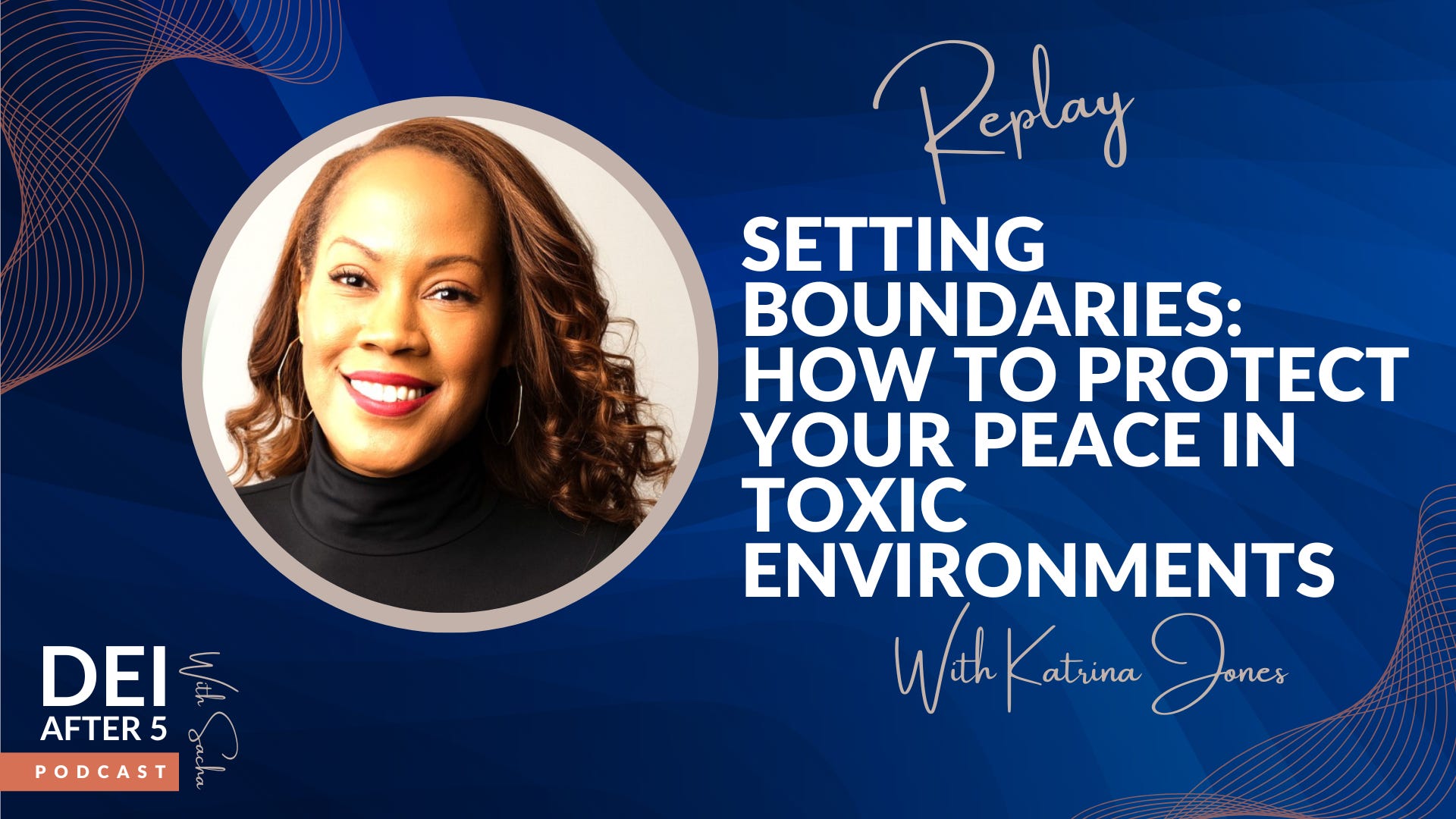
It’s clear people are looking for ways to protect their peace. And if the comments, DMs, and emails are any indication, they’re also looking for permission to do so.That’s exactly why this conversation with Katrina Jones on DEI After 5 hit such a nerve. It’s one of our most-watched episodes, and it makes sense—this is the stuff so many of us have been trying to name. That quiet unraveling you feel when you’re committed to the work, but the workplace doesn’t care. That guilt for wanting to step back when the weight of everything is on your shoulders. That slow erosion of your well-being in places that claim to value you but rarely show it.Katrina and I talked candidly about the emotional toll of toxic work environments—especially for those of us doing work that is rooted in justice, inclusion, or lived experience. There’s a unique pain that comes with trying to create change in systems that don’t want to be changed.But here’s what we explored that I think we all need to hear:👉🏾 Detachment isn’t indifference.It’s not about giving up. It’s about reclaiming your energy. Katrina shared how she learned this through Al-Anon, where detachment is a practice of caring without carrying. That lesson applies to so many of us—especially those who’ve been conditioned to believe that our worth is tied to how much we endure.👉🏾 Boundaries are a gift to yourself.We talked about how hard it can be to stay connected to a toxic space—even after you've technically left. Colleagues texting you with drama. Group chats that keep you emotionally tethered to that old team. Staying in those loops can reopen wounds that you’re trying to heal. Sometimes, the most radical thing you can do is say: No more. That’s not cold—it’s clarity.👉🏾 You are not the vessel for someone else’s journey.This one’s personal for me. As a coach and consultant, I’ve had to learn (sometimes the hard way) that I can’t want transformation more than the people I’m working with. I can offer tools. I can hold space. But I cannot carry people to their breakthrough. That’s not mine to hold. And once I accepted that? Whew. Freedom.So what does detachment and boundary-setting actually look like in practice?Here are a few takeaways from the episode:* Recognize your triggers. Pay attention to the situations, people, or conversations that drain you.* Name your boundaries—and honor them. It’s not just about saying what you won’t tolerate. It’s about practicing it, even when it’s hard.* Redirect energy. Not every conversation deserves your engagement. Sometimes the best move is to shift the subject or step away entirely.* Make space for joy and recovery. Whether it’s rest, creativity, or connection—whatever fuels you needs to be prioritized, not postponed.* Remember, you are not the system. Just because you see what’s broken doesn’t mean it’s yours to fix.There’s power in choosing you. There’s freedom in saying, I can care deeply and still protect my peace.If you’ve been wrestling with how to stay whole in environments that chip away at your spirit, I hope this episode reminds you that you’re not alone—and that you don’t have to keep sacrificing yourself to be “the strong one.”Catch the full episode right here on Substack or where you listen to your favorite podcasts.Let me know—what boundaries are you setting this season to protect your peace? This is a public episode. If you'd like to discuss this with other subscribers or get access to bonus episodes, visit deiafter5.substack.com/subscribe
When most people think about workplace safety, they imagine hard hats, ergonomic chairs, or maybe active shooter drills. What rarely comes up—but absolutely should—is how people feel at work. And that’s where psychosocial hazards come in.These aren’t just buzzwords or boxes to check. Psychosocial hazards are the silent threats that show up in how power is distributed, how people are treated, and what’s tolerated in the day-to-day culture of an organization. And yet, too often, they go unacknowledged—until someone breaks down, quits, or worse.Dr. I David Daniels joined me on DEI After 5 to dig into this topic, and what he shared should have every workplace paying attention.What Are Psychosocial Hazards, Really?Psychosocial hazards are the workplace conditions that can mess with your mental and emotional well-being. Things like:* Bullying or harassment (yep, still happening in 2025)* Excessive workload and unrealistic expectations* Micromanagement and lack of control over your own work* Isolation, exclusion, or lack of social support* Microaggressions (subtle, but cumulative and harmful)* Discrimination—overt or covertThese aren't just "bad vibes." These are real risk factors that impact how people think, engage, and show up at work. And if we’re being honest, they’re often written off as personal problems or interpersonal drama instead of being seen as organizational liabilities.Microaggressions: The “Small” Thing That Adds Up FastLet’s talk about microaggressions—those quick jabs people might not even realize they’re throwing. A joke about someone’s name. A comment about someone’s tone. A backhanded compliment about someone’s hair or clothes. These small moments are heavy for the person on the receiving end, especially when they pile up over time.If people are spending energy trying to decode whether they’re safe in a meeting or if it’s “worth it” to speak up, that’s not a thriving culture. That’s a hazard.Toxic Workplaces Don’t Just Happen. They’re Built.A toxic work environment is often the result of unchecked psychosocial hazards. Maybe it's a culture of fear. Maybe it’s leadership looking the other way when inappropriate behavior happens. Maybe it's the team dynamic that subtly punishes people for being “too different” or “too direct.”Whatever the case, the result is the same: employees disengage, mental health declines, and performance suffers. Burnout isn’t always about doing too much—it’s often about being in an environment that takes too much out of you, with too little support in return.So, What Can Organizations Actually Do?Addressing psychosocial hazards takes more than a wellness webinar or a ping pong table in the break room. Here’s where to start:* Take a real look at the culture. What’s being allowed? What’s being ignored?* Train leaders to recognize and respond to harmful behavior. Silence is complicity.* Reinforce policies with action—not just paperwork. If people don’t trust the system, it doesn’t work.* Create real feedback channels. And act on what you hear.* Prioritize psychological safety. Not just for show—but because it matters.Leadership Sets the ToneThis isn’t just an HR issue—it’s a leadership responsibility. Leaders shape culture, whether intentionally or not. If they’re not actively creating safety, then they might be passively reinforcing harm. Listening, transparency, and accountability are all leadership behaviors that reduce psychosocial hazards. It's time we stop thinking of those things as "soft skills" and start calling them what they are: critical safety tools.If your team is struggling, your retention is dipping, or people are showing signs of burnout—don’t just look at the workload. Look at the environment. Psychosocial hazards may be the root cause.If you're ready to dig into what's really going on in your workplace and want support assessing and addressing psychosocial hazards, schedule a call with our team. We’ll help you build a culture that’s not just productive—but safe, sustainable, and truly inclusive. This is a public episode. If you'd like to discuss this with other subscribers or get access to bonus episodes, visit deiafter5.substack.com/subscribe
We talk a lot about burnout, disconnection, and disengagement at work—but we don’t talk enough about how community can be the antidote.In this episode of DEI After 5, I share some reflections on how easy it is—especially for middle managers—to feel like you're carrying the load alone. You're expected to show up for everyone else, but who’s holding space for you? That’s where community comes in. And I’m not just talking about team bonding or a happy hour after work. I’m talking about the people who see you. The people who remind you that you’re not crazy. The ones who tell you the truth, even when it’s hard—and love you through it.Community isn’t just one thing. It might be your team, your friend group, your family, your group chat, or even your sorority sisters. Each circle gives us something different—sometimes it’s laughter, sometimes it’s accountability, and sometimes it’s the silence we need to breathe. But here’s the catch: we have to nurture it. Community doesn’t just happen. We have to choose to show up and be honest, even when it’s uncomfortable.In one of my recent trainings, folks from different departments came together for the first time—and they were shocked to realize how much they had in common. That moment reminded me how often we operate in silos, even within the same organization. We’re so focused on the work that we forget to connect as people. But when we make time for real conversations, we start to see that we’re not alone. And that changes everything.So I’ll ask you what I asked the group:Who’s in your corner right now?Where do you feel safe enough to be real?And what communities have you maybe drifted away from, that it might be time to revisit?This is about survival. Especially in times like these, we need spaces that refill our cup. And when we tend to those spaces, we become better teammates, better leaders, and better humans.We don't have to do this alone.Let’s stop pretending we do. This is a public episode. If you'd like to discuss this with other subscribers or get access to bonus episodes, visit deiafter5.substack.com/subscribe

In this re-release of my conversation with Amy Waninger, we’re revisiting a topic that’s even more urgent today than when we first recorded it: the vital role middle managers play in building inclusive, psychologically safe workplaces—and the real cost when they’re left out of the conversation.The Reality Behind the RhetoricIt’s easy to talk about inclusion at the top. Executive teams set strategic priorities, launch statements, and announce new initiatives. But the real test of whether those values translate into everyday action? That falls to middle managers.They’re the ones leading the one-on-ones, navigating interpersonal tensions, and trying to keep teams engaged—all while fielding pressure from above and burnout from within. And when they aren’t equipped or supported to lead inclusively, the gap between what’s said and what’s done starts to widen.The Disconnect We’re Not Talking AboutAs Amy and I discussed, the DEI goals that sound good in the boardroom often miss the mark on the ground. Middle managers are expected to deliver results, keep their teams motivated, and somehow embody organizational values—without a clear roadmap or the breathing room to figure it out. No wonder so many feel overwhelmed, unclear, or caught in the middle.And now, with formal DEI programs under scrutiny or disappearing entirely, many organizations are quietly shifting the burden of inclusion to people who are already stretched thin. That’s not a strategy. It’s a setup.Empowerment ≠ Expectations Without SupportIf we want DEI—or more broadly, inclusion, safety, and belonging—to take root, we have to stop treating middle managers like afterthoughts. Instead, we need to empower them with:* Practical, action-focused training that helps them build inclusive habits into how they lead—not just what they know.* Clear expectations and aligned incentives so inclusion isn't treated as "extra" work.* Ongoing coaching and peer learning to normalize the messiness of leading people through real-life challenges.* Resources and tools that take the guesswork out of hard conversations.* Recognition that reinforces that people leadership is culture work—and it matters.This isn’t about turning middle managers into DEI experts. It’s about helping them become the kind of leaders people trust. That’s what psychological safety looks like in practice.What This Means for the Work AheadThe middle manager burnout I’ve been speaking about lately? It’s tied directly to this gap. We keep asking managers to do more without giving them the conditions to do it well. If we want accountability, we need alignment. If we want impact, we need investment. And if we want culture change, we need to start with the people holding the line.Amy’s insights remain incredibly relevant—and if anything, the stakes have gotten higher. Let’s not keep putting the weight of inclusion on the shoulders of people we aren’t willing to support.✨ Want to dig deeper into this conversation and learn how to support your middle managers? This is a public episode. If you'd like to discuss this with other subscribers or get access to bonus episodes, visit deiafter5.substack.com/subscribe
Let’s be real—what’s happening in the world doesn’t stop at the office door. We don’t get to hang our worries on a hook next to our coats and step into a perfectly insulated work bubble. And yet, too often, that’s exactly what workplaces expect us to do.In this week’s episode of DEI After 5, I’m talking about the impact of external events—whether they’re global, national, or deeply personal—and how they show up in our work lives. Because they do show up. In our energy levels. In how we communicate. In the tension that’s just under the surface of our meetings. In our ability to lead, manage, or just make it through the day.If we’ve learned anything over the last few years—from the pandemic to political shifts to ongoing violence and injustice—it’s that there is no clean line separating our professional and personal lives. And pretending that line exists only makes things worse.Workplaces that recognize this reality—and respond with empathy, flexibility, and support—are the ones that build trust and loyalty. The ones that ignore it? They risk burnout, disengagement, and quiet quitting long before anyone sends in a resignation email.DEI After 5 is a reader-supported publication. To receive new posts and support my work, consider becoming a free or paid subscriber.Here’s what I break down in the episode:Leaders, Check In—And Mean ItAsking “how are you?” can’t just be a formality. It has to be an invitation. One that people trust won’t be used against them later. Leaders don’t have to solve everything—but they do need to create space for honesty and support.Stop Romanticizing the GrindTaking a break isn’t weakness. It's wisdom. We all need time to reset, especially when the world feels heavy. Encourage your team—and yourself—to slow down when needed. A rested team is a resilient team.Don’t Wait for the AskSometimes the people who are struggling the most won’t say a word. That’s why it's so important to proactively share resources, support systems, and flexible options. Don’t make care conditional on a formal request.Inclusion Is More Than a PolicyIt’s about recognizing that we all carry different burdens—and that what’s happening outside of work impacts each of us in unique ways. Let’s lead with curiosity, not assumptions.This episode is a reminder that our humanity doesn’t pause during work hours. And that acknowledging what people are carrying—without judgment—might be the most powerful leadership move we make all week.Give it a listen. Reflect. Then ask yourself: how am I showing up for others… and for myself? This is a public episode. If you'd like to discuss this with other subscribers or get access to bonus episodes, visit deiafter5.substack.com/subscribe
Welcome to this week's episode of DEI After 5. Today, I decided to shift our focus slightly while still staying within the realm of diversity, equity, and inclusion (DEI). Specifically, I want to delve into the inclusion aspect and address a pressing issue I've been noticing: burnout among first-line and middle managers.Through my recent webinars, client conversations, and surveys, I've identified that burnout is less about the workload and more about the organizational culture. Middle managers, in particular, are feeling emotionally exhausted and unsupported. They are tasked with creating environments of psychological safety and inclusion but often don't receive the same support from their higher-ups.Three key themes have emerged:* Emotional Exhaustion and Lack of Support: Many middle managers feel they are not getting the support they need, which adds to their emotional burden.* Misalignment Between Actions and Words: There's a disconnect between what organizations say and what they do, leading to a lack of trust and increased burnout.* Need for Connection: Middle managers crave opportunities to connect, brainstorm, and realize they are not alone in their struggles.To address these issues, I suggest the following actionable steps:* Model the Pause: Leaders should demonstrate the importance of taking breaks and reflecting, setting an example for their teams.* Two-Way Feedback Loops: Create environments where feedback is encouraged and valued, and ensure it's not just top-down but also bottom-up.* Shift from Wellness Perks to a Culture of Wellness: Move beyond superficial wellness perks and foster a genuine culture of wellness within the organization.Additionally, always ask your team members, "What can I do to help you be successful here?" This shows that you value them as individuals and are committed to their growth and well-being.I hope these insights and tips help you build a more inclusive and psychologically safe environment within your organization. We'll continue to explore these topics in future episodes. Feel free to leave us a message with any topics you'd like us to cover. DEI After 5 is a reader-supported publication and podcast. To receive new posts and support my work, consider becoming a free or paid subscriber. This is a public episode. If you'd like to discuss this with other subscribers or get access to bonus episodes, visit deiafter5.substack.com/subscribe

Comments

Download from Google Play

Download from App Store
 United States