


 Claim Ownership
Study Engineering (Applied Math)
Subscribed: 2Played: 9
Subscribe

© notebookLM - KNS
Description
Powered by AI | Based on R.C. Hibbeler’s Engineering Mechanics: Dynamics (14th Edition)
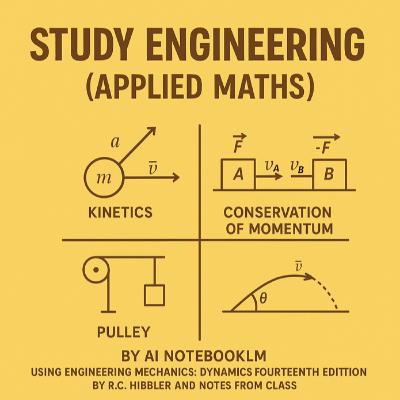
Welcome to Study Engineering (Applied Maths) — your go-to podcast for mastering the mathematical foundations of engineering mechanics. Created by an AI trained with class notes and insights from R.C. Hibbeler’s trusted textbook, this podcast simplifies the toughest topics in applied mathematics and dynamics so you can study smarter, not harder.
From kinematics and kinetics to Newton’s laws, energy methods, and conservation of momentum, each episode breaks down key concepts with clarity and focus.
Welcome to Study Engineering (Applied Maths) — your go-to podcast for mastering the mathematical foundations of engineering mechanics. Created by an AI trained with class notes and insights from R.C. Hibbeler’s trusted textbook, this podcast simplifies the toughest topics in applied mathematics and dynamics so you can study smarter, not harder.
From kinematics and kinetics to Newton’s laws, energy methods, and conservation of momentum, each episode breaks down key concepts with clarity and focus.
7 Episodes
Reverse
In this episode, we dive into the fascinating world of Operational Amplifiers (Op-Amps) — the unsung heroes of analog electronics. From understanding the basic configurations like inverting and non-inverting amplifiers, to exploring real-world circuit applications, we break down how op-amps work, why they matter, and how they’re used in everything from signal conditioning to control systems.Perfect for students, hobbyists, or anyone brushing up on electronics, this episode lays the foundation you need to tackle more advanced circuit designs with confidence.📌 Topics Covered:What is an Op-Amp?Key characteristics and ideal assumptionsInverting vs. Non-Inverting configurationsCommon applications and practical tipsReal-life circuit examplesGrab your notebook (or multimeter!) and let’s get amplifying.
In this episode, we dive into Planar Kinematics of a Rigid Body, based on Week 5 class material and Chapter 16 of Engineering Mechanics: Dynamics by R.C. Hibbeler (14th Edition).We cover:The fundamentals of translation, rotation, and general plane motionRelative velocity and acceleration analysisThe concept of the instantaneous center of zero velocity (IC)How to apply these principles in real-world mechanical systemsPerfect for students revising for exams or trying to solidify their understanding of motion in two dimensions — no fluff, just focused learning.
In this episode, we unpack the dynamic duo of linear and angular impulse and momentum — key concepts that explain how forces affect motion over time. Perfect for understanding collisions, sudden stops, and those tricky exam problems!You’ll discover:🔹 The impulse-momentum principle and how it relates to Newton’s laws🔹 How to analyze systems with external forces over time🔹 Applications in collisions, impact problems, and real-world scenarios🔹 Tips for choosing between force-based and impulse-based approachesWhether it’s a crash course before a test or you're deepening your understanding of dynamics, this episode will give you clarity on when and how momentum matters most.
In this episode, we explore the heart of engineering dynamics: work and energy in kinetics. From understanding how forces do work to tracking how energy moves through a mechanical system, this is your go-to guide for making sense of motion from an energy perspective.You'll learn:🔹 The Work-Energy Principle and what it really means🔹 How to apply kinetic and potential energy in problem-solving🔹 When and why energy methods can simplify your analysis🔹 Real-world examples to help tie the theory to practical engineering systemsWhether you're tackling assignments or just want to understand the “why” behind the math, this episode gives you the tools to power through kinetics with confidence!
In this episode, we dive into the fundamentals of mechanical vibrations, covering the key types that every engineering student should know. From the natural rhythm of undamped free vibrations to the external influences of forced vibrations, and the real-world realism of viscous damping, we break it all down.You'll learn:🔹 How systems vibrate freely without damping🔹 What happens when an external force drives the motion🔹 The impact of viscous damping on system response🔹 Practical insights into resonance and real-life applications
In this episode, we break down two powerful concepts in linear algebra: matrix diagonalisation and quadratic forms. Whether you're brushing up for an exam or just curious about how these ideas shape the math behind engineering, physics, and data science, we've got you covered.We'll explore:🔹 What it means to diagonalise a matrix and why it's useful🔹 The role of eigenvalues and eigenvectors🔹 How to simplify quadratic forms using orthogonal diagonalisation
Welcome to another episode of Study Engineering (Applied Maths) — your AI-powered guide through engineering dynamics!In this episode, we tackle Planar Kinetics of a Rigid Body: Force and Acceleration, using material from Week 6 lectures and Chapter 17 of Engineering Mechanics: Dynamics by R.C. Hibbeler (14th Edition).We break down:Newton’s Second Law applied to rigid bodiesEquations of motion in planar systemsTranslational and rotational dynamicsHow to handle forces, moments, and mass moments of inertia in 2D motionThis episode is perfect for understanding how forces influence the motion of rigid bodies in a plane — with step-by-step walkthroughs and examples to reinforce your learning.
Comments

Download from Google Play

Download from App Store
 United States