


 Claim Ownership
Executive Functions Chat
Subscribed: 20Played: 135
Subscribe

© Bob Bauer and Jack Goldsmith
Description
46 Episodes
Reverse
Jack speaks with Cass Sunstein, the Robert Walmsley University Professor at Harvard Law School, about his new book, Separation of Powers: How to Preserve Liberty in Troubled Times. They discuss why the executive is the most dangerous branch of government, the importance of responsible executive branch lawyers, and contemporary debates over the administrative state, including unitary executive theory in light of the Trump v. Slaughter oral argument and the major questions doctrine after the tariffs case, Learning Resources, Inc. v. Trump. Get full access to Executive Functions at www.execfunctions.org/subscribe
In light of the U.S. attacks on Iran over the weekend, Jack speaks with Elizabeth Sherwood-Randall, former White House Homeland Security Advisor, about how the U.S. government would normally prepare for domestic threats during periods of heightened risk. They discuss how the federal homeland security enterprise activates in response to elevated threat levels, including coordination across the Department of Homeland Security, the FBI, the intelligence community, and state and local law enforcement. They also explore concerns about federal capacity, including a DHS funding lapse, resource diversion away from counterterrorism and toward immigration enforcement, and leadership turnover across key agencies.Thumbnail: FBI Joint Terrorism Task Force photo. (U.S. Government Work.) Get full access to Executive Functions at www.execfunctions.org/subscribe
Jack speaks with Matthew Seligman, a fellow at the Stanford Constitutional Law Center, about the remedial consequences of the Supreme Court’s decision invalidating tariffs imposed under the International Emergency Economic Powers Act. They walk through how tariff collection works, why repayment is not automatic, and the procedural hurdles importers face in trying to recover what they paid, including major barriers to class-wide or aggregate relief. They also examine the practical and political constraints shaping the process, including institutional capacity, litigation costs, and why many smaller importers may never recover their losses. Get full access to Executive Functions at www.execfunctions.org/subscribe
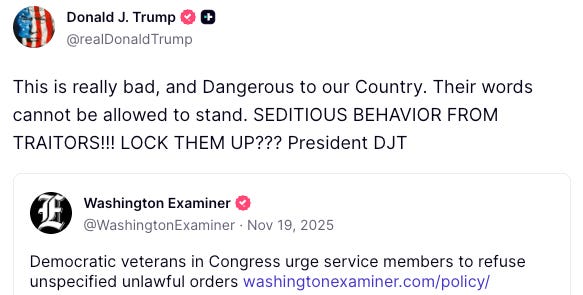
Bob and Jack chat about a federal court’s preliminary injunction blocking the Defense Department’s attempt to reduce Senator Mark Kelly’s military retirement benefits, along with a grand jury’s refusal to indict six Democratic members of Congress, including Kelly, who in a video reminded service members of their duty to refuse unlawful orders. They discuss how Trump administration weaponization can be effective even with court losses, and debate possible reforms to limit politically motivated prosecutions of members of Congress, including Bob’s proposal for a court-appointed special counsel and an alternative that focuses on revising the substance of criminal statutes.Mentioned:“The Bad News in the D.C. Grand Jury’s Refusal to Indict Six Members of Congress” by Bob Bauer (Executive Functions, Feb. 12, 2026) Get full access to Executive Functions at www.execfunctions.org/subscribe
Jack speaks with Richard Ekins, professor of law and constitutional government at Oxford University, about the United Kingdom’s plan to transfer sovereignty over the Chagos Islands to Mauritius while leasing back the Diego Garcia naval base for continued U.S.–U.K. military use—an issue that has drawn renewed attention in recent weeks after President Trump publicly criticized the proposed agreement. They discuss the historical background of the Chagos Islands dispute, the role of international courts, treaty obligations between the United States and the United Kingdom, and the strategic importance of Diego Garcia. They also examine the legal and security risks of the proposed transfer, including constraints on the use of force, nuclear nonproliferation obligations, and the question of why the United States might consent to the agreement.Since this chat was recorded, President Trump today signaled support for the Chagos sovereignty transfer, or at least a rollback of his criticism. He also said: “If the lease deal, sometime in the future, ever falls apart, or anyone threatens or endangers US operations and forces at our Base, I retain the right to Militarily secure and reinforce the American presence in Diego Garcia.”Mentioned:“Britain’s Chagos Deal Can’t Go Forward Without U.S. Consent” by Richard Ekin (National Review, Jan. 30, 2026.) Get full access to Executive Functions at www.execfunctions.org/subscribe
Bob and Jack talk about grievances from President Trump’s first term that continue to shape his second-term conduct. They examine the federal search warrant recently executed at a Fulton County election facility seeking 2020 ballots, including the structure and purpose of the investigation and the president’s asserted authority to use federal law enforcement in election matters. They also discuss Trump’s $10 billion lawsuit against the IRS and the Treasury Department over the disclosure of his tax information, unpacking the basis of the claims and the institutional questions raised by a sitting president suing the executive branch he oversees.Mentioned:“Is the Administration Prepared to Deploy ICE to Police This Fall’s Elections?” by Bob Bauer (Executive Functions, Jan. 27, 2026) Get full access to Executive Functions at www.execfunctions.org/subscribe
Jack speaks with University of Virginia School of Law Professor Saikrishna Prakash about his new book, The Presidential Pardon: The Short Clause with a Long, Troubled History. They discuss the origins of the pardon power, the framers’ anxieties about its breadth, controversies about its early use, how modern presidents have increasingly used clemency to advance ideological, political, and personal goals, and the challenges of reform.Mentioned:Saikrishna Bangalore Prakash, The Presidential Pardon: The Short Clause with a Long, Troubled History (2026)“Trump’s Circumvention of the Justice Department Clemency Process” by Jack Goldsmith and Matt Gluck (Lawfare, Dec. 29, 2020) Get full access to Executive Functions at www.execfunctions.org/subscribe
Jack and Bob examine President Trump’s threat to invoke the Insurrection Act in response to ICE-related unrest in Minneapolis. They discuss the Act’s broad language, the uncertain scope of presidential discretion, the many unresolved constitutional questions that the Supreme Court might consider, and the political and legal risks of deploying troops domestically—particularly against the backdrop of upcoming elections.Further reading:“Trump Threatens to Invoke the Insurrection Act” by Bob Bauer and Jack Goldsmith (Executive Functions, Jan. 15, 2026)“Thoughts on the Interim Order in Trump v. Illinois” by Jack Goldsmith (Executive Functions, Dec. 24, 2025)“Trolling About Habeas Corpus” by Jack Goldsmith (Executive Functions, May 12, 2025) Get full access to Executive Functions at www.execfunctions.org/subscribe
Jack and Bob discuss the subpoena targeting Federal Reserve Chair Jerome Powell, the legal limits on presidential control of the Fed, Senate resistance, and the potential consequences for markets and the administration heading into the midterms. Get full access to Executive Functions at www.execfunctions.org/subscribe
Bob and Jack discuss the legality of the U.S. invasion of Venezuela leading to the capture President Nicolás Maduro, how law matters to presidential uses of force, and what legal issues to expect at Maduro’s trial.Mentioned:“On the Legality of the Venezuela Invasion” by Jack Goldsmith (Executive Functions, Jan. 3, 2026)Curtis A. Bradley, Historical Gloss and Foreign Affairs: Constitutional Authority in Practice (2024) Get full access to Executive Functions at www.execfunctions.org/subscribe
Jack spoke with Chris Mirasola of the University of Houston Law Center about the President’s “protective power” to use the regular armed forces or the National Guard (if properly federalized) in the domestic sphere for the protection of federal property and functions. They discussed the origins and scope of the protective power, its relationship to the Posse Comitatus Act, why it was relevant in Trump v. Illinois, and the president’s prominent options for domestic deployment of the military (including using regular armed forces for a protective function) after Trump v. Illinois.Further reading:Chris Mirasola, Sovereignty, Article II, and the Military During Domestic Unrest, 15 Harv. Nat’l Sec. J. 199 (2023)Jack Goldsmith, Thoughts on the Interim Order in Trump v. Illinois, Executive Functions (December 24, 2025)Chris Mirasola, Unpacking the Protective Power, Lawfare (June 12, 2025)Consider becoming a free or paid subscriber. Get full access to Executive Functions at www.execfunctions.org/subscribe
Bob and Jack discuss the latest developments across three ongoing issues in Trump’s second term: use of the pardon power, unresolved transparency disputes, and the administration’s campaign against major law firms. They examine the political dynamics at play behind a recent series of pardons, promised disclosures related to the Epstein files and the Sept. 2 boat strikes, and how executive orders targeting major law firms, though repeatedly struck down, continue to create uncertainty and pressure within the legal profession. Get full access to Executive Functions at www.execfunctions.org/subscribe
Jack talks with University of Minnesota Law School professor Alan Z. Rozenshtein about how artificial intelligence could reshape the modern presidency by easing bureaucratic limits that have traditionally constrained presidential control. Building on Rozenshtein’s lecture, The Unitary Artificial Executive, they discuss how automated decision systems might function as a presidential “oracle” across the administrative state. The conversation examines how, and to what extent, AI could centralize power throughout agencies, reduce the role of human deliberation, and alter traditional principal–agent relationships inside government.Mentioned:“The Unitary Artificial Executive” by Alan Z. Rozenshtein (Lawfare, Oct. 30, 2025) Get full access to Executive Functions at www.execfunctions.org/subscribe
Bob talks with historian Walter Stahr about William Howard Taft’s model of the presidency. The conversation covers Taft’s remarkably varied career across the executive and judicial branches, his differences with Theodore Roosevelt over the scope of executive power, his stance on war powers, and the significance of his post-presidential writing on executive authority and responsibility. Mentioned:Walter Stahr, Stanton: Lincoln’s War Secretary (2017)William Howard Taft, Our Chief Magistrate and Its Powers (1916)Theodore Roosevelt, An Autobiography (1913) Get full access to Executive Functions at www.execfunctions.org/subscribe
Jack talks with Columbia Law professor David Pozen about Pozen's recent Boston Review essay with Jedediah Britton-Purdy, “What Are We Living Through?” They discuss three competing ways of understanding the Trump administration—authoritarian rupture, continuity with long-running dysfunction, and a transition to a new constitutional regime. The conversation explores whether all three can be true, what kind of damage may be irreversible, and what rebuilding might look like after Trump.Mentioned:“What Are We Living Through?” by David Pozen & Jedediah Britton-Purdy (Boston Review, Oct. 15, 2025)“Hardball and/as Anti-Hardball” by David Pozen (Lawfare, Oct. 11, 2018) Get full access to Executive Functions at www.execfunctions.org/subscribe
Bob and Jack discuss recent reports of internal rifts at the Department of Justice, the loyalty pressures shaping the Trump administration, and whether constitutional reform is needed to curb the spiral of politicized prosecutions. Mentioned:The Imperial Presidency by Arthur M. Schlesinger Jr“Part Enabler, Part Bluffer: The Bind of the Justice Department’s No. 2” by Glenn Thrush and Alan Feuer (NYT)“How Should a DOJ Political Appointee Think About a Trump-Weaponized DOJ?” by Jack Goldsmith (Executive Functions) Get full access to Executive Functions at www.execfunctions.org/subscribe
Bob and Jack discuss (and disagree about) the Oregon National Guard ruling, the deference owed to the president, the relevance of the president’s Truth Social comments, and the ultimate limits on the president’s power to use the military in the domestic sphere. Get full access to Executive Functions at www.execfunctions.org/subscribe
Bob and Jack discuss the Trump administration’s indictment of former FBI Director James Comey, the lawfulness of the Lindsey Halligan appointment as interim U.S. Attorney, the implications of Trump’s full takeover and weaponization of DOJ, and how to think about reform in this context. Get full access to Executive Functions at www.execfunctions.org/subscribe
Keith Whittington, David Boies Professor of Law at Yale Law School and author of The Political Foundations of Judicial Supremacy, joins Jack Goldsmith for a conversation about reconstructive presidents (Jefferson, Jackson, Lincoln, and FDR), and whether Donald Trump fits that mold. They discuss Trump’s constitutional ambitions, judicial supremacy versus departmentalism, and whether Trump will defy the Court. Get full access to Executive Functions at www.execfunctions.org/subscribe
Bob and Jack discuss the performance of White House Counsel David Warrington and examine last week’s lethal strike on alleged Venezuelan terrorists—including its possible implications for domestic presidential military strikes.Consider becoming a free or paid subscriber to Executive Functions.This is an edited transcript of an episode of “Executive Functions Chat.” You can listen to the full conversation by following or subscribing to the show on Substack, Apple, Spotify, or wherever you get your podcasts.Jack Goldsmith: Good morning, Bob.Bob Bauer: Good morning, Jack.There’s been so much in the news since we last chatted, which was quite a while ago, actually. Today, we’re going to focus on some topics that we know a little bit about. We’re going to discuss two stories from last week about Trump administration lawyering: the long New York Times profile on your successor in the White House Counsel’s Office, David Warrington, and the administration’s lethal strike on a speedboat in the southern Caribbean that allegedly contained members of the designated Venezuela terrorist organization Tren de Aragua, allegedly transporting drugs to the United States. These connect insofar as they involve executive-branch legal decision-making. Why don’t you begin by summarizing and commenting on the New York Times story about Warrington?A number of things struck me about the story about Warrington. Of course, it was published against the background of a lot of debate about the role of the White House counsel—the extent to which the White House counsel has supplanted the Department of Justice (DOJ) as the principal channel for legal advice to the president. What that means if presidents pick White House counsels who are particularly friendly to them, have personal or political backgrounds with them, and can be expected to be, if you will, loyal and pliant.Some of that debate has been, in this administration, overtaken by events, because once there was a thought that presidents would nominate somebody relatively uncontroversial—down the middle, if you will—as attorney general, and then have a White House counsel who is much more in that world of friendliness and political background. Now, of course, this particular president has chosen from his own personal legal team the senior officials in the DOJ. So that particular concern about the White House counsel may have been overtaken by events. But it’s still a very powerful legal office right there in the West Wing, one floor above the Oval Office, and probably the last word on any critical legal question that the president has to address.What I found striking, in that article, was that David Warrington gave the interview to the New York Times, understanding perfectly well that that’s a locus of criticism of the president’s legal stances. He said two things that were somewhat in tension. One was that he didn’t feel he should be giving his personal views: He gave the advice he gave, and unless asked, he didn’t say more. But later on, he said he gave the advice that he gave and there was some inclination or some suggestion that he spoke his mind… it wasn’t entirely clear.I have to say, in an administration like this, I’m skeptical about a White House counsel who says, “I’ll keep my thoughts to myself; I’ll just give him my reading of the law. And if I have any concerns about the direction we’re going, I’m just not going to express them.” I have real concerns about that, in any presidency, but particularly in this one. Second, he said his role was to advise with a view toward finding “defensible” positions for the administration to take—e.g., strategies courts have criticized for deporting and trying to avoid court jurisdiction. He was looking for defensible positions and to reduce risk. That raises two questions: What is a defensible position? What’s the standard for determining what a defensible position is? And secondly, what does it mean to reduce risk—what kind of risk are you talking about? The risk that the courts will overturn it? The risk that it will provoke congressional opposition or complaint, particularly from your own side of the aisle? It wasn’t clear how he was, as a professional, defining the way he would approach his job in this very challenging administration where the president has displayed so little regard for the rule of law.I want to press you on a bunch of those points. My reaction to the story was that it was kind of anodyne, actually. I thought a profile of Warrington would show him in the tank for the president, and it wasn’t quite that. Can you briefly explain, to the extent that there is a traditional explanation, the traditional role of the White House counsel as opposed to the traditional role of the attorney general?The White House counsel is a member of the president’s senior staff—end of story. No authority to bind agencies with legal interpretations; a counselor picked by the president, not subject to Senate confirmation. The attorney general of the United States is the second most-senior (to the president) law enforcement officer in the constitutional system, nominated to the Congress, to the Senate, confirmed or rejected by the Senate. And there's been a view, particularly after the Nixon debacle in the Watergate era, that an attorney general has to stand for a department that is like any other department. It's not independent of the president in a formal sense, certainly needs to be attentive to the president's policy priorities. But at the same time, in law enforcement activities in particular, has to avoid any suggestion of political favoritism or impartiality and therefore establishes independence in that sense.There are no criteria like that for the White House counsel. There's no criteria at all prescribed anywhere for the White House counsel. It's really a position that's governed by expectations and by norms—that as influential as a White House counsel can be with such close proximity to the president, the White House counsel will be guided by a concern for representing the presidency as an institution and not merely operating, which he or she shouldn't, as a personal or political lawyer to the president. But isn't it also true (I think we wrote in our book together) that the White House counsel is at the heart of political decision-making inside the White House? Is it fair to say that in a normal administration, the White House counsel is more of a political/legal counselor as opposed to providing the account of the law that should guide the executive branch? Is that—can you just get at that a little bit? Because that'll lead me to my questions about how Warrington was presented. There is always the possibility that that's how the White House counsel sees his or her job as a lawyer—member, loyal member—of the senior legal team. In my time, and I know there are other White House counsels who have shared this view, I thought it was I thought it was very important for the office to distinguish itself from other senior staff members and retain its credibility as legal advisers by not seeming to be full-throated members of the president's political or communications team. The risk of the White House counsel being both a political adviser and a legal adviser is that other members of the senior staff—or the president himself—might wonder, when getting a piece of advice: Is this advice shaped by the law, or is it shaped by the political or communications judgment of the White House counsel? And for a White House counsel, in my view, to have credibility, there has to be no question that their advice is shaped by the law. Now, if they have some view about the political consequences of taking a particular legal position—Congress will object, the press will rise up in fury, allied ideological groups will be unhappy… Then the White House counsel could bring that into the conversation if somebody else doesn't, but can say—and should say, by the way—separately and apart from the legal advice just given, that these other political consequences could follow. But I think it's very important for the White House counsel's office to be a legal operation and not an adjunct of the political and policy operation of the president.Right. Now, I didn’t mean to suggest that it should be an adjunct, and he didn’t even present himself as one. He presented himself as providing legal advice about legal risk. One of the interesting things about the story is that it described a White House counsel’s office that was more law-heavy, doing more DOJ-type legal analysis. I think that’s what I read between the lines of the story.And that he, in some sense, had a more enhanced—arguably more enhanced—legal role than the average White House counsel, because they have not wanted to go to OLC and other elements of DOJ.Can I just mention one think quickly, Jack? He referred to it as more of a litigation shop than any of his predecessors. Right. And so what about that? I mean, you asked the question—he said he was assessing risk. My understanding of the White House counsel's office has been that the law is vetted and presented, including various possible interpretations of the law. Then the president faces legal risk and political risk. And I think it’s important to mention that the president of the United States under Article II is the legal decider for the executive branch.So ultimately, the president—whether a lawyer or not—gets to decide. Part of what I understood the White House counsel to be doing was assessing and advising the president about all of these risks. Is that right or wrong?No, that’s right. It goes to the point I made earlier about distinguishing legal risk from other kinds of risks like political risk, and being very clear. The White House counsel should be explicit when there is a political risk in addition to a clearly presented legal risk. A legal risk is: you’re breaking the law. You are breaking the law. You are doing something that, as the president takes

Comments

Download from Google Play

Download from App Store
 United States