DiscoverThe CEO AI Podcast
The CEO AI Podcast
Claim Ownership

The CEO AI Podcast

Author: Gary Ambrosino

Subscribed: 4Played: 29
Share

Description

The CEO AI Podcast by Gary Ambrosino is the go-to audio destination for CEOs, founders, board members, and C-level executives navigating the transformative power of artificial intelligence in fast-growth businesses.

Each episode is a strategic, no-fluff conversation designed specifically for decision-makers who need to understand and implement AI right now—not in theory, but in practice. Whether you’re an executive at a scaling SaaS startup, a PE-backed portfolio company, or a growth-stage enterprise undergoing digital transformation, this podcast gives you the frameworks, case studies, and tactical insights to lead with confidence in the age of AI.

Host Gary Ambrosino—a veteran tech CEO, board member, and AI entrepreneur—breaks down the essential differences between “AI Forward” and “AI First” strategies, helping executives identify where their organizations sit in the AI adoption curve and how to advance to the next level. You’ll hear from AI innovators, operational leaders, and enterprise strategists as they share how AI is being used in product development, customer success, go-to-market strategies, operations, cybersecurity, investor relations, and more.


23 Episodes
Reverse
Student use of AI is accelerating exponentially.  This deep dive looks into the dynamics and what's next. 
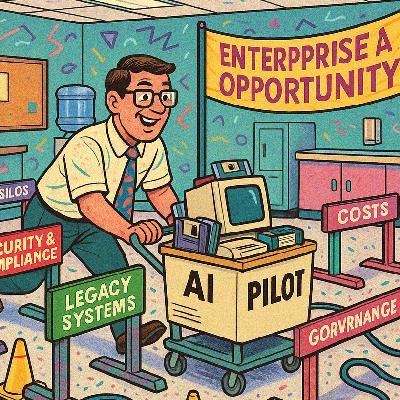
AI is sprinting ahead—but enterprise adoption and ROI are playing catch-up. In this episode, we unpack what’s real inside large companies: why frontline usage lags managers, where pilots stall, and how leaders are closing the gap between hype and productivity. We get practical on what works: redesigning end-to-end workflows (not just adding tools), moving to a product operating model with clear KPIs, metering AI consumption (FinOps), and building trust with governance and explainability. We also hit skills, training, and the “jagged frontier” where AI helps—or hurts—performance. If you own a P&L or lead change, this is your field guide to turning AI into outcomes.
OpenAI has made a significant shift by releasing gpt-oss-120b and gpt-oss-20b, their inaugural open-weight language models since GPT-2. This marks a pivotal strategic move towards greater transparency and global accessibility in artificial intelligence. Open-weight means developers gain access to pre-trained model parameters, allowing them to download, inspect, fine-tune, and run these powerful AI models locally or behind firewalls. These cutting-edge models are genuinely free, incurring no licensing or per-token charges, only compute costs. Designed for efficient operation, gpt-oss-20b needs just 16GB of memory, ideal for laptops and edge devices, while gpt-oss-120b runs on a single 80GB GPU. This enables local AI deployment for privacy-sensitive tasks and offline use. OpenAI aims to reclaim market share from competitors like Meta's Llama and foster developer ecosystem growth. Their hybrid local-to-cloud strategy seamlessly integrates with premium cloud services, offering transparent fallback and cost optimization for enterprise AI solutions. Discover how developers can fine-tune, audit, and build diverse generative AI applications with enhanced data control. #OpenAI #AI #LanguageModels #GenerativeAI #OpenWeightAI #LocalAI #MachineLearning #TechNews #DeveloperTools #AICareer
Dive deep into the high-stakes global AI race with our latest episode, unraveling America's AI Action Plan – a bold strategy designed to secure the United States' global dominance in artificial intelligence. This isn't just about technological advancement; it's about reshaping human flourishing, economic competitiveness, and national security. In this episode, we break down why this 28-page plan signals a decisive shift towards an accelerationist strategy, prioritizing rapid deployment over traditional risk-first approaches. You'll discover how the White House plans to: Slash domestic regulation and use fiscal leverage to prevent a "costly 50-state patchwork" of AI laws, pushing for "innovation-friendly" jurisdictions. Invert previous bias policies by requiring federal AI procurements to be "ideologically neutral," a significant shift away from civil-rights impacts and against "woke" filtering. Initiate a massive infrastructure push, recasting compute and energy availability as strategic assets. We’ll delve into the ambitious targets, including the projected need for 50 gigawatts of electric capacity by 2028 for the US AI sector alone – that's roughly equivalent to the peak demand of an entire country like Sweden or Argentina. Champion "full-stack" exports of U.S. chips, models, and software to allies, a strategic move to lock in American technical standards globally and counter Chinese influence. Emphasize a "worker-first AI agenda," tying training grants and apprenticeships to new data-center and fab jobs, aiming to spread economic gains beyond traditional tech hubs. Support open-source and open-weight AI models, recognizing their geostrategic value in establishing global standards founded on American values. However, we also unpack the principal critiques, including significant safety and accountability gaps (with "safety" mentioned only once in 28 pages), the vagueness of the "ideological neutrality test," and concerns about the plan's global governance vacuum favoring bilateral export deals over multilateral safety efforts. Tune in to understand the nuances of this pivotal plan, its strengths, and its potential pitfalls, as America aims to "Win the Race" for AI dominance. Keywords & Hashtags: #AIPolicy #USA #ArtificialIntelligence #TechNews #Geopolitics #AIInnovation #DigitalTransformation #NationalSecurity #Infrastructure #AIStrategy #TrumpAdministration #TechPolicy #AIActionPlan #FutureofAI #GlobalAI #Regulation #Semiconductors #Workforce
Reid Hoffman SuperAgency and the Fantastic Future of AI In this episode, we break down Reid Hoffman’s visionary concept of Superagency from his latest book Impromptu, and ask the bold question: What could go right with AI? Amid the flood of headlines centered on risk and disruption, this conversation offers a vital counter-narrative—an optimistic and strategic lens for CEOs, founders, executives, and decision-makers looking to lead effectively in the age of artificial intelligence. What You’ll Learn in This Episode 1. What Is Superagency? Hoffman’s definition of Superagency as a state where AI-empowered individuals create compounding impact across society. Why AI is not about replacement but radical amplification of human skill, insight, and agency. 2. From Cognitive Overload to Synthetic Intelligence How AI marks a new cognitive revolution, comparable to the Industrial Revolution’s synthetic energy. Real-world examples: AI assistants in medicine, diagnostics in automotive repair, and strategic decision support in business. 3. Innovation as a Path to AI Safety How safety in AI is achieved not by slowing down, but by rigorous public testing, benchmark competitions, and iterative design. Platforms like Chatbot Arena and benchmarks like SuperGLUE as real-world mechanisms for decentralized AI quality assurance. 4. Data, Privacy, and the Private Commons The shift from hoarding data to data agriculture—where shared, transparent ecosystems create collective value. How large language models turn information overload into executive insight and faster onboarding across teams. 5. Law as Code and Networked Autonomy Exploring how AI reshapes governance and compliance through concepts like smart contracts, adaptive legal frameworks, and AI-enabled regulation. Why “Government 2.0” may not just be possible—it may be essential to reduce polarization and build trust at scale.   Executive Takeaway Adopt a “What Could Go Right?” mindset: Shift focus from fear to strategic opportunity. Embrace iterative deployment: Don’t wait for perfection—test, learn, and refine in real time. Invest in human-centered AI: Prioritize tools that expand capability and creativity, not just efficiency. Make AI a strategic imperative: Your organization’s future productivity and relevance may depend on how well it integrates AI today. Optimized SEO Keywords: AI strategy for business, Reid Hoffman Superagency, Impromptu book summary, AI leadership podcast, artificial intelligence and innovation, future of work with AI, AI governance, AI and executive teams, permissionless innovation, GPT-4o, ChatGPT in the workplace, LLM productivity tools, AI data ethics, AI for business leaders, techno-humanism, cognitive revolution, digital transformation with AI Subscribe and Follow If this episode sparked ideas or changed your perspective, be sure to follow, rate, and share The Deep Dive on Spotify, Apple Podcasts, or wherever you get your podcasts. New conversations drop weekly.       Episode Description: Welcome to The Deep Dive, where we cut through the noise and explore how AI is reshaping business, leadership, and society.   In this episode, we break down Reid Hoffman’s visionary concept of Superagency from his latest book Impromptu, and ask the bold question: What could go right with AI?   Amid the flood of headlines centered on risk and disruption, this conversation offers a vital counter-narrative—an optimistic and strategic lens for CEOs, founders, executives, and decision-makers looking to lead effectively in the age of artificial intelligence.       What You’ll Learn in This Episode       1. What Is Superagency?     Hoffman’s definition of Superagency as a state where AI-empowered individuals create compounding impact across society. Why AI is not about replacement but radical amplification of human skill, insight, and agency.       2. From Cognitive Overload to Synthetic Intelligence     How AI marks a new cognitive revolution, comparable to the Industrial Revolution’s synthetic energy. Real-world examples: AI assistants in medicine, diagnostics in automotive repair, and strategic decision support in business.       3. Innovation as a Path to AI Safety     How safety in AI is achieved not by slowing down, but by rigorous public testing, benchmark competitions, and iterative design. Platforms like Chatbot Arena and benchmarks like SuperGLUE as real-world mechanisms for decentralized AI quality assurance.       4. Data, Privacy, and the Private Commons     The shift from hoarding data to data agriculture—where shared, transparent ecosystems create collective value. How large language models turn information overload into executive insight and faster onboarding across teams.       5. Law as Code and Networked Autonomy     Exploring how AI reshapes governance and compliance through concepts like smart contracts, adaptive legal frameworks, and AI-enabled regulation. Why “Government 2.0” may not just be possible—it may be essential to reduce polarization and build trust at scale.         Executive Takeaways     Adopt a “What Could Go Right?” mindset: Shift focus from fear to strategic opportunity. Embrace iterative deployment: Don’t wait for perfection—test, learn, and refine in real time. Invest in human-centered AI: Prioritize tools that expand capability and creativity, not just efficiency. Make AI a strategic imperative: Your organization’s future productivity and relevance may depend on how well it integrates AI today.         Optimized SEO Keywords:     AI strategy for business, Reid Hoffman Superagency, Impromptu book summary, AI leadership podcast, artificial intelligence and innovation, future of work with AI, AI governance, AI and executive teams, permissionless innovation, GPT-4o, ChatGPT in the workplace, LLM productivity tools, AI data ethics, AI for business leaders, techno-humanism, cognitive revolution, digital transformation with AI       Subscribe and Follow:     If this episode sparked ideas or changed your perspective, be sure to follow, rate, and share The Deep Dive on Spotify, Apple Podcasts, or wherever you get your podcasts. New conversations drop weekly.       Title (Episode Name) Reid Hoffman SuperAgency and the Fantastic Future of AI     Episode Subtitle (Apple Podcasts)     How AI empowers leadership, transforms strategy, and redefines innovation through Superagency       Episode Summary     In this episode of The Deep Dive, we explore Reid Hoffman’s optimistic framework for artificial intelligence—Superagency. Discover how AI amplifies individual and organizational potential, enables iterative innovation, and shapes a future guided by human-centered values. Ideal for business leaders, strategists, and tech-forward executives looking to navigate the AI age.       Episode Keywords / Tags (Use comma-separated list for most CMS platforms)     AI strategy, Reid Hoffman, Superagency, Impromptu book, artificial intelligence, business leadership, executive AI, AI podcast, cognitive revolution, techno-humanism, GPT-4o, ChatGPT for work, innovation, startup strategy, permissionless innovation, AI safety, law as code, networked autonomy, AI productivity, digital transformation, future of work, AI in healthcare, AI in government, large language models, AI trust, data privacy, business transformation, AI for CEOs, AI decision making       Episode Categories (Apple Podcasts & Spotify)     Primary: Technology Secondary: Business Tertiary (optional): Education         Content Rating     Clean       Episode Type     Full episode (not a trailer or bonus)       Author / Creator Gary Ambrosino https://www.linkedin.com/in/garyambrosino/
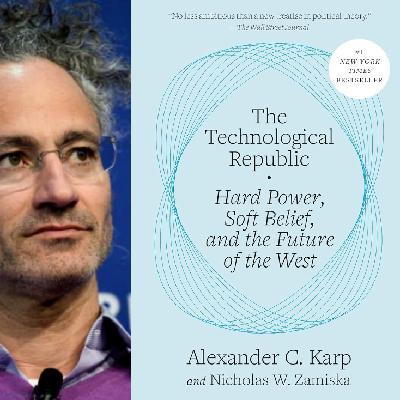
The "Technologic Republic" critiques a contemporary Western society adrift from its historical roots of collaborative innovation and collective purpose. It argues that a combination of government retreat, Silicon Valley's consumer-centric focus, and a cultural abandonment of strong beliefs and shared identity has created vulnerabilities. The authors propose a return to a "technological republic" where the engineering mindset—characterized by pragmatism, a focus on outcomes, and a willingness to challenge conformity—is harnessed for national and collective good, particularly in the critical domain of AI and defense, to safeguard Western geopolitical advantage and societal well-being. This requires a cultural shift to re-embrace shared values, national identity, and a willingness to confront difficult moral and strategic questions.   Key Themes and Most Important Ideas/Facts: 1. The Historical Partnership vs. Current Divergence: Past Collaboration: The American software industry's rise was initially predicated on a "radical and fraught partnership between emerging technology companies and the U.S. government." Early Silicon Valley innovations, from reconnaissance equipment to ballistic missiles, were driven by national significance and military needs. "Indeed, Silicon Valley once stood at the center of American military production and national security." Post-WWII Vision: President Franklin Roosevelt, after WWII, envisioned a continued alliance between government and science to advance "public health and national welfare," ensuring that the scientific machinery used for war could be repurposed for peace. Founding Fathers as Engineers: Early American leaders like Thomas Jefferson and Benjamin Franklin were often polymaths and engineers, demonstrating a historical "entanglement of the state and scientific research" and a focus on practical applications of science for the common good. Modern Retreat: The modern Silicon Valley has "strayed significantly from this tradition," largely focusing on the consumer market, online advertising, and social media. This shift is characterized by a "skepticism of government work and national ambition" and a preference for "narrow attentiveness to the desires and needs of the individual." The "Build" Mantra's Flaw: The rallying cry of Silicon Valley founders was "simply to build. Few asked what needed to be built, and why." This led to a "misdirection, of capital and talent to the trivial and ephemeral." 2. The "Innovation Gap" and Geopolitical Imperative: Government's Retreat: The state has "retreated from the pursuit of the kind of large-scale breakthroughs that gave rise to the atomic bomb and the internet," ceding innovation to the private sector, creating a "widening innovation gap." AI as a Game Changer: The rise of Artificial Intelligence (AI) "presents a plausible challenge to our species for creative supremacy in the world" and has "heightened the urgency of revisiting questions of national identity and purpose." AI Weaponry and National Security: The authors argue that a significant challenge is ensuring the U.S. Department of Defense evolves to "design, build, and acquire AI weaponry—the unmanned drone swarms and robots that will dominate the coming battlefield." They emphasize the urgent need for a "new Manhattan Project" to maintain exclusive control over sophisticated AI for military purposes. Adversaries Are Not Hesitant: Geopolitical adversaries are actively pursuing AI research for military applications, as demonstrated by Chinese advancements in facial recognition and drone swarm technology. "Our hesitation, perceived or otherwise, to move forward with military applications of artificial intelligence will be punished." The Winner's Fallacy: The pervasive belief in the West that "history had come to an end, and that Western liberal democracy had emerged in permanent victory" is dangerous and leads to complacency in maintaining hard power, which in this century "will be built on software." 3. The Hollowing Out of the American Mind and Culture: Abandonment of Belief and Conviction: There has been a "systematic attack and attempt to dismantle any conception of American or Western identity during the 1960s and 1970s." This left a "void" that "the market rushed in with fervor to fill," leading to a "rudderless yet highly educated elite." Agnosticism and Optionality: The current technological elite are "technological agnostics," whose "principal and animating interest was the act of creation itself—decoupled from any grand worldview or political project." They prioritize "optionality," avoiding firm stances or alienating anyone, which has been "crippling." Loss of Public Engagement: Silicon Valley's best minds have "turned to the consumer for sustenance," avoiding "the often messy and controversial work that is most vital and significant to our collective welfare and defense." Critique of Modern Liberalism: The authors argue that a fierce commitment to "classical liberalism" and its emphasis on individual rights has come "at the expense of anything approaching collective purpose or identity." This "moral void" created by the reluctance to engage in moral debates "opens the way for the intolerant and the trivial." The "Grievance Industry": The modern culture fosters a "grievance industry" and an "overly timid engagement with the debates of our time," which robs individuals of "the fierceness of feeling that is necessary to move the world." Consequences of Deconstruction: The deconstruction of Western civilization and American identity, while perhaps rightly addressing historical flaws, has left nothing substantial in its place, leading to a "thin conception of belonging." 4. The Engineering Mindset and Organizational Culture: Lessons from Nature (Bees and Starlings): The authors draw parallels between successful startup culture and the collective intelligence of honeybee swarms and starling flocks. These natural systems demonstrate "coordinated behaviour that emerges without central control," where autonomy is distributed to "the fringes—the scouts—of their organization," who possess the latest and most valuable information. Improvisational Startup Culture: Successful startups embrace "serendipity and a level of psychological flexibility" akin to improvisational theater. They prioritize outcomes over self-serving hierarchies and are sensitive to the audience/customer. Critique of Traditional Corporate Structures: Traditional corporate and government bureaucracies are characterized by "jockeying for position, claiming credit for success, and often desperately avoiding blame for failure," with layers of "vice presidents and deputy vice presidents." This rigidity stifles innovation and wastes creative energy. Palantir as an Example: Palantir is presented as a company that embodies this engineering mindset, with a "commitment to advancing outcomes at the expense of theater, to empowering those on the margins of an organization who may be closest to the problem, and to setting aside vain theological debates in favor of even marginal and often imperfect progress." Resistance to Conformity: The ability to resist group pressure and conformity, as highlighted by Asch's and Milgram's experiments, is crucial for fostering genuine creativity and building something "substantial and differentiated." Pragmatism and Truth: An engineering culture, characterized by "ravenous pragmatism" and a willingness to "descend from his or her tower of theory into the morass of actual details as they exist," is essential for progress. This involves an "unwaveringly focused on understanding what is working well and what is not," and a "willingness to bend one's model of the world to the evidence at hand, not bend the evidence." 5. Rebuilding the "Technological Republic": Reasserting National Culture and Values: Reconstituting a technological republic requires "a reassertion of national culture and values—and indeed of collective identity and purpose—without which the gains and benefits of the scientific and engineering breakthroughs of the current age may be relegated to serving the narrow interests of a secluded elite." Overcoming "Market Triumphalism": Society has "unintentionally deprived ourselves of the opportunity to engage in a critical discussion about the businesses and endeavors that ought to exist, not merely the ventures that could." The market's logic has supplanted broader discussions of societal value. Challenging "Luxury Beliefs": The idea that advanced technology has no place in law enforcement, for instance, is a "luxury belief" held by a privileged elite, out of touch with the realities faced by less privileged communities. Leadership and Incentives: The current public sector compensation disincentivizes talented individuals from public service. The authors advocate for a "far more radical approach to rewarding those who create the value from which we all benefit," drawing a contrast with figures like Admiral Rickover, who achieved significant results despite unconventional methods and criticism. Ownership Culture: Silicon Valley's success was partly due to its "embrace...of an ownership society, a regime in which the labor, the creative talent within organizations, had a substantial stake in the success and outcomes of the businesses they were building." This model should be adopted more broadly, including in government. The Need for Shared Identity: The text repeatedly stresses the human need for collective experience and a shared sense of purpose. "A commitment to capitalism and the rights of the individual, however ardent, will never be sufficient; it is too thin and meager, too narrow, to sustain the human soul and psyche." The Path Forward: The ultimate solution lies in "a reconciliation of a commitment to the free market...with the insatiable human desire for some form of collective experience and endeavor." This means channeling the creative energies of the technic
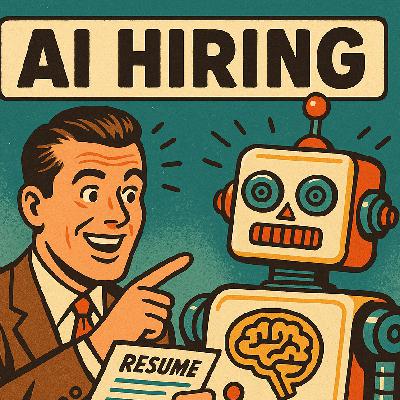
Welcome to 'The State of Talent: Navigating the AI Era in 2025'! In this episode, we dive deep into the groundbreaking 2025 Startup Talent Report, revealing how Artificial Intelligence is fundamentally reshaping the landscape of hiring, compensation, and retention for startups. Discover key insights shaping the future of high-performing teams: AI Skills Evaluation is Exploding: Learn why there's a remarkable 13x year-over-year increase in evaluating AI skills during interviews, particularly in HR and recruiting roles. Despite this surge, less than 3% of companies currently assess these skills directly, presenting a significant opportunity for companies to improve their hiring processes and develop AI fluency via new hires. AI Talent Commands Premium Compensation: Understand why AI and machine learning professionals earn a significant 10-25% cash premium over traditional software engineers, with equity grants valued about 38% higher. The AI industry as a whole uses multiples to their advantage, with equity grants 28% above the median, underscoring the critical role AI expertise plays in driving innovation and success in startups. Startups Lead in AI-Driven Recruiting Transformation: Explore how startups are at the forefront, leveraging AI tools to enhance recruiting efficiency, prioritize high-performing talent, and shift talent acquisition towards strategic partnership aligned with business goals. These tools automate routine tasks, enabling recruiters to focus on strategic collaboration and relationship-building. The Polarized Talent Market and Hiring Shifts: Unpack the forces driving a polarized market where top companies offer significant premiums for elite talent. While overall hiring stagnated in 2024, signs of recovery are emerging, driven by a focus on technical skills, with an 11%+ growth in open roles year-to-date, particularly in Engineering, Product, and Design (EPD). A "tiny team" mentality is taking hold, with founders and leaders focusing on talent density and doing more with less. Retention Challenges and Strategies: Address the rising threat of "quiet consideration" as employee confidence drops and competitive opportunities arise for top performers. Companies are focusing on talent density, operational efficiency, and using performance-based equity grants to retain and attract the best talent, moving away from tenure-based rewards. Merit cycle freezes are easing up, and net equity burn has jumped from 2.4% to 3.03%, continuing in 2025. Experience is King: Decline in Entry-Level Hiring: Discover the striking trend of the plummeting rate of early-career hiring across tech, with companies increasingly "skipping" junior positions in favor of experienced individual contributors. This trend, influenced by automation and an increasing focus on talent density, raises critical questions about career development pathways and long-term impacts on talent pipelines. Geographic Concentration of AI Talent: Learn why the San Francisco Bay Area dominates as the hub for AI talent, accounting for over 31% of AI jobs and attracting nearly one-third of AI/ML professionals. This concentration, coupled with significant venture capital investments, creates a highly competitive environment for startups seeking top AI talent. Earlier stage AI startups, in particular, seem to be returning to a culture of in-office collaboration faster than others, driving hard to win the AI land grab. This episode is essential for founders, HR leaders, and anyone navigating the complex, rapidly evolving world of startup talent. As the report concludes, talent is the moat – no other single variable has a more significant impact on a company’s chance of enduring success. The ability to attract, enable, and retain exceptional talent will separate companies that merely participate in the AI revolution from those that lead it. Tune in to equip your team for success in 2025 and beyond!
This podcast episode provides a concise overview of Ethan Mollick's insights on Generative AI and Large Language Models (LLMs), emphasizing their profound impact on the future of work and education. It highlights Mollick's observation that these new AI systems behave "more like a person" than traditional software, marking a "huge shift" in technology. The discussion frames AI as a General Purpose Technology (GPT), capable of accelerating tasks from generating business ideas to writing code and simulating negotiations. A core concept introduced is the "Jagged Frontier" of AI capabilities, underscoring that AI's strengths and weaknesses can be counterintuitive, making experimentation key for users to become proficient. The episode delves into critical challenges such as AI's tendency to "hallucinate" and its potential to learn "human biases" from training data. It strongly advocates for the user to be the "human in the loop," stressing that "this is the worst AI you will ever use" and the importance of human oversight. Finally, the overview touches upon workplace transformation, noting the potential for significant productivity improvements (20-80%) through human-AI collaboration as a "co-intelligence," and explores the various possible futures for AI.
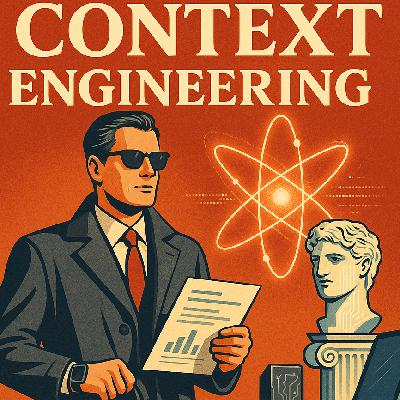
In this episode, we dive deep into one of the most powerful shifts in artificial intelligence today: context engineering. Move beyond basic prompt engineering and discover how building an AI’s “mental world” unlocks more reliable, strategic, and business-ready results.   We explore the growing impact of context engineering across industries, including real-world applications and how it’s reshaping enterprise AI strategy. You’ll also hear insights on AI and copyright law, recent AI product launches, and the emerging best practices for implementing context-rich systems.   Whether you’re a tech leader, innovator, or just AI-curious, this episode unpacks the future of AI performance—and why mastering context is your next competitive edge.   Keywords: context engineering, prompt engineering, AI strategy, artificial intelligence, enterprise AI, AI products, copyright and AI, legal AI, AI performance, AI implementation, machine learning, future of AI, AI business tools
Meet Your AI Agent: The Future According to ARK Invest’s Big Ideas 2025   In this episode, we dive into the AI Agents chapter of Cathie Wood’s ARK Invest Big Ideas 2025 report — and explore why AI agents are set to disrupt search, software, advertising, and e-commerce.   Learn how AI agents will replace apps, automate decision-making, and generate over $9 trillion in AI-driven commerceby 2030. We break down ARK’s vision of a world where personal AI assistants manage your digital life, reshape enterprise workflows, and dominate the digital ad market.   Featuring insights on agentic workflows, next-gen AI tools, OpenAI, ChatGPT, Claude, Perplexity, Bing AI, digital wallets, autonomous search, and the transformation of knowledge work — this is your guide to the agentic AI revolution.   Keywords: AI agents, ARK Invest, Cathie Wood, Big Ideas 2025, artificial intelligence, generative AI, OpenAI, ChatGPT, Claude, Perplexity, Bing AI, digital wallet, agentic workflows, e-commerce, AI search, future of work, automation, productivity, AI advertising, personal AI assistant, AI software, AI commerce, venture capital, disruptive innovation, tech investing.
ARK Invest Big Ideas 2025: Convergence of Innovation This briefing document summarizes the key themes and important insights from ARK Investment Management LLC's "Big Ideas 2025: Convergence" report, published on February 4, 2025. The report highlights significant technological advancements and their potential to disrupt various industries and create massive market opportunities. I. Overarching Themes: Convergence and Disruptive Innovation The core premise of the ARK Big Ideas 2025 report is the concept of "Convergence," where various disruptive technologies are reaching critical compounding thresholds and interacting to create exponential growth and new market opportunities. Compounding Growth and Convergence: The report draws a parallel between the compounding growth of computing power and other disruptive innovations, illustrating how seemingly small initial growth can lead to massive scale. The "Wheat Grains" analogy demonstrates this, where small increases in "rows" lead to exponential increases in "value" over time, mirroring the rapid expansion seen in technology adoption. Quote: "Row 2X Wheat Grains Value Year Computers Crossed The Same Compounding Threshold... 40 1 trillion 1 ton of gold 2018" AI as a Catalyst: Artificial intelligence is presented as a fundamental catalyst for unlocking massive market opportunities across multiple sectors. Quote: "As AI continues to accelerate, robotaxis should proliferate, drug development timelines and costs should collapse, and AI agents should solve software engineering challenges autonomously, monitoring and modifying systems around the clock." Disruptive Innovation Outpacing Traditional Economy: The report contrasts the growth of disruptive innovation (including cryptocurrencies) with non-disruptive GDP and even large incumbent technology companies (Mag 6), showing significantly higher Compound Annual Growth Rates (CAGR) for disruptive technologies. Data Point: Disruptive Innovation shows a 50% CAGR, compared to 24% for Mag 6 and -2% for GDP Non-disruptive. Accelerated Technology Adoption: The adoption rates of new consumer hardware, such as smartphones, smart home devices, and projected AI hardware, demonstrate a consistent trend of faster penetration compared to older technologies like PCs. II. Key Disruptive Technologies and Their Impact The report delves into specific technological domains, detailing their current state, future potential, and associated market implications. A. AI Agents AI agents are poised to revolutionize various aspects of online commerce and software engineering. Impact on E-commerce: AI purchasing agents are expected to generate substantial revenue for digital wallet platforms, ranging from $40 billion (base case) to $200 billion (bull case) in 2030, based on lead-generation take rates. Software Engineering Automation: AI agents are anticipated to autonomously solve software engineering challenges, monitoring and modifying systems around the clock, leading to increased efficiency. B. Bitcoin Bitcoin is presented as a maturing asset class with characteristics of a store of value, gaining institutional and corporate adoption. Record ETF Launch: Spot Bitcoin ETFs experienced the most successful ETF launch in history, attracting over $4 billion in inflows on their first day, significantly surpassing the gold ETF's initial performance. Quote: "The Spot Bitcoin ETF Complex Was The Most Successful ETF Launch In History On their first day of trading, the spot bitcoin ETFs attracted over $4 billion of inflows, a record high for ETF launches, surpassing the $1.2 billion that flowed into the gold ETF in its first month in November 2004." Scarce Asset with Predictable Monetary Policy: Bitcoin's fourth halving reduced its inflation rate to approximately 0.9%, falling below gold's long-term supply growth, underscoring its scarcity. Superior Risk-Adjusted Returns: In 2024, Bitcoin demonstrated an annual return of 122.2% with a Sharpe Ratio of 1.4 and a 5-Year CAGR of 67.2%, outperforming gold, equities, and other major asset classes. Network Security and Transaction Growth: Despite a 50% decline in miner revenue post-halving, Bitcoin's hash rate reached an all-time high, indicating strong long-term conviction among miners. The launch of the Runes protocol led to a record high in daily transaction counts. Market Resilience: Bitcoin successfully absorbed significant selling pressure in 2024 from events like the German government's bitcoin sales and the Mt. Gox creditor repayments, followed by price rallies. Increasing Corporate Adoption: Seventy-four public companies now hold bitcoin on their balance sheets, with the total value quintupling from $11 billion in 2023 to $55 billion in 2024. MicroStrategy (MSTR) holds the largest amount at 446,400 BTC, representing 58.7% of its market cap. Store of Value Characteristics: Bitcoin's transaction velocity dropped to a 14-year low in 2024, while supply held for three years or more reached an all-time high, reinforcing its role as a store of value. 2030 Price Targets: ARK's 2030 price targets for Bitcoin are aggressive: Bear Case: $300,000 (CAGR ~21%), Base Case: $710,000 (CAGR ~40%), Bull Case: $1.5 million (CAGR ~58%). These targets are based on Bitcoin's potential to capture market share across various asset classes (institutional investment, digital gold, emerging market safe haven, nation-state treasury, corporate treasury, and on-chain financial services). C. Stablecoins Stablecoins are a rapidly growing segment of digital assets, challenging traditional payment processors. Transaction Volume Surpassing Traditional Payments: In 2024, the annualized transaction value of stablecoins reached $15.6 trillion, significantly exceeding Visa (119%) and Mastercard (200%), despite a lower transaction count, indicating a much higher value per transaction. Innovation and Growth: Projects like Ethena Labs are thriving, demonstrating significant innovation in the non-fiat-backed stablecoin market. Dominance and Penetration: USDT (Tether) and USDC (Circle) dominate the stablecoin landscape, accounting for 90% of the total supply. Stablecoins are "multichain" and have penetrated almost every major Layer 1 blockchain. Record Active Addresses: Monthly active stablecoin addresses hit an all-time high of 23 million in December 2024, with Tron being the leading network, favored in emerging markets due to low fees. Dollar Dominance and Future Expansion: Dollar-pegged stablecoins constitute over 98% of the supply. ARK suggests the market will expand to include Asian currency-backed stablecoins. Retail Adoption on Layer 2s: Retail investors are increasingly using Layer 2 blockchains (e.g., Arbitrum, Base, Optimism) for cheaper and more efficient stablecoin transactions, while institutions remain on Ethereum's base layer for larger transactions. Use Cases: Peer-to-Peer (P2P) transactions and personal wallet storage are the dominant stablecoin use cases, showing resilience beyond trading. DeFi usage (DEXs, Bridges, Money Markets) is expected to retake market share from P2P in the coming years. Financial Performance: Tether's financial performance is "stunning," generating significant net income with a small headcount compared to traditional financial institutions. Increased Demand for US Government Debt: Stablecoin issuers are increasing demand for US government debt as collateral, counterbalancing "de-dollarization" trends. Tether and Circle combined hold more US Treasury securities than several countries. Yield-Bearing Stablecoins: The market for yield-bearing stablecoins is growing, allowing users to earn risk-free rates. D. Scaling Blockchains Innovations in blockchain technology are addressing scalability and fostering decentralized finance (DeFi). Layer 2 Growth: Ethereum Layer 2 solutions are processing significantly more daily transactions than Ethereum's mainnet, improving scalability and user experience. Decentralized Exchange (DEX) Challenge: DEXs are challenging centralized exchanges in both spot and derivatives trading, leveraging efficient, small teams compared to the massive headcounts of centralized venues like Binance. Restaking: Platforms like Eigenlayer are leading the growth in ETH staked in restaking protocols, enabling staked assets to be used for multiple purposes. Prediction Markets: Decentralized prediction markets like Polymarket are seeing increasing unique addresses and trading volume across various categories, including elections and politics. Developer Activity: The Ethereum ecosystem, including its Layer 2s, continues to attract the highest number of crypto developers. E. Robotaxis Robotaxis are poised to transform personal mobility by lowering costs and enhancing safety, creating a massive market opportunity. EV Market Share Growth: Battery Electric Vehicles (BEVs) are rapidly gaining market share from Internal Combustion Engine (ICE) vehicles in global sales. Cost Efficiency: Robotaxis are projected to drastically reduce the cost per mile to $0.25 globally by 2035, significantly cheaper than human-driven ride-hail and personal cars in 2024. Pioneering Regions: The US and China are leading the development and deployment of robotaxis. Autonomous Miles: Waymo and Baidu Apollo Go are accumulating significant autonomous miles, with Waymo completing approximately 175,000 weekly rides. Market Opportunity: Ride-hail could become a ~$10 trillion addressable market, with autonomous transportation serving a much larger population at lower price points. Enterprise Value: Robotaxis could generate approximately $34 trillion in enterprise value by 2030, distributed among autonomous electric auto manufacturers, fleet owners, and autonomous platform providers. Hurdles to Commercialization: Key challenges include data/testing/validation, manufacturing and customer partnerships, regulation, and technical hurdles. F. Autonomous Logistics (Drones) Logistics drone companies are overcoming regulatory barriers
CEO AI PODcast | Ep. 1 – Artificial Intelligence & Convergence: Inside ARK Invest’s Big Ideas Report We kick off our 3-part series with a bold look into Cathie Wood's ARK Invest’s Big Ideas 2025 - a much anticipated and awaited compendium by Cathie and ARK's hotshot analysts on where the opportunity are in Artificial Intelligence.  In this episode: What “convergence” means for your business $14T impact of AI Agents Multiomics & AI-driven healthcare Robotics & autonomous logistics shaping the future of work Packed with strategic insights and real data — this is what every CEO needs to hear now.   Up next: Episode 2 - 6 More Key AI Growth Areas
Apple just blew the lid off of reasoning models by demonstrating that they break down and become highly inaccurate for many classes of complex problems.   A must listen if you are applying AI to your business in any way ! Dive into the controversial limitations of cutting-edge AI! This episode explores groundbreaking research, including contributions from Apple scientists, revealing that Large Reasoning Models (LRMs) like those from OpenAI, Claude, and DeepSeek face a fundamental challenge: their ability to solve problems and reason collapses at high levels of complexity. Gary Ambrosino unpacks  a paper that investigates how problem complexity breaks down AI thinking, showing that even models designed for sophisticated reasoning struggle beyond a certain threshold. Discover the surprising findings from controlled puzzle environments, where researchers found AI reasoning performance can drop to zero accuracy and models even reduce their reasoning effort when faced with truly difficult tasks. This discussion challenges prevailing assumptions about frontier AI capabilities and raises crucial questions about their true reasoning and generalizable problem-solving abilities. If you're interested in the science of AI, the limits of machine learning logic, and the future of artificial intelligence, this episode is a must-listen. Learn where current AI hits a wall [conversation history] and what it means for building more robust and reliable systems.
This report sets out to compile foundational trends related to Artificial Intelligence. One of the key takeaways is the unprecedented rate at which the world is changing due to rapid and transformative technology innovation and adoption, particularly in AI. The pace of change seems faster than ever, and AI User, Usage, and Capital Expenditure Growth are indeed highlighted as unprecedented. Driving this momentum is significant investment. Big technology companies are generating loads of cash, which they are increasingly directing towards AI efforts to drive growth and fend off competitors. Capital Expenditure (CapEx) spending by major tech companies has been on the rise for years, accelerating with AI's prominence. This spend is primarily driven by the need for compute to train and run AI models. Data centers are a key beneficiary of this massive AI CapEx spend, with construction happening at speeds resembling consumer tech cycles more than traditional real estate development. AI's impact is broad and varied. AI usage is surging among consumers, developers, enterprises, and governments globally. Consumer adoption is unprecedented, with platforms like ChatGPT showing incredibly rapid user growth compared to past technologies. The report also details AI rollouts by tech incumbents across their massive user bases, from Microsoft Copilot chats to Meta AI users and Google's Gemini and AI Overviews. Beyond the digital realm, AI is also ramping up rapidly in the physical world, becoming data-driven in areas like autonomous taxis, mining exploration, and agriculture. The expansion of low-cost satellite internet is enabling AI-native experiences for a new wave of global internet users, potentially bypassing traditional app ecosystems. The AI market is characterized by rising competition among traditional tech companies, emerging attackers, and even sovereign nations. There's a rapid release of new AI models, including large-scale multimodal and language models. The performance gap between closed and open-source models is closing, leading to an explosion of usage by developers as falling token costs make powerful models more accessible. Geopolitical competition is acute, particularly between China and the USA, with China demonstrating rapid relevance and catching up in model performance. Finally, regarding the impact on the workforce, a key message from the report, quoting NVIDIA CEO Jensen Huang, is that "you're not going to lose… your job to an AI… but you're going to lose your job to somebody who uses AI." AI is expected to affect every job, creating some while eliminating others, but ultimately transforming all. Companies like Shopify are already seeing reflexive AI usage as a baseline expectation for employees. AI is presented as a potential opportunity to close the technology divide and increase global GDP. This report paints a picture of accelerating innovation, massive investment, and widespread adoption that is fundamentally reshaping technology and society.
 In this episode, we explore the insightful book "Empire of AI: Dreams and Nightmares in Sam Altman's Open AI" by Karen Hau. This book examines the internal conflicts within OpenAI, highlighting the tension between its original mission for AGI safety and its current commercial ambitions. We discuss how OpenAI's transformation from a non-profit to a commercially driven entity is influenced by significant financial pressures, including a major investment from Microsoft. This episode serves as a cautionary tale about mission drift, emphasizing the importance of strong governance and awareness of ethical and social impacts amidst rapid technological advancements.   #karenhao #TheempireofAI #Openai #samaltman
Welcome to the CEO AI Podcast, where today's discussion focuses on resilience and how setbacks can become the driving force for success, especially in the AI-driven business world. We explore "The Art of Bouncing Back," authored by Darlene Santor, also known as Coach Dar. Coach Dar leverages her extensive experience as an occupational therapist and motivational speaker, focusing on high-pressure environments with pro athletes and Fortune 100 executives. Her book is a guide to finding one's flow after life challenges. Discover how setbacks, rather than being seen as failures, are the norm in ambitious pursuits and how comebacks can refine one's journey. The episode delves into nine principles outlined by Coach Dar, including embracing the current state, understanding personal strengths, seeking feedback, leveraging emotional intelligence, and cultivating grit. Through personal narratives and client stories, the episode offers valuable insights for CEOs looking to foster resilience and peak performance in their teams and themselves, utilizing intentional environments and emotional intelligence. Listen in for practical advice on building a culture that thrives on consistent resilience and relentless effort.
Google made the internet searchable. AI is making it actionable. In this episode, we explore the seismic shift from keyword search to intelligent agents—what it means for business, behavior, and the future of the web. From SEO to LLMs, from PageRank to prompt engineering, this is the real revolution in how humans find, decide, and act online. If you're building, investing, or operating in tech, you can't afford to miss this.  
In this episode of the CEO AI podcast, we delve into Mustafa Suleiman's book "The Coming Wave," exploring the crucial roles AI and synthetic biology are playing in shaping our future. Discussing technological waves throughout history, the episode highlights how emerging technologies today not only follow historical patterns but also introduce unique challenges through their interconnected nature. We examine Suleiman's argument that current tech advancements represent both unprecedented potential and significant risks, emphasizing the urgency of implementing effective containment strategies. Topics include the evolution of technology, such as AI's relentless cognitive progress and synthetic biology's programmable nature, raising ethical and safety concerns. Moreover, the podcast brings attention to the impact on businesses, urging CEOs to incorporate safety, robust risk management, and purposeful leadership rather than merely adopting innovations. Real-world applications and potential futures are discussed, encouraging listeners to consider profound responsibilities accompanying such transformative tools.
In this episode of the CEO AI podcast's "Deep Dive," we delve into Gary Ambrosino's compelling article, "Is AI Eating Itself? The Future of AI Reliability?" The discussion highlights a growing concern in artificial intelligence: the potential crisis of AI models being trained predominantly on machine-generated data rather than original human content. As we explore the concept of "AI eating itself," we examine the risks associated with synthetic data feeding back into AI systems, leading to reduced accuracy and model collapse. Discover how this phenomenon could dramatically impact the quality and trustworthiness of online information, as AI tools become entrenched in a loop of self-generated content, potentially reaching a point where trusted human-made data becomes scarce. With predictions that AI-generated content could dominate the web in the near future, this episode underscores the importance of data integrity and authenticity. We discuss potential solutions, emphasizing the critical role of high-quality, verified training data and innovative methods to avert model collapse. Whether it involves diversified data sources or specialized agentic AI systems, the focus is on maintaining a strong foundation of human-authored knowledge to support AI development. Join us as we explore these challenges and opportunities, offering strategic insights into maintaining reliability in AI systems amidst a sea of synthetic information.
loading
Comments