


 Claim Ownership
OpenAI Podcast
Subscribed: 2,213Played: 7,829
Subscribe

© OpenAI
Description
Hosted by Andrew Mayne, The OpenAI Podcast features conversations with the people working at and building with OpenAI. Topics range from what goes into developing frontier AI models and new features, to what users are doing with the technology. It’s a practical look at how AI is made and where it’s going, told by the people closest to the work.
Hosted on Acast. See acast.com/privacy for more information.
23 Episodes
Reverse

Racing is a sport of tiny margins and mountains of data. OpenAI researcher Joyce Ruffell and RaceTek Systems co-founder Chase Holden are each using AI to help teams make better use of information from the track, the garage, and the people behind the wheel. They discuss OpenAI’s research collaboration with Chip Ganassi Racing and how Chase used ChatGPT and Codex to go from hosting a NASCAR podcast to building a racing intelligence company. They also examine how AI could give smaller teams an edge without replacing the human expertise at the heart of racing, and why car culture runs so deep at OpenAI.Chapters00:43 Intro to OpenAI researcher Joyce Ruffell and Chip Ganassi Racing02:43 Intro to Chase Holden and RaceTek Systems07:45 Joyce’s path into racing10:00 Helping racing teams work with AI15:31 Combining human feedback with racing data18:26 How AI helps smaller teams compete21:43 Spreadsheets and the “data wars” in racing27:03 Getting started with AI and Codex30:08 How RaceTek won its first customer33:01 Humans, robot racing, and the future of competition39:26 Using AI beyond the racetrack Hosted on Acast. See acast.com/privacy for more information.
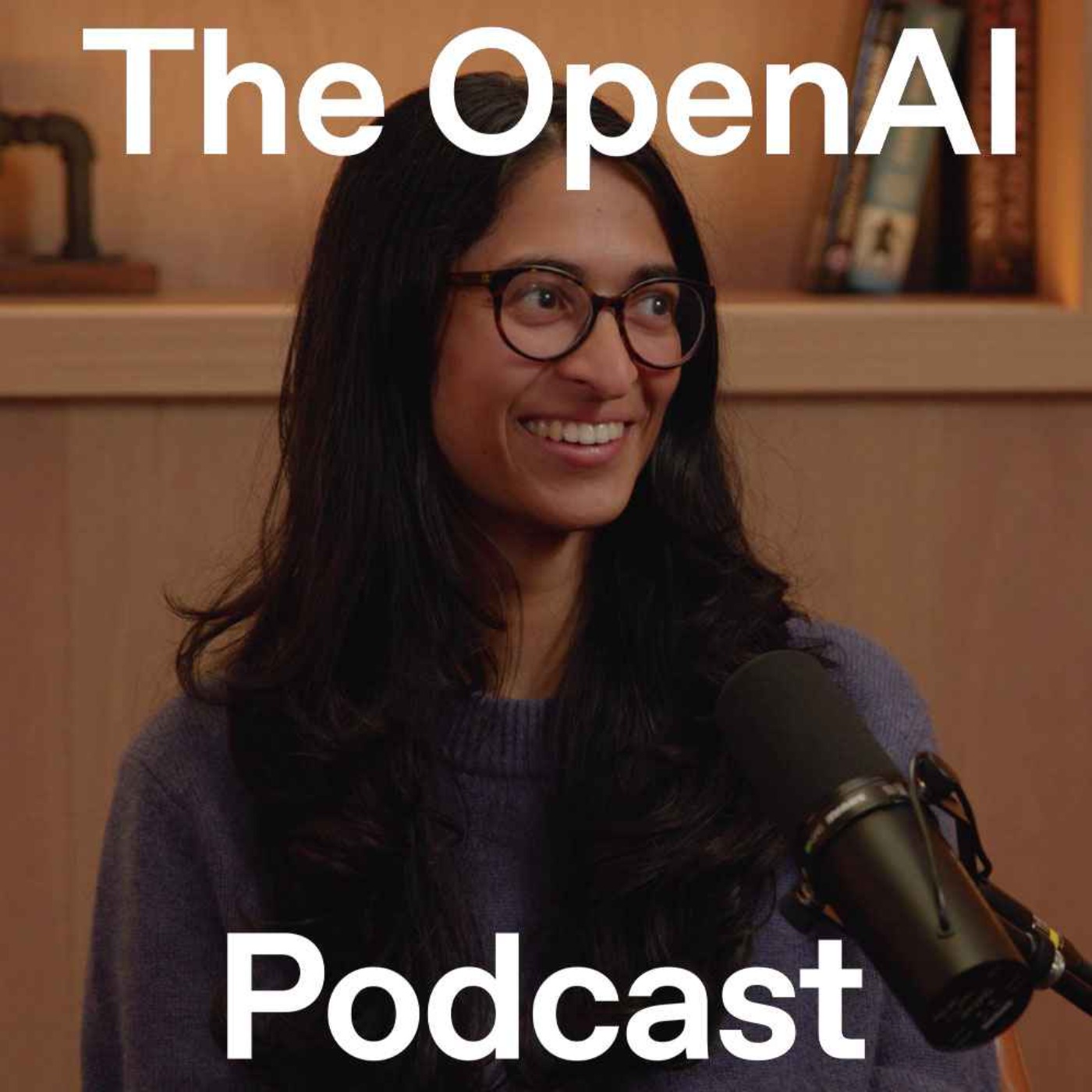
The old tests are getting too easy. Tejal Patwardhan leads OpenAI’s frontier evals team, which is finding new ways to measure and forecast progress as models become more capable. She and host Andrew Mayne discuss why evals matter for research, how benchmarks can break or get gamed, and what models need to be judged on next.Chapters00:00:24 Growing up at OpenAI00:03:10 Why reasoning changed everything00:06:28 What made o1 surprising00:11:20 Why old benchmarks stopped working00:14:45 What makes a good benchmark00:17:35 Why evals are getting harder00:22:09 Measuring voice and vision models00:24:48 Testing models on real science00:33:23 How OpenAI tracks frontier progress00:40:47 What AI means for work Hosted on Acast. See acast.com/privacy for more information.

Last month AI found something mathematicians had missed for decades. Reasoning researchers Alexander Wei, Hongxun Wu, and Lijie Chen join the podcast to discuss how a general-purpose model helped disprove an 80-year-old conjecture from famed mathematician Paul Erdős. They walk through the moment the result started looking real, what it took to verify the proof, and what’s happened since sharing the discovery with the world. They also explore what this means for the future of math and for researchers learning to work with AI.Chapters0:44 AI and the International Math Olympiad and International Olympiad of Informatics6:35 An OpenAI model disproves the Erdős unit distance conjecture8:33 Running the model and checking the proof11:04 Why general models matter for discovery15:55 Creativity, tools, and how the proof worked18:25 Why AI should feel empowering for mathematicians22:31 Advice for researchers using AI27:24 What comes next for math and AI research37:30 Cryptography, quantum computing, and the future Hosted on Acast. See acast.com/privacy for more information.

People are generating over 1.5 billion images a week in ChatGPT. In this episode, Product lead Adele Li and researcher Kenji Hata share some of the new use cases and trends since the launch of Images 2.0. Together with host Andrew Mayne, they trace the progress from the early DALL-E days and dive into the latest capabilities, including better text rendering, photorealism, multilingual support, world knowledge, aspect ratios, and character consistency. They also explore what comes next as image generation models evolve into more capable creative assistants.Chapters00:36 How Adele and Kenji came to work on Images02:27 Images 2.0 launch reception05:25 Productivity use cases and and 360 images09:34: Viral trends, authenticity, and imperfection10:51 Training breakthroughs and photorealism14:06 Evals, prompting, and creative control22:16 Creative agents and what comes next22:27 Images + Codex28:08 Prompt tips Hosted on Acast. See acast.com/privacy for more information.

Training frontier models isn’t as simple as adding more GPUs—one small problem and the whole coordinated dance falls apart. OpenAI’s Mark Handley and Greg Steinbrecher discuss how a new supercomputer network design, used to train some of the company’s latest models, keeps the whole system moving in lockstep, even with record numbers of GPUs. They break down Multipath Reliable Connection, a new protocol OpenAI developed with AMD, Broadcom, Intel, Microsoft, and Nvidia, and why they’re making it available for the whole industry to use.Chapters00:00 Intro00:39 Greg and Mark's paths to OpenAI04:34 Why training AI stresses networks differently10:05 Bottlenecks, failures, and the cost of waiting15:19 How Multipath Reliable Connection works18:59 A protocol to route around failures25:05 Why OpenAI is making MRC an open standard35:09 Could AI compute move to space? Hosted on Acast. See acast.com/privacy for more information.

Comments

Download from Google Play

Download from App Store
 United States