


 Claim Ownership
Where the Past Lives
Subscribed: 0Played: 1
Subscribe

© Brandon Foster
Description
Welcome to Where the Past Lives. This is where I discuss German history from the late ancient to the early medieval period. If you enjoy learning about kings, queens, wars, migrations, and anything in between, this is the show for you.
I upload weekly to bi-monthly, depending on my workload, besides writing a monthly essay.
I upload weekly to bi-monthly, depending on my workload, besides writing a monthly essay.
12 Episodes
Reverse

Following the chaos of 476 AD, the final territorial vestige of Roman rule was the Kingdom of Soissons in Gaul, under the resilient Roman administrator, Syagrius. His authority was dramatically challenged by the rising star of the Germanic world, the fiercely ambitious Frankish King, Clovis I. Their decisive showdown in 486 AD at the Battle of Soissons resulted in Clovis’s complete victory, which swiftly dismantled the last claim to Roman sovereignty in the West. Syagrius’s subsequent capture and execution sealed the final chapter for the empire, while simultaneously laying the groundwork for Clovis to forge the beginnings of the unified Frankish kingdom.Links:LinktreeHuluBooxorSupportMusic:Sunguard by Alexander Nakarada (CreatorChords) | https://creatorchords.comMusic promoted by https://www.free-stock-music.comCreative Commons / Attribution 4.0 International (CC BY 4.0)https://creativecommons.org/licenses/by/4.0/
Following the chaos of 476 AD, the final territorial vestige of Roman rule was the Kingdom of Soissons in Gaul, under the resilient Roman administrator, Syagrius. His authority was dramatically challenged by the rising star of the Germanic world, the fiercely ambitious Frankish King, Clovis I. Their decisive showdown in 486 AD at the Battle of Soissons resulted in Clovis’s complete victory, which swiftly dismantled the last claim to Roman sovereignty in the West. Syagrius’s subsequent capture and execution sealed the final chapter for the empire, while simultaneously laying the groundwork for Clovis to forge the beginnings of the unified Frankish kingdom.Links:LinktreeHuluBooxorSupportMusic:Sunguard by Alexander Nakarada (CreatorChords) | https://creatorchords.comMusic promoted by https://www.free-stock-music.comCreative Commons / Attribution 4.0 International (CC BY 4.0)https://creativecommons.org/licenses/by/4.0/
In April 2019, a fire broke out at Notre Dame Cathedral. It was contained, but the structure needed some renovations. Archaeologists were permitted to excavate, and now they have discovered some really cool things. Here are a few of them.Links:LinktreeHuluBooxorSupportMusic:Sunguard by Alexander Nakarada (CreatorChords) | https://creatorchords.comMusic promoted by https://www.free-stock-music.comCreative Commons / Attribution 4.0 International (CC BY 4.0)https://creativecommons.org/licenses/by/4.0/

The Saxon Wars waged by Charlemagne between 772 and 804 were fought either for territorial expansion or for the Christian faith. Watch this episode from Medieval Germanica to find out what historians and the sources say.If you like medieval history, you should check out my links!
Welcome to Medieval Germanica. I’m your host, Brandon Foster, and today we’re diving into the life of Clovis, the first king of the united Franks. Born around 466 to Childeric I and a Thuringian princess, Clovis—whose name means “famous warrior”—rose to power in 481 and changed the course of European history.We’ll explore how he defeated Roman and Frankish rivals, expanded his kingdom through cunning and conquest, and ultimately unified the Franks. Most famously, Clovis converted to Catholic Christianity, setting the stage for a long alliance between the Frankish kings and the Church. From the Battle of Soissons to the Council of Orléans, from brutal assassinations to the founding of Paris as his capital—this is the story of Clovis, founder of the Merovingian dynasty.For more, click here.

Welcome to Medieval Germanica! Gather round the fire and hear the tales of Germany. Learn her history, her ways, and her people!At Medieval Germanica, you will learn about German history from the Late Ancient Period through the Early Medieval Period. If you like history, especially German history, this podcast is for you.I upload episodes on Friday.For more, click here.

This episode focuses on the Germanic mythological character Mannus and his Hindu counterpart Manu. Both the Germans and the Aryans who invaded India were Indo-Europeans. They shared a similar ancestry, and their mythologies have many similarities.Mannus also had three sons: Ingvaeones, Hirmeaones, and Instvaeones. In addition to their shared "first man" mythology, Manu and Mannus share a flood story similar to the Judeo-Christian flood story.Check out the episode to learn more. Enjoy what you see check out my other social content: LinkTree
The Germanic tribes were a collection of Indo-European speakers who lived near the North Sea. From the 3rd century B.C. (B.C.E.) to the 6th century A.D. (C.E.), they migrated into Gaul and central and southern Europe.This episode of Medieval Germanica explores who these tribes were, where they came from, what languages they spoke, and what they looked like.For more like this, check out my Substack and YouTube.
In the first century B.C., Julius Caesar was given command of Gaul (now mostly present-day France). While there, he waged war against many tribes. One such war was against King Ariovistus, who was "king of the Germans."Links:LinktreeHuluBooxorSupport
In this episode, I discuss trench warfare and Joseph Loconte's book A Hobbit, A Wardrobe, and A Great War. This book discusses the impact of World War I on J. R. R. Tolkien and C.S. Lewis. One of the things he mentions in detail is trench warfare. I wanted to show the detail he goes into compared to other history books.Buy me a coffeeAmazon: A Hobbit, A Wardrobe, and A Great WarMedieval Germanica Substack
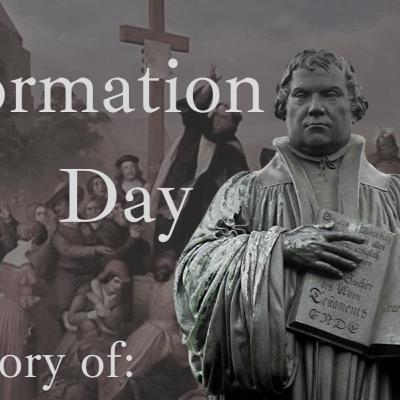
How did Reformation Day start? Tune in to find out!
Read the whole article here.

How did Halloween become the child-friendly holiday that we know today?
Find the whole article here.
Comments

Download from Google Play

Download from App Store
 United States