


 Claim Ownership
The Tsunami Is Coming Podcast
Subscribed: 0Played: 0
Subscribe

© Jeremy Ghez
Description
Giving you insights on the world, shedding light on complex global dynamics as well as the turbulences to come.
jeremyghez.substack.com
jeremyghez.substack.com
17 Episodes
Reverse
Welcome to this new series from The Tsunami is Coming: What Keeps You Up at Night?This is a set of conversations in which experts and thought leaders name the shifts they see coming and the fractures in the status quo that haven’t yet made headlines.Flora Goldenberg is a Paris-based tour guide and lecturer specializing in Le Marais, the city’s historic Jewish quarter. Check out her Instagram account here. She grew up here. Her grandfather ran a restaurant on one of its streets. The restaurant is gone. But his name is still painted on the building.That image is the starting point for this conversation, and for a question worth sitting with: what happens to identity when the container changes but the label stays? Le Marais is still called the Jewish Quarter. Fewer people speak Yiddish. The neighborhood is gentrified, expensive, and transformed — but Flora argues: it’s still alive.A generation ago, protesters filled the streets against globalization. The charge was Americanization: one culture flattening all the others. It didn’t happen that way. What happened instead was something harder to name: an acceleration of exchange that preserved more than it erased, but changed the texture of everything it touched.Flora sees that every day. So does her grandfather’s name, still waiting on the wall.This Substack is reader-supported. To receive new posts and support my work, consider becoming a free or paid subscriber. This is a public episode. If you'd like to discuss this with other subscribers or get access to bonus episodes, visit jeremyghez.substack.com/subscribe
Welcome to this new series from The Tsunami is Coming: What Keeps You Up at Night?This is a set of conversations in which experts and thought leaders name the shifts they see coming and the fractures in the status quo that haven’t yet made headlines.Alastair Newton is a political risk analyst who has spent decades advising financial institutions on geopolitics — starting at Lehman Brothers in 2005, where he launched a series called “What Keeps You Up at Night.” (I borrowed the phrase. He knows.)Newton has been writing about hegemonic transition since 2008. He wanted to talk about Europe, but not the version you’d expect.He’s optimistic. That’s the through-line, not a twist at the end. Europe, he argues, has regained something it lost after the Cold War: the ability to take advantage of crises. Brexit was a shock. Trump is a bigger one. And shocks, Newton believes, are what Europe needs to move.The question is whether it can move fast enough, given how much time its leaders spend, in his phrase, “bickering about angels on pinheads.” Given how hard the United States is working to pull it apart.Newton thinks it can. Far-right parties get found out when they govern. Pragmatism wins. And Trump, paradoxically, may be the best enemy Europe could have asked for.“If you have the opportunity to choose your enemy,” he said, “you probably wouldn’t have managed to come up with something as helpful as Donald Trump.” This is a public episode. If you'd like to discuss this with other subscribers or get access to bonus episodes, visit jeremyghez.substack.com/subscribe
Welcome to this new series from The Tsunami is Coming: What Keeps You Up at Night?This is a set of conversations in which experts and thought leaders name the shifts they see coming and the fractures in the status quo that haven’t yet made headlines.Philip Bruner is a professor of practice in sustainable finance at the University of Washington’s Foster School of Business, where he directs the Climate Risk Lab. Before academia, he spent two decades in the private sector trying to accelerate capital into distributed energy. We met at a climate conference in Berkeley about a year ago.When I asked him what keeps him up at night, he didn’t hesitate: climate narrative collapse.The Paris Accords, he argues, rest on two half-truths. The first is that electrifying transportation, agriculture, and energy will switch the climate problem off. It won’t. We’ve already passed 1.5 degrees. Even full electrification wouldn’t stop runaway destabilization.The second half-truth is that we can have renewables without petroleum. We can’t. Petroleum is upstream from solar panels, wind turbines, and electric vehicles. These technologies are symbiotic, not substitutes.But there’s a silver lining. Distributed renewables may not save the planet, but they do make infrastructure more resilient. And resilience (not salvation) is where the real business case lies.This is a conversation about reframing climate from moral imperative to operational risk. And about what happens when the narrative finally catches up to the physics. This is a public episode. If you'd like to discuss this with other subscribers or get access to bonus episodes, visit jeremyghez.substack.com/subscribe
Welcome to this new series from The Tsunami is Coming: What Keeps You Up at Night?This is a set of conversations in which experts and thought leaders name the shifts they see coming and the fractures in the status quo that haven’t yet made headlines.Frederic Raillard is the CEO and co-founder of Fred & Farid, an international advertising agency, and the founder of [Ai]magination, where he’s exploring the intersection of branding, storytelling, and artificial intelligence. We met on a TV set during the 2024 US elections.When I asked him what keeps him up at night, I expected something about AI disruption or the attention economy. I got something else entirely.Frederic talked about clairvoyance. About the tension between his accelerating professional life—selling, persuading, performing—and a private search for something he calls “verticality.” He’s learning to distinguish imagination from what he describes as “downloading” information, working with people who, as he puts it, access what he calls the invisible world.This conversation went in directions I didn’t anticipate, and I let it run. But underneath the unexpected territory, there’s a diagnosis worth hearing. “The society we live in is losing sense completely,” he said. Brands succeed when they provide meaning—because we’re starving for it. And when I brought up the international success of Stranger Things, we landed on something that’s stayed with me: the difference between a puzzle and a mystery. A puzzle, you solve, like an Agatha Christie murder. A mystery, you don’t even know what you’re looking at, like when you’re watching a Stranger Things episode.The world, right now, looks more like Stranger Things than like Agatha Christie’s stories. Some people build new analytical models. Some people turn to something older.This is the unedited conversation. This is a public episode. If you'd like to discuss this with other subscribers or get access to bonus episodes, visit jeremyghez.substack.com/subscribe
Welcome to this new series from The Tsunami is Coming: What Keeps You Up at Night?This is a set of conversations in which experts and thought leaders name the shifts they see coming and the fractures in the status quo that haven’t yet made headlines.I spoke with Pauline Laravoire, an entrepreneur and sustainability educator who splits her time between Paris and Kolkata.What keeps her up at night? The ongoing transition in higher education. How do we bridge the widening gap between traditional teaching methods and the expectations of a new generation of learners? With brains that function differently, shorter attention spans, and fierce competition from social media, online platforms, and AI, universities must reinvent themselves.Pauline shares her unflinching diagnosis and vision: higher education must shift from information transmission to creating spaces for interaction, debate, and critical thinking. A thought-provoking conversation about the future of education in the digital age.This Substack is reader-supported. To receive new posts and support my work, consider becoming a free or paid subscriber. This is a public episode. If you'd like to discuss this with other subscribers or get access to bonus episodes, visit jeremyghez.substack.com/subscribe

Welcome to this new series from The Tsunami is Coming: What Keeps You Up at Night?This is a set of conversations in which experts and thought leaders name the shifts they see coming and the fractures in the status quo that haven’t yet made headlines. Here’s the very first edition!Leslie Palti-Guzman is a leading expert on global gas markets and energy geopolitics. She’s the founder of the advisory firm Energy Vista and host of the Energy Vista podcast.In this conversation, she tells us why the U.S. may be squandering its greatest strategic advantage: America's energy leverage, built on the shale revolution, may be at risk.The tech wobbles a bit at the start, but the conversation picks up quickly. Consider it the charm of a debut…Leslie’s Substack:This Substack is reader-supported. To receive new posts and support my work, consider becoming a free or paid subscriber. This is a public episode. If you'd like to discuss this with other subscribers or get access to bonus episodes, visit jeremyghez.substack.com/subscribe
What the new U.S. National Security Strategy quietly signalsThe 2025 U.S. National Security Strategy contains one line that should make every European policymaker pause: Washington now wants to “cultivate resistance” inside allied democracies.This isn’t military intervention. It’s something quieter:a willingness to back alternative political forces in Europe to “correct” its trajectory.Key points from the document:* Europe is described as facing “civilizational erasure” and becoming “unrecognizable in 20 years.”* Current European leaders are labeled “unstable” and accused of “trampling democratic principles.”* The U.S. pledges to support “patriotic European parties” and “political allies in Europe.”* It questions whether future European societies will remain “reliable allies.”* It suggests Europe needs to be pushed toward a quicker settlement in Ukraine.Why this mattersThis is a cold reminder that geopolitical risk today isn’t just about borders, armies, or treaties. It’s also about political interference between allies, demographic anxieties, and competing visions of what the West should be.If we keep measuring risk the old way, we will miss what’s unfolding right in front of us.You can read the full document here. This is a public episode. If you'd like to discuss this with other subscribers or get access to bonus episodes, visit jeremyghez.substack.com/subscribe
It’s way too early to determine the long-term effects of the US strike on Iranian nuclear facilities yesterday. Here are a few brief thoughts to get this conversation going. Long story short? Now may be a good time to start doubting if you never had any doubts about the regions future. This is a public episode. If you'd like to discuss this with other subscribers or get access to bonus episodes, visit jeremyghez.substack.com/subscribe
Musk blasted Trump’s signature bill as “disgusting abomination.” He added, moments ago, that Trump would have never been elected without his help. Trump said he found this all very disappointing. High level drama?Yes. And a warning about the new rules of influence.We’re moving from a predictable, institution-based system where companies could rely on established processes and regulatory frameworks, to one where political relationships increasingly determine business outcomes. This creates both unprecedented opportunities for those who can successfully navigate Trump’s transactional approach, and significant risks for those who can’t or won’t engage. In this new world, managing risk means managing relationships — not just regulations. The hard part is less strategy—and more politics. See you tomorrow for the regular installment. And always feel free to hit “reply”. This is a public episode. If you'd like to discuss this with other subscribers or get access to bonus episodes, visit jeremyghez.substack.com/subscribe
Recent concerns about Joe Biden's health and the broader challenges facing the Democratic Party shouldn’t feel normal — and here’s why:* They highlight growing questions about transparency and leadership within a party that seems increasingly out of touch with the U.S. electorate.* These U.S. developments reflect a global pattern: as the world grapples with rapid, disorienting change, the supply of new political ideas is dwindling — just when they’re most urgently needed.Share your thoughts. The road ahead promises to be as painful as it is prolonged… This is a public episode. If you'd like to discuss this with other subscribers or get access to bonus episodes, visit jeremyghez.substack.com/subscribe
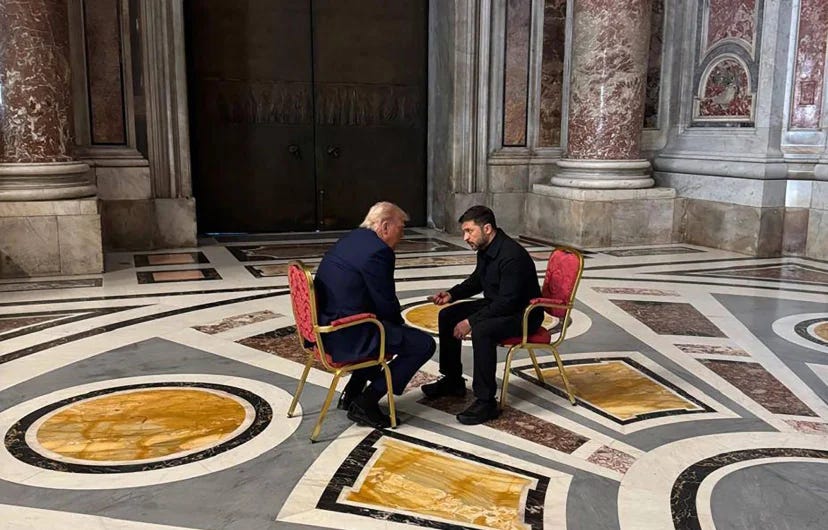
One photo, two leaders, and a thousand headlines. In three minutes I break down why Trump’s Vatican kneel-down with Zelensky looks anything but accidental.Love him or hate him, you must remember something about Trump’s talent: as the former owner of the beauty pageant Miss America, and the former host and producer of The Apprentice, the President of the United States knows what makes a picture appealing and a story good. Long story short: there’s a lot more hesitation in Trump’s mind than what headlines suggest. So, as always, remain open-minded about your future outlook: there are a lot more possible paths for this administration to take than what conventional wisdom suggests. Here’s the thing: the question isn’t whether this was calculated or not—it was. The real question is why? Long story short: there’s a lot more hesitation in Trump’s mind than what headlines suggest. So, as always, remain open-minded about your future outlook: there are a lot more possible paths for this administration to take than what conventional wisdom suggests. The pictureTwo noteworthy commentsChris Ardane writes on something previously known as Twitter: I’m a photographer and understand (I think) Trumps popularity, but I’ve got no answer to how the dude has a knack for producing iconic photos almost weekly. He’s a meme machine.Historian Simon Sebag Montefiore comments (on the same social media): The Grand Prince of Kiev is received by the Holy Emperor of the Romans at the funeral of the Bishop of Rome….Did I miss anything? Do you agree? Just hit reply and let me know. This is a public episode. If you'd like to discuss this with other subscribers or get access to bonus episodes, visit jeremyghez.substack.com/subscribe
Italian Prime Minister Georgia Meloni is in Italy to meet with President Donald Trump amid heightened tensions between the United States and the European Union over trade tariffs and broader transatlantic tensions.The official joint statement from the White House emphasized the commitment of both countries to deepen cooperation on security, defense, and technology, as well as to address issues such as illegal immigration and organized crime. The leaders also reiterated their support for ending the war in Ukraine and strengthening NATO. In addition, the trip was conducted with significant consultation with EU partners, and she has publicly committed to representing European interests. Nonetheless, skepticism remains within the EU about whether this approach can truly serve the collective European good, or if it risks fragmenting the EU’s position in critical negotiations with the US.I wrote about Italy’s temptation to engage alone with the US a little while back, and I stand by it: There is a real risk for European countries engaging on bilateral terms with the Trump administration to be completely steamrolled by the US. This is a hallmark of a transactional globalization. This is a public episode. If you'd like to discuss this with other subscribers or get access to bonus episodes, visit jeremyghez.substack.com/subscribe
The French courts just delivered a verdict that changes everything. Marine Le Pen found guilty and banned from running in 2027—this is justice being served rather than democracy being subverted. I explain why and break down what this political earthquake means for France, Europe, and the future of populist movements. This is a public episode. If you'd like to discuss this with other subscribers or get access to bonus episodes, visit jeremyghez.substack.com/subscribe
When a top U.S. official accidentally added a journalist to a group chat about Yemen war plans, it revealed more than just operational details. This isn't merely about incompetence—it exposes the fundamental tension between Trump's "common sense" governance and the complex realities of national security. More critically, the dismissive language about European allies ("parasites") signals a definitive break in transatlantic relations. Europeans must move beyond shock and recognize this new reality. The West as we knew it no longer exists—this is Europe's moment to create a viable alternative path forward while the world watches. This is a public episode. If you'd like to discuss this with other subscribers or get access to bonus episodes, visit jeremyghez.substack.com/subscribe
Some brief thoughts about the Putin-Trump call yesterday. This is a public episode. If you'd like to discuss this with other subscribers or get access to bonus episodes, visit jeremyghez.substack.com/subscribe
A couple of thoughts on Donald Trump’s address to the joint session of Congress yesterday (which was technically not a State of the Union speech!). Also: Emmanuel Macron will address the (his) nation tonight, on the topic of Ukraine. Again: the future of Ukraine depends more on what the Europeans will do than what Trump says, so it can help to sort out what’s noise and branding, and what actually matters. Any thoughts? Comment below! This is a public episode. If you'd like to discuss this with other subscribers or get access to bonus episodes, visit jeremyghez.substack.com/subscribe
You’ve all seen or heard about the heated exchange in the Oval Office between Presidents Trump and Zelenskyy. The Ukrainian leader must have known this was coming. But did he have another goal? And there is a bigger picture here about disgruntled Americans and non-Americans, a risk this US administration may be overlooking.Any thoughts? Just hit replay!Keep in touch and thank you for subscribing. This is a public episode. If you'd like to discuss this with other subscribers or get access to bonus episodes, visit jeremyghez.substack.com/subscribe
Comments

Download from Google Play

Download from App Store
 United States