


Physician Family Finances Podcast
Subscribed: 14Played: 966
Subscribe

© 2025 2024 Copyright Physician Family Financial Advisors Inc.
Description
Are you a dedicated physician mom or dad, striving to balance your practice and family while securing your financial future? With the demands of work and family life, navigating the complexities of investment options, tax laws, and retirement planning can be overwhelming.
Join Nate Reineke and Chelsea Jones, seasoned Certified Financial Planner™ professionals, on a mission to empower physician parents like you with the knowledge and tools needed to achieve long-term financial security. Through our podcast, we provide expert financial advice tailored to physicians, covering essential topics such as wealth management, retirement savings, tax-efficient investing, and estate planning.
Gain valuable insights into wealth accumulation strategies, investment strategies, and asset allocation techniques to optimize your financial portfolio. Enhance your financial literacy with practical budgeting tips and learn how to set and achieve long-term financial goals. Discover effective risk management strategies to protect your assets and ensure a secure future for your family.
Whether you're planning for retirement, saving for your children's education, or considering estate planning options, our podcast offers actionable advice to help you make informed decisions. Explore college savings plans, retirement income strategies, and specialized financial planning for physicians to maximize your financial well-being and investment.
Subscribe now to our podcast to access guidance on navigating the complex world of finance and visit https://physicianfamily.com/podcast to learn more about how we can help you achieve financial peace of mind and secure your future investments
See Marketing Disclosure at www.physicianfamily.com/disclosures
143 Episodes
Reverse
If you are on track for retirement, college, have an emergency fund, have bought all your cars in cash, and check all the other planning boxes, but find yourself with extra cash, where is the best place to put it? It may seem like a simple math problem to decide if investing is a better option than paying down your mortgage, but the math isn’t actually that easy. Nate Reineke and Kyle Hoelzle break down why it’s not an easy question to answer and the caveats that complicate the math. We also discuss how paying off your mortgage faster helps reduce risk as you head into retirement. We also answer your colleagues’ questions. An ENT in New York says, “If my employer updates the plan’s default investment option, does that change how my current retirement account is invested?” A Critical Care Doctor in Ohio asks, “My oldest child is in college, and we have some of his tuition money in a high-yield savings account. Should we move it to his 529?” An ENT in Oregon wonders, “How should investors think about owning broad index funds when they disagree with the practices of some of the companies inside them?” Are you ready to turn worries about taxes and investing into all the money you need for college and retirement? It’s time to make a plan and get on track. To find out if we’re a match visit physicianfamily.com and click get started or, you can ask a question of your own by emailing podcast@physicianfamily.com. See marketing disclosures at physicianfamily.com/disclosures
The seasons have changed, and fall is coming to an end, which means the holidays are here! While Nate may not be the biggest fan of Thanksgiving food, he and Chelsea take some time to reflect on life and money lessons they are thankful to have learned, often around a dinner table. Nate Reineke and Chelsea Jones break down some of the valuable lessons they learned when they were young, like “don’t spend money you don’t have yet,” and Chelsea’s favorite, “pay yourself first.” We also discuss your colleagues' questions. A Neurosurgeon in New York just got a bonus payment and has a large lump sum to invest. Should they do a one-time deposit to their taxable account or dollar cost average? A Cardiologist in Oregon says, “We earn $700k/year and we watch what we spend to some extent, yet at the end of the month, we are out of money. What do you think the problem is?” The wife of a retired General Surgeon in Oregon asks, “My husband is on Medicare, but I am not, and my insurance covers our youngest son. Should I have an HSA?” A Dermatologist in Texas says, ”My in-laws are selling their home and we are thinking about buying it and turning it into a rental property. What do you think?” However you celebrate the upcoming holiday season, we at Physician Family Financial Advisors are thankful for you! Are you ready to turn worries about taxes and investing into all the money you need for college and retirement? It’s time to make a plan and get on track. To find out if we’re a match visit physicianfamily.com and click get started or, you can ask a question of your own by emailing podcast@physicianfamily.com. See marketing disclosures at physicianfamily.com/disclosures

If you get a distribution from your 457, it may feel like income that you can do whatever with. This time of year, it may be tempting to spend it on a Christmas retreat or a New Year’s reset, but is that going to steal your retirement nest egg? Nate Reineke and Chelsea Jones break down how that distribution can be used to bolster your retirement plans and how for Physician Family clients, it is already factored into their plan. We also answer your colleagues' questions. A Surgeon in New York says, “We are a little bit ahead on college savings for our 7 and 9 year old children, should we slow down?” Retired Family Medicine Doc in Oregon wants to know if they should do QCDs next year? A Psychiatrist in Chicago asks, “We want to move to a better neighborhood and buy a house that is twice as expensive as our current home. If we can afford the monthly mortgage, why not do it?” A Retired Urologist in Oregon is wondering, “Should we consider taking more than just the RMD in our inherited IRA in order to reduce ballooning during the end of the 10-year period, causing our taxable income to spike?” Are you ready to turn worries about taxes and investing into all the money you need for college and retirement? It’s time to make a plan and get on track. To find out if we’re a match visit physicianfamily.com and click get started or, you can ask a question of your own by emailing podcast@physicianfamily.com. See marketing disclosures at physicianfamily.com/disclosures

CAUTION: Tax season is quickly approaching. We know that it can be shocking to see a huge or unexpected tax bill, and this time of year, it seems like everyone is advertising a way to save. How can physicians like you know if these methods are legit or a good idea? Nate Reineke and Chelsea Jones break down some of the ways you may be able to save on taxes throughout the year and what accounts could offer you tax savings. We also talk about ways you could lower your “lifetime tax bill.” We also answer your colleagues' questions. A Cardiologist in Oregon says, “As I approach my retirement date, what should I be doing to optimize my taxes for the near future?” Another cardiologist in Oregon asks, “I am retiring next year, and we plan to downsize. If we have to buy the smaller house before our current house sells, should we liquidate part of our portfolio to pay for it/ have a sizable down payment?” An Orthopedic surgeon in Illinois was just reading a story that, in the future, catch-up contributions to our 401(k) will have to be put into a Roth. They are pretty sure their company does not offer a Roth. In the event that their company does not offer a Roth, can they just put those into my Betterment Roth? A Family Med doctor in California is having trouble with their CPA. They ask, “Should I just do my own taxes, or do I need a tax professional?” Are you ready to turn worries about taxes and investing into all the money you need for college and retirement? It’s time to make a plan and get on track. To find out if we’re a match visit physicianfamily.com and click get started or, you can ask a question of your own by emailing podcast@physicianfamily.com. See marketing disclosures at physicianfamily.com/disclosures
The market is always moving, and it can be tempting to try to rebalance when you’d have to pay the least capital gains taxes. Tax savings are great, but is this really the best way to decide when to rebalance? Nate Reineke and Kyle Hoelzle break down how the market may play into rebalancing and what doctors like you should consider when deciding to rebalance. We also discuss why it is worth paying some taxes in order to manage your risk. We also answer your colleagues' questions. A listener emailed in and said, “I’m a 58-year-old surgeon in Pennsylvania and have been practicing for about 25 years, always as an employed physician. Over that time, I’ve built up several retirement accounts — a 401(k) with TIAA, a 457(b) plan from my second job that was frozen when the hospital was acquired in 2011, and my current 401(k) that started in 2011. I also have a cash balance pension plan that appears to be invested in a money market fund. As I start thinking about retirement in the next five to seven years, would it make sense to consolidate these accounts in one place — and if so, when is the best time to do that?” An OBGYN from Maryland got an email offering to put an ACATS Block on their account. They’re curious what that is, and why they would need one? The spouse of an OBGYN in Texas asks, “What is the Pro Rata rule, and how does it affect having/ opening a backdoor Roth?” A family med doc in California owns 2 properties that they use as investments, and they want to get a third so they can leave each child a property. They are three years from retirement and have enough for a down payment, but not enough to buy outright. Is it a good idea to buy? Are you ready to turn worries about taxes and investing into all the money you need for college and retirement? It’s time to make a plan and get on track. To find out if we’re a match visit physicianfamily.com and click get started or, you can ask a question of your own by emailing podcast@physicianfamily.com. See marketing disclosures at physicianfamily.com/disclosures

It is Halloween! The kids are out trick-or-treating, and the air is a little crisper as the seasons change. A change in jobs or open enrollment can lead to the spooky decision of what retirement plan is best: a defined benefit plan or a defined contribution plan? Nate Reineke and Chelsea Jones break down what each plan means and the benefits that come with each. We also discuss some key things you should consider when deciding.
We also answer your colleagues' questions.
A Cardiologist in Oregon asks, “Should I own gold?” They also say, “My workplace plan now offers a Roth 403(b). Should I maximize that to get more into my Roth or just continue as normal with the backdoor Roth?”
The Spouse of a dermatologist in Virginia says, “We want to retire at 50, but know that we can’t get Medicare until we are 65. What are our options to stop working or dramatically scale back with that in mind?”
An Internal Med Doc in Washington just switched jobs. With their new employer, they can elect for the employer match to go into my 401 (k) or take it as a cash balance. Which should they choose?
Are you ready to turn worries about taxes and investing into all the money you need for college and retirement? It’s time to make a plan and get on track.
To find out if we’re a match visit physicianfamily.com and click get started or, you can ask a question of your own by emailing podcast@physicianfamily.com. See marketing disclosures at physicianfamily.com/disclosures
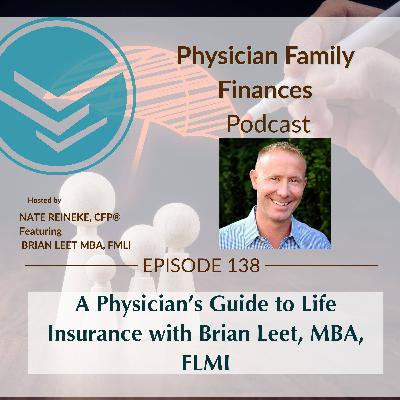
Life insurance is becoming a standard benefit for employers to offer, but is the group policy enough for a doctor like you? Nate Reineke is joined by Brian Leet, who helps families across the country navigate life and disability insurance. We discuss what to consider when calculating a life insurance policy, and when group life insurance through an employer isn’t enough. We also break down when a permanent policy may make more sense compared to a term policy, and how a conversion rider on a term policy could be beneficial to physicians who are just starting.
If you’d like to work with Brian, he can be reached at brian@incomepa.com or 503-928-4103.
Are you ready to turn worries about taxes and investing into all the money you need for college and retirement? It’s time to make a plan and get on track. To find out if we’re a match visit physicianfamily.com and click get started or, you can ask a question of your own by emailing podcast@physicianfamily.com.
See marketing disclosures at physicianfamily.com/disclosures
As a young doc, it can seem like everyone has something to sell you. Many physicians can end up with a whole life policy that they don’t actually need, and that policy can have a loan against it without you really knowing what’s happening. Nate Reineke and Chelsea Jones break down why these policies are often sold in the first place, how the loans work, and how you can get out of them. They also give some suggestions on what you can do with that money once you escape the trap. We also answer your colleagues' questions. A webinar attendee asked, “Should I make a retirement budget or use 80% of my current expenses when calculating how much I need to save?” A double doc family in West Virginia says both of us work at a University and have a plan with a mandatory 6% contribution. Is this outside the $23,500 limit in 401(k)’s (or other plans)? An emergency med doctor in Tennessee wants to know if he should set up an S-Corp instead of being a sole proprietor, and if he can pay his wife a salary for the work she does to help him. A Psychiatrist in West Virginia just relocated and has some cash leftover from the sale of their home. They want to know where the best place is to put this? Are you ready to turn worries about taxes and investing into all the money you need for college and retirement? It’s time to make a plan and get on track. To find out if we’re a match visit physicianfamily.com and click get started or, you can ask a question of your own by emailing podcast@physicianfamily.com. See marketing disclosures at physicianfamily.com/disclosures

Have you ever been told to keep municipal bonds, instead of corporate bonds, in your brokerage account? You may think that there isn’t that big of a difference… after all, they’re both bonds. Nate Reineke and Kyle Hoelzle break down the advantages municipal bonds may provide for doctors like you and why they can help your diversification. We also answer your colleagues’ questions. A vascular surgeon in Oregon says, 'My son is in college and wants to start investing. What tools should he consider?’ A General Surgeon in Oregon asks, with my 529 plan, if my child is over 18, can they be the successor and the beneficiary? A Psychiatrist in Virginia wants to know when target date investing, should the investment target be based on your current age or your planned retirement year? A Pain Management Specialist in NY said that their 403 (b) custodian sent a message stating that they were invested too aggressively. What could cause this? A Pulm Crit Care doctor in California is curious about how to handle RSUs in their portfolio. Are you ready to turn worries about taxes and investing into all the money you need for college and retirement? It’s time to make a plan and get on track. To find out if we’re a match visit physicianfamily.com and click get started or, you can ask a question of your own by emailing podcast@physicianfamily.com. See marketing disclosures at physicianfamily.com/disclosures
Starting a new job always brings changes and new opportunities. For some docs, it may bring the question if being a 1099 contractor will create tax savings or a headache? Nate Reineke breaks down what you should consider if you are deciding between being a W-2 employee or a 1099 contractor. We discuss how things like benefits and employer costs should factor into the decision. Be sure to listen to the end to hear what you should ask your CPA in order to make the best decision. We also answer your colleagues’ questions. A Surgeon in New York is planning to pay for their child to attend undergraduate and graduate school in the Northeast. They are worried about overfunding a 529 and want to know if they should use a 529 to save everything for college. An audience member at our webinar asked us how to choose a 529 plan since the state they live in doesn’t offer any state benefits. An Ophthalmologist in Chicago says, we are building a house and are being offered a “lender's credit”. Should we put it toward closing costs or use it to buy down the interest rate? Are you ready to turn worries about taxes and investing into all the money you need for college and retirement? It’s time to make a plan and get on track. To find out if we’re a match visit physicianfamily.com and click get started or, you can ask a question of your own by emailing podcast@physicianfamily.com. See marketing disclosures at physicianfamily.com/disclosures
Old IBR, New IBR, PAYE, REPAYE, RAP, it may seem like a fruit salad of letters. In reality, these are just some of the payment plans doctors have used on their quest to PSLF. It can be confusing, especially in recent years, to understand what plan is best for you. Listen in as Nate Reineke breaks down the history of PSLF, the chaos and uncertainty in recent years, and where the program stands now. We also discuss recent changes that have just passed in the One Big Beautiful Bill Act. Be sure to listen to the end to hear what physicians can do right now to make meaningful progress toward loan forgiveness. Are you ready to turn worries about taxes and investing into all the money you need for college and retirement? It’s time to make a plan and get on track. To find out if we’re a match visit physicianfamily.com and click get started or, you can ask a question of your own by emailing podcast@physicianfamily.com. See marketing disclosures at physicianfamily.com/disclosures
There are a thousand opinions out there on how to raise kids, but the one thing everyone can agree on is that raising kids is expensive. Luckily, there’s a way that doctors like you can save on taxes and use pretax dollars to pay for childcare. Nate Reineke breaks down how a dependent care FSA can be used to pay for daycare or nannies and how it helps physicians get an easy tax break. We also answered your colleagues’ questions. A Pediatrician in California says, I inherited an IRA from my mom. I plan to work for the next 10 years, and the IRA is subject to the 10-year rule. I am switching jobs to a higher-paying job in 2026. Should I withdraw now or wait? A business owning spouse of a Dermatologist in Virginia opened a group 401 (k) plan with a non-spouse employee who never became eligible for the plan. They want to know if they can close the group plan and roll the funds into a Solo 401 (k). A cardiologist in Oregon says that his wife has an inactive 401 (k) that is changing custodians and is in a blackout period. He wants to know what that means. An Addiction Medication Specialist in Oregon says, according to my plan, I am on track for retirement, and I may decrease my working hours soon. Should I open a cash balance account? Are you ready to turn worries about taxes and investing into all the money you need for college and retirement? It’s time to make a plan and get on track. To find out if we’re a match visit physicianfamily.com and click get started or, you can ask a question of your own by emailing podcast@physicianfamily.com. See marketing disclosures at physicianfamily.com/disclosures

Before Amazon was Amazon, some people took a huge risk and bought stock in the company. Luckily, that risk paid off for them! Now, history is repeating itself with some AI stocks where they could be the next Amazon, or they could completely fail. So, how should physicians who want to invest in AI take an appropriate level of risk? Nate Renieke and Kyle Hoelzle answer exactly that and break down how you can make riskier investments and still be on track for retirement. We discuss how investing “extra” money allows doctors to invest in the “hot” new things, if they want to, while still saving enough to retire without regrets. We also answer your colleagues’ questions. A Family Medicine doctor in Oregon says, My wife is retiring soon at 50, and she is wondering if it makes sense to do Roth conversions in her 401(k) plan? A Dermatologist in Texas asks, I have accumulated several million dollars, and according to your plan, I could retire today. My portfolio is made up mostly of stocks, but is it a good idea to adjust it so I own more bonds? An Emergency Med Doc in North Carolina was told by their CPA to not be in a solo 401(k) and instead be in a SEP IRA. They want to know what we think of that advice. Are you ready to turn worries about taxes and investing into all the money you need for college and retirement? It’s time to make a plan and get on track. To find out if we’re a match, visit physicianfamily.com and click get started or, you can ask a question of your own by emailing podcast@physicianfamily.com. See marketing disclosures at physicianfamily.com/disclosures
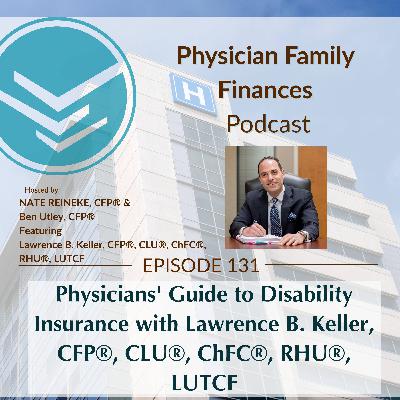
Disability insurance may feel like just another thing physicians have to figure out. Like a retirement account, your employer may offer a plan, but that is almost never enough to cover your bases. Nate Reineke and Ben Utley are joined by Lawrence B. Keller, CFP®, CLU®, ChFC®, RHU®, LUTCF (or Larry to us). From his New York office, he’s been working with doctors for more than 30 years. We break down when an individual, private policy is necessary, and when in your career you can consider dropping your policy. Be sure to listen to the end, where Larry explains the most common mistake he sees physicians make and how shopping for an agent, rather than a policy, can help you save on your premiums. If you’d like to work with Larry, you can reach him at lkeller@physicianfinancialservices.com or by phone at 516-677-6211. Are you ready to turn worries about taxes and investing into all the money you need for college and retirement? It’s time to make a plan and get on track. To find out if we’re a match visit physicianfamily.com and click get started or, you can ask a question of your own by emailing podcast@physicianfamily.com. See marketing disclosures at physicianfamily.com/disclosures This podcast is intended for general public use and is for informational purposes only. The Physician Family Finances podcast is not affiliated with or endorsed by Park Avenue Securities, Guardian, or Physician Financial Services and opinions stated are their own. Lawrence B. Keller is a Registered Representative and Financial Advisor of Park Avenue Securities LLC (PAS). OSJ: 355 LEXINGTON AVE, 9TH FLOOR, NEW YORK NY, 10017, 212-261-1850. Securities, products and advisory services offered through PAS, member FINRA, SIPC. Financial Representative of The Guardian Life Insurance Company of America® (Guardian), New York, NY. PAS is a wholly owned subsidiary of Guardian. Physician Financial Services is not an affiliate or subsidiary of PAS or Guardian. CA Insurance License #0C37340, AR Insurance License #1057229. 7545285.4 Exp 8/27
You’ve planned, you’ve saved, and finally, you've retired. Now it’s time to spend what you’ve saved and enjoy all the retirement vacations you’ve been planning. Listen in as Nate Reineke and Chelsea Jones dive into when you should start proactive backdoor Roth conversions and what accounts you should withdraw from first. We also break down what approaches you can use if donating to charity is part of your retirement goals and how working part-time may impact your Social Security. Be sure to listen to the end to hear the one lever you can pull if life suddenly changes while you’re retired and you don’t want to go back to work. Are you ready to turn worries about taxes and investing into all the money you need for college and retirement? It’s time to make a plan and get on track. To find out if we’re a match visit physicianfamily.com and click get started or, you can ask a question of your own by emailing podcast@physicianfamily.com. See marketing disclosures at physicianfamily.com/disclosures
Summer means vacations, and vacations can lead to splurges. While following a plan is important, the occasional splurge is inevitable, even for the pros. Listen in as Nate Reineke, Chelsea Jones, and Kyle Hoelzle reveal their recent splurges and give some ideas on what extra cash can be used for. They also break down steps physicians can take to protect their accounts from being hacked, the general order you should follow when it comes to making withdrawals from your retirement accounts, and why your automatic 529 contributions may stop. Be sure to listen to the end to hear when it may be worth recognizing some capital gains taxes for the sake of rebalancing your portfolio. Are you ready to turn worries about taxes and investing into all the money you need for college and retirement? It’s time to make a plan and get on track. To find out if we’re a match visit physicianfamily.com and click get started or, you can ask a question of your own by emailing podcast@physicianfamily.com. See marketing disclosures at physicianfamily.com/disclosures
Summer is a great time to teach kids about finances by running a lemonade stand or selling ice cream at the park. However, if you try to teach them too much, kids will miss some of the important stuff. Physicians are no different and can miss some vital elements when it comes to investing. Listen in as Nate Reineke and Kyle Hoelzle break down some of the most common mistakes physicians make when it comes to investing. We discuss UTMAs and Minor Roths, diving into the pros and cons of each and if they may be right for your family. We also look at the importance of filling out IRS Form 8606 every year, what to consider if you are eligible for two retirement plans, and why you shouldn’t have a target date fund in you brokerage account. Are you ready to turn worries about taxes and investing into all the money you need for college and retirement? It’s time to make a plan and get on track. To find out if we’re a match visit physicianfamily.com and click get started or, you can ask a question of your own by emailing podcast@physicianfamily.com. See marketing disclosures at physicianfamily.com/disclosures
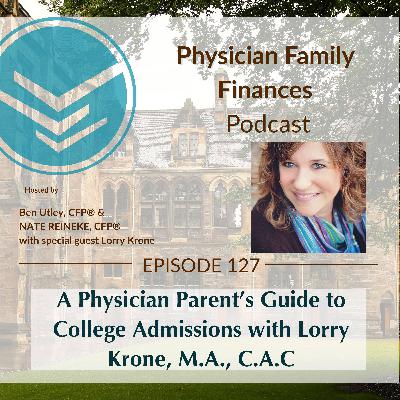
As a physician parent, you went through more school than the average Joe. You may think you know the system but college admissions is constantly evolving. Listen in as Nate Reineke and Ben Utley are joined by Lorry Krone, M.A., C.A.C, a certified college admissions counselor. From the San Francisco Bay Area, Lorry helps students from across the country get into the school that is the right fit for them. We discuss some of the best practices that you can start with a young child, what helps kids stand out, some common myths and misconceptions that parents have, and why it is important to have a list of college options. If you want to work with Lorry, you can reach her at lorrykrone@gmail.com or visit their website, andersonandkrone.com. Are you ready to turn worries about taxes and investing into all the money you need for college and retirement? It’s time to make a plan and get on track. To find out if we’re a match visit physicianfamily.com and click get started or, you can ask a question of your own by emailing podcast@physicianfamily.com. See marketing disclosures at physicianfamily.com/disclosures
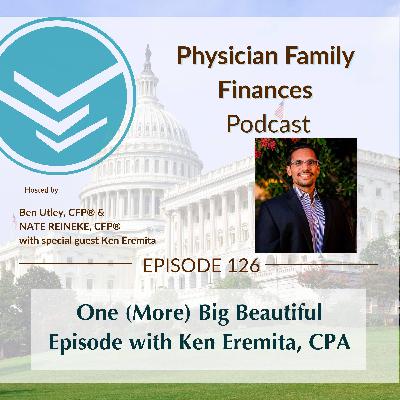
The One Big Beautiful Bill remains long and confusing. Some people think that the new tax laws are barking mad, while others are wagging their tails with delight. Listen in as Ben and Nate are joined by Ken Eremita, CPA and his dogs. From his Los Angeles office, Ken breaks down what SALT deductions are and how the changes could result in big tax savings for docs like you. We also cover qualified business income deductions and how the changes will impact self-employed physicians. Ben, Nate, and Ken also talk about some changes that will specifically impact doctors with kids, like the new 529 rules and changes to Estate Taxes. If you’d like to work with Ken, you can find him on his website, keneremita.com, or email him at info@keneremita.com Are you ready to turn worries about taxes and investing into all the money you need for college and retirement? It’s time to make a plan and get on track. To find out if we’re a match visit physicianfamily.com and click get started or, you can ask a question of your own by emailing podcast@physicianfamily.com. See marketing disclosures at physicianfamily.com/disclosures

Finally being ready to retire is a huge milestone. It takes years of planning and hard work. There is nothing worse than feeling like you missed something in all that preparation. Listen in as Ben Utley and Nate Reineke break down whether it is worth it to open a new backdoor Roth account right before retirement. We discuss the factors to consider and how your time will come into play when making that decision.
We also answer your colleagues' questions.
Social Security: A Pain Management doc in New York is wondering, with everything happening politically, should we take Social Security early since it may go away? And a Psychiatrist in Missouri read the latest federal report that Social Security will run out in the next 8 years. They ask if they should include Social Security in their plan.
Emergency Fund: The spouse of a hospitalist in Tennessee says that they have 7 kids, so that's a lot of college to pay for. They also don’t have an emergency fund. They’re curious about what to put off while building the emergency fund.
Paying for private K-12: The spouse of a dermatopathologist in Pennsylvania asks, given the recent 529 rule changes that are coming with the “Big Beautiful Bill,” should I be putting more money in my 529 to pay for private K-12 school?
Are you ready to turn worries about taxes and investing into all the money you need for college and retirement? It’s time to make a plan and get on track. To find out if we’re a match visit physicianfamily.com and click get started or, you can ask a question of your own by emailing podcast@physicianfamily.com.
See marketing disclosures at physicianfamily.com/disclosures

Comments

Download from Google Play

Download from App Store
 United States