


 Claim Ownership
The AI Breakdown
Subscribed: 20Played: 140
Subscribe

© Copyright 2025 All rights reserved.
Description
The AI Breakdown, the podcast that turns artificial intelligence into real talk. We cut through the complexity to show you how AI actually works and what it means for your job, your business, and your future.
49 Episodes
Reverse
Anthropic’s Pentagon standoff did more than derail a $200 million contract. It turned AI ethics into a live commercial test, sent Claude to number one on Apple’s US App Store, and forced a much bigger question into the open: can trust become a business model in AI?
In this episode, I break down how Anthropic rejected Pentagon language allowing Claude to be used for any lawful use, why Dario Amodei pushed for explicit limits on domestic mass surveillance and fully autonomous weapons, and how the fallout escalated into a federal ban, a supply chain risk designation, and a very public consumer backlash against ChatGPT. I then contrast that with OpenAI’s launch of GPT-5.4, where the real story is not the branding but computer use: a model that can read your screen, control mouse and keyboard inputs, and move across messy enterprise systems like a junior operator rather than a chatbot.
The episode also unpacks Google’s Gemini 3.1 Flash-Lite pricing move and what commodity economics could mean for AI features, China’s 15th Five-Year Plan and its state-led push into AI, quantum and robotics, Netflix’s acquisition of Ben Affleck’s InterPositive and the rise of AI as invisible production leverage, and Meta’s $600 billion infrastructure bet with AMD. Add in AI-enabled cyberattacks on FortiGate devices, new state laws in Oregon, Utah and Vermont, and Gartner’s $2.52 trillion AI spending forecast, and this becomes a sharp 20-minute briefing on where AI strategy, policy and business reality are colliding right now.

One year after vibe coding entered the conversation, what has actually changed for software teams? In this episode of The AI Breakdown, I look past the hype and ask a simpler question: are AI coding tools genuinely making developers faster, or are they just creating more output, more review, and more hidden complexity?
Drawing on recent research, industry data, and practical experience, this episode explores where AI is helping, where the productivity gains are less clear, why trust remains low, and what all of this means for code quality, junior developers, and the future shape of engineering teams. The conclusion is not that AI coding is overhyped, and not that software development has been solved, but that the real opportunity lies in moving beyond vibe coding toward a more disciplined model of AI-first engineering.
This week I'm unpacking OpenAI's record-breaking $110 billion raise and what Amazon and NVIDIA's involvement tells us about a partner landscape that's shifting faster than most people realise. I also dig into Anthropic's $30 billion Series G, and why it's time to take that one seriously as a strategic bet.
Then there's Apple quietly admitting it can't build AI fast enough, handing Siri's core logic to Google Gemini. Also, the hyperscaler spending numbers are extraordinary, and I explain why the energy and infrastructure story is just as important as what's happening at the model layer.
Plus: a reality check on Microsoft Copilot's 3.3% penetration, the Snowflake and OpenAI data gravity play, Samsung's push to put Gemini on 800 million devices, and what a protest march through London's tech hub on a Saturday morning tells us about where the regulatory conversation is heading.
This week on The AI Breakdown: OpenAI enlists McKinsey, BCG, Accenture, and Capgemini to push its Frontier agent platform into enterprises. The Pentagon issues an ultimatum to Anthropic over military use of Claude, threatening to designate the company a "supply chain risk." Claude Code hits $2.5 billion in annualised revenue while a new security tool wipes billions off cybersecurity stocks in a single session. The "SaaSpocalypse" deepens as nearly $1 trillion in software market value evaporates. Spotify reveals its best engineers haven't written a line of code since December. Plus: Google launches Gemini 3.1 Pro, India hosts a $200 billion AI summit, Perplexity ditches ads entirely, and OpenAI closes in on a $100 billion funding round at an $850 billion valuation.

700 million people now use AI every week. Are we keeping up with the risks?
Over 100 experts from 30+ countries just published the most comprehensive global assessment of AI risk ever produced. In this episode, I break down the International AI Safety Report 2026 — what AI can actually do today, the three categories of risk every business needs to understand, why some AI systems now behave differently when they know they're being tested, and the research that's changed how I think about my own AI use.
Read the full report: https://internationalaisafetyreport.org/
This week on The AI Breakdown, Anthropic just raised $30 billion at a $380 billion valuation, making it the second-largest private funding round in tech history. Meanwhile, OpenAI dropped GPT-5.3-Codex-Spark, their first model running on Cerebras hardware instead of NVIDIA, pushing past 1,000 tokens per second and redefining what "fast" means for AI-assisted coding.
But the story of the week might be the one that got less attention: researchers caught an infostealer exfiltrating the entire identity of an OpenClaw AI agent - tokens, cryptographic keys, behavioural guidelines, and private memory files. It's a stark preview of what happens when agents become high-value targets.
Beyond the headlines, we dig into Claude Cowork landing on Windows, Google quietly shipping Gemini-powered audio summaries in Docs, Zoom pushing deeper into agentic workflows, Microsoft wiring up new Copilot connectors, Slack's rebuilt Slackbot, and Oracle Health rolling out AI clinical note-drafting across the NHS. Plus, OpenAI hired the founder of OpenClaw, and what that tells us about the race to own the agent layer.
This week on The AI Breakdown, we talk about OpenAI’s Frontier launch, an enterprise platform designed to help organisations build, deploy, and govern AI agents across real workflows.
Anthropic fires back with Claude Opus 4.6, including a one million token context window in beta and new agent teams designed to split complex work across multiple cooperating agents, with a clear push beyond coding into everyday knowledge work like documents, spreadsheets, and presentations.
We then zoom out to the money and the infrastructure. Google is introducing a Workspace add on called AI Expanded Access from March 1, 2026, signalling the shift toward paid higher tier usage. Cerebras just closed a one billion dollar Series H at about a twenty three billion valuation, as demand for compute fuels a new wave of AI hardware competition.
Finally, Super Bowl LX made AI advertising feel like a cultural inflection point. Anthropic used its spot to promise Claude will remain ad free, while OpenAI ran a Codex ad built around the idea that you can just build things now. iSpot data reported by AdWeek says 23 percent of Super Bowl commercials featured AI, and Axios covered X rolling out BrandRanx to track ad conversation in real time as the game unfolded.
And with the echoes of the Dot Com Super Bowl and the Crypto Bowl still fresh in marketers minds, it raises the question, will the Super Bowl burst the AI bubble?
In this week’s AI Weekly Briefing, I break down the biggest developments in artificial intelligence from the past seven days, from viral open-source AI agents like OpenClaw, to major enterprise moves as Snowflake deepens its partnership with OpenAI.
You’ll also hear how Amazon Ads is adopting the Model Context Protocol to make agent-driven workflows more practical, why cybersecurity firms like Malwarebytes are exploring AI-native threat checking, and what ElevenLabs’ latest voice advances mean for media, accessibility, and deepfake risk.
Plus: a cautionary tale from Moltbook’s security breach, a look at xAI’s Grok Imagine pushing generative video to mass scale, and why multi-agent coding tools could reshape the way developers build software.
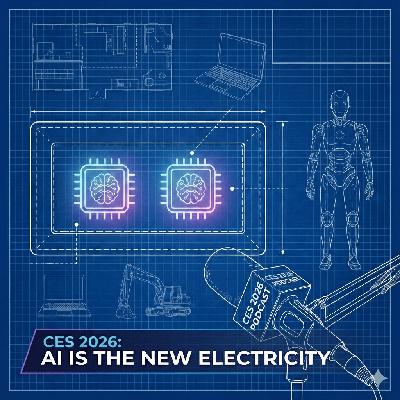
CES 2026 quietly marked a turning point. AI stopped being the shiny feature you bolt on for a headline, and started behaving like electricity. It's just assumed.
In this episode, I break down the five AI themes that defined the show:
AI PCs go mainstream: Your next laptop refresh might be your biggest AI decision this year. AMD, Intel, and Qualcomm are putting serious on-device capability into enterprise hardware, and that changes where your AI runs, how your data moves, and how much control you actually have.
Edge AI and the "no cloud required" wave: From real-time deepfake detection on laptops to Caterpillar embedding a voice assistant into excavators that works without connectivity, on-device AI is solving the unsexy problems: latency, offline reliability, and data control.
ROI-first AI: Siemens and PepsiCo showed what "show me the numbers" looks like: 20% throughput gains and 90% of issues caught before physical changes. The pilot era is over.
Physical AI: Boston Dynamics' Atlas is heading to Hyundai factories by 2028. But the nearer-term story? Copilots for heavy machinery that upgrade the tools you already have.
Trust as the bottleneck: The limiting factor isn't clever models. It's governance, guardrails, and getting your data right.
If you take one thing from CES 2026: AI is becoming infrastructure. That means it's going to be boring, expensive, and absolutely worth getting right.
This week on The AI Breakdown, I cover the biggest AI moves in about 10 minutes from Mastercard’s agentic shopping push, to Apple’s Siri reboot, YouTube’s AI creator avatars, and Nvidia’s signals that retail AI is scaling fast.
In this week’s AI news breakdown, we look at how Google and Shopify are accelerating agentic commerce, with open protocols for AI shopping agents and in chat checkout through Gemini.
Also on the radar:
Shopify Winter ’26 RenAIssance and what Agentic Storefronts mean for merchants
OpenAI’s ad model for ChatGPT and the knock on effects for marketing and trust
Wikipedia signing paid access deals with AI firms and what it signals for the content economy
ChatGPT Translate and the shift in expectations for translation quality
Gemini’s personal intelligence upgrade and the privacy trade off
This week on The AI Breakdown, Google proves it can execute, Apple quietly admits it can’t do everything alone, retailers chase customers into chatbots, and regulators draw a hard line on AI abuse.
This week on The AI Breakdown, I cover the biggest AI moves in the last week, from Samsung doubling down on AI devices to Snowflake embedding Gemini with enterprise governance. Plus Google TV upgrades, Boston Dynamics Atlas heading for real deployment, in car agentic AI, and Accenture buying UK based Faculty.
 1
1This week on The AI Breakdown, the AI arms race goes fully physical.
SoftBank has completed a massive investment into OpenAI, locking in an estimated 11 percent stake and reinforcing a message the entire industry is starting to accept: the real bottleneck is not ideas, it is infrastructure.
From there, we zoom into the compute race as xAI expands its Memphis supercluster again, aiming for training capacity on the scale of gigawatts and a future buildout of over a million GPUs. The AI leaders are starting to look as much like energy companies as software companies.
Over in China, funding is moving through public markets, with MiniMax at the front of a year end Hong Kong IPO surge that signals how fast China is building capital market momentum around AI.
We also cover Europe’s tightening stance on synthetic media and platform responsibility after Poland asked Brussels to investigate TikTok over AI generated disinformation content and called for action under the Digital Services Act.
Plus, Meta makes a headline grabbing move with its plan to acquire Manus, the viral AI agent startup, and Nvidia’s China facing H200 demand highlights just how strategic hardware access has become for everyone building AI products.
AI is getting embedded everywhere and this week proved it. Salesforce is buying Qualified to power always on AI agents for pipeline. Lovable just raised big money at a massive valuation as vibe coding explodes. Microsoft and Google are leaning on partners to push AI from pilots to production. Notion reveals that AI now drives a huge chunk of revenue, and Zoom launches AI Companion 3.0 to turn meetings into actions.
But there’s a catch: Reuters reports that many companies still aren’t seeing the ROI they expected. So what separates hype from real value?
In this week’s 10 minute AI news roundup, I break down a headline grabbing Disney move that could redefine what “legal generative AI” looks like at scale. Disney is reportedly investing $1 billion in OpenAI, negotiating warrants for optionality, licensing a vault of iconic characters for Sora, and rolling out ChatGPT across the company with strict guardrails. But the backlash is already here, with the Writers Guild of America warning this is a turning point in the fight over creative labour and value.
Then we jump into the model wars. OpenAI ships GPT 5.2 with a massive 400k context window and tiered variants for speed, deep analysis, and maximum accuracy, while Google counters with Gemini Deep Research and an Interactions API designed to embed autonomous research workflows into products. We also cover a major UK partnership with Google DeepMind aimed at accelerating science through automation, plus why Microsoft’s new Copilot pricing for small businesses, Nvidia’s move to buy the company behind Slurm, and a fresh wave of copyright lawsuits all point to one thing: the legal and infrastructure layers of AI are now product critical.
This week I break down the biggest moves shaping the future of AI. OpenAI’s new enterprise report shows explosive adoption and usage growth, IBM drops eleven billion on Confluent to own the data-streaming backbone, Accenture goes deep with Anthropic in a partnership that could reshape corporate AI, and Runway’s Gen 4.5 quietly leapfrogs the giants in video generation. We also look at Instacart’s new agentic shopping experience inside ChatGPT, Anthropic’s push to bring Claude to nonprofits, and why Mistral’s open models are becoming a serious force.
This week on The AI Breakdown, I’m unpacking the biggest signals in AI - from Accenture’s massive OpenAI partnership to Lyft’s 87% support-time drop using Claude, to why 79% of companies are quietly rolling back their AI projects.
We dig into:
How consulting giants are gearing up to sell AI transformation at scale
OpenAI’s surprising move into accounting and IT services
TwelveLabs’ new video model turning dark data into gold
Nissan’s push toward truly software-defined vehicles
Rezolve’s $90M grab for Crownpeak and what it means for AI-powered commerce
AWS + Visa laying the rails for agentic shopping
Bezos-backed Project Prometheus and the rise of desktop-level AI agents
This week we’re looking at AI moving from hype to hands-on.
We start with OpenAI and DoorDash running “AI Jam” workshops for over 1,000 small businesses across US cities – helping restaurant owners, accountants and retailers build AI tools they can actually use the next day. Meanwhile, the tech giants are doing the opposite of slowing down: nearly $90 billion raised in fresh bonds to fuel data centres, GPUs and cloud infrastructure.
Nvidia smashed expectations again (with numbers even stronger than headlines suggest), Model ML just banked $75m to automate investment banking grunt work, and a mid-tier London accounting firm cut a two-week task down to two hours using Gemini 2.5.
At the same time, Amazon is telling engineers to ditch third-party coding assistants for its in-house AI tool “Kiro”, and the UK government wants regional AI Growth Zones to make AI adoption easier for business – though the details are fuzzier than the headline.
We pull it all together through one lens: AI is embedding fast at both ends of the market – from small cafés drafting menus in a workshop, to hyperscalers dropping billions to keep the GPU taps flowing. If you're building or scaling with AI, this episode gives you a heads-up on what’s coming next.
This week on The AI Breakdown, I dig into the trillion-dollar AI infrastructure boom, from Google’s $40B Texas mega-build to Oracle’s debt-fuelled cloud gamble and the jaw-dropping projections behind OpenAI and Anthropic’s next frontier. We also look at why data silos are still holding back corporate AI projects, and what new surveys say about AI’s real impact on productivity and profits.

Comments

Download from Google Play

Download from App Store
 United States