


Eclipse 4diac™ EN presented by Franz Höpfinger
Subscribed: 0Played: 0
Subscribe

© Franz Höpfinger, Meisterschulen am Ostbahnhof, München, Landmaschinenmechanik
Description
Eclipse 4diac™ presented by Franz Höpfinger
7 Episodes
Reverse
IEC 61499 Power Up: Feature Freeze Reveals the Eclipse 4diac 3.0 Revolution for Industrial AutomationSource: Eclipse 4diac 3.0 Enters Feature Freeze!Tune in to explore the Eclipse 4diac 3.0 Revolution!After over two years of development and a "tremendous community effort," Eclipse 4diac 3.0 has entered the feature freeze phase, marking a major milestone for this next big release. This milestone was achieved through more than 7200 commits across 4diac IDE and 4diac FORTE (with over 5800 commits in the IDE and 1400 in FORTE), resulting in a modernization, optimization, and extension of the platform's capabilities.This release brings a "wealth of new functionality" and "improved usability", focusing on streamlining the IEC 61499 development process:Structured Text Interpreter: The 4diac IDE features completely reworked and improved IEC 61131-3 Structured Text editors. Most notably, it now includes an Interpreter for IEC 61131-3 Structured Text, which allows for the testing and debugging of Function Blocks (FBs) directly within the 4diac IDE.4diac FBE (Function Block Environment Builder): This is a new component in 4diac 3.0. The FBE builds 4diac FORTE fully automatically, eliminating the need for downloads or the installation of third-party software. It simplifies configuration management by allowing a single developer machine to manage multiple 4diac FORTE configurations for various target machines and operating systems. A beta-quality setup is currently available.Core Performance: The 4diac FORTE code base and build system have been modernized, leading to greatly reduced overhead in both event processing and data connection handling.Other highlights include refactoring functions in graphical and textual editors, validation of IEC 61499 projects (including the ability to load and repair incomplete projects), support for named constants, and simplified deployment and monitoring capabilities that can store configurations.With the feature freeze in place, the focus now shifts entirely to stabilization and polishing to ensure a "solid and reliable 3.0 release," which is planned for approximately three weeks from the announcement date. The team invites the community to download the early access builds and share feedback through the issue trackers to help make 4diac 3.0 the "most solid and feature-rich release yet".
Eclipse 4diac: Unpacking Open-Source Industrial Automation and the Power of Application-Centric Design
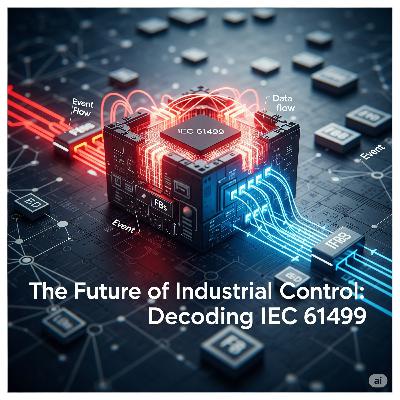
The Future of Industrial Control: Decoding IEC 61499Source: https://github.com/eclipse-4diac/4diac-documentation/blob/main/src/intro/iec61499.adoc"Dive into the evolving landscape of industrial automation with 'The Future of Industrial Control: Decoding IEC 61499.' In this episode, we break down the foundational IEC 61131-3 standard for PLC programming, exploring its graphical and textual languages like Ladder Diagram (LD) and Function Block Diagram (FBD). We'll discuss how a Programmable Logic Controller (PLC) is a small, specialized computer for industrial use, programmed via an IDE supplied by the vendor.We then journey beyond traditional PLCs, uncovering the challenges of centralized systems and vendor-specific communication that led to the emergence of IEC 61499. Discover how IEC 61499 revolutionizes industrial control by defining a domain-specific modeling language for distributed industrial control solutions. It extends IEC 61131-3 by improving the encapsulation of software components for increased re-usability, providing a vendor-independent format, and simplifying support for controller-to-controller communication. This standard also provides the required infrastructure for Industry 4.0 and industrial IoT applications.Learn about the key concepts of IEC 61499, including the event-driven nature of Function Blocks (FBs), where events trigger functionality using available data. We'll explain how an FB's behavior depends on its Event Execution Control, coordinating the execution of encapsulated functionalities and sending output events. You'll understand how applications, created by connecting individual FBs, can be split and deployed across multiple devices (PLCs). We'll also detail the different kinds of Function Blocks: Basic Function Blocks (BFB), which define a state machine using an Execution Control Chart (ECC); Composite Function Blocks (CFB), which contain an internal network of other FBs; and Service Interface Function Blocks (SIFB), which are needed to access specific hardware parts and the platform. Finally, we'll touch on Compliance Profiles, which fill the gaps left by the standard's abstraction, specifying crucial 'things' like communication for proper system execution."

From Pyramid to Plug-and-Play: The Rise of Self-Configurable Industrial AutomationEclipse Insight: Self-Configurable Automation Systems
Eclipse 4diac: Revolutionizing Industrial Control with Open-Source Cyber-Physical Systems
Eclipse 4diac and FORTE: Unlocking Next-Gen Industrial Automation with Open-Source Power
Simplifying Industrial Control: Your Deep Dive into Eclipse 4diac and IEC 61499
Comments

Download from Google Play

Download from App Store
 United States