


 Claim Ownership
The Deep Dive Lab: Unraveling Materials Science
Subscribed: 2Played: 0
Subscribe

© Son Hoang
Description
Hey, fellow science enthusiasts! Welcome to our podcast, where we dive deep into the fascinating world of Materials Science! Join us as we explore groundbreaking discoveries in computing, memory, energy, and environmental applications. We’ll unpack the latest research from top-tier journals and shine a spotlight on the innovations that are shaping our future. Get ready for insightful discussions, expert interviews, and a dash of nerdy fun—because science is best when shared!
220 Episodes
Reverse
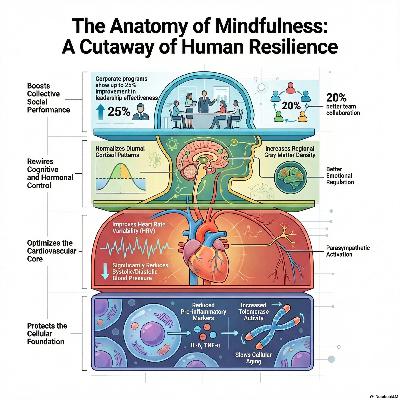
We often chase health through workouts, diets, and supplements—but what if the most powerful upgrade is invisible?In this episode, we explore the biological ROI of mindfulness—how simply being present can rewire your immune system, regulate your heart, and even elevate your career performance.From cytokines and cortisol rhythms to heart rate variability and emotional intelligence, science is revealing that mindfulness is not just mental—it’s deeply physiological. We break down how chronic stress silently damages your body, and how small daily practices can reverse that trajectory.You’ll also discover why companies like Google and Microsoft treat mindfulness as a high-performance skill, not a wellness trend—and how just 2 minutes a day can unlock better focus, resilience, and collaboration.But we also cut through the hype: when does mindfulness actually work—and when doesn’t it?🧠 Your mind isn’t just thinking—it’s signaling your entire biology.So… what is yours telling your body today?#Mindfulness #StressScience #MentalHealth #Biohacking #Productivity#EmotionalIntelligence #CareerGrowth #Neuroscience #Wellbeing #Leadership#PeakPerformance #Psychology #HealthOptimization #deepdivelab🔖 Hashtags
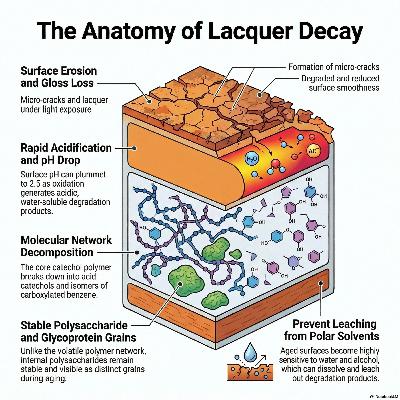
Vietnamese lacquer painting isn’t just art—it’s a chemical masterpiece shaped by tree sap and time. 🎨🧪In this episode, we peel back the glossy surface to reveal the hidden polymer science behind lacquer: how natural molecules crosslink into a coating that can last centuries. But here’s the paradox—the very light that reveals its beauty is slowly breaking it apart. 😶🌫️You’ll discover:🔬 Why a “waterproof” surface can turn fragile and water-sensitive over time🌈 The strange glow scientists use as a chemical aging clock🧪 The surprising role of so-called “impurities” in long-term stability⚠️ And why even gentle cleaning can accidentally erase historyFrom traditional Vietnamese masterpieces to next-generation sustainable materials, this episode explores where chemistry, culture, and time collide.#VietnameseArt #Lacquer #PolymerScience #ArtConservation #MaterialsScience #Chemistry #SustainableFuture #deepdivelab
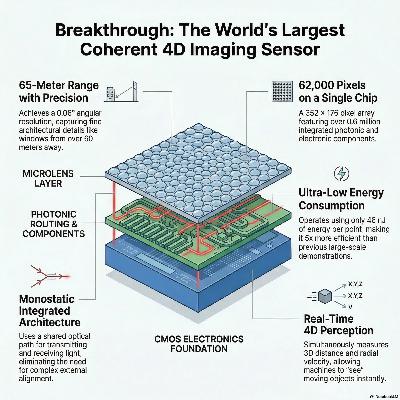
For years, LiDAR—the “eyes” of autonomous vehicles and robots—has remained bulky, complex, and power-hungry. But a new breakthrough is about to change everything.In this episode, we explore a 4D LiDAR sensor integrating over 600,000 components onto a single chip—a true “CMOS moment” for machine vision.🔥 What makes it different?This system doesn’t just see in 3D space—it also measures the speed of every pixel in real time.👉 That means machines no longer just know where you are…they know how fast you’re moving, with incredible precision.In this episode, we break down:🧩 How researchers packed hundreds of thousands of photonic components onto one chip⚡ Why this system operates at nanojoule-level energy, a massive leap in efficiency🎯 How FMCW LiDAR enables instant, high-precision velocity detection🔍 The “camera-like” design—swap the lens, change the entire field of view🚘 Why this could redefine safety for autonomous vehicles and roboticsAnd the bigger question:👉 When machines can see motion as clearly as humans—or even better—are we ready to share the world with them?This isn’t just an upgrade.It’s the beginning of ubiquitous machine vision.📄 Source: A large-scale coherent 4D imaging sensor. Nature, volume 651, pages 364–370 (2026).#4DVision #LiDAR #AutonomousVehicles #AI #DeepTech #Photonics #Semiconductors #Robotics #Innovation #SciencePodcast #deepdivelab
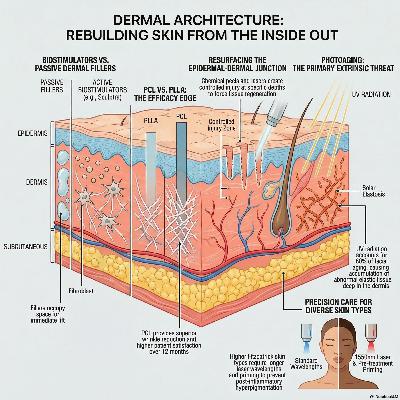
Who said youthful skin means endless filler injections? 😏 In this episode, we dive into the latest scientific breakthroughs that help your skin heal itself—from collagen to elastin—without looking like you overdid it at the “pump-up” station.You’ll discover:Traditional fillers vs. biostimulators: which is temporary, and which actually teaches your skin to rebuild?Why controlled inflammation is your skin’s BFF, not its enemy 😅A clinical showdown: PLLA vs. PCL for nasolabial folds—get results with less swellingNext-gen laser technology, creating “mini miracles” under your skin without weeks of hidingIn short, this episode is about more than covering up wrinkles. It’s about waking up your body’s own repair system so your skin stays youthful, glowing, and naturally awesome.#AntiAgingScience #SkinRegeneration #Biostimulator #CollagenBoost #AestheticMedicine #deepdivelab
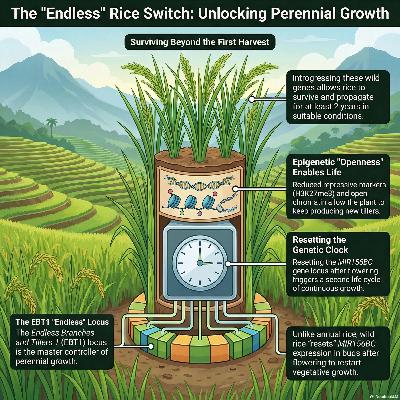
What if crops didn’t die after harvest… but simply reset and grow again?In this episode, we explore a groundbreaking discovery published in Science revealing how researchers uncovered a genetic “reset button” that can transform rice from a one-season crop into a perennial, self-renewing organism.For thousands of years, domesticated rice (Oryza sativa) has followed a rigid life cycle: grow → reproduce → die. But its wild ancestor, Oryza rufipogon, plays by a different rulebook—it keeps coming back.Scientists have now identified the EBT1 (Endless Branches and Tillers 1) locus and its control over a tiny molecule called microRNA156 (MIR156BC)—a master regulator that allows the plant to “forget” it already reproduced and restart growth.The twist?This isn’t about changing DNA—it’s about epigenetics, a biological “software reset” that turns genes back on after flowering.🚀 In this episode, we break down:🌱 The discovery of the “Endless Branches” gene🔁 How plants biologically reboot themselves⚖️ The hidden trade-off of domestication (yield vs. immortality)🌍 A future where rice fields no longer need replantingCould this lead to a world of self-sustaining agriculture—with less labor, healthier soil, and endless harvests?🎧 Press play to discover how scientists may have just redefined the life cycle of crops.📄 Source Paper:Resetting of a tandem microRNA156 enables vegetative perennial growth in riceScience, 19 Mar 2026, Vol 391, Issue 6791, pp. 1239–1245
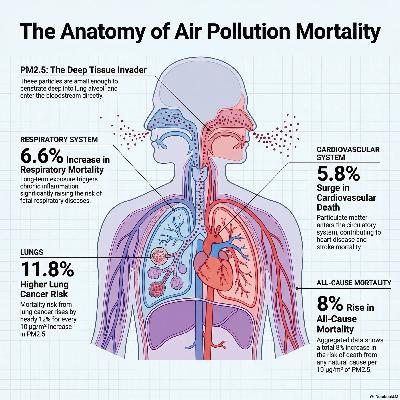
We’ve been looking at air pollution the wrong way.If the sky is blue, the air must be clean… right?New research—from massive studies like the ELAPSE project to global health analyses—reveals a far more unsettling truth: there may be no safe level of air pollution. 😶🌫️In this episode, we unpack the quiet science behind the air you breathe every second:💨 Why “safe limits” might be dangerously misleading🫁 How pollution triggers lung cancer—even in non-smokers👩 Why women may face higher risks than men🧠 The hidden link to dementia, mental health, and chronic disease⏳ Why we’re living longer—but sicker (the healthspan crisis)⚖️ And how inequality is literally built into the air around usThis isn’t just an environmental issue.It’s a biological reality shaping how long—and how well—we live.By the end, you may never think about a “fresh breath of air” the same way again.#AirPollution #Healthspan #InvisibleDanger #CleanAirMyth #SciencePodcast #PublicHealth #PM25 #ClimateAndHealth #DeepScience #BreathingRisk #deepdivelab 🌫️🧠💨🏷️ Hashtags
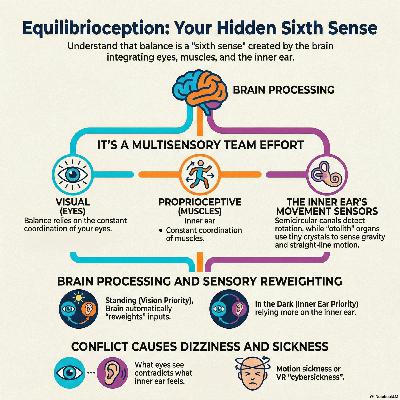
You know the five classic senses—but what if there’s another one quietly working behind the scenes every second of your life?In this episode, we explore Equilibrioception, the body’s remarkable sense of balance. Controlled by the Vestibular System inside your inner ear, this hidden sensory network constantly calculates gravity, motion, and orientation to keep you upright in a moving world.But what happens when this system fails? Why do astronauts lose their sense of balance in space? And how does the brain resolve conflicts between what your eyes see and what your body feels?We dive into the neuroscience of balance and uncover:• How the inner ear detects motion and gravity• Why dizziness and vertigo occur• How the brain recalibrates when sensory signals conflict• Why balance training can literally reshape your nervous systemFrom walking down the street to navigating virtual reality, your brain is performing a silent physics experiment every moment. This is the science of the sense you never knew you had.🎧 #Neuroscience #Balance #InnerEar #VestibularSystem #HumanBody #BrainScience #HiddenSenses #SciencePodcast #deepdivelab
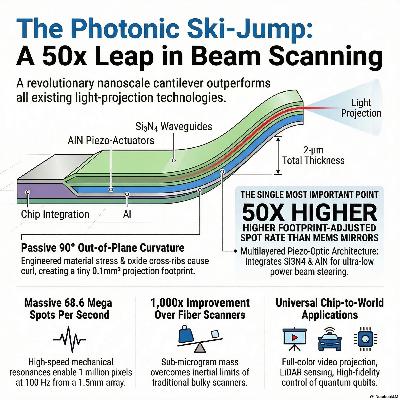
For decades, we perfected the data highways of light—fiber optics and photonic waveguides that move information across the globe at incredible speeds. But the moment light tries to leave the flat surface of a chip and enter the messy, three-dimensional world… it hits a wall.This episode explores a radical new solution: the “photonic ski-jump.” A nanoscale device that literally curls upward from the chip surface and launches light into free space with astonishing speed and precision.Engineered using piezo-opto-mechanical photonic integrated circuits (POMPIC) and fabricated with standard CMOS foundry processes, this device turns a classic semiconductor problem—thin-film stress—into an advantage. By carefully balancing layers of aluminum nitride and silicon nitride, researchers created a passive 90-degree curl that points a waveguide off-chip like a microscopic ski ramp.The result?• Beam scanning 50× faster than MEMS mirrors• 1,000× higher performance density than fiber scanners• A path to billion-pixel “Gigaspot” LiDAR engines• And even a scalable optical interface for quantum computers controlling millions of qubitsIn this episode, we unpack how a device smaller than 0.1 mm² could become the missing bridge between chips, machines, and the physical world.If a single chip can project a billion points of light per second, what happens when machines gain vision at that scale?📚 Source PaperNanophotonic waveguide chip-to-world beam scanning. Nature, Volume 651, Pages 356–363 (2026).#Photonics#Nanotechnology#IntegratedPhotonics#LiDAR#QuantumComputing#AR#Semiconductors#Optics#FutureTech#deepdivelab
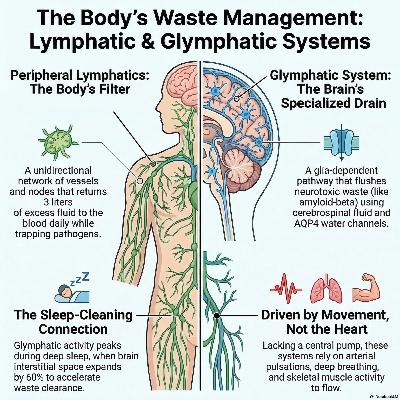
After surgery or injury, doctors promise a “speedy recovery.” Yet some people heal quickly while others struggle with chronic swelling and stiffness. Why?This episode explores the hidden biology of recovery: the lymphatic system, your body’s silent fluid-drainage network moving nearly 3 liters of fluid daily—without a heart.We examine surprising research that challenges common recovery advice:• Why Manual Lymphatic Drainage (MLD) may not improve recovery after Total Knee Replacement• How deep breathing and muscle movement act as the real pumps of lymph flow• The brain’s nighttime cleaning crew: the glymphatic system, which activates during deep sleep• How stagnant fluid can trigger fibrosis and scar stiffness• Whether trendy recovery gadgets like pressotherapy actually workThe science reveals a surprising truth: the most powerful recovery tools may not be expensive treatments—but sleep, movement, and physiology working as designed.Sources discussed:Lu et al. (2024) – Systematic review on MLD after total knee replacementAyverdi & Erbaş (2025) – Glymphatic system and neuroprotectionWiśniowski et al. (2022) – Pressotherapy and recovery evidence#deepdivelab #lymphaticsystem #surgeryrecovery #sleepscience #glymphaticsystem #medicalscience #healthpodcast #sciencedeepdive
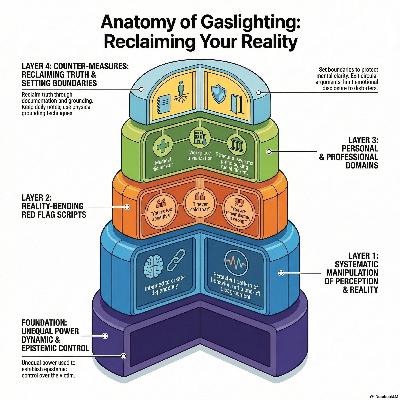
What happens when someone slowly convinces you that your own perception of reality cannot be trusted?Gaslighting is more than manipulation—it’s a psychological war on perception. In this episode, we explore the science behind how gaslighting dismantles a person’s epistemic agency—their ability to trust their own knowledge and experience.We unpack:🧠 The surprisingly dangerous “Good-Guy Gaslighter”🌀 The three-stage spiral from disbelief to self-gaslighting🏥 Why medical gaslighting is becoming a major bioethical crisis🏢 How institutions and workplaces quietly deploy gaslighting tactics🔎 Practical ways to rebuild trust in your own mindBecause recovery from gaslighting isn’t about winning arguments—it’s about reclaiming your reality.If truth is constantly questioned around you, how do you know when to trust yourself?🎧 Listen in as we examine one of the most subtle psychological weapons in human relationships.#Gaslighting #Psychology #MentalHealth #SciencePodcast #CognitiveScience #TraumaRecovery #HumanBehavior #DeepDive #deepdivelab
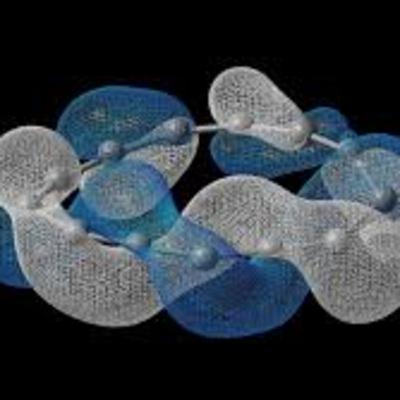
For decades, molecular topology seemed simple: flat rings like benzene or twisted Möbius molecules with a 180° twist. But scientists have now revealed something once thought impossible—a half-Möbius molecule with a 90° twist.This remarkable C₁₃Cl₂ molecular ring introduces an entirely new topological state where electrons must travel four full loops around the molecule to return to their starting quantum state. Even more fascinating, researchers can toggle the molecule between multiple topological forms using scanning probe microscopy, effectively turning it into a quantum molecular switch.Behind this discovery lies exotic physics:⚛️ the helical pseudo-Jahn–Teller effect🧠 quantum simulations on a 72-qubit processor🌀 and a rare π/2 Berry phase, producing quarter-integer quantum states.This isn’t just a chemical curiosity—it could shape the future of quantum materials, spintronics, and molecular electronics, where information may be stored not in charges, but in topological braids of electrons.Source paper:A molecule with half-Möbius topology. Science First Release.#nanoscience #quantumchemistry #moleculartopology #spintronics #materialsScience #quantumtechnology #deepdivelab
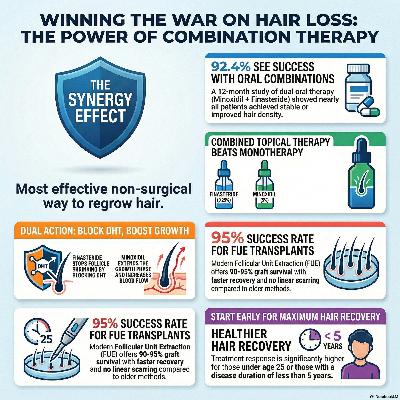
For centuries, baldness was treated as an unavoidable biological fate. From the ancient “Hippocratic wreath” to the crude hair transplants of the past, most men believed hair loss was simply part of aging.But modern science is rewriting that narrative.Advances in molecular biology, pharmacology, and microsurgery are transforming how we understand and treat androgenetic alopecia—the most common form of hair loss. New research shows that combining Minoxidil and Finasteride can significantly improve hair density, while emerging “all-in-one” oral therapies have demonstrated stability or regrowth in over 90% of patients, even in advanced stages of baldness.Meanwhile, surgical innovations such as FUE hair transplantation have replaced older techniques, offering more natural results with minimal scarring. Complementary therapies like platelet-rich plasma (PRP) and low-level light therapy (LLLT) are also helping reduce follicular inflammation and stimulate key growth factors.As researchers decode the androgen paradox—why the same hormone that grows a beard can shrink scalp hair follicles—we may be approaching a turning point in hair restoration science.If science can now stabilize and even reverse hair loss with such precision, the question is no longer if baldness can be treated… but when it becomes optional.#HairLossScience #HairRestoration #Minoxidil #Finasteride #HealthScience #Biohacking #SciencePodcast #deepdivelab
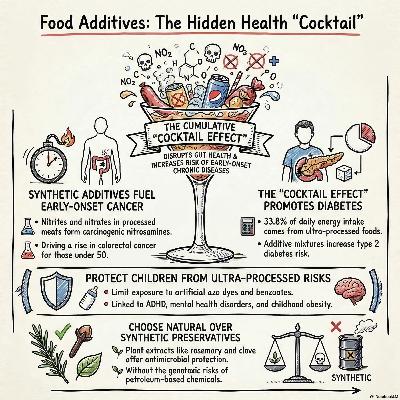
In modern diets, ultra-processed foods provide more than half of daily calories in many high-income countries. While food additives are typically classified as “safe” when evaluated individually, our real diets contain dozens of additives interacting together.Emerging research suggests this “cocktail effect” may be linked to Type 2 diabetes, gut microbiome disruption, and the rise of early-onset colorectal cancer.In this episode, we explore the science behind food additives, the limitations of current safety models, and a critical question:If every ingredient is individually safe, what happens when we consume them all together every day?#FoodScience #UltraProcessedFoods #GutMicrobiome #NutritionScience #PublicHealth #FoodAdditives #CleanLabel #SciencePodcast #deepdivelab
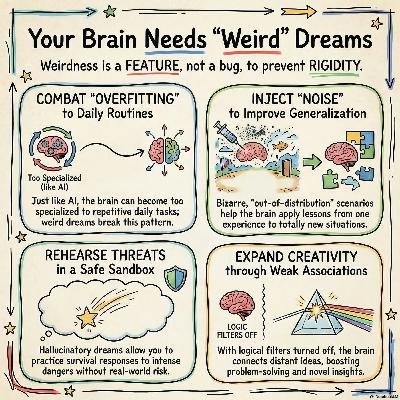
Every night, your brain creates bizarre, hallucinogenic stories—flying through the air, escaping danger, or meeting impossible characters. But why would evolution design such strange experiences? 🤔According to neuroscientist Erik Hoel’s Overfitted Brain Hypothesis, dreams are not random. They are the brain’s way of preventing itself from becoming too specialized in the routines of everyday life.In artificial intelligence, systems that train too narrowly suffer from “overfitting”—they perform perfectly on familiar data but fail when facing something new. Your brain faces the same risk. When life becomes repetitive, our mental models become rigid.Dreams solve this problem by generating wild, out-of-distribution experiences—a kind of neural noise that forces the brain to stay flexible and creative.This episode explores:🧠 Why only 2% of dreams replay real life🤖 The surprising connection between dreams and AI training🌙 Why weird dreams are essential for intelligence⚠️ How dreams act as a nightly threat-simulation system for survival📚 Why fiction, movies, and art may function as “artificial dreams”In a world of algorithms that constantly feed us what we already believe, dreams may be the brain’s last defense against intellectual stagnation.#sciencepodcast #neuroscience #dreamscience #sleepresearch #brainscience #AI #cognition #psychology #learning #deepdivelab
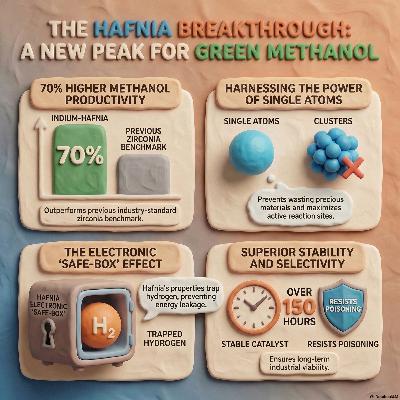
For nearly a decade, scientists believed the race to produce green methanol from CO₂ had hit a hard limit. The benchmark catalyst—based on zirconia—seemed impossible to beat.Then an unlikely challenger appeared: hafnia, a material best known as a high-κ dielectric used in semiconductor chips.Once dismissed as chemically inert, hafnia has now shattered the field’s performance ceiling. By anchoring single indium atoms onto flame-engineered hafnia surfaces, researchers achieved 70% higher methanol productivity—breaking a decade-long stagnation in catalyst design.The secret lies in hafnia’s electronic DNA. Its wide bandgap and high dielectric constant, famous for preventing electron leakage in microchips, now create a cooperative hydride–proton reservoir that keeps catalytic reactions highly active.Even more exciting, this platform may be universal. The same dielectric-supported single-atom strategy dramatically boosts other metals as well—showing 268× improvement for gallium systems and 137× for zinc systems.This discovery reveals something remarkable:the materials inside our electronics and processors may hold hidden solutions for the clean-energy transition.🎧 In this episode, we explore the moment when semiconductor physics meets green chemistry.Source:Single atoms of indium on hafnia enable superior CO₂-based methanol synthesis.Nature Nanotechnology (2026).#materialsScience #greenMethanol #catalysis #CO2Conversion #cleanEnergy #nanotechnology #singleAtomCatalysts #climateTech #deepdivelab

In many cultures, girls are still quietly taught to be polite, agreeable, and not too loud. But in today’s world, raising confident daughters means raising girls who can speak up, set boundaries, and believe their voice matters.What actually builds that kind of confidence?Research in developmental psychology and education suggests that the key is not just talent, grades, or opportunities—but something deeper: psychological capital, especially self-efficacy—the belief that you can overcome challenges and achieve your goals.In this episode, we explore:🔬 The crucial difference between self-esteem and self-efficacy👨👩👧 How family culture and expectations shape a child’s confidence across generations👨👧 The powerful role fathers play in helping daughters develop courage, independence, and the confidence to speak their minds📚 The ABC of learning: Attitudes, Behaviours, and Capability🌱 Why small things—like encouragement, belonging, mentors, and role models—can profoundly shape a child’s futureRaising confident daughters isn’t about making them perfect.It’s about helping them trust their voice, embrace challenges, and believe their goals are achievable.Because sometimes the most powerful inheritance we give our children isn’t wealth or status…It’s the belief that their voice matters and their future is theirs to shape.#parenting #raisingdaughters #confidence #selfefficacy #psychology #education #fatherhood #sciencepodcast #deepdivelab
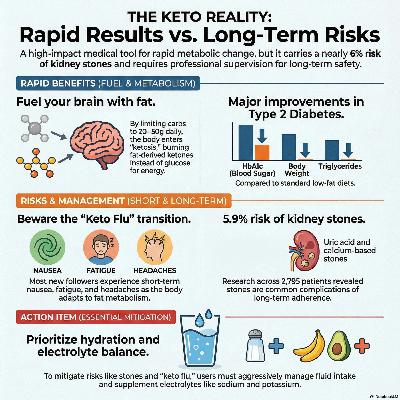
For many people, the ketogenic diet looks like a modern internet trend filled with butter coffee and bacon. But its origins go back more than 2,500 years, when ancient physicians used fasting-like treatments to control seizures.In this episode, we unpack the real science of ketosis—a metabolic state where the body switches from burning glucose to burning fat-derived ketone bodies for energy.🔬 You’ll discover:Why keto is essentially a biological “starvation hack” that forces the body to change its fuel systemThe surprising lipid paradox—how eating more fat can sometimes lower triglycerides and raise HDLThe hormonal hunger hack that makes keto easier to sustain than many dietsThe hidden metabolic costs, including a higher risk of kidney stones and uric acid buildupWhat animal studies reveal about long-term metabolic consequences and possible insulin problems when carbs returnKeto may help with rapid weight loss and Type 2 diabetes management, but scientists warn that its long-term effects remain uncertain.Is keto a powerful metabolic tool, or a temporary intervention that requires medical supervision?Let’s dive into the science.#KetoDiet #Metabolism #NutritionScience #WeightLossScience #DiabetesResearch #Ketosis #HealthScience #DeepDiveScience #SciencePodcast #deepdivelab
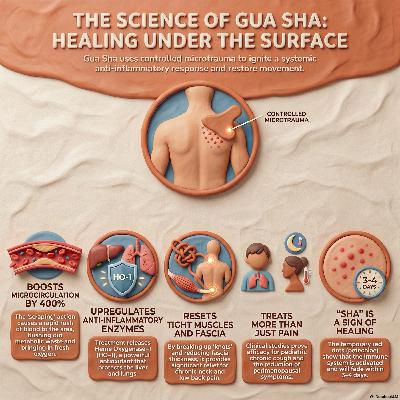
After a Gua Sha session, the skin often blooms with small red spots known as petechiae—a sight that can look alarming. But within the 2,000-year tradition of East Asian medicine, this “sha” is considered the signature of a successful treatment.Modern research is beginning to uncover the biology behind this ancient technique. By creating controlled micro-stress on the skin, Gua Sha can trigger what scientists call a “directed healing cascade.” This process activates Heme Oxygenase-1 (HO-1), a powerful antioxidant enzyme that helps regulate inflammation and cellular defense.In this episode, we explore how Gua Sha may influence the body far beyond the skin:🧬 Systemic anti-inflammatory effects through HO-1 activation🫁 Respiratory support, with studies showing benefits for chronic cough in children🌙 Hormonal balance, helping relieve symptoms of perimenopause🦴 Fascial remodeling, reducing chronic low back pain by restoring tissue mobility🧠 Neurological pain modulation, activating the brain’s natural pain-suppression pathwaysWe also discuss the surprising science behind the four-fold increase in microcirculation that occurs during treatment—and why this ancient practice is now gaining attention in modern integrative medicine.Could the “red mist” of Gua Sha actually be the visible signature of systemic healing?🎧 Tune in to explore the intersection of traditional medicine and modern biology.#GuaSha #TraditionalMedicine #Inflammation #PainScience #IntegrativeMedicine #HealthScience #AncientWisdom #MedicalResearch #deepdivelab
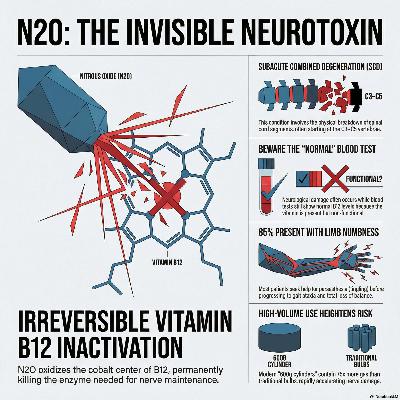
The sharp metallic hiss of a canister piercing a balloon has become a familiar soundtrack in nightlife culture. But behind the fleeting euphoria of Nitrous Oxide (N₂O) lies a rapidly escalating neurological crisis.Between 2019 and 2023, the CDC reported a four- to five-fold increase in poison center calls and emergency visits related to N₂O misuse. What was once dismissed as harmless “laughing gas” is now linked to a surge in N2O-induced myeloneuropathy — a devastating condition where minutes of dissociation can result in permanent nerve damage.This episode dives deep into the molecular mechanism behind the damage:🧪 How N₂O oxidizes the cobalt atom in Vitamin B12🧠 Why it shuts down methionine synthase — the enzyme that protects your myelin📉 The dangerous illusion of “normal” B12 blood tests🏭 The industrial shift from 8g nangs to 600g cylinders📊 The clinical correlation between weekly dose and metabolic collapse🦴 MRI evidence of spinal cord degeneration (C3–C5)❤️ The hidden cardiovascular risks: clots, strokes, endothelial dysfunctionThe effects disappear in sixty seconds.The damage can last a lifetime.Is a one-minute escape worth the risk of losing the ability to walk?#deepdivelab#NitrousOxide #N2O #Neurology #PublicHealth #VitaminB12 #HarmReduction #AddictionScience #Neurotoxicity #SciencePodcast
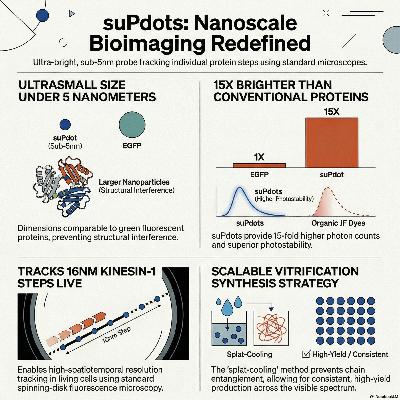
Biology has long faced a trade-off: small fluorescent probes are dim, and bright ones are bulky enough to disturb the proteins they track.A 2025 Nature Photonics breakthrough introduces single-chain ultrasmall fluorescent polymer dots (suPdots) — sub-5 nm probes as small as GFP, yet up to 15× brighter.📄 Source: Single-chain ultrasmall fluorescent polymer dots enable nanometre-resolution cellular imaging and single protein tracking, Nature Photonics, Vol. 19, pp. 1336–1344 (2025).Using a rapid “splat-cooling” vitrification method, researchers prevented polymer entanglement, creating single-chain dots capable of nanometer localization (~8 nm).The result? Real-time tracking of kinesin’s 16-nm steps inside living HeLa cells — using standard spinning-disk microscopy.Bright. Tiny. Non-disruptive.Nanoscopic imaging just became accessible.#Nanotechnology #CellBiology #NaturePhotonics #SingleMolecule #SuperResolution #ProteinTracking #deepdivelab

Comments

Download from Google Play

Download from App Store
 United States