


 Claim Ownership
Agents of Scale
Subscribed: 8Played: 93
Subscribe
© 2026 Wade Foster
Description
Agents of Scale is a show about real stories of AI transformation. Hosted by Zapier CEO Wade Foster, each episode features a candid conversation with a C-suite leader who’s scaling AI across their organization—turning early experiments into lasting change. From mindset shifts to automation breakthroughs, these are the untold stories behind the enterprise AI wave.
22 Episodes
Reverse
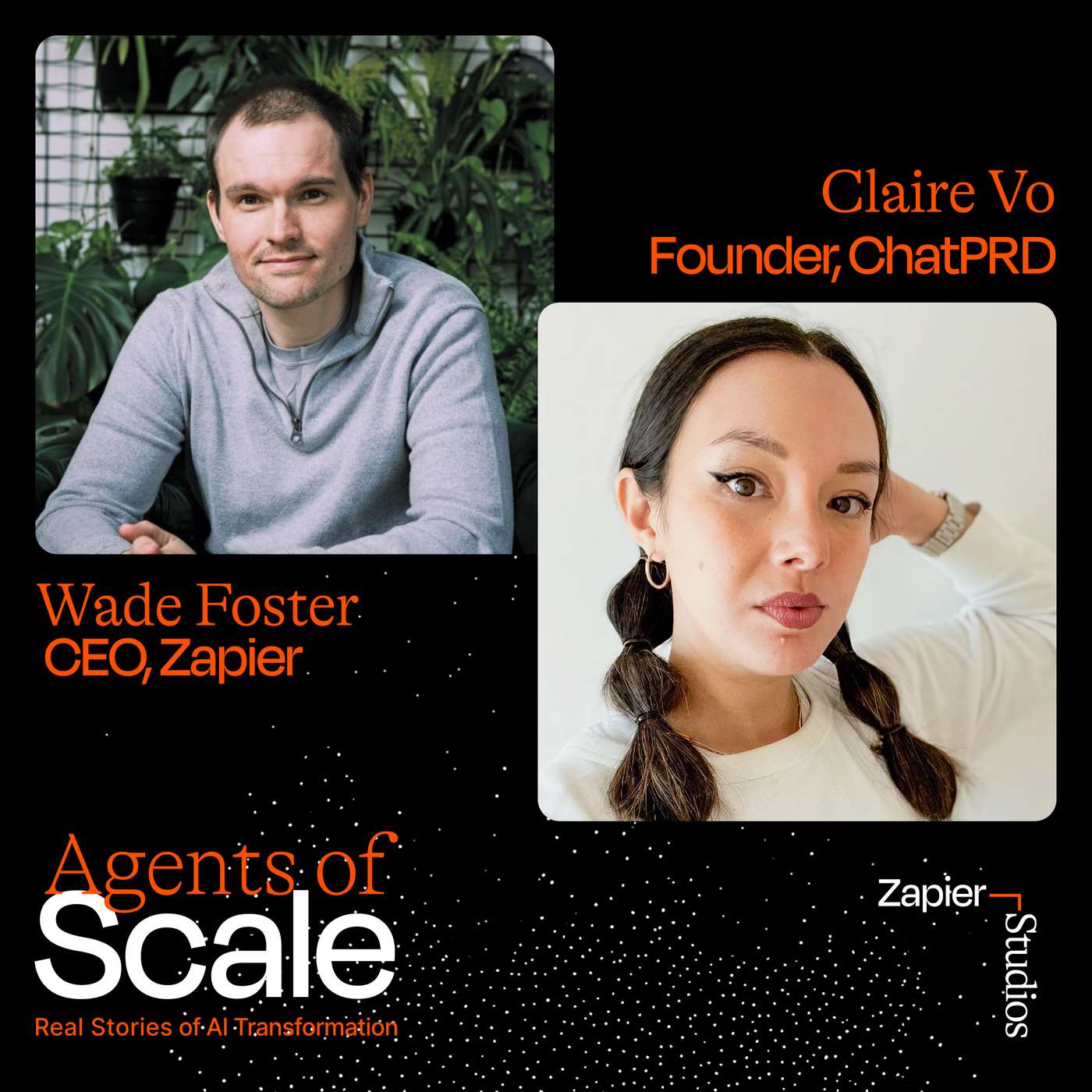
Product and leadership roles are changing—and “PM is dead” still holds. Claire Vo, CEO of ChatPRD (100,000+ users) and former CPTO at LaunchDarkly, Color Health, and Optimizely, joins Wade to talk about what that means for how you show up: as a leader driving adoption or as someone deciding whether to lean in.They cover why CEO "AI Mandates" and headcount freezes don’t move the needle—and what does. Claire shares how she frames AI as career development for skeptics, the rituals that actually stick (AI Fridays, hack weeks, “no lanes”), and why executives have to get hands-on themselves (“era of the hard skill”). She gives concrete ways to start if you’re rusty: the Sunday Scaries Zapier agent, vibe coding a prototype, exec hackathons—and why leader vulnerability makes it safe for everyone to experiment. They also talk about making space for ideas at every level (dogfooding, the “cringe” channel, trading certainty for ambition), what the future product role looks like, and why hiring for willingness to learn and fearlessness about tooling beats tenure. Claire walks through how she’s building ChatPRD with fewer humans—where she’s not constrained and where she still invests in people—as a lens on how work is shifting.In this episode, you’ll hear:- Why “PM is dead” still holds and what the skill of the future looks like for product and leadership.- What actually drives AI adoption—and why CEO edicts don’t.- Why execs’ jobs are changing too and where to start if you’re embarrassed or rusty.- How to create an environment where ideas can come from anywhere.- Why leaning in now is a career move and what hiring looks like when adaptability and tooling matter more than tenure.- How one AI-native company is built: where humans still matter and where they don’t.Guest: Claire Vo — CEO & Founder, ChatPRD. X: @clairevo.
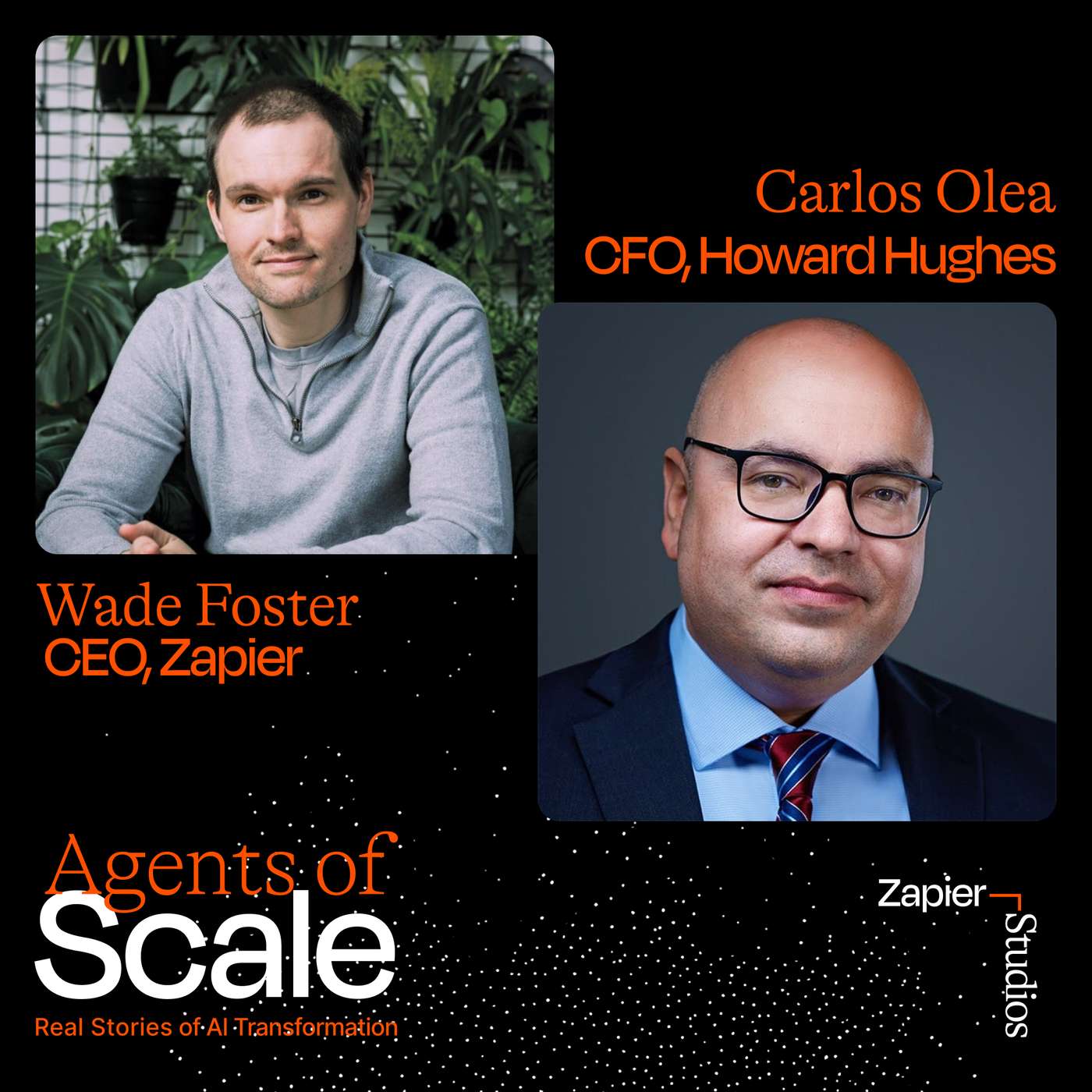
Most companies wait for their tech team to lead AI adoption. At Howard Hughes, the push started from the CFO's office.Carlos Olea spent decades mentally cataloging process inefficiencies — as an auditor, he'd spot problems he had no authority to fix; as a finance leader, he'd hit budget or technology walls. When AI broke through both barriers, he pulled out his backlog and started building. His first project? A tool that parsed vendor bids to surface the best value — not just the cheapest price. That small win opened the door to automating lease abstraction, a notoriously manual process in real estate, with higher accuracy than humans.Carlos talks about the risks of being a "very different CFO," why imagination — not tools or budget — is now the real bottleneck, and how he assembled a tiger team that moves at startup speed inside a public company. His playbook for winning over skeptics: fix the tasks everyone hates first.- Why a CFO — not a CTO — became Howard Hughes' AI champion- The decades-long efficiency backlog that finally found its tools- How to pitch AI to your board when you don't have a tech background- Why chasing every new model is the fastest way to accomplish nothing- Building a tiger team that blends enterprise rigor with startup speedCarlos Olea — Chief Financial Officer, Howard Hughes Holdings. A CPA-turned-AI-builder who led the company's first AI investments and now runs its innovation push from the finance function.Howard Hughes Holdings: https://www.howardhughes.com/Carlos Olea on LinkedIn: https://www.linkedin.com/in/carlosolea/
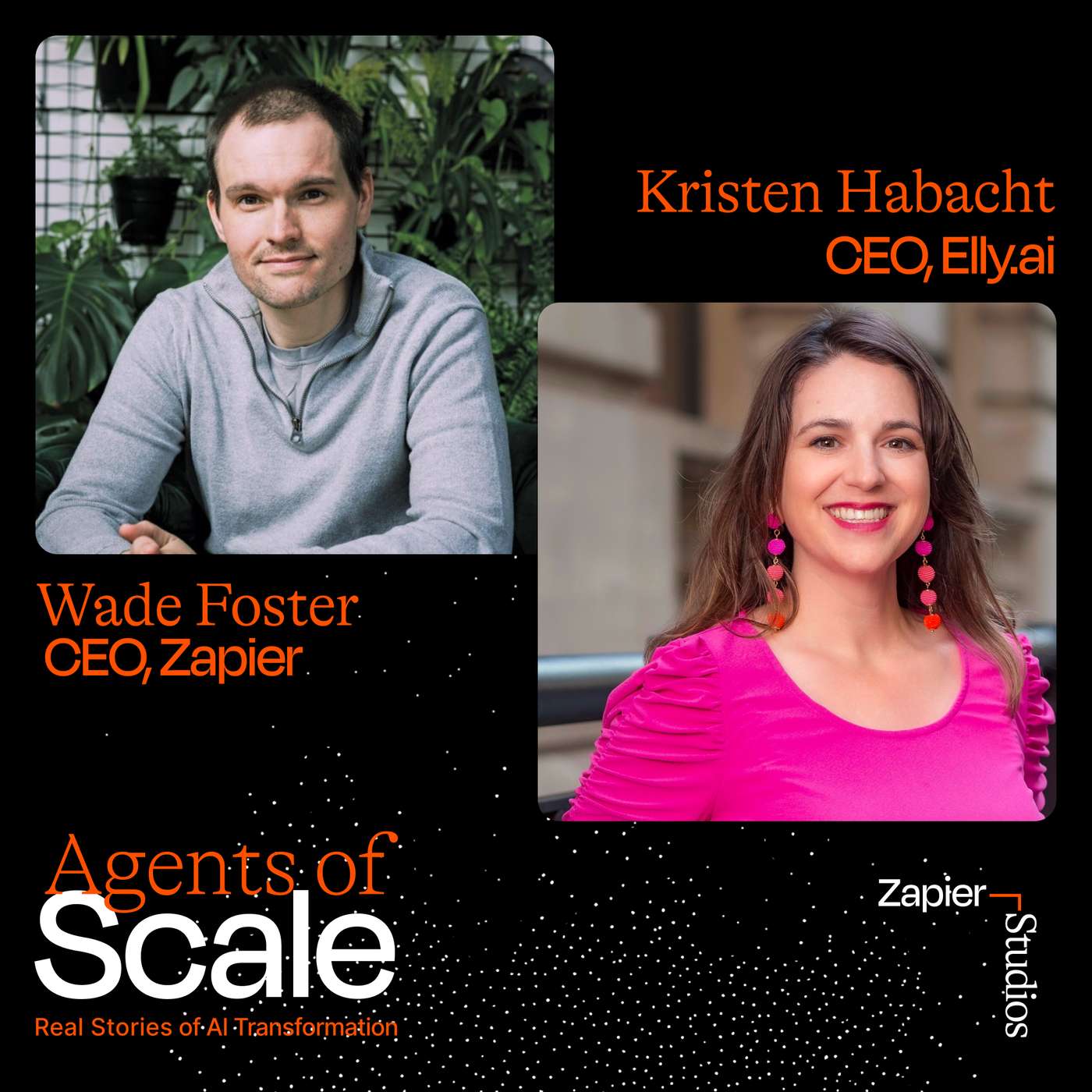
Recruiting is in an arms race: job seekers spray AI at every open role; recruiters crank filters to keep up. Nobody wins. ⚡ Kristen Habacht—CEO of Elly and former head of revenue at Trello (then Atlassian) and CRO at Typeform—thinks the fix isn’t more filters. It’s tech that actually learns, so recruiters can do the human work.Wade and Kristen talk about why most ATSs are “filing cabinets,” what “ICP for hiring” would look like, and why Elly never says yes or no to a candidate—only “did you see this? Is it important?” They cover the 1,000-applicants-in-24-hours reality, PLG in talent/HR, bias and AI screening, her take on AI “cheating” in interviews (“who really cares? It shows they know how to use the tool”), and why she’s giving away a lot of free usage instead of buying a billboard. Plus the story of the day she found out Trello was being acquired by Atlassian—and shoved her co-founder thinking he was joking.In this episode, you’ll hear:- 🎯 Why recruiting is broken for both sides and how the current arms race got here.- 📋 What’s wrong with today’s ATSs and why “ICP for hiring” could change the game.- 👥 How Elly keeps humans in the loop—and why the AI never decides anyone in or out.- 🔍 Why keyword search fails hiring (and what Trello’s early PLG hiring had to do with it).- 🤖 Whether AI in interviews is “cheating,” proctored interviews, and what might actually stick.- 🔗 Why TA and HR still don’t talk—and why that has to change.- 🌐 What a “universal job application” could look like—and where Elly is putting its $8M.Guest: Kristen Habacht — CEO, Elly.
Is SaaS about to be replaced by people “vibe-coding” their own apps — or is something deeper at stake? Dharmesh Shah, co-founder and CTO of HubSpot, joins Wade to cut through the hype and give a refreshingly practical view of how companies should show up for AI.Dharmesh argues the right question isn’t “How do I compete against AI?” but “How do I compete with AI?” — and explains how culture, curiosity, and a little bit of tinkering unlock real value. From practical starting points for SMBs, to why large SaaS vendors still have a massive advantage, to the power of simulation and retrieval-augmented workflows, this episode maps out what leaders and teams should actually do next.In this episode you’ll hear:Why “compete with AI” beats “compete against AI.”The rituals that help organizations adopt AI (hackathons, demos, and scheduled retries).Low-risk starting points: creation → synthesis → automation → simulation.Why large SaaS companies likely aren’t going extinct — and when vibe-coding does make sense.How AI can amplify careers: automate the small stuff, get promoted to bigger problems.Practical ideas for marketing, personalization, and building dynamic UIs that fade into the background.Guest: Dharmesh Shah — Co-founder & CTO, HubSpotSubscribe for more Agents of Scale — actionable conversations with builders, leaders, and product thinkers who are shaping the next era of work.Try Zapier for yourself: https://bit.ly/4hWQES5If you enjoyed this episode, please subscribe, leave a review, and share with someone building for the future.
Most companies talk about becoming “AI-first.” Very few actually stop the business to make it real.Wes Schroll — Founder & CEO of Fetch — joins Wade to unpack what it actually takes to scale a consumer platform, evolve a decade-old company, and integrate AI without losing focus, culture, or trust. From building his first business at 14 to leading a reward destination that now influences more consumer spend than nearly anyone outside Walmart and Amazon, Wes shares the behind-the-scenes decisions that shaped Fetch’s growth.They dig into Fetch’s business model, how Wes’s perspective on AI shifted from skepticism to urgency, and why leadership had to get hands-on — not delegate AI exploration to a task force. Wes breaks down the decision to shut down the company for a full week so 1,000+ employees could participate in an AI hackathon, the hard lessons learned from early automation missteps, and why simple, readable AI guidelines matter more than fear-based policy.The conversation also explores how AI is changing founder–engineering dynamics, reshaping what counts as a competitive advantage, and lowering the barrier for non-technical leaders to communicate, prototype, and collaborate more effectively.In this episode, you’ll hear:How a founder’s personal AI “aha moment” sparked a company-wide shift.Why task forces fail and hands-on leadership creates real momentum.What Fetch learned from shutting down the company for a week-long AI hackathon.How to evaluate AI aptitude, scalability, and vendor promises realistically.Why short, human-readable AI guidelines outperform long, punitive policies.How AI reduces expertise asymmetry between founders, product, and engineering teams.Lessons on resilience, responsibility, and surviving the emotional highs and lows of entrepreneurship.Why using AI isn’t “cheating” — and how leaders must reset that narrative.Guest: Wes Schroll—Founder & CEO, Fetch
Most security playbooks weren’t built for an era where AI moves faster than policy. Rob T. Lee says the default answer of “no” is creating a far bigger problem: shadow AI — widespread, unsanctioned usage that quietly exposes organizations to risk.Rob T. Lee — Chief of Research & Chief AI Officer at the SANS Institute — joins Wade to unpack pragmatic ways leaders can move forward without breaking things. From the “tinker/hacker” mindset that helps teams learn, to treating security like a lifeguard (not a chokehold), Rob lays out the short, repeatable moves that actually get enterprises experimenting safely: enable small experiments, create accountability partners (not mythical “AI champions”), red-team your integrations, and make governance part of the daily routine.In this episode you’ll hear:Why a blanket “no” to AI creates shadow AI and greater risk.How to flip policy toward a cautious “yes” and act like a lifeguard, not a jailer.Practical training tactics: 30 minutes a day, micro-projects, and hackathons.What good AI governance looks like — rules of acceptable use, vendor checks, red teams, and regulatory thinking.Why executives and boards need to be hands-on learners, not just hire an “expert.”The origins and purpose of the SANS Secure AI Blueprint and how to use it to align strategy, governance, and operations.Guest: Rob T. Lee — Chief of Research & Chief AI Officer, SANS Institute
Most enterprise AI talk sounds great in theory—until you try to make it work across 40 disconnected systems. Jason Cottrell says that’s exactly where the real wins are hiding.As CEO of Orium (and the new president of the MACH Alliance), Jason has seen what happens when companies stop chasing one big AI solution and start stacking small, composable ones. The result? For one retailer, a 9-month transformation that led to 5x digital growth—and a repeatable roadmap any enterprise can follow.In this episode, Jason and Wade unpack why “many agents, many jobs” beats the mythical all-knowing AI, how interoperability is quietly rewriting retail, and the cultural shifts that make automation actually stick.
Grammarly didn’t just change its company name—it changed the story of AI.In a deep-dive conversation following the company's rebrand, Superhuman CEO Shishir Mehrotra joins Zapier CEO Wade Foster to unpack why this move signals a seismic industry shift: AI is moving from tools you have to remember to use to infrastructure that works wherever you do. Superhuman’s “AI superhighway” already makes 100 billion LLM calls a week, running across over 1 million apps and websites where work happens.Shishir shares how Superhuman Go—the company's proactive AI assistant—turns intention into execution, how to run four products as a “compound startup,” and why the next frontier of AI-driven productivity won’t look like traditional software at all.A rare glimpse into a monumental shift—from AI as a product to AI as the plumbing of modern work.
What happens when AI meets 10 years of enterprise data?Box CTO Ben Kus joins Zapier CEO Wade Foster to dig into how enterprise AI actually works when scale, security, and governance aren’t optional. They explore what happens when agents start reasoning across real customer data—and why the hardest part isn’t the model, it’s everything around it.Ben shares how Box is teaching AI to work with human workflows, not against them, while Wade connects it to the shift he’s seeing inside automation: from “set it and forget it” to systems that think alongside you.Because in the enterprise, AI has to earn trust before it scales.
AI that sells, reasons, and closes like your top rep? It sounds terrifying—but it’s not. Amanda Kahlow’s Superhumans are proving that automation doesn’t erase people; it elevates them. Her team rewards employees who replace their own jobswith AI by promoting them, not firing them. And her customers? They’re seeing sales cycles shrink from 22 days to 2 and average deal sizes double.In this episode, Zapier CEO Wade Foster and Amanda dig into what “AI-led growth” really means—and why the smartest move in 2025 isn’t resisting AI, it’s learning how to lead with it. They unpack why 76% of 1Mind’s pipeline now comes from their own AI, and how org charts are evolving around a new role: the agent manager.It’s a grounded, surprisingly human look at the future of work—and a reminder that the best way to stay relevant is to build the AI version of your best self. As Amanda puts it: “Your sellers hallucinate—AIs do it less.”
For Chris Pedregal, CEO of Granola, AI isn’t about replacing thinking—it’s about deepening it. He joins Zapier CEO Wade Foster to talk founder-to-founder about what it takes to build products that think with you, not for you. Together they explore why it’s the best time in history to be a builder, how AI can eliminate busywork without erasing human judgment, and why context will define the next decade of AI.From living on the bleeding edge to running their own company on Granola, this is a masterclass in building AI that actually makes people smarter.
Replit’s mission: turn 100 million people into builders. CEO Amjad Masad joins Zapier CEO Wade Foster to discuss the real blocker to AI adoption—creativity, not code—and how enterprises can unlock it. They cover why most users freeze at the prompt, how social contagion drives adoption, and why your next “employee” might be an AI agent sitting in Slack.
What does it take to reinvent a billion-dollar SaaS company in the age of AI? For Intercom, the answer was refocusing the business, betting everything on an AI-first future, and a $50 million pricing model gamble. In this episode, co-founder Des Traynor pulls back the curtain on the bold moves that reset Intercom’s trajectory and turned its AI agent, Fin, into a powerhouse that resolves 65% of customer conversations. If you’re leading AI transformation, this is the playbook: how to make the painful cuts, how to reset culture, and how to price AI in a way that actually works. It’s not theory—it’s the story of one of the biggest AI reinventions in SaaS.
This week’s full episode is only available through ZapConnect. To catch the full conversation with Airtable Co-founder & CEO Howie Liu and Zapier CEO Wade Foster, register for free at https://zapier.com/zapconnect—available on-demand until October 24.What does it take to build a company that truly grows with its customers? In this special ZapConnect edition of Agents of Scale, Airtable Co-founder & CEO Howie Liu joins Zapier CEO Wade Foster for a rare founder-to-founder conversation. Together they dig into what it means to scale responsibly—evolving from startup to enterprise, weaving AI into your product without losing its soul, and staying close to customer needs even as complexity grows. From early tinkering to enterprise platforms, this conversation offers honest insights for leaders building not just for scale, but for longevity.
Most weeks on Agents of Scale, you’ll hear from CEOs and execs scaling AI across industries. But this week, we’re zooming in on how AI can transform a single person—and by extension, entire businesses.Joe’s story starts with living in his car after cycling through 32 jobs. Then he discovered Zapier. What began as small automations for a roofing company turned into a career building systems for influencers, enterprises, and beyond.In this episode, Zapier CEO Wade Foster talks with Joe about the moment automation “clicked,” how he taught himself APIs with the help of AI, and why curiosity and small wins can completely rewrite your trajectory.
What started as a “texting call center” for real estate leads is now an enterprise platform powering millions of conversations across industries. Verse—acquired by NICE and trusted by brands in healthcare, higher ed, and financial services—evolved from 100% human to AI-first, with humans still in the loop to train, guide, and build trust.Zapier CEO Wade Foster sits down with Verse co-founder Avi Tal to talk about how Verse layered automation one step at a time, why clients went from avoiding the word “AI” to demanding it, and how Zapier became their secret weapon for integrating with any CRM without armies of engineers.
Before AI copilots and receptionists, trades pros were still running businesses from binders and carbon-copy invoices. Jobber set out to change that—and today powers 300,000+ plumbers, landscapers, and contractors.CTO Forrest Zeisler joins Zapier CEO Wade Foster to share how the trades moved from manual chaos to AI copilots that have already booked 200,000+ after-hours calls and coached pros to win more work.They dig into why trust—not hype—matters most when scaling AI in overlooked industries, how customer voice guides Jobber’s roadmap (all the way to board meetings), and why the trades might be the sector that benefits most from AI.
Gamma had signups, usage, and early traction—but growth was flat. With the fundraising climate collapsing and runway shrinking, co-founder Jon Noronha and his team realized traction alone wouldn’t cut it.In this episode, Jon joins Zapier CEO Wade Foster to share how Gamma rebuilt its product in three months, unlocked runaway growth, and scaled past $50M ARR in just six. He also explains why “dabbling” in AI isn’t enough, how to rethink hiring for lean AI-native teams, and what it really feels like when product-market fit finally clicks.Ready to stop dabbling and start scaling? Connect Gamma's AI presentations to over 8,000+ with Zapier. Get started here: https://zapier.com/apps/gamma/integrations
Zapier’s Wade Foster talks with Newfront CEO Spike Lipkin to learn how an AI-powered insurance brokerage is rethinking a $2 trillion industry, without forcing new workflows or long trainings.Spike shares the moments where AI finally matched the hype—from a hackathon where half of projects went straight into production, to an AI benefits bot that saves HR teams a month of work every year, to contract reviews that now take just 20 seconds.The two also dig into why 1 in 5 unicorns trust Newfront with their insurance needs in a $2T industry where a single gap in coverage can make or break a business, how “the email inbox is the API” became their rallying cry, and why the real future of work might mean less doing, more delegating—and much stronger client relationships.
What if AI isn’t replacing your team—but making them irreplaceable? In this episode, Zapier’s Wade Foster talks with Gainsight CEO Nick Mehta and Enterprise AI Transformation lead Seth Wylie about how they got 90% of their teams actively using AI—and not because they had to, but because they realized it made them better at their jobs. From grassroots experimentation meetups (that employees attend even on PTO) to personalized GPTs in the voice of execs, Nick and Seth share the cultural unlocks that made AI feel accessible, personal, and valuable. They explain how psychological safety, not top-down mandates, created a movement—and why AI’s most powerful role might be helping your people break out of theirs.Whether you're leading a company or reinventing your own role, this is a masterclass in how to become irreplaceable.

Comments

Download from Google Play

Download from App Store
 United States