DiscoverFamily IT Guy Podcast
Family IT Guy Podcast
Claim Ownership

Family IT Guy Podcast

Author: Family IT Guy

Subscribed: 13Played: 200
Share

Description

Ben Gillenwater helps families protect children from digital dangers, bringing 30 years of cybersecurity expertise to the parenting journey. His background includes working with the NSA and serving as Chief Technologist of a $10 billion IT company, where he built global-scale systems and understood technology's risks at every level.


His mission began when he gave his young son an iPad with "kid-safe" apps—only to discover inappropriate content days later. Despite his deep technical background, Ben realized that if protecting children online was challenging for him, it must be even more difficult for parents without his expertise.


Through Family IT Guy, Ben creates videos and articles that help parents and kids learn how to leverage the positive parts of the internet while avoiding the dangerous and risky parts. His approach bridges the knowledge gap between complex technology and practical family protection, making digital safety accessible to everyone.

48 Episodes
Reverse
At least 20 states are pushing bills that claim to protect your kids online. I've read them. I testified against one in South Dakota. The problems they're trying to solve are real. The bills don't solve them. I'm Ben Gillenwater — dad, cybersecurity expert, 30 years in the field. In this video I break down exactly what these laws would actually do, why the last major child safety law passed in 1998 made things worse, and why the most powerful protection for your kid isn't in a state capitol. It's in your house. The two things that actually put your kid in danger online: → Addictive algorithms engineered like slot machines → Anonymous strangers who can reach your child through games, apps, and messaging Online enticement reports to the National Center for Missing and Exploited Children went from 186,000 in 2023 to over one million in 2025. Laws didn't stop that. And the ones being proposed won't either. Rules expire. Skills don't. That's what this channel is about. 📱 Step-by-step iPhone safety guide: http://familyitguy.com/go/iphoneguide 🔔 Subscribe for the full series 📤 Send this to a parent who needs to hear it
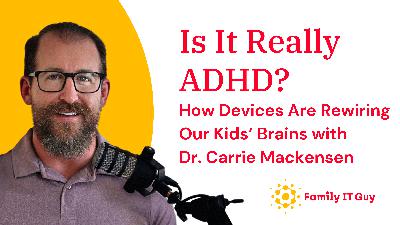
Dr. Carrie Mackensen is a clinical psychologist with 25 years of experience directing addiction and eating disorder treatment programs. She's raising two boys without iPads and is writing a book on parenting in the digital age. In Part 2 of our conversation, we dig into the places where parents actually get stuck: the meltdowns when you take devices away, how to tell if screens are the problem or just puberty, what device withdrawal really looks like (and how long it lasts by age), why Silicon Valley parents send their kids to screen-free schools, the alarming 40% drop in empathy among young people since 2000, and why saying no to screens might be the most loving thing you can do. This is a real conversation between two parents trying to figure this out. No judgment, no perfect answers — just honest experience from someone who's spent decades helping families navigate this. CHAPTERS: 0:00 Introduction 1:27 Assessing Device Impact vs Normal Development 6:32 Conscious Transitions and Being Present 11:36 Are You More Affected Than You Think? 14:31 Co-Regulation: The Breathing Exercise Story 18:53 You Can't Solve a Math Problem While Drowning 24:43 Device Withdrawal: What to Expect 30:11 Screen Time Boundaries by Age 35:38 Schools Using Devices as Babysitters 42:08 Practical Steps for Reducing Screen Time 46:23 The Gamification of Education 49:28 The Good News: Your Brain Can Rewire 51:31 Communication Without Screens 56:45 Road Rage and Digital Dehumanization 1:03:25 Screens Are Erasing Empathy 1:09:36 Gratitude as a Digital Antidote 1:12:13 The Worst Crisis Humanity Has Faced? 1:15:40 Saying No is an Act of Love 1:22:28 Whitelist vs Blacklist: Device Restrictions 1:27:18 One Change Every Parent Should Make 1:39:43 Closing Thoughts Find Dr. Carrie at www.successfulparent.com Free Resources at www.familyitguy.com
Is Roblox safe for kids? In this interview, Chris Hansen shares findings from his investigation into predators, grooming tactics, and why thousands of families have reported harm on the platform. Chris Hansen, who has exposed online predators for over two decades, explains how grooming works on modern platforms, why Roblox has become a growing concern for families, and what parents can do right now to reduce risk. This conversation breaks down the real tactics predators use, how children are targeted, and the specific steps families can take to protect kids without removing technology entirely. What parents will learn in this episode: • How predators identify and groom children on gaming platforms • Warning signs your child may be communicating with strangers • Why popular safety assumptions about Roblox can be misleading • The connection between online grooming and real-world exploitation • Practical rules every family can implement today • Where parents should and should not allow devices Timestamps 0:00 Is Roblox safe for kids? 1:25 Chris Hansen’s history investigating predators 5:28 How online grooming works 12:57 Why Hansen began investigating Roblox 28:44 Why Roblox declined on-camera questions 31:32 A Roblox grooming case explained 40:09 Sextortion and modern threats 41:23 What parents can do right now 50:31 Upcoming documentary release CHRIS HANSEN'S DOCUMENTARY "Taking Down Roblox" drops February 27 on True Blue: https://www.watchtrublu.com ABOUT FAMILY IT GUY Ben Gillenwater is a 30-year cybersecurity expert (including NSA) helping parents protect their families online. GET MY iPHONE SAFETY GUIDE: https://www.familyitguy.com/iphone-setup-guide.html SUBSCRIBE for weekly digital safety content for parents.
Mike McLeod is a speech-language pathologist and ADHD executive function specialist who has worked with over 500 families to eliminate screens since 2016. He hosts the ADHD Parenting Podcast and has two books that released in January 2026. In this conversation, we get into the hard stuff: why screen addiction looks identical to drug addiction, what the withdrawal period actually looks like when you take a phone away, what EdTech has done to education (and how to opt out of school Chromebooks), and why parents need to organize with other families instead of waiting for institutions to fix this. Timestamps: 0:00 - Introduction 1:00 - Mike's background in ADHD and executive functioning 3:05 - ADHD is really an executive functioning disorder 5:05 - The four pillars of executive functioning 9:55 - How screens stop brain development 12:25 - The youth mental health crisis 14:59 - Suicide rates tripled after the iPhone launched 18:31 - Getting a real ADHD evaluation 20:14 - Screens stole boredom from childhood 26:14 - Why parents keep screens in their kids' lives 29:48 - Four cognitive distortions parents tell themselves 33:40 - What phone withdrawal actually looks like 47:12 - You can't teach a kid to manage an addiction 53:04 - 500 families eliminated screens, zero regrets 58:55 - EdTech is destroying education 63:34 - Life at 18 with vs. without executive function 69:17 - The one thing every parent should do right now If you're a parent dealing with screen battles at home, you're not alone. Mike has seen this hundreds of times and it does get better: https://www.grownowadhd.com/about/ Check out his new book: https://www.grownowadhd.com/grownow-book/ Family IT Guy helps parents block harmful content, limit screen time, and prevent contact from strangers. Guides: www.familyitguy.com Subscribe for more conversations with experts who work directly with families.
For the first time, social media executives are being forced to answer to a jury for the impact their platforms have had on children. This trial in Los Angeles (MDL 3047) brings together claims from more than 2,000 families who allege that platform features such as infinite scroll, autoplay, notifications, and reward systems were intentionally designed to encourage compulsive use in kids and teens. Evidence presented in court includes: • Internal memos comparing Instagram to a drug • Research showing vulnerable teens were especially at risk • Warnings about beauty filters contributing to body dysmorphia • Testimony distinguishing “clinical addiction” from “problematic use” • Allegations linking platform contact to exploitation, drug access, and suicide At the center of the case is a critical question: Are these technology companies — or advertising companies built on capturing attention? Follow Nicki Petrossi of Scrolling to Death for ongoing courtroom coverage and analysis. To track the proceedings, search: MDL 3047
Dr. Lisa Strohman spent 30 years studying what hurts kids—from profiling at FBI Quantico after Columbine to serving as an expert witness in New Mexico v. Meta. Her conclusion? The phone in your child's pocket is more dangerous than a gun on your kitchen table. At least the kid knows to be afraid of the gun. We get into the CDC data, what she saw inside Meta's own research, why 400 girls at one school deleted social media on Valentine's Day, and what happened when she gave her own son Snapchat and immediately regretted it. Timestamps: 0:00 - Lisa's background: FBI, Columbine, 30 years in digital safety 2:15 - 800,000 kids follow the Columbine ideology 5:10 - CDC data: self-harm spikes after social media 7:00 - False narratives from platforms 9:30 - "A phone is more dangerous than a gun on the table" 12:05 - Inside the case against Meta 19:40 - 400 girls quit social media on Valentine's Day 22:50 - "Tech is a tool, not a toy" 27:00 - Warning signs for parents of girls 33:37 - The expert's own parenting story 39:40 - "I gave my son Snapchat" 43:17 - One thing parents can do this week 45:11 - Digital Citizen Academy 49:45 - Final question About Dr. Lisa Strohman: Clinical psychologist, attorney, and founder of Digital Citizen Academy (digitalcitizenacademy.org). Her free book "Digital Distress" is available at digitalcitizenacademy.org/digital-resources. Resources: Family IT Guy: https://www.familyitguy.com iPhone Setup Guide: http://familyitguy.com/go/iphoneguide
How do you protect your kids online when even adults can’t tell what’s real anymore? AI-generated videos, deepfakes, and synthetic audio are not just a tech issue. They are showing up inside the apps our kids use every day, mixed in with cartoons, music clips, and “safe” educational content. Most children, and plenty of adults, are being trained to trust whatever looks and sounds real. In this episode of the Family IT Guy Podcast, I sat down with Jeremy Carrasco@showtoolsai a media producer and AI analyst, to talk about what parents need to understand right now. How AI content is made, how algorithms push it, and how families can spot it before it causes harm. Jeremy is not guessing from the outside. He has spent years in professional video production, live streaming, and audio engineering. He knows what real human media looks like when it is made by actual people, and where AI still gives itself away. One of the biggest tells? 👉 AI doesn’t breathe. AI videos can look believable, especially on a small phone screen. But once you know what to listen and look for, the cracks show up fast. Those cracks matter because kids do not have the life experience or media literacy to notice them on their own. In this conversation, we break things down in a way parents can actually use. First, AI videos versus deepfakes. They are often treated as the same thing, but they are not. Jeremy explains the difference, why deepfakes tend to be targeted, and why mass-produced AI videos are now flooding platforms at scale, often designed to hook kids with familiar characters, faces, or voices. Second, why audio matters more than visuals. Parents are taught to watch what their kids see, but listening is just as important. We talk about unnatural speech pacing, missing breaths, flat or mismatched emotion, and why the human voice is still one of the hardest things for AI to fake convincingly. Third, visual and behavioral red flags parents can learn. Subtle background warping, strange eye movement, awkward timing, and non-human rhythm. These are things media professionals spot quickly, but they can also be taught to parents who want to be more proactive instead of reactive. We also zoom out to the bigger issue parents are up against. Algorithms do not understand childhood, safety, or values. They understand engagement. A feed that starts with something harmless, Bluey, Miss Rachel, animal videos, or learning content, can shift quickly after one curious search or autoplay chain. That is how kids end up exposed to disturbing, violent, or sexualized AI-generated content that looks playful but is not. We talk about: - Why kids’ algorithms are some of the most profitable and dangerous systems online - How “safe” feeds slowly drift without parents realizing - Why YouTube Kids is safer than regular YouTube but still not a set-it-and-forget-it solution - The rise of AI-generated sexualized content involving children - Why sharing kids online can create exposure parents never intended - Safer ways to share family photos using privacy-first tools - Why adults have to act as stewards of their children’s digital privacy, even when the platforms will not This episode is not about fear or banning technology. It is about giving parents clarity in a digital world that is changing faster than most families realize. If you are raising kids right now, or care about the internet they are growing up in, this conversation is worth your time. 🎙️ Guest: Jeremy Carrasco — Media Producer & AI Analyst 🎧 Podcast: Family IT Guy
In this episode of the Family IT Guy Podcast, I sit down with Shawnna Hoffman, CEO of the International Center for Missing and Exploited Children (ICMEC), for a raw and deeply personal conversation about online exploitation, AI-enabled scams, human trafficking, and the growing risks facing kids and teens online. Shawnna shares her journey from decades in Big Tech and AI leadership to leading a global organization focused on returning missing children to their families. She also opens up about her own family’s experience with a long-term online scam that targeted her autistic son, exposing how sophisticated, patient, and psychologically damaging modern online exploitation has become. This episode covers: • How online grooming and long-term scams target kids and young adults • The role AI and social platforms play in exploitation and manipulation • Why parental controls alone are not enough • The reality of missing children and trafficking on a global scale • How ICMEC measures success by one metric only: kids reunited with families • The difference between facial detection and facial recognition • Why digital safety requires community action, better safeguards, and real accountability If you are a parent, caregiver, educator, or anyone concerned about child safety online, this conversation is essential listening. 🔒 Learn more about protecting kids online: https://familyitguy.com 🌍 Learn more about the International Center for Missing and Exploited Children: https://www.icmec.org
Earlier this year, I spoke with Jason Sokolowski about the loss of his 16-year-old daughter, Penelope, after she was targeted by the online criminal network known as 764. This video is an update — and the situation is escalating. 764 is a decentralized exploitation network targeting vulnerable kids, primarily girls ages 10–17, across platforms like Discord, Roblox, TikTok, Instagram, and Snapchat. The FBI and DOJ are actively investigating, but reports are increasing, not slowing down. In this video, I cover: • What 764 is and how it operates • Why it’s designed to turn victims into perpetrators • Warning signs parents should never ignore • Why monitoring alone is not enough • What to do if your child may be targeted If your child can receive messages from strangers online, they are at risk. This is information every parent needs to hear. 📌 If you suspect exploitation: Report to the FBI at ic3.gov Or call DHS Know2Protect: 833-591-5669 Please share this with other parents.
The internet is constant noise: endless scrolling, reacting and stimulation. It's rewiring our brains to consume information in tiny bursts and it's affecting everyone, including our kids. So what's the antidote? Stillness. I've spent 30 years in cybersecurity and I help families navigate technology and online safety. One pattern shows up again and again. We can't teach our kids to manage digital chaos if we can't manage it ourselves. Psychiatrist Dr. Daniel Amen teaches a simple 15-second breathing protocol. Inhale for 4 seconds, hold, exhale for 8 seconds, hold again, then repeat several cycles. That longer exhale sends a signal to the body that things are safe and it's okay to calm down. I looked for an app that uses this pattern without endless menus or decisions and couldn't find one. So I built one called Being - One Minute to Calm. When you open it, it starts immediately. No signups, no subscriptions, just breathing and stillness. It uses gentle haptic taps so you can follow the pattern with your eyes open or closed. Available on iPhone, iPad, Apple Watch and Apple TV. Android is coming soon. Search "Being - One Minute to Calm" in the App Store or visit https://www.familyitguy.com/being/ Do you have any experience with meditation or breathwork? Share your story in the comments.
How can families protect children from dangerous predators - both online and in real life? In this eye-opening episode of the Family IT Guy Podcast, Dr. Leslie Dobson, forensic psychologist, dives into the psychology of violent offenders, including child predators, and reveals why consequences in the justice system often fall short. Dr. Dobson shares real stories from her decades of experience working in prisons, state hospitals, and private practice, explaining how understanding the criminal mind can empower families to protect their children. She also discusses how social media can be a powerful tool for raising awareness and holding offenders accountable. In this episode, you’ll learn: - How offenders cycle through the criminal justice system - The limitations and corruption in handling child predators - The role of forensic psychology in protecting victims - How families can use knowledge and advocacy to improve safety - Practical insights for keeping kids safe online 📌 Subscribe for more on family safety, online protection, and tech. 👍 Like if you want to protect your family better 💬 Comment your thoughts or questions about child safety online
When smartphones started showing up in 1st grade, Meri knew something had to change. As a PR expert and mom who understood AI, algorithms, and why these devices are so addictive, she dove into the research—and then took action. In this episode, we talk about how she: 1. Partnered with schools and clinical psychologists to educate kids AND parents 2. Helped implement Wait Until 8th in her community 3. Worked with school leadership on behavior impacts from devices and social media 4. Started a “Tech Corner” in school and church newsletters 5. Equipped parents with the data they needed to make informed choices 6. Built a like-minded community instead of fighting the battle alone Her mission? Arm parents with information so they can protect their kids’ brains—not just hope tech companies or the government will. Actionable steps for parents (we cover in detail): • Alternatives to smartphones • Parent email template you can send TODAY (email info@familyitguy.com for template) • How to build a community of like-minded families: – FITG Community: https://lnk.bio/s/84ae0 – @WaitUntil8th: https://lnk.bio/s/fd234 – TinCan Phone pods: https://lnk.bio/s/1074b – Playdates with shared rules – No-photo posting waivers at school • How to confidently start conversations with other parents Your kids’ safety isn’t up for grabs—and you don’t have to wait for someone else to draw the line. Watch now and share with a parent who needs this! Subscribe for more Family IT Guy episodes that help YOU navigate tech and parenting with confidence.
Join me as I explore the world of AI toys and share my thoughts on their impact on children. As a cybersecurity expert and parent, I delve into the potential risks and benefits of these innovative toys. I discuss how AI toys work, the privacy concerns they raise, and why it's crucial for parents to stay informed. Let's ensure our kids' safety in this digital age. For more insights, visit https://www.familyitguy.com and follow me on social media. #aitoys #childsafety #FamilyITGuy This is from my conversation with the Utopian Society Project on their South Bay Live show.
This is a complete Bark Phone review and setup guide from a cybersecurity expert and dad. After testing every feature, here's my take on what Bark does well, where it falls short, and the settings I recommend changing before giving this phone to your child. THE SHORT VERSION: Bark Phone delivers on its claims. The parental controls actually work and kids can't bypass them. If my son needed a smartphone and I wanted to monitor his conversations for concerning behaviors, I would use a Bark phone. 📱 Full setup guide with screenshots: https://www.familyitguy.com/bark-phone-review.html 🔗 Get Bark Phone: https://www.familyitguy.com/go/bark 📦 Accessories you'll need that are not included: • USB-C Charger: https://amzn.to/4p42rB3 • Protective Case: https://amzn.to/3M7oqs2 DISCLOSURE: Bark sent me this phone for free to review. I have no contract with Bark and no agreement about the nature of this review. Links above are affiliate links - I earn a commission if you purchase through them, at no extra cost to you. #BarkPhone #parentalcontrols #kidsphone #firstphone #onlinesafety
Roblox just rolled out age verification THIS week, and it could put your child’s personal data at risk. If you’re a parent, you need to know what this really means—and why you don’t have to hand over your child’s face or ID to use any app. Governments and platforms are claiming these systems protect kids, but what they’re really doing is creating massive databases of children’s IDs and biometric data. And those databases are getting hacked. Last month, Discord’s age verification vendor was breached and 70,000 government IDs were stolen, including kids’ documents. Now Roblox is requiring facial age estimation or government ID to use chat, sending that data to a third-party vendor. We can say NO. You do NOT have to hand over your child’s face or your family’s IDs to use an app. I know this video is long, but it’s important for every parent to understand what’s happening. Please share this and help other families stay informed. 👇 Comment your thoughts and share this with a parent who needs to hear it. #ageverification #robloxupdate #parents #cybersecurity #parentingtips #digitalparenting
Are devices causing ADHD-like symptoms in your child? Clinical psychologist Dr. Carrie Mackensen joins The Family IT Guy Podcast to expose what she calls a “misdiagnosis epidemic.” Dr. Carrie explains why screen-induced ADHD looks identical to neurological ADHD — and how a 21–31 day digital detox can reveal the truth. She shares five essential digital boundaries every family needs, and how modeling healthy tech use can rebuild connection at home. In this episode: - Why kids are being misdiagnosed with ADHD, anxiety, and depression - How devices mimic neurological disorders - The power of a 4-week digital detox - Five healthy digital boundaries for families - How to strengthen the parent-child bond in a tech-driven world #FamilyITGuy #ParentingPodcast #DigitalAddiction #ADHD #ScreenTime #DigitalDetox #ParentingTips #KidsAndScreens
I'm asking Tim Cook and his team at Apple to make child safety as easy as Apple Pay. The technology already exists for schools and businesses - families just can't access it. I made an 82-page guide just to help parents set up Apple's Screen Time correctly. That's the problem. The statistics related to kids having smartphones are alarming: • Suicide rates for kids 10-14 tripled from 2007-2019 • Child exploitation reports nearly tripled from 2023 to 2024 • 2025 is on track to exceed 1 million child exploitation reports Apple's Mobile Device Management infrastructure delivers pre-configured, tamper-proof devices to schools and corporations every day. But Apple’s policy restrictions prevent families from accessing the same capability. The technology exists to protect kids from addictive algorithms and anonymous strangers. We need Apple to make it accessible to families. Share this if you would like Apple to offer tamper-proof devices to families.
loading
Comments