DiscoverBuilders of the Broken Bazaar
Builders of the Broken Bazaar
Claim Ownership

Builders of the Broken Bazaar

Author: Dr. Tabish Zaman

Subscribed: 1Played: 0
Share

Description

Builders of the Broken Bazaar

When systems collapse, people still build. In a world obsessed with billion-dollar startups and tech-driven progress, Builders of the Broken Bazaar turns the microphone towards those who build from the ashes — refugees, migrants, and everyday innovators creating meaning, work, and dignity in the ruins of broken systems.

Hosted by Dr. Tabish Zaman, this series dives deep into the informal, the invisible, and the overlooked where entrepreneurship isn’t a choice, but a lifeline. From camps and conflict zones to Britain’s forgotten high streets, we uncover the moral and human frontlines of enterprise: where survival fuels innovation and community becomes the last safety net.

Through unflinching conversations with founders, reformers, and thinkers, we challenge the economisation of human effort — moving far beyond Silicon Valley myths to reframe entrepreneurship around social value, solidarity, and repair. When profit stops being the purpose, building becomes an act of defiance, not accumulation.

🎙 “This podcast is for those who rebuild what the world broke not for profit, but for purpose.”

🎧 Listen and subscribe to the voices of those proving that hope doesn’t come from systems, it comes from people.
23 Episodes
Reverse
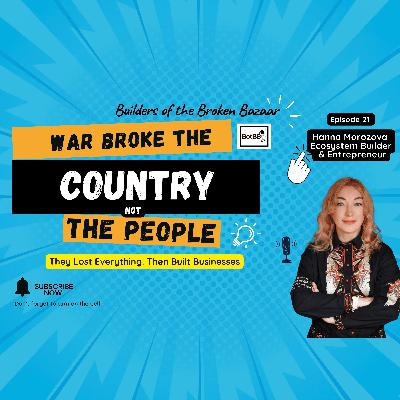
When war collapses a country, the systems fail, but the people remain. What happens when a high-level business leader is forced to become a "refugee," trading a boardroom for a production line in a salad factory?In this episode of Builders of the Broken Bazaar, Dr. Tabish Zaman sits down with Hanna Morozova, an Ecosystem Builder & Entrepreneur who is redefining what it means to rebuild after a catastrophe. From her background building Ukraine’s national garlic cooperative to her current work supporting over 600 refugee entrepreneurs and 120 veterans, Hanna shares the raw, human reality of displacement.Together, they discuss the psychological power of building a business to regain agency, the shift from competition to collaboration within displaced communities, and why the world needs to stop seeing refugees as victims and start seeing them as vital economic contributors.This is a conversation about the bravery it takes to start from zero—and the resilience that ensures you never really have to.🎙 “Entrepreneurship isn't just making money, it's about having control again.”👉 Watch on YouTube: https://www.youtube.com/@buildersofthebrokenbazaar Host: Dr. Tabish Zaman Guest: Hanna Morozova (Ecosystem Builder & Entrepreneur ) Editors: Liam Gadsby Research and Impact Officer: Mohammad AlauthmanKeywords Ukrainian resilience refugee entrepreneurship veteran SMEs ecosystem building agency and identity economic assets collaboration over competition builders of the broken bazaar Dr Tabish Zaman
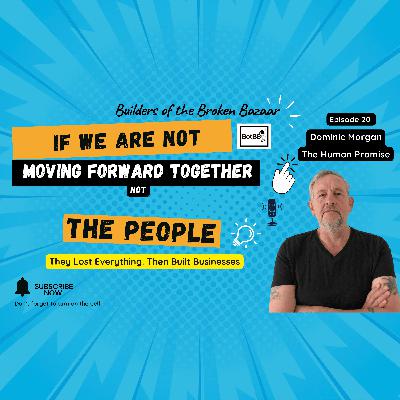
The world hasn't simply become more unstable; it has become normalized in its instability. We are told that global crises are being "managed" through summits, panels, and statements, yet 5 billion people have become poorer while displacement reaches record heights.In this episode of Builders of the Broken Bazaar, Dr. Tabish Zaman is joined by Dominic Morgan, the voice behind "The Human Promise." Together, they sit with a question most institutions avoid: What does responsibility look like when the harm is systemic and power is unequal?Dominic dismantles the idea that geopolitics is too "complicated" for the average person to understand, reframing the crisis as a moral misalignment. He introduces a simple but radical five-point commitment designed to act as a mirror and a compass for humanity.This is not a conversation about fixing the world through external power, but about moral alignment as the first step toward cultural change. It is an invitation to stay in the present longer than the system requires and to refuse to let responsibility dissolve into procedure.🎙 “Outrage spreads faster than understanding... and opinion is loud, but responsibility is really quiet.”👉 Watch on YouTube: https://www.youtube.com/@buildersofthebrokenbazaar Host: Dr. Tabish Zaman Guest: Dominic Morgan (co-founder of the Authentic Leaders initiative) Editors: Liam Gadsby Research and Impact Officer: Mohammad Alauthman
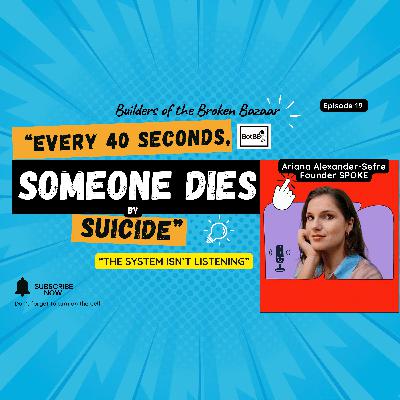
We are constantly told that mental health is an individual responsibility. That "self-care" is the solution. That if we just "optimize" our routines or download the right app, the pain will subside.But what if the real problem isn't a lack of clinical tools, but a resistance to help that doesn't sound like anything people recognize in their everyday lives?In this episode of Builders of the Broken Bazaar, Dr. Tabish Zaman is joined by Arianna Alexander-Sefre, founder and co-CEO of Spoke, to challenge the idea that mental health is merely an individual failing. Instead, they reframe it as a global systemic social issue that requires culture as infrastructure.Together, they explore the "silence" of young men, the capitalization of ancient healing practices into the "wellness industry," and Arianna’s journey in building a platform that integrates clinical psychology with music to reach underserved populations.This episode challenges the idea that clinical therapy is the only gateway to healing. Because care shouldn't require people to be coached or persuaded to access it. It should meet them where they already are.🎙 “Sound is always there... it meets people without asking them to explain first.”👉 Watch on YouTube: https://www.youtube.com/@buildersofthebrokenbazaar
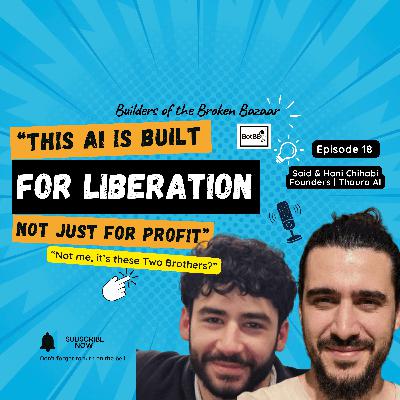
Episode 18: This AI Is Built for Liberation, Not Just for ProfitWe are constantly told that artificial intelligence is neutral.That data is objective.That algorithms simply optimise.That harm is an unfortunate side effect of progress.But what if the real question isn’t what AI can do but who it is built to serve?In this episode of Builders of the Broken Bazaar, Dr Tabish Zaman is joined by Said and Hani Chihabi, brothers and founders of Thaura AI, to explore what it means to build technology from the margins rather than for the market alone.This is not a conversation about AI hype or technical superiority.It is not about disruption for disruption’s sake.It is a conversation about power, dignity, and liberation.Drawing on their lived experiences and their work developing Thaura AI, Said and Hani reflect on what it means to build artificial intelligence that resists surveillance, extraction, and domination and instead centres justice, context, and human consequence.Together, they discuss:• Why most AI systems reproduce existing power structures rather than challenge them• How surveillance technologies disproportionately harm already marginalised communities• Why “ethical AI” often fails when it avoids politics and power• What it means to design AI from places shaped by conflict, occupation, and exclusion• How language, culture, and history are erased in dominant AI models• Why liberation must be a design principle, not a marketing claim• How entrepreneurship can be a tool for resistance, not just valuation• What responsibility looks like when technology operates at scale🎙 “Technology is never neutral, it always reflects who had the power to build it.”This episode challenges founders, technologists, investors, and policymakers to reconsider what responsibility really means in the age of artificial intelligence.Because when AI is built without accountability, it doesn’t just optimise systems it decides who is seen, who is protected, and who is erased.And if AI is shaping the future,we must ask a harder question:Who gets to define that future and at whose cost?Host: Dr Tabish ZamanGuests: Said Chihabi & Hani Chihabi (Founders, Thaura AI)
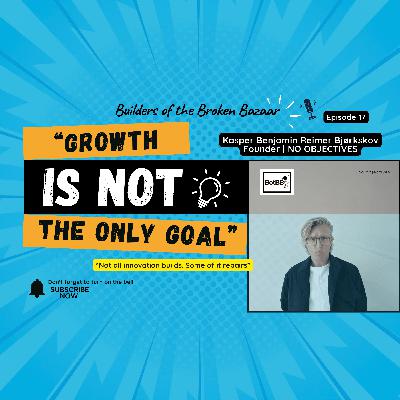
Episode 17: Growth Is Not the Only GoalWe are constantly told that growth equals success.That scaling is progress.That innovation means moving faster, bigger, and further no matter the cost.But what if growth itself has become the problem?In this episode of Builders of the Broken Bazaar, Dr Tabish Zaman is joined by Kasper Benjamin Reimer Bjørkskov, Founder of No Objectives, to challenge one of the most deeply embedded assumptions in entrepreneurship, innovation, and design.This is not a conversation about sustainability as a checkbox.It is not about green growth or better metrics.It is a conversation about repair.Drawing on Kasper’s work in post-growth design, systems change, and collective action, the episode explores what happens when innovation stops chasing expansion and starts taking responsibility for the harm it leaves behind.Together, they discuss:• Why climate collapse and social collapse are the same design failure• How optimisation without empathy leads to extraction, not progress• Why growth has replaced meaning and what that has cost us• How systems are designed to concentrate power rather than distribute care• Why sustainability is an outcome, not a process• What regenerative design requires in a world already in overshoot• Why collective action matters more than individual heroics• How innovation should be measured by restoration, not valuation🎙 “Not all innovation builds. Some of it repairs.”This episode challenges founders, designers, policymakers, and anyone working inside systems that claim to create value while quietly producing harm.Because if growth is not the goal, we are forced to ask a harder question:What are we actually building for and who does it serve?Host: Dr Tabish ZamanGuest: Kasper Benjamin Reimer Bjørkskov (Founder, No Objectives)
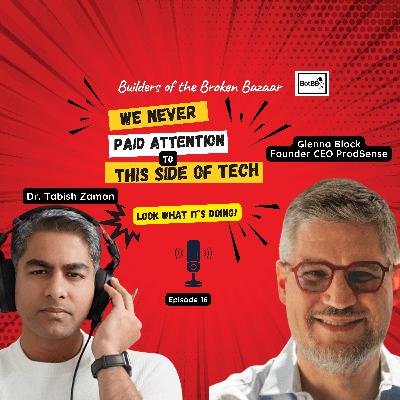
Technology Isn’t Neutral. It’s Cultural.We are constantly told technology is neutral.That algorithms are objective.That design is “just technical.”But technology doesn’t appear from nowhere.It is built by people, shaped by culture, and assembled through decisions, decisions that increasingly determine who gets a job, who gets a mortgage, and who receives medical care.In this episode of Builders of the Broken Bazaar, Dr Tabish Zaman is joined by Glenn Block (Founder & CEO, ProdSense) to unpack what the tech industry often refuses to name:Neutrality is not the absence of bias.It is often the protection of privilege.This is not a conversation about hype.It is a conversation about responsibility and what happens when innovation scales faster than care.Together, they explore:• Why “neutral technology” is a dangerous myth• How culture shapes design decisions long before launch• What product equity means in practice, not as a slogan• Why exclusion is often designed in, not discovered later• Who is missing from the rooms where products are imagined• How startup culture rewards speed, not accountability• Why accessibility and inclusion cannot be retrofitted after harm• And what responsible innovation should demand from entrepreneurs, designers, and institutions🎙 “The bias isn’t in the zeros and ones it’s in how we assemble them.”This episode is a challenge to founders, innovators, and anyone building systems that touch other people’s lives. Because if technology reflects our culture, we have to ask:what kind of world are we building and for whom?
At Christmas, we are told stories about generosity and togetherness.But in many UK cities, the reality looks very different.Shrinking public services.Widening inequalities.Communities carrying more with less.In this Christmas Special of Builders of the Broken Bazaar, Dr Tabish Zaman returns to Hull — a city often reduced to statistics, but held together by people.Joined by Paul Hamnett, CEO of the Hull KR Foundation, and Vikki Tate, Employability and Skills Manager, this episode explores how a rugby league club has become a form of social infrastructure.This is not a story about sport.It is a story about belonging, dignity, and civic repair — and what happens when community organisations step in where systems fall short.Together, they explore:• How sport becomes a vehicle for trust and connection• Why community organisations now fill gaps left by shrinking public services• How youth employment, mental health, education, and inclusion intersect• Why prevention is undervalued — and crisis is always more expensive• What real inclusion looks like beyond slogans🎙 “When a sporting institution becomes social infrastructure, it’s worth asking why it had to.”This episode reframes rugby not as entertainment, but as care.A conversation about leadership rooted in service.About communities holding the social fabric together.And about what Christmas really means in places rarely associated with hope.
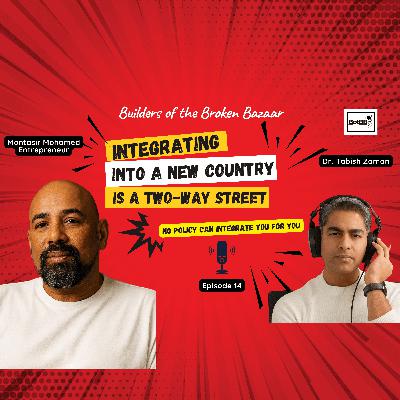
Integration is often treated as a checklist.Learn the language.Follow the rules.Fit in quietly.But real integration doesn’t work that way.In this episode of Builders of the Broken Bazaar, Dr Tabish Zaman speaks with Montasir Mohamed — entrepreneur, business leader, and refugee-turned-citizen in Finland — about what integration actually looks like when it moves beyond policy and into everyday life.This is not a conversation about charity.It is not about compliance.It is about agency, responsibility, trust, and belonging — on both sides.Together, they explore:• Why integration fails when only one side carries the burden• How language becomes dignity rather than assimilation• Why waiting for stability keeps people stuck• How fear — not culture — blocks belonging• Why refugees are framed as dependents instead of contributors• How entrepreneurship becomes survival, not ambition• What Finland gets right — and where it still struggles• Why policies can open doors, but people must walk through them🎙 “Integration isn’t something that happens to you. It’s something you build.”This episode challenges the idea that inclusion can be delivered by systems alone.Because belonging is not granted.It is built — together.
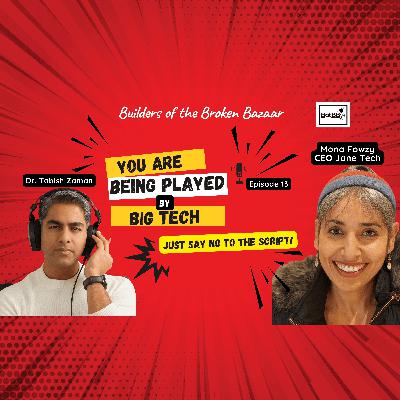
You Are Being Played by Big TechIn this episode of Builders of the Broken Bazaar, Dr Tabish Zaman speaks with Mona Fowzy — CEO of JaneTech and a software engineer with over 25 years across EA, AOL, Yahoo, CBS, and global scientific labs — about why we don’t need more technology at all.We need less hype, less manipulation, and far more courage to question the systems shaping our lives. Together, they explore:• Why most new technology fixes nothing but extracts everything• How AI, crypto, and surveillance tools manufacture fear, urgency, and dependency• How everyday people are turned into test subjects for corporate agendas• Why engineers have become foot soldiers for political and military power• How Big Tech’s greed has erased usability, access, and trust• Why the most “advanced” products are often the most exploitative• Why real progress won’t come from Silicon Valley, but from ignored communities• And how Palestine reveals exactly who technology was designed to privilege — and who it was built to erase🎙 “The real risk isn’t being left behind — it’s being led blindly.”👉 Watch on YouTube: https://www.youtube.com/@buildersofthebrokenbazaar
In this episode of Builders of the Broken Bazaar, Dr Tabish Zaman speaks with Paul Biggar — founder of CircleCI and DarkLang, and co-founder of Tech for Palestine — a leading voice challenging the myth of “neutral” technology.From inside Silicon Valley’s inner circle to the frontlines of digital justice, Paul unpacks the uncomfortable truths about the industry that claims to build the future.Together, they explore:• Why “tech is neutral” was always a lie• How Silicon Valley’s gatekeepers shape inequality and global politics• Why founders are rewarded for silence — and punished for moral clarity• What Israel’s genocide revealed about the tech industry’s complicity• How Tech for Palestine is helping engineers reclaim their voice🎙 “Technology isn’t broken — it’s behaving exactly as it was designed. The question is who gets to redesign it.”👉 Watch on YouTube: https://www.youtube.com/@buildersofthebrokenbazaar
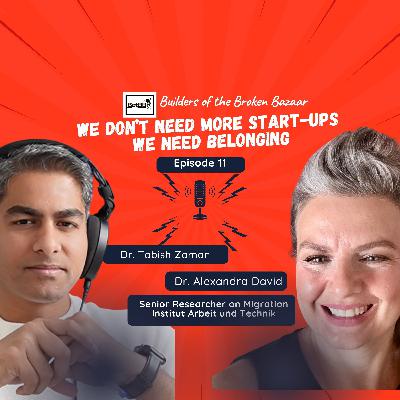
We Don’t Need More Start-Ups. We Need Belonging!In this episode of Builders of the Broken Bazaar, Dr Tabish Zaman speaks with Dr Alexandra David — sociologist at the Institute of Work and Technology in Germany and one of Europe’s leading voices on migration, innovation, and inclusion.Together, they explore:How refugee and migrant entrepreneurs turn displacement into innovation.Why “deprived areas” are often the most creative spaces in Europe.The real meaning of embeddedness, connectedness, and belongingness.Why inclusion begins with trust, not policy.🎙 “Entrepreneurship isn’t just economic — it’s emotional. It’s how people rebuild belonging.”👉 Watch on YouTube: https://www.youtube.com/@buildersofthebrokenbazaar
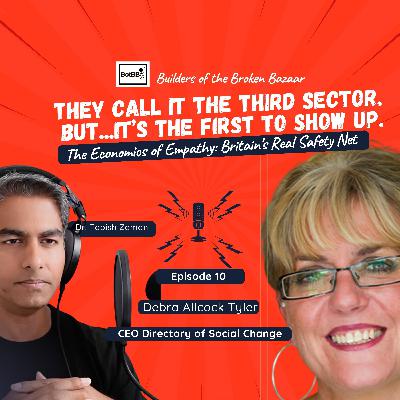
When systems crumble, who still shows up? In this episode of Builders of the Broken Bazaar, Dr Tabish Zaman speaks with Debra Allcock Tyler, CEO of the Directory of Social Change — one of the UK’s most fearless voices on charity leadership, advocacy, and justice.From shrinking council budgets to silenced community voices, Debra unpacks what it means to lead when compassion itself is under attack. Together, they explore:Why charities are not a luxury, but the last line of defence for millions.How leadership, truth-telling, and advocacy can survive political hostility.Why the voluntary sector holds the moral fabric of a democracy fraying at its edges.And what happens when those who care are told to “stay out of politics.”🎙 “Charities don’t exist to fill gaps — they exist to stop people falling through them.”👉 Watch on YouTube: https://www.youtube.com/@buildersofthebrokenbazaar
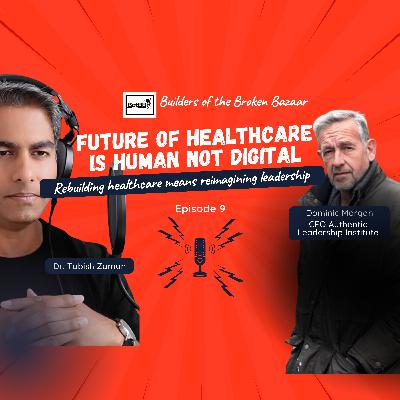
Leadership isn’t forged in comfort—it’s shaped in crisis. In this episode of Builders of the Broken Bazaar, Dr Tabish Zaman sits down with Dominic Morgan, CEO of Rethink Crisis and Founder of the Authentic Leaders Institute, whose journey from army jail to NHS commissioner reshaped how we understand leadership, integrity, and reform.From war zones to hospital corridors, Morgan has led through pressure few can imagine. Together they ask:Why the NHS doesn’t just face a service crisis—but a leadership one.How emotion, integrity, and vulnerability can be strengths, not weaknesses, in high-pressure systems.Why every crisis—whether in healthcare or humanity—is also a melting pot for innovation.And what it means to build organisations that put quality and people before performance and profit.🎙 “Leadership isn’t about performance—it’s about presence.”👉 Watch on YouTube: https://www.youtube.com/@buildersofthebrokenbazaar
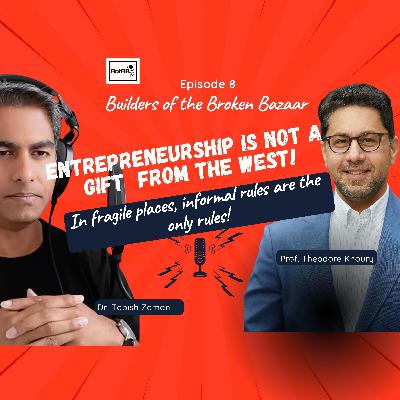
Displacement isn’t just about borders or bombs - it’s about the systems that strip people of dignity and the ways they resist. In this episode of Builders of the Broken Bazaar, Dr. Tabish Zaman speaks with Professor Theodore Khoury, one of the world’s leading voices on entrepreneurship in fragile and conflict-affected contexts. From refugee camps in Jordan to the shadow economies of Lebanon, Khoury’s work reveals how survival-driven enterprise challenges the polished models of business schools. Together we explore:Why informal economies are not failures but lifelines - and why policymakers get them wrong.How masculinities and social norms shape entrepreneurship in war zones, often in unexpected ways.Why the “mask is off” for institutions that preach international law yet ignore it in places like Palestine.🎙 “Entrepreneurship is not always opportunity. Sometimes, it is survival itself.”👉 Watch on YouTube: https://www.youtube.com/@buildersofthebrokenbazaar
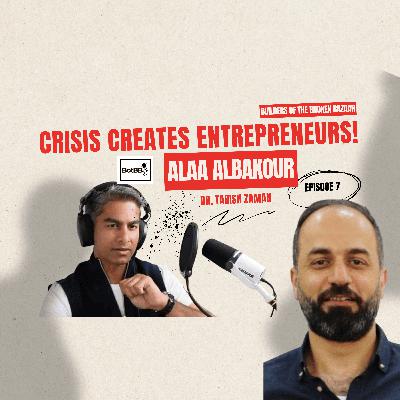
When war collapses every system, who keeps communities alive? In this episode of Builders of the Broken Bazaar, Dr. Tabish Zaman speaks with Alaa Albakour, director of Localized Action, about how Syrians rebuilt from nothing but trust and necessity. From food committees and youth volunteer networks to women-led initiatives that turned leftover aid into dignity, Alaa shows how resilience emerges not from capital, but from care.🎙 “Real enterprise doesn’t begin with money — it begins with community.”👉 Watch on YouTube: https://www.youtube.com/@buildersofthebrokenbazaar
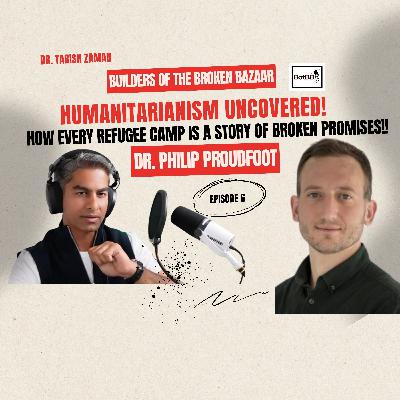
Displacement is too often called a crisis. But what if it’s actually a system — one built to manage people, not empower them? In this episode of Builders of the Broken Bazaar, Dr. Tabish Zaman speaks with Dr. Philip Proudfoot, political anthropologist and author of Rebel Populism, about how exile has become permanent, how aid budgets follow politics more than need, and why dignity in displacement is fought for in everyday acts of resistance. From Lebanon’s construction sites to Gaza’s blockade, Proudfoot shows how survival itself becomes deeply political — and why accountability in humanitarianism must mean more than feedback forms.🎙 “Displacement is not about movement — it’s about rights.”👉 Watch on YouTube: https://www.youtube.com/@buildersofthebrokenbazaar
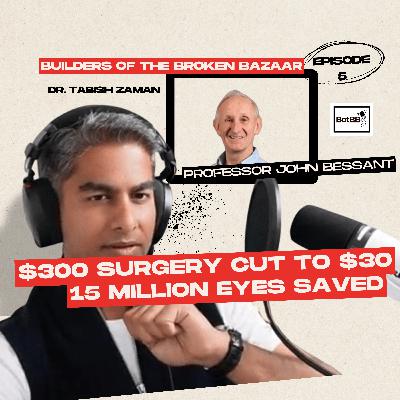
We love the myths: Silicon Valley geniuses, billion-dollar unicorns, “lightbulb moments.” But the truth is far messier. Real innovation is born of necessity — in the relentless grind of failure.In this episode of Builders of the Broken Bazaar, Dr. Tabish Zaman speaks with Professor John Bessant — one of the world’s leading voices on innovation and inclusive entrepreneurship. From Edison’s 10,000 failed filaments to Dyson’s 5,000 prototypes, from $30 eye surgeries that restored sight to millions to Syrian rescue tools made from pool mattresses, John reveals why resilience, not disruption, is the real currency of innovation.🎙 “Innovation isn’t about Silicon Valley hype — it’s about resilience.”👉 Watch on YouTube: https://www.youtube.com/@buildersofthebrokenbazaar
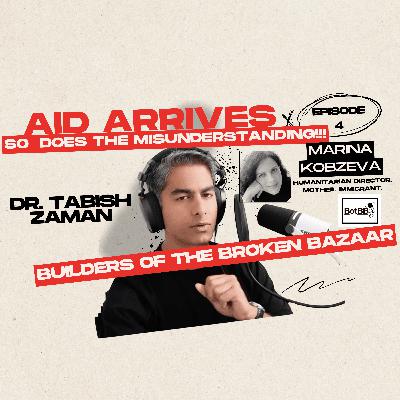
Aid is meant to save lives. But no one wants to depend on it. Families don’t wait in hope for cardboard boxes — they organize, barter, build, and survive. Yet the humanitarian system continues to treat them as passive recipients, delivering assumptions instead of answers. In this episode of Builders of the Broken Bazaar, Dr. Tabish Zaman speaks with Marina Kobzeva, a former aid recipient turned humanitarian leader, about what’s broken in the global aid system — and what real accountability should look like. From post-Soviet Azerbaijan to two decades inside the sector, Marina shares why 90% of aid money never reaches communities, how colonial mindsets still shape aid delivery, and why true innovation lives in mutual aid, remittances, and grassroots resilience.🎙 “People don’t want charity — they want agency.”👉 Watch on YouTube: https://www.youtube.com/@buildersofthebrokenbazaar
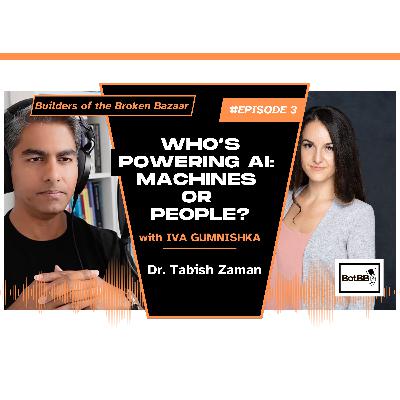
Every “smart” AI system — from ChatGPT to self-driving cars — runs on unseen human labor. Behind the algorithms are people in refugee camps, conflict zones, and struggling economies, quietly training the machines that shape our world. In this episode of Builders of the Broken Bazaar, Dr. Tabish Zaman speaks with Iva Gumnishka — founder of Humans in the Loop and Cartier Women’s Initiative Award winner — about harnessing technology to create dignified livelihoods for displaced people from Syria, Ukraine, Palestine, and beyond. We explore the hidden workforce behind AI, the ethics of the digital economy, the environmental cost of technology, and what it takes to build sustainable businesses rooted in dignity, not disruption.🎙 “AI doesn’t just run on data — it runs on human lives.”https://www.youtube.com/@buildersofthebrokenbazaar
Every 30 hours, a new billionaire is created.Every 33 hours, a million people fall into extreme poverty. Over 120 million people are now forcibly displaced — not by accident, but by political choices, economic extraction, and systemic neglect. In this episode of Builders of the Broken Bazaar, Dr. Tabish Zaman examines why refugee and migrant entrepreneurship is so often survival-driven rather than opportunity-driven. From Gaza to Kakuma Refugee Camp, discover how displacement shapes enterprise, why markets fail the most vulnerable, and how grassroots economies emerge when every other door is closed. We explore refugee entrepreneurship, crisis-driven enterprise, and dignity-based economies that challenge profit-first models — and ask what it really means to build in a broken system.🎙 “Sometimes, entrepreneurship isn’t innovation — it’s endurance.”https://www.youtube.com/@buildersofthebrokenbazaar
loading
Comments 
loading