


 Claim Ownership
Tepperspectives
Subscribed: 0Played: 0
Subscribe

© Carnegie Mellon University
Description
The Tepperspectives Podcast is a conversation with researchers, experts, and thought leaders in the business disciplines. Join us for insights into how artificial intelligence and machine learning intersect with economics, management science, and organizational behavior. Tepperspectives is guided by The Intelligent Future℠, a data-informed and human-driven approach to innovation and problem solving for today and tomorrow.
7 Episodes
Reverse
What should users consider when using generative AI to create or manipulate images of other people? What policies should companies adopt to ensure that their products don't cause harm? Ethicist Derek Leben joins the Tepperspectives podcast to discuss.Links to news, ideas, and concepts in the episode:Derek Leben's book, AI Fairness: Designing Equal Opportunity Algorithms from MIT Press: https://mitpress.mit.edu/9780262552363/ai-fairness/Center for Countering Digital Hate report: https://counterhate.com/research/grok-floods-x-with-sexualized-images/Utilitarianism: https://plato.stanford.edu/entries/utilitarianism-history/Liberitarianism: https://plato.stanford.edu/entries/libertarianism/The Nash Equilibrium: https://www.investopedia.com/terms/n/nash-equilibrium.aspParteto Efficiency/Optimality: https://en.wikipedia.org/wiki/Pareto_efficiency
Tepper School doctoral student Pim Assavabhokhin speaks with Professor Emily DeJeu about how AI can enhance short-term decision accuracy and transactive memory systems to improve team speed, but over-reliance on technology can create a dependency. tepperspetives.cmu.educmu.edu/tepper

Tepper School researchers Taya Cohen and Sofía Rodríguez Chaves look at how ethics and moral character influence responsible AI use in the absence of policy or regulations.To learn more about the Center for Intelligent Business, please visit: https://www.cmu.edu/intelligentbusiness/ For more thought leadership from the Tepper School of Business at Carnegie Mellon University, please visit: https://tepperspectives.cmu.edu

We can use this as the description: Professor Tim Derdenger joins the Tepperspectives Podcast to discuss the impact that name, image, and likeness (NIL) have on college sports. In "Does Personalized Pricing Increase Competition? Evidence from NIL in College Football," Derdenger and his co-author Ivan Li examine how the results from NIL deals have done the opposite of expectations by dispersing talent and increasing competition in college football.
Emily DeJeu, Assistant Teaching Professor of Business Communication, speaks with Brandy Aven, Associate Professor of Organizational Behavior and Theory, about the evolving role of artificial intelligence in business and the workplace. In the past few months, several companies and company leaders have floated the idea of reducing the workforce and giving those jobs to AI. What are the positive and negative aspects of this? What are the advantages and disadvantages of incorporating AI into the workplace? Also, what are the conversations that we should be having about AI that we’re not?

Tariffs have become a household word in the last few months, but the situation and questions around tariffs is getting more complex. Associate professor of economics Ali Shourideh discusses the current situation with US tariffs and their effect on businesses, consumers, and international trade.
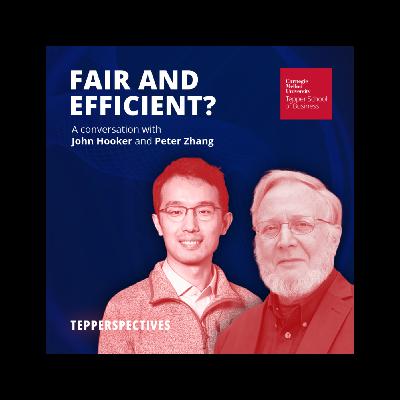
Carnegie Mellon University professors John Hooker (Tepper School of Business) and Peter Zhang (Heinz College of Information Systems and Public Policy) join the Tepperspectives Podcast to discuss their new book, The Structure of Fair Solutions, co-authored with Tepper School alumnus Özgün Elçi. The Structure of Fair Solutions introduces a mathematical framework for building ethical optimization models that balance efficiency with fairness, providing practical tools and a new way to evaluate the societal impact of algorithmic decisions.
Comments


Download from Google Play

Download from App Store
 United States