


 Claim Ownership
The Quiet Footnote: Extended Edition
Subscribed: 9Played: 35
Subscribe

© Nomad Raga
Description
The original offered quiet summaries; now, we go deeper. In this series, we return to the same books to explore lingering questions and fresh insights—moving beyond the first impression into thoughtful, ongoing conversations. If you crave more than summaries, you’re home.
69 Episodes
Reverse
🎙 Welcome to The Quiet Footnote — where we don’t just summarize books, we uncover the hidden levers that shape our choices, our actions, and our lives.In this episode, we explore Unlimited Power by Tony Robbins — a book that blends psychology, physiology, and strategy to show how much control we truly have over our state of mind and destiny.This isn’t about blind motivation or hype.It’s about learning how your thoughts, emotions, language, and body are interconnected — and how small shifts can create massive changes in your results.📜 “The quality of your life is the quality of your communication.”
🎙 Welcome to The Quiet Footnote — where we don’t just summarize books, we slow down to explore the hidden patterns in how we think, feel, and connect.In this episode, we step into Introducing NLP by Joseph O’Connor & John Seymour — a guide to Neuro-Linguistic Programming, a practical toolkit for understanding how language, thought, and behavior intertwine.This isn’t about manipulation or quick hacks.It’s about recognizing the codes we run unconsciously — and learning how to rewrite them for clarity, influence, and growth.📜 “The map is not the territory. Change the map, and you change the journey.”
🎙 Welcome to The Quiet Footnote — where we don’t just summarize books, we uncover the invisible frameworks that quietly govern how the world works.In this episode, we step into Thinking in Systems by Donella Meadows — a timeless guide to seeing the world not as separate parts, but as interconnected wholes.This isn’t about solving problems in isolation.It’s about understanding feedback loops, leverage points, and why simple fixes so often backfire.📜 “We can’t control systems, but we can dance with them.”
Welcome to The Quiet Footnote — where we don’t just summarize books, we sit with the patterns, questions, and systems that shape the way we see the world.In this episode, we explore The Art of Problem Solving by Russell Ackoff — a classic in systems thinking that challenges the way we approach complexity.This isn’t about quick fixes.It’s about learning to see problems not as isolated events, but as parts of larger systems — where solutions often create new problems if we fail to look deeply enough.📜 “We fail more often because we solve the wrong problem than because we get the wrong solution to the right problem.”
🎙 Welcome to The Quiet Footnote — where we don’t just summarize books, we uncover the quiet truths behind the choices, voices, and beliefs that shape our lives.In this episode, we step into The Confidence Code by Katty Kay & Claire Shipman — a book that unpacks the science and psychology of confidence, especially for women navigating careers, relationships, and self-doubt.This isn’t about blind bravado.It’s about understanding where confidence comes from — biology, behavior, and belief — and learning how to grow it from the inside out.📜 “Confidence, like a muscle, grows the more you use it.”
🎙 Welcome to The Quiet Footnote — where we don’t just summarize books, we uncover the states of being that make life worth living.In this episode, we step into Flow by Mihaly Csikszentmihalyi — a book that explores the psychology of optimal experience, those moments when time dissolves, focus sharpens, and life feels both effortless and full.This isn’t about chasing happiness.It’s about learning how to enter that state where effort becomes joy and action merges with awareness.📜 “The best moments in our lives are not the passive, receptive, relaxing times… they are when we are fully engaged in something meaningful.”
🎙 Welcome to The Quiet Footnote — where we don’t just summarize books, we uncover the inner compass points that quietly steer our lives.In this episode, we step into The Values Factor by John Demartini — a book about discovering what truly matters to you and aligning your life with it.This isn’t about chasing someone else’s version of success.It’s about uncovering your highest values — the principles that ignite your energy, shape your purpose, and direct your destiny.📜 “When you live according to your highest values, your life becomes inspired, not required.”
🎙 Welcome to The Quiet Footnote — where we don’t just summarize books, we pause long enough to notice the tools that help us listen to ourselves more deeply.In this episode, we step into Journal to the Self by Kathleen Adams — a guide to journaling as a practice of healing, clarity, and creativity.This isn’t about keeping a diary of daily events.It’s about using writing as a mirror — a way to meet your inner voice, untangle emotions, and discover truths that don’t surface in conversation.📜 “Your journal is your personal laboratory, your private therapist, your creative playground.”
🎙 Welcome to The Quiet Footnote — where we don’t just summarize books, we trace the threads of thought that connect desire, belief, and creation.In this episode, we step into Ask and It Is Given by Esther and Jerry Hicks — a cornerstone in the teachings of Abraham-Hicks, and a book that reframes desire not as lack, but as guidance.This isn’t about wishful thinking.It’s about aligning with the frequency of what you seek — and realizing that life itself is a cooperative dance between asking and allowing.📜 “You are the creator of your own reality.”
🎙 Welcome to The Quiet Footnote — where we don’t just summarize books, we pull apart the stories we think we know, to see what’s hidden beneath.In this episode, we step into Talking to Strangers by Malcolm Gladwell — a book about why we so often misread, misunderstand, and misjudge the people we don’t know.This isn’t about small talk.It’s about the fatal mistakes, quiet assumptions, and cultural blind spots that shape every interaction — from casual encounters to world-changing events.📜 “We think we can look into someone’s eyes and know their heart. We can’t.”
🎙 Welcome to The Quiet Footnote — where we don’t just summarize books, we decode the art of human connection hidden inside everyday words.In this episode, we step into Never Split the Difference by Chris Voss — a masterclass in negotiation from an FBI hostage negotiator who learned that compromise isn’t always the answer.This isn’t about haggling harder.It’s about listening deeper — using empathy, tone, and presence to uncover what people really want when the stakes are highest.📜 “He who has learned to disagree without being disagreeable has discovered the most valuable secret of negotiation.”
🎙 Welcome to The Quiet Footnote — where we don’t just summarize books, we uncover the frameworks that quietly steer the biggest shifts in work, vision, and impact.In this episode, we step into Measure What Matters by John Doerr — the book that popularized OKRs: Objectives and Key Results. A deceptively simple system that powered Google, Intel, and countless other organizations to clarity, focus, and scale.This isn’t about chasing endless goals.It’s about setting the right ones — and measuring what actually moves the needle.📜 “Ideas are easy. Execution is everything.”
🎙 Welcome to The Quiet Footnote — where we don’t just summarize books, we step into the pauses between thoughts, the quiet places where truth often hides.In this episode, we step into The Wisdom of Insecurity by Alan Watts — a meditation on why our search for certainty keeps us from the very peace we crave.This isn’t about controlling life.It’s about surrendering to it — learning to live fully in the present moment instead of chasing futures or clinging to pasts.📜 “The more we try to hold on, the more life slips through our fingers.”
🎙 Welcome to The Quiet Footnote — where we don’t just summarize books, we question the everyday truths we’ve swallowed without chewing.In this episode, we step into The Plant Paradox by Dr. Steven R. Gundry — a book that flips the script on what “healthy eating” really means.This isn’t about calories or carbs.It’s about lectins — the hidden proteins in many so-called healthy foods that, Gundry argues, may be quietly fueling inflammation, fatigue, and disease.📜 “What you stop eating has far more impact on your health than what you start eating.”
🎙 Welcome to The Quiet Footnote — where we don’t just summarize books, we lean into the gentle truths that often arrive with a smile rather than a lecture.In this episode, we step into The Tao of Pooh by Benjamin Hoff — a playful yet profound introduction to Taoist wisdom, told through the simple honey-loving bear, Winnie-the-Pooh.This isn’t about philosophy with heavy words.It’s about how childlike wonder, ease, and presence can reveal what sages spend lifetimes chasing.📜 “Things are working out the way they’re supposed to, don’t you think?”
🎙 Welcome to The Quiet Footnote — where we don’t just summarize books, we tune into the voices that move hearts, minds, and sometimes… entire rooms.In this episode, we step into Talk Like TED by Carmine Gallo — a guide to the hidden art behind the world’s most powerful talks.This isn’t about memorizing speeches.It’s about discovering what makes ideas stick, stories resonate, and audiences lean in instead of tune out.💡 What’s Inside This Summary:Why passion isn’t optional — it’s the engine of persuasionThe storytelling secrets TED speakers use to move millionsHow to blend data with emotion so facts actually landThe role of novelty and surprise in keeping audiences hookedWhy authenticity is the ultimate microphone🌍 Why It Matters Now:In a noisy world where everyone is speaking, few are truly heard.Whether on stage, at work, or in everyday life, your ability to communicate can change your career, your impact, even your legacy.🕯 Because ideas don’t change the world until they’re shared.
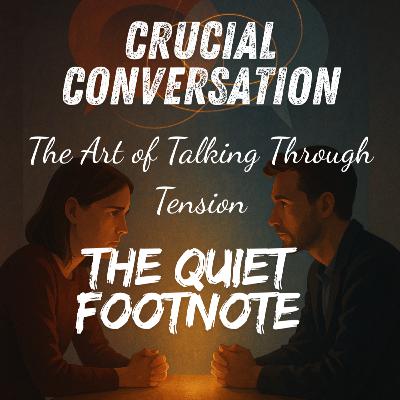
🎙 Welcome to The Quiet Footnote — where we don’t just summarize books, we search for the words that shift silence into understanding and conflict into connection.In this episode, we step into Crucial Conversations — a book that teaches us how to speak when the stakes are high, emotions run deep, and opinions couldn’t be further apart.This isn’t about winning arguments.It’s about creating a dialogue where truth can be spoken without breaking the bond between us.💡 What’s Inside This Summary:How to recognize the exact moment a conversation turns “crucial”Why silence and violence are the two dead ends in dialogueThe path to safety — the foundation of all meaningful conversationTools to speak your truth without shutting others downHow to turn high-stakes clashes into shared understanding🌍 Why It Matters Now:In a world of fractured opinions, quick tempers, and endless comment wars, our ability to stay present in difficult conversations isn’t just a skill — it’s survival.Because relationships don’t break from the easy talks.They break from the ones we avoided.🕯 Because courage isn’t shouting louder.It’s speaking clearer — and listening deeper.
🎙 Welcome to The Quiet Footnote — where we don’t just summarize books, we pause long enough to notice the wisdom hiding in the quiet.In this episode, we step into The Art of Stillness by Pico Iyer — a book that feels less like advice and more like an invitation.This isn’t about doing more.It’s about doing less.Not running further, but sitting closer — to yourself, to silence, to presence.📜 “In an age of speed, nothing is so exhilarating as going slow.”
🎙 Welcome to The Quiet Footnote — where we don’t just summarize books, we listen for the whispers that free us from the cages we build inside ourselves.In this episode, we step into Radical Acceptance by Tara Brach — a gentle yet piercing guide to ending the war we wage against our own hearts.This isn’t about fixing yourself.It’s about embracing yourself — completely, tenderly, without conditions.
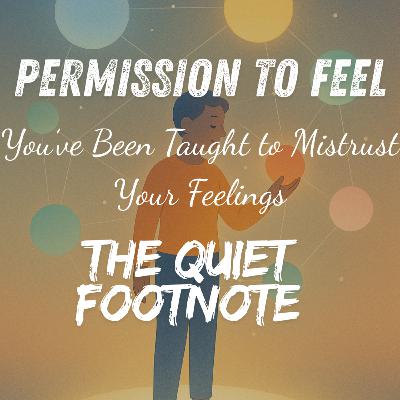
🎙 Welcome to The Quiet Footnote — where we don’t just summarize books, we soften the noise and listen for the wisdom beneath it.In this episode, we step into Permission to Feel by Marc Brackett — a book that argues something simple yet radical: emotions are not distractions from life… they are life.For too long, we’ve been told to “toughen up,” “calm down,” “don’t be so sensitive.” Brackett flips that script. He shows us that emotions are data — vital signals that, when understood, can guide our choices, shape relationships, and build resilience.📜 “When we give ourselves permission to feel, we give ourselves permission to heal.”💡 What’s Inside This Summary:The RULER framework — Recognize, Understand, Label, Express, and Regulate emotionsWhy naming emotions transforms them from chaos into clarityHow emotional literacy boosts decision-making, learning, and leadershipThe science behind why suppressing feelings harms both mind and bodySimple tools to build an “emotionally intelligent culture” at home, school, or work🌍 Why It Matters Now:In a world spinning with stress, polarization, and burnout, emotional intelligence is not optional — it’s survival. Permission to Feel reminds us that every emotion is valid, every feeling has a place, and that awareness is the beginning of change.🕯 Because strength isn’t the absence of feelings.It’s the ability to listen to them.

Comments

Download from Google Play

Download from App Store
 United States