


 Claim Ownership
Helping Children Audiate Music
Subscribed: 2Played: 4
Subscribe

© Eric M Bluestine
Description
Here you'll find ideas about how children learn to understand music, and how you can best teach them.
ericmbluestine.substack.com
ericmbluestine.substack.com
18 Episodes
Reverse

I have an Audiation Episode coming up during which I’ll play and compare Bach’s Sinfonias #2 and #4. But I wanted to finish recording the 2-Part Inventions first. Here they are. Now I start working on the Sinfonias! This is a public episode. If you would like to discuss this with other subscribers or get access to bonus episodes, visit ericmbluestine.substack.com
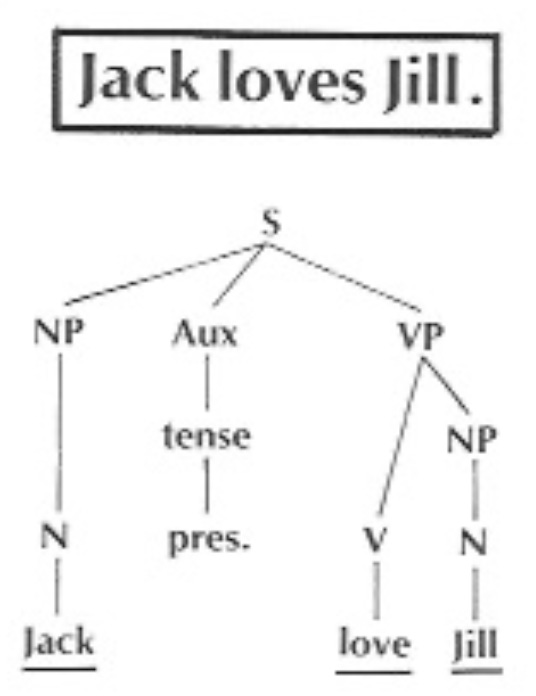
FIGURE 1: Tree diagram of the surface structure sentence — Jack loves Jill (Bernstein, 1976)._________________________________________________FIGURE 2: Tree diagram of the surface structure sentence — Jill is loved by Jack (Bernstein, 1976)._________________________________________________Aitchison, Jean. 1999. Teach Yourself Linguistics. London: Hodder & Stoughton Ltd.Bernstein, Leonard. 1976. The unanswered question: Six talks at Harvard. Cambridge, Massachusetts: Harvard University Press.Bluestine, Eric. 2023. “Whole-Part-Whole: Its Meandering Path To Prominence.” https://thewayschildrenlearnmusic.wordpress.com/2023/08/27/whole-part-whole-its-meandering-road-to-prominence/Gordon, Edwin. 2012. Learning Sequences in Music: Skill, Content, and Patterns. Chicago: GIA.Smith, Frank. 1994. Understanding reading: A psycholinguistic analysis of reading and learning to read. Hillsdale: Lawrence Erlbaum Associates. This is a public episode. If you would like to discuss this with other subscribers or get access to bonus episodes, visit ericmbluestine.substack.com
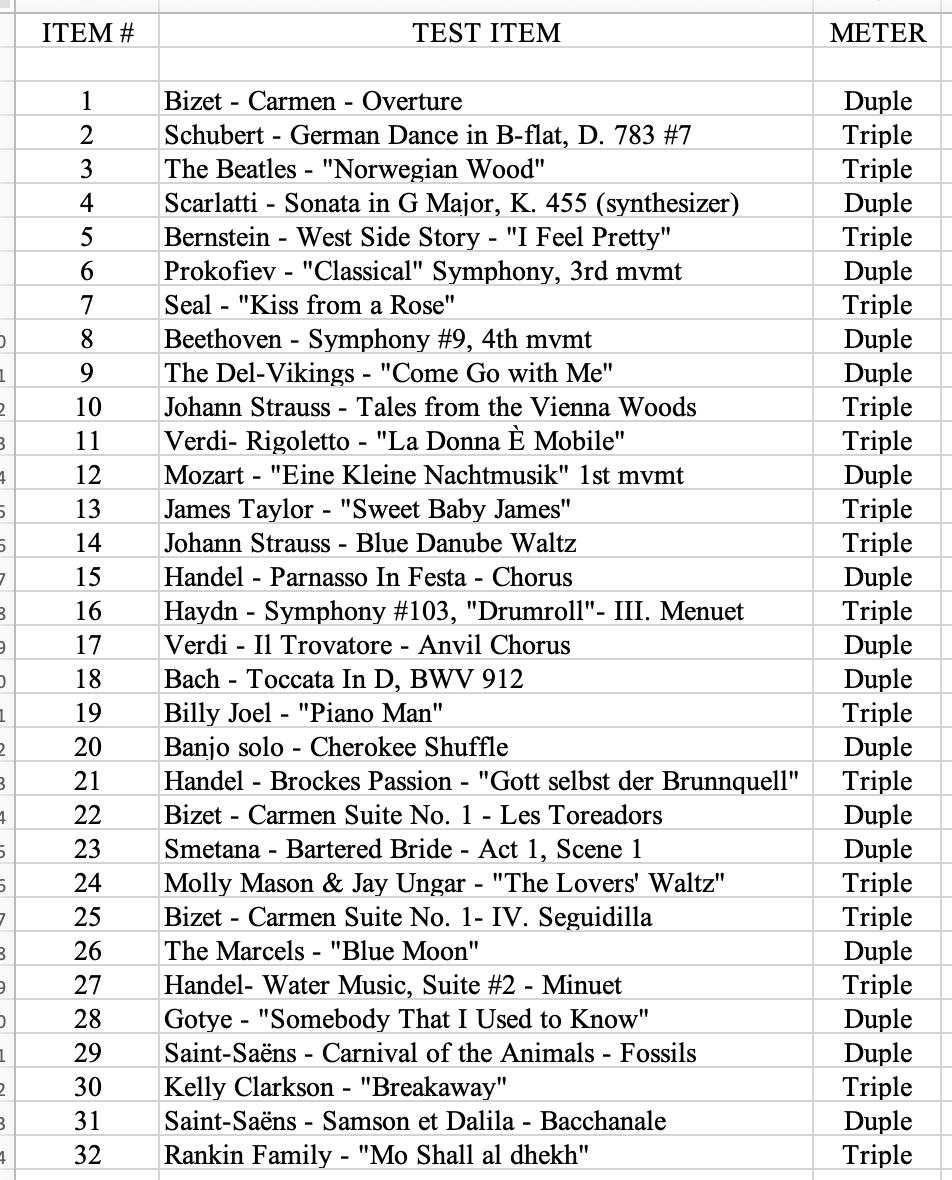
Students are to listen to each item and then mark (on their Google Answer Sheet) whether the musical excerpt was in duple or triple meter.The test was designed for upper elementary students, but it may be suitable for students of any age with enough musical knowledge to identify the meters of pieces that are (most likely) unfamiliar to them.In Figure 1, I show the names of the musical items along with their meters.FIGURE 1: Meter Test - 1st revision - Items and Meters This is a public episode. If you would like to discuss this with other subscribers or get access to bonus episodes, visit ericmbluestine.substack.com
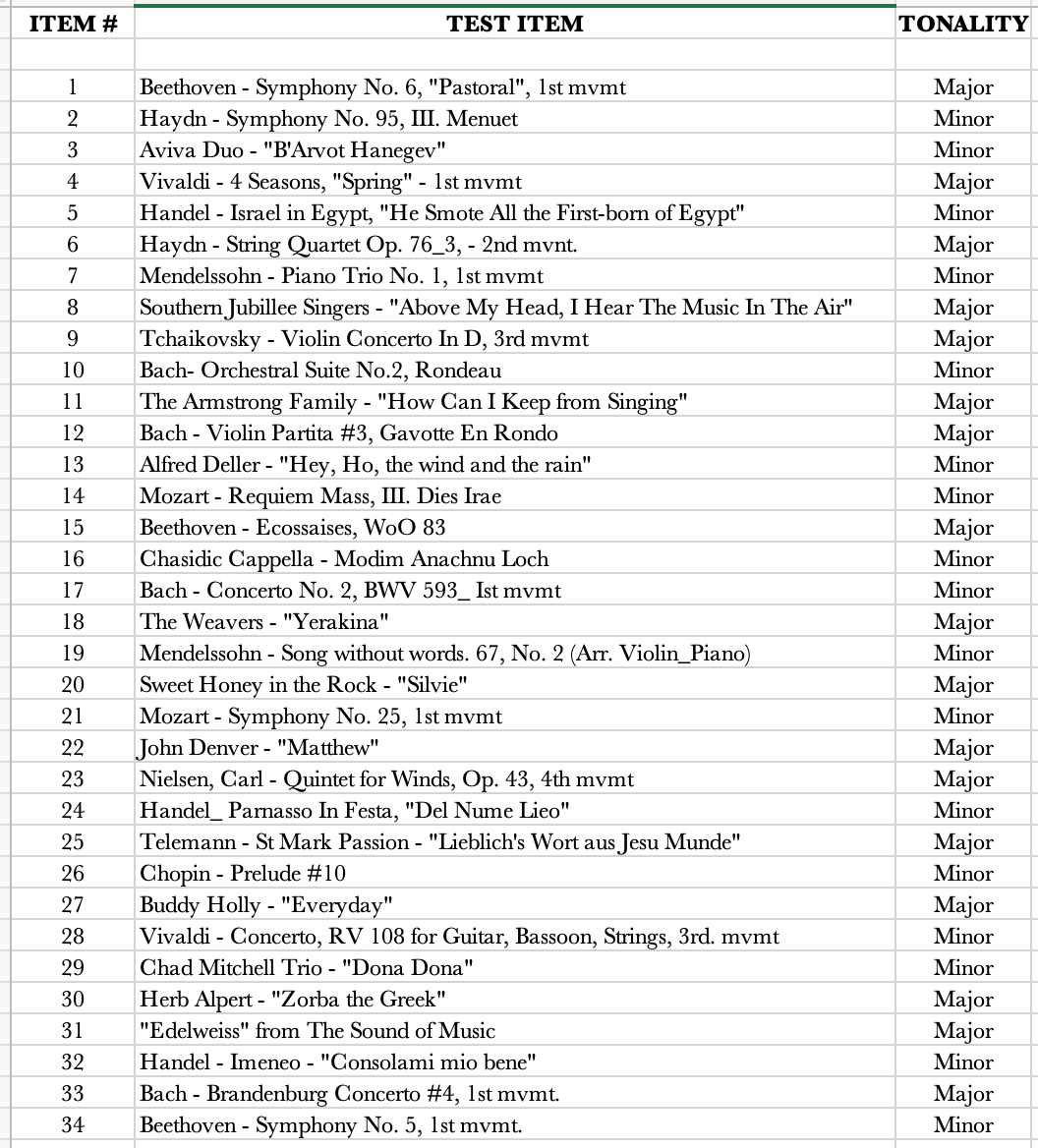
Students are to listen to each item and then mark (on their Google Answer Sheet) whether the musical excerpt was in major or minor tonality.The test was designed for upper elementary students, but it may be suitable for students of any age with enough musical knowledge to identify the tonalities of pieces that are (most likely) unfamiliar to them.In Figure 1, I show the names of the musical items along with their tonalities.FIGURE 1: Tonality Test Items and Tonalities This is a public episode. If you would like to discuss this with other subscribers or get access to bonus episodes, visit ericmbluestine.substack.com
Bernstein, Leonard. 1966. The Infinite Variety of Music. New York: Simon and Schuster.Bernstein, Leonard. 1976. The unanswered question: Six talks at Harvard. Cambridge, Massachusetts: Harvard University Press.Bluestine, Eric. 1995. The ways children learn music: An introduction and practical guide to music learning theory, 1st edition. Chicago: GIA.Gordon, Edwin. 1986. Manual for the Primary Measure of Music Audiation and the Intermediate Measures of Music Audiation. Chicago: GIA.Gordon, Edwin. 2012. Learning Sequences in Music: Skill, Content, and Patterns. Chicago: GIA.Rasmussen, Eric and Taillefer Beau: https://audiation-in-the-wild.simplecast.com/episodes/s3309-dr-terry-bacon-discusses-renorming-pmma.Reimer, Bennett and Gordon, Edwin. 1994. “The Reimer/Gordon Debate on Music Learning: Complementary or Contradictory Views?” MENC National Biennial In-service Conference in Cincinnati, Ohio. Audio Tape Stock #3004, ISBN 1-56545-052-3Taggart, C. C., Bolton, B. M., Reynolds, A. M., Valerio, W. H., & Gordon, E. E. (2000). Jump right in: The general music series (2nd ed.). GIA Publications.Terry, Keith. (Director & Performer). 2002. Body Music, Part One [DVD]. Crosspulse Media. This is a public episode. If you would like to discuss this with other subscribers or get access to bonus episodes, visit ericmbluestine.substack.com

I needed a break from writing and thinking about audiation. I had to clear my head, so I decided to play some Bach tonight — 8 of the 2-part inventions.Here are the timings:Invention #1 in C major: 0:00Invention #2 in c minor: 1:29Invention #6 in E major: 3:44Invention #7 in e minor: 6:08Invention #8 in f major: 7:29Invention #10 in G major: 8:32Invention #12 in A major: 9:35Invention #13 in a minor: 11:04 This is a public episode. If you would like to discuss this with other subscribers or get access to bonus episodes, visit ericmbluestine.substack.com
This is a public episode. If you would like to discuss this with other subscribers or get access to bonus episodes, visit ericmbluestine.substack.com
Bluestine, Eric. 2000. The ways children learn music: An introduction and practical guide to music learning theory. Chicago: GIA.Gordon, Edwin. 1984. “The Basis of Music Learning Theory.” [audiocassette]. Music Educator’s National Conference [MENC], International Audio Stats Educational Services: Los Angeles, Calif. [OCC Number / Unique Identifier: 12019891]Gordon, Edwin. 2012. Learning Sequences in Music: Skill, Content, and Patterns. Chicago: GIA.Reimer, Bennett and Gordon, Edwin. 1994. “The Reimer/Gordon Debate on Music Learning: Complementary or Contradictory Views?” MENC National Biennial In-service Conference in Cincinnati, Ohio. Audio Tape Stock #3004, ISBN 1-56545-052-3The Incredibles. 2004. Directed by Brad Bird, Pixar Animation Studios; Buena Vista. This is a public episode. If you would like to discuss this with other subscribers or get access to bonus episodes, visit ericmbluestine.substack.com
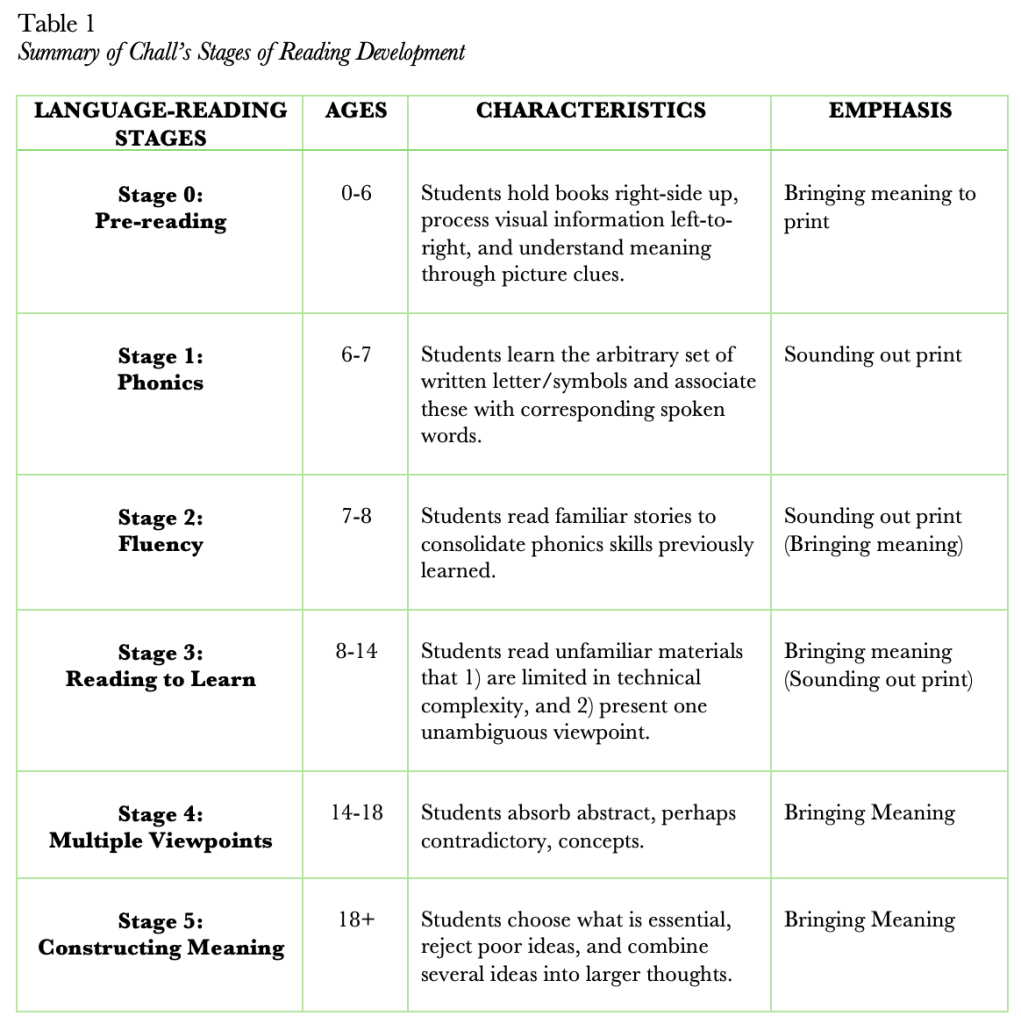
Table 2: Listening vs. Reading When We AudiateBluestine, Eric. Music/Language Analogies Part 7b: Chall’s Stages of Language Reading Development. Wordpress, 2025. https://thewayschildrenlearnmusic.wordpress.com/2025/08/11/music-language-analogies-part-7b-challs-stages-of-language-reading-development/Bluestine, Eric. A Comparative Study of Four Approaches to Teaching Tonal Music Reading to a Select Group of Students in Third, Fourth, and Fifth Grade. 2007. Temple University, PhD dissertation. ProQuest Dissertations and Theses Global.Chall, Jeanne S. Learning to Read: The Great Debate. 1st ed., McGraw-Hill, 1967.Chall, Jeanne S. “The Great Debate: Ten Years Later, with a Modest Proposal for Reading Stages.” Theory and Practice of Early Reading, edited by Lauren B. Resnick and Phyllis A. Weaver, Lawrence Erlbaum, 1979, pp. 29–55.Chall, Jeanne S. Stages of Reading Development. 2nd ed. New York: McGraw-Hill, 1996.Flesch, Rudolf. Why Johnny Can’t Read – and What You Can Do About It. New York: Harper & Brothers, 1955.Hodges, D. A. The acquisition of music reading skills. In R. Colwell (Ed.), Handbook of Research on Music Teaching and Learning. New York: Schirmer Books, 1992, pp 466-471. This is a public episode. If you would like to discuss this with other subscribers or get access to bonus episodes, visit ericmbluestine.substack.com
This is a public episode. If you would like to discuss this with other subscribers or get access to bonus episodes, visit ericmbluestine.substack.com
*Note: In this podcast episode, I used 2 Speechify voices: To read the quote from the film Dead of Night, I chose a British actor with a deep stentorian voice whom Speechify calls, simply, Benjamin; and for some perverse reason, I chose Mr. Beast to read the Rudolf Flesch quote. ———————————————————————————————Flesch, Rudolf. 1954. How To Make Sense. New York: Harper & Brothers .Forster, E. M. 1927. Aspects of the Novel. London: Harcourt, Inc.Gordon, Edwin. 1984. “The Basis of Music Learning Theory.” [audiocassette]. Music Educator’s National Conference [MENC], International Audio Stats Educational Services: Los Angeles, Calif. [OCC Number / Unique Identifier: 12019891]Gordon, Edwin. 2012. Learning Sequences in Music: Skill, Content, and Patterns. Chicago: GIA.McCullough, David. https://www.mprnews.org/story/2006/08/30/midday2Reimer, Bennett and Gordon, Edwin. 1994. “The Reimer/Gordon Debate on Music Learning: Complementary or Contradictory Views?” MENC National Biennial In-service Conference in Cincinnati, Ohio. Audio Tape Stock #3004, ISBN 1-56545-052-3. This is a public episode. If you would like to discuss this with other subscribers or get access to bonus episodes, visit ericmbluestine.substack.com
Edwin Gordon’s Summary of the Stages of Audiation:Stage 1: Momentary retentionStage 2: Imitating and audiating tonal patterns and rhythm patterns and recognizing and identifying a tonal center and macrobeats.Stage 3: Establishing objective or subjective tonality and meter.Stage 4: Retaining in audiation tonal patterns and rhythm patterns that have been organized.Stage 5: Recalling tonal patterns and rhythm patterns organized and audiated in other music.Stage 6: Anticipating and predicting tonal patterns and rhythm patterns.___________________________________My Summary of the Stages of Audiation:Stage 1: In our minds, we hear an “aftersound” of the music we just heard.Stage 2:* We mentally imitate all the pitches and durations we just heard;* Then we extract from those pitches and durations the ones we think are essential;* Then we group those essential pitches and durations into tonal and rhythm patterns;* And finally, based on the patterns we just organized, we discern macro beats and a pitch center.Stage 3: We discern the tonality and meter of the music we are hearing.Stage 4: We reassess the formal structure of the music we’re hearing based on the following: 1) repeated or varied phrases and sections; 2) modulations of tonality, keyality, tempo, and meter; and 3) changes in texture, timbre, and dynamics.Stage 5: We discern how musical elements develop in tandem — sometimes in cooperation, and sometimes in conflict — in ways that affect how we understand the phrase structure, sectional structure, and overall form of a piece of music. The elements may include tonality, keyality, harmony, melody, tempo, meter, melodic rhythm, dynamics, articulation, phrase structure, sectional structure, texture, register, and orchestration.Stage 6: We compare formal elements (tonality, meter, etc.) in the music we are hearing with those same elements in pieces we have heard before.Stage 7: As we listen to music, we foresee musical events such as phrase endings, modulations, and sectional changes. If we’re hearing familiar music, we anticipate such events; if we’re hearing unfamiliar music, we predict such events. This is a public episode. If you would like to discuss this with other subscribers or get access to bonus episodes, visit ericmbluestine.substack.com
Audiation is the mental process that takes place when we organize musical sounds so that we may understand how pieces of music develop.The next 15 episodes will be about Gordon’s Stages of Audiation. The episodes will cover the following topics:* Musical form and fluidity;* Musical order and conflict;* Ambiguity within and between musical elements;* The elusiveness of clock-time;* The pecking order of essential pitches, durations, and musical patterns.* The process of mentally compressing and expanding music as we compare one piece of music with another.What follows are the titles of each episode in my 16-part audiation series. The titles themselves give you, I hope, a taste of what each episode will be about:Part 1: What is audiation?Part 2: An overview of the stages of audiation.Part 3: Audiation Stage 1 — We hear an “aftersound” of the music we just heard.Part 4: Audiation Stage 2a — We mentally imitate all the pitches and durations we just heard.Part 5: Speculations on the early stages of notational audiationPart 6: Audiation Stage 2b — From all the pitches and durations we’ve heard, we choose the ones we think are essential to the music.Part 7: Audiation Stage 2c — As we continue to listen, we organize essential pitches and durations into tonal and rhythm patterns.Part 8: Audiation Stage 2d — As we continue to listen, we discern the music’s macro beats and pitch center.Part 9: Audiation Stage 3 — We discern the tonality and meter of the music we’re hearing.Part 10: A brief tutorial on surface structure and deep structure.Part 11: A Skip Ahead to Audiation Stage 6 — When we discern an underlying sameness in pieces of music, we do so by mentally compressing music into patterns, and by expanding patterns into music.Part 12: Audiation Stage 4 — Modulation and development of a single domain of music.Part 13: Audiation Stage 5 — Two music domains develop in tandem to affect how we audiate phrase structure in a Beethoven symphony.Part 14: Audiation Stage 6 revisited — Comparing 2 Bach Sinfonias and discerning their underlying sameness.Part 15: Audiation Stage 5 revisited, and a look at Stage 7 — Two music domains develop in tandem to affect how we audiate the form of a Beethoven sonata movement.Part 16: Conclusion — The integration of musical elements, the beauty of ambiguity, and the elusiveness of form._________________________________________________Bluestine, Eric. 1995. The ways children learn music: An introduction and practical guide to music learning theory, 1st edition. Chicago: GIA.Gordon, Edwin. 1977. Learning Sequence and Patterns in Music (revised edition). Chicago: GIA.Gordon, Edwin. 1988. Learning Sequences in Music: Skill, Content, and Patterns. Chicago: GIA.Gordon, Edwin. 2012. Learning Sequences in Music: Skill, Content, and Patterns. Chicago: GIA.Maltin, Leonard. 2016. Theatre of the Imagination – History of the Mercury Theatre on the Air – Youtube, uploaded by Marc Baroni, 8 Sept. 2016. Shouldice, Heather. https://everydaymusicality.com/2023/01/10/e01-52-types-and-stages-of-audiation/Walters, Darrel L. 1989. “Audiation: The Term and the Process.” In D. L. Walters and C. C. Taggart (Eds.), Readings in Music Learning Theory. Chicago: G.I.A. This is a public episode. If you would like to discuss this with other subscribers or get access to bonus episodes, visit ericmbluestine.substack.com

Gordon, Edwin. 1981. The Manifestation of Developmental Music Aptitude in the Audiation of “Same” and “Different” as Sound in Music. Chicago: G.I.A.Gordon, Edwin. 1982. Intermediate Measures of Music Audiation. Chicago: G.I.A.Gordon, Edwin. 1989. Audie. Chicago: G.I.A.Rasmussen, Eric and Taillefer, Beau. https://audiation-in-the-wild.simplecast.com/episodes/033-special-guest-eric-bluestine This is a public episode. If you would like to discuss this with other subscribers or get access to bonus episodes, visit ericmbluestine.substack.com
This is a public episode. If you would like to discuss this with other subscribers or get access to bonus episodes, visit ericmbluestine.substack.com
This is a public episode. If you would like to discuss this with other subscribers or get access to bonus episodes, visit ericmbluestine.substack.com

1. Children learn to understand expressive elements (articulation, tempo, dynamics, balance, and phrasing) in pieces of music that have moved listeners for generations. 2. Children learn to understand musical structure. 3. Children learn that music is not a byproduct of culture or an addendum to history. 4. Children learn the joy that comes from creating, improvising, and composing music.5. Children learn that performance is a creative act, and not the recreation of a teacher’s orders. This is a public episode. If you would like to discuss this with other subscribers or get access to bonus episodes, visit ericmbluestine.substack.com

This is a public episode. If you would like to discuss this with other subscribers or get access to bonus episodes, visit ericmbluestine.substack.com
Comments

Download from Google Play

Download from App Store
 United States