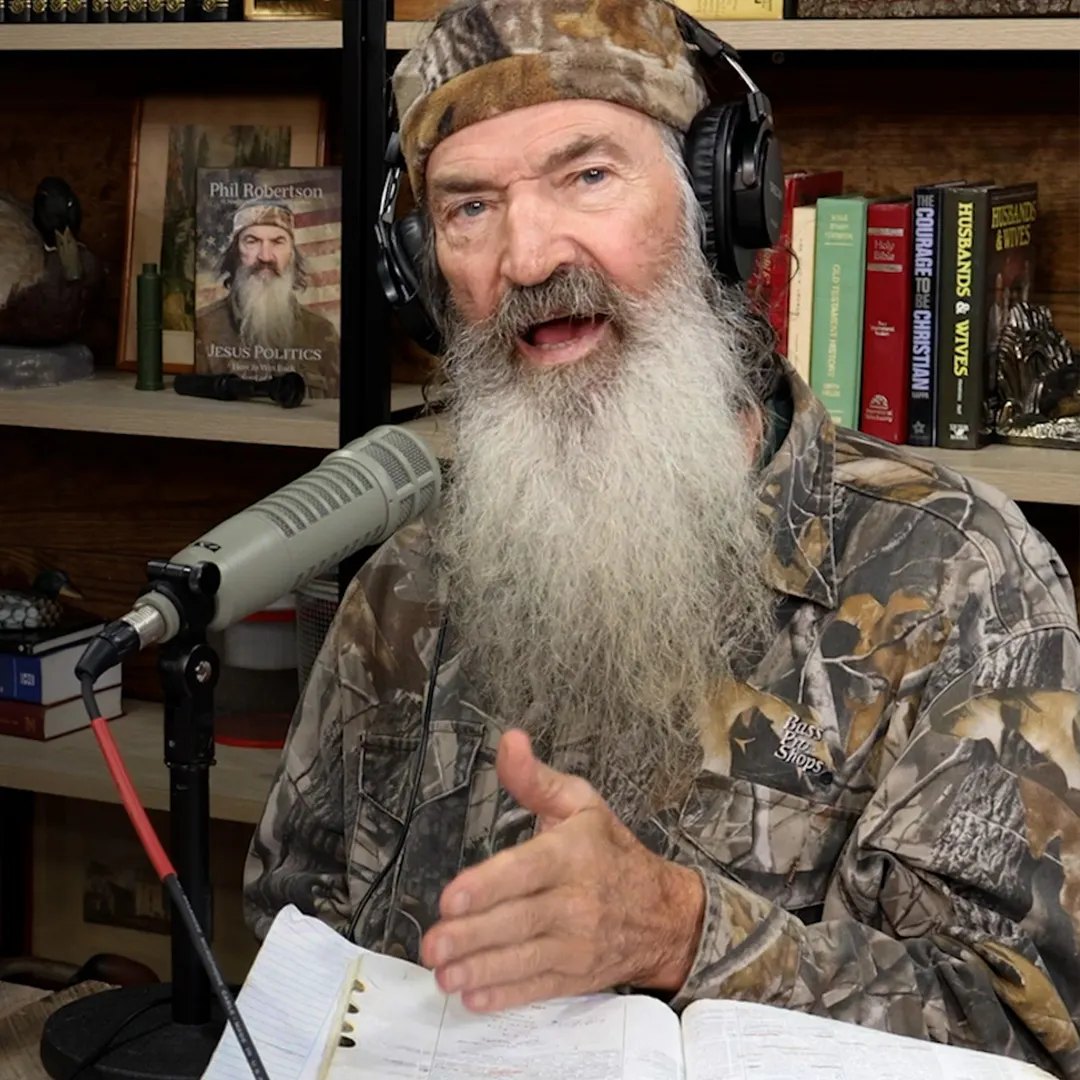
DiscoverAt Home with Phil Robertson
At Home with Phil Robertson
Claim Ownership

At Home with Phil Robertson

Author: Phil Robertson

Subscribed: 88Played: 2,166
Share

Description

Duck Dynasty star Phil Robertson’s legacy of faith and storytelling lives on in nearly 800 episodes of unfiltered wisdom, humor, and biblical truth. At Home with Phil Robertson is Phil's enduring reminder that no one is too far gone to turn their life around. There's always hope in Jesus.

115 Episodes
Reverse
esus made his death, burial, and resurrection plain before it happened. The prophets pointed to it, Jesus said it clearly, and the gospel still calls for the same response now: believe him, trust him, repent, confess him as Lord, and obey what he said. In this episode: Matthew 20 verses 17 through 19, Mark 8 verse 31, Mark 10 verses 32 through 34, Luke 18 verse 31, John 12 verses 31 through 33 Learn more about your ad choices. Visit megaphone.fm/adchoices
Filmed in June of 2020 Phil lays this out as a direct warning. God does not stay silent about wickedness, judgment, repentance, or the need to turn to Jesus. This episode is about hearing that warning clearly, refusing to treat sin lightly, and remembering that the answer is not political, social, or cosmetic. The answer is spiritual. Christ removes sin, justifies the believer, and gives peace to the one who turns and believes. In this episode: Ezekiel chapter 3 verses 17–21, Romans chapter 3, Psalm 32— Learn more about your ad choices. Visit megaphone.fm/adchoices
Your years are running out, your sin is not hidden, and physical death is coming. That is the reality Phil lays out here. But that is not the end of the story. Jesus entered death, removed its sting, and made a way out for the people who put their faith in him. This episode is about facing death honestly, numbering your days rightly, and trusting the only one who can get you out of here alive. In this episode: Psalm 90 verses 8–12, 1 Corinthians 15 verses 55–56 Learn more about your ad choices. Visit megaphone.fm/adchoices
Phil tells the truth plainly: everything else runs out. What looks like wisdom, freedom, or fulfillment apart from Christ ends in a dead end. Jesus is not one more option to try. He is the only one who gives peace of mind, hope, and the wisdom God had hidden in plain sight from the beginning. In this episode: 1 Corinthians chapter 2, 1 Timothy chapter 3 verse 16 Learn more about your ad choices. Visit megaphone.fm/adchoices
Pilate asked the question people are still asking: What is truth? Jesus answered it by pointing to himself. Truth is not private, flexible, or self-made. It conforms to reality, and Christ stands over it without error. Phil Robertson walks through Jesus before Pilate and shows why confused people do not need a new definition of truth. They need to hear the one who came into the world to testify to it. In this episode: John chapter 18 verse 37 and following, Romans chapter 6 Learn more about your ad choices. Visit megaphone.fm/adchoices
If the world will eventually end, what kind of people should Christians be right now? In this episode, Phil Robertson walks through 2 Peter 3 and the promise that the Day of the Lord will come unexpectedly. If everything we see will one day disappear, the real question isn’t when it happens — but how we should live before it does. Phil discusses repentance, holy living, and what it means to hold on to simple moral clarity in a world that seems to have forgotten basic decency. Learn more about your ad choices. Visit megaphone.fm/adchoices
Phil Robertson often explains the gospel using a simple diagram built from five symbols. Each one represents a central event in the message of Jesus: God becoming flesh, the cross, the burial, the resurrection, and the return to heaven. In this episode, Phil walks through the drawing step by step and explains how it summarizes the gospel message taught in the New Testament. The claim is straightforward: Jesus came from heaven, died for sin, was buried, rose from the dead, and ascended again. The response is belief, repentance, confession of Jesus as Lord, and baptism into His death so that a new life can begin. This simple outline has been used for decades to communicate the core of the Christian message in a way that is easy to understand and remember. In this episode: John 1 verse 14, 1 Corinthians 15 verses 1 through 4, Acts chapter 1 verse 3, Romans 6 verses 1 through 4 Learn more about your ad choices. Visit megaphone.fm/adchoices
The Function of Thorns

The Function of Thorns

2026-03-1009:47

The statistical probability of moving from birth to death without being invaded by a microbe or a systemic failure of the flesh is near zero. These blows are not accidents; they are "thorns" functioning to prevent a man from becoming conceited and to clarify his total dependence on the Creator. While the medical profession offers a temporary reprieve, it cannot offer a permanent exit. Suffering is the necessary friction that forces a man to look past the temporary and stay the course toward the only one who holds the power to save or destroy. In this episode: Acts 9, Acts 26, 2 Corinthians 12, Romans 5 Learn more about your ad choices. Visit megaphone.fm/adchoices
A free nation depends on something deeper than laws and institutions. The American founding assumed that liberty required a religious and moral people. Remove that foundation and the system designed to preserve freedom begins to break down. Phil Robertson walks through the logic behind the Declaration of Independence, the Constitution, and the warnings of early American leaders who believed self-government only works when the people governing themselves live under God. In this episode: Acts chapter 10 Learn more about your ad choices. Visit megaphone.fm/adchoices
People want happiness, peace, and what is good. Yet throughout history, humans repeatedly turn away from the very path they know leads there. Phil Robertson explores the strange contradiction at the center of human nature: people recognize right and wrong, understand the consequences of their choices, and still choose the wrong road. This struggle isn’t new. It has been observed for centuries and explained clearly in Scripture. The deeper issue is not ignorance but the human condition itself. When people knowingly leave the right path, the question becomes whether anyone can return from it—and what power is strong enough to restore them. In this episode: Romans chapter 1, Colossians chapter 3 Learn more about your ad choices. Visit megaphone.fm/adchoices
Trust used to be assumed. Now it has to be questioned. Phil Robertson explains why trust has become so difficult in a culture filled with gossip, slander, and deception. Scripture describes what happens when people reject the knowledge of God—character collapses, truth becomes negotiable, and even private words get turned into weapons. A society without the fear of God produces people who talk too much, betray confidence, and trade information for status or advantage. The result is a world where loyalty is rare and trust is constantly broken. This conversation looks at why gossip destroys relationships, why secrets get leaked, and why moral corruption always erodes trust—person by person, system by system. In this episode: Romans 3 verses 9–10, Proverbs 11 verse 13 Learn more about your ad choices. Visit megaphone.fm/adchoices
Jesus ended the argument about location. In John 4, the Samaritan woman ties worship to a mountain. Jesus removes the mountain. Worship is no longer anchored to Gerizim or Jerusalem. The time has come. True worship is in spirit and truth. If the Spirit lives in you, you are the temple. There is no sacred structure to travel to. There is no geographic advantage. The presence of God is not confined to a building. Where two or three gather in His name, He is there. Wherever you are, He is. Worship is not a place. It is a reality carried by Spirit-filled people. In this episode: John chapter 4, 1 Corinthians 3 verse 16, Matthew 18 verse 20 Learn more about your ad choices. Visit megaphone.fm/adchoices
Phil explains the simple approach he’s used for decades — start with Jesus, read the words in context, take them at face value, and obey what you understand. No complicated systems. No academic hurdles. No twisting the text to fit yourself. This conversation isn’t about collecting information. It’s about clarity. The Bible isn’t meant to confuse you — but it does require humility and obedience. Phil walks through how to approach Scripture in a way that is direct, serious, and grounded in reality. If you’ve ever wondered where to begin, how to avoid misreading passages, or how to move from reading to living, this episode lays it out plainly. Learn more about your ad choices. Visit megaphone.fm/adchoices
The standard is not unclear. Titus does not debate personality or preference. It repeats a command across generations: love what is good, teach what is good, set an example by doing what is good, be ready to do what is good, devote yourself to doing what is good. The dividing line is conduct. Some claim to know God but deny Him by their actions. They are described as unfit for doing anything good. Grace is not permission to drift. It trains self-control, obedience, seriousness, and productive lives. This episode narrows the issue to decision. The instruction is plain. The responsibility is personal. In this episode: Titus chapter 1 verse 8, Titus chapter 1 verse 16, Titus chapter 2 verses 3–6, Titus chapter 2 verses 11–14, Titus chapter 3 verses 1–14 Learn more about your ad choices. Visit megaphone.fm/adchoices
Phil walks through the Beatitudes and makes the dividing line clear. The first movements are toward God — poor in spirit, mourning, meek, hungry for righteousness. The next movements are toward others — mercy, purity, peacemaking, endurance under persecution. You can tell who someone belongs to by their conduct. Not by their volume. Not by their affiliation. Mercy exposes the difference. In this episode: Matthew 5, 1 Timothy chapter 1 verse 12, Titus chapter 3 Learn more about your ad choices. Visit megaphone.fm/adchoices
We don’t argue about sin anymore. We avoid it. Consequences remain. Corruption remains. Death remains. But the category that explains them has been quietly removed from public life. Government won’t say it. Media won’t say it. Schools won’t say it. Much of the church softens it. When sin is no longer acknowledged, accountability feels harsh and judgment feels outdated — but the outcomes don’t disappear. Phil surfaces the fracture beneath the confusion: we removed the explanation, not the reality. In this episode: John chapter 5 verse 25 Learn more about your ad choices. Visit megaphone.fm/adchoices
We keep blaming culture for the chaos around us. Jesus doesn’t. In Matthew 15, he makes it clear: what defiles a person doesn’t come from the outside. It comes from the heart. Phil walks through how Romans 1 describes a culture that suppresses truth and how Romans 6 explains the only real shift that changes a life. The issue isn’t what the world is doing. The issue is where sin actually begins. In this episode: Matthew 15, Romans 1 verse 27 and 28, Romans 6 Learn more about your ad choices. Visit megaphone.fm/adchoices
Thomas Jefferson was not confused about the foundation of a nation. He publicly affirmed Almighty God, credited Him for America’s independence, and spoke plainly about religion, virtue, and the gospel of Jesus Christ. Phil walks through Jefferson’s own words and clarifies what has been lost — and why the gospel remains the answer. In this episode: 1 Corinthians 15 verses 1 through 4 Learn more about your ad choices. Visit megaphone.fm/adchoices
Phil lays out the problem plainly: the line between good and evil is not disappearing — it is being moved. God is the lawgiver. Civil laws reflect His standards when they align with truth and abandon them when they conflict with desire. Murder, sexual sin, greed, deceit — these categories are not evolving. They are being reframed. Phil argues that even the refusal to call abortion murder is part of the same pattern: redefine the act, soften the language, blur the moral boundary. The issue is not psychological confusion or cultural complexity. It is spiritual warfare. Sin is lawlessness. When sin is removed from the conversation, clarity collapses. Phil points back to the only resolution that has ever addressed the problem at its root — Jesus bearing sin, defeating death, and establishing the standard that does not change. Clarity begins when the line is restored. In this episode: Genesis 6, 1 John 3, Hebrews 2 Learn more about your ad choices. Visit megaphone.fm/adchoices
The early church did not operate on a mandated percentage. They met in homes. They shared what they had. Money moved when someone had need—not to sustain structures. In this episode, Phil Robertson walks through Acts and Stephen’s sermon to clarify what the first believers actually practiced. The Law of Moses required ten percent. The church is not under the Law of Moses. Acts describes generosity under grace, not obligation under law. Stephen declared that the Most High does not live in houses made by men. The household of God is the people themselves. The church is a spiritual house—not a financial system built around structures. This episode addresses the tension between generosity and extraction, hospitality and infrastructure, and what happens when that distinction is blurred. In this episode: Acts 2, Acts 7 verses 44–50 Learn more about your ad choices. Visit megaphone.fm/adchoices
loading
Comments 
loading