


Meditation Land
Subscribed: 0Played: 4
Subscribe

© CTDev
Description
Is higher consciousness a genuine human potential, a psychological process, or a grand illusion?
133 Episodes
Reverse

Are you reacting to life like a thermometer, or setting the temperature like a thermostat? This guided visualization explores "The Thermostat Law"—the powerful psychological principle that your life reflects your lowest standards, not your highest dreams. This is perfect for anyone feeling stuck, undervalued, or ready to level up their mindset. Stop tolerating the cold. Set the standard and watch your reality adjust.

Life doesn't listen to your hopes; it obeys your standards. Stop reading the room and start setting the temperature.The "Thermostat Law" of psychology suggests that we always regress to our lowest allowable standard. If you are unhappy with your reality, do not look at your dreams; look at what you are tolerating. To change your life, you must stop being a thermometer that reacts to the environment and become the thermostat that controls it.

Escape the noise of daily life and find instant peace with this guided Stoic visualization. Using the ancient technique known as "The View From Above" (or Plato's View), this audio journey helps you mentally zoom out—from your room to the city, the Earth, and finally, the cosmos. By shifting your perspective to a planetary scale, your current anxieties and stressors shrink into insignificance. This track combines cinematic ambient music with spoken-word guidance to help you detach, reset, and return to your day with unshakable clarity.

This guided meditation focuses on the Stoic concept of Amor Fati—the love of one's fate. Stop fighting against reality and start using it to your advantage. Instead of merely tolerating difficult times, you will learn to embrace them as necessary fuel for your personal growth. By shifting your perspective, you can transform anxiety and frustration into enthusiasm and strength. Perfect for dealing with sudden change, failure, or daily stress. Imagine your spirit as a fire that consumes obstacles to burn brighter.

Discover the science of Positive Psychology and the VIA Classification. Learn why fixing your flaws isn't enough and how to use your 24 character strengths to thrive.Character Strengths and Virtues, a framework that redefined the discipline of psychology. We begin by discussing the historical pivot from studying mental illness to mapping the "sanities" of human life, championed by Martin Seligman and Christopher Peterson. The discussion covers the rigorous criteria used to identify the 24 universal character strengths, ranging from Curiosity and Bravery to Kindness and Hope. We also examine the concept of "Signature Strengths"—the traits that feel most authentic to you—and delve into the fascinating dynamics of the "Golden Mean," which explains how a virtue like Prudence can become paralyzing rigidity if overused, or how Curiosity can turn into intrusive nosiness. Finally, we look at evidence-based interventions that prove how simply using your top strengths in new ways can measurably increase well-being.

Are you struggling with insomnia or a racing mind that won't quiet down? In this debut episode of "The Elven Path," we invite you to leave the noise of the modern world behind and step into the ancient, mist-covered Ironwood. This guided sleep meditation combines a deep, progressive body scan with immersive fantasy storytelling to help you achieve a state of profound relaxation.

Karen Horney’s psychoanalytic theory explains why the "Tyranny of the Shoulds" creates self-hate and burnout. Discover the 10 Neurotic Needs driving your anxiety.In this episode of our podcast, we explore the profound and often unsettling insights of Karen Horney regarding the "Idealized Self." We dig into the concept of the "Search for Glory," examining how our attempts to solve inner conflicts by creating a godlike self-image actually lead to a "police state" in our minds known as the "Tyranny of the Shoulds." We discuss how this drive for perfectionism isn't just a habit, but a structural change in personality that alienates us from our "Real Self." We also look at the mechanism of neurotic pride and how the very pursuit of being unassailable guarantees feelings of worthlessness and self-contempt.

The famous Zen story of Nan-in and the overflowing tea cup. Learn the meaning of "Empty Your Cup" and why beginner's mind (Shoshin) is essential for growth.

Ancient texts described a "restless mind" thousands of years before fMRI scans. Here is the surprising connection between Sanskrit mantras and modern brain science.

Discover the science of Non-Sleep Deep Rest (NSDR). Learn how to manually switch off your stress response and replenish dopamine in 10 minutes.The concept that humans can manually "toggle" their autonomic nervous system using specific respiratory and visual protocols to enter a paradoxical "liminal state"—a biological territory that is neither sleep nor wakefulness—to dramatically accelerate learning and replenish dopamine reserves.In this podcast episode, we explore the fascinating neuroscience behind Non-Sleep Deep Rest (NSDR), a set of protocols designed to give you manual control over your own autonomic nervous system. We discuss how techniques like the "physiological sigh" and "somatosensory rotation" effectively jam the brain's stress circuits, allowing you to access the restorative "liminal state" between wakefulness and sleep. We also break down the specific benefits of this state, such as clearing metabolic waste like adenosine and spiking dopamine levels by up to 60%. Finally, we walk through the practical application of these protocols, explaining why sensations like "falling" or sudden twitching are actually signs that the system is working exactly as intended.

The revolutionary idea that human behavior is not driven by past trauma, but is "pulled" forward by an invented, unconscious goal of the future—meaning every neurotic symptom is actually a creative, albeit flawed, attempt to solve the problem of existence.Join us for a deep dive into "Fictional Finalism," the cornerstone concept of Alfred Adler's Individual Psychology. In this podcast, we explore the radical shift from Freud’s biological determinism to Adler’s teleological view—the idea that we are not pushed by our pasts, but pulled by the future goals we create. We discuss how these "useful fictions," inspired by the philosophy of Hans Vaihinger, act as maps for navigating life. We will examine how the "Style of Life" is formed in early childhood, the critical difference between the flexible goals of a healthy mind versus the rigid dogmas of neurosis, and how Adlerian therapists use early recollections to uncover the hidden "private logic" behind our behaviors.
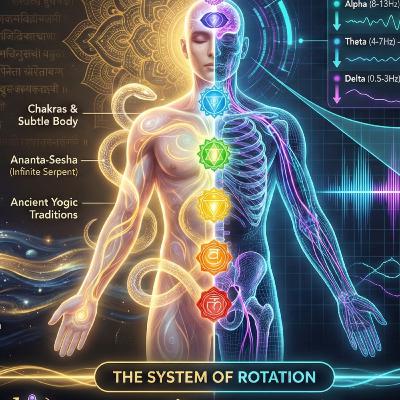
The biological paradox of "Conscious Delta"—a state where the brain produces deep-sleep waves while awareness remains fully active, effectively hacking the nervous system to resolve trauma and restore dopamine without chemical stimulants.In this episode of The Inner Lab, we explore the fascinating territory of Yoga Nidra, often called "yogic sleep." It sounds like a contradiction—how can you be asleep and awake at the same time? We dive into the science behind this state, looking at how it differs from standard meditation and even hypnosis. We discuss the concept of "local sleep," where parts of your brain rest while others remain alert, and examine the modern popularity of Non-Sleep Deep Rest (NSDR). We also touch on its ancient roots in Tantric rituals and how the US military is utilizing this practice today to help treat trauma and PTSD.
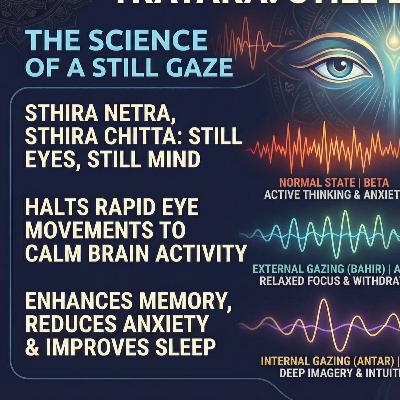
The concept that the eyes are not just sensory organs but external levers for the brain; by mechanically freezing the "saccades" (micro-movements) of the eyes, a practitioner can physically force the mind to stop thinking, triggering a unique neurochemical state involving the pineal gland.In this episode, we explore the ancient practice of Trataka, or candle gazing, moving beyond its reputation as a simple relaxation exercise to examine it as a sophisticated neuro-optical intervention. We discuss the physiological axiom of Hatha Yoga—"Still eyes, still mind"—and how modern science backs this up through the study of saccadic inhibition and the Troxler Effect. The conversation breaks down how fixing the gaze on a flame engages the oculomotor nerve to trigger a parasympathetic rebound, effectively hacking the nervous system to produce a state of alert relaxation. We also delve into the critical safety warnings found in both ancient texts and modern medical journals, particularly regarding the risks of photosensitive epilepsy and the potential for meditation-induced psychosis in vulnerable individuals.

Jung's "mystical" theory of archetypes—the idea that we inherit ancestral memories—was dismissed as unscientific for decades. But what if modern science, specifically epigenetics, is proving he was right all along?This podcast explores Carl Jung's foundational theory of archetypes. We move beyond simple definitions of figures like the "Hero" or "Trickster" to understand their true function. This episode begins with the concept of the collective unconscious and explains the critical difference between a universal archetype and a personal "complex," using the Mother complex as a case study. We will also discuss the four primary archetypes that structure the psyche: the Persona, the Shadow, the Anima/Animus, and the Self. The ultimate goal of integrating these, a process Jung called "individuation," is also examined. This podcast covers the practical applications of these ideas in psychotherapy, film, and surprisingly, in modern brand marketing. Finally, the episode investigates the long-standing scientific criticisms of the theory and explores how new fields, especially epigenetics and cognitive science, are beginning to re-evaluate Jung's most controversial ideas.

In this episode of our podcast, we explore the concept of parapraxis, commonly known as the "Freudian slip". We'll begin with Sigmund Freud's original psychoanalytic theory, which defines these errors not as random accidents, but as meaningful expressions of a repressed unconscious thought or desire. This podcast will look at how this idea fits into his models of the mind, where a "censor"—the Superego—fails to block an "unacceptable" impulse from the Id. Next, the episode contrasts this with the modern cognitive-linguistic explanation. This view reframes the slip as a non-motivated "processing error" that is statistically inevitable due to the sheer complexity of producing speech. Finally, this podcast examines the neuroscientific evidence. We'll discuss how specific brain networks, particularly the supplementary motor area (SMA) and anterior cingulate cortex (ACC), function as a literal "quality control" monitor , replacing Freud's metaphorical censor. We will also touch on the concept's cultural legacy and why it remains popular, even as its scientific basis has been critiqued.

The counter-intuitive concept that true Dhyana (meditation) is not an action you "do," but an effortless state that arises naturally after mastering the prerequisite, effortful stage of Dharana (concentration).In this episode, we explore the precise definition of Dhyana, or meditation, according to the foundational text of Classical Yoga, Patañjali's Yoga Sutras. This podcast provides a deep philosophical analysis of this often-misunderstood concept. We begin by locating Dhyana as the seventh limb in the Eight-Limbed Path and examining its definitive sutra (3.2), which defines it as "an uninterrupted flow of cognition." The central theme of this episode is the critical distinction between Dharana (concentration) and Dhyana (meditation). We discuss how Dharana is the effortful practice of holding focus, often likened to a dripping faucet, while Dhyana is the effortless state of sustained flow that arises only after concentration is mastered—like a steady stream of oil. This podcast explains why, according to Patañjali, you cannot "do" meditation, but can only create the conditions for it to blossom. We also cover the essential preparatory limbs, from the ethical foundations of Yama and Niyama to the sensory withdrawal of Pratyahara. Finally, the episode analyzes how Dhyana fits into the internal triad (Antaranga Sadhana) with Dharana and Samadhi, which together form the powerful investigative tool known as Samyama.

In this podcast, we explore Carl Jung's comprehensive theory of dreams. We begin by examining his foundational concept: compensation. For Jung, the psyche is a self-regulating system, and dreams are its primary way of balancing our often one-sided conscious attitudes, pointing out our "blind spots" to guide us. This episode contrasts Jung's forward-looking, teleological view with Freud's backward-looking, causal model of wish fulfillment. We will discuss the two primary sources of dream content: the personal unconscious, which creates "personal dreams" from our complexes and Shadow, and the collective unconscious, which generates "big dreams" filled with universal archetypes.This podcast also explains the ultimate goal of this entire process, which Jung called individuation—the lifelong journey toward psychological wholeness, not perfection. We'll outline the key archetypes that appear as messengers in dreams, such as the Shadow, the Anima and Animus, and the Self, which is often symbolized by the mandala. Finally, the episode touches on Jung's unique interpretive method of amplification and also reviews some of the scientific critiques leveled against his theories.

Active Imagination is often misunderstood as simple visualization or daydreaming. This podcast reveals it as a radical, high-stakes method of dialogue with autonomous figures from the unconscious (like the Shadow or Anima). It's not about "interpretation" (like Freud's method) but about an "ethical confrontation"—a voluntary "dive" into the same psychic depths where others might "fall" into psychosis.In this episode, we explore one of the most radical and foundational methods of Depth Psychology: Carl Jung's Active Imagination. This podcast goes beyond the popular definition of "visualization" to discuss what this practice truly entails. We'll cover its origins in Jung's own profound personal crisis, as documented in his Red Book, and how it differs fundamentally from Freud's "interpretation" of dreams. This episode explains Active Imagination as a deliberate, conscious dialogue with the autonomous figures of the psyche, such as the Shadow or Anima. We'll discuss the ultimate goal of this method: activating the "transcendent function" to create a new synthesis in the personality, a process Jung called individuation. A central theme of the podcast is the "ethical confrontation," the idea that insight is not enough; it must be followed by an ethical obligation and a change in real life. We will also compare this rigorous method to other practices, explaining why it is not dream analysis, guided imagery, or mindfulness meditation. Finally, this podcast will touch upon the practical steps for engaging the imagination, the serious dangers and contraindications, and the surprising validation for this 100-year-old method found in modern neuroscience.

In this episode of our series on Alfred Adler's Individual Psychology, we go deep into his most famous concept: the "inferiority complex." This podcast explores the critical difference Adler saw between the universal, motivating feeling of inferiority and the pathological complex that paralyzes an individual. We'll discuss how he believed this complex develops from childhood experiences like pampering or neglect. This episode also examines how the inferiority complex fits into his wider theory, including the "striving for superiority" and the vital role of "social interest." Finally, the podcast details Adler's dramatic break from Freud by deconstructing the Oedipus complex, reinterpreting it not as a sexual issue, but as a power struggle found in pampered children.

In this episode, we explore one of the foundational concepts of Carl Jung's work: the "complex." This podcast will discuss what a complex actually is, moving beyond the simple idea of a "trigger." We'll look at how Jung's early experiments with the Word Association Test led him to discover these "emotionally charged clusters" and how he found they operate as autonomous "splinter personalities" within the psyche. This episode also examines the structure of a complex, including its personal, memory-based parts and its deeper, universal archetypal core. Finally, this podcast will reframe the complex not just as a problem or an unresolved conflict, but as the essential engine of psychological growth, exploring how confronting it is the key to the process Jung called "individuation."

Comments

Download from Google Play

Download from App Store
 United States