DiscoverSLOW ENGLISH PODCAST. YOUR ENGLISH TOOLBOX
SLOW ENGLISH PODCAST. YOUR ENGLISH TOOLBOX

SLOW ENGLISH PODCAST. YOUR ENGLISH TOOLBOX

Author: YOUR ENGLISH TOOLBOX

Subscribed: 58,429Played: 387,571
Share

Description

This podcast is narrated using advanced AI voice technology (powered by ElevenLabs) to ensure consistent clarity, natural pacing, and an easy-to-follow listening experience — especially helpful for language learners.

All scripts are written and carefully edited by real humans, combining expert content creation with voice technology to bring you the best of both worlds:

✅ Human intelligence and creativity

✅ AI precision and clarity

We use slow, natural pronunciation and carefully chosen vocabulary to support learners at every level.

🎧 Listen slowly. Learn deeply. Speak confidently.


ENGLISH PODCAST, PODCAST ENGLISH, PRACTICE ENGLISH, LISTENING ENGLISH , PREPARE EXAM, LEARN ENGLISH ONLINE, IELTS PREPARATION, TOEFL LISTENING PRACTICE, CAMBRIDGE ENGLISH EXAMS, CAE, FCE, CPE, ENGLISH VOCABULARY, BUSINESS ENGLISH, ESL LISTENING, ENGLISH BOOK SUMMARIES, ENGLISH AUDIOBOOKS, SPEAKING PRACTICE, STUDY ENGLISH, ADVANCED ENGLISH, INTERMEDIATE ENGLISH, ENGLISH GRAMMAR, FLUENCY TRAINING, AMERICAN ENGLISH PRONUNCIATION, BRITISH ENGLISH PRONUNCIATION.


🎧 Slow English Podcast — Learn English Naturally, One Word at a Time

Welcome to the Slow English Podcast, your new space to learn English in a calm, clear, and confident way. Whether you're a beginner or an intermediate learner, this podcast is designed to help you improve your English through the power of slow listening.

We believe that language learning doesn’t have to be fast or overwhelming. That’s why each episode is crafted using the slow listening method — where you hear real English spoken clearly and at a natural, slower pace. This helps you train your earbuild vocabulary, and understand pronunciation, all without feeling rushed.


🚀 Prepare for Success (Exam Prep)

Are you studying for an international certification? We don't just chat; we strategize. Our episodes cover high-frequency vocabulary and listening comprehension skills essential for major exams. Whether you are aiming for a high band score or a university acceptance letter, our slow-paced method helps you catch every detail

.

📚 New: English Book Summaries

Love stories but feel intimidated by full-length novels? Tune in to our Book Summaries section. We break down famous English literature, business bestsellers, and self-improvement books into easy-to-digest English. It’s the perfect way to absorb "Big Ideas" in "Simple English" while expanding your vocabulary naturally.


🎧 What You Will Achieve:

• Understand native-speed conversations by training your ears slowly.

• Master phrasal verbs, idioms, and collocations used by native speakers.

• Gain confidence for your speaking tests and job interviews.


🧰 What We Offer:

  • Real English conversations and vocabulary explained simply
  • Cultural insights and expressions you’ll actually use
  • Clear pronunciation and natural intonation
  • Short, easy-to-follow episodes for daily learning
  • The same trusted content from Your English Toolbox, now in a new format


📌 Listen slowly. Learn deeply. Speak confidently.


Hosted on Acast. See acast.com/privacy for more information.

55 Episodes
Reverse
This podcast is narrated using advanced AI voice technology (powered by ElevenLabs) to ensure consistent clarity, natural pacing, and an easy-to-follow listening experience — especially helpful for language learners.All scripts are written and carefully edited by real humans, combining expert content creation with voice technology to bring you the best of both worlds:✅ Human intelligence and creativity✅ AI precision and clarityWe use slow, natural pronunciation and carefully chosen vocabulary to support learners at every level.Are your thoughts truly yours?Or are they shaped by social media, culture, algorithms, and invisible mental habits?In this powerful 17-minute deep dive, Martin and Julia explore what it really means to think independently in a world designed to influence you. This episode is both a personal development conversation and a high-value English listening practice session built around critical thinking, cognitive bias awareness, and intellectual independence.You will learn:• Why most of our opinions are inherited rather than examined• How confirmation bias quietly controls decision-making• What the availability heuristic is — and how it distorts reality• Why social conformity feels safe but limits growth• How to apply first-principles thinking in daily life• How to design your own “mental operating system”• Practical vocabulary for discussing freedom, manipulation, identity, and autonomyThis episode is ideal for learners preparing for:IELTS Speaking Parts 1–3 (topics: society, media influence, personal beliefs, education, independence)TOEFL Speaking Tasks (expressing and defending complex opinions clearly)Cambridge B2 First & C1 Advanced (argumentation, abstract discussion, listening comprehension)You’ll hear exam-relevant vocabulary such as cognitive bias, intellectual independence, conformity pressure, first principles, critical reasoning, information overload, attention economy, and identity formation — all presented in clear, structured, slow English to strengthen academic listening and high-band speaking performance.If this episode challenges you, write one idea you are now questioning.Tell us where you are listening from.Your comment helps platforms recognise active communities and recommend the Slow English Podcast to more learners worldwide.Freedom begins in the mind.And strong English begins with strong thinking.⏱️ TIME STAMPS00:00 – Introduction & The Core Question01:20 – Why Independent Thinking Feels Uncomfortable02:50 – The Invisible Script We All Follow04:20 – Social Survival and Conformity Pressure05:40 – Confirmation Bias Explained Clearly07:00 – The Availability Heuristic in Daily Life08:20 – Changing Your Mental Window09:30 – First-Principles Thinking10:50 – The Attention Economy & Information Diet12:10 – Pluralistic Ignorance and Social Fear13:30 – Designing Your Mental Operating System14:40 – Intellectual Courage15:50 – Final Reflection16:40 – Closing Message & Call to ActionKEYWORDSslow english podcast, english comprehension, english listening practice, learn english, your english toolbox, english shadowing, english mindset, vocabulary practice, critical thinking in english, cognitive bias explained, confirmation bias, availability heuristic, independent thinking, mental programming, intellectual freedom, first principles thinking, social conformity psychology, attention economy, academic vocabulary practice, IELTS speaking practice, IELTS vocabulary, TOEFL speaking, Cambridge B2 First, C1 Advanced, exam English, academic English listening, exam strategiesHASHTAGS#SlowEnglishPodcast #YourEnglishToolbox #LearnEnglish #EnglishListeningPractice #IELTS #TOEFL #CambridgeEnglish #CriticalThinking #CognitiveBias #IndependentMind #AcademicEnglish #EnglishVocabulary #ExamPreparation💬 We’d love to hear from you!If you enjoyed this episode, leave a comment, share your thoughts, or tell us how you’re using these tips to improve your English. Your feedback helps us grow and create even better content for you. Hosted on Acast. See acast.com/privacy for more information.

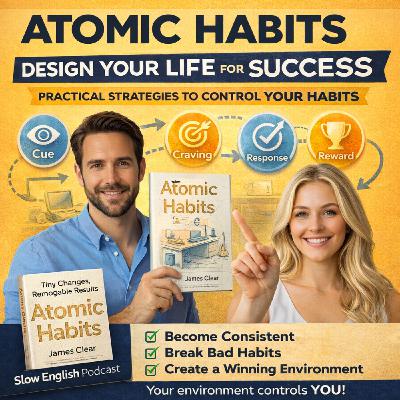
This podcast is narrated using advanced AI voice technology (powered by ElevenLabs) to ensure consistent clarity, natural pacing, and an easy-to-follow listening experience — especially helpful for language learners.All scripts are written and carefully edited by real humans, combining expert content creation with voice technology to bring you the best of both worlds:✅ Human intelligence and creativity✅ AI precision and clarityWe use slow, natural pronunciation and carefully chosen vocabulary to support learners at every level.In this second deep dive into Atomic Habits, Martin and Julia guide you through five powerful chapters in just 25 minutes. Instead of reading for hours, you’ll understand the science of habit loops, environment design, and the hidden forces that shape your daily behaviour — all explained in clear, intermediate-level English.Today we explore:• The 4-step habit loop: cue, craving, response, reward• Why Japanese train conductors “point and call” to prevent mistakes• The Freedom Paradox — how habits actually create freedom• The Diderot Effect and habit stacking• Why motivation is overrated and environment is everything• How to redesign your physical and digital spaces for successThis episode is especially useful for IELTS Speaking Part 3, TOEFL Speaking tasks, and Cambridge B2/C1 discussions about psychology, self-improvement, behaviour, and productivity. You’ll learn exam-relevant vocabulary such as context association, subconscious processing, decision fatigue, choice architecture, friction, cue-induced craving, and identity-based habits. These concepts are ideal for higher-level speaking answers and academic listening development.Martin and Julia don’t just explain theory — they show you how to apply it immediately. You’ll reflect on your own room, your phone, your routines, and your invisible triggers.By the end of this episode, you’ll understand one key idea: disciplined people are not superheroes — they are architects of their environment.If you enjoyed this episode, leave a comment telling us one small environmental change you will make today. Your comments help platforms recommend our podcast and help more learners discover Slow English Podcast.Slow listening. Deep thinking. Practical English.⏱️ TIME STAMPS00:00 – Introduction & What You’ll Learn01:30 – The Puzzle Box Experiment (How Habits Are Born)04:00 – The Freedom Paradox06:30 – The 4-Step Habit Loop Explained09:30 – The First Law: Make It Obvious11:00 – Japanese “Pointing and Calling” Technique13:00 – The Habit Scorecard Exercise15:00 – Implementation Intention Formula17:00 – The Diderot Effect & Habit Stacking19:00 – Why Motivation Is Overrated21:00 – Environment Design & Context Association23:00 – Self-Control Is Environment Control24:00 – Final Recap & Action StepKEYWORDS slow english podcast, english comprehension, english listening practice, learn english, your english toolbox, english shadowing, english mindset, vocabulary practice, atomic habits deep dive, habit loop explained, environment design psychology, habit stacking, self improvement habits, decision fatigue, subconscious behaviour, cue craving response reward, IELTS speaking practice, IELTS vocabulary, TOEFL speaking, Cambridge B2 First, C1 Advanced, exam English, academic English listening, exam strategiesHASHTAGS#SlowEnglishPodcast #YourEnglishToolbox #LearnEnglish #EnglishListeningPractice #IELTS #TOEFL #CambridgeEnglish #AtomicHabits #HabitLoop #SelfImprovement #ProductivityMindset #EnglishVocabulary #AcademicEnglish #MindsetTraining💬 We’d love to hear from you!If you enjoyed this episode, leave a comment, share your thoughts, or tell us how you’re using these tips to improve your English. Your feedback helps us grow and create even better content for you. Hosted on Acast. See acast.com/privacy for more information.
This podcast is narrated using advanced AI voice technology (powered by ElevenLabs) to ensure consistent clarity, natural pacing, and an easy-to-follow listening experience — especially helpful for language learners.All scripts are written and carefully edited by real humans, combining expert content creation with voice technology to bring you the best of both worlds:✅ Human intelligence and creativity✅ AI precision and clarityWe use slow, natural pronunciation and carefully chosen vocabulary to support learners at every level.In this episode of The Sound Lab, Martin and Julia guide you through one of the most powerful and misunderstood sounds in English: the J sound.Why is this sound so important?Because without it, your English can suddenly sound uncertain, soft, or even confusing. “Joke” becomes “yoke.” “Just” becomes “yust.” And your confidence drops.Today’s episode is a full pronunciation workout. You’ll train your tongue, your ears, and your confidence through:• Clear articulation drills• Listening challenges• Common mistakes by language group• Minimal pairs (J vs Y, CH, Z, etc.)• Spelling patterns (soft G, DGE endings)• Natural collocations and micro-sentences• A final pronunciation trap storyThis episode is especially helpful if your first language is Spanish, French, Italian, German, Russian, Arabic, Japanese, or any language where the J sound behaves differently.🎯 EXAM FOCUSThis training directly supports:IELTS Speaking Parts 1–3 (clear pronunciation & confidence)TOEFL Speaking Tasks (intelligibility under pressure)Cambridge B1/B2/C1 (pronunciation clarity & listening discrimination)Academic English listening and articulation precisionYou will improve:✔ Consonant articulation✔ Voiced vs unvoiced sound awareness✔ Minimal pair discrimination✔ Listening under cognitive load✔ Exam-relevant pronunciation controlBy the end, you won’t just understand the J sound — you’ll own it.Tell us in the comments:Is your J more like a Y, a CH, or something else?Your comments help platforms recommend this podcast to more English learners around the world.Let’s build strong, confident English — one sound at a time.⏱️ TIME STAMPS00:00 – Welcome to The Sound Lab01:10 – Why the J Sound Changes Everything02:30 – How to Physically Produce the J Sound04:00 – Listening Challenge 1 (Jerry Story)05:30 – Why Your Native Language Tricks You07:20 – Listening Challenge 2 (Lazy J Test)09:00 – The Spelling Code (J, Soft G, DGE)10:30 – Listening Challenge 3 (Hidden G Sounds)12:00 – Collocation Workout (Gym Practice)14:30 – Riddle Challenge (Double J Sound)15:40 – Minimal Pairs Training (J vs Y / CH / Z)18:30 – Final Trap Story19:30 – Recap & Confidence Boost20:00 – Final Message & Call to Action🔎 KEYWORDSslow english podcast, english pronunciation practice, english listening practice, learn english, your english toolbox, english shadowing, articulation training, pronunciation drills, J sound English, soft G pronunciation, minimal pairs English, voiced consonants, IELTS speaking practice, IELTS vocabulary, TOEFL speaking, Cambridge B2 First, C1 Advanced, exam English, academic English listening, exam strategies🔖 HASHTAGS#SlowEnglishPodcast #YourEnglishToolbox #LearnEnglish #EnglishListeningPractice #IELTS #TOEFL #CambridgeEnglish #EnglishPronunciation #Jsound #SpeakConfidently #ExamEnglish #EnglishFluency #MinimalPairs #ArticulationTraining💬 We’d love to hear from you!If you enjoyed this episode, leave a comment, share your thoughts, or tell us how you’re using these tips to improve your English. Your feedback helps us grow and create even better content for you. Hosted on Acast. See acast.com/privacy for more information.
https://www.patreon.com/posts/100-essential-a2-150231656?utm_medium=clipboard_copy&utm_source=copyLink&utm_campaign=postshare_creator&utm_content=join_link100 SENTENCES TRANSCRIPTION IN PATREON . FOR FREE. CHECK THE LINKThis podcast is narrated using advanced AI voice technology (powered by ElevenLabs) to ensure consistent clarity, natural pacing, and an easy-to-follow listening experience — especially helpful for language learners.All scripts are written and carefully edited by real humans, combining expert content creation with voice technology to bring you the best of both worlds:✅ Human intelligence and creativity✅ AI precision and clarityWe use slow, natural pronunciation and carefully chosen vocabulary to support learners at every level.In this episode of Slow English Podcast — Your English Toolbox, Martin guides you through one of the most powerful listening workouts you can do to rebuild your English from the ground up.You’ll train with 100 essential A2-level English phrases using a scientifically effective fast–slow–fast listening method, designed to improve comprehension, pronunciation, and real-world fluency.You’ll hear everyday English in its natural colloquial form, then the clear foundation version, and then natural English again — exactly how your brain needs to process language to build automatic understanding.What you’ll practice in this episode:• Introductions and personal life• Shopping and everyday services• Eating out and ordering food• Directions, travel, and transport• Hotel situations• Health and emergencies• Daily life and social conversations• Polite phrases and opinionsThis episode is especially useful for learners preparing for IELTS Speaking (Parts 1–3), TOEFL Speaking tasks, and Cambridge B1–B2 exams, as it focuses on functional language, natural rhythm, connected speech, and pronunciation under real conditions.🎯 Exam-focused benefits:• Speak with more natural rhythm and confidence• Understand fast native speech without translating• Improve listening accuracy for exam recordings• Build automatic responses for speaking testsBy the end of this episode, you won’t just know these phrases — your brain will expect them, recognize them instantly, and reproduce them more naturally.🎧 Listen slowly.🧠 Train your ear.🗣️ Speak with confidence.👉 Leave us a comment and tell us: Which phrase was hardest to catch at full speed?Your comments help platforms recommend this podcast and allow us to keep creating new episodes every week.⏱️ TIME STAMPS 00:00 – Welcome & philosophy of slow listening02:10 – How the fast–slow–fast method rewires your brain04:30 – Part 1: Introductions & personal life08:10 – Part 2: Shopping & services11:30 – Part 3: Eating & drinking15:00 – The power of basics and pronunciation reset17:00 – Part 4: Directions & getting around21:10 – Part 5: At the hotel24:30 – Rebuilding confidence through repetition26:20 – Part 6: Health & emergencies29:00 – Part 7: Daily life & socializing31:40 – Part 8: Polite phrases & communication33:40 – Final reflection, next levels & call to action35:20 – End of episode🔍 KEYWORDSslow english podcast, english listening practice, english comprehension, learn english naturally, english shadowing, your english toolbox, spoken english practice, real life english phrases, colloquial english, fast english listening, slow listening method, pronunciation training, everyday english vocabulary, A2 english practice, IELTS speaking practice, IELTS vocabulary, TOEFL speaking, Cambridge B1 listening, Cambridge B2 speaking, exam english, academic english listening, exam strategies💬 We’d love to hear from you!If you enjoyed this episode, leave a comment, share your thoughts, or tell us how you’re using these tips to improve your English. Your feedback helps us grow and create even better content for you. Hosted on Acast. See acast.com/privacy for more information.
This podcast is narrated using advanced AI voice technology (powered by ElevenLabs) to ensure consistent clarity, natural pacing, and an easy-to-follow listening experience — especially helpful for language learners.All scripts are written and carefully edited by real humans, combining expert content creation with voice technology to bring you the best of both worlds:✅ Human intelligence and creativity✅ AI precision and clarityWe use slow, natural pronunciation and carefully chosen vocabulary to support learners at every level.What if one of the most powerful tools for mental health and language learning is something you already had as a child?In this episode, Martin and Julia explore a forgotten human superpower: the ability to feel amazement in ordinary moments.Through a powerful story, real psychology, and practical examples, you’ll discover how curiosity and presence can reduce anxiety, quiet negative self-talk, and completely change the way you experience English.In this episode, you will learn how to:• Understand why amazement calms the anxious brain and brings you into the present moment• Use curiosity instead of pressure when learning English• Replace stress and self-criticism with attention and enjoyment• Learn English more naturally by slowing down and observing language like a child• Build gratitude, focus, and emotional balance through everyday momentsThis episode is especially useful for learners preparing for exams such as IELTS Speaking, TOEFL Speaking, and Cambridge B1, B2, and C1, as it trains presence, listening focus, pronunciation awareness, and exam-relevant functional language.You’ll also develop exam-ready skills like staying calm under pressure, thinking clearly while speaking, and responding more naturally in real conversations.At the end of the episode, you’re invited to try a simple daily challenge that can change both your English practice and your mindset — and to share your experience with our growing Slow English community.Listen slowly. Learn deeply. Stay amazed.⏱️ TIME STAMPS 00:00 – Welcome & opening reflection01:05 – The idea of a forgotten superpower02:20 – The dark restaurant story begins04:10 – Two couples, same situation, opposite experiences05:50 – Why amazement changes everything07:15 – The science of awe and the anxious brain08:55 – Anxiety, depression, and the present moment10:30 – Finding amazement in ordinary daily life12:10 – Gratitude as a natural result of attention13:30 – What this means for learning English15:05 – Slow learning vs rushed learning16:10 – Weekly challenge & final message🔎 KEYWORDS slow english podcast, english listening practice, learn english naturally, your english toolbox, english mindset, english comprehension, english shadowing, vocabulary practice, emotional intelligence in english, curiosity and learning, learning english without stress, mindfulness and language learning, present moment awareness, IELTS speaking practice, IELTS vocabulary, TOEFL speaking, Cambridge B2 First, C1 Advanced, exam English, academic English listening, exam strategies💬 We’d love to hear from you!If you enjoyed this episode, leave a comment, share your thoughts, or tell us how you’re using these tips to improve your English. Your feedback helps us grow and create even better content for you. Hosted on Acast. See acast.com/privacy for more information.
This podcast is narrated using advanced AI voice technology (powered by ElevenLabs) to ensure consistent clarity, natural pacing, and an easy-to-follow listening experience — especially helpful for language learners.All scripts are written and carefully edited by real humans, combining expert content creation with voice technology to bring you the best of both worlds:✅ Human intelligence and creativity✅ AI precision and clarityWe use slow, natural pronunciation and carefully chosen vocabulary to support learners at every level.In this episode, Martin and Julia kick off our Atomic Habits for English deep dive with the two foundations that change everything: the 1% rule and identity-based habits.You’ll learn why progress often feels invisible at the start (the Valley of Disappointment), how tiny improvements compound, and how to stop saying “I’m trying to learn English” and start becoming the kind of person who learns English naturally.✅ What you’ll get in 16 minutes:The truth about “instant success” (and why it’s a trap)The 1% improvement method you can apply todayWhy systems beat goals (especially for language learning)The identity shift: “What would an English speaker do?”A simple weekly plan you can repeat all year🎓 Exam boost (IELTS / TOEFL / Cambridge):This episode trains the mindset that improves consistency — the hidden skill behind higher scores. Use it to build a weekly routine for Listening (Part 1 / Part 3), Speaking fluency, and vocabulary retention, plus better “task endurance” (staying calm and focused under time pressure).💬 Your mini-challenge:Comment one sentence starting with: “This year, I’m the kind of person who…”Example: “This year, I’m the kind of person who listens to English every day.”3) Chapters / Time stamps 00:00 Welcome + what this series will do for your English01:02 The 1% rule: tiny improvements that compound01:59 Fundamentals: why habits work (and why they don’t at first)02:06 Destroying the myth of instant success03:20 The compounding effect (the simple math that changes motivation)06:41 The Valley of Disappointment + the “ice cube” idea08:40 Goals vs systems: why goals fail for language learners10:50 Identity habits: become the person who learns English13:43 “Votes for your identity” + how to lock the habit in15:00 Recap + what’s coming next4) Keywords atomic habits, english habits, learn english consistently, 1 percent better, identity based habits, systems vs goals, valley of disappointment, motivation myth, language learning routine, slow listening, english listening practice, daily english habit, build discipline, habit tracker, micro habits, compound growth, english fluency plan, confidence in english, improve pronunciation, shadowing routine, vocabulary retention, ielts listening strategy, toefl preparation mindset, cambridge b2 routine, exam endurance, productivity for language learners, stop procrastinating, habit stacking, environment design, consistency over intensity, new year english plan5) Hashtags#LearnEnglish #AtomicHabits #EnglishHabits #SlowListening #EnglishListening #EnglishRoutine #Fluency #StudyMotivation #LanguageLearning #IELTS #TOEFL #CambridgeEnglish #B2English #Shadowing #Vocabulary #Pronunciation #EnglishPodcast #SelfImprovement #DailyHabits #Consistency6) “Call to Action” Audio CTA (natural, short):“If you want real progress this year, don’t chase motivation—build identity. Comment: This year, I’m the kind of person who… and I’ll reply to you.”💬 We’d love to hear from you!If you enjoyed this episode, leave a comment, share your thoughts, or tell us how you’re using these tips to improve your English. Your feedback helps us grow and create even better content for you. Hosted on Acast. See acast.com/privacy for more information.
This podcast is narrated using advanced AI voice technology (powered by ElevenLabs) to ensure consistent clarity, natural pacing, and an easy-to-follow listening experience — especially helpful for language learners.All scripts are written and carefully edited by real humans, combining expert content creation with voice technology to bring you the best of both worlds:✅ Human intelligence and creativity✅ AI precision and clarityWe use slow, natural pronunciation and carefully chosen vocabulary to support learners at every level.In this episode, we explore a powerful idea that can change the way you face problems in life and in learning: the obstacle is not the enemy — it is the path forward.Together with Martin and Julia, and supported by calm reflection and clear language, we look at how challenges can become tools for growth instead of sources of fear or frustration.You will hear practical reflections, simple examples, and calm explanations designed to help you think differently when things feel difficult — whether you are learning English, preparing for an exam, or facing a personal challenge.In this episode, you will learn how to:• Reframe problems as opportunities for learning and progress• Use calm thinking instead of panic when things go wrong• Build resilience through language and mindset• Understand key abstract vocabulary related to difficulty, effort, and growth• Follow complex ideas in slow, clear EnglishThis episode is especially useful for learners preparing for IELTS Speaking (Parts 2–3), TOEFL Speaking tasks, and Cambridge B1, B2, and C1 exams, as it includes exam-relevant vocabulary, reflective language, and listening strategies often required in higher-level speaking and comprehension tasks.Before you leave, we invite you to reflect with us.Leave a comment using one idea or expression you learned today, tell us where you are listening from, or share one obstacle you are currently facing.Your comments help platforms recommend our podcast and allow this learning community to grow.Short recap:Obstacles do not block the path — they are the path.Calm thinking creates clarity.And every difficulty can become a step forward.⏱️ TIME STAMPS 00:00 – Welcome and opening reflection02:10 – Why we fear obstacles04:30 – The meaning behind “The Obstacle Is the Way”06:40 – Problems as teachers, not enemies09:00 – Language, mindset, and emotional control11:20 – How this idea applies to learning English13:40 – Real-life examples of reframing difficulties16:00 – Staying calm when things go wrong18:20 – Mid-episode reflection and learning pause20:10 – Exam relevance: speaking about challenges22:30 – Key vocabulary and expressions for exams25:00 – Final reflections and mindset shift27:30 – Final message and call to action🔑 KEYWORDS slow english podcast, english listening practice, learn english naturally, your english toolbox, english mindset, calm english learning, personal growth in english, motivation vocabulary, emotional intelligence english, problem solving vocabulary, resilience in english, mindset learning english, IELTS speaking practice, IELTS vocabulary, TOEFL speaking, Cambridge B1 speaking, Cambridge B2 First, C1 Advanced, exam english listening, academic english comprehension, exam strategies for speaking#️⃣ HASHTAGS #SlowEnglishPodcast #YourEnglishToolbox #LearnEnglish #EnglishListeningPractice #EnglishMindset #PersonalGrowth #EmotionalIntelligence #IELTS #TOEFL #CambridgeEnglish #EnglishVocabulary #CalmLearning💬 We’d love to hear from you!If you enjoyed this episode, leave a comment, share your thoughts, or tell us how you’re using these tips to improve your English. Your feedback helps us grow and create even better content for you. Hosted on Acast. See acast.com/privacy for more information.
This podcast is narrated using advanced AI voice technology (powered by ElevenLabs) to ensure consistent clarity, natural pacing, and an easy-to-follow listening experience — especially helpful for language learners.All scripts are written and carefully edited by real humans, combining expert content creation with voice technology to bring you the best of both worlds:✅ Human intelligence and creativity✅ AI precision and clarityWe use slow, natural pronunciation and carefully chosen vocabulary to support learners at every level.This is a deep, respectful, and practical episode created especially for Farsi and Dari speakers, though its lessons apply to any learner whose English feels tiring, heavy, or fragile.Learning English is not just about vocabulary.It’s about structure, sound, rhythm, and culture.In this episode, Martin, Julia, and Peter work together to rebuild English from the inside out — calmly, patiently, and without pressure.We explore:why English feels mentally exhaustinghow sentence order creates anxietywhy pronunciation errors are muscle problems, not intelligence problemshow politeness in English is grammatical, not emotionaland why slowing down is a necessary step toward fluencyThis is not an episode about “sounding native.”It’s about removing friction so real communication can flow.🔹 DETAILED TIMESTAMPS (31-MINUTE STRUCTURE)00:00 – 03:30Welcome & dedicationLanguage as freedom, not performance03:30 – 08:00The hidden mental wall: sentence architectureSOV vs SVO explained with the “train” metaphorWhy English feels tiring even when you know the words08:00 – 11:30Syntax repair strategy“Throw the verb first”Subject → Action → DetailHow clarity reduces anxiety11:30 – 16:30The sound ghosts of EnglishW vs VTH vs S / TWhy listeners get tired before you do16:30 – 20:30The sound gymLips vs teethTongue placementPronunciation as muscle memory, not talent20:30 – 24:30The snake problem & vowel trapsWhy “eschool” happensLive vs leaveWhy vowel length changes meaning24:30 – 27:30Politeness and cultureWhy direct translations sound rude in EnglishCommands vs requestsPrepositions that quietly betray fluency27:30 – 30:00The sandwich methodHow grammar creates kindnessChunks instead of isolated words30:00 – 31:00The U-shaped curve of learningWhy slowing down means you are doing it rightClosing message: clarity, dignity, connectionslow english, calm english, farsi speakers english, dari speakers english, english pronunciation problems, th sound, w vs v, english sentence order, english politeness, ielts speaking help, toefl speaking, english fluency mindset, english confidence, english for tired learners, learn english calmly, your english toolbox, slow listening method💬 We’d love to hear from you!If you enjoyed this episode, leave a comment, share your thoughts, or tell us how you’re using these tips to improve your English. Your feedback helps us grow and create even better content for you. Hosted on Acast. See acast.com/privacy for more information.
Atomic Habits for English

Atomic Habits for English

2026-01-2114:5914

This podcast is narrated using advanced AI voice technology (powered by ElevenLabs) to ensure consistent clarity, natural pacing, and an easy-to-follow listening experience — especially helpful for language learners.All scripts are written and carefully edited by real humans, combining expert content creation with voice technology to bring you the best of both worlds:✅ Human intelligence and creativity✅ AI precision and clarityWe use slow, natural pronunciation and carefully chosen vocabulary to support learners at every level.Welcome to the Slow English Podcast — Your English Toolbox.In today’s episode, Martin and Julia explore one of the most powerful ideas from the book Atomic Habits by James Clear, and show you how tiny daily habits can completely change the way you learn English.Most learners fail not because they are not intelligent, but because they use the wrong system.They set big goals, feel motivated for a few days, and then slowly give up.In this episode, you will discover:• Why goals are less important than systems• What the 1% rule really means for your English• How identity changes your learning results• How to build habits using habit stacking• Why environment design matters more than motivation• How the two-minute rule can save your consistencyThis episode is perfect for learners who:✔ Feel tired of traditional studying✔ Want to learn English with less stress✔ Are preparing for IELTS, TOEFL, Cambridge B1, B2, or C1✔ Want to build real daily habits✔ Want to improve listening, pronunciation, and confidence🎯 Exam Focus:This episode helps you build the long-term habits required for success in:IELTS Listening & SpeakingTOEFL Listening & SpeakingCambridge B1 PreliminaryCambridge B2 FirstCambridge C1 AdvancedBecause exams are not about talent — they are about consistency.CALL TO ACTION If this episode helped you, please follow the podcast and leave a short comment. Tell us: What is one tiny atomic habit you will start today? Your support is crucial for us to continue creating new episodes every week. EPISODE NOTESGuided by: Julia & MartinEpisode Type: Teaching / Book SummaryTheme: Atomic Habits & Learning SystemsDifficulty: Intermediate (Slow English)Best for: Motivation, consistency, mindset shift, study skillsPart of the series: Your English ToolboxKEYWORDS english learning, atomic habits, james clear, learn english podcast, slow english, english fluency, habit stacking, language learning tips, esl podcast, study routine, english listening practice, daily english habits, 1% rule, self improvement, english mindset, stop quitting, consistent learning, environment design, two minute rule, english vocabulary, english pronunciation, intermediate english, fluent speaker, identity shift, language mastery, speaking confidence, english for beginners, education podcast, study motivation, learning psychology 💬 We’d love to hear from you!If you enjoyed this episode, leave a comment, share your thoughts, or tell us how you’re using these tips to improve your English. Your feedback helps us grow and create even better content for you. Hosted on Acast. See acast.com/privacy for more information.
This podcast is narrated using advanced AI voice technology (powered by ElevenLabs) to ensure consistent clarity, natural pacing, and an easy-to-follow listening experience — especially helpful for language learners.All scripts are written and carefully edited by real humans, combining expert content creation with voice technology to bring you the best of both worlds:✅ Human intelligence and creativity✅ AI precision and clarityWelcome to Your English Toolbox — where we build your confidence, one sound at a time.In this episode, Martin and Julia focus on one of the most feared sounds in English: the TH sound.Not as a rule.Not as a list of words.But as a muscle-training exercise.You’ll discover why:pronunciation is physical, not intellectualtrying to “get it right” blocks real progressclarity comes from repetition, not perfectionUsing a gym-style metaphor, this episode walks you through:why the TH sound feels difficulthow to stop guessing and start traininghow families of words help your brain learn fasterwhy making mistakes is part of the workoutYou’ll also practice with a short ping-pong drill, designed to help you feel the sound in your mouth — not analyse it in your head.🎓 Exam focus (IELTS · TOEFL · Cambridge B1/B2/C1):Clear TH pronunciation directly improves speaking clarity, examiner comprehension, and confidence under pressure, especially in spontaneous answers.🎧 How to use this episode:Listen once.Then repeat the sounds out loud.No mirror.No tension.Just training.Progress comes from repetition, not judgment.⏱️ TIME STAMPS00:00 – Welcome & pronunciation mindsetWhy sounds are trained, not memorised.00:45 – The gym metaphor for pronunciationWhy English sounds work like muscles.01:45 – Why the TH sound feels difficultPhysical vs mental misunderstanding.03:00 – Stop trying to “say it correctly”Confidence before accuracy.04:10 – Word families & pattern learningWhy groups of words help faster.05:30 – Ping-pong pronunciation drillListen, repeat, don’t analyse.07:00 – Mistakes as part of the workoutWhy discomfort means progress.08:20 – Identity shift: “I’m training, not failing”Reframing pronunciation emotionally.09:30 – Final encouragement & close🔍 KEYWORDS th sound pronunciation, english pronunciation workout, improve english speaking, pronunciation confidence, th sound practice, learn english sounds, english phonetics, ielts pronunciation, toefl speaking clarity, cambridge speaking, your english toolbox, english pronunciation practice, th sound workout, how to pronounce th in english, speak english clearly, pronunciation training for english learners, english speaking confidence, fix pronunciation mistakes, th sound ielts speaking, improve accent in english, english phonetics made easy, stop mispronouncing english words, pronunciation for b1 b2 learners, english speaking exam tips, cambridge speaking pronunciation, toefl pronunciation practice, learn english sounds naturally, mouth position for th sound, spoken english improvement, pronunciation drills english, english sound training, reduce foreign accent english, daily pronunciation practice, clear spoken english, english pronunciation confidence, natural english pronunciation#️⃣ HASHTAGS#EnglishPronunciation#THSound#YourEnglishToolbox#LearnEnglish#EnglishSpeaking#IELTS#TOEFL#CambridgeEnglish💬 We’d love to hear from you!If you enjoyed this episode, leave a comment, share your thoughts, or tell us how you’re using these tips to improve your English. Your feedback helps us grow and create even better content for you. Hosted on Acast. See acast.com/privacy for more information.
This podcast is narrated using advanced AI voice technology (powered by ElevenLabs) to ensure consistent clarity, natural pacing, and an easy-to-follow listening experience — especially helpful for language learners.All scripts are written and carefully edited by real humans, combining expert content creation with voice technology to bring you the best of both worlds:✅ Human intelligence and creativity✅ AI precision and clarityWelcome to Day 7 of Seven Days of Calm English — the final episode of this short journey together.Today is not about learning something new.It is about looking back calmly and looking forward with clarity.Over the past seven days, we explored a different way to stay with English — without stress, panic, or self-pressure.We slowed down.We stopped measuring ourselves every day.We focused on small habits, real listening, and calm presence.This final episode brings everything together into a new English plan for the year in front of you.Not a plan based on studying more.But a plan based on daily habits, attention, and emotional connection.You’ll hear how:calm listening becomes the foundationsmall daily actions build real progressemotions fuel motivation better than disciplineconnection with others makes the journey lighterPeter also introduces the CLEAR method — Choose, Lay the ground, Engage, Adapt, Reinforce — and invites you to continue this journey through future episodes, including the Be Unstoppable episode and the Atomic Habits series.🎓 Exam-oriented focus:This episode supports IELTS, TOEFL, and Cambridge B1/B2/C1 preparation by reinforcing long-term consistency, emotional regulation, attention control, and confidence — all essential for real exam success.🎧 How to use this episode:Listen calmly.No notes.No pressure.Let this be a closing — and a beginning.👉 Special community request:If you comment regularly, please share this:How does it feel when you comment here and receive an answer?Your words may help silent learners feel less alone and take their first step.This space is your home for English.You are always welcome here.⏱️ TIME STAMPS00:00 – Welcome & calm introductionSetting the tone for the final day.00:30 – What this series was really aboutLearning without pressure or stress.02:00 – A new English plan for the year aheadFrom short challenge to long-term habit.03:30 – Daily habits instead of motivationWhy small actions matter more than effort.05:00 – Emotions, interest, and enjoymentReading and listening about what you love.06:30 – Learning with othersCommunity, comments, and shared progress.08:00 – The CLEAR method & what comes nextFuture episodes and staying consistent.09:20 – Final message & calm goodbye🔍 KEYWORDS calm english, slow english podcast, new year english plan, learn english naturally, english habits, language learning mindset, your english toolbox, ielts mindset, toefl preparation, cambridge english, emotional motivation learning, daily english habit#️⃣ HASHTAGS#CalmEnglish #SlowEnglishPodcast #YourEnglishToolbox #LearnEnglish #NewYearEnglish #EnglishHabits #IELTS #TOEFL #CambridgeEnglish 💬 We’d love to hear from you!If you enjoyed this episode, leave a comment, share your thoughts, or tell us how you’re using these tips to improve your English. Your feedback helps us grow and create even better content for you. Hosted on Acast. See acast.com/privacy for more information.
This podcast is narrated using advanced AI voice technology (powered by ElevenLabs) to ensure consistent clarity, natural pacing, and an easy-to-follow listening experience — especially helpful for language learners.All scripts are written and carefully edited by real humans, combining expert content creation with voice technology to bring you the best of both worlds:✅ Human intelligence and creativity✅ AI precision and clarityWe use slow, natural pronunciation and carefully chosen vocabulary to support learners at every level.This episode belongs to  Your Week of Calm English with three simple tools that can support your English for an entire year — without pressure, overload, or burnout.In this final reset, Peter focuses on what really helps learners stay consistent over time.Not motivation.Not discipline.And not studying harder.Instead, you’ll hear three calm tools that reduce tension, remove daily judgment, and help English stay present in your life — even on tired days, busy days, or days when confidence feels low.These tools are designed to:lower pressure around progresshelp you keep listening without forcing resultssupport long-term consistency instead of short-term intensityThis episode is not about doing more.It’s about doing less — but doing it regularly.🎓 Exam-oriented focus:These three tools directly support IELTS, TOEFL, and Cambridge B1/B2/C1 preparation by improving emotional regulation, focus under pressure, listening stamina, and tolerance of uncertainty — all critical skills for real exam performance.🎧 How to use this episode:Listen calmly.Do not take notes.Do not measure your level.Let this be a reset, not a task.👉 Call to action:After listening, choose one of the three tools and write it down.Not all three.Just one you can carry with you into the next months of English.A calm system lasts longer than motivation.⏱️ TIME STAMPS 00:00 – Welcome to the final episode of Your Week of Calm English00:55 – Why most English plans don’t last a year02:20 – The danger of pressure-based learning04:10 – Tool 1: Staying connected without judging progress07:20 – Why listening still works on tired days09:40 – Tool 2: Removing daily evaluation12:50 – Mistakes, awareness, and growth15:10 – Tool 3: Consistency over intensity18:30 – What to keep after this week ends20:10 – Final calm reminder and closing🔍 KEYWORDScalm english, slow english podcast, learn english naturally, english listening practice, english without pressure, language learning mindset, long term english learning, ielts listening, ielts speaking mindset, toefl listening, cambridge b2 listening, english consistency, your english toolbox#️⃣ HASHTAGS#CalmEnglish #YourEnglishToolbox #SlowEnglishPodcast #LearnEnglish #EnglishListening #LanguageLearning #IELTS #TOEFL #CambridgeEnglish #EnglishMindset💬 We’d love to hear from you!If you enjoyed this episode, leave a comment, share your thoughts, or tell us how you’re using these tips to improve your English. Your feedback helps us grow and create even better content for you. Hosted on Acast. See acast.com/privacy for more information.
This podcast is narrated using advanced AI voice technology (powered by ElevenLabs) to ensure consistent clarity, natural pacing, and an easy-to-follow listening experience — especially helpful for language learners.All scripts are written and carefully edited by real humans, combining expert content creation with voice technology to bring you the best of both worlds:✅ Human intelligence and creativity✅ AI precision and clarityWe use slow, natural pronunciation and carefully chosen vocabulary to support learners at every level.Welcome to Day 5 of Calm English, part of the Seven Days of Calm English series — a gentle reset for learners who feel tired, overwhelmed, or discouraged.In this episode, Peter talks about a moment that scares many English learners:the moment English suddenly feels harder.When listening becomes heavier, when confidence drops, many learners assume something is wrong.They think they are getting worse.They think their method has failed.They think they should stop or change everything.This episode offers a calmer and more powerful interpretation.You’ll learn why difficulty is often a signal of growth, not failure, and why feeling uncomfortable can mean your brain is adjusting to a new layer of English — a new speed, accent, topic, or type of sentence.Peter introduces one simple tool to protect your progress on hard days:instead of judging your level, ask only one question —“Am I still listening and staying present?”If the answer is yes, you are doing the right thing.If the answer is no, you don’t quit — you adjust gently and return tomorrow.🎓 Exam-oriented focus:This episode supports IELTS Listening and Speaking, TOEFL Listening, and Cambridge B1/B2/C1 preparationby training tolerance of ambiguity, emotional regulation, and consistency — three critical skills for real exam performance.🎧 How to use this episode:Listen without evaluating yourself.Do not measure progress today.Stay present with the voice and rhythm.👉 Call to action:After listening, leave a comment answering this question:What usually makes English feel harder for you — speed, vocabulary, accent, or topic?Hard days do not stop progress.Running away from them does.⏱️ TIME STAMPS 00:00 – Welcome to Day 5 of Calm English00:45 – The moment English suddenly feels harder01:45 – The dangerous story learners tell themselves03:00 – Why difficulty often means growth04:30 – Familiarity vs real progress05:50 – New layers: speed, accents, deeper topics07:10 – The one protective question to ask08:30 – Adjust gently, don’t quit09:30 – Final reassurance and calm close🔍 KEYWORDScalm english, slow english podcast, english listening practice, english feels hard, language learning mindset, learn english naturally, your english toolbox, listening confidence, english motivation, english anxiety, IELTS listening, IELTS speaking confidence, TOEFL listening practice, Cambridge B1 listening, Cambridge B2 First, C1 Advanced, exam english mindset#️⃣ HASHTAGS#CalmEnglish #SlowEnglishPodcast #YourEnglishToolbox #LearnEnglish #EnglishListening #LanguageLearning #IELTS #TOEFL #CambridgeEnglish #EnglishMindset💬 We’d love to hear from you!If you enjoyed this episode, leave a comment, share your thoughts, or tell us how you’re using these tips to improve your English. Your feedback helps us grow and create even better content for you. Hosted on Acast. See acast.com/privacy for more information.
his podcast is narrated using advanced AI voice technology (powered by ElevenLabs) to ensure consistent clarity, natural pacing, and an easy-to-follow listening experience — especially helpful for language learners.All scripts are written and carefully edited by real humans, combining expert content creation with voice technology to bring you the best of both worlds:✅ Human intelligence and creativity✅ AI precision and clarityWe use slow, natural pronunciation and carefully chosen vocabulary to support learners at every level.Welcome to Day 4 of Calm English, a short daily series designed to help English feel lighter, easier, and more natural in your life.In this episode, Peter focuses on one of the most powerful but underestimated ideas in language learning: the power of a small, daily listening habit.Many learners believe progress comes from long study sessions, strong discipline, and intense effort.But these sessions are difficult to repeat, easy to postpone, and often create guilt instead of progress.This episode explains why learning grows through regular contact, not intensity, and why habits work best when they are simple and pressure-free.You’ll learn:Why long study sessions are hard to maintainHow short daily listening creates familiarity and confidenceWhy repetition matters more than effortHow to choose one small listening moment that fits your real life🎓 Exam-oriented focus:This episode supports IELTS Listening and Speaking Parts 1–3, TOEFL listening comprehension, and Cambridge B1/B2/C1 preparation by helping you build regular exposure, reduce cognitive load, and improve real-time understanding — all essential for exam performance.🎧 How to use this episode:Listen while making coffee, walking, or resting.Do not study.Do not measure progress.Just repeat the habit.👉 Call to action:After listening, leave a short comment answering this question:When could a small daily listening habit fit naturally into your day?Your comments help this podcast grow and help other learners feel less pressure.Small habits create continuity.Continuity creates confidence.And confidence changes everything.⏱️ TIME STAMPS 00:00 – Welcome to Day 4 of Calm English00:40 – Why long study sessions often fail01:40 – Effort vs repetition in language learning02:45 – The guilt cycle of postponed study03:45 – What makes a habit repeatable04:45 – Listening while living your life05:45 – Why familiarity builds confidence06:45 – Five minutes a day explained07:45 – Choosing your daily listening moment08:40 – Final reflection and invitation to continue🔍 KEYWORDSslow english podcast, calm english, english listening practice, learn english naturally, daily english habit, english mindset, english comprehension, language learning habits, your english toolbox, listening habit english, IELTS listening practice, IELTS speaking skills, TOEFL listening, Cambridge B1 listening, Cambridge B2 First, C1 Advanced, exam english strategies, academic english listening#️⃣ HASHTAGS#SlowEnglishPodcast #YourEnglishToolbox #LearnEnglish #EnglishListeningPractice #CalmEnglish #EnglishHabits #EnglishMindset #IELTS #TOEFL #CambridgeEnglish💬 We’d love to hear from you!If you enjoyed this episode, leave a comment, share your thoughts, or tell us how you’re using these tips to improve your English. Your feedback helps us grow and create even better content for you. Hosted on Acast. See acast.com/privacy for more information.
This podcast is narrated using advanced AI voice technology (powered by ElevenLabs) to ensure consistent clarity, natural pacing, and an easy-to-follow listening experience — especially helpful for language learners.All scripts are written and carefully edited by real humans, combining expert content creation with voice technology to bring you the best of both worlds:✅ Human intelligence and creativity✅ AI precision and clarityWe use slow, natural pronunciation and carefully chosen vocabulary to support learners at every level.Welcome to Day 3 of Calm English, a gentle daily series designed to change how English feels in your life.In this episode, Peter talks about one of the most exhausting habits English learners have: constantly measuring their level while listening, speaking, or studying.Many learners ask themselves the same questions again and again:“Was that good enough?”“Did I understand enough?”“Am I improving or falling behind?”This episode explains why constant self-evaluation creates tension, breaks concentration, and turns English into a permanent test.You’ll learn why progress in language learning is often invisible in the short term, why comparing days or weeks is misleading, and how calm exposure works even when you don’t notice results.You’ll discover:Why measuring your level too often increases frustrationHow learning continues even when progress feels invisibleThe difference between growth and performanceA simple mindset shift to make English feel lighter and more sustainable🎓 Exam-oriented focus:This episode supports IELTS Speaking Parts 1–3, TOEFL Speaking Tasks, and Cambridge B1/B2/C1 preparationby helping you reduce performance anxiety, improve focus, and build the calm confidence needed in real exam situations.🎧 How to use this episode:Listen without evaluating yourself.Do not score your understanding.Let English be present without judgment.👉 Call to action:After listening, leave a short comment answering this question:When do you measure yourself the most — while listening, speaking, or after studying?Your comments help this podcast grow and help other learners feel less alone.Progress does not need constant checking.It needs time, calm, and trust.⏱️ TIME STAMPS 00:00 – Welcome to Day 3 of Calm English00:45 – The habit of constant self-evaluation01:45 – Why measuring feels useful but creates tension02:50 – English as a test vs English as a presence03:55 – Why progress is often invisible at first05:05 – Performance days vs learning days06:10 – A calmer way to notice progress07:20 – Today’s mindset reset08:20 – Final reflection and invitation to continue🔍 KEYWORDSslow english podcast, calm english, english mindset, english listening practice, learn english naturally, your english toolbox, language learning anxiety, english confidence, self evaluation english, progress in english, IELTS speaking practice, IELTS vocabulary, TOEFL speaking, Cambridge B1 speaking, Cambridge B2 First, C1 Advanced, exam english strategies, academic english listening💬 We’d love to hear from you!If you enjoyed this episode, leave a comment, share your thoughts, or tell us how you’re using these tips to improve your English. Your feedback helps us grow and create even better content for you. Hosted on Acast. See acast.com/privacy for more information.
This podcast is narrated using advanced AI voice technology (powered by ElevenLabs) to ensure consistent clarity, natural pacing, and an easy-to-follow listening experience — especially helpful for language learners.All scripts are written and carefully edited by real humans, combining expert content creation with voice technology to bring you the best of both worlds:✅ Human intelligence and creativity✅ AI precision and clarityWe use slow, natural pronunciation and carefully chosen vocabulary to support learners at every level.Welcome to Seven Days of Calm English, a short daily series designed to reset the way English feels in your mind.In this episode, Peter gently explores one of the most exhausting habits English learners have: translating every sentence in their head while listening.Many learners feel tired, stressed, or blocked when listening to English, even when the topic is familiar.This episode explains why that happens, how translation creates mental overload, and how calm listening can slowly replace control with real understanding.You’ll learn:Why translating feels safe but makes listening heavierHow meaning can appear without forcing every wordWhat “listening like your first language” really meansA simple habit to reduce mental noise while listening🎓 Exam-oriented focus:This episode supports IELTS Listening and Speaking Parts 1–3, TOEFL listening comprehension, and Cambridge B1/B2/C1 listening skills, helping you train real-time understanding, tolerance of ambiguity, and natural processing — all essential for exam performance.🎧 How to use this episode:Listen while walking, resting, or doing something simple.Do not pause to translate.Let meaning appear gradually.👉 Call to action:After listening, leave a short comment telling us where translation appears most for you.Your comments help platforms recommend our podcast and allow this project to keep growing.Slow listening is not lazy listening.It is how real understanding begins.⏱️ TIME STAMPS 00:00 – Welcome to Seven Days of Calm English00:40 – Why listening feels tiring for many learners01:30 – The hidden habit of translating in your head02:30 – Why translation creates mental overload03:40 – Control vs real comprehension04:40 – Listening without stopping the flow05:40 – A walking-and-listening example06:40 – Why understanding less can mean learning more07:40 – Today’s gentle listening challenge08:30 – Final reflection and invitation to continue tomorrow🔍 KEYWORDSslow english podcast, english listening practice, english comprehension, learn english naturally, english shadowing, calm english, listening without translating, english mindset, mental noise english, your english toolbox, IELTS listening practice, IELTS speaking skills, TOEFL listening, TOEFL speaking, Cambridge B1 listening, Cambridge B2 listening, C1 Advanced listening, exam english strategies, academic english listening#️⃣ HASHTAGS#SlowEnglishPodcast #YourEnglishToolbox #LearnEnglish #EnglishListeningPractice #CalmEnglish #EnglishMindset #IELTS #TOEFL #CambridgeEnglish #ListeningSkills #EnglishFluency💬 We’d love to hear from you!If you enjoyed this episode, leave a comment, share your thoughts, or tell us how you’re using these tips to improve your English. Your feedback helps us grow and create even better content for you. Hosted on Acast. See acast.com/privacy for more information.
📌 DESCRIPTION This podcast is narrated using advanced AI voice technology (powered by ElevenLabs) to ensure consistent clarity, natural pacing, and an easy-to-follow listening experience — especially helpful for language learners.All scripts are written and carefully edited by real humans, combining expert content creation with voice technology to bring you the best of both worlds:✅ Human intelligence and creativity✅ AI precision and clarityWe use slow, natural pronunciation and carefully chosen vocabulary to support learners at every level.Welcome to Seven Days of Calm English, a short series designed to help you reset how English feels in your life.This is not about studying more, memorizing faster, or pushing harder.It is about changing your relationship with English — from pressure and tension to calm and familiarity.In this first episode, Martin introduces the idea behind the series:many learners don’t need a new goal — they need a healthier relationship with the language.When English feels like a test, learning slows down.When English feels safe, progress happens naturally.Across these seven days, you will explore simple shifts such as listening without pressure, stopping constant self-measurement, trusting slow progress, and building gentle daily habits that last.This episode is ideal if you feel frustrated, stuck, or tired of traditional English study methods.🎯 What you’ll learn today:– Why stress blocks language learning– How mindset affects listening and comprehension– Why calm exposure is more effective than forced study– How slow listening supports long-term fluency🎓 Exam focus:This episode supports IELTS Speaking confidence, TOEFL listening comfort, and Cambridge B1/B2/C1 mindset preparation by reducing anxiety, improving focus, and strengthening natural comprehension — all essential for real exam performance.💬 Call to action:Please leave a short comment with just one word: YES if you like this seven-day format, or NO if you prefer regular episodes.Your comments help us shape future content and help platforms recommend this podcast to more learners.Recap:Today is not about doing more.It’s about listening calmly.Tomorrow, we continue — slowly.⏱️ TIME STAMPS00:00 – Welcome to Seven Days of Calm English00:35 – Why January is stressful for language learners01:40 – The problem with constant goals and pressure02:45 – English as a relationship, not a task04:05 – Why calm helps your brain learn faster05:20 – How the seven-day series works06:20 – Listener question and comment invitation07:00 – Gentle close and preview of tomorrow🔎 KEYWORDS slow english podcast, english listening practice, learn english naturally, calm english, english mindset, your english toolbox, english comprehension, slow listening method, language learning anxiety, english confidence, IELTS speaking practice, IELTS vocabulary, TOEFL speaking, Cambridge B1 listening, Cambridge B2 speaking, C1 Advanced listening, exam english strategies, academic english listening#️⃣ HASHTAGS #SlowEnglishPodcast #YourEnglishToolbox #LearnEnglish #EnglishListeningPractice #CalmEnglish #EnglishMindset #IELTS #TOEFL #CambridgeEnglish #EnglishConfidence #SlowListening #LanguageLearning💬 We’d love to hear from you!If you enjoyed this episode, leave a comment, share your thoughts, or tell us how you’re using these tips to improve your English. Your feedback helps us grow and create even better content for you. Hosted on Acast. See acast.com/privacy for more information.
This podcast is narrated using advanced AI voice technology (powered by ElevenLabs) to ensure consistent clarity, natural pacing, and an easy-to-follow listening experience — especially helpful for language learners.All scripts are written and carefully edited by real humans, combining expert content creation with voice technology to bring you the best of both worlds:✅ Human intelligence and creativity✅ AI precision and clarityWe use slow, natural pronunciation and carefully chosen vocabulary to support learners at every level.In this episode of Slow English Podcast — Your English Toolbox, Martin and Julia continue their two-part series on nurturing relationships, focusing on what really helps love survive conflict, stress, misunderstandings, and difficult periods.Strong relationships are not those without problems — they are the ones that know how to repair, adapt, and stay emotionally connected when things go wrong.In this episode, you’ll discover five proven habits, supported by psychological research, that protect relationships during moments of tension and uncertainty.These habits apply to all human relationships — romantic partners, family members, friends, and even professional relationships at work — because they are based on universal emotional needs such as safety, respect, and trust.🧠 What you’ll learn in this episode:• Why laughter and play reduce emotional distance• How “micro-repairs” prevent small conflicts from becoming big ones• How curiosity and positive intent protect trust• Why self-care is essential for healthy communication• How small digital touchpoints keep relationships warm during busy days🎓 Exam-relevant benefits for English learners:This episode uses clear, natural B1–B2 English, with practical vocabulary and functional language commonly used in discussions about emotions, conflict, and relationships — ideal for:• IELTS Speaking (Parts 2–3: conflict, problem-solving, relationships)• TOEFL Speaking (explaining personal experiences and emotional responses)• Cambridge B1 / B2 / C1 (listening comprehension, pragmatic language, tone)🎯 Why this episode matters:Healthy relationships are one of the strongest predictors of long-term happiness and mental well-being.When you practise these habits, conflict becomes less threatening, communication improves, and daily stress decreases — not only at home, but also in social and professional environments.📌 Stay with us until the end for practical advice on how to apply these habits in a formal workplace setting, where emotional intelligence matters but is often overlooked.💬 Call to action:If something in this episode resonates with you, please leave a short comment.Your comments help platforms recommend our podcast and allow this project to grow and reach more learners.⏱️ TIME STAMPS00:00 – Welcome & quick recap of Episode 101:20 – Why conflict is normal in healthy relationships02:40 – Habit 6: Laughter, play, and emotional relief04:20 – Habit 7: Micro-repairs and emotional intelligence06:40 – Habit 8: Curiosity and assuming positive intent08:50 – Mid-episode reminder & learning resources10:00 – Habit 9: Self-care and emotional regulation11:40 – Habit 10: Digital touchpoints and connection13:10 – Using these habits in professional environments14:30 – Final recap & series closing reflection🔍 KEYWORDSslow english podcast, english listening practice, learn english naturally, your english toolbox, emotional intelligence, relationship communication, conflict vocabulary, emotional regulation, self-care language, workplace communication, healthy relationships, trust and repair, IELTS speaking practice, IELTS vocabulary, TOEFL speaking, Cambridge B2 First, C1 Advanced, exam English, academic English listening, exam strategies#️⃣ HASHTAGS#SlowEnglishPodcast #YourEnglishToolbox #LearnEnglish #EnglishListeningPractice #EmotionalIntelligence #HealthyRelationships #ConflictResolution #EnglishVocabulary #IELTS #TOEFL #CambridgeEnglish💬 We’d love to hear from you!If you enjoyed this episode, leave a comment, share your thoughts, or tell us how you’re using these tips to improve your English. Your feedback helps us grow and create even better content for you. Hosted on Acast. See acast.com/privacy for more information.
This podcast is narrated using advanced AI voice technology (powered by ElevenLabs) to ensure consistent clarity, natural pacing, and an easy-to-follow listening experience — especially helpful for language learners.All scripts are written and carefully edited by real humans, combining expert content creation with voice technology to bring you the best of both worlds:✅ Human intelligence and creativity✅ AI precision and clarityTRANSCRIPTION AVALAIBLE HEREhttps://www.patreon.com/posts/do-not-take-love-146987296?utm_medium=clipboard_copy&utm_source=copyLink&utm_campaign=postshare_creator&utm_content=join_linkIn this episode of Slow English Podcast — Your English Toolbox, Martin and Julia begin a special two-part series on how to nurture and protect your personal relationships through small daily habits.Many relationships don’t break because of big arguments — they slowly weaken because of neglect, routine, and taking people for granted.In this episode, you’ll discover five research-backed daily habits that help keep relationships alive, emotionally safe, and resilient.These habits apply to all human relationships — romantic partners, family members, close friends, and even colleagues — because they are based on universal psychological needs: feeling seen, valued, and secure.🧠 What you’ll learn in this episode:• How small “emotional bids” quietly build or break trust• Why daily appreciation changes the emotional climate of a relationship• How active listening and validation reduce conflict and stress• The psychological power of small moments of physical connection• Why shared rituals create emotional safety and stability🎓 Exam-relevant benefits for English learners:This episode exposes you to clear, natural B1–B2 English with practical relationship vocabulary and functional language that is useful for:• IELTS Speaking (Parts 1–3: relationships, feelings, daily habits)• TOEFL Speaking (personal experiences, emotional responses)• Cambridge B1 / B2 / C1 (listening comprehension, pragmatic language, tone)🎯 Why this episode matters:Strong relationships are one of the strongest predictors of happiness, mental health, and emotional resilience.When you practise these habits consistently, your stress decreases, your communication improves, and your daily life feels more supportive and calm.📌 Stay with us until the end for a simple mini-plan you can start using today — even if your life feels busy or emotionally full.💬 Call to action:If something in this episode resonates with you, please leave a short comment.Your comments help platforms recommend our podcast and allow this project to grow and reach more learners.⏱️ TIME STAMPS00:00 – Welcome & introduction to the series01:15 – Why relationships need daily care (living systems, not guarantees)02:30 – Research, psychology, and emotional well-being benefits03:00 – Habit 1: Turning toward emotional bids05:45 – Habit 2: Daily appreciation and gratitude07:35 – Habit 3: Active listening and validation09:35 – Mid-episode reminder & learning resources10:45 – Habit 4: Small moments of physical connection12:00 – Habit 5: Shared rituals and emotional safety13:10 – Psychological benefits of healthy relationships14:10 – Mini-plan for today & recap of the 5 habits14:50 – Closing reflection & invitation to Episode 2🔍 KEYWORDSslow english podcast, english listening practice, learn english naturally, your english toolbox, english comprehension, english mindset, relationship vocabulary, emotional communication, daily habits, emotional intelligence, healthy relationships, trust and communication, IELTS speaking practice, IELTS vocabulary, TOEFL speaking, Cambridge B2 First, C1 Advanced, exam English, academic English listening, exam strategies#️⃣ HASHTAGS#SlowEnglishPodcast #YourEnglishToolbox #LearnEnglish #EnglishListeningPractice #HealthyRelationships #EmotionalIntelligence #DailyHabits #EnglishVocabulary #IELTS #TOEFL #CambridgeEnglish💬 We’d love to hear from you!If you enjoyed this episode, leave a comment, share your thoughts, or tell us how you’re using these tips to improve your English. Your feedback helps us grow and create even better content for you. Hosted on Acast. See acast.com/privacy for more information.
his podcast is narrated using advanced AI voice technology (powered by ElevenLabs) to ensure consistent clarity, natural pacing, and an easy-to-follow listening experience — especially helpful for language learners.All scripts are written and carefully edited by real humans, combining expert content creation with voice technology to bring you the best of both worlds:✔ Human intelligence and creativity✔ AI precision and clarityEPISODE TRANSCRIPT IN PATREONhttps://www.patreon.com/posts/calm-english-for-146772302?utm_medium=clipboard_copy&utm_source=copyLink&utm_campaign=postshare_creator&utm_content=join_linkWe use slow, natural pronunciation and carefully chosen vocabulary to support learners at every level — including days when you feel tired, unmotivated, or simply don’t want to study.Welcome back to Your English Toolbox — Slow English Podcast.This episode is designed for those moments when studying feels heavy.When your energy is low.When your mind feels tired.On days like this, calm English is not a break from learning — calm English is the practice.In this Peter Shadowing episode, we return to the foundations.You don’t need to learn something new.You don’t need to push yourself.You simply listen, follow the sentences, and rebuild confidence through repetition.You will practice 100 highly useful everyday sentences, carefully selected to strengthen your real-life English in four common situations:Morning routines and coffee before workBusiness meetings and professional communicationMessages, emails, and everyday written EnglishEvening conversations and retelling your dayThis is part of the Slow Listening method:strong foundations are built through calm repetition, not effort or stress.🎧 You can lie down, relax, and let English flow through you.Confidence grows when your base becomes familiar and secure.📄 Transcript & extra materialsThe full transcript and additional learning materials are available on our Patreon page.You’ll find the link in the episode description.If Patreon is restricted in your country and you’re interested in the transcript, write “YES” in the comments.If many listeners need it, we will create an alternative delivery channel.Thank you for practicing calmly today.⏱️ TIME STAMPS00:00 – Welcome & Slow Listening philosophy01:10 – Why calm English is perfect when you feel tired02:20 – Block 1: Lazy is OK — rebuilding foundations05:30 – Reflection: permission to slow down06:00 – Block 2: Morning coffee & before work09:00 – Reflection: everyday usefulness09:30 – Block 3: Business meetings & workday English13:00 – Block 4: Messages, emails & chats15:30 – Block 5: Evening conversations & retelling the day17:30 – Transcript, Patreon & closing message🔑 KEYWORDSslow english podcast, peter shadowing, english shadowing practice, calm english, learn english listening, tired mind english, lazy day english practice, rebuild english foundation, slow listening method, everyday english sentences, business english listening, english for emails, conversational english practice, english confidence, stress free english learning, your english toolbox, english repetition practice, english listening a2 b2🏷️ HASHTAGS#SlowEnglishPodcast#YourEnglishToolbox#PeterShadowing#CalmEnglish#LearnEnglish#EnglishListeningPractice#StressFreeLearning#EnglishConfidence#SlowListening#EverydayEnglish💬 We’d love to hear from you!If you enjoyed this episode, leave a comment, share your thoughts, or tell us how you’re using these tips to improve your English. Your feedback helps us grow and create even better content for you. Hosted on Acast. See acast.com/privacy for more information.
loading
Comments (390)

Majid Hosseini

Thank you again , Your precious words remind me of who we are and our path to finding the best version of ourselves, but I confess that this episode ' s notes are easier siad than done . hopefully , every person can find a unique path of original life created by their own rather than intimate ohthers. I am working on it, but It can not be achievable overnight

Feb 16th
Reply

sara

my learning journey just became so much easier since im listening to your pods thanks a lot

Feb 15th
Reply (1)

amir amini

As a persian,I really appreciate it

Feb 15th
Reply (1)

amir amini

Thanks

Feb 14th
Reply (1)

amir amini

Very interesting, thanks

Feb 14th
Reply (1)

amir amini

Thank you so much

Feb 14th
Reply (1)

hamid

so good thank you 🙏😊

Feb 13th
Reply (1)

mozhgan heydarpour

Thank you for this helpful episode. I listen to the episodes on most days while I prepare breakfast for my children.

Feb 10th
Reply (1)

Majid Hosseini

Thank you for sharing the amazing idea , I think all your episodes are correlated to each other, and I enjoy listening to them as it is like eating delicious food or interesting hobby which produce dopamine in my body , that induces to see the world differently and you have made my world spacious. please keep going . Your method will be long-lasting for people who want to grow in all life dimensions .

Feb 7th
Reply (1)

Mohammad Mashhadi

please add text of episode

Feb 5th
Reply (1)

Arezoo

thanks for providing differences between English and Farsi.

Feb 3rd
Reply (3)

Majid Hosseini

This episode must be useful and practical as same as atomic habit, but I have just listened to it once . let me listen for more times and practice it in my daily life , and I will share the result with you .

Feb 1st
Reply (2)

Majid Hosseini

Thank you for sharing this book . I am just telling you that since I listened to this episode , my habit tracker software statistics have been changed . I installed Habit Maker three months ago on my phone for 6 new habits. believe me or not , I had done new habits rarely about 45 % on average, but now the application shows 65 %, which this progress is definitely related to this episode, especially the law of first two minutes . please listen them .

Feb 1st
Reply (2)

mastane rahmani

Thank you very much indeed for analyzing Persian phonetic , also , in Persian we insert a vowel at the beginning of every English word initiating with two consonats in row making it easier to pronounce , as all Persian words begin with a combination of one vowel and one consonant or vice versa : like we tend to pronounce the word school like this: /eskool/ stable / es tei bel/ --> here , we naturally insert 2 vowels under the influence of our first language to make it easier to pronounce.

Feb 1st
Reply (3)

غزاله شعبانی

🌻🌻🌻🌻🌻🌻

Jan 30th
Reply (1)

غزاله شعبانی

👏👏👏👏👏👏👏👏

Jan 30th
Reply (1)

غزاله شعبانی

I listened to this whole part, and I really enjoyed it. You mentioned an important fact about changing our lives, which is building tiny habits. Every tiny habit has a big impact on our lives.

Jan 30th
Reply (2)

Radin Goodarzi

hey there I'm trying to learn English with listen to your podcast ❤️

Jan 28th
Reply (1)

noshin Rastegar

happy to find you.. and glad for this beautiful, possible path✨🤍

Jan 27th
Reply (1)

Majid Hosseini

I already read this book and you have recapped it very perfessionaly and interestingly . Thank you for your efforts on the path of learning and awareness .

Jan 27th
Reply (1)
loading