


 Claim Ownership
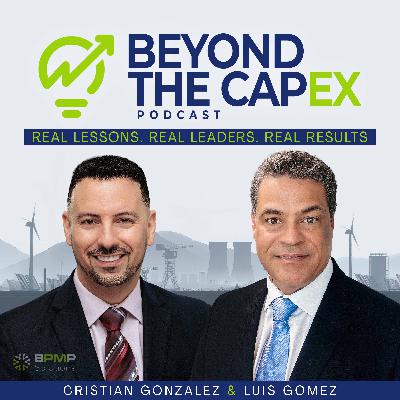
Beyond the CapEx
Subscribed: 1Played: 1
Subscribe

© BPMP Solutions
Description
Beyond the CapEx is a podcast about mastering capital projects through leadership, vision, and disciplined execution. Each episode offers practical insights into coordination, strategy, and lessons learned from real projects: both successful and failed.
We go beyond the numbers to explore what drives long-term success and how strategic leadership aligns execution with business goals when project complexity and stakes are high.
We go beyond the numbers to explore what drives long-term success and how strategic leadership aligns execution with business goals when project complexity and stakes are high.
11 Episodes
Reverse
In Episode 11 of Beyond the CapEx, Cristian Gonzalez and Luis Gomez are joined by Bryan Guess, Founder of Bartizan, to explore why so many projects fail even when the technical work is done right.Bryan shares a real-world story from commercial construction: a six-figure roof replacement executed flawlessly… only for the building to be sold and demolished months later. The takeaway applies across industries, including industrial capital projects, manufacturing, construction, and complex operational initiatives, most failures aren’t technical. They’re business and people problems wearing technical disguises.The conversation dives into front-end planning (FEL),stakeholder alignment, PMO governance, and the hidden risks of tribal knowledge and organizational silos. Cristian, Luis, and Bryan discuss why organizations repeatedly skip the “vitamins” that prevent rework and firefighting, and instead rely on reactive fixes after damage is already done.This episode also explores how trust is built, why detractors can become your strongest allies, and why small projects can be just as complex, if not more, than large capital investments when alignment and governance are missing.If you work in project management, capital projects, FEL/FEED, engineering, operations, manufacturing, or PMOs, this episode will help you spot early warning signs and ensure projects are aligned with real business objectives before time and money are lost.Guest: Bryan Guess, Founder of BartizanWebsite: www.bartizan.groupLinkedIn: https://www.linkedin.com/in/bryan-guess/⏱️ Chapters00:00 – Projects, politics, and why alignment isn’t a vote01:02 – Introducing Bryan Guess and cross-industry failure patterns03:44 – The $100k roof: perfect execution, wrong business objective07:20 – PMOs, governance, and tribal knowledge13:42 – Why process improvement fails after the crisis20:44 – Turning detractors into champions32:10 – Why small projects can be harder than big ones37:31 – Wrap-up and how to connect with Bryan📩 ContactQuestions or topics you’d like us to cover?Email podcast@bpmpsolutions.com🌐 www.beyondthecapex.com 🌐www.bpmpsolutions.comIf this episode resonated, please follow, rate, and reviewthe show.
In this episode of Beyond the CapEx, Cristian Gonzalez and Luis challenge one of the most common blind spots in capital projects and CapEx decision-making: the belief that capital risk starts in execution.It doesn’t.The most consequential risks are embedded early, during front-end loading (FEL), project shaping, and business case development — when spending is low, scrutiny is minimal, and leadership attention is often elsewhere. By the time a project reaches approval, most of the enterprise value, capital exposure, and optionality are already locked in.This conversation reframes capital risk away from dashboards, controls, and execution metrics, and toward decision quality, project governance, and leadership involvement at the front end. The hosts explore why project predictability continues to elude the industry, how “small” early decisions create irreversible commitments, and why execution teams don’t create problems, they inherit them.This episode is essential listening for CEOs, CFOs, board members, project sponsors, investors, and leaders responsible for capital allocation, industrial projects, megaprojects, and protecting enterprise value through major capital investments.Key takeaway:Execution doesn’t destroy value. It delivers exactly what was shaped upstream.⏱️ Chapters01:30 – Why early decisions have the greatest influence03:45 – Predictability problems: are we focusing too late?06:20 – FEL spending vs. asymmetrical risk09:30 – Commitment risk vs. execution risk13:00 – The “brick wall” analogy for poor front-end discipline18:00 – Optionality and silent decisions22:30 – Governance without bureaucracy26:00 – Why execution only delivers what was shaped early29:50 – Final takeaway for CEOs, CFOs, and boards📩 ContactQuestions or topics you’d like us to cover?Email podcast@bpmpsolutions.com🌐 www.beyondthecapex.com 🌐 www.bpmpsolutions.comIf this episode resonated, please follow, rate, and review the show.
In this episode of Beyond the CapEx, Cristian Gonzalez and Luis Gomez examine why the project charter is one of the most underutilized — yet critical — tools in capital project delivery.Many projects begin with broad agreement but vague definitions of success. This conversation explains how unclear objectives, weak decision boundaries, and implicit assumptions create misalignment that surfaces later as rework, conflict, and lost value.Cristian and Luis reframe the charter as a decision framework, not a formality, one that aligns stakeholders, clarifies intent,and anchors governance throughout the project lifecycle.This episode is essential listening for sponsors, project directors, and leaders responsible for aligning organizations before execution begins.Key takeawayIf success isn’t explicit, execution will optimize the wrong outcome.⏱️ Chapters01:20 – Why charters are often ignored04:40 – Alignment versus agreement08:50 – Defining success before execution13:30 – Decision boundaries and authority18:10 – Governance anchored in intent22:50 – Using the charter throughout execution27:30 – Final perspective on alignment 📩 ContactQuestions or topics you’d like us to cover? Email podcast@bpmpsolutions.com🌐 www.beyondthecapex.com 🌐www.bpmpsolutions.comIf this episode resonated, please follow, rate, and reviewthe show.
In this episode of Beyond the CapEx, Cristian Gonzalez and Luis Gomez reframe the role of the Project Management Office (PMO) from a perceived administrative burden to an owner’s value-protection system.Projects are complex, capital-intensive, and exposed to decision risk long before execution begins. Relying solely on individual capability, even strong capability, is not a strategy. This conversation explains how a PMO establishes consistency in decision-making, governance, and accountability across capital portfolios.Cristian and Luis clarify what a PMO is — and what it is not— and explain why organizations without these disciplines struggle to achieve predictable outcomes despite experienced teams.This episode is essential listening for executives, sponsors, and organizations scaling capital investment.Key takeawayGood people need systems that protect their decisions.⏱️ Chapters01:10 – Why “good people” isn’t enough04:20 – PMO myths and misconceptions08:30 – Governance as value protection13:10 – PMO versus bureaucracy17:50 – Portfolio-level discipline22:20 – Owner accountability26:40 – PMO as an operating system30:00 – Final perspective on predictability📩 ContactQuestions or topics you’d like us to cover? Email podcast@bpmpsolutions.com🌐 www.beyondthecapex.com 🌐www.bpmpsolutions.comIf this episode resonated, please follow, rate, and reviewthe show.
In this episode of Beyond the CapEx, Cristian Gonzalez and Luis Gomez explore how effective change control enables flexibility without sacrificing predictability.Change is inevitable in complex projects. The problem is not change itself, it is unmanaged change introduced without understanding its downstream consequences. This conversation examines how organizations confuse adaptability with permissiveness, and why disciplined change managementprotects both schedule and business intent.Cristian and Luis discuss the structural, cultural, and leadership elements required to manage change effectively once executionbegins, and why strong front-end alignment is the foundation of successful control mechanisms.This episode is essential listening for project leaders navigating evolving requirements under real-world constraints.Key takeawayChange is not the enemy; unmanaged change is.⏱️ Chapters01:20 – Change versus chaos04:50 – Why change control fails in practice09:00 – Leadership behavior and enforcement13:30 – Change timing and cost asymmetry18:10 – Governance without rigidity22:40 – Execution discipline under pressure27:20 – Final perspective on adaptive control 📩 ContactQuestions or topics you’d like us to cover?Email podcast@bpmpsolutions.com🌐 www.beyondthecapex.com 🌐www.bpmpsolutions.comIf this episode resonated, please follow, rate, and reviewthe show.
In this episode of Beyond the CapEx, Cristian Gonzalez and Luis Gomez challenge the assumption that front-end loading (FEL) is only necessary for large capital projects.Smaller projects often operate with thinner margins, tighter schedules, and less tolerance for error yet they are frequently rushed through early planning. This conversation explains why small projects require precision, not shortcuts, and how right-sizing FEL improves predictability without unnecessary overhead.Cristian and Luis discuss how FEL principles scale by intent, not volume, and why engineering rigor, scope clarity, and early discipline matter even more when projects cannot absorb mistakes.This episode is essential listening for operations leaders, maintenance teams, and organizations managing recurring capital work.Key takeawaySmall projects don’t tolerate mistakes, they amplify them. ⏱️ Chapters01:30 – Why “small” doesn’t mean simple04:40 – Error tolerance and scale08:10 – Right-sizing FEL without bureaucracy12:50 – Engineering rigor in small projects17:30 – Cost impacts of late corrections22:10 – Discipline versus overhead26:40 – Practical guidance for recurring capital work30:10 – Final perspective on proportional rigor 📩 ContactQuestions or topics you’d like us to cover? Email podcast@bpmpsolutions.com🌐 www.beyondthecapex.com 🌐www.bpmpsolutions.comIf this episode resonated, please follow, rate, and reviewthe show.
In this episode of Beyond the CapEx, Cristian Gonzalez and Luis Gomez examine one of the most underestimated threats to capital predictability: scope creep.Rarely driven by bad intent, scope creep often enters projects quietly — through well-meaning ideas, late input, and leadershipsignals that unintentionally bypass discipline. Over time, these incremental changes erode cost certainty, delay schedules, and weaken business outcomes without a single defining moment of failure.The conversation reframes scope creep as a leadership andcultural issue, not a paperwork problem. Cristian and Luis explore why strong front-end definition, clear decision boundaries, and consistent change governance are essential to protecting capital once execution begins.This episode is essential listening for sponsors, executives, and project leaders responsible for maintaining control without stifling good ideas.Key takeawayScope rarely explodes; it quietly accumulates. ⏱️ Chapters01:10 – Why scope creep is rarely intentional04:30 – Leadership signals and unintended consequences08:20 – Cultural roots of scope growth12:40 – Change discipline versus rigidity17:10 – Why small changes compound21:50 – Protecting capital during execution26:30 – Scope control as leadership behavior30:00 – Final perspective on discipline and trust 📩 ContactQuestions or topics you’d like us to cover? Email podcast@bpmpsolutions.com🌐 www.beyondthecapex.com 🌐www.bpmpsolutions.comIf this episode resonated, please follow, rate, and reviewthe show.
In this episode of Beyond the CapEx, Cristian Gonzalez and Luis Gomez explore how artificial intelligence can be used responsibly and effectively during front-end loading (FEL) without outsourcing judgment or accountability.As AI tools rapidly enter engineering, planning, and project management workflows, many organizations struggle to distinguish between acceleration and abdication. This conversation reframes AI as a decision-support partner, not a decision-maker, and clarifies where AI adds value; and whereit must never be accountable.Cristian and Luis walk through practical use cases for AI in FEL 1 and FEL 2, including research, option evaluation, and scenario development. They also discuss the limits of AI, emphasizing thataccountability, relationships, and judgment remain human responsibilities.This episode is essential listening for leaders exploring AI adoption while maintaining rigor, governance, and ownership in capital decision-making.Key takeawayAI can accelerate thinking but accountability must remainhuman. ⏱️ Chapters01:20 – Why AI belongs in front-end planning04:10 – AI as a decision-support partner07:30 – Where AI adds value in FEL 1 and FEL 211:40 – RACI, accountability, and AI limitations16:30 – Risk of outsourcing judgment20:40 – Human judgment and relationship-driven decisions25:10 – Responsible AI adoption in projects28:40 – Final perspective on AI and accountability 📩 ContactQuestions or topics you’d like us to cover? Email podcast@bpmpsolutions.com🌐 www.beyondthecapex.com 🌐www.bpmpsolutions.comIf this episode resonated, please follow, rate, and reviewthe show.
In this episode of Beyond the CapEx, Cristian Gonzalez and Luis Gomez unpack one of the most persistent sources of tension inindustrial capital projects: the fundamentally different ways owners and contractors perceive risk.Although both sides want projects to succeed, their businessmodels, incentives, and exposure to downside risk are not the same. These differences shape how contracts are priced, how contingencies are built, and why relationships often become adversarial, even when intentions are good.The conversation explores how risk is introduced upstreamthrough contracting strategies, scope definition, and front-end decisions. Cristian and Luis explain why execution teams are often blamed for outcomes that were structurally locked in long before construction began.For owners, sponsors, and commercial leaders, this episodeprovides a clear framework for understanding contractor behavior — and how better front-end alignment reduces friction, cost escalation, and value leakage.Key takeawayOwner-contractor conflict is rarely personal, it is usuallystructural. ⏱️ Chapters01:30 – Why owners and contractors see risk differently04:40 – Business models and risk exposure08:20 – Contracting strategy and unintended consequences12:50 – Lump-sum pricing and uncertainty17:40 – How early decisions shape execution behavior22:10 – Why execution inherits upstream risk26:30 – Creating win-win alignment30:00 – Final perspective on contracting discipline 📩 ContactQuestions or topics you’d like us to cover?Email podcast@bpmpsolutions.com🌐 www.beyondthecapex.com 🌐www.bpmpsolutions.comIf this episode resonated, please follow, rate, and reviewthe show.
In this episode of Beyond the CapEx, Cristian Gonzalez and Luis Gomez explore a subtle but critical distinction in capital project leadership: the difference between communicating information and creating genuine connection.Many project teams believe that dashboards, reports, and status meetings are enough to align organizations. Yet misalignment, resistance, and disengagement persist even when information is technically correct and widely distributed.This conversation examines why communication alone rarely changes behavior, and why connection — built through trust, listening, and shared understanding — is essential for driving alignment on complex projects. The hosts discuss how leadership presence, body language, and intent influence outcomes far more than metrics alone.For project leaders operating in high-stakes, multi-disciplinary environments, this episode reframes leadership as a human system, not just a technical one.This episode is essential listening for leaders responsible for mobilizing teams, influencing decisions, and aligning stakeholders across complex capital initiatives.Key takeawayAlignment doesn’t come from being heard, it comes from being understood. ⏱️ Chapters01:10 – Communication versus connection defined04:00 – Why information alone doesn’t drive alignment07:30 – Trust as a project performance variable11:10 – Active listening and leadership presence15:40 – Body language, intent, and influence19:30 – Remote work and the loss of connection cues23:50 – Creating alignment without authority27:40 – Final leadership reflection 📩 ContactQuestions or topics you’d like us to cover?Email podcast@bpmpsolutions.com🌐 www.beyondthecapex.com 🌐www.bpmpsolutions.comIf this episode resonated, please follow, rate, and reviewthe show.
In this inaugural episode of Beyond the CapEx, Cristian Gonzalez and Luis Gomez introduce the foundational discipline behind predictable industrial capital projects: front-end loading (FEL).Across the industry, a large percentage of capital projects miss their original cost, schedule, or performance objectives. Not because execution teams are ineffective, but because early decisions are made with incomplete definition, weak alignment, and limited appreciation for their long-term consequences.This conversation walks through the FEL stage-gate methodology, breaking down FEL 1, FEL 2, and FEL 3, and explaining the purpose of each phase in shaping scope, risk, and value. Cristian and Luis discuss why rushing early phases creates downstream uncertainty, cost growth, and operational challenges that often surface only after startup.Front-end planning is not bureaucracy. It is a decision-qualityand risk-management discipline that protects capital, improvespredictability, and strengthens business outcomes long before execution begins.Many of the principles discussed in this episode are expanded in The Industrial Capital Project Playbook, a practical guide for project leaders navigating early-stage decision-making, risk, and alignment in complex industrial investments: 📘 https://a.co/d/0eYKK6QzThis episode establishes the core philosophy of Beyond the CapEx and sets the foundation for how disciplined early decisions shape everything that follows.Key takeawayProjects don’t lose value in execution — they inherit the consequences of early decisions. ⏱️ Chapters01:20 – Why early decisions dominate project outcomes03:40 – Cost, schedule, and performance gaps in capital projects06:10 – What front-end loading actually is (and isn’t)09:00 – FEL 1, FEL 2, and FEL 3 explained14:30 – Why FEL 2 is where predictability is won or lost18:50 – The long-tail consequences of rushing early phases23:40 – Front-end discipline as risk management27:10 – Final perspective on capital predictability 📩 ContactQuestions or topics you’d like us to cover?Email podcast@bpmpsolutions.com🌐 www.beyondthecapex.com 🌐www.bpmpsolutions.comIf this episode resonated, please follow, rate, and review the show.
Comments


Download from Google Play

Download from App Store
 United States