


 Claim Ownership
Differentiated Understanding
Subscribed: 6Played: 43
Subscribe

© Proem
Description
Every episode, I bring in a guest with a unique point of view on a critical matter, phenomenon, or business trend—someone who can help us see things differently.
aiproem.substack.com
aiproem.substack.com
21 Episodes
Reverse
Every panel on AI and geopolitics seems to default to the same cliché: “the US–China race.” In this episode of Differential Understanding, I wanted to sit with someone who has actually lived inside DC, Silicon Valley, and the US–China tech corridor, and ask whether that framing still makes sense.My guest is Kevin Xu, founder of Interconnected Capital – a global hedge fund focused on the picks and shovels of AI – and author of the Interconnected newsletter, which sits at the intersection of tech, business, and geopolitics. Kevin’s path runs from Obama campaign staffer and White House / Commerce Department comms to GitHub’s international expansion lead, and now to full-time investor–writer with a very explicit geopolitical lens.We start with why he insists on “thinking in public” as an investor, and why he believes ideas soulocking in a vault. From there, we dive into his critique of the “race” narrative and his alternative concept of US–China co-opetition – a messy mix of competition, cooperation, and outright co-opting of each other’s models and research. That leads naturally into China’s open-source AI ecosystem, the Manus–Meta deal, and what he would need to see before feeling comfortable owning the upcoming MiniMax and Zhipu IPOs in Hong Kong.In the second half, we zoom out to sovereign AI: why South Korea might be one of the few countries outside the US and China with a shot at true full-stack AI sovereignty; how to read OpenAI’s Stargate initiative as an explicit American export play; and why the Gulf – particularly the UAE – is emerging as an AI “swing vote”, combining abundant energy, sovereign wealth, and a 1.5 million-strong construction workforce into a potential global compute hub. We close with Kevin’s differentiated view on China: AI diffusion is far more visible there, but the economic impact is not necessarily greater, and Beijing may end up being the first government forced to confront AI’s social implications.In today’s world, there’s no shortage of information. Knowledge is abundant, perspectives are everywhere. But true insight doesn’t come from access alone—it comes from differentiated understanding. It’s the ability to piece together scattered signals, cut through the noise and clutter, and form a clear, original perspective on a situation, a trend, a business, or a person. That’s what makes understanding powerful.Every episode, I bring in a guest with a unique point of view on a critical matter, phenomenon, or business trend—someone who can help us see things differently.For more information on the podcast series, see here.Timestamps (chapters):* 00:57 – From DC to GitHub to Interconnected Capital* 02:39 – Why Kevin “thinks in public” and writes Interconnected* 04:44 – US–China AI is not a “race”: co-opetition explained* 09:27 – Open-source / open-weight AI as last bastion of global cooperation* 12:14 – Capital flows, decoupling and why “capital finds a way”* 15:36 – Manus x Meta: product quality, viral growth, rationality in AI* 19:40 – MiniMax & Zhipu IPOs: revenue reality vs AI lab hype* 24:39 – Can Chinese labs win the Global South with cheaper AI?* 27:09 – Sovereign AI 101 and why South Korea looks uniquely powerful* 32:03 – Stargate as de-facto US sovereign AI and export strategy* 34:44 – Kevin’s trip to UAE: Gulf AI strategies and the “swing vote” thesis* 40:06 – Sovereign funds, MGX, and attracting talent from Hong Kong & beyond* 44:18 – Non-consensus bet: UAE Stargate as a global compute hub* 46:57 – Differentiated views on China AI diffusion and economic impact* 51:29 – Embodied AI, “aunties pressing elevator buttons” and social risk* 55:01 – Robotaxis, delivery drivers, and why China may go slower than expectedAI-generated transcriptGrace Shao (00:00)Hey everyone, welcome back to another episode of Differential Understanding. This is your host, Grace Shao And joining me today is Kevin XuKevin Xu is the founder of Interconnected Capital, a global hedge fund focused on the picks and shovels of AI. He writes the Interconnected newsletter on SubSac, which covers tech, business, and geopolitics.His insights have been frequently cited by the New York Times, Bloomberg, Economist, CNBC Information, Financial Times, Wall Street Journal, among many other media outlets. He previously worked as a senior executive at GitHub, the world’s largest developer platform, and served in the White House and Commerce Department during the Obama administration. He studied international relations at Brown University and law and computer science at Stanford.Grace Shao (00:40) Hey Kevin, thank you so much for joining us today. I already introduced you, but for listeners who may not know you that well, can you introduce yourself, the different hats you wear today, running Interconnected Capital, writing Interconnected Newsletter, and operating at the intersection of US, Asia, tech, geopolitics, and investing.Kevin Xu (00:57) Yeah, first of all, thank you for having me. So as you mentioned, what I do currently during the day is I write the interconnected newsletter on the intersections of geopolitics, technology, and business. I also run my own long only fund called Interconnected Capital, focused on the picks and shovels of AI, both hardware and software. Prior to that, I actually work as an operator inside multiple Silicon Valley tech startups. The most recent one is GitHub, which is the Microsoft-owned developerplatform. I was their lead for international expansion strategy. That was my most recent real job, if you will. I also spent a bunch of time at different startups of varying sizes. And before that, actually started my career in politics. So I joined the first Obama administration’s campaign back in 2008. I was a campaign staffer. That was my first job out of college and then moved with the campaign team to DC, ⁓ worked in a few different roles.in the Commerce Department as well as the White House doing mostly press and communications work. So that is ⁓ my sort of all over the place background that led me to what I’m doing today, which is investing and writing ⁓ in technology, but with a very heavy geopolitical lens to the process.Grace Shao (02:13) I think that’s really interesting and explains to why you have a geopolitical lens, given that you actually have a DC background, right? But you run a fund and you actually keep most of your thinking, public, So instead of just keeping it mostly all private, which is what most investors do, why do you publish a very opinionated, very insightful sub stack and, share it very, I think generously with the public?What kind of conversation gap are you trying to fill when you start the interconnected newsletter?Kevin Xu (02:39) I think there are two elements to that. First is that this is more of my Silicon Valley ethos, which is that no idea is that worth keeping in secret. It’s all about the execution. Like I’m not, I didn’t come from a Wall Street finance background, right? Where a proprietary trading algorithm or some secret information you got from a meeting is this big trade secret that you want to lock into a vault inside Goldman Sachs or whatever. And that’s going to make you billions of dollars. That is not my approach to investing.I think thinking in public, sharing in public, and really getting the feedback that I get from writing is much more valuable than keeping all these thoughts in my head as if they’re the next best thing since sliced bread. When you actually write it down, when you put it out into the internet, half of them are good, half of them are actually crap. And I use writing and writing in public specifically basically as a canvas for meto think better, to hold my thoughts more clearly. I think knowing how to think is the most important skill for any investor to be able to succeed for the long term. And if any idea that I shared out there benefits somebody else, and you made some money off of it for free, so be it. Good for you that you actually understood some of the value from the writing, even perhaps more than I did as the writer. But for me, that’s not something that I keep very possessively as a trade secret.Grace Shao (04:00) I really relate to that and I think exactly to your point you’re like writing everything down is the way of thinking through your thoughts sometimes it’s all jumbled up in there and then also people ask me why do you keep AI Pro all free? I was like well if it really benefits you you know I don’t really mind I’m not trying to make money off of like selling you know just my content but really the content is my thinking and to your point sometimes I put in so much work and then the result and feedback is so bad and then some things I just kind of like throw out thereAnd then it actually really sticks with people you never know. It’s really good to get the feedback from the public as well. Well, I think now I want to ask you about your journey into investing and really covering China and US. So you are based in the US, but you are Chinese.birth, right? ⁓ So does that play into why you cover China-U.S. related work right now? And I do want to talk about your recent article, which you said you think calling the China-U.S. relationship in tech and AI a race is quite lazy. You said instead of seeing it as pure competition, you think it’s more of a competition. So cooperation plus competition. Do walk us through that and how you kind of came out with this frame.Kevin Xu (04:44) Correct.So just to put a finer print on it, as far as the personal history is concerned, I was born in China. I moved to Canada when I was little, similar to you, think, Grace. And I moved to US later on. So obviously, I work in the US government. So I’m a US citizen. So I’m actually a card-carrying Canadian as well as an American right now. And I think having had a very global citizen-ishGrace Shao (05:22) Mm-hmm.Kevin Xu (05:30) upbringing and life experience was the lens that wanted to bring to my newsletter when I first started writing
In this episode, I sit down with Alan Zhang (Principal & Portfolio Manager at Ox Capital Management) to map China’s tech landscape through an investor’s lens. We break down how Alibaba, Tencent, and ByteDance are approaching AI, and why the “AI OS” is the real endgame. Finally, we analyze what’s changing in China’s consumer internet, EV ecosystem, and embodied AI pipeline. We also unpack China’s delivery wars (Alibaba vs Meituan vs JD), why quick commerce is structurally different from traditional e-commerce, and how markets price geopolitical risk into China tech valuations.Alan Zhang is a Principal and Portfolio Manager at Ox Capital Management, a boutique investment firm focused on emerging market equities that he co-founded in 2021. At OxCap, Alan leads investments across Asia; previously, he spent years as an investment analyst on the Asia team at Platinum Asset Management.He studied Actuarial Science and Commerce at the University of New South Wales, and he’s even taught advanced econometrics. So if you like the intersection of fundamentals, market structure, and Asia platform businesses, well then, this one’s for you.In today’s world, there’s no shortage of information. Knowledge is abundant, perspectives are everywhere. But true insight doesn’t come from access alone—it comes from differentiated understanding. It’s the ability to piece together scattered signals, cut through the noise and clutter, and form a clear, original perspective on a situation, a trend, a business, or a person. That’s what makes understanding powerful.Every episode, I bring in a guest with a unique point of view on a critical matter, phenomenon, or business trend—someone who can help us see things differently.For more information on the podcast series, see here.Chapters 01:34 Alan’s background: quant → Asia equities03:11 US vs China AI: frontier vs “two-legged” approach05:25 “Uninvestable” China and what changed07:31 Beyond BAT: Xiaomi, Meituan, Mindray, MicroPort09:24 BAT AI strategies and the AI OS thesis13:45 Tencent: tools, data, distribution, and model strategy16:33 AI-native phones: ByteDance × ZTE and what’s next26:51 China EV landscape: BYD, Huawei, Xiaomi, Zeekr31:28 Why phone OEMs can compete in EVs34:16 Embodied AI: robotics parts, redundancy, and Unitree39:38 Valuation + geopolitics: why Asia tech trades discounted41:53 China delivery wars: subsidies, quick commerce, Meituan’s edge50:27 12–18 month predictions + what investors miss (healthcare)AI-Generated TranscriptGrace Shao (00:00)In today’s world, there’s no shortage of information. Knowledge is abundant. Perspectives are everywhere. But true insight doesn’t come from access alone. It comes from differentiated understanding — the ability to piece together scattered signals, cut through the noise and clutter, and form a clear, original perspective on a situation, a trend, a business, or a person. That’s what makes understanding powerful.Every episode, I bring in a guest with a unique point of view on a critical matter, phenomenon, or business trend — someone who can help us see things differently.So today, joining me is Alan Zhang. And I’m Grace Shao. Alan, really excited to have you. I’m excited about today’s conversation because we’re going to get into the investor’s perspective on Asia tech and emerging markets — with a proper markets-and-math backbone.Alan Zhang is Principal and Portfolio Manager at Ox Capital Management, a boutique investment firm focused on emerging market equities that he co-founded in 2021. At OxCap, Alan leads investments across Asia. Before that, he spent years as an investment analyst on the Asia team at Platinum Asset Management. He studied actuarial science and commerce at the University of New South Wales, and he’s even taught advanced econometrics.So if you like the intersection of fundamentals, market structure, and Asia platform businesses, this episode is for you. Alan, welcome.Alan Zhang (01:31)Thank you, Grace. Pleasure to be here.Grace Shao (01:34)Alan, to start, why don’t you tell us about yourself — your background — and what it is that you cover now?Alan Zhang (01:40)I grew up partly in Hong Kong, mainland China — Shenzhen particularly — and in Australia. I spent close to a decade in Australia doing my schooling and education, and worked for a firm called Platinum Asset Management, then co-founded Ox Capital with Joseph Lai.I studied actuarial science, so I’ve had a lot of experience manipulating numbers, cleaning up data — and that helped me tremendously in public equities. Nowadays there’s no shortage of financial data, and the ability to understand them — and the intent behind them — is crucial to investing.Grace Shao (02:34)Yeah, yeah.Alan Zhang (02:46)At Ox Capital, we also built a tool called the Mode Model, which distills more than a million financial data points from various sources to help us understand our coverage region a lot more. In terms of my coverage, I build quant models, I look at equities, and I also help with portfolio positioning based on macroeconomics in Asia.Grace Shao (03:11)That’s interesting because you started off in quant, but now you’re looking at equities — the fundamentals, right? You’re covering a lot of ADRs, and a lot of China’s big tech.Let’s talk about that. What is the China big tech internet ecosystem looking like right now? How does it compare to the US?Alan Zhang (03:20)In the US, they are focusing more on frontier models, while Chinese companies are taking more of a two-legged approach — tackling AI with different approaches. The US has invested a lot of resources into advancing frontier models. On one hand, we see successful cases like Gemini, Anthropic, and OpenAI, while we also see a lot of AI subscriptions cutting their prices by more than 90% in the last few years.If you remember in 2023 and 2024, many subscriptions were priced at a few hundred — some over $1,000 a month — based on investment assumptions. Now they’re cutting prices to sub-$100 a month. Some may never make their money back based on those assumptions, but it’s not being discussed today because the benefit of AI far outweighs that blip, and large-cap companies are investing enough to offset the impact.If we look at China, they haven’t gone through this episode — and I don’t think they will. Anyone who looks at Asia understands Asian users will never assume people will pay over $1,000 a month for subscriptions. China is working on frontier models, applications, and infrastructure at the same time.In summary, China is still the runner-up, but they’re developing AI in a more balanced manner. And it’s also good to see the US pivoting — in the recent 12 months, we’re seeing more US companies investing in software and applications rather than just frontier models.Grace Shao (05:25)China was deemed uninvestable, especially for Western investors. Your fund is based in Australia and Hong Kong, and your LPs are non-Chinese. For public investors who want exposure to China’s AI upside — what are they looking at? What are they thinking?Alan Zhang (05:46)Usually the big tech. China went through the property adjustment and the antitrust campaign in the internet space. It was painful — people called it uninvestable because they couldn’t see new growth drivers. And if they could, they were too insignificant compared to the two most important industries at the time: internet tech and property, which were both recalibrating.But things are different now because investors can see new growth drivers scaling up. In hindsight, these adjustments also helped innovation: talent that dreamed of landing a job at Meituan, Tencent, Alibaba went to smaller firms or startups; capital that made easy money in real estate went to new areas.Economic transformation is still a work in progress, and investing in China becomes more attractive if we see AI, consumption, and advanced manufacturing play a bigger role. We’re still in that phase. But we’re glad to see some companies bottoming out and making progress under the current setup.Grace Shao (07:19)In a pragmatic way, does that mean we’re looking at BAT? What companies should we be looking at for exposure to Chinese AI and economic transformation?Alan Zhang (07:31)Besides Alibaba and Tencent, people should look at relatively smaller cap — but still large-cap — companies like Xiaomi and Meituan. And also industries outside the internet. For example, Mindray in healthcare, or MicroPort in surgical robotics — they can implement AI into their products and make their portfolio more attractive.Grace Shao (07:41)When we chatted offline, you said a lot of companies are overlooked. Beyond BAT — what are some “1.5 tier” or “second-tier” companies that are huge by market cap but not well known in the West?Alan Zhang (08:09)People will naturally see them more over time. Tencent and Alibaba were making active efforts overseas; now as the market matures, more companies are going global. If I’m on a roadshow, people ask about Keeta, which is a subsidiary of Meituan. Xiaomi is opening more stores in Europe — even Africa and South America. People will naturally see them more.If you come to China and compare what’s here to where you live, you’ll see a clear difference.Grace Shao (09:24)Let’s double click on BAT — Alibaba, Tencent, and ByteDance. At a high level, how do you compare their AI strategies? Are they playing the same game, or different playbooks?Alan Zhang (09:52)Same, but different. They’re all investing heavily in frontier models and infrastructure. Ultimately, they all want to build the AI OS people will use. The DoorDash–OpenAI collaboration was a good example of what AI and a commerce company can do. Whether it’s an app within an app or an app within a phone — that’s still an open question.Alibaba is e-commerce and cloud. They have to build a competitive model or their cloud becomes commoditized. Tencent is a platform — they build tools. In LLMs or AGI, late movers can have an advantage because users
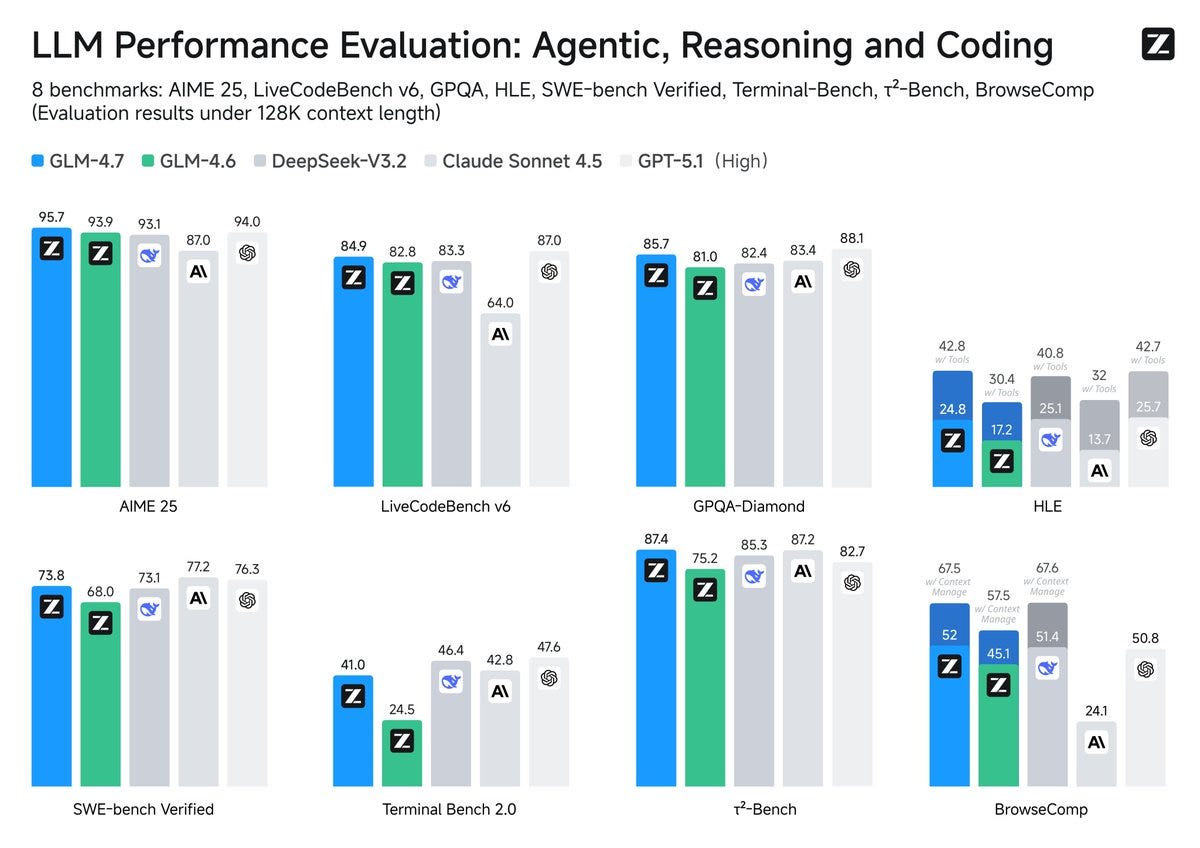
In this episode, I sit down with Zixuan Li, who leads the chat API and global partnerships at Z.ai, one of China’s leading LLM labs (one of the four tigers) and now one of the first to head toward an IPO. Z.ai started as THUDM, a Tsinghua data-mining lab best known in open-source circles for GLM and CogVideo, and has since grown into a model-as-a-service platform powering millions of devices and thousands of enterprises in China and beyond.We talk about what it actually means to be an “independent” lab in a market dominated by platform giants like Alibaba, ByteDance, and Tencent, why Z.ai pivoted from SOE-heavy infrastructure projects to a product-led GLM stack, and how they landed on a different business model, and the creation of the GLM Coding Plan, instead of charging by tokens. Zixuan is very candid about pricing (“If Anthropic charges $200, we charge 200 yuan”), the realities of on-prem-first China vs cloud-first West, and what it’s like to race against Minimax and Moonshot with fewer GPUs and less cash.We also zoom out and look at China’s AI talent pipeline (and the meme that the AI race is “Chinese in China vs Chinese in the US”), how he thinks about AGI as self-learning agents that live on your phone, why he’s comfortable being a white-label backbone in the Global South, and where he sees China’s AI landscape in the next 6–12 months. If you want a ground-level view of how a Tsinghua spinout is trying to survive, and maybe win, in the LLM wars, this one’s for you.Newly launched (Dec. 22) GLM 4.7: In today’s world, there’s no shortage of information. Knowledge is abundant, perspectives are everywhere. But true insight doesn’t come from access alone—it comes from differentiated understanding. It’s the ability to piece together scattered signals, cut through the noise and clutter, and form a clear, original perspective on a situation, a trend, a business, or a person. That’s what makes understanding powerful.Every episode, I bring in a guest with a unique point of view on a critical matter, phenomenon, or business trend—someone who can help us see things differently.For more information on the podcast series, see here.01:20 – From THUDM to Z.ai: rebrand, Tsinghua roots, and model-as-a-service03:30 – Quiet period & IPO: pride, pressure, and the business challenge of LLMs06:33 – Pivoting from SOEs: infra projects, agentic models, and why strategy followed capability07:25 – Competing with Minimax, Moonshot & DeepSeek: focus, compute, and capital constraints08:34 – Chasing benchmarks vs real-world IQ: math, humanities, and alignment trade-offs11:05 – On-prem vs cloud: why Chinese SOEs still won’t touch APIs13:43 – Zero-retention and trust: can China’s culture around data ever shift?14:07 – Inventing the GLM Coding Plan: subscriptions, stickiness, and “pay by value, not tokens”16:00 – “If Anthropic charges $200, we charge 200 yuan”: pricing strategy and margins and GLM’s open-source flywheel19:41 – Who really pays: sticky indie devs, big tech customers, and bargaining power23:32 – GLM Coding Plan vs Cursor/Qwen/Claude: plans, agents, and avoiding lock-in25:57 – Z.ai’s AGI ladder: AutoGLM, self-learning, and personalized weights27:03 – Independent labs vs platforms in China: speed, resources, and “dirty work”29:34 – Moonshot vs Z.ai: chasing the moon vs being “down to earth”30:53 – Will China’s LLM market consolidate?: 5–10 players, Doubao, and video-generation winners31:44 – Doubao phone & Honor partnership: bargaining power with OEMs34:11 – Beyond China–US: Global South strategy and being a white-label backbone35:29 – Being comfortable as infrastructure: letting others own the brand38:05 – Who joins Z.ai and AI talent: thriving with scarce resources40:07 – Culture, 007 hours, and survival: what it takes to be infrastructure42:33 – Social welfare, AI safety, and cheap tools in India & Indonesia44:38 – How China actually talks about AI safety (or doesn’t)47:29 – Differentiated view: why Zixuan believes you should “enjoy lacking resources”AI-Generated TranscriptGrace Shao:Hey Zixuan, thank you so much for joining us today. Really excited to have you on. Walk us through your journey and what led you to Z.ai to start off with.Zixuan Li:Yeah, so currently I’m the head of Zhipu AI’s chat API services and also head of global partnerships. I collaborate with LMSys Chatbot Arena, OpenRouter, Vercel, these large companies, and ship our products through their platforms.The reason why I joined Zhipu is it’s one of the leading AI labs in China and I can do overseas businesses, because I have a background at MIT’s Schwarzman College of Computing. So that brings my knowledge into real-world practice.Grace:I see. Was there any incentive for you to move back to China versus stay in the US?Zixuan:I think it’s more personal, because my wife’s based in China and she’s used to her work, so there’s no way she can move to the US.Grace:Fair enough.So let’s talk about the company’s mission and origins, because I think it does seem a bit mysterious, especially to people outside of China. From the outside, people know Zhipu, Z.ai as one of the leading Chinese LLMs. But that doesn’t really capture everything you guys do, right?In your recent prospectus, you describe yourself as a MaaS — model-as-a-service — company first. So tell us about that.Zixuan:Okay, so before Zhipu AI, we were called Zhipu or THUDM, because we named ourselves by the AI lab’s name. We originated from Tsinghua University’s data mining group — THUDM. But I think it’s hard to pronounce, and also “Zhipu” is also very hard to pronounce. So this year we bought the Z.ai domain and finally changed our name to Z.ai.When we were called THUDM, we were very famous inside the open-source community because we had a lot of repos, a lot of models under the THUDM name. And we open-sourced not only text models, also CogVideo, CogView, these models. I think they were sold at that time.But with the launch of VEO, Hailuo, and also a lot of current top models, we began to be more focused — basically more focused on text models, visual understanding, and so on. So I think that’s the origination of the lab.But as you said, there’s this terminology called model-as-a-service. From our side, when we compete with large companies like Alibaba and ByteDance, we need to be more focused. They have their inference level, they have their cloud services, but we don’t. So we try to let the model itself provide the service — like the API, or technologies like visual understanding — and try to use the model itself to be the selling point.Grace:I definitely want to double-click on how you position yourself compared to peers — a few of them you just mentioned, whether it’s Minimax and Moonshot, and then you also mentioned the BATs.But to start off with, you’re currently in your quiet period as your prospectus just hit the public. And if successful, you will become one of the first major LLM startups globally to be listed on a stock exchange. How does that feel?Zixuan:I think we are proud of it, but things are very challenging, because it’s really hard to do LLM inference. Both OpenAI and Anthropic have very high revenue, but a lot of loss on their income statements. So we have to figure out how to make money from large language models and also provide cheaper service to the customer.So I think it’s only a starting point for us.Grace:Definitely. I think right now only the big tech companies in many ways are essentially seeing ROI, and the model companies and the model labs themselves are really finding it hard to make a profit.I want to ask you about the branding. You did say you guys changed your company’s name to Z.ai this year, partially because Zhipu is just hard to pronounce. But was that also related to the fact that you guys seem to have made a pivot into really focusing on going global? Z.ai seems to be a lot more non-Chinese-native-speaker friendly, right? So is that the push right now?Zixuan:I think that played an important role, because we have observed the success of DeepSeek, Qwen — they got famous globally and Chinese people will think that they are the “SOTA” in the domain and their models are the best. They are recognized by NVIDIA and other large company CEOs. So I think that’s one factor.But the other factor is when we changed the name to Z.ai, the dot also plays an important role. We want people to enter that URL into their browser and try to visit our website. Yeah, two factors.Grace:And tell me about your origin story, actually. You mentioned earlier you started off from the Tsinghua data mining group. Maybe provide some context to people outside of China. What does Tsinghua represent? I mean, it’s an institution, it’s a university, but why are so many of these LLM companies or even deep tech companies coming out of Tsinghua right now?Zixuan:I think it’s kind of a combination of Stanford and MIT. So talents are everywhere and there’s a lot of funding from internally and also externally. And also people are chasing the highest IQ there. So it will be very natural to pursue AI in Tsinghua University.Grace:So I have a question on that, because a lot of tech companies, even the previous generation internet companies that came out of Tsinghua, had some kind of connection with Beijing city. And my understanding is Zhipu’s original business model was also very focused on SOEs and local government work, both in China and even across Southeast Asia.Before the more recent pivot leaning into tools and APIs, what were the reasons for the pivot from the heavy AI infrastructure focus and SOE projects to a much more product-led tools and API strategy?Zixuan:I think it depends on the capabilities of the model, because nowadays the model can perform agentic tasks, use tools, use coding to perform tasks. But before that, we could only do customer service, data processing — these “dirty work.” I think it’s better for SOEs or other scenarios.But with the change of Cloud Code, GLM 4.5, these agentic stuf
In this episode, I sit down with Kyle Chan (Brookings Institution) to unpack the thinking behind his provocative New York Times op-ed, “In the Future, China Will Be Dominant, the U.S. Will Be Irrelevant.” We start with the DeepSeek moment and why it surprised the West, why it didn’t surprise many China-watchers, and why Kyle sees it as only “the tip of the iceberg.”From there, we zoom out into the bigger story: China’s rise isn’t just one breakthrough model or one champion company. It’s a system of interlocking capabilities: EVs, batteries, renewables, industrial automation, robotics, and AI, advancing in parallel and reinforcing each other through spillovers, supply chains, and fast-moving “Swiss Army Knife companies” like Xiaomi and Huawei.We also dig into what people often get wrong about China’s state role: not pure top-down command, but a mix of industrial policy + private-sector experimentation, including practical mechanisms like compute vouchers and local-government support. Finally, we cover India’s trajectory, geopolitical constraints, and Kyle’s “hedges”—scenarios in which today’s narratives (in both China and the U.S.) could still break in unexpected directions.Relevant links: https://www.brookings.edu/people/kyle-chan/In today’s world, there’s no shortage of information. Knowledge is abundant, perspectives are everywhere. But true insight doesn’t come from access alone—it comes from differentiated understanding. It’s the ability to piece together scattered signals, cut through the noise and clutter, and form a clear, original perspective on a situation, a trend, a business, or a person. That’s what makes understanding powerful.Every episode, I bring in a guest with a unique point of view on a critical matter, phenomenon, or business trend—someone who can help us see things differently.For more information on the podcast series, see here.00:00 — The NYT op-ed + the DeepSeek catalyst: why Kyle wrote the piece, what he wanted to correct, and why DeepSeek was a wake-up call (“tip of the iceberg”).06:53 — Kyle’s origin story: infrastructure obsession (high-speed rail) → the path into tech & industrial policy.12:31 — China’s “electric tech stack” + spillovers: EVs, batteries, renewables, robotics, AI moving in parallel—and why “Swiss Army Knife” firms (Xiaomi/Huawei) can leap across categories.19:12 — Why autonomy pairs with EVs: the technical and architectural reasons autonomous systems “almost always” sit on EV platforms.24:01 — China AI ecosystem in practice: startups + hyperscalers + policy “tailwinds” (compute vouchers, industrial parks, local government support) and how that differs from the U.S. model.29:46 — China’s development playbook vs others + the India comparison: proactive bottleneck-solving (“ground game”), plus India’s tailwinds and constraints over the next decade.41:00 — The hedges + the wrap: what could derail or reshape the trajectory (trade backlash, geopolitics, bubble risk, robotics paths), and Kyle’s non-consensus take on policy intervention.AI-generated transcriptGrace Shao (00:00)Hi, Kyle. Thank you so much for joining us today. Kyle, I want to start with your recent New York Times op-ed, which had a pretty provocative headline. It’s called, In the Future, China Will Be Dominant, the U.S. Will Be Irrelevant. When I saw that, I was like, whoa, this guy, someone’s going to go get blood now. How did that piece actually come about? What was the main, I guess, objective or goal out of that piece?Kyle Chan (00:16)Yeah, yeah. Thanks for asking about that piece. Yeah, that piece, it got quite a reaction. I was surprised. And there’s been a number of pieces I feel like now—sort of, it’s almost become a genre of like all the things that China’s doing, all the things that the US is doing, the sort of divergent trajectories of the two countries, especially on technology. And for me, one thing I really wanted to focus on was—So we had the big DeepSeek moment earlier in the year, and that really got people to wake up and take notice of what’s happening in China and China’s tech development in a way that really, I mean, I can’t remember the last time that something like that happened. And so that was quite a big wake up call. But as someone following a number of different sectors in China for a while, I was like, this is just the tip of the iceberg.I mean, first off, within AI itself, DeepSeek—I think it was kind of funny—was surprising for a lot of people who follow actually China’s AI industry quite closely, because I think we might have been expecting some of the bigger tech companies to have made a bigger splash, but DeepSeek seemed a little bit out of left field. But within AI in China in general, there is so much talent, so much engineering talent, a vibrant developer community, top-notch researchers.So like when you look at, say, who is accepted, whose papers are accepted for NeurIPS, one of the top AI conferences, right? It’s many, many, many names from Peking University or Tsinghua University or Zhejiang University. And so if you follow that space for a while, DeepSeek was not so surprising. Maybe it was surprising that it was DeepSeek itself, but that China could produce a world-class AI model on par or nearly on par with some of the best in the US—that was maybe not so surprising.And then it’s not just AI. The other thing is like when you follow EVs or when you follow batteries, or if you follow anything related to clean tech—solar, wind, hydrogen fuel cells. If you follow robotics, anything related to industrial automation, industrial robotics, also self-driving cars, smart driving systems. I mean, the list goes on and on for all these different areas.And then it gets even down to sort of like the basics, right? So like some of these traditional industries where you just see this like classic China chart. Call it like the classic China chart where it’s like the share of global manufacturing for shipbuilding, say, or steel—is like, at first you see like China is growing and then soon it’s like eclipsing the rest of world combined.So to me, it was this bigger story that I really want to highlight: not just DeepSeek and not just AI China, but more broadly speaking, what is this bigger trend and why should we care? How is this going to shape not just Chinese society, but the rest of world?Grace Shao (03:11)I think to your point, DeepSeek was very secretive, yet it wasn’t like it’s within the AI industry in China—people were already noticing it and people were talking about, I think maybe six months before even they came out with their first R1 and then V1. But I think to your point, yeah, it was a shot to the West because it was like, wow, we always knew that China had strong industrial capacities, right? Like you said, like we had the manufacturing capabilities, the factories and whatnot, the hardware capabilities.They didn’t expect something like a software to come out of China that was almost on par with what they could produce in the West. I guess my question for you next is then to highlight that—what was your goal really? What was your real message that brought you public? Why did you publish an op-ed on the New York Times?Kyle Chan (03:55)Yeah, so part of it was to kind of point to the underlying drivers for what was happening because I also wanted to kind of correct this image of China, not only in terms of like China’s tech development, but also what really was responsible for some of that.So like the image I want to correct was basically this very old notion of China making, you know, low value added commodities like household goods, basic consumer electronics maybe—stuff that maybe is good for economic growth, but isn’t so impressive technologically and doesn’t really challenge, say, the US or Europe or other industry incumbents in these areas.I want to first point out that, yeah, this is different China now. And this process has been unfolding for a long time, actually. So I was trying to highlight some of the efforts that the government was trying to do to help accelerate not just industrialization, but innovation itself.This idea that it’s still so deeply controversial in the US—the idea that the government might have a positive role to play in supporting private sector development, supporting cutting edge technology—I think that that is still something that’s debated very hotly in the United States. And I wanted to point out how China has been able to use—not successfully every time, and there’s definitely issues along the way, but overall, quite effectively—it has been able to use industrial policy to really move the needle and support its industries and its private sector.And so this combination too of like, it’s not just one or the other. It wasn’t just sort of all top-down state driven and it wasn’t just all sort of bottom-up private markets. It was this interesting combination that has produced, I think, these sort of like world beating industries.And I think the lesson—a big part of the piece was about the US side of it and what lessons we might take away and how the US might need to step up its game. I don’t know if this competitive framing is the right one, but in general, a realization that, okay, there’s a lot happening. This assumption that China would always be the center of low-cost manufacturing and the United States would be the center of high-tech R&D, innovation, Silicon Valley—that the picture was much, much blurrier than that. So that was sort of like my overarching goal.Grace Shao (06:27)I definitely want to double click on the part where you talk about how the state and the private sector actually work together. And we can talk about that later. But I want to get a sense on what kind of feedback or pushback or even maybe criticism did you get from that piece?Then furthermore, I want to get understanding: how did you get involved in all of this? You’re in the US, right? You’re in New York, right? How did you get into studying China’s industrial pol
Most AI policy conversations still orbit around Washington and Brussels, but Asia-Pacific is already writing a very different rulebook. In this episode, I talk with George Chen, Digital Partner at The Asia Group and former Meta policy executive, about how AI is actually being governed, built, and deployed across APAC, China, and the global south.George traces his own path from journalism to big tech to advisory work, and uses that vantage point to explain why APAC is not “one market”—and why the EU analogy breaks down almost immediately. Countries like Japan, Korea, Singapore, and China are leaning into AI as a tool for economic recovery and industrial upgrading, often taking a much more pro-innovation, pro-growth stance than the EU’s more precautionary approach. At the same time, Southeast Asia is becoming the physical backbone of the AI build-out: Singapore as HQ and regulatory hub, with Malaysia, Indonesia, Thailand, and the Philippines hosting the data centers, power, and connectivity—along with all the local tensions that come with that.We also get into what “responsible AI” actually looks like inside a company. Beyond the buzzwords, George breaks it down to three pillars—security, safety, and privacy—and talks through how mature players like Microsoft or Meta build these into product design from day one, versus the reality for startups trying to ship fast with one lawyer and a single policy person supporting multiple markets. He also makes the case that fragmented regulation and the lack of international standards are becoming a real tax on innovation, especially outside the US and EU.Another big thread is the emerging US–China competition over AI governance itself. It’s no longer just about who has the best models or chips; it’s also about who exports their rules, norms, and defaults to the rest of the world. The US is pushing an “America-first” innovation and safety model to allies, while China is pitching AI as a kind of public good to the global south—combined with a more cost-efficient, top-down deployment model and very strict cyber and real-name rules at home. George argues this divergence is already shaping how content, deepfakes, and AI-generated media are treated in different jurisdictions.We talk about the local edge of Chinese models—why in places like Beijing, models such as DeepSeek can be more useful than ChatGPT or Gemini for everyday queries because they’re trained on more localized, timely data. From there, we zoom out into the new AI talent map: countries like Indonesia, Vietnam, Kazakhstan, and Uzbekistan trying to position themselves as low-cost AI talent hubs and “back offices” for global AI companies as coding gives way to prompting and applied ML.We close on a more philosophical note: should AI be built as a subordinate assistant or a true partner? George shares his uncertainty here, and we talk about what happens when we give AI more agency, emotional intelligence, and continuous workloads. At some point, the conversation shifts from safety checklists to ethics, culture, and even “digital colonialism”: whose values, whose norms, and whose worldview are encoded into the systems that end up mediating how we see the world.In today’s world, there’s no shortage of information. Knowledge is abundant, perspectives are everywhere. But true insight doesn’t come from access alone—it comes from differentiated understanding. It’s the ability to piece together scattered signals, cut through the noise and clutter, and form a clear, original perspective on a situation, a trend, a business, or a person. That’s what makes understanding powerful.Every episode, I bring in a guest with a unique point of view on a critical matter, phenomenon, or business trend—someone who can help us see things differently.For more information on the podcast series, see here.AI-generated transcript.Grace Shao (00:00)Hey George, thank you so much for joining us today. I’ve been really excited and waiting for this chat. You know, you are a very busy man. You’re constantly traveling. I can barely reach you in Hong Kong. So really appreciate your time today. Sit down with me and share your insights with my followers and some of our listeners. To start with, you’ve worn many, many hats. A journalist, tech executive, policy advisor, and now a partner at the Asia Group where you advise a lot of force, you’re probably helping companies on, I believe, geopolitical positioning, right?George Chen (00:29)Thank you. First of all, thanks for the invite. It’s quite an honor to join a growing cohort of guests for your program. Really happy to have a discussion about tech and policy issues because I think you’re right. My first 10 years in media, similar to your background, and most recent decade, I work very much on the intersection between technology and policy.My biggest takeaway from my last job at Meta, one of the platform operators in the world, is sometimes we very much focus on technology development, like the breakthrough, while the resources for policy support are actually quite limited, especially in the Asia-Pacific region compared with the US. think for all the...Big tech in the US, given the politics domestically, they have to do a lot on political and policy part. But for Asia Pacific, the policy work, compared with other investments, like in data center, technology, hiring of engineers, it’s still very, very, very understaffed, under-resourced, and sometimes under-appreciated. This is why we need to...address some concerns about policy issues as we advance the technological part. Because I always tell my students, tell my friends, tell my partners that the key challenge, even you have CharGBT 5.0 or 6.0, the key challenge is how to get the government to understand new technologies and also get the users to have more trust in those new technologies. Otherwise, nobody use it, nobody trust those things. And that makes them.Grace Shao (02:15)I think that’s super helpful. A lot of times when we think about policy or safety issues, we think about it as like a siloed part of the ecosystem. But really like exactly to your point, like, you know, we need the developers to understand the concerns of the users. We need the users to understand the safety risks of the products. We need the regulators to understand what it means to implement these like technology throughout our economy, right? So there’s it’s like, it’s actually all interrelated.I think today to start off with, let’s like go into big tech, just give in your background with Metta, working with a lot of these big tech companies. You’re based in Hong Kong for the listeners, but actually work predominantly for American big tech companies. What is like the, I guess, the fundamental feel right now as we see the evolution be from a social media company for AI to AI of focused company as this is now the forefront of their strategy.George Chen (03:11)Right, so for the Asia-Pacific region, it’s big. I always try to explain to my clients and friends, when people talk about Asia-Pacific, the first gross perception, perhaps from Western perspective, is, okay, treat Asia-Pacific like the EU, right? But EU is a single market. They have very much shared the language, English, also one currency and they have the European Parliament to pass legislation for EU member countries. Asia-Pacific is far diverse, far different, and much bigger. So it’s hard to just copy whatever works in EU and then let’s also do it in APAC. Using AI regulations as a clear and classic example, you know, you is the first You know government, you know to have the world’s first AI act, right? But the so-called the Brussels effect didn’t really happen this time in Asia Pacific countries You didn’t see like all the countries, you know, like Singapore or you know Japan to quickly follow up on You know to have a similar like a risk-based approach or penalty focused approach to AI, right? Instead, you know if you look at Japan. They are very much welcoming. Japan declared to be, they want to be the most friendly open country for AI developments. The first data exception for AI testing was actually in Japan. And then Singapore followed, and Hong Kong’s also not considering, right? So APAC took a very different regulatory approach to AI versus EU. I think this is something all the American tech companies have to realize. It’s not like America leads technology and then EU matters because of the special relationship between US and EU. So as I mentioned at the beginning, the resources for public policy work are very limited in AIPAC, but EU still enjoy a lot of resources, this English-speaking market that has lot of political connections. And then Asia-Pacific, when it comes to policy enforcement, like policy support it feels more like a third country, overall speaking Asia-Pacific as a whole. So there’s still a lot of educational process, the learning curve for big tech, largely from the US to understand what are the challenges, what are the opportunities in the Asia-Pacific market. However, I also need to highlight for many big platforms, Asia-Pacific is actually not just the largest market by internet users for American tech companies, for almost for all of them, right? You know, in terms of user base. It is also a very important revenue source, know, the source of revenue for those American companies. So now you see the imbalance, right? You you make a lot of money from Asia-Pacific, but the support you give to Asia-Pacific is quite limited, know, compared to in the US ⁓ and EU. So the learning curve is there.American tech companies want to have a more sustainable development and want to have a more constructive relationship, sort of a more constructive partnership with Asian governments. I think there’s still a lot of work to do.Grace Shao (06:31)I think that’s really helpful to help listeners understand because sometimes people also approach me, they’re like, what’s APAC? I’m like, APAC is gazillion different mark
In this episode of Differentiated Understanding, I talk with James Wang, general partner at deep-tech fund Creative Ventures, author of What You Need to Know About AI: A Primer on Being Human in an Artificially Intelligent World, and writer of the newsletter Weighty Thoughts. James has sat on nearly every side of the table — Bridgewater investor, startup founder/CTO in healthcare, engineer at Google — and now backs “real-world AI” from semiconductors and interconnects to diagnostics and industrial systems.We start with how the AI investing landscape has evolved since 2016: why “AI” used to be a dirty word in pitch decks, how the post–ChatGPT boom funneled capital into a small set of model companies, and why so many AI startups shot up to tens of millions in ARR only to fall back as incumbents absorbed their features. James explains where he still sees real opportunity — especially in vertical AI built on hard-to-replicate proprietary data — and why moats in healthcare and industrial AI look very different from the “GPT wrapper” era.From there, we zoom out. We compare China vs. the US on AI pragmatism, industrial policy, and consumer vs. enterprise strengths; unpack the open-source vs. closed-source model debate; and talk about how agentic AI is already furthest along in developer tools. James also breaks down the energy reality of AI: why GPUs turn power into intelligence, how much additional load AI really adds to the grid, and what the Inflation Reduction Act and its partial rollback actually changed (and didn’t) for data centers and renewables.We close with James’s differentiated view: that over time, AI’s gains will be largely socialized — diffused into everyday life via cheap, ubiquitous models (often running at the edge) rather than captured as persistent monopoly profits by a tiny set of firms.In today’s world, there’s no shortage of information. Knowledge is abundant, perspectives are everywhere. But true insight doesn’t come from access alone—it comes from differentiated understanding. It’s the ability to piece together scattered signals, cut through the noise and clutter, and form a clear, original perspective on a situation, a trend, a business, or a person. That’s what makes understanding powerful.Every episode, I bring in a guest with a unique point of view on a critical matter, phenomenon, or business trend—someone who can help us see things differently.For more information on the podcast series, see here.Topics we covered:* What “real-world AI” means: interconnects, power, semis, diagnostics, industrial systems* How AI investing has changed from “don’t say AI” to “everyone is an AI startup”* Why many high-flying AI startups lacked moats and saw revenue fall back to earth* The case for vertical AI built on scarce, proprietary data (e.g., medical imaging, acoustics)* China’s strength in industrial AI and consumer apps vs. the US edge in enterprise SaaS* Open-source vs. closed-source models, and what really matters for enterprise buyers* What “agentic AI” actually is, and why dev tools are still the most advanced real use case* AI’s power appetite, data centers going “behind the meter,” and the limits of US grid politics* Why James believes most of AI’s value will show up in broad productivity gains, not just in a few mega-capsAI-generated transciptGrace Shao (00:01)Hey everyone, welcome back to another episode of Differential Understanding. Today, joining me is James Wong. James is a general partner at Creative Ventures, spearheading investments in AI across the stack. He was previously the co-founder and CTO of Lioness Health, and before that he was on the core investment team at Bridgewater Associates. He founded a nonprofit consulting firm specializing in microfinance and had a short stint at Google. I’m very excited to actually have you on today, James.James Wang (00:33)Super excited to be here too. Thanks so much, Grace.Grace Shao (00:36)James, it’s really great to actually finally meet you, I guess, in person. We were just kind of laughing about this. We’ve talked on and off on Substack on WhatsApp, on email for quite a while now. I’ve been a really big fan of your writing and you are actually one of the first paid, I think, subscribers to my own newsletter, AI Proem as well. So for listeners, his newsletter is called Weighty Thoughts. He writes everything about the startup space, VC, AI, know, FinTech, I think, and know, bigger pictures as well, right? But ⁓ start with James, why don’t you tell us about your day job? What is it that you do when you say you invest in AI? What are you investing in? And what kind of businesses are you looking at these days?James Wang (01:19)Yeah, sounds great. yeah, glad to be one of the early subscribers to AI Proem because yeah, as a VC, you have to catch the good thing early. it’s a part of the job there. Yeah. So Creative Ventures is an early stage deep tech fund. So deep tech has gone through quite a few evolutions in terms of what it is or isn’t to people.For us, it is things with harder science and IP barriers. So that includes things like battery manufacturing platforms that cost a billion dollars a piece, AI diagnostics that are completely end to end with no clinicians in the loop, things like materials discovery platforms using AI. So a lot of these different areas that have gotten pretty exciting with AI as well. think one of the interesting things is deep tech, especially within say like some of the materials discovery spaces, the bio space, like a lot of these areas have accelerated quite a bit with AI’s ⁓ involvement at this point. And there’s a lot of exciting things coming up in those areas.Grace Shao (02:27)I think you know beyond a business background which a lot of investors have you actually have a technical background as well ⁓ What do you think that like does that make you? More understanding of the deep tech that you’re looking into or do you have any unique perspective on technology companies when you look at investing in them?James Wang (02:47)Yeah, totally. So for us, for our team, actually, I’m one of the few folks without a PhD. So a of the team does actually have that kind of background, which is needed within deep tech ⁓ in large part because it’s you do need to understand how the technology works in order to understand the market that it goes into. That being said, like like most technology startups, the ultimate challenge is finding the right market and scaling.But if you don’t understand the technology on a base level in terms of what it does, it’s really, really hard to actually figure out how to scale the thing. So a lot of that technical background, especially within these areas is quite critical. And I guess just my opinion as well, like a lot of different asset management areas undergo evolution. VC historically has been one that has allowed a lot of generalism within it just because of the nature of how a lot of the software boom went came up and went through and everything. But our opinion is actually a lot of the investors in this particular area will get more and more niche, especially with AI, which I think we might jump into as well. AI does actually involve and help enable a lot of vertically integrated industries ⁓ in interesting ways, which means that, you end up with investors who get more and more specialized in their areas.Grace Shao (04:00)Mm-hmm. How big are these ticket sizes that we’re talking about when you’re investing in and how early are you looking at?James Wang (04:13)Yeah, typically speaking for us, we are often the first institutional investor in that being said, some of our companies have five, 10, even like 20 million dollars in non dilutive government grant funding or research funding before we actually invest. So it’s kind of hard to say when you’re trying to pin that down. That being said, yeah, we’re among the first investors in. Usually we invest around a million in terms of initial check size and sort of ramp from there.Grace Shao (04:28)I see.James Wang (04:42)⁓ And then our companies obviously like as they get larger and larger later on They can have quite a bit of range in terms of like where they end upGrace Shao (04:52)I see. I definitely want to double click on the vertical AI space later. But to start with, another personal question I want to touch on is your book. You’ve just launched a new book. It came out in October, I believe, right? It’s called What You Need to Know About AI, A Primer on Being Human in an Artificially Intelligent World. Can you tell us a bit about the book, a preview of like, I mean, the gist of your book or why we should go read your book?James Wang (05:19)Yeah, totally. Well, think the most recent thing I can remember was someone told me the other day, think yesterday actually, that this is a great stocking stuffer for all the boomers in your life. I believe that was a compliment. So ultimate, I think so. So the book is actually a end to end. Here’s what you need to know to kind of get up to speed on AI.Grace Shao (05:33)It sounds like a compliment.James Wang (05:44)⁓ It goes through the history of it. It goes through some of the technical background. ⁓ Not too deep, but then again, like also doesn’t really pull too many punches in terms of like actually getting into the structure of it. And then finally it goes into how it’s being used today and some implications of it coming up. So it’s meant to take you through end to end. ⁓ You know, we have a lot of interesting endorsements of it. Reid Hoffman actually had read through it and gave a great endorsement of it as well and I’ve had both people within the AI business sector. So basically people trying to market AI and push it out into market as well as engineers, both tell me that they’ve learned something from it. So I think actually a lot of people can get something out of it. It’s just different people will find different parts of the book difficult or not. but it does attempt to like step you through it. s
In this episode, I speak with Bei Zhang, VP of Growth at Tanka, about the company’s mission to empower AI-native founders. The conversation covers why persistent, organization-wide memory is the missing ingredient for truly proactive agents, how Tanka stitches together chat, email, calendars, and documents into a single “remembering” teammate, and what agentic work could look like over the next 12 to 18 months. We also take a closer look at the future of founding teams and how agent tools can enable a super-individual way of working without losing control, auditability, or taste.Tanka sits inside a three-layer stack incubated by Shanda Group. EverMind is the AI infrastructure arm that builds a long-form memory orchestration platform. MiroMind is the research lab, built on Qwen models, focused on long-term memory and reasoning. Tanka is the consumer-facing agentic workspace that applies those capabilities to help startup founders run their day-to-day.All three were incubated by the family office of Tianqiao Chen, the Chinese internet entrepreneur and investor behind Shanda.In today’s world, there’s no shortage of information. Knowledge is abundant, perspectives are everywhere. But true insight doesn’t come from access alone—it comes from differentiated understanding. It’s the ability to piece together scattered signals, cut through the noise and clutter, and form a clear, original perspective on a situation, a trend, a business, or a person. That’s what makes understanding powerful.Every episode, I bring in a guest with a unique point of view on a critical matter, phenomenon, or business trend—someone who can help us see things differently.For more information on the podcast series, see here.Topics we covered:* Tanka’s Mission: to empower future AI-native founders to transform their ideas into successful businesses swiftly and efficiently. * The Problem Tanka Aims to Solve: Founders often struggle with information overload, with critical insights scattered across various platforms such as Slack, Google Drive, and numerous AI tools. * How Tanka Works: Tanka’s unique AI memory framework.* The Team: Tanka’s diverse team is rooted in the heart of Silicon Valley, comprising individuals with rich backgrounds in big tech and startups. * Competition is not with general agents—focused and niche market.* Connecting Founders with Investors: It actively seeks to connect founders to investors, creating a community and offering consulting services as well.* Risks of Using AI agents: Human quality control remains essential; a hybrid model is a sustainable, long-term work model.AI-generated transcriptGrace Shao (00:00)Hi, Bei thank you so much for joining us today. I understand you lead Tanka’s growth right now. It’s a very, very exciting startup. I’ve heard a lot about it. Why don’t we start with your role and just tell us about the company, Tanka, the founding mission, what problem you guys are trying to solve, and just a bit about the team.Bei (00:16)Sounds good. Sounds good. Hi, Grace. Thank you for having me. Hi, everyone. My name is Bei. ⁓ I lead the product and growth in Tanka. Before I joined Tanka, I had been in various roles in different AI and SaaS companies, mostly in the GTM function. So what Tanka is about? Tanka is on a mission to empower the future AI native founders to go from ideas to founded very fast, very efficiently. And the core technology we’re putting behind the Tanka is the long-term memory behind the agents. End of the day, we’re trying to create a proactive companion, or we say that AI co-founder, because compared to typical AI chatbots, we are putting more power behind our AI agents that can remember all the conversation, remember all the relationship, and eventually can be the proactive.AI partner to propel the founder to move as fast as possible. So that’s essentially our mission. And we’re hoping we believe the future is the world of super individuals and the lean teams. We’re trying to make the Tanka to be the powerful operating system for the future startups.Grace Shao (01:25)So I think there’s some fun and irony in that, right? what does it mean really when you say it’s an AI co-founder? Like for someone like myself, I’m a independent or I would say like a founder of a startup, I have a small team. What is Tanka really helping me do in a very practical sense?Bei (01:43)Yeah, yeah, great question. We are essentially the kind of startup, so we help ourselves, right? We’re trying to leverage the resources to help others too. what it would mean, maybe we’ll take a step back to get down to the problems we’re trying to solve. Essentially, we being the center of the Silicon Valley, we’ve been hanging out with a lot of founders, or a lot of individual, a lot of lean teams, a lot of them are just like you, Grace. ⁓ You are a super individual. We also have friends being just a three to five person teams. And the common problem we’re seeing they’re facing is the highly scattered information, overload of information, a bloat of different AI tools, and a very spread of key knowledge across different platforms. So even though we’re saying we’re putting the many of the platforms are wonderful. You got all the nice conversations on the Slack. You got all your documents in Notion and the Google Drive. And there are some offline chats. I’m sure there are valuable informations embedded into various GPT tools or AI chatbots. So the core challenge is not having the right tool. The core challenge is when founders are all of a sudden going from a single threat, trying to take on the world, trying to build a business, the tendency is that there is overloading of the information from all kinds of directions. Because for example, we’ve had a very good friend being a very technical researcher in Stanford. But the moment when he or she step into the founder role, he or she will have to handle not only the product, but also engineer the sales, the marketing, the product dev, legal and tax and BD, right? All kinds of stuff going on. So essentially having all those information scattered in different places create a few effects. Number one, it create a huge overload on the human brain, right? Nobody can process the information so effectively. Especially, we even come across multiple founders doing multitasking because they are trying different ideas, right? Which they will just multiply the pins. And separately, when the brain is overloaded, it instantly distracts the founder from the core duty, which is building the product. So that is causing many problems to be happening. It is causing key information getting lost. It is causing one part of the valuable information not necessarily getting fit into the other nice tools or very powerful AI agents, so the outcome isn’t as optimal. It’s far from it, right? The outcome is far from optimal when they’re trying to make a progress on the project. So that’s the mission. That’s what we’re trying to solve in Tanka. So in Tanka, here are a few things we’re trying to tackle the problem. Number one is the AI memory. Without putting the fancy word out here, just thinking...As of you have, let’s say, today, whichever, most of the AI tools are not really memorizing your conversations. Because when you open a window, it has a conversation with you. But the moment you close the session, it doesn’t really record anything. So the next conversation is new. So with the 10Cut AI memory framework, all the conversations and all the documents you put in the tool are automatically compressed, stored properly, and also stored with a high fidelity so that when you have a conversation once, the future conversation will always remember what you had before. So it put a piece of mind to founder’s head so that you know there is a trusted partner that never forgets anything. So every company is about moving forward, not to remember what happened in the past. So on top of that, we’re adding the connectors, making sure Tanka can digest information not only happening within Tanka, but also connected from other sources as a deep memory and context. And with the memory, we’re able to put in the right AI agents, whether to produce the business plan, whether to just do the deep thinking and a deep conversation, or whether to produce an investor-ready pitch deck.They are all based on the actual information in greater details, without you having to chase across all different things. So that’s what we say. That’s the actual specifics we’re putting in behind the tanker, because we’re not calling that just, we want to go beyond the typical AI assistant, because when we say AI assistant, meaning there is some, it’s a reactive, right? There is a AI sitting there and waiting for me to ask the questions or waiting for me to give the proper prompt. So we almost have to treat the typical, even for the very powerful AI chat bot, we have to carefully curate. We have to carefully protect the conversation, making sure it doesn’t generate anything wrong because garbage in, garbage out principle. But with Tanka, because the more you work with Tanka, the more Tanka knows about you, we almost can forget about prompting. It is an actually intelligent person sitting right next to you as a founder. So whenever the conversation happens, we just keep marching forward. And we’re even building more of a proactive AI functions because now that Tanka knows everything, what do we have happening in theory? You should know what I need to do next. even before, in theory, even before I ask,Tanka to do anything, there should be more proactive actions. For example, hey, I need to follow up with certain investors. I need to update the pitch deck, for instance. Some of them are already realized, and many are definitely on the road as we speak. But that’s what we mean by AI co-founder, because we want to essentially have an AI that can essentially propel you to go forward instead of just waiting there for you to comment the way I do things for you.Gr
David Fishman is a Principal at The Lantau Group who advises on energy development, infrastructure, and electricity markets across East Asia, with a focus on China. His expertise spans power-sector policy and economics, grid development, project bankability, and transaction support, backed by regulatory and economic intelligence across China’s solar, wind, coal, nuclear, hydro, transmission, and power markets. He has led work on policy forecasting and tariffs, renewable-asset due diligence, China business matchmaking, and green-power procurement for multinationals.In our conversation, David unpacks how China’s decades-long planning underpins its energy transition and how renewables, storage, and grid build-out are looking to be able to meet AI-era compute demand. We also touch on China’s East Data West Compute and how it leveraged strong geographical planning, as well as discuss the cultural and commercial reasons behind the global retail adoption of solar energy. For me, the most interesting point he brought up is that electricity used to be bound to scarce resources, but as the saying goes, the sun shines, wind blows, and water flows everywhere. Access to reliable power will become more evenly distributed, which can raise living standards in places left out of prior industrial revolutions - and Chinese technology is driving that change.In today’s world, there’s no shortage of information. Knowledge is abundant, perspectives are everywhere. But true insight doesn’t come from access alone—it comes from differentiated understanding. It’s the ability to piece together scattered signals, cut through the noise and clutter, and form a clear, original perspective on a situation, a trend, a business, or a person. That’s what makes understanding powerful.Every episode, I bring in a guest with a unique point of view on a critical matter, phenomenon, or business trend—someone who can help us see things differently.For more information on the podcast series, see here.ChaptersIntroduction to China’s Energy LandscapeThe Evolution of China’s Energy DemandNuclear Energy: Pros and ConsData Centers and Electricity ConsumptionMain Drivers of China’s Growing Electricity DemandChallenges of Renewable Energy for Data CentersGeographical Dynamics of Energy Supply in ChinaInfrastructure Challenges in Southeast AsiaCommercial Reasons for Renewable Energy AdoptionChina’s 2030 Renewable Energy Goals and BeyondThe Transition to an Electricity CivilizationTranscript generated by AIGrace Shao (00:00)David, welcome to Differentiated Understanding. Thank you so much for joining us today. I have been following a lot of your work on X and LinkedIn and you’re such a prolific writer yourself. And thank you so much for dissecting the industry, but really also breaking down the jargon on energy-related industry policies. So today I think we’re going to cover quite a broad range of topics, but really starting off from the high-level China energy planning, how it came about, and why their leaders are right now.How that plays into right now, obviously, the energy competition within the AI boom, and then the companies that are backing these developments and growth, whether it’s like PV or solar. But yes.Thank you so much. So to start off with, why don’t we start with your work and what you do at Lantau Group?David Fishman (00:44)Yeah, so I’m, I’m a principal, I’m a principal consultant at the Lantau group. We’re an energy economics consultancy. We’re focused on the commercial and economic aspects of the business of electricity or energy broadly around the region. And in China, I’m focused entirely on the business of electricity. That could mean either working with generators, right, producers of electricity, or those who invest in generation projects.It could mean working with the markets, the grid, either the physical infrastructure of the grid or the commercial or virtual infrastructure of power markets that help connect power generators to power buyers. And then the ultimate user of the electricity, the end user, which could be a large producer of physical goods or IT infrastructure like data centers. Anyone who has a lot of exposure to electricity as a buyer or seller would be somebody that we work with in our business.Grace Shao (01:40)Perfect, so you are the perfect person to go to help us understand China’s energy buildup then. We always hear about China being the biggest emitter, But then at the same time, they’re now the leaders in renewable energy generation. How did that really come about? What’s the kind of dynamic there now?David Fishman (01:56)it’s all driven by the need for electricity consumption demand, which has been rising incredibly rapidly at the same pace as the Chinese economy, right, electricity or energy consumption really closely correlated with GDP growth. So as long as your, your economy is doing more things, it starts needing more energy as well. And we went from a period where, you know, the the pace of the growth was even outpacing the ability of energy sector players to meet.that need. They were not able to build enough electricity infrastructure. They were not able to find enough primary energy sources to meet the growing demand. We’re talking about the 90s, the 2000s. And then in the last 20 years or so, we swung around more towards being in a position of relative abundance on the energy side, where it’s possible to have more energy than the economy is currently calling for. And that’s where we got to where we are now. We built up a huge energyelectricity generation base that was primarily powered by what at the time was the best option, which was coal. Coal-fired power became the backbone of the entire Chinese electricity grid. And because China is huge, whatever is the leading share of something in China becomes just massive in the world. It becomes massive overall. The renewables didn’t really come on the scene until about 2011, 2012 is when the first really strong installation capacity subsidy programs were put into place to really encourage generators to build wind and solar farms and started ramping up the scale of the industry overall. But at that point you already had tons and tons of coal fired generation that was, you know, the backbone of the entire fleet. And that wasn’t going to go away so quickly. So over the last 10 years, we can add tons and tons of wind and solar, but it doesn’t, you know, it only stems the growth of coal. It hasn’t really even started taking away from the total generation of coal fired power. So that’s how you end up having, you know, the largest coal generation sector in the world, the most emissions in the world, and the largest renewable sector in the world all at the same time.Grace Shao (04:01)But how did China become so dominant in solar and all the renewable manufacturing? was like scale, was it cheaper capital, cheaper labor, policy support? How do we understand this? Because right now we’re seeing that the US is talking about transitioning to a more, you know, green energy, but like economy.David Fishman (04:18)Yeah, well, mean, every to have an industry that is somewhat speculative, relies on new emergent or unproven technology. And in 2011, China didn’t necessarily set out to say, we’re going to go all in on wind and solar, and we’re going to count on this becoming world beating in the next 10 to 15 years. At the time, it was just, you know, we’ve built up a lot of production capacity or a decent amount of production capacity for for solar panels and wind turbines, and we’ve been exporting them.And now we would like to start installing some of them domestically. But it’s not going to be so competitive or so profitable if we do it right now. So let’s make sure there are very comfortable, good incentives in place so that anybody who builds a wind or a solar farm will be guaranteed a good rate of return on their expenditures. So you start out by saying state support. We need to offer state support to incentivize certain types of things to happen that the market wouldn’t want to build on its own.⁓ And then we need to be able to, you know, apply pressure throughout the value chain, wherever there would be somebody who’s unhappy about not getting an acceptable rate of return on their activities, generating electricity or producing solar panels or lending money to people who want to do this. Everybody needs to be incentivized to participate in this game. We’re trying to create electricity from wind and solar and it’s not very economically competitive right now. So how do we help them, right? That’s where you get Yes, your subsidies, your state support, your low interest loans, your affordable land access, things like that, all of those things, those help thing scale up, right? Those give you scale. And once you start getting that scale, you start to enjoy the economies of scale, you start to enjoy the effects of competitors on the production side entering into price wars to try to maintain market share. You get these jumps forward in innovation. I’m going to squeeze an extra 1 % out of my solar panels. going to I’m to beat the other guys, right? The scale turns into a bit of a snowball where all these other effective, enjoyable benefits, your economies of scale, you’re increasingly lower costs, you’re increasingly more attractive technology are all piling up. And all along the way, you’ve still got the state presidents hanging out in the background saying, will help, will make sure that your rate of return is acceptable. If things look like they’re getting out of hand, we’ll tweak things so that you still make enough money to keep yourself solvent. And then finally, one really important factor in all of this is the state owned enterprises themselves. The state owned enterprises are mostly involved in the capital intensive section of the industry. So that means building and operating the solar farms and the wind farms. That’s the really risky part of the entire value chain.And s
“So our philosophy here is to integrate the globally optimal models and give users the best results.” — Hang Yu, Head of Product at Qoder, AlibabaThis is the first episode in a series of founder and builder dispatches, featuring interviews with the people creating the future. If you are a founder, builder, or investor in this space and would like to share your story, please reach out.Today, I am joined by two guests from the Qoder team at Alibaba: Hang Yu, Head of Product, and Christian Hu, Head of Global Marketing and Operations. The Qoder team launched just over two months ago, joining the likes of Cursor, Warp, and Copilot to make coding more agentic, so today we get to learn from them directly about their unique positioning being part of the Alibaba ecosystem.Hang discusses the thinking behind designing Qoder, how it differentiates itself from peers currently available on the market, the future of agentic work, his fears and excitement about the pursuit of AGI, and finally, challenges the notion that the future of AI may not be based on Transformers.Christian walks us through Qoder’s business positioning, global ambitions, how it fits into the Alibaba ecosystem, and the reasons for routing between models, beyond just Qwen.In today’s world, there’s no shortage of information. Knowledge is abundant, perspectives are everywhere. But true insight doesn’t come from access alone—it comes from differentiated understanding. It’s the ability to piece together scattered signals, cut through the noise and clutter, and form a clear, original perspective on a situation, a trend, a business, or a person. That’s what makes understanding powerful.Every episode, I bring in a guest with a unique point of view on a critical matter, phenomenon, or business trend—someone who can help us see things differently.For more information on the podcast series, see here.Topics we covered:Product* Introduction to Qoder and AI Coding Agents* The Transition from Copilot to Agentic AI* The Future of Developer Productivity with AI* Addressing Developer Bottlenecks* Multi-Model Strategy and (Qwen) Integration* Differentiated Views on AGI and AI’s FutureBusiness* Understanding Qoder’s Positioning in the Market* The Competitive Landscape of Coding Tools* Qoder’s Role in Alibaba’s AI Strategy* International Ambitions and ChallengesTranscript (AI-generated)A. Hang Yu, Head of Product at QoderGrace ShaoAnd again, I just want to say thank you so much for joining me today, Hang and Christian. So today, the first half of our conversation will really focus on the product design of Qoder and the transition that we’re seeing from Copilot to Agentic. And then we’ll move into the second half of the conversation, which will really focus on the business strategy of Qoder, international expansion goals, objectives, and then how it really fits into the bigger Alibaba AI plan and the bigger AI playbook. So with that, I just want to bring in Hang. Hang, it’s lovely to meet you and thank you so much for joining us today. Let’s start with the very, very basics. What is Qoder in plain language and what does it actually do for developers day to day?Hang Hey, great. Thanks for having me. So yeah, so in one sentence, Qoder is an AI coding assistant that helps developers maintain and improve existing software system, not just build some new stuff from scratch. And I think that distinction is actually really important. So when we look at what developers actually do every day, we found that 95 % of professional developers spend their time maintaining what we call real software.So commercially valuable, long-lived systems that are not building new projects every day from zero. So that’s why we design code around that reality. We are optimizing for the messy, important work of understanding existing code, making targeted improvements, and maintaining production systems.Grace Shao That’s really interesting. you know, there’s for me again, not a technical person. The hype we hear about is all this vibe coding. And then there’s even these marketing phrases calling it like ⁓ AI coding, build your app from a single prompt. That’s not what’s really happening, right? How does it actually really work?Hang Yeah, exactly. actually, that’s the flashy use case everyone talks about, like building one app from a single prompt. But if you’re working at a real company maintaining a five-year-old code base with 500,000 lines of code and 20 different developers who have touched it over time, you need help understanding what’s actually here. So you need help making careful modifications without breaking things.That’s where code delivers value. So in terms of how we think about the AI developer relationship, we see it evolving through three stages. So the first is assistive programming. In this stage, AI helps the developer while human leads. So like code completion, fixing syntax errors. And the second stage is collaborative programming, like co-pilot. Like the human and AI works together like pair programming.And the final stage is autonomous programming. In this stage, AI takes on complete tasks independently. So the developer can delegate work, and the AI runs in the background and comes back with results. That’s what our Qoder Quest mode does.Grace Shao So the really unique bit of Qoder Quest is the autonomous piece, right? And I really want to dig into that a bit more, a bit later. So right now I’m curious. So when you say the user experience is intuitive even for non-technical users, what design choices really led to that? Because honestly, a lot of developer tools are pretty intimidating, especially for people like myself who’ve never done any coding. But what I’m hearing on the street is people are going out of their way, even as non-technical people, building their own apps now with the help of AI. How are they able to do that?Hang Yeah, great question. So we have this philosophy. So don’t make users think about things they shouldn’t have to think about. So for example, if you look at some products, they have like 40 different AI models in a dropdown menu. Honestly, that creates a lot of cognitive load. So developers end up becoming model select or instead of focusing on building their own product. So our philosophy here is integrate the globally optimal models and give users the best results. So we will auto select the right model based on the task. So we believe model selection will be better than human selection. And the same thing with context management. The users shouldn’t have to manually figure out, OK, which files to include, what tokens to optimize. Our context engineering handles that automatically. So the goal here is to remove the cognitive overhead. And let developers focus on what they are trying to build, not on configuring the AI tool.Grace Shao I have a really dumb question, but is there a latency then between me prompting like, can you help me build this versus the machine telling me which model is optimized? Is there like a latency? It’s automatic.Hang No, no, there would be no latency. Yeah, it’s all automatically. The user will not feel it.Grace Shaothat’s amazing. Okay, let’s talk about kind of the hype right now, the copilot versus the agentic transition right now in the coding space. Many tools are being called assistants or some are called copilots, You know, the cursors of the world. And cursors essentially been leading this. So where does coders autonomous capability really truly defer or is unique or different? And what’s really the big breakthrough we’ve seen here?Hang Yeah, this is the defining question, So Cursor has ⁓ perfected the co-pilot approach, real-time help while you’re coding. Their tab completion, tab, tab, tab, is industry-leading after two years of their custom model training. But I’ll say this. So Cursor’s tab completion compatibility is catching up fast. We have made significant progress in recent months and rapidly closing the gap.But here’s where we see the real future, the autonomous programming. So you delegate a complete task, implement this feature, fixing this bug, et cetera, whatever. And then the AI works on it in the background. You don’t have to watch every line of code being written. You just come back and review the result. now sophisticated autonomous coding and production skill is still involved.Hang We think it’s about two to three years out, maybe 2027 or 2028, before it’s really mature. But that creates an opportunity window.Grace Shao That’s actually quite soon. So what does that really mean practically?Hang Yeah,so it means With autonomous coding you can actually Delicate your work and make and the the AI agentic will can work it background in the cloud so Like you can close your laptop and the AI keeps workinggo to a meeting, go home, do whatever you want, the coder is still running. So in other words, you can spin up 10 parallel sessions working on different tasks, and it doesn’t slow down your own machine. As one colleague said, he said, I’m managing 10 agents. My productivity went up 10 times, and it didn’t mess up my work-life balance. So yeah.Hang So this cloud execution model is pretty similar to what cursor recently launched with their cloud agents feature. So both approaches let you handle your tasks to agent running remotely. The key advantage here is you are not tied to your machine. You can dedicate the work and then close your laptop and then come back to complete the result. And then when theHang Yeah, and then when the agent finishes, we just need to review the results.Grace Shao So that’s actually my question. Like when you talk about reviewing the results, is it very obvious to kind of find the issues only in the result or do you have to go back to the process? Like how do you audit the whole process actually?Hang Yeah, so the agents will present to you summary of, this is what I’ve done. This is the result of the question, or this is the feature. You can see it through the browser, or the agents
“Retail is simple. Retail is just how do you sell something, and make someone’s eye light up. AI or any technology you add to it, is just another way to do that,” — Sharon Gai, retail tech and AI expert, former Alibaba executive.Joining me today is Sharon Gai, an expert in AI and innovation, with a focus on retail. She was an executive at Alibaba, where she advised brands and heads of state in crafting their digital strategy with programmatic marketing and AI. In this conversation, Sharon shares her journey from working at Alibaba to becoming a consultant in AI technology for global companies. She discusses her experiences in e-commerce, particularly the evolution of live streaming and innovative marketing strategies in China. Sharon emphasizes the importance of AI integration in retail operations and the future of shopping with AI avatars. The conversation concludes with insights on simplifying retail to focus on core selling principles.Sharon was selected as a RETHINK Retail’s Top Retail Expert and a LinkedIn Community Top Voice in 2024. She has two books, E-commerce Reimagined and How to Do More with Less Using AI. For more of her work, go to sharongai.com.In today’s world, there’s no shortage of information. Knowledge is abundant, perspectives are everywhere. But true insight doesn’t come from access alone—it comes from differentiated understanding. It’s the ability to piece together scattered signals, cut through the noise and clutter, and form a clear, original perspective on a situation, a trend, a business, or a person. That’s what makes understanding powerful.Every episode, I bring in a guest with a unique point of view on a critical matter, phenomenon, or business trend—someone who can help us see things differently.For more information on the podcast series, see here.Chapters02:27 Experiences at Alibaba: The Global Leadership Program05:11 E-Commerce Evolution: Insights from Tmall and Live Streaming07:54 Innovative Marketing Strategies in Chinese E-Commerce10:23 The Rise of Live Streaming in E-Commerce31:33 The Evolution of AI Avatars in Retail34:09 The Impact of AI on Shopping Experiences41:00 Challenges in Retail During the AI Revolution43:22 Integrating AI into Retail Operations48:43 The Simplicity of Retail: A Unique PerspectiveTranscript [AI generated]Grace Shao (00:00)Hey Sharon, thank you so much for joining us today. It’s great to reconnect with you. We met like, I think four or five years ago back in Shanghai and you were still with Alibaba, right? So why don’t you start with telling us about your journey? Like you grew up in Canada, you worked in Hangzhou, Alibaba. I know now you live in New York. How does it like, how did you kind of bring together all those expertise to what you do today, which is help?Sharon Gai (00:27)Sure. So when we met, I was working at Alibaba still. For me, as somebody who was born in China and raised in North America, and then I chose specifically to go back to China to work for a bit, the reason why I did what I did is I just knew that going forward 10, 20 years out, the two major superpowers would be the US and China. And I already had a pretty good understanding of things that were going on in North America.⁓ Going back to where I was born and getting the chance to work there at one of the tech companies there really opened my eyes to how both countries work. I think in the future it’s going to be a ping ponging back and forth of I’m sure different ⁓ globalized companies and projects between the two places.⁓ And so that had blended pretty well to what I do now, which is a lot of writing and keynote speaking and consulting for global companies that both have a footing in China and the U.S. So it all ties together pretty well now, but definitely as I was going through my through line or life trajectory, it seemed very confusing in the beginning phases.Grace Shao (01:35)Yeah, tell us a bit more about your time at Alibaba, because I know you were part of quite a special cohort. was a of a test and trial group of international cadets, per se.Sharon Gai (01:47)I’ve never been in cadets before. But I guess with anyone joining Alibaba, it feels like going into entering some, a ⁓ corporate army of sorts. But the program was originally set up by, or it was a brainchild of Jack Ma’s. He had always, I think he had similar thoughts, which was, you know, eventually you’ll hit the ⁓ bottleneck of about a billion or so. ⁓Sharon Gai (02:09)internet users in China, where do you then grow the company beyond the billion users? You have to find it outside of China. And so the first place of external search was Southeast Asia and then into the Middle East, Africa, Europe, and then eventually the US. And so his long-term vision wasto recruit people who came from those places, those corners of the earth, to get them to come to China to be in green with Alibaba’s culture, a way of working, and to bring them back out again, and then ping pong back and forth, just as I thought. So I think his vision and my own personal vision aligned pretty well. So that’s what got me to join the program. And yes, it was definitely an experiment. There were many, what I would call seasons of us or cohorts.every single year there were new people that came in, from different cultures based on the strategy of the company at the time. think in certain years, they really wanted more, a certain language to be spoken. So they, really hired for that specific language. and it, definitely changed at different versions. but the idea was to bring in.people who are bicultural, multicultural to eventually lead some of the business units that was trying to expand outside of...Grace Shao (03:22)And actually on that point, what were you doing at Alibaba? I believe you were involved with Tmall, right? So the international business, flagship business of Alibaba’s e-commerce sides. Could you tell us a bit more about that?Sharon Gai (03:34)So the first sort of business unit I was in was called Tmall Global. Our larger BU was called Tmall Import Export. of course, as you would know, Chinese tech companies always like to change names and just change things. Embracing change is one of the values.So at first it was called Tmall, import and export. And I was first on the import side. And then I went to the export side, which is what we call Tabout Tmall world, where there’s about 50 million Chinese diaspora around the world. And they also will use Tabout as a shopping app. At the time was also the growing footprint of the Shiians and Tmus of the world, where these local Chinese e-commerce apps were trying to leave China.And so Taobao Tmall World was also part of that exercise. And so those were my main two. the first was, or sorry, one of them was Taobao Tmall Import-Export. And then I moved to Tmall Classic, which is the domestic side of Tmall.where the brands, most brands were either Western brands selling into China or Chinese brands selling to local Chinese consumers.Grace Shao (04:47)So you’ve really got a good look into how the retail e-commerce digital evolution happened in China. You’re super plugged in. And you were there for like six, seven years, right? So when you left, you published a book, you published E-Commerce Reimagined. And I believe at that time it was COVID, pre-COVID, and just everything kind of changed again. And we saw the rise of e-commerce really.⁓ being part of the daily lives of North American consumers as well. Tell us a bit about like, I guess, first your book and then tell us about what you witnessed over the 10 decades, sorry, about six or seven years while you were Alibaba.Sharon Gai (05:25)Yeah, so in 2017 when I joined, was the height of live streaming starting in China. When I joined T-Mall Classic, I was actually one of the first teams to set up a live stream and take it to the US. So funny today, I’m back in, funny today I’m in Kuala Lumpur, Malaysia where I’m joining you for this podcast, where Jackson Wang had a concert here yesterday.And he was one of the celebrities that we collaborated with first to do one of those live streams. At the time when we were trying out and testing out live stream rooms, we didn’t know about the flow, how to direct things, what questions to ask him, how do you showcase the products in a very natural, organic way. All of those were tests and experiments that we figured out throughout the process.But during that time, I mean, in a lot of, so I do a lot of keynote speaking today and in a lot of the keynotes that I do, I always start off with comparing just the size of the consumer economy of China, where it is the largest one in the world. It has the most number of internet users. It also just has a very voracious consumption habit. It also has the highest,internet penetration in the world, the number of mobile users in the world, and people, and out of those users, people who are buying things online. There’s a high amount of trust online because historically from Tmall, from JD, there’s been very, very high standards by merchants. So when merchants enter a marketplace, there’s usually very demanding.terms for them to host returns, be able to accept returns, to deliver things on time. And that standardization eventually increases trust in the marketplace that even if there is a new seller, new tab out seller that emerges, the consumer will most likely trust them versus if you had that same transaction happen in the US, there’s a lot less trust in the marketplace.So 2017, 2018, we’re laying out all of these foundations. And I think what I took away is the immense competitiveness of that space. And so out of competition, naturally there’s more innovation because as a merchant, you’re fighting for the same eyeball that your competitor is. So either you’re going to lower your price orbetter your brand or better your quality. There’s some sort of lever that you have to tweak to be better than your competitor. I’m sure you’ve heard the term involution. In China, it’
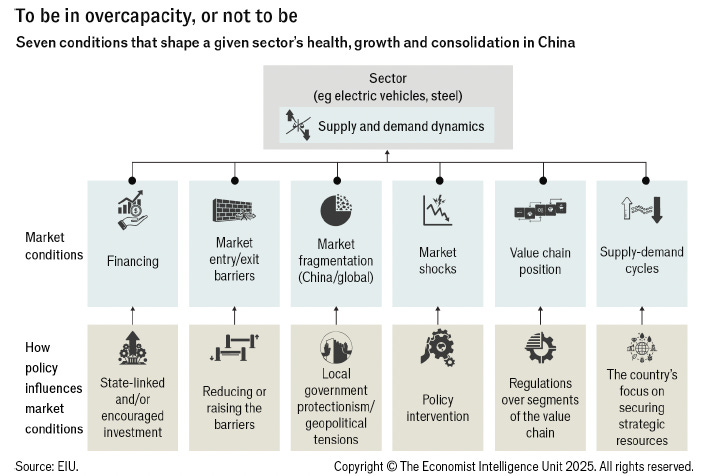
Joining me today is Chim Lee, Senior Analyst at the Economist Intelligence Unit. He works in EIU’s China and Asia teams, and is based in the company’s Beijing and Hong Kong offices.He leads EIU’s research on China’s advanced technologies, Climate change, Energy, Semiconductors, and Artificial intelligence, and also covers how China’s industrial policies link up with the broader diplomatic and macroeconomic dynamics.Our conversation starts with China’s newly announced 15th Five-Year Plan proposal, which reveals the country's next priority and how it may impact its economy, society, and trade relations with the rest of the world.We then dove into the current involution 内卷 issue, particularly zooming in on the solar and EV sectors. Then we look at the data center build-out driven by the AI boom and how local and regional governments are making sure involution does not hamper this sector.Finally, Chim reflects on his work and his analysis of China’s economic planning and innovation direction.--In today’s world, there’s no shortage of information. Knowledge is abundant, perspectives are everywhere. But true insight doesn’t come from access alone—it comes from differentiated understanding. It’s the ability to piece together scattered signals, cut through the noise and clutter, and form a clear, original perspective on a situation, a trend, a business, or a person. That’s what makes understanding powerful.Every episode, I bring in a guest with a unique point of view on a critical matter, phenomenon, or business trend—someone who can help us see things differently.For more information on the podcast series, see here.They delve into the strategic priorities outlined in the plan, including self-reliance in technology, maintaining manufacturing dominance, and the role of private and public sectors in driving economic growth. The conversation also touches on the challenges of overcapacity and the evolving landscape of China’s international cooperation.--* China’s Five-Year Plan signals strategic priorities.* Focus on self-reliance in technology and innovation.* Maintaining manufacturing dominance is crucial.* Private sector plays a key role in economic growth.* Overcapacity remains a challenge in various sectors.* International cooperation is evolving in China’s strategy.* AI and new energy are critical emerging industries.* China’s economic planning involves both public and private sectors.* The plan addresses geopolitical tensions and trade flows.* China’s approach to technology is both strategic and adaptive. Get full access to AI Proem at aiproem.substack.com/subscribe
In this conversation, I spoke with Tom Nunlist from policy consultancy Trivium, about China’s AI Plus plan and its implications for the economy and society. We discussed the role of digital infrastructure in AI adoption, the transformation of production relations, demographic challenges, and the government’s role in connecting academia and industry. The conversation also covers the complexities of navigating China’s regulatory landscape, municipal and provincial implementations of AI policies, and the measurement of AI’s economic impact. Tom shares insights on how MNCs can better align corporate strategies with government objectives during the AI growth era, and talks about the emerging AI pilot zones and how China balances between innovation and regulation. Tom Nunlist is the Associate Director of Tech and Data Policy at Trivium, a leading China policy research consultancy. Tom’s work explores the intersection of politics and technology, with a focus on data and artificial intelligence. His hands-on consulting work with Fortune 100 clients covers policy analysis, risk assessment, government relations, and communications.In today’s world, there’s no shortage of information. Knowledge is abundant, perspectives are everywhere. But true insight doesn’t come from access alone—it comes from differentiated understanding. It’s the ability to piece together scattered signals, cut through the noise and clutter, and form a clear, original perspective on a situation, a trend, a business, or a person. That’s what makes understanding powerful.Every episode, I bring in a guest with a unique point of view on a critical matter, phenomenon, or business trend—someone who can help us see things differently.For more information on the podcast series, see here.Chapters04:27 Understanding China’s AI Plus Plan10:55 Transforming Production and Society with AI15:54 Government’s Role in AI Development24:59 Measuring AI’s Economic Impact27:12 Local Adaptation in Policy Implementation28:01 Understanding Chinese Policymaking for MNCs28:59 Aligning Corporate Goals with Government Objectives31:19 AI Pilot Zones and Innovation Hubs33:26 Promising Use Cases for AI Adoption35:56 Balancing Innovation and Regulation in AI42:52 Shifts in Government Priorities for Technology45:56 Tracking Real AI Diffusion in the Economy48:57 The Skills Gap Created by AIAI Generated TranscriptGrace Shao (00:00)Joining me today is Tom Nunlist, Associate Director of Tech and Data Policy at Trivium, a leading China policy research consultancy. Tom’s work explores intersection of politics and technology with a focus on data and artificial intelligence. His hands-on consulting work with Fortune 100, clients, covers, policy analysis, risk assessment, government relations, and communications. Tom, it’s so great to have you here and it was lovely meeting you online actually a couple weeks ago at one of the panels we were on together.So today, will unpack China’s AI Plus plan, what it means for the real economy and how AI governance is viewed by China, sorry, viewed in China and compare that to what’s happening really in the US. But to start, tell us about Trivium and what’s your own professional journey. How did you kind of end up in Shanghai?Tom Nunlist (00:45)Cool, thanks, Grace. That was a nice introduction and likewise, good to meet you and good to be here on your podcast. Definitely flattering. I’ve seen your upcoming guest list and lots of exciting personalities coming up to be on the podcast. So yeah, a little bit about Trivium. We were founded ⁓ in, I think, 2017. So we’ve been around about eight years now. We are a China-focused, or right now China-only policy consultancy.⁓ And so we really our kind of like value ⁓ is that we really know how the sausage is made here in terms of policy and politics in China and we help our clients mostly multinationals and investor clients understand that. So, you know, for example, a new policy like AI plus, you know, comes out, you know, we can come in very quickly and, you know, help inform our clients, you know, what this is, where it comes from, its overall context.and then forming scenarios for how it’s gonna play out and kind of what they might wanna do. As you mentioned, I’m on our tech team, but we cover a lot more ⁓ than tech, really kind of the whole nine yards of ⁓ policy making, be it from economics to labor to kind of everything in between.Tom Nunlist (02:01)Yeah, as for for myself, I think I have a pretty typical China story, you know, insofar as, you know, long time expats. I came here in 2008, you know, more or less on a lark as a study abroad students, you know, to figure it all out and, know,then life happened, got interested in it. I moved here permanently in 2013. My undergrad background is in journalism. So I studied here for a bit. Then I worked at a business review magazine and then eventually kind of made my way into the consulting space. Not too much of a very strict career plan, but again, one thing sort of leading to the next and here we are.Grace Shao (02:43)Awesome. So I think we’re going to go straight into it. What everyone’s interested right now is in the AI Plus plan. So that rolled out in August this year, believe, late August. It’s quite new. think people are still trying to understand what it really means. So the Chinese State Council published a high level paper that was basically pushing all sectors to really embrace AI.It’s said to be the most comprehensive blueprint for AI development domestically, and even touches on China’s international ambitions or diplomacy as well. So to start off with, can you just tell us, high level, what is this really about? How do we understand this policy?Tom Nunlist (03:24)So this is the second high level AI policy to come out of China. The first was some years ago already back in 2017. That was about, you know, it was about the new generation of AI. AI Plus, the concept has been around for two years already now. It was originally announced at the two sessions. Hopefully our listeners know what that is. an annual meeting like that sets policy. It was announced two years ago, talked about again this year, but you know, not manydetails were revealed about it. There was some assumptions which they were correct that it would be a bit like a former policy from 2015 called Internet Plus, was kind of following in that same vein. And just to sort of like set the stage of like what a document like this is, so it’s called a State Council opinion, you know we’re referring to it as a plan, it’s called Plan in the name, but it’s really a sort of like high levellike political document that is setting the priorities for what the nation wants to do, right? Like here’s the direction we’re gonna move in. Here are some like broad, you know, over the horizon kind of KPIs. This is where we all wanna go. ⁓ And then, you know, the plan will cascade kind of down from there. We’ll get more details over time. In terms of the name, AI Plus, that’s AI Plus or added to everything.So everything in the economy, in all sectors, in society, we wanna see, the government wants to see AI make its way into there to get the most use out of it, to really ultimately transform the way that the economy and society works. It’s big, it’s a big vision is the answer.Grace Shao (05:04)think it’s really interesting you mentioned Internet Plus because I remember when that came out. So you said roughly 10 years ago, It was really embraced by every part of the economy and society. So have you seen any attitude changes or shifts or how people view AI Plus just being on the ground in China right now?Tom Nunlist (05:22)Well, in terms of views on the ground, like in terms of people talking about it publicly, not a whole bunch. I think what’s really happened here is these both internet plus and AI plus are responding to things that are already happening. So the internet certainly did not arrive in China in 2015. was ⁓ like.Grace Shao (05:42)Yeah.Tom Nunlist (05:43)very, very much going strong and was already one of the world’s leading digital economies at that time. And so what it was really seeking to do is kind of take the momentum for things that were already happening and push that further. So obviously, in 2015,you know, the consumer internet, know, Alibaba, Taobao, like those type of, certainly WeChat Pay was introduced in 2013. You know, these were making waves, making big changes in the way that society just kind of basically works. And then Internet Plus was like, yeah, let’s take this momentum and apply it to everything else. Let’s have Internet Plus healthcare. How can we use the Internet there? You how can we use it in government services? And again, AI Plus is sort of doing the same thing. You know, the, you know, this is an introducing the AI wave to China, the AI wave is here, it’s happening, everyone’s using it, everyone’s excited. And so this is getting behind that momentum that is naturally already here and attempt to build a policy framework around it and like, yeah, really, where are we going with all this momentum, right? What are we aiming to achieve?Grace Shao (06:52)Yeah, I think actually on that, I am curious, has China’s highly digitalized society and the infrastructure made AI implementation or diffusion any easier in your eyes? Or how has that kind digital infrastructure played a part in just the mass consumer adoption of AI we’re seeing right now in China?Tom Nunlist (07:05)Mm-hmm.Yeah, it’s a huge part. mean, from just the consumer side, China is like the US or Europe, just an extremely connected society. Everyone, even in the most remote places in the country, has their smartphone, has probably even has like 5G.WeChat is something of a national infrastructure at this point. It’s a messaging app that everyone uses for work and life. It really is absolutely indispensable. And so having that infrastructure already there, or having everybody with a phone in their pocket automatically mak
Joining me today is Natalia Cote-Munoz, a policy strategist, writer, and International Strategy Forum (ISF) Fellow— a program by Schmidt Futures that supports rising leaders at the intersection of geopolitics, technology, and public service. Natalia has served in the U.S. State Department, leading foreign policy think tanks and crisis diplomacy roles. She is a graduate of the Harvard Kennedy School and speaks English, Spanish, and Mandarin, among other languages.In this conversation, we discuss Natalia’s unique upbringing as a third-culture kid, her experiences in tech diplomacy, and the evolution of US-China relations in the tech sector. Natalia reflects on her recent return to Beijing after a decade, sharing insights on the rapid technological advancements in China, particularly in AI and digital payments. We also discuss her observations of how diplomats are trained as an international relations teacher at China’ Foreign Affairs University, how AI cannot be replacing humans in diplomacy, her embrace of AI in productivity and creativity work while she was experiencing a concussion, and lastly her unconventional belief about the societal views on Labubus, highlighting the cultural differences in perceptions of childishness and professionalism.In today’s world, there’s no shortage of information. Knowledge is abundant, perspectives are everywhere. But true insight doesn’t come from access alone—it comes from differentiated understanding. It’s the ability to piece together scattered signals, cut through the noise and clutter, and form a clear, original perspective on a situation, a trend, a business, or a person. That’s what makes understanding powerful.Every episode, I bring in a guest with a unique point of view on a critical matter, phenomenon, or business trend—someone who can help us see things differently.For more information on the podcast series, see here.Chapters01:30 A Third Culture Kid’s Journey04:21 Evolution of US Tech Diplomacy11:32 Reflections on Beijing After a Decade17:54 Exploring the Red App and AI Conversations - Doomism vs. Optimism28:35 Education and Talent Development in AI38:20 Exploring Student Aspirations in International Affairs40:33 The Role of International Faculty in Education41:56 STEM vs. Liberal Arts: Educational Mindsets47:41 AI as a Productivity Partner: A Personal Journey56:24 AI in Diplomacy: The Human Element01:01:26 Legitimacy in AI: Who Builds It Matters?01:02:00 Cultural Perspectives on ProfessionalismAI Proem is a reader-supported publication. To receive new posts and support my work, consider becoming a free or paid subscriber. Get full access to AI Proem at aiproem.substack.com/subscribe
Kevin is an investor at a family office, where he leads AI investments across asset classes. His career has spanned roles as a venture capitalist, startup founder, and software engineer, with experience in both Silicon Valley and New York, before moving to Asia. He brings deep technical and product expertise across domains from machine learning to enterprise software. In his spare time, Kevin writes East Wind, which is focused on technology investing.In this conversation, Kevin Zhang shares his insights on the evolving landscape of AI investments, the implications of hyper-scaler capital expenditures, and the future of AI model training. He discusses the cultural differences between investment ecosystems in the US and China, the valuation of private market companies, and the role of neoclouds in the AI sector. Kevin emphasizes the importance of capital and distribution in determining the success of AI companies and reflects on the future of work in the context of AI adoption.In today’s world, there’s no shortage of information. Knowledge is abundant, perspectives are everywhere. But true insight doesn’t come from access alone—it comes from differentiated understanding. It’s the ability to piece together scattered signals, cut through the noise and clutter, and form a clear, original perspective on a situation, a trend, a business, or a person. That’s what makes understanding powerful.Every episode, I bring in a guest with a unique point of view on a critical matter, phenomenon, or business trend—someone who can help us see things differently.For more information on the podcast series, see here.Chapters00:00 Kevin Zhang's Journey From Software Engineering to VC to Equity Investment02:04 The Hyper-Scaler Capex Debate04:31 The Capital-Intensive Nature of AI Models07:49 Future of AI Capex and Market Dynamics11:43 Understanding Private Market Valuations14:49 Consensus Capital and Investment Strategies17:10 Cultural Differences in Investment Ecosystems21:50 The Future of Chinese AI Companies23:50 Capital and Distribution in AI27:47 Open Source vs. Closed Source Models32:22 The Role of Neoclouds in AI40:40 Investment Opportunities in AI and BeyondTranscript generated by AIGrace Shao (00:01)Hi everyone, this is Grace Shao. Joining me today is Kevin Zhang. Kevin is an investor at a family office where he leads AI investments across asset classes. His career has spanned roles as a venture capitalist, startup founder, and software engineer, with experience in both Silicon Valley and New York, before moving to Asia. So he’s now based in Asia. He brings deep technical and product expertise across domains from machine learning to enterprise software. And in his spare time, Kevin writes a blog on Substack called East Wind. Go check it out.It’s focused on technology investing. So Kevin, thanks so much for joining us today.Kevin Zhang (00:33)Hi, great pleasure to be here.Grace Shao (00:36)Yeah, tell us about yourself. You’ve had quite a journey, you know, from Silicon Valley and now into your base in greater China. You’ve worked as an engineer and now an investor. You know, that’s quite unique. Tell us about your professional journey.Kevin Zhang (00:50)Great. So I guess going all the way back to my college days, ⁓ studied computer engineering, both in Canada and then states for grad school. And then spent most of my career in the States ⁓ in Silicon Valley and New York. So started as an engineer at a company called Salesforce. So they make CRM software before ⁓ transitioning to a couple of venture funds, ⁓ one in the Bay Area, one in New York. So primarily the focus has been onearly stage software, AI investing. And in these days, I look primarily at public equities, specifically focusing on the companies that have exposure to AI or ⁓ businesses who ⁓ will see a re-acceleration of growth because of AI.Grace Shao (01:39)Awesome, so we’re gonna go straight into this. I think we have a lot to cover. ⁓ First, let’s get into the hyper scalar capex kind of story. We’ve been seeing jaw dropping capex commitments, alphabet raising, AI capex too, 85 billion, meta committing hundreds of billions, ba-ba 10 cent I think over the next couple years, also committing like 300 billion upwards. It’s just these crazy numbers.Do you see this as a necessary investment or do you think they’re absolutely overspending right now and they’re creating a bubble?Kevin Zhang (02:11)I think if we look at past ⁓ technology cycles, there will always be, or there has always been ⁓ some overspend across the industry. ⁓ So I think ⁓ bring it down to on a per company level, I think things get more nuanced, right? So looking at, for example, alphabet, right? How much of that is internal workloads for search, right? For their Gemini answers, ⁓ looking at open AI where how, ⁓whatever their, can we maybe start this again? Let’s do a rewind. Okay, great. ⁓ So I think across the industry, if we look at past ⁓ technology waves, ⁓ most famously in the ⁓ initial tech kind of a dot-com bubble, the industry has overspent, right? But as we zoom out, ⁓Grace Shao (02:49)Just go ahead, just restart your answer.Kevin Zhang (03:11)the spend becomes more normalized and then the demand ⁓ ends up catching up. And so I think the real question is on a per company basis, right? Whether it’s Alphabet, Meta, Azure, with Microsoft, AWS, how much of that is overspending? How much demand can they generate, right? With their ⁓ whale customers? And then if they end up overspending, how many of these players can survive, right? So for some of the smaller players,who are comparatively more leveraged, who don’t have the cash flows to support some of the CapEx, right? They’re maybe in a little bit more of a dangerous territory than one of the Meg-7, where they’re generating a significant cash flow to ⁓ fund their operations.Grace Shao (04:01)And I think this kind of goes into also one of your writings recently. You were saying that, like, look, it’s all these big tech that are able to afford ⁓ spending on, like, LLM training and inference, as well as whatever infrastructure that’s needed to really build out, like, sophisticated LLMs. And you said it’s basically foundation models are a rich company’s game. Why is it the model layer is so capital intensive? And do you think that means we’re going to see the startups just kind ofin this field kind of just die out one by one or acquired or what’s trajectory going forward?Kevin Zhang (04:38)I think there are two paths that the industry can take. So the default path is if we look at ⁓ the progression of ⁓ costs for model training, whether it’s pre-training or post-training, ⁓ each generation has been significantly more expensive. So ⁓ many years ago, it might have been ⁓ several hundred thousand dollars. Then it went to the millions, tens of millions, hundreds of millions to train a model.So assuming that trend holds, ⁓ we’ll see kind of billion dollar training runs, right? So taking a billion dollars to train, let’s say GPT-6 or GPT-7. And so if that is kind of where the world goes, then these companies will need to raise more and more capital to fund their training. They will raise more and more capital to fund their inference, right? So once you train a model, how do you serve it to...⁓ and users, right? That’s also very, very expensive. ⁓ However, if you’re of the view that there will be, or transformers, which is kind of the models that are used in ⁓ LLM or ⁓ used in things like ChatGPT these days, ⁓ if you believe that there will be other model architecture paradigms ⁓ that are going to be significantly cheaper, then maybe there will be another kind of startup that comes and disrupts.the entire business model of an OpenAI or Anthropic or any of these labs.Grace Shao (06:07)and was DeepSeat one of those that kind of disrupted the whole model.Kevin Zhang (06:11)⁓ I think not necessarily. think ⁓ going a little bit into the weeds, the, I think, five, six million dollar ⁓ final training run touted in their paper, ⁓ that was only for the final training room, which is not inclusive of the GPUs that they’ve acquired, ⁓ their human capital.all the prior training runs and experiments that they’ve run. And then also within kind of AI training, if you basically train last year’s model today, right, it’s significantly cheaper than if you want to train a frontier model. ⁓ And I think Anthropic had a paper where, or had a blog post where basically ⁓ for if they want to train a similarly similar model to the DeepSeq R1 a year ago, it would have been 10x more.Right, so essentially the costs track. And so it’s less so disruptive ⁓ than I think some of the folks in media might have thought. And certainly they have ⁓ made certain architectural improvements as well as inference improvements at DeepSeek.Grace Shao (07:32)So like if that’s the thinking, like looking ahead next three to five years or even a longer run, is this like the hyperscaler arms, I guess, if you put it that way, is it gonna just keep on climbing up that capex or will it eventually plateau or is this question we will never know.Kevin Zhang (07:49)⁓ it depends on like, like how long the labs, right? The, the open AI anthropics, even Google can sustain, ⁓ this pace of model improvements, right? So we we’ve seen a little bit of plateauing in, in, in the past year or so, ⁓ as, as we’ve kind of reached the limits of pre-training, right? So, ⁓ right now, a lot of the emphasis is on like these like thinking models, right? So, ⁓ when you actually type a prompt,into ChatGP, you know, think for a while and then that tends to ⁓ generate better answers for you. ⁓ And so it feels like the like assuming compute requirements continue to wait, what can we start the question again? What was the specific question? Like what is the arm? ⁓ Okay.Grace Shao (08:43)Yeah, I’ll just redo it.So if we use this logic, right? Like, does that mean that in the next three to five years, we will in the longer run that the capex
In this conversation, Jing Yang, Asia Bureau Chief of The Information, a former WSJ reporter, discusses the evolution of China's tech landscape over the past decade.We explore the corporate strategy and positioning differences between established tech giants like Baidu, Alibaba, and Tencent and newer entrants like Pinduoduo and Shein. Jing also talks about her reporting on Shein and Temu and their attempts to be publicly listed in the West.The conversation delves into the regulatory challenges faced by these companies both domestically and internationally, and how that has led to a belief shared amongst Western investors that “China is uninvestible.”She dives into the implications of the AI arms race between China and the US, and the shifting dynamics in the venture capital landscape in China. She explains the differences between RMB-denominated funds and US-dollar-denominated funds, as well as how the VC ecosystem has evolved over the last few years.—Jing Yang is the Asia Bureau Chief at The Information. Based in Hong Kong, Jing leads a team of reporters covering the region's vibrant tech and venture capital scene and has written and overseen agenda-setting stories on topics ranging from AI to semiconductors to marquee companies like Nvidia and ByteDance. Prior to joining The Information, Jing was a Senior Correspondent at The Wall Street Journal where she covered a broad range of topics, including Wall Street’ foray into China, Beijing’s crackdown on internet platforms, and the 2022 Beijing Winter Olympics. Jing also has reporting stints at Bloomberg News and the South China Morning Post. She has won three Society of Publishers in Asia Awards and three Best in Business Awards at the Society for Advancing Business Editing and Writing in the US. She is an honorary lecturer at her alma mater, the University of Hong Kong’s Journalism and Media Studies Centre, and a board member of the Foreign Correspondents’ Club in Hong Kong.In today’s world, there’s no shortage of information. Knowledge is abundant, perspectives are everywhere. But true insight doesn’t come from access alone—it comes from differentiated understanding. It’s the ability to piece together scattered signals, cut through the noise and clutter, and form a clear, original perspective on a situation, a trend, a business, or a person. That’s what makes understanding powerful.Every episode, I bring in a guest with a unique point of view on a critical matter, phenomenon, or business trend—someone who can help us see things differently.For more information on the podcast series, see here.Chapters00:00 Introduction to Jing Yang and Her Journey02:35 The Evolution of Chinese Tech Mindset08:08 Comparing Old and New Chinese Tech Giants11:16 The Unique Business Models of Pinduoduo and Shein17:41 Regulatory Challenges for Chinese Tech Companies22:04 The Impact of AI on Chinese Tech Giants32:30 US-China AI Arms Race: Context and Implications34:55 Bridging the Gap: US and China Perspectives39:10 China's AI Strategy: Open Source vs Closed Source44:32 Emerging Players in China's AI Landscape51:41 The Impact of Decoupling on VC Landscape: Sequioa to HongShan01:05:44 Future Trends in China's AI Tech SpaceAuto generated transcript for reference, typos might occurGrace Shao (00:00)Hi, this is your host Grace Shao and joining me today is Jing Yang, Asia Bureau Chief of Information. Previously, she was a senior correspondent at the Wall Street Journal in Hong Kong where she covered a range of topics including Wall Street’s foray into China, the globalization of China’s most prominent tech companies, and the country’s domestic tech regulatory crackdown. Jing, it’s so great to have you on and ⁓ it was lovely running into you actually recently at Karen’s book launch in Hong Kong. We’ve known each other for a few years now, you know, over like our paths crossing.whether in journalism or when I was working in Alibaba, you’ve covered Chinese business and tech for over a decade across from SCMP, Bloomberg, Wall Street Journal, and now obviously leading the information out here in Asia. So looking back right now, like over the last decade, what’s really changed the most in terms of talent, capital, and company building China, and just your own kind of observations of the whole industry?Jing Yang (00:52)Sure. Thank you for having me. Yeah, it was indeed good to run into you at Karen (Hao)’s book talk. So I think the one thing that sort of really struck me is that when I started covering the, started ⁓ working as a reporter, 10 plus years ago, at that time, if you recall, then China was rapidly still integrating into sort of the West led global order.A lot of the Chinese companies and executives and entrepreneurs, think their mindset was still like there’s so much we can learn from the West, from the US, from Europe, from what companies have achieved there. And then now that has changed for various reasons we can get into later into sort of, know, this is the way actually, you know, we do things in China and it has in so many cases proved to be actually working better oror there’s more this awareness of things are different in China, whether it’s cultural or economical or social. And I think then you also have seen sort of equally some examples from Silicon Valley or elsewhere sort of looking eastward and looking at what are the things that China or Chinese companies have done that we may actuallythere are some lessons or experiences we can draw from. I think that is a very interesting sort of shift. It’s not just one way anymore, it’s more two-way.Grace Shao (02:17)For sure. But I think in that sense still, you know, we have people like Bill Gurley going on his podcast saying like Chinese entrepreneurs or business leaders are just so much more attuned to what’s happening in the U.S. compared to vice versa. But there’s definitely more more interest coming from the West to China. Right. I think on that, like one interesting, you know, Chinese tech culture that’s really being adopted and, you know, seeing it being embraced by Silicon Valley right now is the 996. You know, likeThat’s an interesting phenomenon. What do you think of that? Do think people are realizing that you got a 996 to really push ahead?Jing Yang (02:50)Yeah, that is a very good question. And I think I’d like to actually unpack what we are talking about when we’re talking about 996. When it first started in China, and by the way, that wasn’t just something adopted by tech companies, but also in general, a lot of big companies in the private sector in China were doing that. And I think what in that sense, from the mid to late 2010s,When companies were adopting 996, it was mostly codified. Remember, that was a pre-COVID world. You are expected, when you’re working, you’re expected to show up in the office, at your booth or whatever. So that means you have to clock in at 9 a.m., clock out at 9 p.m., and then for six days a week. But why you actually do in those 12 hours and six days a week is another question.And I think over time, some companies realize there’s actually some kind of waste and inefficiency that this codified system has created. For example, a lot of companies, ⁓ employers, in order to entice employees to work longer hours, they provide dinner and then they provide, say, you can expense your cabaret home if you work past 9 p.m., that kind of thing. And over time, then, I think that actually did lead to some sort of inefficiency in the sense thatMaybe some people just want to stay back. If I’m going to go home and have a take on myself, then why don’t I do it at the office when it’s paid for? I’m not saying everybody does that, right? But certainly there are people who did that. And I think while I’m not discounting at all, Codefine 996 has led to burnout and even much worse things. But on the flip side.is that when you codify something like that, that is the problem. So then if we look at in the US, for example, if you are a Wall Street banker or lawyer or a management consultant, I think you are expected to work long hours when you are servicing a client who has urgent needs or you are just on some really tight project deadline or say if there is a market meltdown.And then nobody would say anything about, that is 996 or not. And then so I think it’s easy to throw the labels around and then not to actually look at what is happening. It’s not like in the US or anywhere in this world that people just don’t work extra hours. That’s certainly not true. And in terms of, I read the reports. I think there was a wide article that wrote in depth about this.But the one thing that I think is quite different is that we haven’t seen this being adopted as a policy across-broad, especially by big companies in the US or anywhere else. And in China, when they loosened the 996, what was loosened was just like you are not expected to clock in and out at 9 a.m. and 9 p.m. But you do still expect to work when needed.And then, and I think in a way, the post COVID world where most workplaces is set up to have employees work, you know, virtually from anywhere has actually made it worse for people everywhere, right? You know, as long as you still have your laptop or even your phone with you, you’re expected to say if your boss messages you at, you know, 10 PM with some questions.I think it’ll be unthinkable that I just ignore that, right? And so I think that is actually the real issue than when we say, you know, 9-8-6.Grace Shao (06:26)Yeah, think it like I totally agree with you in many ways that like this whole working from home thing has actually made everyone feel like they’re more like glued to their devices and more clocked in. But I think it also just showcases that this whole adoption of so-called 996 in the US right now is really driven by, you know, just the excitement and I guess competition now we’re seeing in AI because, you know, for big tech for many years, we’re used to this kind of story of like, you know, ⁓no
In this episode, Wency delves into the details of her journey, from working at a leading Chinese-language tech publication to joining an international VC firm, and now writing about China’s AI and tech ecosystem for a global audience. Wency provides a holistic view of the different players from the LLM startups to the leaders in consumer applications and to the rising domestic Nvidia challengers. She is also someone who’s really on the ground and plugged in with the startup community in China, so she sheds light on the real hustle culture and dichotomy of “lying flat” vs. “involution”.Highlighting the differences between tech events in China and the US. She dissects the discourse in China’s youth today, where two seemingly contrasting sentiments coexist. China’s generational gap feels like it happens every five years because of the vast difference of the speed of technology development. Comparing the differences between tech events in China and the US, the invisible hand of the local governments encourages innovation and commerce. She then also addresses misconceptions about Chinese startups and emphasizes the importance of understanding the unique dynamics of the Chinese tech landscape and how Chinese founders still see the US as the benchmark. And ending the conversation with a personal reflection of how her father had never dreamed of the economic growth and personal gains he would experience in a lifetime, a look into the average Chinese man’s sentiment towards the country’s technological development, and showcasing her collection of Labubus.Spotify link here.In today’s world, there’s no shortage of information. Knowledge is abundant, perspectives are everywhere. But true insight doesn’t come from access alone—it comes from differentiated understanding. It’s the ability to piece together scattered signals, cut through the noise and clutter, and form a clear, original perspective on a situation, a trend, a business, or a person. That’s what makes understanding powerful.Every episode, I bring in a guest with a unique point of view on a critical matter, phenomenon, or business trend—someone who can help us see things differently.For more information on the podcast series, see here.Chapters00:00 Wency’s Journey from VR to China Journalism to VC and to International Journalism06:48 The Evolution of China Tech from 2020-2025: Trends and Change11:51 Deep Dive into AI: Observations and Major Players23:19 China’s Youth: “Lying Flat,” Involution and the Hustle Culture30:15 Generational Perspectives on Success32:14 The Mission-Driven Entrepreneurial Spirit34:58 Contrasting Global Tech Events38:12 Misconceptions About Chinese Startups41:13 Trade Policies Affecting The Average Business and Average Person43:51 Perceptions of Tech Competition with the West47:58 The Future of Technology and SocietyAI Proem is a reader-supported publication. To receive new posts and support my work, consider becoming a free or paid subscriber. Get full access to AI Proem at aiproem.substack.com/subscribe
For long-term China tech investors and journalists, she needs no introduction. Rui Ma is a leading voice in the space, a trusted China internet analyst. She is the founder of TechBuzz China. She began her career in traditional finance and then early-stage investing. In recent years, she has advised AI companies and established herself as the founder of an AI school to prepare the next generation for the AI era.In this conversation, we discuss the evolution of the Chinese tech ecosystem and the current trends in AI investment - her bullish view on EVs and robotics. Rui shares insights on the major players in the industry and common misconceptions about Chinese tech. Based in the Bay Area, Rui travels to China regularly, bringing a nuanced understanding of the two worlds and bridging that information gap. The conversation also touches on cultural attitudes towards technology and the future outlook for AI in China. Finally, she discusses her unconventional approach to introducing screens, technology, and now AI to her children.Spotify link here.00:00 Journey from Finance to Tech and AI02:24 Evolution of the Chinese Podcasting Landscape - going on Acquired05:43 Investment Trends in EVs, AI and Robotics08:10 Results > Subsidies10:50 AI bubble?13:34 WAIC: Willingness to pay for LLMs isn't there27:48 Robotics at the front and center31:35 Energy Innovations and Geopolitical Implications35:07 Global Interest in Chinese Technology - Esp. from India40:01 Understanding Cost and Value in Technology Adoption44:42 Unconventional attitude towards technology and educationIn today’s world, there’s no shortage of information. Knowledge is abundant, perspectives are everywhere. But true insight doesn’t come from access alone—it comes from differentiated understanding. It’s the ability to piece together scattered signals, cut through the noise and clutter, and form a clear, original perspective on a situation, a trend, a business, or a person. That’s what makes understanding powerful.Every episode, I bring in a guest with a unique point of view on a critical matter, phenomenon, or business trend—someone who can help us see things differently.For more information on the podcast series, see here.AI Proem is a reader-supported publication. To receive new posts and support my work, consider becoming a free or paid subscriber. Get full access to AI Proem at aiproem.substack.com/subscribe
Joining me today is Diana Wu David, Director of Futures at ServiceNow. Diana is ranked number #2 futurist in the world by Global Gurus. She ran her own business for nearly a decade called Future Proof Lab where she worked with C-suite executives and boards to help them create future-focused, resilient organizations. She is an expert in guiding professionals and leaders in this ever-evolving business landscape, leveraging strategic foresight to turn uncertainty into a competitive advantage.In this conversation, Grace and Diana explore the transformative impact of AI on the future of work, discussing how organizations can adapt to this change. They delve into the challenges and opportunities presented by AI, the importance of measuring its effectiveness, and the cultural differences in technology adoption between the US and Asia. Diana emphasizes the need for a shift in organizational structures and the importance of preparing future generations for a rapidly evolving workforce. The discussion also touches on the necessity of fostering critical thinking and creativity in education to equip individuals for the future.Spotify link here.In today’s world, there’s no shortage of information. Knowledge is abundant, perspectives are everywhere. But true insight doesn’t come from access alone—it comes from differentiated understanding. It’s the ability to piece together scattered signals, cut through the noise and clutter, and form a clear, original perspective on a situation, a trend, a business, or a person. That’s what makes understanding powerful.Every episode, I bring in a guest with a unique point of view on a critical matter, phenomenon, or business trend—someone who can help us see things differently.For more information on the podcast series, see here.Chapters00:00 Navigating the Information Overload04:04 The Future of Work and AI Integration08:54 AI's Impact on Productivity and Organizational Structure14:48 Measuring AI Effectiveness in Enterprises19:41 The Evolution of Work and Education29:40 Cultural Perspectives on Technology Adoption39:24 Unconventional Views on the Future of Work Get full access to AI Proem at aiproem.substack.com/subscribe
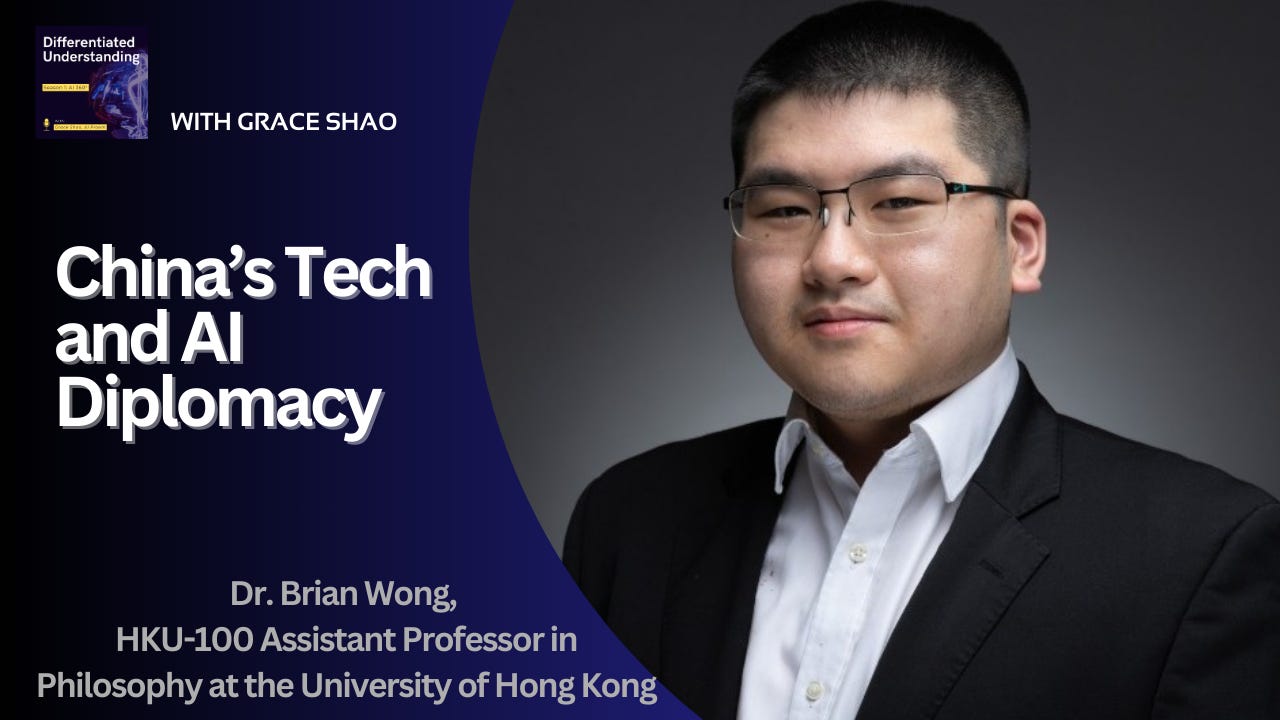
Dr. Brian Wong is a HKU-100 Assistant Professor in Philosophy at the University of Hong Kong. His research examines the ethics and dynamics of authoritarian regimes and their foreign policies, historical and colonial injustices, and the intersection of geopolitics, political and moral philosophy, and technology. At HKU, he serves as a Fellow at the Centre on Contemporary China and the World, sits on the Steering Committee for the Hong Kong Ethics Lab, and advises the Interdisciplinary Dynamics: Ethics, AI, and Society at the Institute of Data Science. A Rhodes Scholar and Kwok Scholar, Brian holds a DPhil in Politics from the University of Oxford.In this conversation, Dr. Brian Wong discusses his research at the intersection of moral philosophy, technology, and geopolitics. He emphasizes the importance of understanding AI's impact on employment and the need for academia to adapt to teach AI effectively. Dr. Wong also explores China's tech diplomacy, highlighting its focus on self-sufficiency and global partnerships. He argues that Hong Kong's unique status is crucial for its role in global tech and governance, and he concludes with a reflection on the future of technology and humanity, stressing the importance of human values in the tech race.Spotify link here.In today’s world, there’s no shortage of information. Knowledge is abundant, perspectives are everywhere. But true insight doesn’t come from access alone—it comes from differentiated understanding. It’s the ability to piece together scattered signals, cut through the noise and clutter, and form a clear, original perspective on a situation, a trend, a business, or a person. That’s what makes understanding powerful.Every episode, I bring in a guest with a unique point of view on a critical matter, phenomenon, or business trend—someone who can help us see things differently.For more information on the podcast series, see here.Chapters00:00 Introduction to Dr. Brian Wong's Research02:47 Exploring the Intersection of Philosophy, Technology, and Geopolitics10:38 Chinese Tech Diplomacy and AI Development21:39 China's Global Tech Goals and Misconceptions36:16 Innovation in the Chinese Ecosystem41:20 The Impact of AI on Workforce Dynamics52:16 Navigating AI in Education57:21 Hong Kong's Unique Role in the Global Landscape01:06:43 The Future of Technology and HumanityAI Proem is a reader-supported publication. To receive new posts and support my work, consider becoming a free or paid subscriber. Get full access to AI Proem at aiproem.substack.com/subscribe
Today we speak to Cameron Johnson, who delves into the complexities of global supply chains, particularly focusing on the dynamics between the US and China. We explore the implications of trade policies, the evolving role of Asian countries in manufacturing, and the intersection of AI and technology with supply chain management. Cameron shares insights from his extensive experience in the field, highlighting the multifaceted nature of supply chains and the importance of understanding the broader ecosystem that supports them. Furthermore, we discuss the intricate relationship between government regulations, robotics, and supply chains in China. And finally, Cameron shares his conviction that well-managed supply chains can foster peace among nations.Every episode, I bring in a guest with a unique point of view on a critical matter, phenomenon, or business trend—someone who can help us see things differently. Get full access to AI Proem at aiproem.substack.com/subscribe

Comments

Download from Google Play

Download from App Store
 United States