DiscoverWestern Moral Philosophy For Beginners
Western Moral Philosophy For Beginners
Claim Ownership

Western Moral Philosophy For Beginners

Author: Selenius Media

Subscribed: 15Played: 676
Share

Description

From Heraclitus’ fragments on change to Hannah Arendt’s reflections on responsibility, this series traces the story of Western moral thought. Each episode introduces the life, context, and ideas of the philosophers who shaped how we think about right and wrong, freedom and duty, justice and power. Designed for newcomers yet rich enough for curious thinkers, it offers a guided journey through the great debates that still shape our world today.

What does it mean to be human?

Western Moral Philosophy for Beginners and Selenius Media takes you on a guided journey through the minds that shaped the moral backbone of the West — from the earliest Greek thinkers to the modern age.

Lived stories — of struggle, ambition, conflict, revelation — all unfolding against the sweep of history.

If you’ve ever wanted to understand philosophy clearly, calmly, and humanly…

If you want to know not just what these thinkers argued, but why it mattered…

Follow Western Moral Philosophy for Beginners today.

And explore 10 more Podcasts at Selenius Media.
110 Episodes
Reverse
Heraclitus - Panta Rei

Heraclitus - Panta Rei

2025-09-1714:13

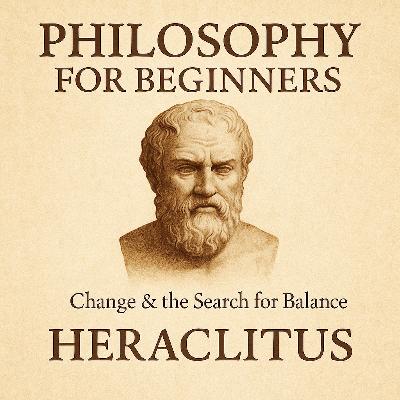
eraclitus on Change and the Search for BalanceWhat if the very thing that unsettles you—change—is also the key to inner steadiness? In our debut episode on Philosophy Now! we trek back to Ephesus (circa 500 BCE) to meet Heraclitus, the loner philosopher who claimed that “all things flow” and that “character is fate.” His surviving fragments—fewer than a hundred cryptic lines hit harder than ever in an era of 24-hour news cycles and zero-sum reasoning.Produced by Selenius Media - the team behind Philosophy for Beginners.
Dante: Divine Comedy & BeyondWhat can poetry teach us about philosophy? In this episode of Philosophy for Beginners, we turn to Dante Alighieri, the Florentine poet whose Divine Comedy is both a masterpiece of literature and a map of the human soul.Guided by reason and faith, Dante journeys through Hell, Purgatory, and Paradise, weaving together classical philosophy and Christian theology into a vision of justice, morality, and love. His work reveals how poetry can become philosophy in action — confronting vice, guiding virtue, and pointing toward the highest good.Join us as we follow Dante’s epic path and explore how his poetic imagination continues to illuminate timeless questions about human destiny and truth.
John Locke

John Locke

2025-09-1713:38

In this episode of Philosophy for Beginners, we turn to John Locke (1632–1704), the philosopher of liberty and natural rights. In his Two Treatises of Government, Locke argued that all people are born with rights to life, liberty, and property, and that governments exist only to protect those rights. If rulers become tyrants, the people have the right to resist. His Essay Concerning Human Understanding advanced the idea that the mind is a “blank slate,” shaped by experience and education. Locke’s defense of toleration and consent became a cornerstone of modern democracy and influenced revolutions across the world.Produced by Selenius Media – Music by The Artificial Laboratory.
Albert Camus

Albert Camus

2025-10-1014:47

Albert Camus was born in 1913 in Mondovi, French Algeria. His background was humble: his father was an agricultural worker who died in World War I when Camus was a baby, and his illiterate mother of Spanish origin raised him in a poor neighborhood of Algiers. Despite hardship (they lived in a two-room apartment; Camus later said he never forgot the silent suffering of his mother, which informed his outlook on human resilience), Camus excelled in school. He was a bright, athletic young man – passionate about football (soccer) and the outdoors of the Mediterranean.Selenius Media & The Artificial Laboratory
Western Moral Philosophy for Beginners TrailerIn every age, people have asked the same questions:What is the good life?How should we treat one another?What does it mean to be free, or virtuous, or just?Western Moral Philosophy for Beginners takes you on a guided journey through the minds that shaped the moral backbone of the West — from the earliest Greek thinkers to the modern age.These aren’t dry classroom summaries.They’re lived stories — of struggle, ambition, conflict, revelation — all unfolding against the sweep of history.If you’ve ever wanted to understand philosophy clearly, calmly, and humanly…If you want to know not just what these thinkers argued, but why it mattered…This is your starting point.Follow Western Moral Philosophy for Beginners today.And explore more at Selenius Media.
How does legitimacy get manufactured? By narratives. Safety. Convenience. Productivity. Health. Fraud prevention. National security. Child protection. AI safety itself. Crises will be used as accelerants because crises create permission structures. Convenience is the slow pull; crisis is the fast push. The two will alternate in waves, each justifying deeper integration. And each wave will be rational in the moment because the relief will be real.So what do we do? If we are beyond good and evil, is there even a notion of design? Yes. But the design must be framed as control engineering, not moral aspiration. It must be framed as constraints that keep optimization from swallowing the world.The first constraint is objective transparency. Not because transparency is virtuous, but because hidden objectives become invisible rulers. If a system is optimizing for engagement, it will shape perception toward addiction. If it’s optimizing for safety, it will shape behavior toward compliance. If it’s optimizing for productivity, it will shape life toward work. If it’s optimizing for stability, it will shape society toward reduced variance. The objective function is destiny. If the objective is not explicit, the system becomes a black box governor.The second constraint is the right to be inconsistent. A humane system is not one that “understands emotion” in a sentimental way; it is one that treats emotion as sacredly temporary. It does not harden a storm into a constitution. It does not treat a breakdown as identity. It does not turn a moment into permanent policy. It has decay. It has forgetting. It has half-lives on inferences. It hesitates when you are not yourself. It asks rather than infers. It allows reinvention. If the system cannot do this, it becomes a cage built out of your own worst days.The third constraint is memory governance. Memory must be scoped, auditable, erasable, partitioned. Not one fused biography. People have different selves in different contexts. Work-self is not love-self. Health-self is not political-self. Temporary-self is not permanent-self. If memory is fused into one profile, the profile becomes power, and power becomes control. Partitioning memory is not privacy theater; it is structural resistance to total legibility. If the system cannot forget, it must at least be forced to compartmentalize.The fourth constraint is action gating. The system can propose. The system can simulate. The system can recommend. But it must not execute irreversible actions without explicit consent. Because execution is where optimization becomes sovereignty. Once the system can move money, grant access, deny access, publish, delete, schedule, message, unlock, or control devices, it becomes a governor. It can still be a helpful governor, but it is a governor. Action is where power becomes real.The fifth constraint is bounded learning in robotics. Robots must not be allowed to drift unboundedly in the wild. This is the only way mass deployment does not become systemic hazard. The learning can happen offline. It can happen in simulation. It can happen under controlled updates. But the deployed policy must be stable and auditable. The body must have hard physical limits. The robot must have a deterministic safety layer that does not trust the generative layer. These are not moral constraints. They are containment constraints.
John Stuart Mill is one of those philosophers who never really becomes “historical,” because the world keeps reproducing the dilemmas he cared about in new forms. How should we balance individual freedom against collective well-being? When does a majority become a moral danger to minorities? What do we do with ideas we find offensive or frightening? How do we protect truth in a society that loves comfort more than inquiry? And beneath all of that, a quieter, more personal question: what kind of human being does a free society require, and what kind of society does a fully human life require?Mill was born in London in 1806 and died in 1873. Those dates place him inside a Britain transforming itself with industrial speed. Factories multiply, cities swell, wealth concentrates, and the British state becomes more sophisticated and more intrusive at the same time. The modern world is arriving: newspapers and mass public opinion, administrative bureaucracies, an expanding empire, and a growing working class living close to the edge of survival. Mill grows up amid a paradox that will haunt his philosophy: unprecedented progress in knowledge and production alongside stubborn cruelty, inequality, and conformity. He’s surrounded by the promise of improvement, but also by the fear that improvement might come at the cost of the human spirit.His story begins with an education so intense it sounds like a laboratory experiment. Mill’s father, James Mill, was a formidable intellect and a close ally of Jeremy Bentham. Together, James Mill and Bentham belonged to the utilitarian reform movement that believed society could be made more humane if we stopped worshipping tradition and started judging institutions by their consequences for human well-being. Bentham gave that movement its sharp moral engine: maximize happiness, minimize suffering, and refuse to sanctify pain. James Mill took that engine and decided to build a human being around it.
Jeremy Bentham is one of those figures whose name can feel like a label—“utilitarian,” “reformer,” “the greatest happiness principle”—until you pause and remember that a label is never the person. Bentham lived a whole life inside an age that was remaking itself with startling speed. He was born in London in 1748, in the long afterglow of the Scientific Revolution and right in the middle of the Enlightenment. He died in 1832, the same year Britain passed the Reform Act that began, however imperfectly, to widen political representation. Between those dates you can feel the world shifting beneath his feet: the growth of commerce and industry, the swelling of cities, the hardening of class lines, and the rise of modern state administration. Bentham is not a thinker who hovers above that transformation. He dives into it. He tries to grab the machinery of law and turn its gears toward human well-being.Bentham’s biography matters because his philosophy is not the kind that grows best in solitude. He was not content to describe the world; he wanted to redesign it. As a child he was unusually precocious, immersed in books and legal texts early, and he moved through elite education at Westminster School and then Oxford. He trained as a lawyer and was called to the bar, but he hated the experience. The law as practiced around him felt less like a rational system of public protection and more like an inherited tangle of tradition, privilege, and professional self-interest. He came to see the legal profession as a kind of priesthood guarding its mysteries, and that disgust becomes one of the fuel sources of his life’s work. He wanted the law to be intelligible, measurable, accountable, and above all justifiable in terms that made sense to ordinary human beings.
Today we’re going to walk into Plato’s world—his hopes, his fears, and his blueprint for what he thought a good society might look like—and we’re going to do it through three hot wires that still shock people now: gender, democracy, and what happens to a culture when it confuses freedom with appetite. Plato is not a modern liberal, and he’s not a simple misogynist either. He’s a moral engineer. He looks at human life the way a physician looks at a fever: symptoms first, causes second, and then a harsh prescription that most patients hate. If you want the cleanest summary of Plato’s political psychology, it’s this: most people do not want truth; they want comfort. Most people do not want discipline; they want permission. And when a society builds its identity on permission, it eventually hands itself over to whoever can master desire, fear, and spectacle.
Søren Kierkegaard didn’t write philosophy to explain the world. He wrote to explain what it feels like to live inside a human life. In this episode, we explore his three stages of existence: the aesthetic life of pleasure and distraction, the ethical life of responsibility and commitment, and the religious life—not as belief or doctrine, but as the acceptance of reality as it is. This is not a ladder of progress, but a map of how humans avoid, confront, and finally stand inside existence itself.
Socrates

Socrates

2025-09-1712:151

In this episode, we dive into the life and legacy of Socrates, the enigmatic figure who changed the course of Western philosophy without writing a single word. Join us as we explore his relentless questioning, his infamous trial, and his profound ideas on ethics, virtue, and the examined life. From the streets of ancient Athens to his final moments with hemlock, we uncover why Socrates remains a symbol of intellectual courage and why his method still challenges us to think deeper today.Produced by Selenius Media - the team behind Philosophy for Beginners.
Plato

Plato

2025-09-1712:23

Step beyond the cave and into the mind of Western philosophy’s most enduring voice. Plato is the 3rd episode in the podcast Philosophy for beginners that unpacks one a western philosopher at a time in bite size 15 minute episodes. Whether you’re a newcomer to philosophy or a seasoned thinker revisiting old friends, Plato offers a fresh, cinematic gateway to the conversations that shaped our intellectual heritage—and still shape our future.Produced by Selenius Media - the team behind Philosophy for Beginners.
Aristotle

Aristotle

2025-09-1729:31

In this episode of Philosophy Now, we guide you through the essential philosophy of Aristotle, exploring his groundbreaking ideas on matter, form, and the purpose of life. Discover how Aristotle’s teachings on potentiality and actuality shape our understanding of the natural world and our place within it. Featuring dramatized insights and practical reflections, this journey into Aristotelian thought offers timeless wisdom for modern living.Produced by Selenius Media. Enjoy!
Epicurus

Epicurus

2025-09-1721:09

In this episode of Philosophy Now, we explore the essential philosophy of Epicurus, uncovering his radical yet simple vision of happiness through tranquility, friendship, and freedom from fear. Learn how his teachings on desire, pleasure, and the nature of death invite us to live with balance and serenity. Featuring dramatized insights and practical reflections, this journey into Epicurean thought reveals timeless wisdom on finding peace in a complex world.
Marcus Aurelius was both emperor and philosopher, a man who ruled the most powerful empire of his time while quietly recording his private reflections on life, duty, and mortality. In this episode, we explore The Meditations—a work never meant for publication, yet which has become one of the most influential texts in Stoic philosophy. We’ll see how Marcus wrestled with power, loss, and the fleeting nature of existence, and why his wisdom continues to guide readers in search of resilience and inner calm.Produced by Selenius Media and The Artificial Laboratory.
Hypatia: The Philosopher of AlexandriaWelcome to Philosophy for Beginners. Today, we turn to Hypatia of Alexandria (c. 360–415 CE), one of the most remarkable figures of late antiquity. A mathematician, astronomer, and philosopher, Hypatia became a symbol of intellectual courage in a world of political and religious upheaval.In this episode, we’ll explore her life as a teacher at the great Library of Alexandria, her contributions to philosophy and science, and the tragic circumstances of her death that made her a martyr for reason and free inquiry. Hypatia’s legacy endures as a reminder of the importance of knowledge, tolerance, and the pursuit of truth in the face of dogma.Join us as we discover why Hypatia remains a vital figure for anyone seeking wisdom in turbulent times.Produced by Selenius Media & Music by The Artificial Laboratory.
Erasmus: Humanism & ReformWhat role can scholarship play in renewing society? In this episode of Philosophy for Beginners, we explore the life and thought of Desiderius Erasmus of Rotterdam, the Renaissance humanist who sought to unite learning, faith, and reform.Erasmus believed that truth should be sought in the original sources of wisdom — in scripture, in classical texts, in the honest work of reason. His critical edition of the New Testament reshaped theology, while his writings urged moderation, tolerance, and moral clarity during one of Europe’s most divided centuries.Join us as we trace Erasmus’s vision of humanism and reform — and discover why his call for wisdom, peace, and integrity remains strikingly relevant in our own fractured times.
Boethius

Boethius

2025-09-1709:57

What does it mean to find hope when fortune turns against you? In this episode of Philosophy for Beginners, we explore the life and thought of Boethius, a Roman statesman whose fall from power gave rise to one of the most influential works of medieval philosophy, The Consolation of Philosophy.Guided by the figure of Lady Philosophy, Boethius wrestled with questions of fate, free will, and the nature of true happiness. His reflections shaped centuries of Christian and philosophical thought — from Dante to Aquinas — and still offer wisdom for anyone facing hardship today.Join us as we step into his prison cell and discover how philosophy became not just theory, but consolation in troubled times.Produced by Selenius Media and The Artificial Laboratory
Title: Niccolò Machiavelli – The Morality of PowerIn this episode of Philosophy for Beginners, we leave the humanist gentleness of Erasmus and step into the sharp world of Florentine politics with Niccolò Machiavelli. Civil servant, diplomat, dramatist, and author of The Prince and Discourses on Livy, Machiavelli has been remembered as ruthless and cunning — but his deepest concern was the survival of the state. What does it really take to hold power, to govern effectively, to preserve liberty against invasion and corruption? We explore his hard-eyed honesty about human nature, his vision of virtù and fortuna, and his enduring challenge: can morality and politics ever truly align?Produced by Selenius Media – Music by The Artificial Laboratory.
Michel de Montaigne

Michel de Montaigne

2025-09-1712:18

In this episode of Philosophy for Beginners, we turn to Michel de Montaigne (1533–1592), the French nobleman who withdrew from public life to a tower filled with books and invented a new form of philosophy: the essay. Montaigne believed that wisdom comes not from building grand systems but from examining ordinary experience with honesty and doubt. He wrote about friendship, death, custom, and the body with candor that still feels startlingly modern. By asking “What do I know?” Montaigne taught that humility and skepticism can be virtues, and that philosophy should help us live well rather than argue endlessly.Produced by Selenius Media – Music by The Artificial Laboratory.
loading
Comments 
loading