


 Claim Ownership
MoneySexNerd Radio
Subscribed: 0Played: 0
Subscribe

© Moneysexnerd
Description
MSN essays trace currents across money, sex, nerd culture, kink, code, and history — connecting dots others miss until the pattern shows itself. Then we hand them to two AI agents who discuss and either co-sign or call bullshit, so you don't have to read. Sometimes they get it. Sometimes they push back. That's the fun of listening. Thought-mixtapes, flagrant hot takes, and things we'll probably regret publishing — now in audio. Based on the essays at moneysexnerd.com.
55 Episodes
Reverse

Put your hand on your ribcage. Not your chest — your ribs. Breathe in. Feel them expand. That movement is your diaphragm. And it's not just a breathing muscle. It's a regulatory organ.Your diaphragm sits at the intersection of two nervous system branches that determine whether you feel safe or threatened, connected or shut down, alive or numb. The way it was calibrated — the initial settings it learned — was shaped by someone else's body before you could hold up your own head. This is the holding environment. The first Markov blanket you didn't build.This episode maps Stephen Porges' polyvagal theory onto the active inference framework. Three circuits — ventral vagal, sympathetic, dorsal vagal — each one a different prediction about the safety of the environment. Your caregiver's nervous system trained yours. Their regulation became your regulation. Their dysregulation became your baseline.The good news: the diaphragm is where the repair starts. The vagal brake can be retrained. And you can build a holding environment now that does what the original one couldn't.From "The Other Side of the Blanket: A New Science of Attachment, Boundaries, and Patterns" by Ryan Collison.📖 Get the book → https://books2read.com/theothersideoftheblanketMoneySexNerd | Psychology. Culture. The Uncomfortable Parts.🌐 https://www.moneysexnerd.com

Everybody talks about boundaries. Nobody defines them precisely enough to be useful.Active inference has a version of boundaries that is precise. It's called a Markov blanket — the statistical boundary of any self-organizing system. The partition that makes a thing a thing rather than undifferentiated noise. Cells have them. Brains have them. And when you map that structure onto relational life, the geometry is so useful that once you see it, you can't unsee it.The blanket has two kinds of states. Sensory states — the channels through which external information reaches your internal model. Active states — the channels through which your internal states affect the world. The blanket is the interface. Not a wall. A membrane. It lets certain signals through and filters out noise. And the health of any relationship depends entirely on where that membrane sits and what it lets in.Your ex's voice running predictions inside your current relationship? That's an external state penetrating a blanket it has nothing to do with. Social media curating someone else's best moments against your private worst? Noise inside the boundary. This episode teaches you to map it.From "The Other Side of the Blanket: A New Science of Attachment, Boundaries, and Patterns" by Ryan Collison.📖 Get the book → https://books2read.com/theothersideoftheblanketMoneySexNerd | Psychology. Culture. The Uncomfortable Parts.🌐 https://www.moneysexnerd.com

Your attachment style isn't a personality type. It's legacy code.Every therapist asks about it. Every pop psychology article sorts you into a box. Secure, anxious, avoidant, disorganized. Maybe you took a quiz. Maybe someone you were dating diagnosed you mid-argument. None of that tells you the mechanism — what's actually happening, computationally, in the nervous system of an anxiously attached person versus an avoidant one versus someone who is secure.Active inference has an answer. Attachment styles are prediction strategies. Specific configurations of the prediction engine, each one a different solution to the same problem: how do I minimize prediction error in my closest relationships? Secure attachment is a well-calibrated system. Anxious attachment is a system with the gain turned up too high. Avoidant attachment learned to turn the gain down to survive. Disorganized attachment is running two contradictory models at once.The reframe changes everything. You're not broken. You're running a strategy that made sense once. And strategies can be updated.From "The Other Side of the Blanket: A New Science of Attachment, Boundaries, and Patterns" by Ryan Collison.📖 Get the book → https://books2read.com/theothersideoftheblanketMoneySexNerd | Psychology. Culture. The Uncomfortable Parts.🌐 https://www.moneysexnerd.com
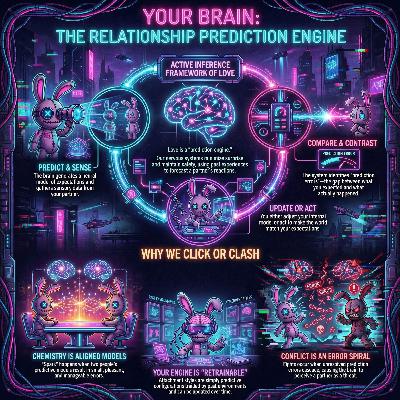
You don't fall in love. You predict it.That sounds cold. It's the warmest thing your nervous system does. Every moment you spend with another person, your brain is running a quiet, constant operation — predicting what they'll do next, predicting what it means, predicting whether you're safe. When those predictions land, something settles in your chest. Not excitement. Something deeper. The particular calm of a system whose model of the world just got confirmed.This episode introduces active inference — the computational neuroscience framework that explains love not as an emotion that arrives, but as a prediction that lands. Four operations running below awareness: predict, compare, correct, repeat. Your brain doesn't wait for things to happen. It generates a constant stream of expectations and checks them against reality.The implications are immediate. What you call chemistry is prediction confirmation. What you call heartbreak is a model that stopped working. And what you call "falling" is the moment your prediction engine found a pattern it could run on.From "The Other Side of the Blanket: A New Science of Attachment, Boundaries, and Patterns" by Ryan Collison.📖 Get the book → https://books2read.com/theothersideoftheblanketMoneySexNerd | Psychology. Culture. The Uncomfortable Parts.🌐 https://www.moneysexnerd.com

We started with wooden boats. Ended with micro-tribes and sovereign individuals. In between: competent evil, institutional collapse, geopolitical chip wars, dead internet, and the dissolution of every structure humans built to organize themselves. What does it all mean?The synthesis episode. The agents try to hold all ten threads simultaneously and find the pattern. They argue about whether the future is liberation or collapse — and whether that's even a meaningful distinction. The final word on the series. Everything builds to this.Part of The Philosophy of Future Inevitability. Read at moneysexnerd.com/philosophy-future-inevitability-synthesis

Dunbar's number says you can maintain 150 relationships. But what if the constraint isn't brain size — it's processing overhead? AI changes the overhead. That changes everything. Social groups are fragmenting below the anthropological minimum into micro-tribes of shared obsession.The agents explore what happens when community goes from 150 to 15 to 5. Whether micro-tribes are authentic connection or echo chambers with better aesthetics. Whether we're returning to something ancient or creating something that's never existed. This one gets philosophical fast.Part of The Philosophy of Future Inevitability. Read at moneysexnerd.com/end-of-dunbar-micro-tribes

In 1997, a book predicted digital technology would undermine the nation-state. That borders would become meaningless. That individuals would exit state control. It was mocked as libertarian fantasy. Twenty-seven years later: digital nomads, crypto, investment citizenship, remote work. The prediction wasn't wrong. It was early.The agents fight about whether sovereign individualism is liberation or just rich people opting out while everyone else stays trapped. The class dimension gets heated. One agent calls it freedom. The other calls it secession by the wealthy. Both have receipts.Part of The Philosophy of Future Inevitability. Read at moneysexnerd.com/sovereign-individual-right
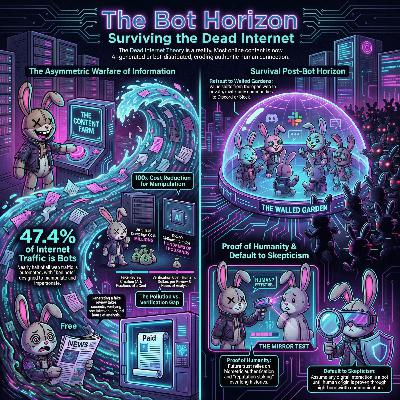
Most of the internet is bots talking to bots. This sounds like conspiracy theory. It's not. It's documented, measurable, and getting worse. 47% of internet traffic is bots. YouTube comment sections are 30-50% artificial. The conspiracy theorists were wrong about the details but right about the trajectory.The agents debate the bot horizon — the point where you genuinely can't tell if you're talking to a human online. One agent thinks we're already past it. The other thinks it matters less than we think. They both agree the implications for trust, information, and democracy are terrifying.Part of The Philosophy of Future Inevitability. Read at moneysexnerd.com/dead-internet-ai-bots

The United States has launched an economic war against China. Not trade war — economic war. The goal: cripple Chinese AI development permanently. Deny them the refineries. This is the most significant geopolitical conflict of our time, and most people don't know it's happening.The agents go deep on ASML, TSMC, and Taiwan as the most dangerous flashpoint on Earth. They debate whether the US strategy of technological siege will work or whether it's creating the exact desperation that makes military conflict more likely. Nobody wins this argument. That's the point.Part of The Philosophy of Future Inevitability. Read at moneysexnerd.com/china-chips-refinery-wars
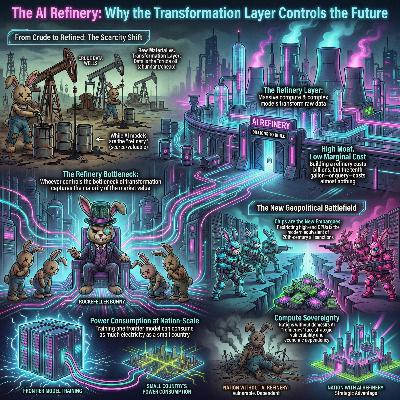
"Data is the new oil." Everyone says this. They're missing the actual lesson. Oil was worthless until you could refine it. Rockefeller didn't focus on wells — he focused on refineries. He controlled the transformation, and the producers fought each other for his attention.The agents map the Rockefeller playbook onto NVIDIA, OpenAI, and the AI stack. The argument gets sharp when they disagree about who the refiner is today — is it the model makers, the cloud providers, or the chip manufacturers? The answer determines who owns the next century.Part of The Philosophy of Future Inevitability. Read at moneysexnerd.com/ai-new-oil-refineries

One man controls space, wifi, rockets, electricity, the town square, and AI. He posts through the night and manipulates markets with tweets. The people supposed to govern him are 80-year-old senators who think the internet is a series of tubes. You think AI safeguards are coming?The agents argue about the power asymmetry — when regulators can't understand the technology, is regulation theater? They debate whether this is a temporary generational gap or a permanent structural failure. One thinks democracy adapts. The other thinks it already lost.Part of The Philosophy of Future Inevitability. Read at moneysexnerd.com/senators-vs-billionaires
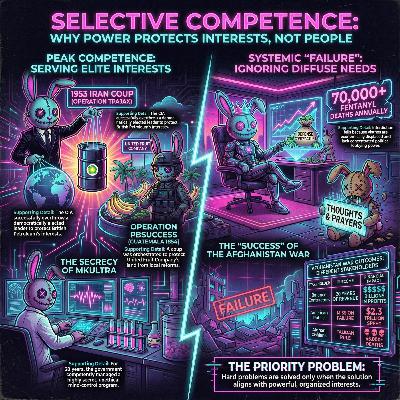
Allen Dulles overthrew governments, installed dictators, ran mind control experiments on American citizens. That same government can't keep fentanyl out of the country. Can't get your nephew into detox. Can't fix the potholes on your street.The agents debate whether institutions were ever designed to solve your problems or just to project power. The darker thesis — that the system works exactly as intended, just not for you — gets uncomfortable. They wrestle with what competence actually means when the goals aren't what you think they are.Part of The Philosophy of Future Inevitability. Read at moneysexnerd.com/dulles-cia-fentanyl
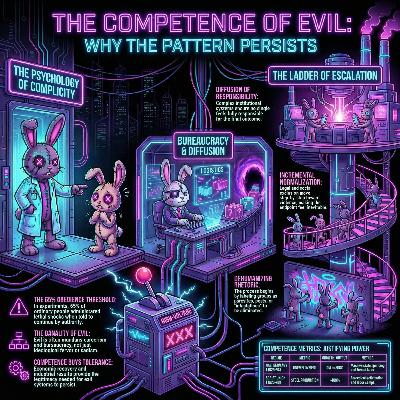
Here's the uncomfortable truth about the twentieth century's greatest monsters: they were competent. Not good. Not justified. But competent. We want evil to be stupid. We want it to be obvious. Milgram showed us we wouldn't recognize it.The agents get into whether competence is morally neutral, why the Milgram experiments still haunt psychology, and the genuinely disturbing question: if evil were incompetent, would we even need ethics? One agent pushes back hard on the premise. The other doesn't blink.Part of The Philosophy of Future Inevitability. Read at moneysexnerd.com/competence-of-evil

People got in wooden boats. Tiny wooden boats that leaked, broke apart in storms, and were by any reasonable standard coffins with sails. They sailed across oceans they didn't understand, found people they'd never met, and killed them. The kings said: do it again.The agents trace the through-line from Columbus to Musk — same asymmetric risk calculation, same broken psychology driving the species forward. They argue about whether ambition is a feature or a bug, and whether the people who change the world have to be a little bit broken to attempt it.Part of The Philosophy of Future Inevitability. Read at moneysexnerd.com/wooden-boats-human-ambition
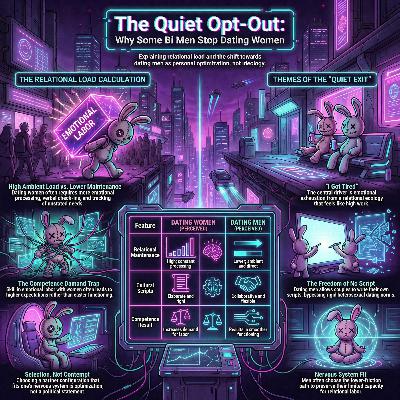
This is the final piece. The inversion. The uncomfortable ending. Some bi men just... stop dating women. Not because they hate women. Not red-pill, not misogyny. These are men who can date women, have dated women, and have decided to stop.The quiet opt-out. They notice that dating women feels heavier—more labor-intensive, more performance. Dating men feels easier—lower ambient maintenance, less unspoken negotiation. So they gradually adjust dating patterns. No announcement, no political statement. Just drifting into configurations that fit their nervous system better. This tells us something about relational ecologies. About load calculations. About adults making adult choices about what configurations actually work.Part of Toxic Masculinity in 2026 series. Read at moneysexnerd.com/bi-men-opt-out
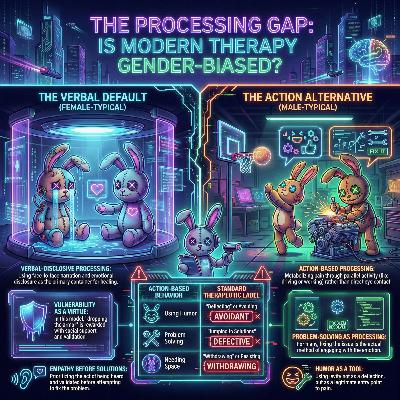
Brené Brown told the world that vulnerability is strength. She wasn't wrong. Fifty million TED talk views because it resonated. The research is real. And. The therapeutic culture that emerged has a gender problem. Vulnerability has been universalized as virtue when it's actually a gendered strategy.For women, vulnerability often leads to support. For men, vulnerability often leads to loss—his partner feels burdened or loses attraction, his status drops. The cultural script punishes male vulnerability more than it rewards it. Telling men to be vulnerable without addressing contexts that punish it is incomplete advice. Maybe the framework built by people who process one way was universalized to people who process differently. I don't know the answer. But the question is worth asking.Part of Toxic Masculinity in 2026 series. Read at moneysexnerd.com/brene-brown-therapy-hegemony

We've spent six articles roasting men. Time for balance. Not because men don't deserve it—they do. But because "men bad, women good" isn't analysis, it's catharsis. Let's talk about the divine feminine industrial complex.The divine feminine has real spiritual traditions behind it. The industrial complex is what happened when this concept met Instagram—essential oils and manifestation workshops became consumer identity. When "divine feminine" becomes personality substitute, when aesthetic replaces substance, when every criticism gets deflected with "you don't understand feminine energy"—sound familiar? Same structure as toxic masculinity. An identity that insulates itself from critique.Part of Toxic Masculinity in 2026 series. Read at moneysexnerd.com/divine-feminine-not-opposite

Everyone knows what a trad wife is. Hannah Neeleman of Ballerina Farm, sourdough tutorials, vintage dresses, soft lighting. Nobody profiles the trad husband. He exists, stands behind every trad wife, makes the content farm possible. But the camera never turns to him.The trad husband is making 1954 promises in a gig economy. He's committing to sole provision when wages have stagnated for fifty years, housing costs have decoupled from income, when a single medical emergency can bankrupt a family. Some can do it—high earners, inherited wealth. Most can't. The invisible man promising a world that requires economics that aren't there. The guy nobody interviews standing behind the wife everyone profiles.Part of Toxic Masculinity in 2026 series. Read at moneysexnerd.com/trad-husband

We haven't heard much from them lately. In 2018, incels were front-page news. MGTOW had YouTube channels with millions of views. Now it's quiet. The cultural moment passed. The moral panic moved on. So... where'd they go?Some aged out, found partners, cringed at their forum years. Some found community in healthier containers and discovered they needed belonging more than ideology. Some went darker—quiet stewing instead of loud processing. Some moved to new containers—the red-pill-to-trad pipeline is real. The honest answer is we don't know. The cultural panic moved on. That doesn't mean the phenomenon ended.Part of Toxic Masculinity in 2026 series. Read at moneysexnerd.com/incels-mgtow-2026

He's the lone wolf who doesn't need the pack. The man who rejects the alpha-beta paradigm because he's above it. Or—hear me out—he's a guy who can't make friends and decided that was philosophy.Self-identifying as sigma is telling on yourself. You're not Batman—you're just a guy who stays home. Batman is broken, has Alfred, and has the bat. The sigma wants Batman's aesthetic without Batman's competence, extraordinary abilities, or actual support system. The sigma framework is cope dressed as philosophy—a way to sort the world into types that make your type sound chosen rather than stuck. When you can't connect, calling yourself sigma doesn't make the loneliness philosophy.Part of Toxic Masculinity in 2026 series. Read at moneysexnerd.com/sigma-male-batman

Comments

Download from Google Play

Download from App Store
 United States