


 Claim Ownership
The Affirming Village Podcast
Subscribed: 2Played: 12
Subscribe

© Dr. Destiny Huff & Lisa Baskin Wright
Description
Two neurodivergent mamas — one Black, one White — with lived experience raising neurodivergent kids. One is still navigating IEPs and school calls; the other has walked the path into adulthood. Dr. Destiny Huff, LPC, a mental health therapist and advocate, and Lisa Baskin Wright, an educator and advocate, help families approach the IEP table with clarity, compassion, and power. They also train professionals on affirming practices for neurodivergent learners.
This is The Affirming Village — where stories, strategy, and community meet.
This is The Affirming Village — where stories, strategy, and community meet.
19 Episodes
Reverse
In this episode of the Affirming Village Podcast, Dr. Destiny and Lisa Wright take a deeper look at the fragility of the IEP table. Following our conversation on ego, we are exploring what happens when the collective wisdom of a team is silenced by a single individual—and why that "one voice" can be the biggest barrier to a learner’s success.The truth? Collaboration doesn't just "stop"—it’s often hijacked. When one person’s rigid narrative or "home court advantage" takes over the room, curiosity dies, and the focus shifts from supporting a child to protecting a professional's power or perspective.In this episode, we unpack:The "One Voice" Phenomenon: How a single person—whether an administrator, a specialist, or a teacher—can shift the entire tone of a meeting from supportive to adversarial.Character vs. Learning: Why kids saying "crummy things" is often a reflection of social learning and the environment, not a permanent character flaw or a "lack of empathy."The Speech vs. Cognition Trap: Challenging the "unsafe assumption" that a non-speaking learner lacks the capacity to think, learn, or contribute to their own path.Interrupting Harm: Recognizing the moment a professional becomes defensive and learning how to pivot the conversation back to the person who matters most: the learner.Advocacy isn't just about paperwork; it's about making sure the "One Voice" doesn't become the only voice. It’s time to reclaim the narrative and keep the focus on student potential.Are you dealing with a "One Voice" dynamic in your IEP meetings? Join the village as we discuss how to navigate these power shifts and stay neuroaffirming in the face of adult ego.Listen now to learn how to move from compliance-based meetings to true, child-centered collaboration.#Neurodiversity #IEPAdvocacy #SpecialEducation #PresumeCompetence #AffirmingVillage #StudentPotential #Neuroaffirming #ParentAdvocacy
It’s centering credentials over curiosity. It’s protecting professional identity instead of protecting the learner.Have you ever walked out of an IEP meeting with a lingering “ick” feeling? You can’t always pinpoint exactly what was said, but the vibe was off. Often, what is blocking true collaboration isn’t a lack of funding or a policy—it’s ego. In this episode, Lisa and Destiny have a raw conversation about how pride and defensiveness can hijack the IEP process. When adults prioritize their own reputation, authority, or comfort over accountability, the learner is the one who ultimately loses. In this episode, we’re unpacking:Subtle vs. Obvious Ego: How ego manifests through dismissive words, but also through silent body language—like the "two-screen" administrator who spends the meeting typing or eating while turned away from the camera. The "Compliance" Trap: The danger of administrators who enter meetings with predetermined decisions under the guise of "fixing" past paperwork, even when those decisions cause direct harm to the student. The Impact on School Staff: Why a leader’s ego doesn’t just affect parents—it deflates and undermines the teachers and case managers who are actually on the ground doing the work every day. Centering Curiosity: Shifting from "I am right" to "How can I help?" and why being an expert doesn’t exempt you from being reflective in your practice. If you’ve ever felt dismissed, talked over, or like the conversation shifted from supporting your child to defending an adult's decision, this episode is a must-listen. Listen now to join the village and learn how to put the learner back at the center of the table.#AffirmingVillagePodcast #IEPAdvocacy #NeuroAffirming #SpecialEducation #IEPMindset #ParentAdvocacy #StudentFirst
"It’s easier to attack the vulnerable instead of the system because the system feels untouchable."In this episode of the Affirming Village Podcast, Dr. Destiny and Lisa Wright dive into a conversation that is long overdue. Triggered by a viral "No to Inclusion" movement on social media, we are pulling back the curtain on why inclusion feels "impossible" for so many educators and families right now.The truth? Inclusion isn't failing—it’s being systemically sabotaged. When we see educators reaching their breaking point, we have to look past the classroom door and look at the lack of funding, the lack of staffing, and the historical patterns of segregation that keep repeating.In this episode, we unpack:The "Inclusion Trap": How districts use "on the books" general ed labels to create disproportionate and unsupported classrooms.The Missing Layers: Why the lack of understanding between Accommodations, SDI, and SAI is making it harder for neuroaffirming educators to succeed.The Funding Gap: The reality of the IDEA never being fully funded and the "scarcity mindset" it creates at the IEP table.Presuming Competence: Challenging the system that decides a child’s future at 3 years old.Inclusion is a civil right. It’s about belonging, access, and equity. It’s time we stop blaming the children and start demanding a system that actually supports the village.Connect with the Village: Follow us on Instagram for more neuroaffirming resources and advocacy tips. If this episode resonated with you, please leave a review and share it with a parent or educator in your circle!#Neurodiversity #InclusionMatters #IEPCoach #SpecialEducation #AffirmingVillage #Advocacy #EducationReform
In the world of special education, these are some of the most frustrating words a parent can hear during an IEP meeting, especially when it involves a child who is non-speaking or has significant support needs.In this episode, Lisa Wright and Dr. Destiny Huff dive deep into the critical (and often overlooked) world of home-to-school communication. We’re moving beyond the basic daily sheets that tell you what your child ate for lunch. Instead, we’re discussing communication as a tool for safety, medical transparency, and legal protection.In this episode, we discuss:The Communication Gap: Why relying on verbal "hallway chats" and "handshake deals" leaves your child and their rights unprotected.The Reality of Documentation Fear: Understanding why schools are often hesitant to put things in writing and how parents can navigate that resistance.• Safety & Medical Urgency: A serious look at the life-altering consequences that occur when self-injurious behaviors or physical incidents aren't reported to parents immediately.• From "Kindness" to "Compliance": How to write communication systems into the IEP as a mandatory accommodation so your child’s safety isn't dependent on the personality of a specific teacher.Whether your child is non-speaking, minimally speaking, or uses unreliable speech, this episode is a guide to building a communication system that ensures they are seen, heard, and protected.Connect with us: If this episode resonated with you, please leave a review and share it with another parent or educator in the trenches. Let’s change the narrative for our neurodivergent learners together.#IEP #SpecialEducation #Advocacy #HomeToSchool #Neurodiversity #ParentingPodcast #SchoolSafety #NonSpeaking
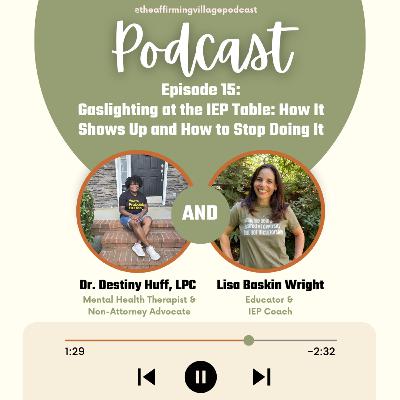
In this eye-opening episode of The Affirming Village Podcast, Dr. Destiny Huff and Lisa Wright pull back the curtain on a phenomenon that leaves many families feeling disoriented and unheard: gaslighting at the IEP table. If you’ve ever walked out of a school meeting feeling like you’re in the "Twilight Zone," questioning your own reality despite having clear evidence of your child's needs, this conversation is for you.Instead of assuming every disagreement is a simple misunderstanding, Destiny and Lisa name the subtle and overt patterns—both intentional and unintentional—that systems use to protect themselves at the expense of the learner. From weaponizing data to reframing valid parental concerns as mere "emotions," we’re unpacking how power dynamics dictate whose voice is believed and whose expertise is dismissed.Inside this episode, we explore:Intentional vs. Unintentional Gaslighting: Distinguishing between a team member who is trying to be "reassuring" and a system using "garbage" strategies to deny access and services.The "Wait and Fail" Trap: Why families are told to "trust the process" while schools delay evaluations or ignore private data, effectively waiting for a child to fall behind before acting."Lisa is Well-Liked": A deep dive into how school staff often use surface-level reassurance to dismiss parent reports of social exclusion or "higher masking" struggles.Habit vs. Law: Identifying when "well-ingrained habits" (the way we've always done it) are falsely presented as legal requirements or policy.Comfort Items as Necessities: Why adult necessities—like coffee and planners—are the perfect analogy for why a child's sensory and comfort items are not "optional."Weaponized Documentation: How predetermined language in assessments is used to steer parents away from necessary supports, such as 1:1 paraprofessionals.Your observations are valid, and your lived experience as a caregiver is data. Whether you are a parent looking for validation or a school professional looking to do better by your students, this episode provides the tools to recognize gaslighting and stop it in its tracks.Listen now on Spotify and join the village as we advocate for truth, validation, and centering the learner’s reality.#TheAffirmingVillage #IEPGaslighting #SpecialEducation #Neuroaffirming #IEPMeeting #ParentAdvocacy #WaitAndFail #SpecialEdLaw #AdvocacyMatters #InclusiveEducation #HighMasking #AutismAdvocacy
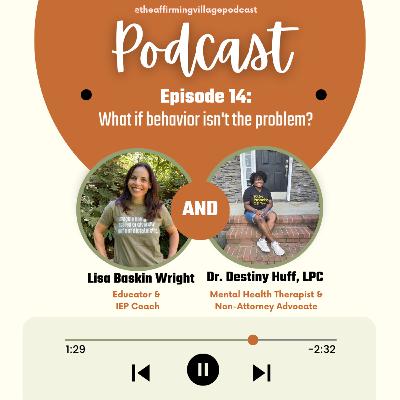
In this powerful episode of The Affirming Village Podcast, Dr. Destiny Huff and Lisa Wright challenge the compliance-first narrative that often traps neurodivergent learners. When a student is labeled as "non-compliant" or "defiant," we rarely stop to ask: What are the barriers to access in this moment? Instead of viewing behavior as a character flaw, we unpack how it is often the first sign that a student’s environment is failing them. From sensory needs to communication tools, we’re shifting the lens from control to curiosity.Inside this episode, we explore:The Compliance Trap: Why framing behavior as a "compliance issue" ignores the actual barriers to learning.The Home vs. School Disconnect: How environments with sensory supports, like swings and movement breaks, change the "behavior" we see.AAC as an Access Hill: Why a "robust" IEP is meaningless if we aren't granular about who is programming the device and how we consider motor planning.Curriculum Barriers: The critical need for academic tools on AAC devices—not just basic icons—to allow for meaningful participation.Labels for Unreliable Speakers: Why minimally speaking students are frequently misidentified as "behavior issues" simply because they lack access to communication.The Power of Curiosity: Simple shifts for educators and parents to identify triggers, like new academic concepts, before dysregulation starts.Routines should support us, not control us. If we aren’t thoughtfully considering how a student accesses their education, we aren’t teaching—we’re just demanding compliance.Listen now on Spotify and join the village as we advocate for access, dignity, and true autonomy.#TheAffirmingVillage #Neuroaffirming #AAC #SpecialEducation #IEPCoach #BehaviorIsCommunication #AccessOverCompliance #NeurodivergentLearners #InclusiveEducation #SensorySupport #MotorPlanning
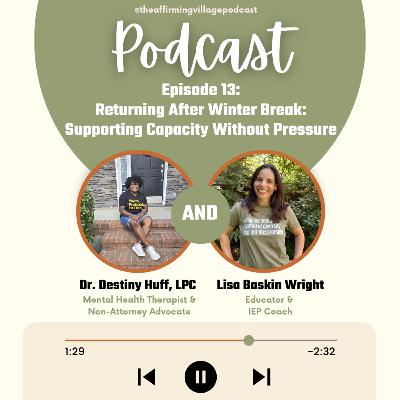
"It’s not about ability—it’s about capacity."In this mid-season premiere of The Affirming Village Podcast, Dr. Destiny Huff and Lisa Wright dive into the "January Slump." If the transition back into school routines has felt harder than expected for you, your students, or your children, this episode is a deep exhale.Instead of pushing to just "get back on track," Destiny and Lisa unpack the physiological and emotional reality of the return to school after a period of rest. They discuss why capacity isn't a fixed state and how the pressure to "perform" in the second half of the year can lead to burnout and punitive cycles.Inside this episode, we explore:Ability vs. Capacity: Understanding why a child who can do something on Tuesday might not be able to do it on Wednesday.The "You Know Better" Trap: How our expectations as adults shift in the second half of the year and why that can be damaging to neurodivergent learners.Adult Triggers & Self-Regulation: Identifying the specific behaviors that dysregulate us as caregivers and how to "tap out" when needed.Curing Safety in the Classroom: Why meeting a struggling student with humanity actually stabilizes the entire group rather than causing "chaos."The Impact of "Ableist Trash": A real-life look at how a learner’s capacity is stripped when they are met with judgment instead of understanding.Key Takeaway: Routines are meant to support the person, not control the behavior. When we lower the pressure, we actually create the safety required for a learner to thrive.Connect with us: Follow the show to never miss an episode as we continue Season 1 with even more deep dives into neuroaffirming advocacy and parenting.#TheAffirmingVillage #Neuroaffirming #ParentingPodcast #SpecialEducation #CapacityOverAbility #IEPCoach #NeurodivergentLearners #BurnoutRecovery #NervousSystemHealth #InclusiveClassroom #GentleParenting #ExecutiveFunctioning #JanuarySlump #EducationalAdvocacy #RegulationBeforeExpectation
In this intimate episode of The Affirming Village Podcast, Dr. Destiny Huff and Lisa Baskin Wright get personal about their own neurodivergence and how it impacts the way they parent, advocate, communicate, and navigate daily life.Instead of hiding or minimizing their neurodivergent identities, Destiny and Lisa talk openly about the strengths, challenges, and patterns that show up in their parenting — and how understanding these pieces of themselves helps them better support their children.Inside this episode, we explore:What happens when neurodivergent parents are raising neurodivergent childrenThe emotional load carried in “being the strong one”How lived experience becomes one of our greatest advocacy toolsWhat burnout looks like for neurodivergent caregiversHow sensory needs, executive functioning differences, and masking show up in family lifeMoving past shame and toward self-acceptanceWhy embracing our own neurodivergence helps us advocate more effectivelyThis conversation is both personal and deeply practical:Our neurodivergence is not separate from the way we parent — it’s part of the story.If you’ve ever wondered how your brain wiring impacts your parenting, emotional capacity, or advocacy style, this episode will feel like a deep exhale.Subscribe, listen, and share with a parent or caregiver who needs this today.#TheAffirmingVillagePodcast #NeurodivergentParents #NeuroaffirmingParenting #AutismAcceptance #ADHDParenting #DisabilityJustice #SelfAdvocacy #IEPSupport #ParentAdvocacy #Neurodiversity
In this episode of The Affirming Village Podcast, Dr. Destiny Huff, LPC, and IEP Coach Lisa Baskin Wright expand the conversation on self-advocacy by pushing beyond the basics of services, checkboxes, and compliance.Your learner deserves more than services — they deserve support, understanding, and environments that affirm who they are.Destiny and Lisa dive into what true support looks like for neurodivergent learners, exploring:Why “services” alone aren’t enough for meaningful growthHow communication and sensory needs shape advocacyBuilding collaborative, affirming teams around childrenWhat it looks like to support a whole child, not a checklistWhy adults must shift their expectations, language, and reactionsHow advocacy begins with recognizing communication differences, not correcting themCreating home and school environments where a child’s identity, voice, and needs are honoredThis episode is a reminder that self-advocacy can only grow when adults see the child as a full human — not a list of interventions.If you are raising or supporting a neurodivergent learner, this conversation will help you think beyond services and toward real support, real understanding, and real empowerment.🎧 Listen to the full episode and join the conversation.Follow us on Instagram @theaffirmingvillagepodcast.#TheAffirmingVillagePodcast #NeuroaffirmingEducation #SelfAdvocacy #AutismSupport #ADHDParenting #DisabilityJustice #IEPAdvocacy #CommunicationDifferences #SensorySupport #WholeChildSupport
In this powerful new episode of The Affirming Village Podcast, Dr. Destiny Huff and Lisa Baskin Wright dig into the foundation of self-advocacy — what it really means, why it’s often misunderstood, and how to use it as a tool of empowerment inside systems that don’t always listen.Too often, parents, educators, and even neurodivergent adults are told to “speak up,” but not taught how to do it effectively or safely. This episode breaks that down with real-world context, lived experience, and practical strategies.Inside this conversation:How to advocate for yourself without losing your peaceWhat self-advocacy looks like in IEP meetings and beyondHow to navigate fear, power imbalance, and gaslightingReframing “being difficult” as being determined and informedBuilding confidence through clarity, documentation, and boundariesIf you’ve ever left a conversation feeling dismissed, unheard, or second-guessing your right to speak — this one’s for you.🎧 Listen, learn, and reclaim your power.
Welcome back to The Affirming Village Podcast with Dr. Destiny Huff, LPC, and IEP Coach Lisa Baskin Wright.This episode continues our powerful conversation on self-advocacy, this time going even deeper — from what self-advocacy means to how we actually support it in our neurodivergent children, students, clients, and even in ourselves.Inside Episode 10 (Part 2), we discuss:The difference between permission and power in advocacyHow adults unintentionally silence self-advocacy attemptsWhat it looks like to proactively model and honor advocacy in school and home settingsHow service providers, educators, and caregivers can support without overcorrectingBridging the gap between emotional regulation and empowered communicationImplementing neuroaffirming practices in real time — even when systems resistSelf-advocacy is not just a concept. It’s a skill. It needs practice, modeling, and space to grow.🧠 If you want to raise or support a child who confidently advocates for their needs — this episode is essential.🎧 Listen to Episode 10 now and join the conversation.Subscribe, share, and connect at @theaffirmingvillagepodcast.
In this episode of The Affirming Village Podcast, Dr. Destiny Huff, LPC and Lisa Baskin Wright, IEP Coach, unpack what effective communication really looks like in IEP meetings, emails, and conversations with schools.Advocacy isn’t just about knowing your rights — it’s about knowing how to communicate your child’s needs clearly, calmly, and confidently, even when emotions are heavy or the environment doesn’t feel supportive.They discuss:Why communication breakdowns happen in IEP spacesThe emotional labor of having to advocate again and againHow to speak with clarity when you feel overwhelmed or unheardStrategies for grounding yourself before meetingsWhat collaborative advocacy can look like without sacrificing boundariesIf you’ve ever left a meeting thinking, “I wish I had said that differently…” — this episode is for you.🔗 Tune in, subscribe, and share with another caregiver who needs this conversation.#TheAffirmingVillagePodcast #IEPAdvocacy #NeuroaffirmingEducation #ParentAdvocate #ADHDParenting #AutismAcceptance #CommunicationSkills #DisabilityJustice #NeurodiversityPodcast #SpecialEducationSupport
In this episode of The Affirming Village Podcast, hosts Dr. Destiny Huff, LPC and Lisa Baskin-Wright hold an honest conversation about caregiver burnout, rest, and the emotional labor of advocating for neurodivergent children.So many caregivers are running on empty — juggling IEPs, school meetings, behavior notes, therapies, emotional support, and holding the household together. This episode is a reminder that your well-being matters, too.Destiny and Lisa discuss:What burnout looks like when you've normalized “just pushing through”How guilt keeps parents from resting, even when they're exhaustedWhy rest is not laziness — it is necessary for sustainabilityHealthy boundaries that protect your emotional energySmall practices that help you reconnect with joy and self-compassionThis episode is not about judgment — it’s about permission to breathe.You are not meant to carry it all alone.And rest is not optional — it is survival.✨ Keywords: caregiver burnout, rest for parents, neurodivergent families, advocacy exhaustion, IEP emotional labor, gentle parenting, neuroaffirming care, disability justice, boundaries for caregivers, sustainable advocacy, special needs parenting support
In this episode of The Affirming Village Podcast, hosts Dr. Destiny Huff, LPC and Lisa Baskin Wright explore one of the most underestimated tools in the IEP process — parent input.Your perspective as a parent is more than background information; it’s data that drives decisions. Destiny and Lisa break down how your words can change how educators see your child, shift IEP language from deficit to affirming, and ensure your learner’s story is seen beyond behaviors or test scores.They discuss:What meaningful parent input sounds likeHow to write IEP parent statements that reflect your child’s strengths and needsWhy your voice matters as much as any expert at the tableReal examples of how advocacy rooted in affirmation changes outcomesThis episode will help you show up in every IEP meeting with clarity, confidence, and compassion.
In this powerful episode of The Affirming Village Podcast, hosts Dr. Destiny Huff, LPC and Lisa Baskin Wright go beyond the surface to explore what it truly means to be neuroaffirming.This conversation dives deep into the uncomfortable truth: many modern attitudes toward neurodivergence still carry echoes of eugenics, the harmful belief that difference should be prevented or “cured.”Together, Destiny and Lisa discuss:How outdated, ableist ideas still influence policy and public perceptionThe dangers of framing neurodivergence as something to fix rather than affirmHow misinformation—like linking acetaminophen use in pregnancy to autism—perpetuates fear and stigmaWhat it really looks like to create spaces, schools, and systems rooted in humanity, truth, and resistanceThis episode isn’t about fear—it’s about reclaiming the narrative and reminding us that being neuroaffirming means naming harm and choosing humanity.
In this episode of The Affirming Village Podcast, hosts Dr. Destiny Huff, LPC and Lisa Baskin Wright break down why documentation and accessibility are some of the most powerful—and overlooked—tools in the IEP process.They explore:Why documentation isn’t just paperwork, but a roadmap for accountabilityHow vague or inaccessible language creates confusion for parents, teachers, and studentsThe difference between physical accessibility and accessible communicationHow the words used in IEPs can either affirm or undermine a child’s supportPractical ways families and schools can ensure clarity, equity, and accountability in every IEPThis episode is a must-watch for parents, educators, and advocates who want to ensure that IEPs are not only written but understood, accessible, and actionable.
In this episode of The Affirming Village Podcast, hosts Dr. Destiny Huff, LPC and Lisa Baskin Wright get real about what happens when bias enters the IEP room.They share powerful lived experiences as parents and advocates navigating a system where racism, ableism, and classism can shape outcomes for children. Together, they explore:How bias shows up in IEP meetings—sometimes obvious, sometimes subtleWhy certain parent voices are dismissed until repeated by someone with privilegeReal examples of disparities in access, belief, and supportStrategies to name bias without losing your seat at the tableWhat parents and educators can do to push for equity in special educationThis conversation is a must-watch for parents, teachers, and advocates who want to understand how systemic bias affects IEP decisions—and how to fight for fair, affirming practices.
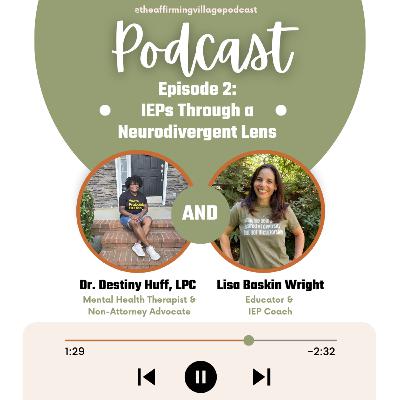
In this episode of The Affirming Village Podcast, hosts Dr. Destiny Huff, LPC (autistic & ADHD mental health therapist and special education advocate) and Lisa Baskin Wright (dyslexic & ADHD IEP coach) unpack how their own neurodivergent identities shape the way they read and write IEPs.Together, they explore:How lived experience as neurodivergent parents makes them see what’s missing in IEPs—not just what’s writtenThe difference between deficit-based vs. affirming approaches to goals and accommodationsCommon red flags to look for in IEPs that might signal bias, gaps, or cookie-cutter planningWhy parent and student voices must be centered in special education planningReal examples of how to push back on vague goals and advocate for meaningful supportsThis conversation is a reminder that IEPs are more than paperwork—they’re about equity, access, and affirming every learner’s voice.
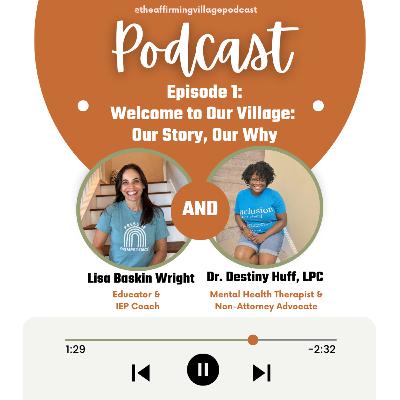
In this first episode of The Affirming Village Podcast, Dr. Destiny Huff and Lisa Baskin Wright share their journeys as moms and advocates raising neurodivergent children. They discuss bias in the IEP process, systemic barriers for marginalized families, and the importance of community, communication, and neuroaffirming practices. Tune in for real stories, advocacy tips, and a reminder that no parent should walk this journey alone.
Comments


Download from Google Play

Download from App Store
 United States